


 Скачать презентацию Keys to Success Module III Review Solving
ca6a12b3c88e555b8e14a05f1be5bc3b.ppt
- Количество слайдов: 39
 Keys to Success Module III Review
 Solving Financial Problems Module III considers the process of solving problems from the client’s initial contact to the creation of the action plan. The Problem-Solving Process Where the Client Is Now Where the Client Wants To Go How the Client Will Get There
 Unit 9: The Problem-Solving Process The Problem-Management/Opportunity-Development Model describes the helping process as: “Managing problems more effectively & developing opportunities more fully” Compliments financial problem-solving - managing problems (reducing debt) & developing opportunities (increasing income).
 Problem solving is a natural process People are naturally motivated to resolve issues, conflicts & dilemmas. 7 Steps that occur naturally: 1. Awareness of the problem. Financial stress or dissatisfaction. 2. Problem creates urgency. Financial issues interfere with personal & business life. 3. The search begins. The individual starts to explore ways to resolve the problem or issue.
 Natural problem-solving process (continued) 4. 5. 6. 7. Decisions, decisions. The individual considers the consequences of the various alternatives. What if I did nothing? Possible solutions are weighed against simply ignoring the problem. I’ve made a decision! The individual makes an intellectual decision to follow a course of action. “C” is for commitment. The individual makes an emotion commitment to act. How do these two differ?
 Steps toward a solution… Determine where “Ray” is in the problem-solving process. “What you’re telling me sounds good but I just need some more time to think this through and go over the numbers. Based on interest rates, I know my debt is just going to increase but my income—that’s a variable I am not comfortable with. My unemployment benefits won’t last indefinitely. Of course, I will get a job. Software designers are supposed to be in demand. ”
 People often get stuck on a particular step… Determine where “Sarah” is in the problem-solving process: “If I had all the child support due to me, I could pay off my debt and then some. You know, they started to garnish his wages and then guess what? He lost his job!”
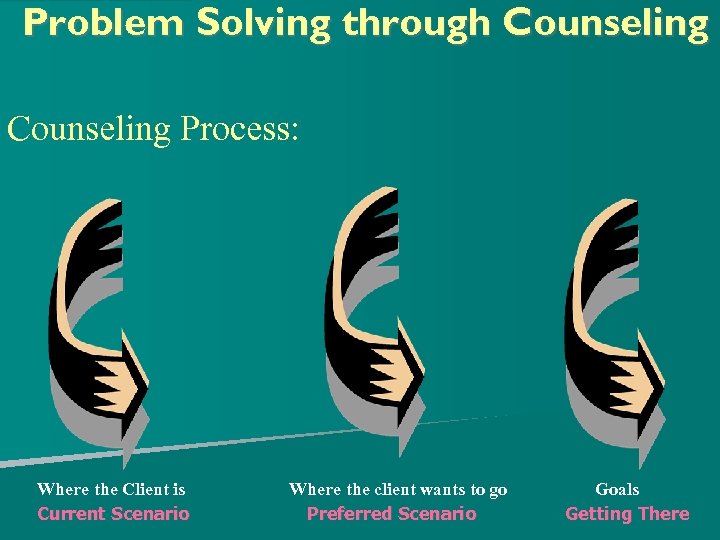 Problem Solving through Counseling Process: Where the Client is Current Scenario Where the client wants to go Preferred Scenario Goals Getting There
 Unit 9 Summary The Problem-Management/Opportunity. Development Model describes the helping process inherent in all counseling. People are naturally motivated to resolve financial dilemmas. Counseling facilitates the natural process individuals follow to find solutions.
 Unit 10: Where the Client is Now
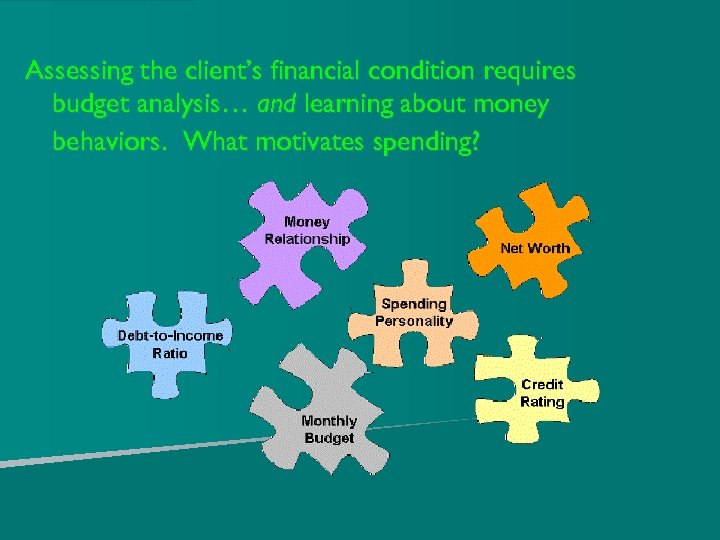 Assessing the client’s financial condition requires budget analysis… and learning about money behaviors. What motivates spending?
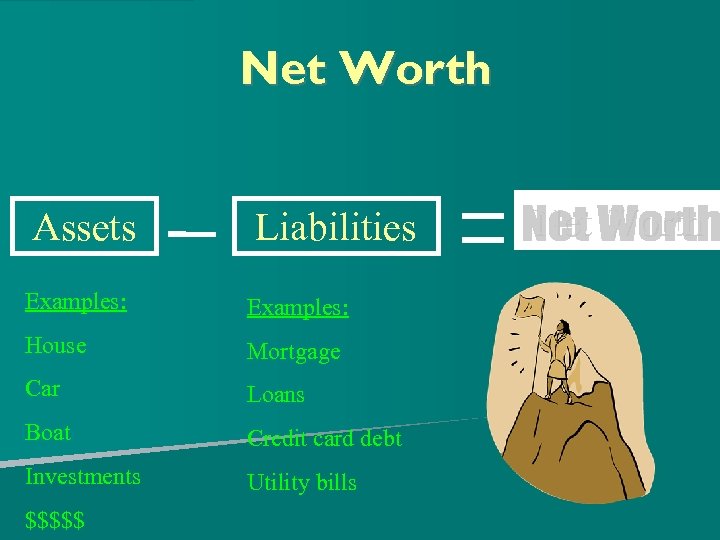 Net Worth Assets Liabilities Examples: House Mortgage Car Loans Boat Credit card debt Investments Utility bills $$$$$ Net Worth
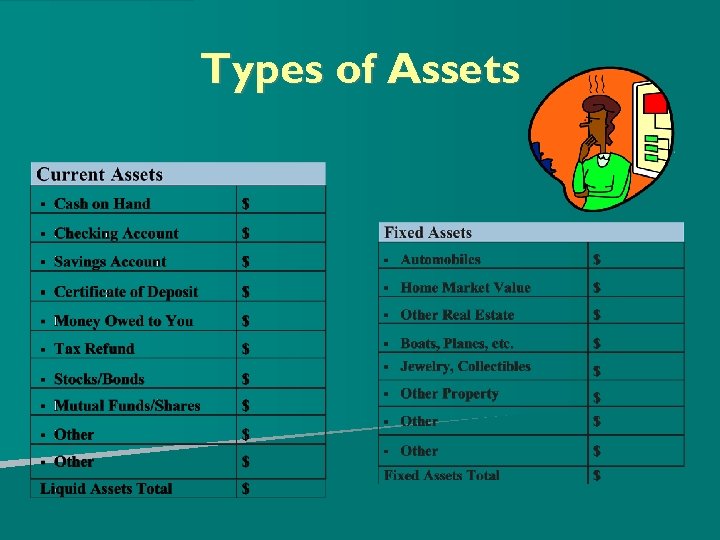
 How much are you worth? Steps in calculating net worth 1. Identify all items of value 2. Determine market value *What are some ways to determine value of assets? *What is typically the greatest liability to consumers? *Give an example of a liquid asset.
 Types of Assets
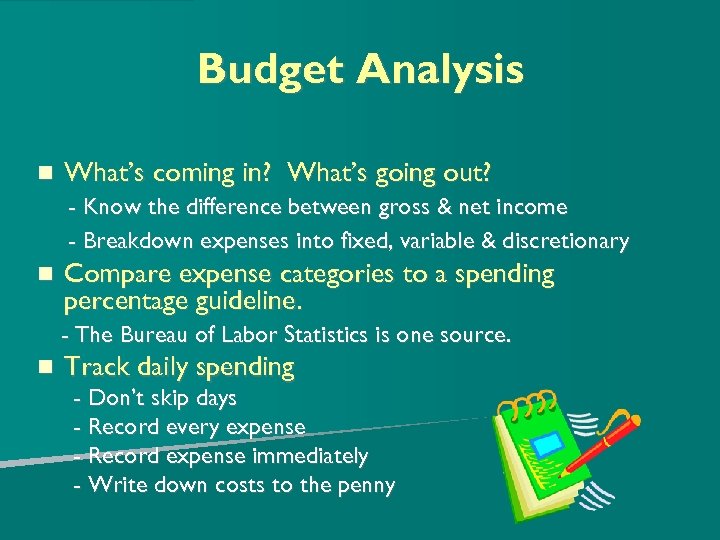 Budget Analysis What’s coming in? What’s going out? - Know the difference between gross & net income - Breakdown expenses into fixed, variable & discretionary Compare expense categories to a spending percentage guideline. - The Bureau of Labor Statistics is one source. Track daily spending - Don’t skip days - Record every expense - Record expense immediately - Write down costs to the penny
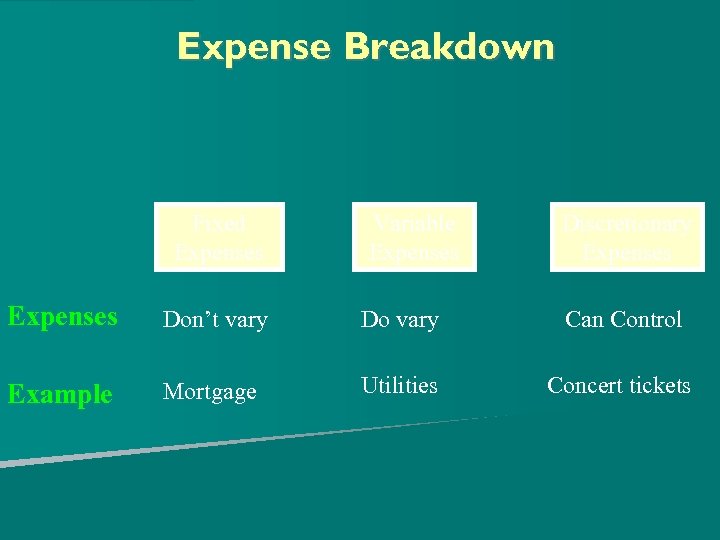 Expense Breakdown Fixed Expenses Variable Expenses Discretionary Expenses Don’t vary Do vary Can Control Example Mortgage Utilities Concert tickets
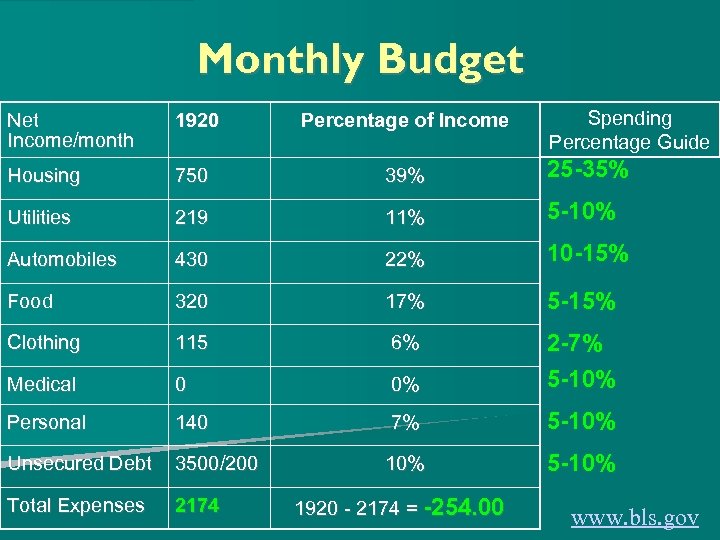 Monthly Budget Spending Percentage Guide Net Income/month 1920 Percentage of Income Housing 750 39% 25 -35% Utilities 219 11% 5 -10% Automobiles 430 22% 10 -15% Food 320 17% 5 -15% Clothing 115 6% Medical 0 0% 2 -7% 5 -10% Personal 140 7% 5 -10% Unsecured Debt 3500/200 10% 5 -10% Total Expenses 2174 1920 - 2174 = -254. 00 www. bls. gov
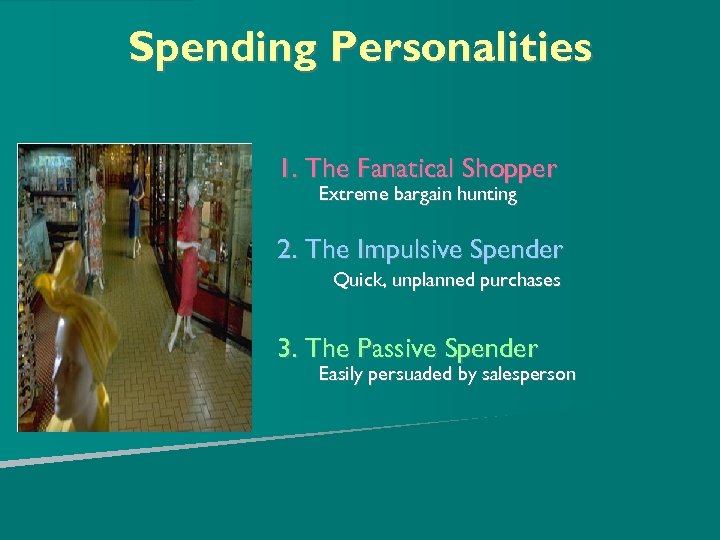 Spending Personalities 1. The Fanatical Shopper Extreme bargain hunting 2. The Impulsive Spender Quick, unplanned purchases 3. The Passive Spender Easily persuaded by salesperson
 Spending Personalities 4. The Ulterior Motive Spender Shop to escape or get revenge 5. The Esteem Spender Shop to impress 6. Special Interest Spender Spend on hobbies or addictions 7. Hot Potato Spender May panic & then buy quickly
 Destructive Money Beliefs I deserve it! I need a fix -- now! I don’t expect much I’m not good with money I’m waiting for a miracle I will impress you I’m showing them I really care I believe money corrupts people I’m not like everybody else It doesn’t really matter
 3 A’s Of Money Relationships Money & Achievement Work hard & want something tangible to show for it Money & Approval Want everybody to like them Money & Agitation Purchase items based on emotions *Which “A” best describes your relationship with money?
 Unit 10 Summary 1. 2. 3. Budget analysis along with net worth & debt-toincome ratio calculations help to assess the client’s current financial situation. Spending percentage guides are a good objective measure of how well money is spent in each budget category. Clients will exhibit a variety of spending personalities & relationships with money.
 Unit 11: Where the Client Wants To Go
 Life-Cycle Planning 1 7 2 3 6 4 5
 Four Steps to Planning: 1. 2. 3. 4. State goals in specific terms Create a plan to achieve each goal. Evaluate progress toward each goal. Decide whether to keep working toward a goal or to focus on a new one.
 Goals Must Be: 1. Specific 2. Measurable 3. Viable
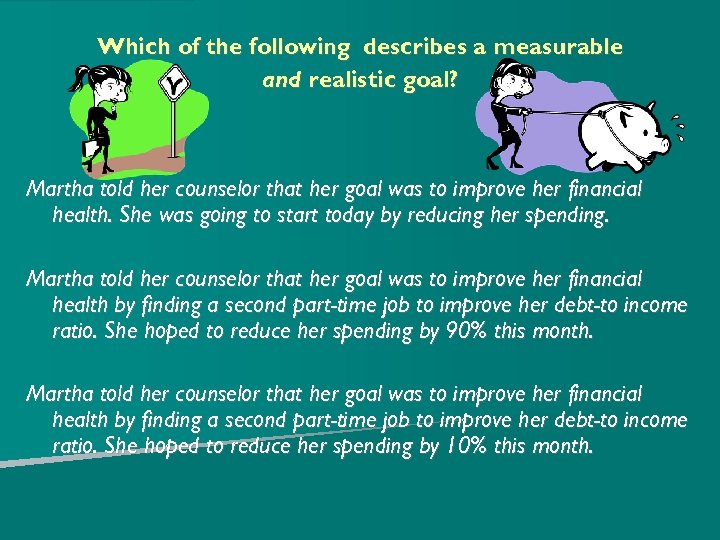 Which of the following describes a measurable and realistic goal? Martha told her counselor that her goal was to improve her financial health. She was going to start today by reducing her spending. Martha told her counselor that her goal was to improve her financial health by finding a second part-time job to improve her debt-to income ratio. She hoped to reduce her spending by 90% this month. Martha told her counselor that her goal was to improve her financial health by finding a second part-time job to improve her debt-to income ratio. She hoped to reduce her spending by 10% this month.
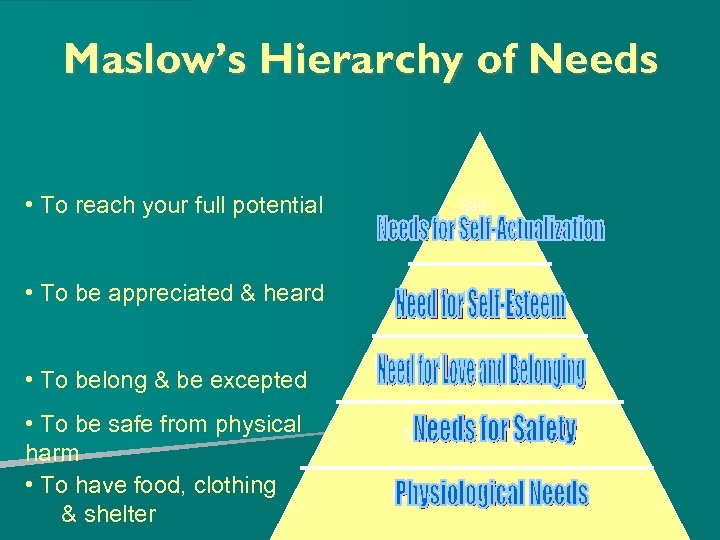 Maslow’s Hierarchy of Needs • To reach your full potential Self. Actualization • To be appreciated & heard • To belong & be excepted • To be safe from physical harm • To have food, clothing & shelter Need for Love and Belonging Needs for Safety Physiological Needs
 EXERCISE Does Your Spending Reflect Your Values? When making your financial plans, it is important to reflect on what is truly important to you. Step 1: Take a moment to think about what is most important to you. List the top five things you most value in life. For example, time with my family, a beautiful home, traveling, etc. Step 2: For each value you have listed, think of 3 ways that the money you have today can help you realize that particular value. For example, if you value romance, you might list a vacation, fresh flowers or spending on a baby-sitter.
 Unit 11 Summary 1. Financial goals shift throughout the life-span. 2. Goals need to be defined in specific terms, be measurable & viable. 3. Maslow’s Hierarchy of Needs is a tool to help evaluate an individual’s needs, wants & desires. 4. It’s important to determine what you value in life & evaluate whether your current spending aligns with those vales.
 Unit 12: How the Client Will Get There
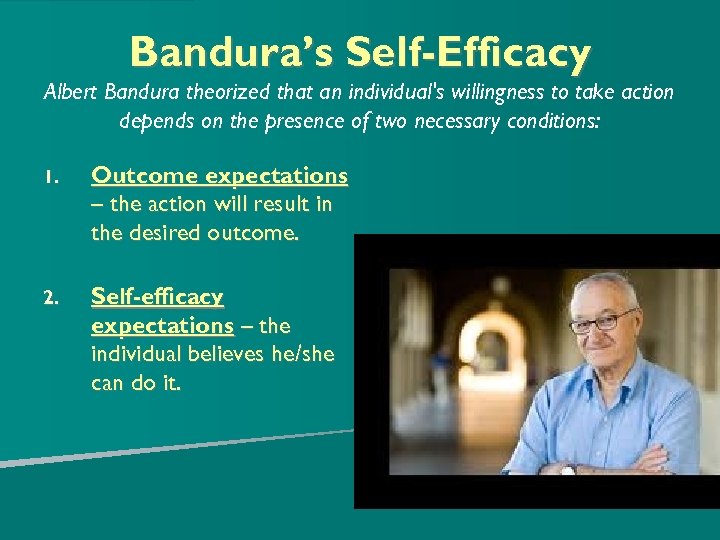 Bandura’s Self-Efficacy Albert Bandura theorized that an individual's willingness to take action depends on the presence of two necessary conditions: 1. Outcome expectations – the action will result in the desired outcome. 2. Self-efficacy expectations – the individual believes he/she can do it.
 Self-Efficacy: The Can-Do Attitude! You can help client’s develop self-efficacy by: Monitoring progress. Acknowledging small successes can help build confidence to tackle bigger problems. Inspiring by example. Seeing is believing & believing is what self-efficacy is all about. Encouraging & challenging. Self-defeating beliefs need to be challenged & replaced by the idea that desired outcomes are not only possible but also realistic. Helping clients overcome anxiety. Fear of failure is a sure recipe for non-action. Help clients overcome fear with solid facts.
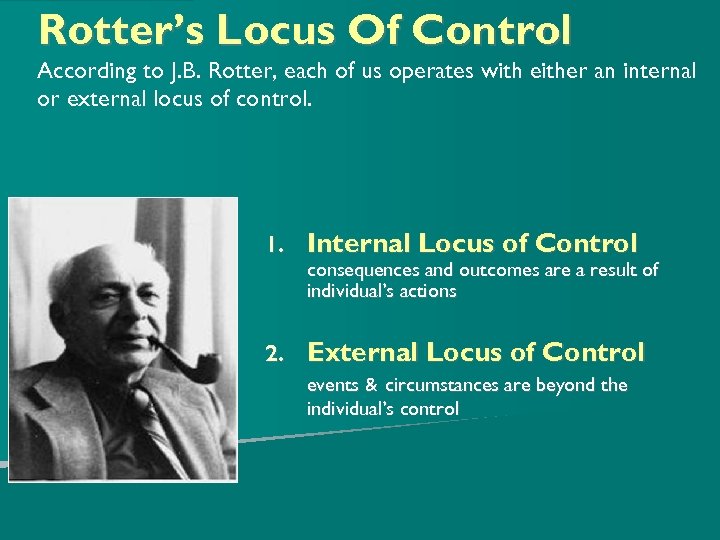 Rotter’s Locus Of Control According to J. B. Rotter, each of us operates with either an internal or external locus of control. 1. Internal Locus of Control 2. External Locus of Control consequences and outcomes are a result of individual’s actions events & circumstances are beyond the individual’s control
 Do you have an internal or external locus of control? Complete… ROTTER'S LOCUS OF CONTROL SCALE …and find out!
 The Spending Plan A monthly plan has 4 primary benefits: 1. Helps to identify overspending 2. Promotes honest interpersonal communication & accountability 3. Increases motivation 4. Tracks your success
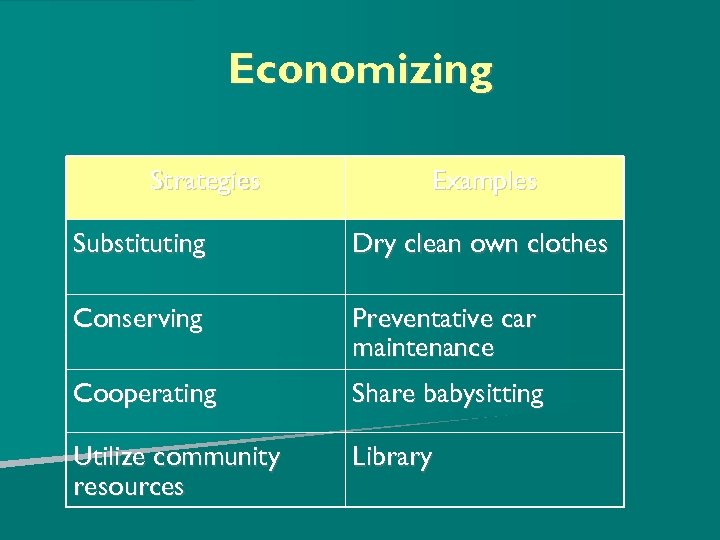 Economizing Strategies Examples Substituting Dry clean own clothes Conserving Preventative car maintenance Cooperating Share babysitting Utilize community resources Library
 Unit 12 Summary 1. In order for an individual to take action, a client must believe the action will result in a desired outcome & they have the ability to make it happen. 2. Individuals may possess an external or internal locus of control. 3. There are 4 primary benefits of keeping a spending plan: helps pinpoint problem spending, promotes honest communication, increases motivation & tracks progress. 4. There are 4 ways to economize: substituting, conserving, co-operating & utilizing community resources.
 This Concludes Module III Review