


Key Word Bingo! • • • Gulag Solkhoz Kolkhoz NEP Nepmen • • • Kulak Stakhanovite Gosplan Magnitorgarsk Motor Tractor Station
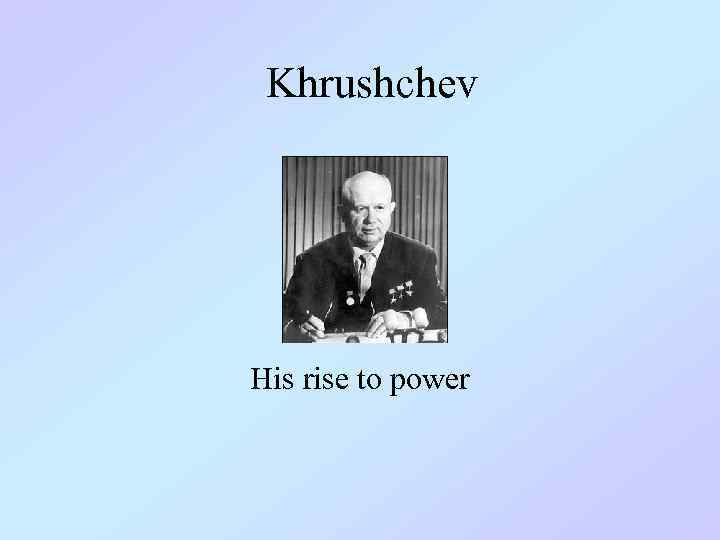
Khrushchev His rise to power
Khrushchev’s background • 1894 – born in Kolnikova a village in southern Russia. • Parents were poor peasants • Little education beyond 4 years in primary school • Early jobs included shepherd, railways, brick factory and miner • 1917 led a local metalworkers union • 1918 joined Bolsheviks • Red army commissar during the civil war • At the time of Stalin’s death he was regarded as hardworking and enthusiastic but not serious contender for power
The Contenders • Malenkov – Stalin’s favourite – chairman of the council of ministers and 1 st secretary of the communist party central committee. • Beria – head of MVD – new name for NKVD • Molotov – foreign minister • Khrushchev – although a member of the presidium he was not in a top position
Khrushchev’s Rise The Fall of Malenkov March 1953 – opposition led by K. insisted that he should give up one of his posts. He gave up the secretariat which was given to K. The Fall of Beria had massive power as head of MVD. He had under his control several hundred thousand troops. K. Convinced the other contenders that Beria was planning a coup this led to Beria being arrested at a meeting of the Presidium. Beria was tried and executed in secret.
Khrushchev in power • Pravda switched its support to K. by 1955 • Feb 1955 K. had enough support to call Malenkov to resign as chairman of council of ministers. • K. was in complete control. He appointed officials who were loyal to him.
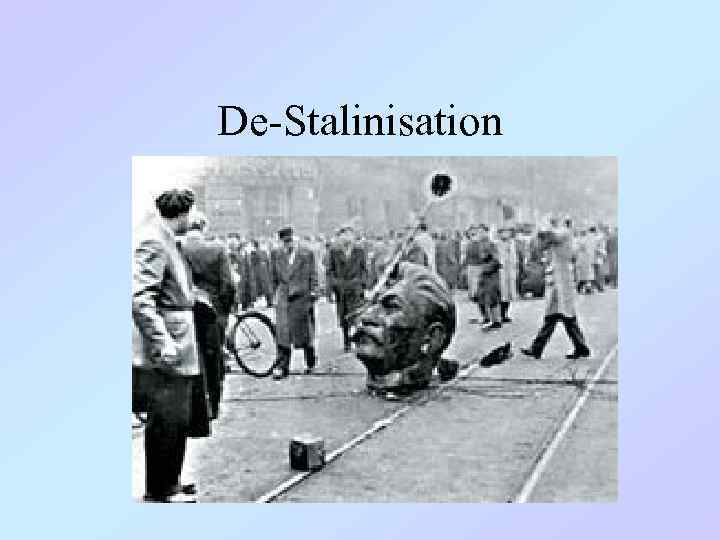
De-Stalinisation
Pospelov Comission • Q – how come that bulk of deputies from 17 th party congress of 1934 (Congress of Winners) turned out enemies of the state? • To answer this special group was formed in january 1955 by Presidium. • Its findings were presented to the top officials on February 9 th 1956 and later were used as a basis for Khrushchev’s “Secret Speech”
The secret speech • 25 th February 1956 at a closed session of 20 th party congress Khrushchev made a 4 hour speech. • Details were given of the purges, the creation of a myth about Stalin as a war hero • Stalin was also criticised for destroying party democracy
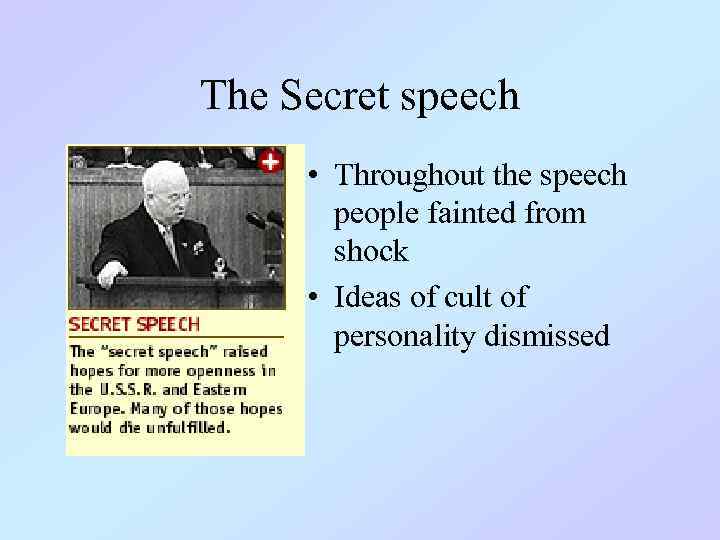
The Secret speech • Throughout the speech people fainted from shock • Ideas of cult of personality dismissed
The secret speech reveals the purges • After the criminal murder of S M Kirov, mass repressions and brutal acts of violation of socialist legality began. . the circumstances surrounding Kirov’s murder hide many things which are inexplicable and mysterious. . . top functionaries of the NKVD were shot presumably to cover up. . . • Mass repressions grew tremendously from the end of 1936. . . the mass repressions at this time were made under the slogan of a fight against the Trotskyites. . . but. . . Trotskyism was completely disarmed. . . it was clear that there was no basis for mass terror in the country. • This terror was actually directed not at the remnants of the exploiting classes but against the honest workers. .
Why did Khrushchev make the secret speech? • Four possible reasons given by historians
Why did Khrushchev make the secret speech? 1) Sooner or later the truth would come out There was a large number of inmates who had been in camp for 20 years being released. They would talk about the repressions. It would be better if the party took the initiative.
Why? 2) Khrushchev had much to gain by making the speech • By omitting his role in the Moscow and Ukranian purges he gave the clear impression that other senior party members like Malenkov and Molotov were more responsible for the crimes than he was.
Why? 3) He was able to begin the process of De. Stalinisation – He could go against Stalin’s policies with less criticism 4) He believed that Stalin’s system held up progress – He believed that it stifled initiative and creativity.
Not so secret anymore • March 5 th – Speech made it to local party cells • March 4 -9 – riot in Tbilisi where people treated Stalin as national hero.
What was De-Stalinisation? • • • End terror – Labour camps were emptied People rehabilitated Greater freedom in culture and science New initiatives in industry Peaceful co-existence with the west
Was Khrushchev a reformer? The Cold War and Eastern Europe
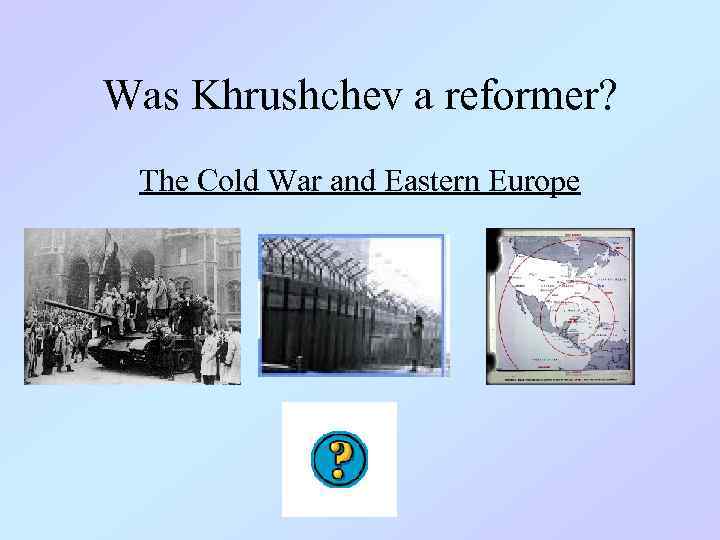
The Cold War and Eastern Europe • 1) Poland – De-Stalinisation led to the belief in greater political freedom in the Eastern bloc. – Gomulka led calls for Greater freedom – Accepted by Khrushchev as long as remained in Warsaw pact.
The Cold War and Eastern Europe • 2) Hungary – Rakosi pro – Stalin leader – After the success of Gomulka there was a full scale rising in Hungary – Nagy became leader – Announced leaving Warsaw pact – 1, 000 Soviet tanks sent into Hungary led to 20, 000 killed
The Cold War and Eastern Europe • 3) The Berlin Wall 1961 – West Berlin was surrounded by Eastern Germany – It received aid from the west and had a high standard of living – Between 1949 and 1957 over two million Germans fled to west Berlin – Loss of skilled manpower leading to economic problems in Eastern Germany. – Allowed E. German government to build a wall between East Berlin and West Berlin – Anyone who crossed the wall was shot dead.
The Cold War and Eastern Europe • 4) The Cuban Missile Crisis – 1962 American Spy Planes discovered that the Russians were building bases on Cuba – Khrushchev was ordered by Kennedy to remove them – After two weeks Khrushchev did back down. – Closest the world has come to Nuclear war
Key Question? • Key question: Did Khrushchev follow the policy of peaceful co-existence?
Other areas for De- Stalinisation • Economy • Industry • Religion Homework (for Tuesday): • Make sure that you have read chapter 14 and read my hand out about Agriculture and De-Stalinisation under Khrushchev….
Khrushchev Industrial Policy
The Space Programme • In 1957 Russia stunned America by putting the first ever man made satellite into orbit around the earth. • In 1961 America was again beaten when Yuri Gagarin became the first man in space.
Why did Khrushchev pursue this policy? • Prestige for USSR – shows the success of Communism and the strength of Soviet industry • Propaganda victory against America in the Cold War
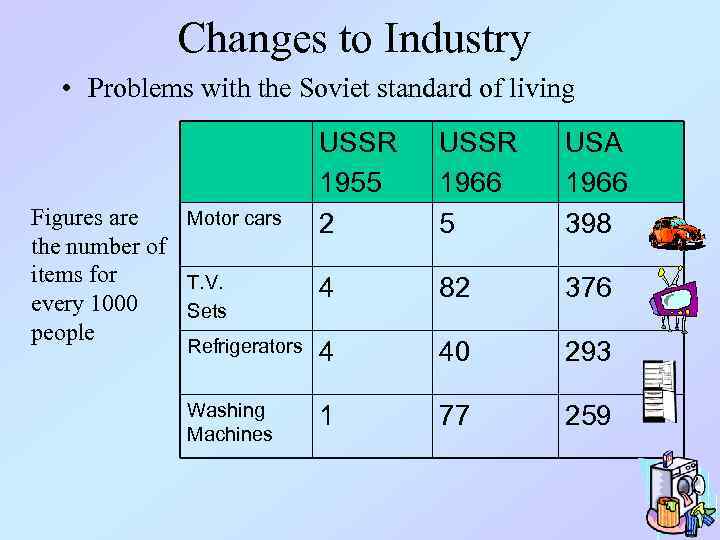
Changes to Industry • Problems with the Soviet standard of living USSR 1955 2 USSR 1966 5 USA 1966 398 4 82 376 Refrigerators 4 40 293 Washing Machines 1 77 259 Figures are Motor cars the number of items for T. V. every 1000 Sets people
Industrial programme • Sixth five year plan was abandoned in 1955 because it was over ambitious • 7 year plan – focussed on consumer goods, chemicals and plastics • Hoped to improve the standard of living for the Soviet people and therefore have greater propaganda against the U. S as well as greater support at home.
Decentralisation • One of Khrushchev’s criticisms of Stalin’s system was that there were too many ministries in Moscow. He believed that they were too centralised, that they were out of touch with the different regions of USSR and did not have enough new ideas.
The Solution • In 1957 – the central ministries were broken up into 105 regional economic councils. • Why would this be a good thing? • However – by closing the ministries in Moscow Khrushchev made new enemies. • Regional areas were not coordinated, industry in the area only met local needs not national needs.
Khrushchev improves conditions for the workers • • Wage increases Introduced minimum wage There were lower taxes on the poorer paid Some manufactured goods were cheaper Shorter working week Improved pensions and disability benefits Tuition fees at Schools ended
Why? • Motivate the workers to work harder and therefore improve industrial production. • Make himself more popular and improve his power base. • Propaganda
Khrushchev’s Agricultural policies
Summary Was Khrushchev a success or failure?
Failure! • Agricultural schemes • Decentralising policies • Slow growth of Industry under Khrushchev • Hungary • Cuban Missile Crisis • Lack of success in Science and Technology • Limits of De Stalinization
Success! • Supplies of food and consumer goods increased under Khrushchev • Greater freedom of discussion in his earlier years • He had the courage to break from Stalin
More Success! • Apartment blocks built in every city • Meat consumption increased by 50% 1958 – 1965 – better food! • More people owned Fridges, televisions and washing machines
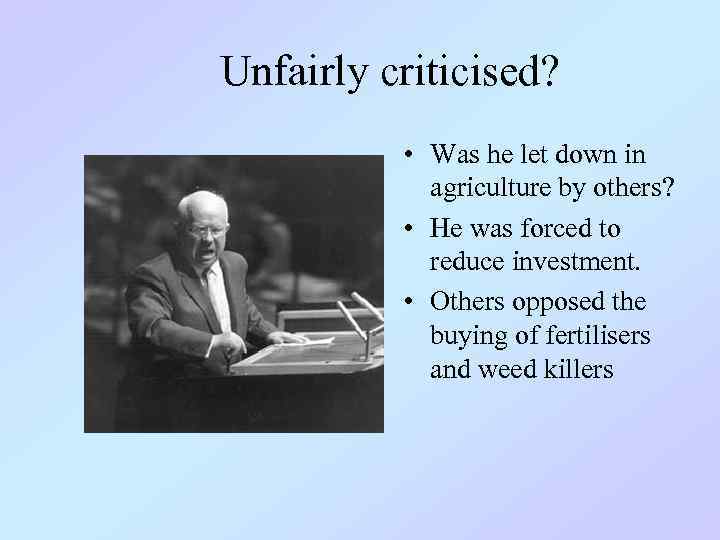
Unfairly criticised? • Was he let down in agriculture by others? • He was forced to reduce investment. • Others opposed the buying of fertilisers and weed killers
Khrushchev: The Debate • Khrushchev’s can be considered a savior of the USSR, following his succession to power after Stalin. • We will be having this debate during the second half of Wednesday’s class. • In your teams prepare your arguments in for or against this statement.
The fall of Khrushchev
The events • October 1964 – Khrushchev holidaying at a Black sea resort • During his absence secret meeting of Politburo – decided to remove K. from leadership • K. summoned back from holiday told that he had retired through ill health and age.
Why was K. removed? 1) K. attempts to decentralise areas of government and party made enemies with bureaucracy. 2) De-Stalinisation – after decades of hero worship many found it difficult to accept that Stalin had been wrong on so many counts. 3) Less censorship – seemed to many that K. had created unnecessary danger for the party. 4) K. had lost support of the military – in 1960 he had proposed cutting the armed services by over a million men, this and Cuba led to him becoming unpopular with the military.
Why? continued 5) Foreign affairs – few successes – fell out with China, awakened hopes of independence in eastern bloc countries and the embarrassment of Cuba. 6) Economy – failed to overtake the west. Virgin land scheme had led to criticism.
Homework for Monday Continuity and Change • Read chapter 16, pages 295 -301 – Complete the tables on pages 296 and 298 • “war is the locomotive of History” (Trotsky) – How did the first and second World Wars help to bring about changes in Russia?
