


 Скачать презентацию Key Management Network Systems Security Mort Anvari 9 16 2004
98fde8f2da931370489eb595b4d4deb2.ppt
- Количество слайдов: 24
 Key Management Network Systems Security Mort Anvari 9/16/2004
 Key Management n n Asymmetric encryption helps address key distribution problems Two aspects n n distribution of public keys use of public-key encryption to distribute secret keys 9/16/2004 2
 Distribution of Public Keys n Four alternatives of public key distribution n n Public announcement Publicly available directory Public-key authority Public-key certificates 9/16/2004 3
 Public Announcement n Users distribute public keys to recipients or broadcast to community at large n n E. g. append PGP keys to email messages or post to news groups or email list Major weakness is forgery n n anyone can create a key claiming to be someone else and broadcast it can masquerade as claimed user before forgery is discovered 9/16/2004 4
 Publicly Available Directory n n Achieve greater security by registering keys with a public directory Directory must be trusted with properties: n n n contains {name, public-key} entries participants register securely with directory participants can replace key at any time directory is periodically published directory can be accessed electronically Still vulnerable to tampering or forgery 9/16/2004 5
 Public-Key Authority n n Improve security by tightening control over distribution of keys from directory Has properties of directory Require users to know public key for the directory Users can interact with directory to obtain any desired public key securely n require real-time access to directory when keys are needed 9/16/2004 6
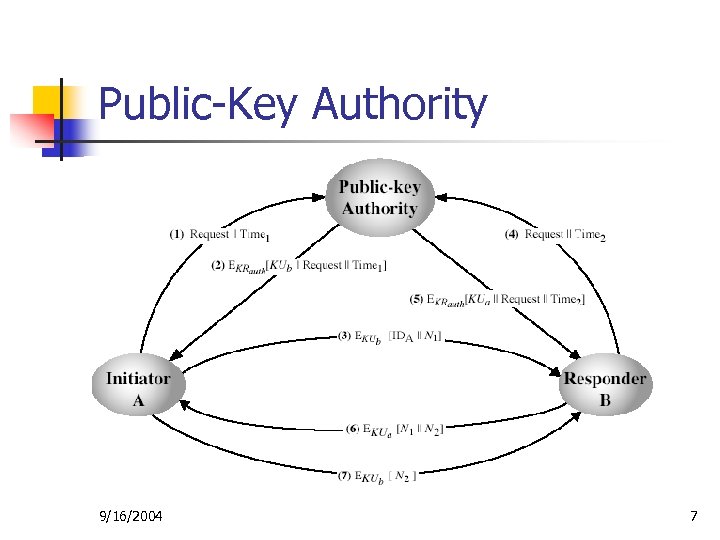 Public-Key Authority 9/16/2004 7
 Public-Key Certificates n n Certificates allow key exchange without realtime access to public-key authority A certificate binds identity to public key n n n usually with other info such as period of validity, authorized rights, etc With all contents signed by a trusted Public. Key or Certificate Authority (CA) Can be verified by anyone who knows the CA’s public key 9/16/2004 8
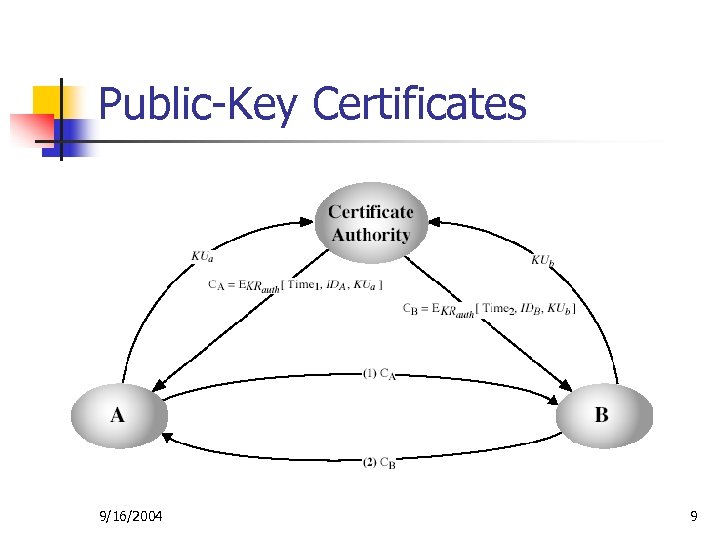 Public-Key Certificates 9/16/2004 9
 Distribute Secret Keys Using Asymmetric Encryption n n Can use previous methods to obtain public key of other party Although public key can be used for confidentiality or authentication, asymmetric encryption algorithms are too slow So usually want to use symmetric encryption to protect message contents Can use asymmetric encryption to set up a session key 9/16/2004 10
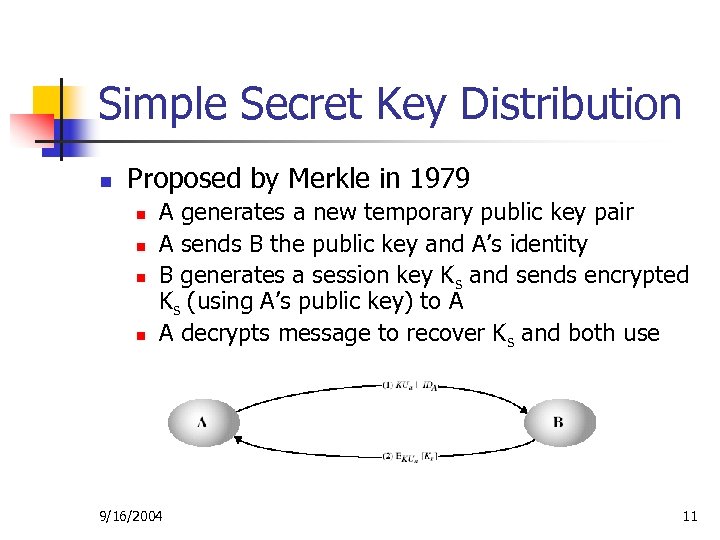 Simple Secret Key Distribution n Proposed by Merkle in 1979 n n A generates a new temporary public key pair A sends B the public key and A’s identity B generates a session key Ks and sends encrypted Ks (using A’s public key) to A A decrypts message to recover Ks and both use 9/16/2004 11
 Problem with Simple Secret Key Distribution n An adversary can intercept and impersonate both parties of protocol n n n A generates a new temporary public key pair {KUa, KRa} and sends KUa || IDa to B Adversary E intercepts this message and sends KUe || IDa to B B generates a session key Ks and sends encrypted Ks (using E’s public key) E intercepts message, recovers Ks and sends encrypted Ks (using A’s public key) to A A decrypts message to recover Ks and both A and B unaware of existence of E 9/16/2004 12
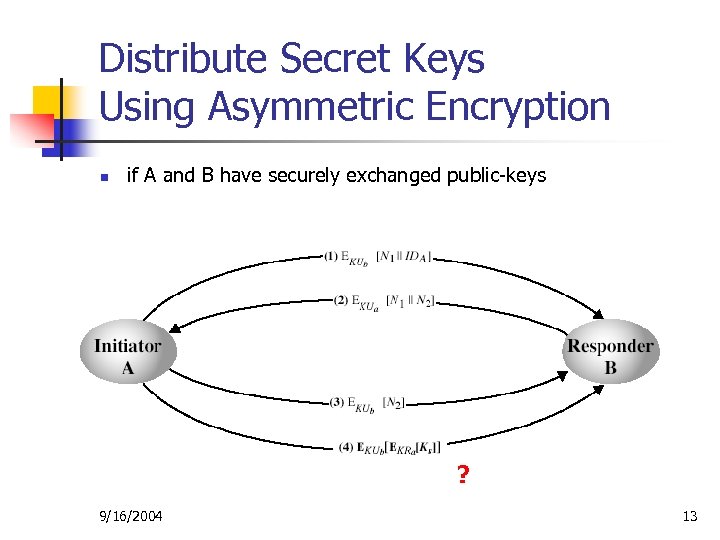 Distribute Secret Keys Using Asymmetric Encryption n if A and B have securely exchanged public-keys ? 9/16/2004 13
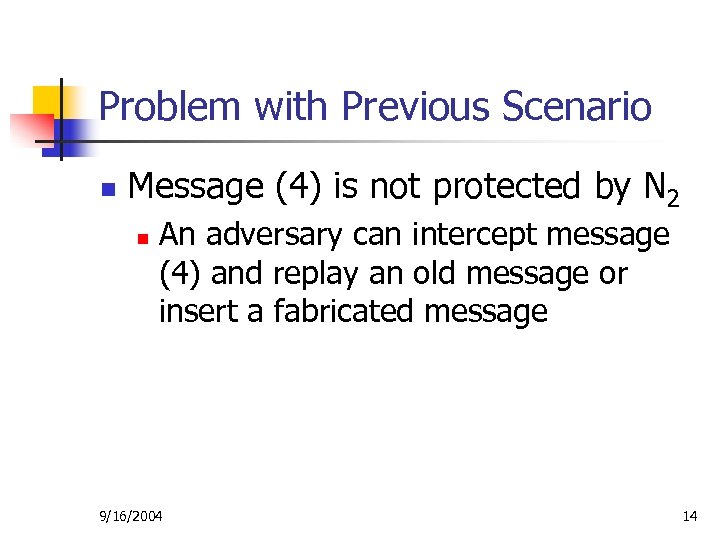 Problem with Previous Scenario n Message (4) is not protected by N 2 n An adversary can intercept message (4) and replay an old message or insert a fabricated message 9/16/2004 14
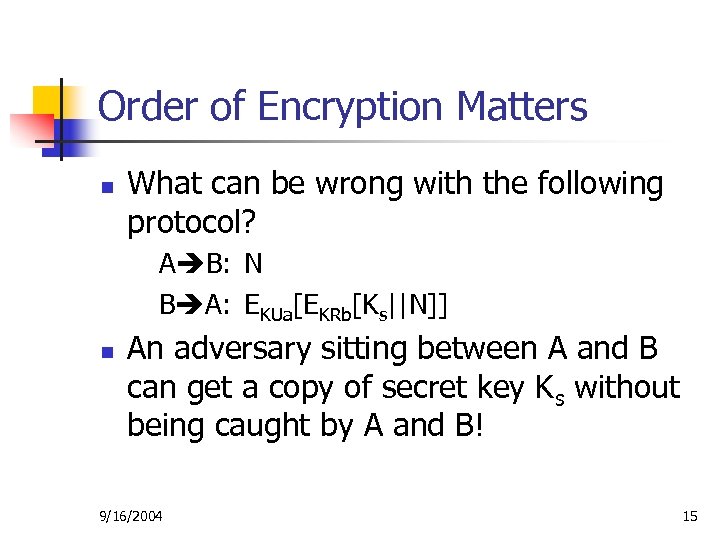 Order of Encryption Matters n What can be wrong with the following protocol? A B: N B A: EKUa[EKRb[Ks||N]] n An adversary sitting between A and B can get a copy of secret key Ks without being caught by A and B! 9/16/2004 15
 Diffie-Hellman Key Exchange n n First public-key type scheme proposed By Diffie and Hellman in 1976 along with advent of public key concepts A practical method for public exchange of secret key Used in a number of commercial products 9/16/2004 16
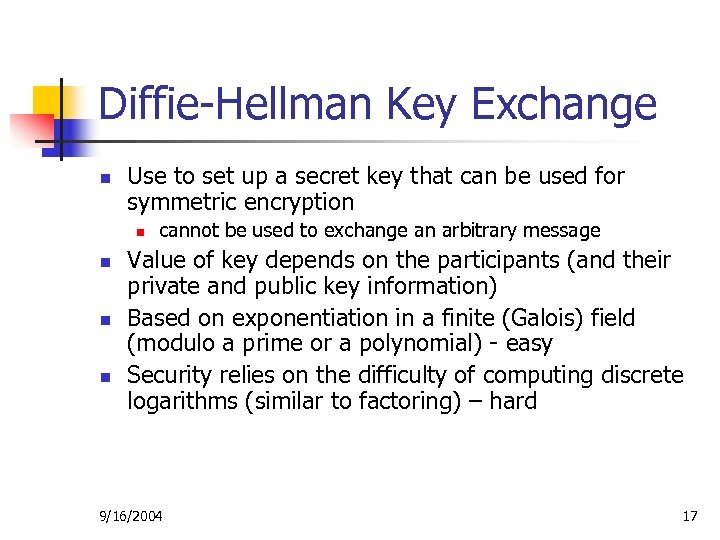 Diffie-Hellman Key Exchange n Use to set up a secret key that can be used for symmetric encryption n n cannot be used to exchange an arbitrary message Value of key depends on the participants (and their private and public key information) Based on exponentiation in a finite (Galois) field (modulo a prime or a polynomial) - easy Security relies on the difficulty of computing discrete logarithms (similar to factoring) – hard 9/16/2004 17
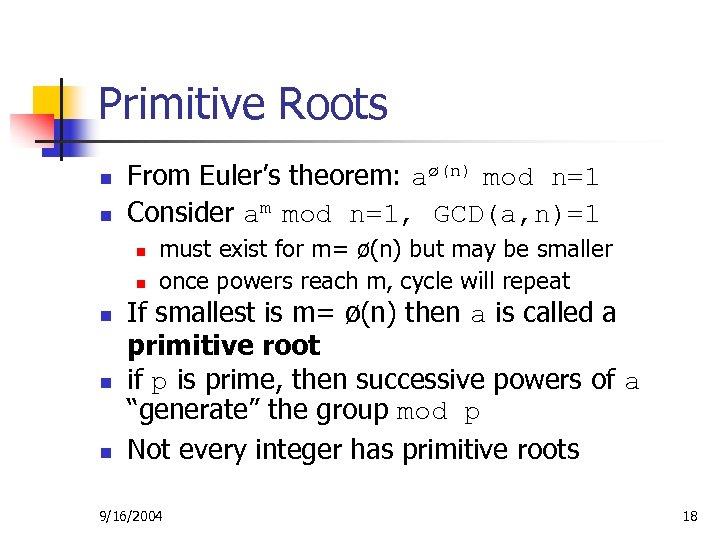 Primitive Roots n n From Euler’s theorem: aø(n) mod n=1 Consider am mod n=1, GCD(a, n)=1 n n n must exist for m= ø(n) but may be smaller once powers reach m, cycle will repeat If smallest is m= ø(n) then a is called a primitive root if p is prime, then successive powers of a “generate” the group mod p Not every integer has primitive roots 9/16/2004 18
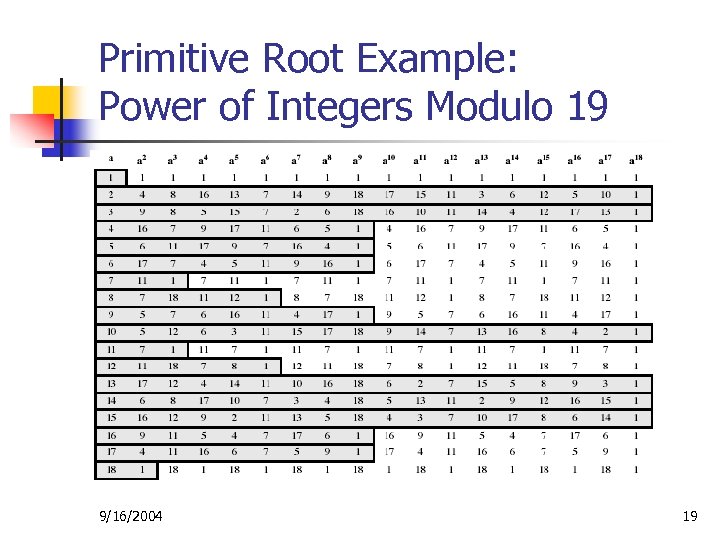 Primitive Root Example: Power of Integers Modulo 19 9/16/2004 19
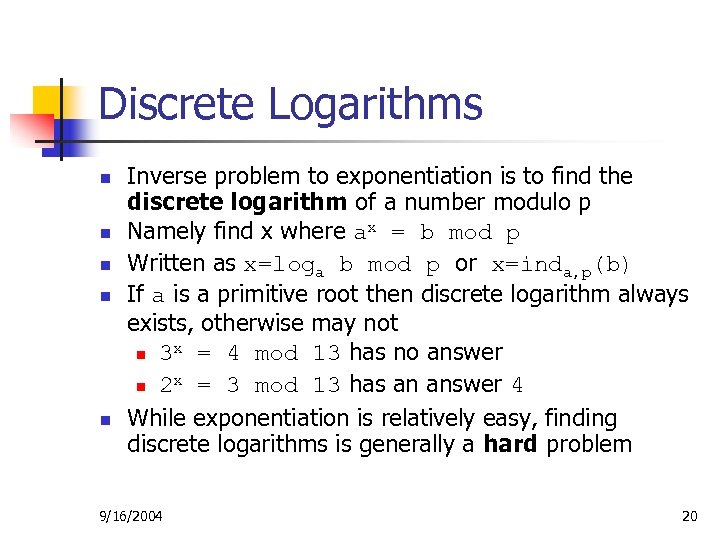 Discrete Logarithms n n n Inverse problem to exponentiation is to find the discrete logarithm of a number modulo p Namely find x where ax = b mod p Written as x=loga b mod p or x=inda, p(b) If a is a primitive root then discrete logarithm always exists, otherwise may not x = 4 mod 13 has no answer n 3 x = 3 mod 13 has an answer 4 n 2 While exponentiation is relatively easy, finding discrete logarithms is generally a hard problem 9/16/2004 20
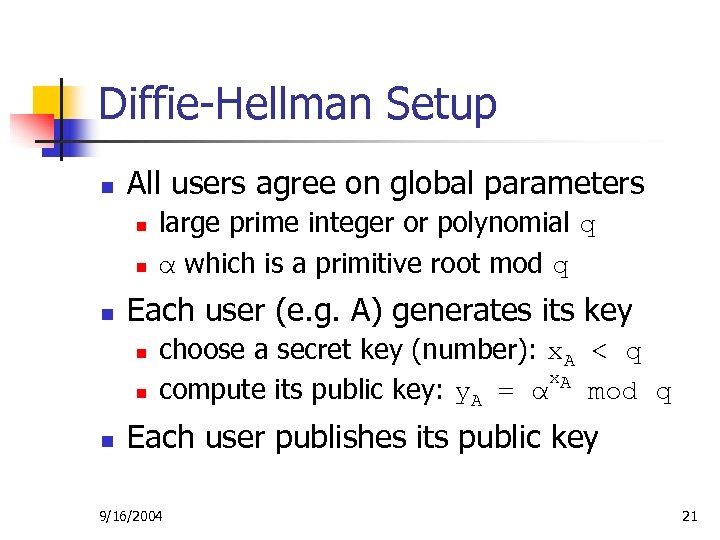 Diffie-Hellman Setup n All users agree on global parameters n n n Each user (e. g. A) generates its key n n n large prime integer or polynomial q α which is a primitive root mod q choose a secret key (number): x. A < q x. A compute its public key: y. A = α mod q Each user publishes its public key 9/16/2004 21
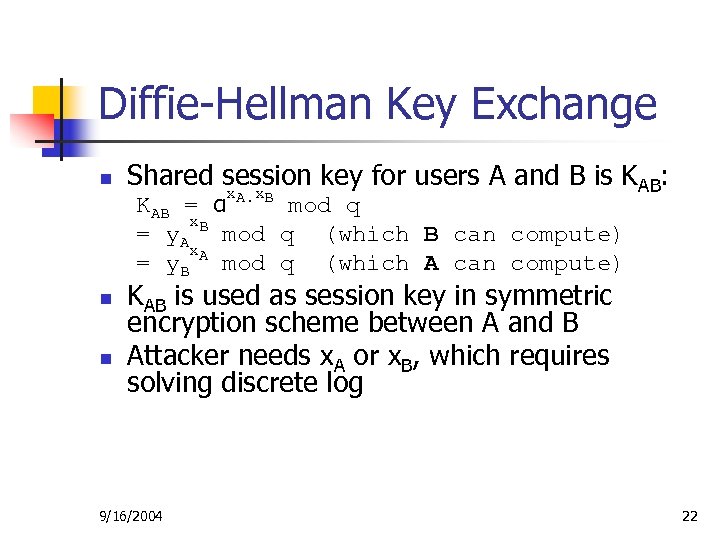 Diffie-Hellman Key Exchange n n n Shared session key for users A and B is KAB: x x KAB = α A. B mod q x. B = y. A mod q (which B can compute) x. A = y. B mod q (which A can compute) KAB is used as session key in symmetric encryption scheme between A and B Attacker needs x. A or x. B, which requires solving discrete log 9/16/2004 22
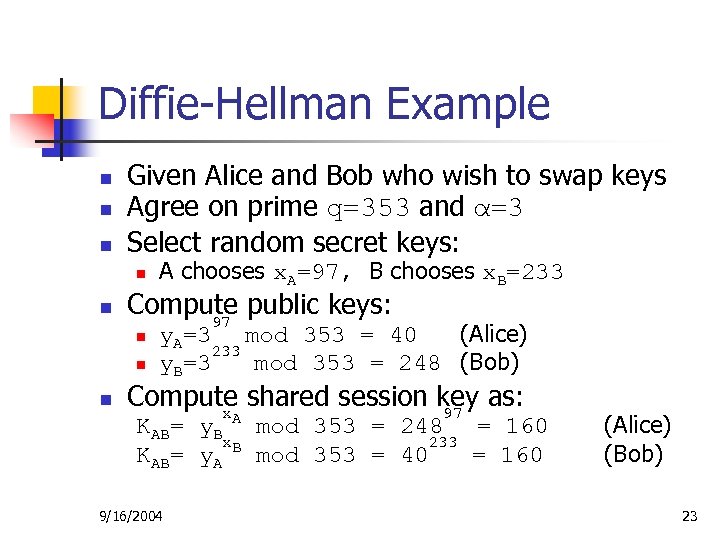 Diffie-Hellman Example n n n Given Alice and Bob who wish to swap keys Agree on prime q=353 and α=3 Select random secret keys: n n Compute public keys: 97 n n n A chooses x. A=97, B chooses x. B=233 y. A=3 mod 353 = 40 (Alice) 233 y. B=3 mod 353 = 248 (Bob) Compute shared session key as: x 97 KAB= y. B A mod 353 = 248 = 160 x. B 233 KAB= y. A mod 353 = 40 = 160 9/16/2004 (Alice) (Bob) 23
 Next Class n n Hashing functions Message digests 9/16/2004 24