


 Скачать презентацию Key issues related to proposal development Yunae Yi
dc34f098a6a6fead33d1f7b274cecbbc.ppt
- Количество слайдов: 48
 Key issues related to proposal development Yunae Yi Secretary of the Project Approval Group UNEP, Nairobi PCMU/UNEP
 Results-Based Management n Why focus on results? ¨ Shift of focus from delivery of goods and services to benefits to the target beneficiaries ¨ Focus on effectiveness and impact of our work n What does it mean? ¨ Flexible and optimal approach to achieve results ¨ Accountability of the project team ¨ Continuous monitoring of the progress ¨ Demonstration of measurable changes PCMU/UNEP
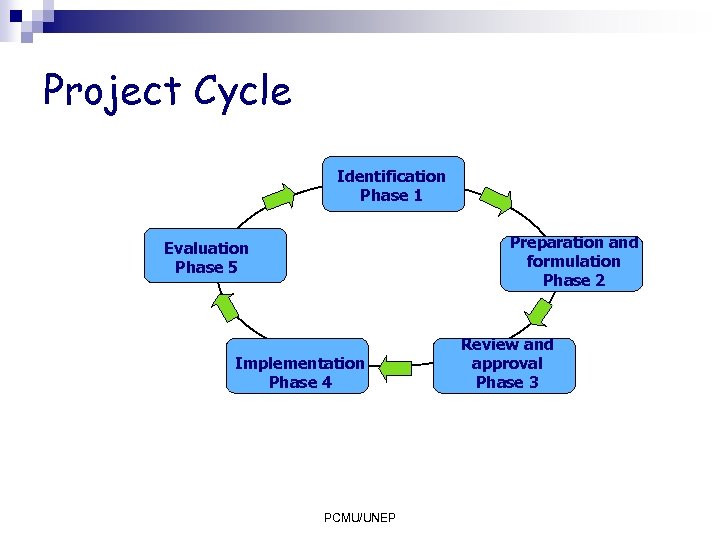 Project Cycle Identification Phase 1 Preparation and formulation Phase 2 Evaluation Phase 5 Implementation Phase 4 PCMU/UNEP Review and approval Phase 3
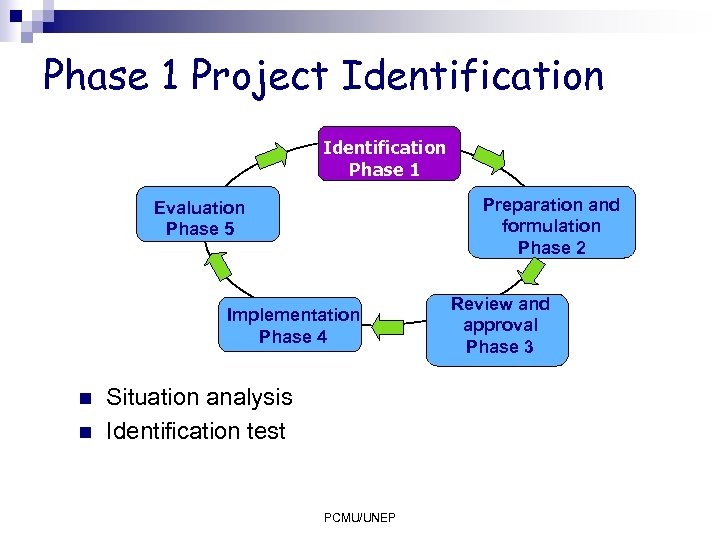 Phase 1 Project Identification Phase 1 Preparation and formulation Phase 2 Evaluation Phase 5 Implementation Phase 4 n n Situation analysis Identification test PCMU/UNEP Review and approval Phase 3
 Situation analysis ¨ Assess and analyze an environmental situation needs ¨ Include analyses of needs, interests, strengths and weaknesses of key stakeholders and beneficiaries (stakeholder analysis) ¨ Explores likely causes and linkages between existing problems and the needed actions (Problem and objective analyses) ¨ Generates key actions and strategies to be applied PCMU/UNEP
 Situation analysis (1): Stakeholder analysis 1. Identify the principal stakeholders at various levels – local, national, regional and international 2. Investigate their roles, interests, and relative powers and capacities to participate 3. Identify the extent of cooperation or conflict in the relationships among stakeholders 4. Interpret the findings of the analysis and define how they should be incorporated into project design PCMU/UNEP
 Situation analysis (2): Problem analysis 1. Define precisely the situation to be analyzed (sector, sub sector, area, etc. ); 2. Define some major problem conditions related to the selected situation; 3. Organize the problem conditions according to their cause–effect relationships; 4. Check the logical order. PCMU/UNEP
 Situation analysis (3): Objectives analysis • Reformulate the problems as objectives; • Check the logic and plausibility of the meansto-ends relationship; • Select the scope and level of project intervention; • Link to Logical Framework development PCMU/UNEP
 Identification test n There is compatibility with COP mandates; n Major options and alternatives have been identified and some initial choices made; n The principal institutional and policy issues affecting project outcome have been identified and deemed amenable to solution; n There is justifiable expectation that the project will have adequate support from the relevant political authorities, other stakeholders and the intended beneficiaries; n The project options selected are expected to be justified, given rough estimates of the expected costs and benefits. PCMU/UNEP
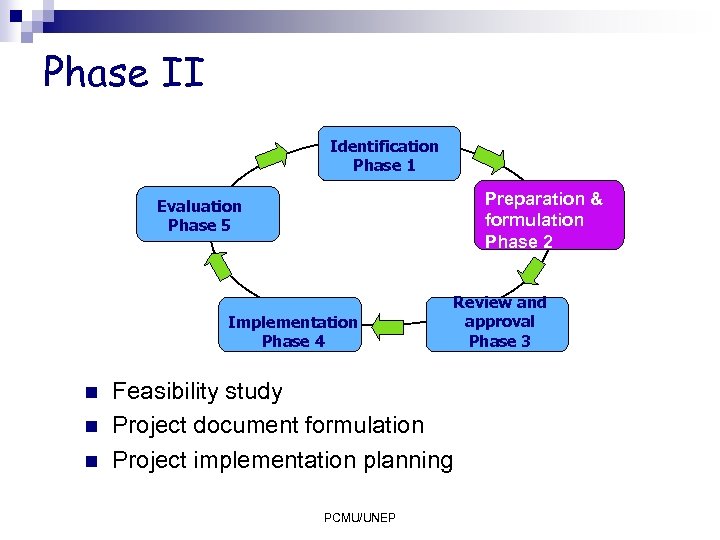 Phase II Identification Phase 1 Preparation & formulation Phase 2 Evaluation Phase 5 Implementation Phase 4 n n n Review and approval Phase 3 Feasibility study Project document formulation Project implementation planning PCMU/UNEP
 Feasibility study n The core of the proposal preparation process n To provide the basis for choosing the most desirable options n Consideration of the following basic questions: ¨ Does it conform to the development and environmental priorities, such as PRSP? ¨ Is it technically and scientifically sound, and is the methodology the best among the available alternatives? ¨ Is it administratively manageable? ¨ Is it financially justifiable and feasible? ¨ Is it compatible with the culture of the beneficiaries? ¨ Is it likely to be sustained beyond the intervention period? PCMU/UNEP
 Project document formulation n Add logical framework matrix, details on budget, implementation plan and modalities to the existing concept proposal n Project and project document formulation are simultaneous and iterative processes n The project document come from each step taken through project cycle phases 1 and 2 PCMU/UNEP
 Project document formulation (con’t) The full project document is: n A legal agreement once signed; n A tool formulating and implementing projects; n A tool for communication among key partners; n A tool for project monitoring and evaluation; n Basis for the terms of agreement for any consultancy/contractual service. PCMU/UNEP
 Sustainability (1/2) n Most project interventions are temporary in nature n What happens after the project? n Capacity-building measures should be an integral part of project strategies and activities n Area of repeated concern by the donors and auditors PCMU/UNEP
 Sustainability (2/2) Project will be sustainable depending on the following factors: n Policy support n Institutional and management capacity n Economic and financial viability n n Ownership by beneficiaries Appropriate technology Social and cultural issues Environmentally sustainable PCMU/UNEP
 Logical framework (1/3) n Donors often consider it as a mandatory component of the projects n It identifies and states the main factors related to the success of the project n It clarifies how project success (qualitative and quantitative) will be judged or measured, thus providing a basis for monitoring and evaluation. PCMU/UNEP
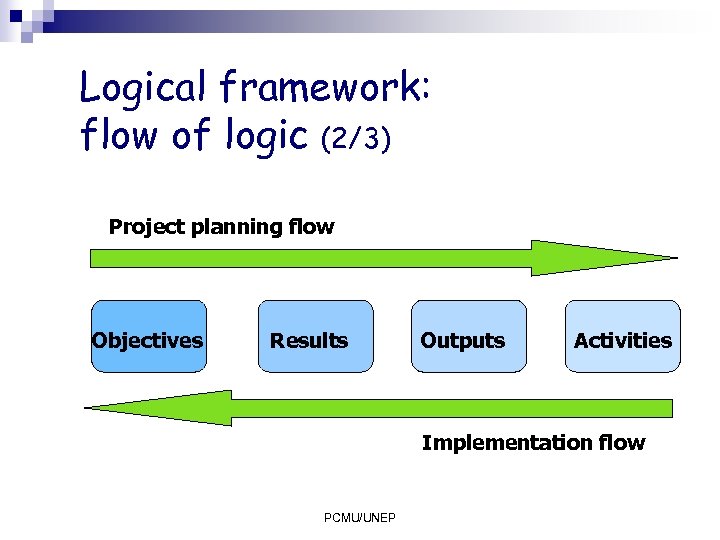 Logical framework: flow of logic (2/3) Project planning flow Objectives Results Outputs Activities Implementation flow PCMU/UNEP
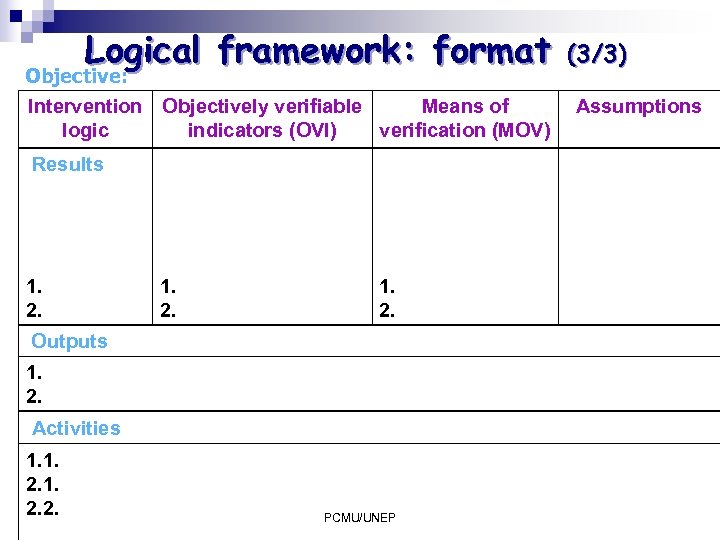 Logical framework: format Objective: Intervention Objectively verifiable Means of logic indicators (OVI) verification (MOV) Results 1. 2. Outputs 1. 2. Activities 1. 1. 2. 2. PCMU/UNEP (3/3) Assumptions
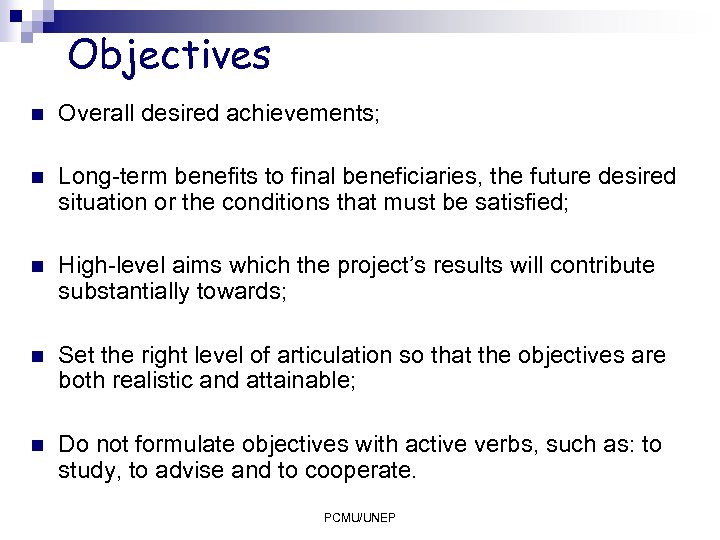 Objectives n Overall desired achievements; n Long-term benefits to final beneficiaries, the future desired situation or the conditions that must be satisfied; n High-level aims which the project’s results will contribute substantially towards; n Set the right level of articulation so that the objectives are both realistic and attainable; n Do not formulate objectives with active verbs, such as: to study, to advise and to cooperate. PCMU/UNEP
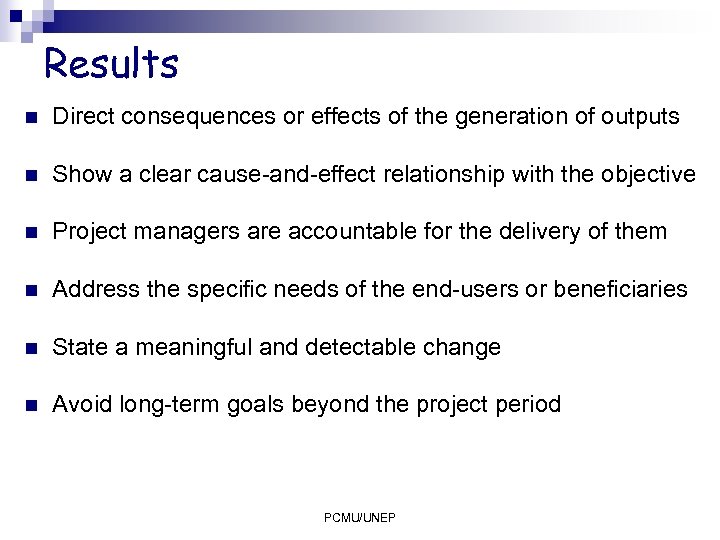 Results n Direct consequences or effects of the generation of outputs n Show a clear cause-and-effect relationship with the objective n Project managers are accountable for the delivery of them n Address the specific needs of the end-users or beneficiaries n State a meaningful and detectable change n Avoid long-term goals beyond the project period PCMU/UNEP
 Outputs n The lowest level results of the project n The optimal combination necessary for achieving the results n Its delivery must be within the control of project management team n Outputs are the outcomes of activities PCMU/UNEP
 Activities n The specific work or tasks to be performed within the project to transform resources into outputs n The links between inputs and outputs n Activities must be pertinent not only to the project outputs but also to the wider context of the project’s aims n Special attention to the interests of under-represented groups, such as women and people living in poverty PCMU/UNEP
 Indicators n What will show us that the objective, results and outputs have indeed occurred? n Indicators provide an opportunity to restate intervention logic in specific and directly observable terms n Objectively verifiable indicators should be ‘SMART’. SMART stands for: q Specific q Measurable q Attainable q Realistic q Time-based PCMU/UNEP
 Means of verification n Maximize existing data sources n With existing data sources, caution regarding validity and reliability of the data n Review or content analysis; internal records; audit reports; reports by NGOs and other international agencies; surveys; interviews; and rapid assessments n Build the cost for data collection in the project budget PCMU/UNEP
 Assumptions n External factors which could affect the progress and success of the programme or project, or its longterm sustainability n Underlying conditions which have to be met for the project to succeed n Project managers should assess external factors and risks in project implementation and articulate them in the planning phase n Project managers should monitor the influences of key external factors PCMU/UNEP
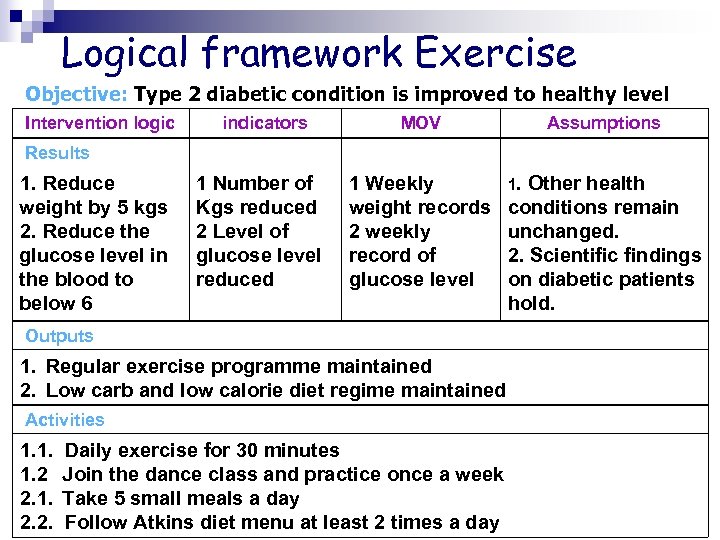 Logical framework Exercise Objective: Type 2 diabetic condition is improved to healthy level Intervention logic indicators MOV Assumptions Results 1. Reduce weight by 5 kgs 2. Reduce the glucose level in the blood to below 6 1 Number of Kgs reduced 2 Level of glucose level reduced 1 Weekly weight records 2 weekly record of glucose level Outputs 1. Regular exercise programme maintained 2. Low carb and low calorie diet regime maintained Activities 1. 1. 1. 2 2. 1. 2. 2. Daily exercise for 30 minutes Join the dance class and practice once a week Take 5 small meals a day Follow Atkins diet menu at least 2 times a day 1. Other health conditions remain unchanged. 2. Scientific findings on diabetic patients hold.
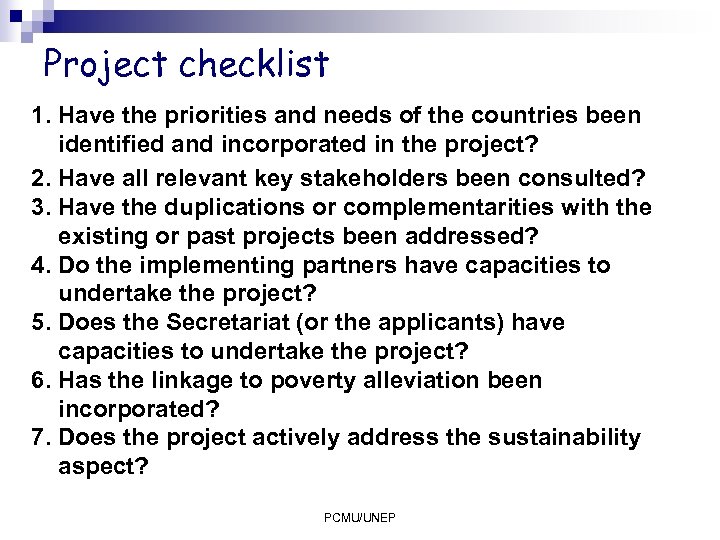 Project checklist 1. Have the priorities and needs of the countries been identified and incorporated in the project? 2. Have all relevant key stakeholders been consulted? 3. Have the duplications or complementarities with the existing or past projects been addressed? 4. Do the implementing partners have capacities to undertake the project? 5. Does the Secretariat (or the applicants) have capacities to undertake the project? 6. Has the linkage to poverty alleviation been incorporated? 7. Does the project actively address the sustainability aspect? PCMU/UNEP
 UNEP Project Document PCMU/UNEP
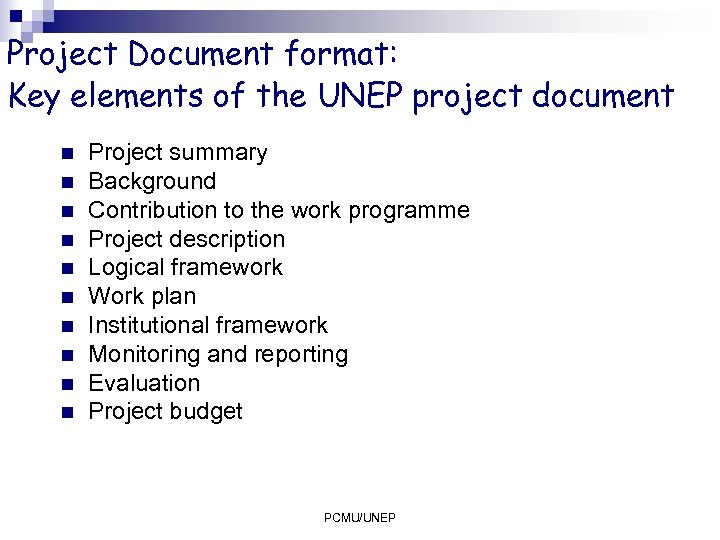 Project Document format: Key elements of the UNEP project document n n n n n Project summary Background Contribution to the work programme Project description Logical framework Work plan Institutional framework Monitoring and reporting Evaluation Project budget PCMU/UNEP
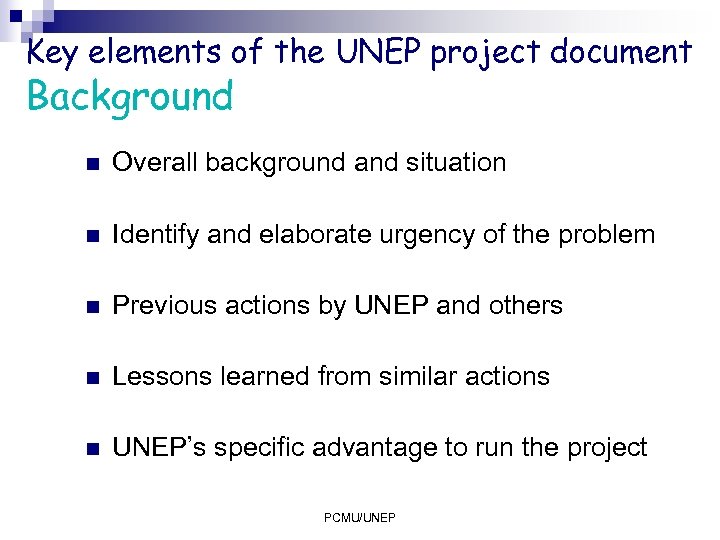 Key elements of the UNEP project document Background n Overall background and situation n Identify and elaborate urgency of the problem n Previous actions by UNEP and others n Lessons learned from similar actions n UNEP’s specific advantage to run the project PCMU/UNEP
 Key elements of the UNEP project document Contribution to work programme n Clear linkage to ¨ COP decisions and programme of work (objectives? ) ¨ MDG, WSSD and other major Conference outcomes PCMU/UNEP
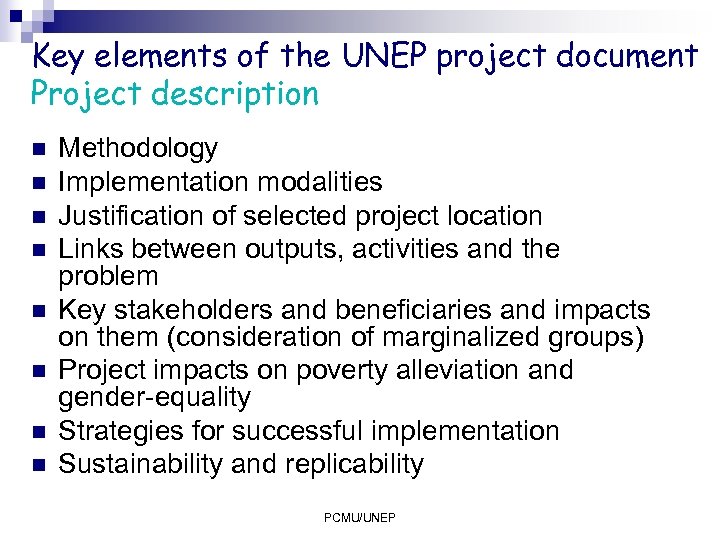 Key elements of the UNEP project document Project description n n n n Methodology Implementation modalities Justification of selected project location Links between outputs, activities and the problem Key stakeholders and beneficiaries and impacts on them (consideration of marginalized groups) Project impacts on poverty alleviation and gender-equality Strategies for successful implementation Sustainability and replicability PCMU/UNEP
 Key elements of the UNEP project document Logical framework PCMU/UNEP
 Key elements of the UNEP project document Work Plan n Timetable for activities n Roles and responsibilities among implementation partners identified n Tool for monitoring and self-evaluation by project managers and project coordinators n Activity flow sequences to be carefully examined n Situation analysis and project planning part of work plan? PCMU/UNEP
 Key elements of the UNEP project document Institutional framework • Institutional arrangement of project implementation • Project implementation modality PCMU/UNEP
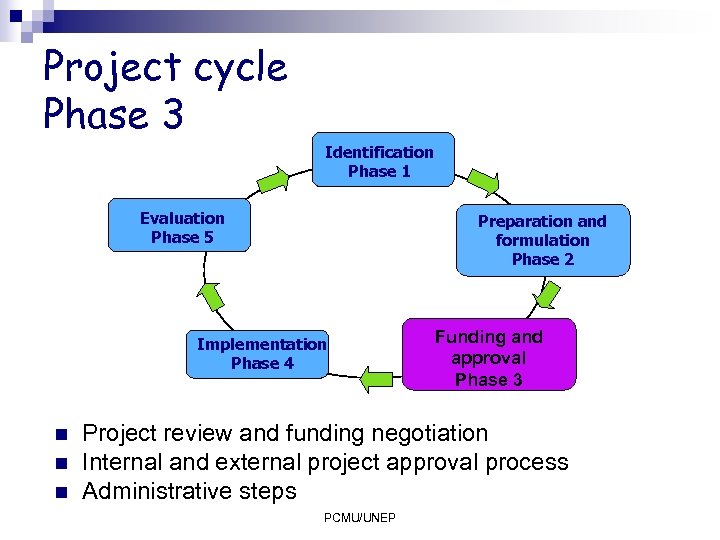 Project cycle Phase 3 Identification Phase 1 Evaluation Phase 5 Preparation and formulation Phase 2 Implementation Phase 4 n n n Fundingand Review and approval Phase 3 Project review and funding negotiation Internal and external project approval process Administrative steps PCMU/UNEP
 Administrative process Review and approval by fund management office, Nairobi n Chief of BFMS verifies and sends project document to cooperating or supporting agency for signature n Chief of BFMS counter signs n Project is allocated a project number and IMIS identification n No financial obligations can occur before this! n PCMU/UNEP
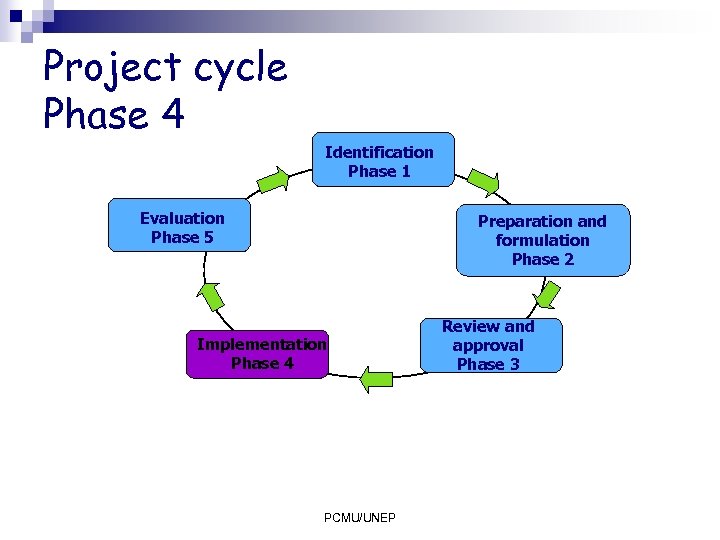 Project cycle Phase 4 Identification Phase 1 Evaluation Phase 5 Preparation and formulation Phase 2 Implementation Phase 4 PCMU/UNEP Review and approval Phase 3
 Project Implementation Financial Regulations and Rules according to UN Secretariat system n Contractual agreements (Mo. Us) will soon need to follow UNEP standard formats n Hiring of staff have to follow UN OHRM Regulations and Rules (e. g. To. R, classification, contractual types) n Implementing organizations should comply with the agreed terms--on time, on budget and on-project terms n PCMU/UNEP
 Project monitoring Growing emphasis to demonstrate performance n In-built in the activities as routines n Agree on performance measurement tool, frequency of analysis and method and data source n Assess performance against the results and management risks n Assessment of project activities vis-à-vis results n Regular documentation and analysis of reports n Generation of lessons learned and possible adjustment of activities strategy and methodologies PCMU/UNEP
 Project reporting Why reporting is needed: n To inform management of progress n To validate usage of funds n Tool for audits and evaluation n Reference for future projects (lessons learnt) n Reporting towards donors on project progress n Projects can only be closed once all reporting requirements have been met PCMU/UNEP
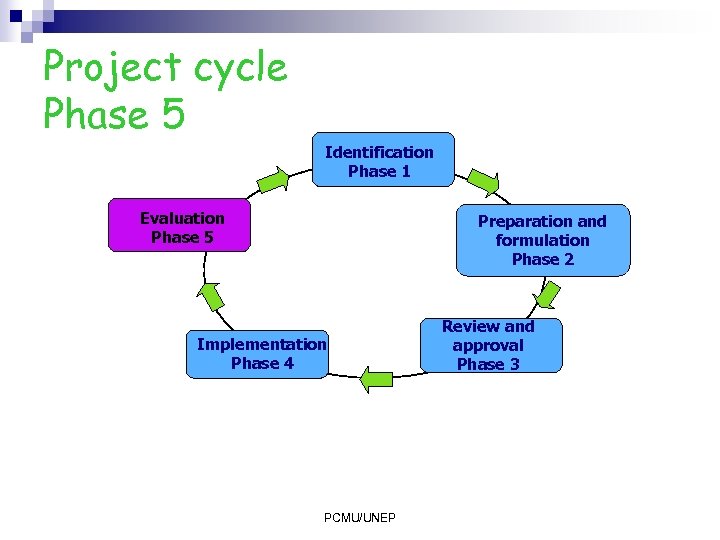 Project cycle Phase 5 Identification Phase 1 Evaluation Phase 5 Preparation and formulation Phase 2 Implementation Phase 4 PCMU/UNEP Review and approval Phase 3
 Evaluation 4 types of evaluations: ¨Desk ¨In-depth ¨Impact ¨Self-evaluations n Timing of evaluations: at any point during the life of the project (mostly mid-term an final stages) n PCMU/UNEP
 Evaluation n UNEP requires all projects to include evaluation in project budget (e. g. consultants fees, travel and communication and dissemination) n Usually a few % of total budget n For a project over $500, 000, in-depth evaluation is required (suggested $20, 000+) PCMU/UNEP
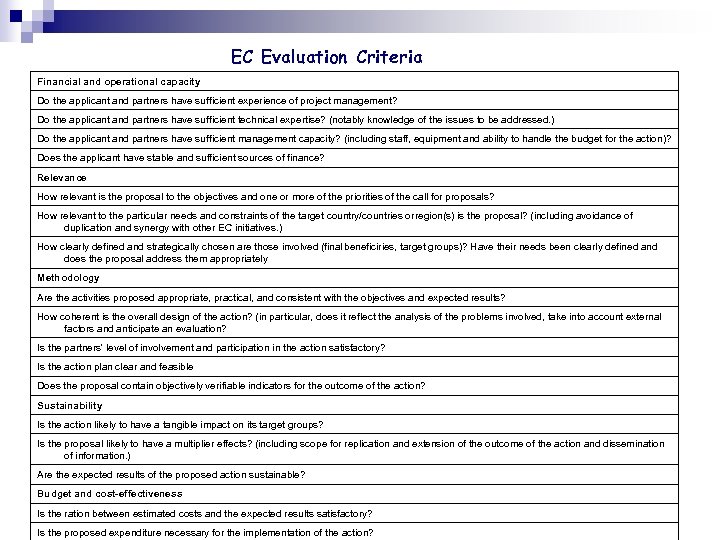 EC Evaluation Criteria Financial and operational capacity Do the applicant and partners have sufficient experience of project management? Do the applicant and partners have sufficient technical expertise? (notably knowledge of the issues to be addressed. ) Do the applicant and partners have sufficient management capacity? (including staff, equipment and ability to handle the budget for the action)? Does the applicant have stable and sufficient sources of finance? Relevance How relevant is the proposal to the objectives and one or more of the priorities of the call for proposals? How relevant to the particular needs and constraints of the target country/countries or region(s) is the proposal? (including avoidance of duplication and synergy with other EC initiatives. ) How clearly defined and strategically chosen are those involved (final beneficiries, target groups)? Have their needs been clearly defined and does the proposal address them appropriately Methodology Are the activities proposed appropriate, practical, and consistent with the objectives and expected results? How coherent is the overall design of the action? (in particular, does it reflect the analysis of the problems involved, take into account external factors and anticipate an evaluation? Is the partners' level of involvement and participation in the action satisfactory? Is the action plan clear and feasible Does the proposal contain objectively verifiable indicators for the outcome of the action? Sustainability Is the action likely to have a tangible impact on its target groups? Is the proposal likely to have a multiplier effects? (including scope for replication and extension of the outcome of the action and dissemination of information. ) Are the expected results of the proposed action sustainable? Budget and cost-effectiveness Is the ration between estimated costs and the expected results satisfactory? Is the proposed expenditure necessary for the implementation of the action?
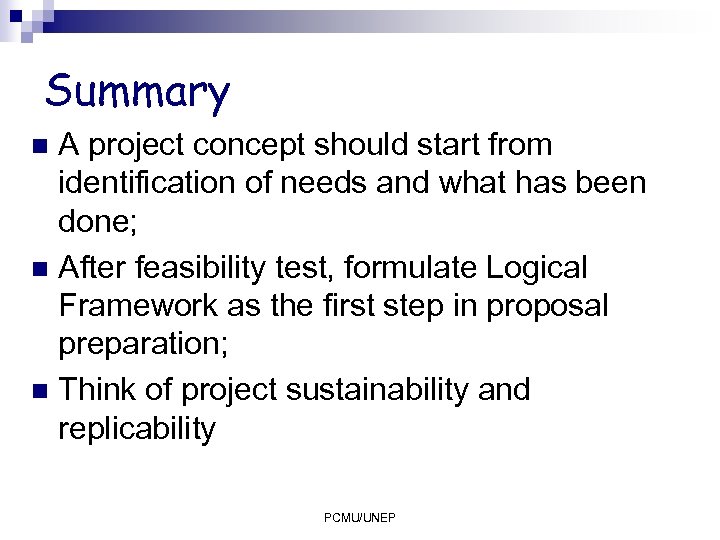 Summary A project concept should start from identification of needs and what has been done; n After feasibility test, formulate Logical Framework as the first step in proposal preparation; n Think of project sustainability and replicability n PCMU/UNEP
 Website www. unep. org/pcmu/project_manual/ PCMU/UNEP
 Yunae Yi Secretary of the Project Approval Group (PAG) PCMU/UNEP Yunae. yi@unep. org 254 -20 -762 -4660 PCMU/UNEP