 Скачать презентацию Key issues in CBRM Why objectives
063579083676847b828ee6dd817fedcf.ppt
- Количество слайдов: 9



Key issues in CBRM • Why – objectives: Community based or top down? • What is the community’s involvement • Who is involved • How - process design and methods
Who participates? Who should be involved – “stakeholders” • People, groups, institutions that are involved or possibly affected by the intended project • May include different people, women, youth, fishermen, families, clans, NGOs, religious organizations, local government, national ministries, commercial interests etc.
Stakeholder exercise – Who should be involved 1. Write down a list of possible people who should be involved in resource management (stakeholders) in a village you know well. 2. Please go back in your groups and compile a joint list of the people who should be involved in resource management
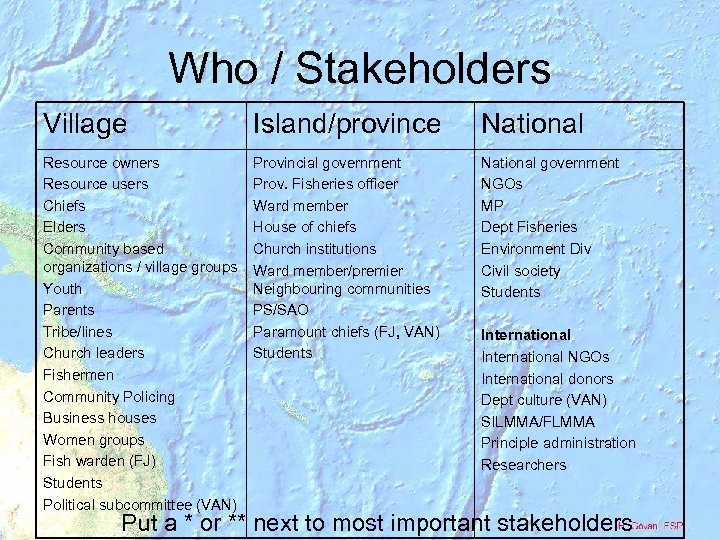
Who / Stakeholders Village Island/province National Resource owners Resource users Chiefs Elders Community based organizations / village groups Youth Parents Tribe/lines Church leaders Fishermen Community Policing Business houses Women groups Fish warden (FJ) Students Political subcommittee (VAN) Provincial government Prov. Fisheries officer Ward member House of chiefs Church institutions Ward member/premier Neighbouring communities PS/SAO Paramount chiefs (FJ, VAN) Students National government NGOs MP Dept Fisheries Environment Div Civil society Students International NGOs International donors Dept culture (VAN) SILMMA/FLMMA Principle administration Researchers Put a * or ** next to most important stakeholders
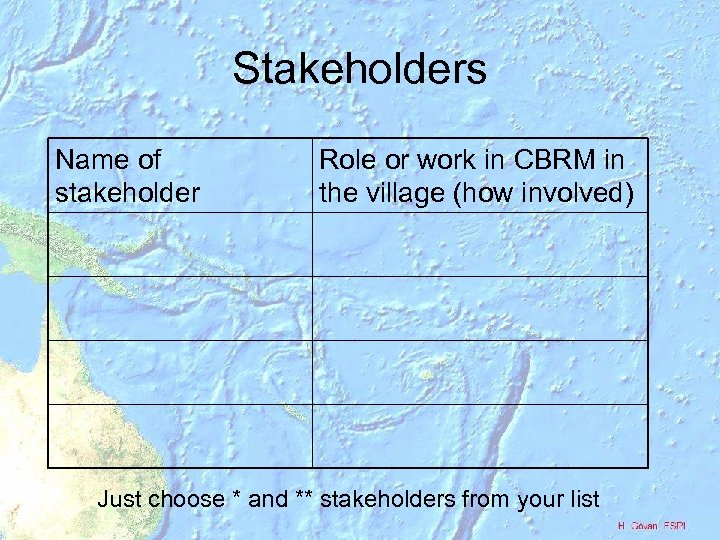
Stakeholders Name of stakeholder Role or work in CBRM in the village (how involved) Just choose * and ** stakeholders from your list
Enforcement Who enforces? • In top down or state management? • In bottom up or community based management?
For what reasons would fishermen change their ways or obey community decisions?
Community Based Management • Groupmaker – birth months • Please read “Why Community Based Management (Lambeth and Watt 2004)” • Discuss in the group what are the reasons for the 8 rules in the “philosophy for CBM workers box” [20 mins] • Plenary report back
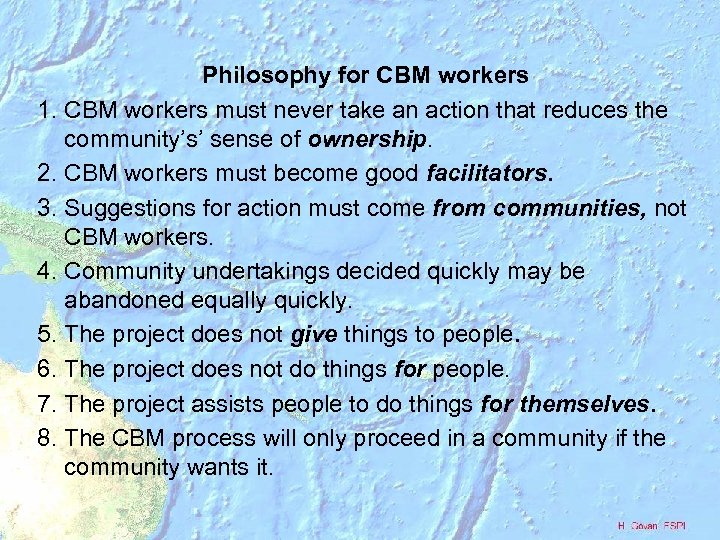
Philosophy for CBM workers 1. CBM workers must never take an action that reduces the community’s’ sense of ownership. 2. CBM workers must become good facilitators. 3. Suggestions for action must come from communities, not CBM workers. 4. Community undertakings decided quickly may be abandoned equally quickly. 5. The project does not give things to people. 6. The project does not do things for people. 7. The project assists people to do things for themselves. 8. The CBM process will only proceed in a community if the community wants it.
Скачать презентацию Key issues in CBRM Why objectives
063579083676847b828ee6dd817fedcf.ppt