


 Скачать презентацию KEY FORMS FILL OUT AND DELIVER TO RF-104
88cf2f8562768079891e48bf04b8d9d3.ppt
- Количество слайдов: 18
 KEY FORMS!!! FILL OUT AND DELIVER TO RF-104 (TECHNICIAN’S OFFICE) (LEAVE UNDER DOOR IF HE’S NOT THERE) OR: DELIVER TO MAILROOM, RF-327 DOMINIQUE COTE -TECHNICIAN’S MAILBOX (TO LEFT OF ROOM) I’VE LEFT COPIES IN MY MAILBOX (MICHAEL PINSONNEAULT, CENTER OF MAILROOM BY PRINTER) FOR PEOPLE TO PICK UP IF NECESSARY mikep@alcor. concordia. ca http: //alcor. concordia. ca/~mikep/eamt 205
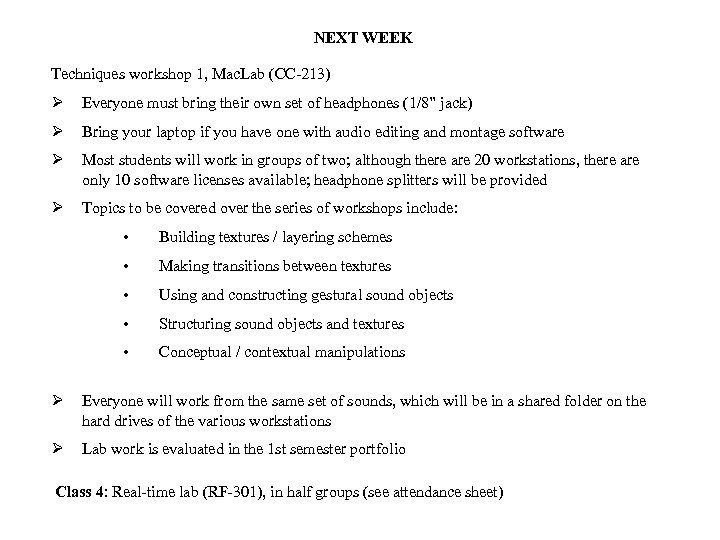 NEXT WEEK Techniques workshop 1, Mac. Lab (CC-213) Ø Everyone must bring their own set of headphones (1/8” jack) Ø Bring your laptop if you have one with audio editing and montage software Ø Most students will work in groups of two; although there are 20 workstations, there are only 10 software licenses available; headphone splitters will be provided Ø Topics to be covered over the series of workshops include: • Building textures / layering schemes • Making transitions between textures • Using and constructing gestural sound objects • Structuring sound objects and textures • Conceptual / contextual manipulations Ø Everyone will work from the same set of sounds, which will be in a shared folder on the hard drives of the various workstations Ø Lab work is evaluated in the 1 st semester portfolio Class 4: Real-time lab (RF-301), in half groups (see attendance sheet)
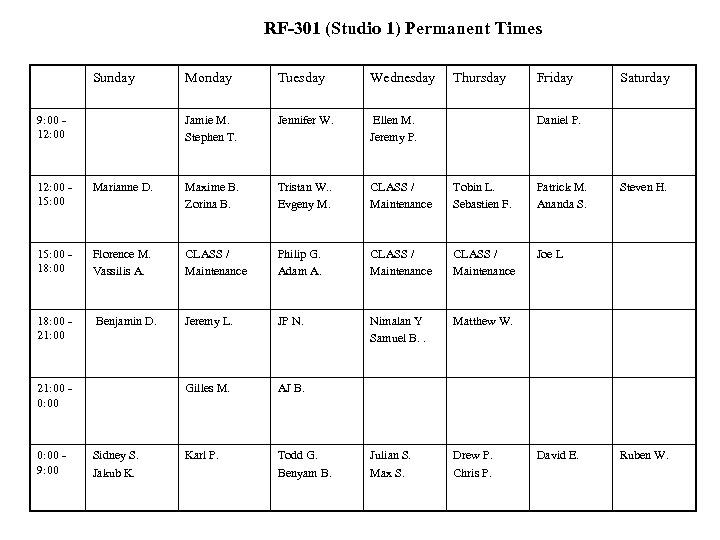 RF-301 (Studio 1) Permanent Times Sunday Tuesday Wednesday Jamie M. Stephen T. 9: 00 12: 00 Monday Jennifer W. Thursday Ellen M. Jeremy P. Friday Saturday Daniel P. 12: 00 15: 00 Marianne D. Maxime B. Zorina B. Tristan W. . Evgeny M. CLASS / Maintenance Tobin L. Sebastien F. Patrick M. Ananda S. 15: 00 18: 00 Florence M. Vassilis A. CLASS / Maintenance Philip G. Adam A. CLASS / Maintenance Joe L 18: 00 21: 00 Benjamin D. Jeremy L. JP N. Nimalan Y Samuel B. . Matthew W. Gilles M. AJ B. Karl P. Todd G. Benyam B. Julian S. Max S. Drew P. Chris P. 21: 00 0: 00 9: 00 Sidney S. Jakub K. David E. Steven H. Ruben W.
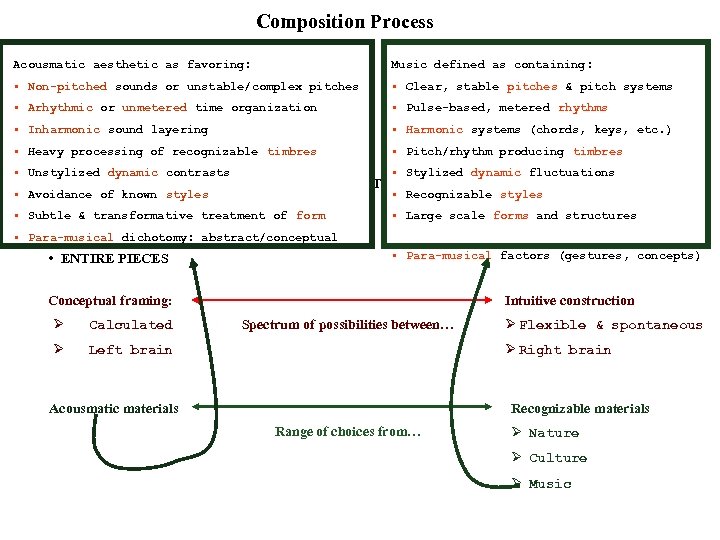 Composition Process Points aesthetic as Acousmatic to be included in: favoring: Music defined as containing: • Non-pitched sounds or unstable/complex pitches • Portfolio documentation • Clear, stable pitches & pitch systems • Arhythmic or assignment reviews organization • Listening unmetered time • Pulse-based, metered rhythms • Inharmonic sound layering • Harmonic systems (chords, keys, etc. ) • Heavy processing of recognizable timbres • Pitch/rhythm producing timbres • Unstylized dynamic contrasts • Stylized dynamic fluctuations • Avoidance of known styles • Recognizable styles • Subtle & transformative treatment of form • Large scale forms and structures • Concert reports DECISION AREA #1: BASIC APPROACH AND MATERIALS FOR: • SOUND OBJECTS • TEXTURES • Para-musical dichotomy: abstract/conceptual • ENTIRE PIECES • Para-musical factors (gestures, concepts) Conceptual framing: Ø Calculated Ø Intuitive construction Left brain Spectrum of possibilities between… Ø Flexible & spontaneous Ø Right brain Acousmatic materials Recognizable materials Range of choices from… Ø Nature Ø Culture Ø Music
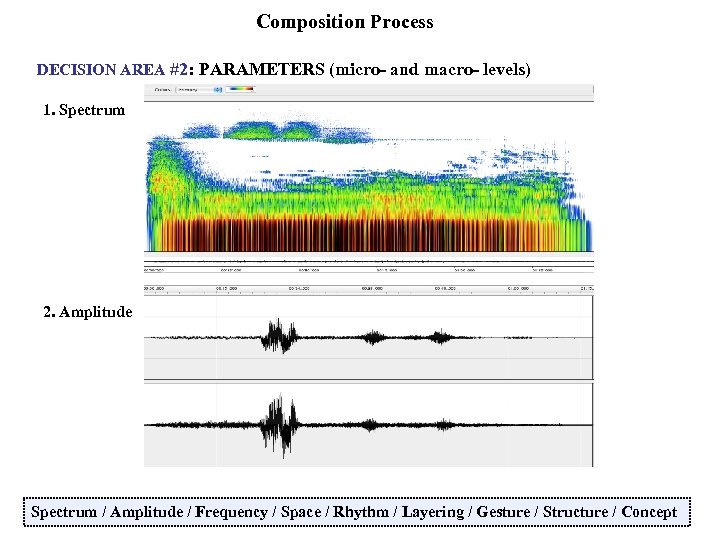 Composition Process DECISION AREA #2: PARAMETERS (micro- and macro- levels) 1. Spectrum 2. Amplitude Spectrum / Amplitude / Frequency / Space / Rhythm / Layering / Gesture / Structure / Concept
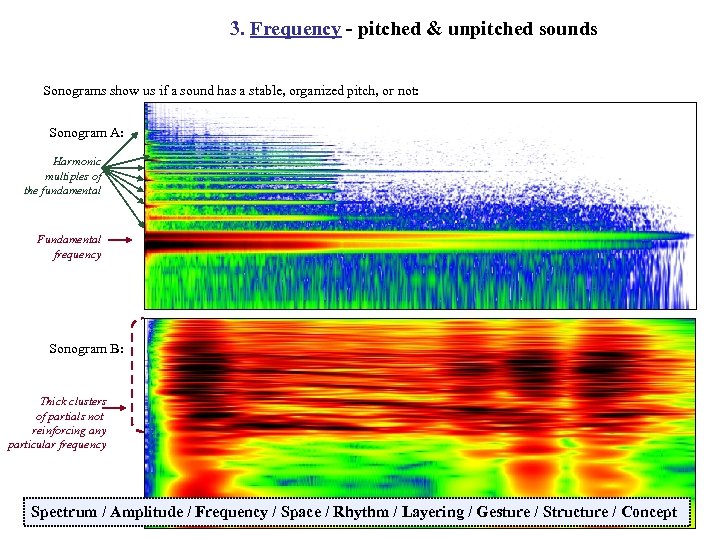 3. Frequency - pitched & unpitched sounds Sonograms show us if a sound has a stable, organized pitch, or not: Sonogram A: Harmonic multiples of the fundamental Fundamental frequency Sonogram B: Thick clusters of partials not reinforcing any particular frequency Spectrum / Amplitude / Frequency / Space / Rhythm / Layering / Gesture / Structure / Concept
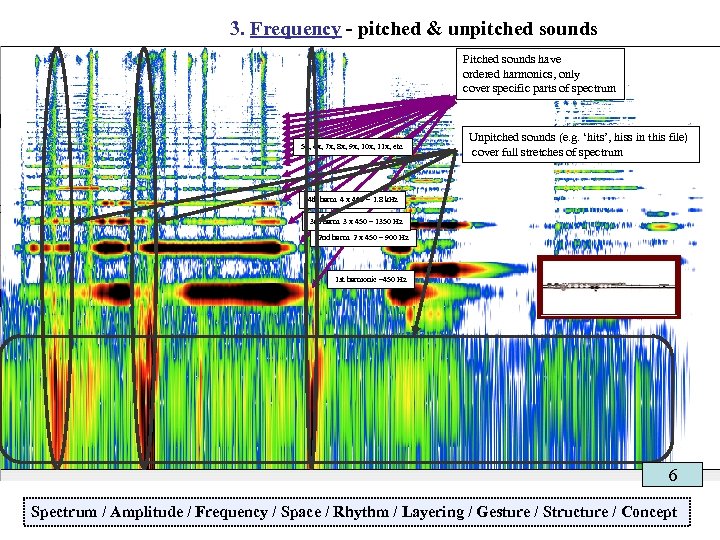 3. Frequency - pitched & unpitched sounds Pitched sounds have ordered harmonics, only cover specific parts of spectrum 5 x, 6 x, 7 x, 8 x, 9 x, 10 x, 11 x, etc. Unpitched sounds (e. g. ‘hits’, hiss in this file) cover full stretches of spectrum 4 th harm. 4 x 450 = 1. 8 k. Hz 3 rd harm. 3 x 450 = 1350 Hz 2 nd harm. 2 x 450 = 900 Hz 1 st harmonic ~450 Hz 6 Spectrum / Amplitude / Frequency / Space / Rhythm / Layering / Gesture / Structure / Concept
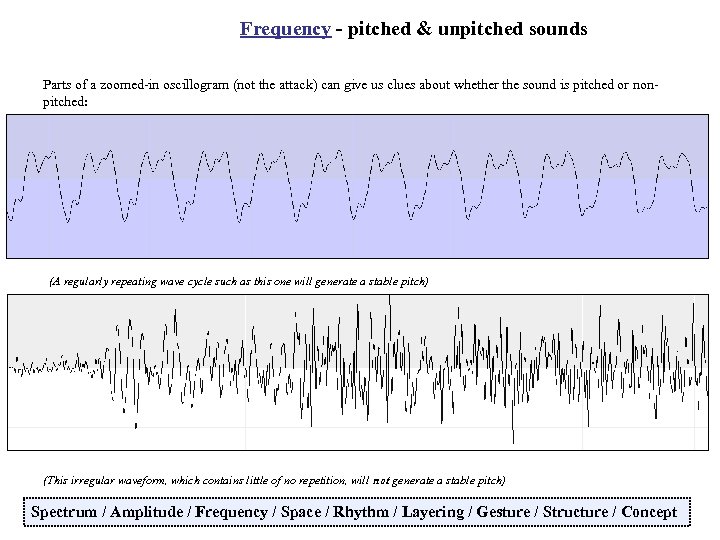 Frequency - pitched & unpitched sounds Parts of a zoomed-in oscillogram (not the attack) can give us clues about whether the sound is pitched or nonpitched: (A regularly repeating wave cycle such as this one will generate a stable pitch) (This irregular waveform, which contains little of no repetition, will not generate a stable pitch) Spectrum / Amplitude / Frequency / Space / Rhythm / Layering / Gesture / Structure / Concept
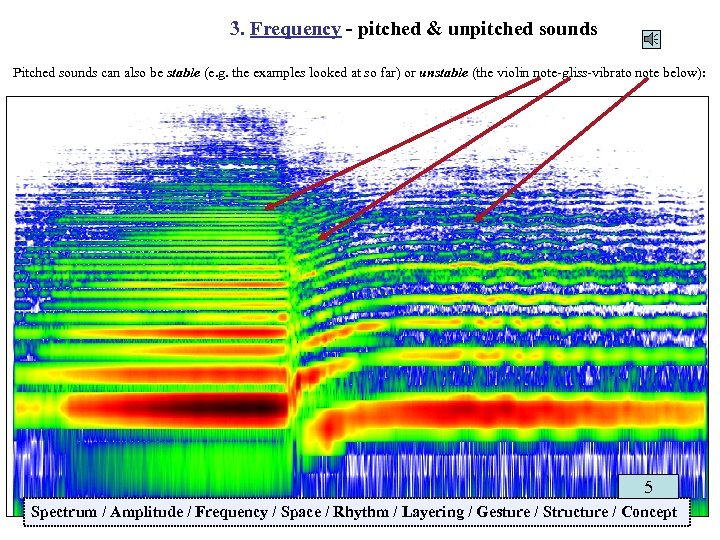 3. Frequency - pitched & unpitched sounds Pitched sounds can also be stable (e. g. the examples looked at so far) or unstable (the violin note-gliss-vibrato note below): 5 Spectrum / Amplitude / Frequency / Space / Rhythm / Layering / Gesture / Structure / Concept
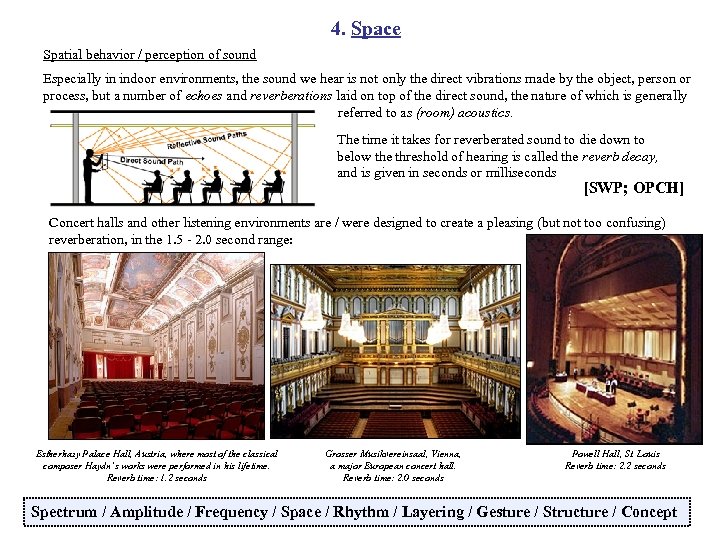 4. Space Spatial behavior / perception of sound Especially in indoor environments, the sound we hear is not only the direct vibrations made by the object, person or process, but a number of echoes and reverberations laid on top of the direct sound, the nature of which is generally referred to as (room) acoustics. The time it takes for reverberated sound to die down to below the threshold of hearing is called the reverb decay, and is given in seconds or milliseconds [SWP; OPCH] Concert halls and other listening environments are / were designed to create a pleasing (but not too confusing) reverberation, in the 1. 5 - 2. 0 second range: Estherhazy Palace Hall, Austria, where most of the classical composer Haydn’s works were performed in his lifetime. Reverb time: 1. 2 seconds Grosser Musikvereinsaal, Vienna, a major European concert hall. Reverb time: 2. 0 seconds Powell Hall, St. Louis Reverb time: 2. 2 seconds Spectrum / Amplitude / Frequency / Space / Rhythm / Layering / Gesture / Structure / Concept
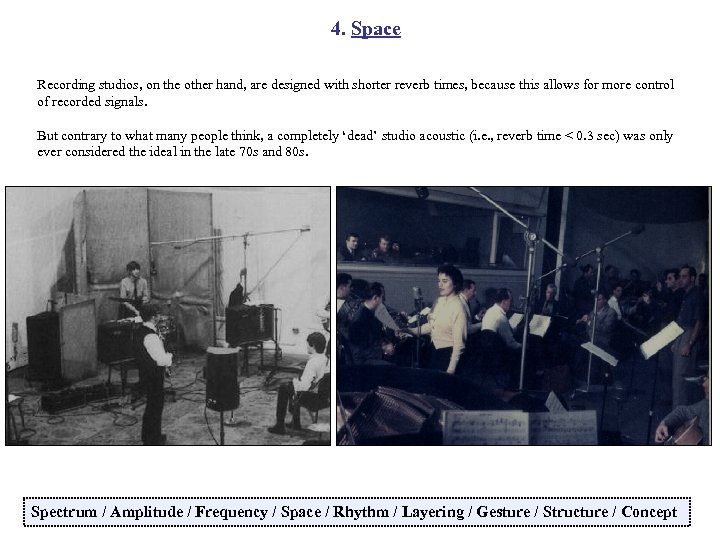 4. Space Recording studios, on the other hand, are designed with shorter reverb times, because this allows for more control of recorded signals. But contrary to what many people think, a completely ‘dead’ studio acoustic (i. e. , reverb time < 0. 3 sec) was only ever considered the ideal in the late 70 s and 80 s. Spectrum / Amplitude / Frequency / Space / Rhythm / Layering / Gesture / Structure / Concept
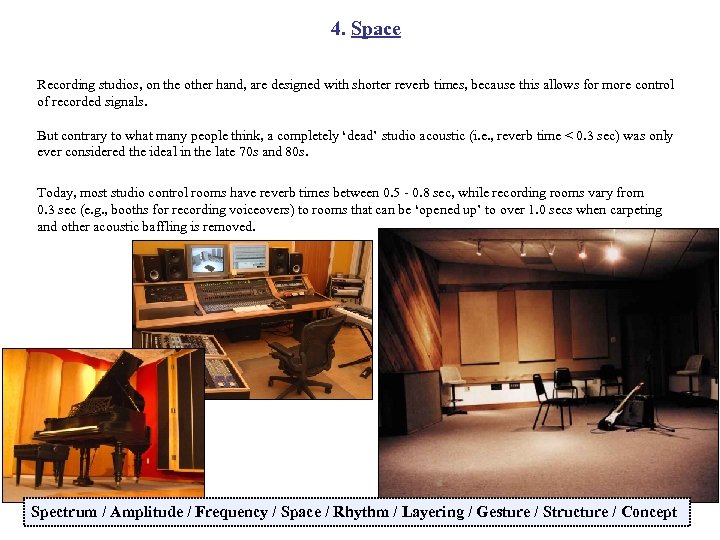 4. Space Recording studios, on the other hand, are designed with shorter reverb times, because this allows for more control of recorded signals. But contrary to what many people think, a completely ‘dead’ studio acoustic (i. e. , reverb time < 0. 3 sec) was only ever considered the ideal in the late 70 s and 80 s. Today, most studio control rooms have reverb times between 0. 5 - 0. 8 sec, while recording rooms vary from 0. 3 sec (e. g. , booths for recording voiceovers) to rooms that can be ‘opened up’ to over 1. 0 secs when carpeting and other acoustic baffling is removed. Spectrum / Amplitude / Frequency / Space / Rhythm / Layering / Gesture / Structure / Concept
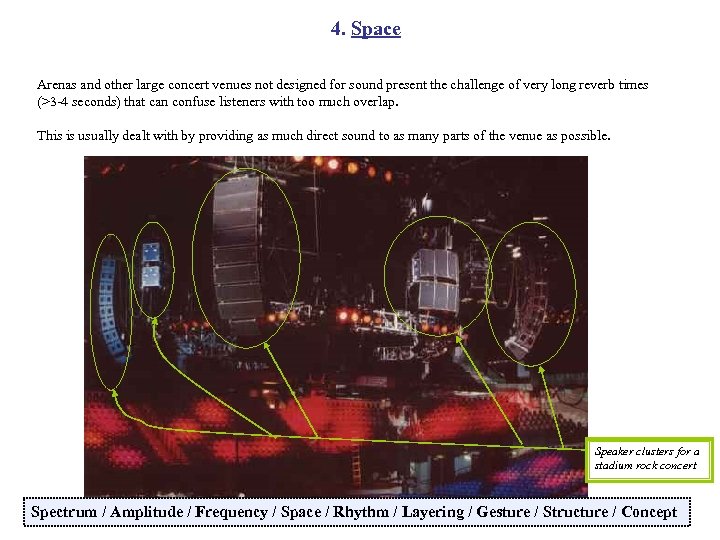 4. Space Arenas and other large concert venues not designed for sound present the challenge of very long reverb times (>3 -4 seconds) that can confuse listeners with too much overlap. This is usually dealt with by providing as much direct sound to as many parts of the venue as possible. Speaker clusters for a stadium rock concert Spectrum / Amplitude / Frequency / Space / Rhythm / Layering / Gesture / Structure / Concept
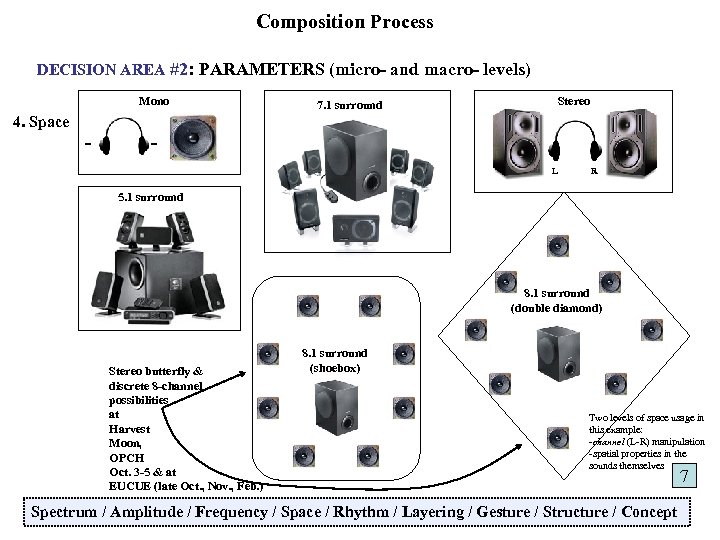 Composition Process DECISION AREA #2: PARAMETERS (micro- and macro- levels) Mono Stereo 7. 1 surround 4. Space = = L R 5. 1 surround 8. 1 surround (double diamond) Stereo butterfly & discrete 8 -channel possibilities at Harvest Moon, OPCH Oct. 3 -5 & at EUCUE (late Oct. , Nov. , Feb. ) 8. 1 surround (shoebox) Two levels of space usage in this example: -channel (L-R) manipulation -spatial properties in the sounds themselves Spectrum / Amplitude / Frequency / Space / Rhythm / Layering / Gesture / Structure / Concept 7
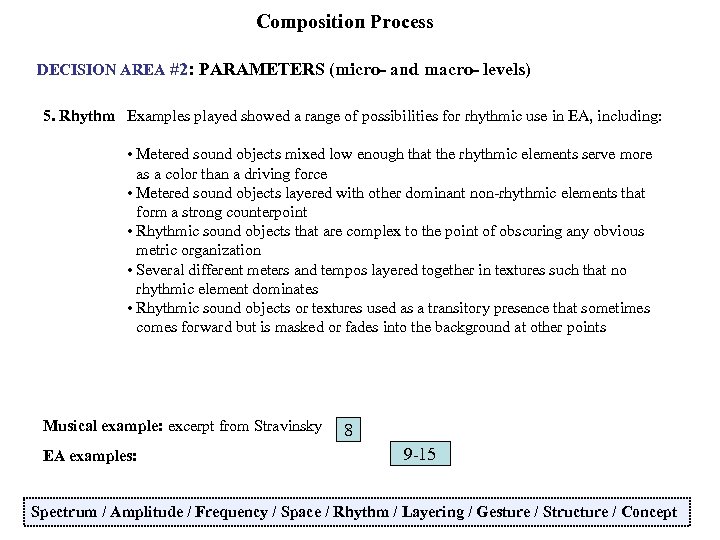 Composition Process DECISION AREA #2: PARAMETERS (micro- and macro- levels) 5. Rhythm Examples played showed a range of possibilities for rhythmic use in EA, including: • Metered sound objects mixed low enough that the rhythmic elements serve more as a color than a driving force • Metered sound objects layered with other dominant non-rhythmic elements that form a strong counterpoint • Rhythmic sound objects that are complex to the point of obscuring any obvious metric organization • Several different meters and tempos layered together in textures such that no rhythmic element dominates • Rhythmic sound objects or textures used as a transitory presence that sometimes comes forward but is masked or fades into the background at other points Musical example: excerpt from Stravinsky EA examples: 8 9 -15 Spectrum / Amplitude / Frequency / Space / Rhythm / Layering / Gesture / Structure / Concept
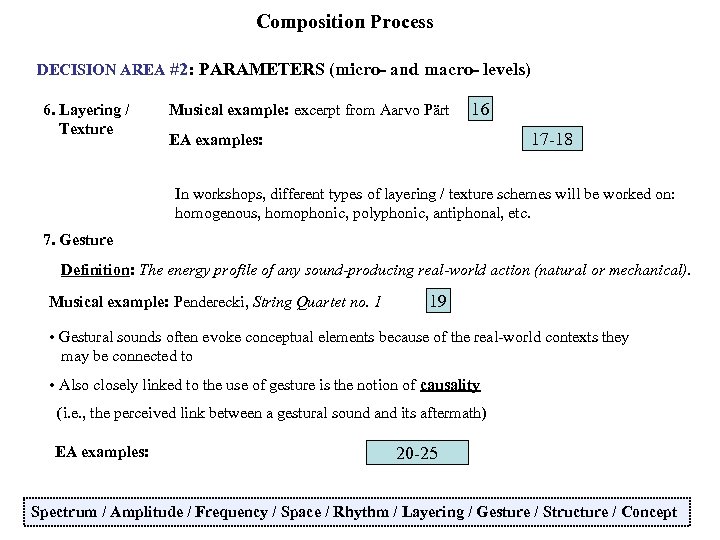 Composition Process DECISION AREA #2: PARAMETERS (micro- and macro- levels) 6. Layering / Texture Musical example: excerpt from Aarvo Pärt 16 17 -18 EA examples: In workshops, different types of layering / texture schemes will be worked on: homogenous, homophonic, polyphonic, antiphonal, etc. 7. Gesture Definition: The energy profile of any sound-producing real-world action (natural or mechanical). Musical example: Penderecki, String Quartet no. 1 19 • Gestural sounds often evoke conceptual elements because of the real-world contexts they may be connected to • Also closely linked to the use of gesture is the notion of causality (i. e. , the perceived link between a gestural sound and its aftermath) EA examples: 20 -25 Spectrum / Amplitude / Frequency / Space / Rhythm / Layering / Gesture / Structure / Concept
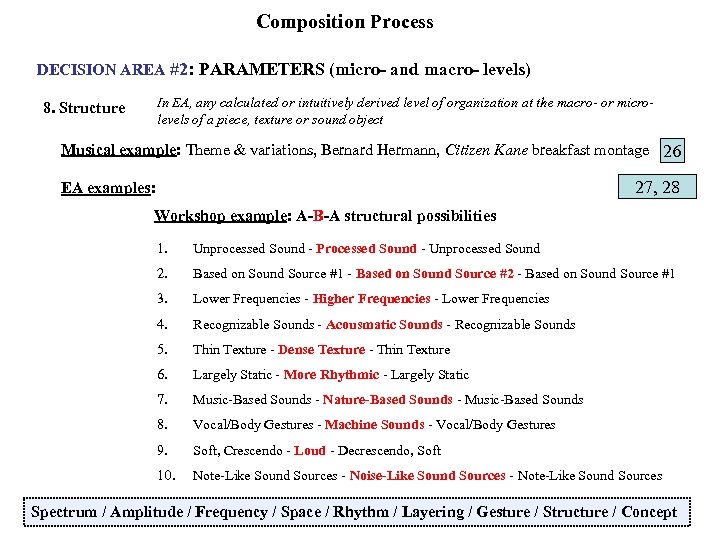 Composition Process DECISION AREA #2: PARAMETERS (micro- and macro- levels) In EA, any calculated or intuitively derived level of organization at the macro- or microlevels of a piece, texture or sound object 8. Structure Musical example: Theme & variations, Bernard Hermann, Citizen Kane breakfast montage 26 27, 28 EA examples: Workshop example: A-B-A structural possibilities 1. Unprocessed Sound - Processed Sound - Unprocessed Sound 2. Based on Sound Source #1 - Based on Sound Source #2 - Based on Sound Source #1 3. Lower Frequencies - Higher Frequencies - Lower Frequencies 4. Recognizable Sounds - Acousmatic Sounds - Recognizable Sounds 5. Thin Texture - Dense Texture - Thin Texture 6. Largely Static - More Rhythmic - Largely Static 7. Music-Based Sounds - Nature-Based Sounds - Music-Based Sounds 8. Vocal/Body Gestures - Machine Sounds - Vocal/Body Gestures 9. Soft, Crescendo - Loud - Decrescendo, Soft 10. Note-Like Sound Sources - Noise-Like Sound Sources - Note-Like Sound Sources Spectrum / Amplitude / Frequency / Space / Rhythm / Layering / Gesture / Structure / Concept
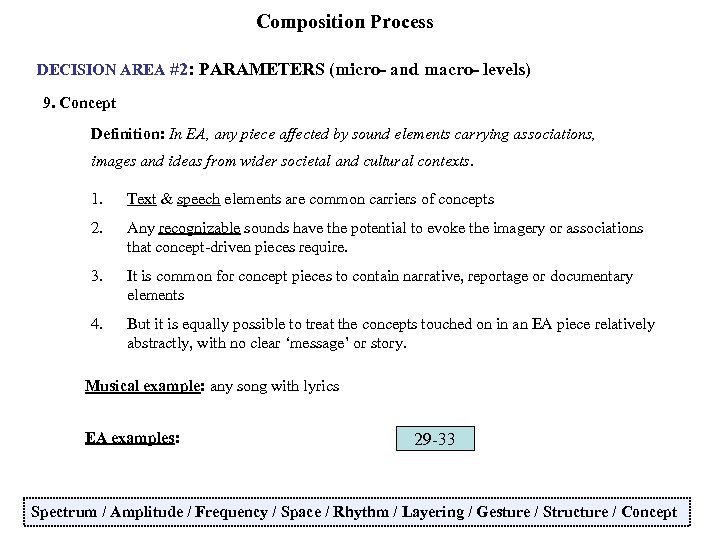 Composition Process DECISION AREA #2: PARAMETERS (micro- and macro- levels) 9. Concept Definition: In EA, any piece affected by sound elements carrying associations, images and ideas from wider societal and cultural contexts. 1. Text & speech elements are common carriers of concepts 2. Any recognizable sounds have the potential to evoke the imagery or associations that concept-driven pieces require. 3. It is common for concept pieces to contain narrative, reportage or documentary elements 4. But it is equally possible to treat the concepts touched on in an EA piece relatively abstractly, with no clear ‘message’ or story. Musical example: any song with lyrics EA examples: 29 -33 Spectrum / Amplitude / Frequency / Space / Rhythm / Layering / Gesture / Structure / Concept