 Скачать презентацию KEY ASPECTS OF NAVIGATION — HOUSE NUMBERS
8b57ef5afe47fa2299dc56dac3c88275.ppt
- Количество слайдов: 29



KEY ASPECTS OF NAVIGATION - HOUSE NUMBERS § 1
Definition House Number Range is the database representation of the house numbers associated with an addressable element and the order in which they appear along that addressable element. www. rmsi. com #2
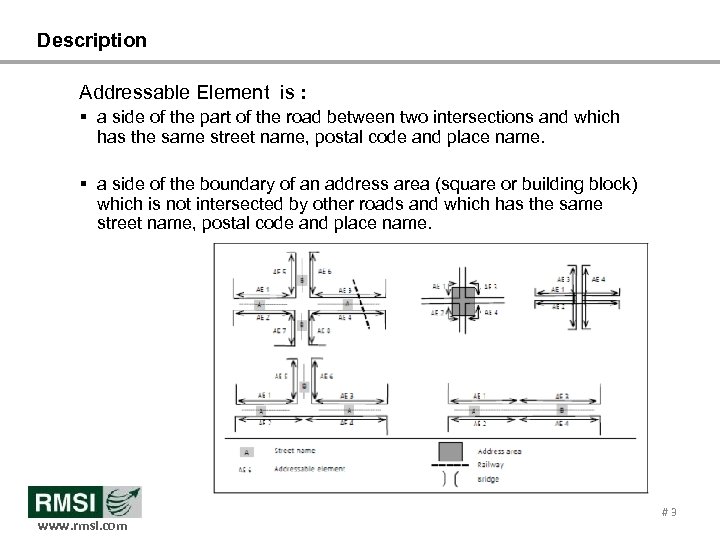
Description Addressable Element is : § a side of the part of the road between two intersections and which has the same street name, postal code and place name. § a side of the boundary of an address area (square or building block) which is not intersected by other roads and which has the same street name, postal code and place name. www. rmsi. com #3
Description Address § An address is typically composed of street name, house number, postal code, place name and possibly other address components such as identification of building (e. g. A). House Number Range § § House Number Range contains information that reflects the house number part of an address. It only contains house numbers, having a numerical, alphabetic or mixed character. House Number Range represents that information which - in conjunction with other address information – is necessary to locate an address at the correct addressable element. www. rmsi. com
Description House Number Range is composed out of several sub-attributes: § § § House Number Structure Intermediate House Number First House Number Last House Number Street Side www. rmsi. com
Description House Number Characters § A House Number consists out of max 10 characters. § Allowed characters are digits, alphabetic characters, roman numerals, a fraction, a hyphen, a space or a slash. § Most house numbers consist out of a solid sequence of numbers with or without alphabetic characters. § Occasionally, a space separates house number suffix from the body of the house number (e. g. 22 100). § Only one fraction, hyphen or slash is allowed per house number. Fractions are separated by a space from the rest of the house number (e. g. 252 1/4 A). Hyphens, spaces and slashes do not occur at the end of the house number. www. rmsi. com
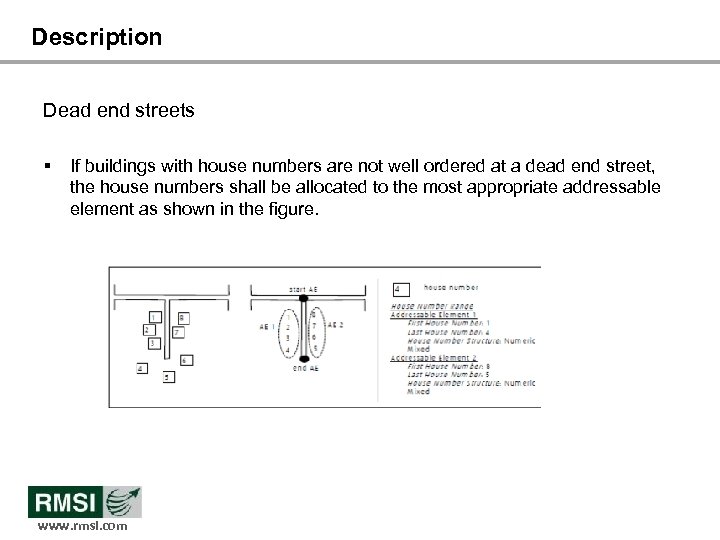
Description Dead end streets § If buildings with house numbers are not well ordered at a dead end street, the house numbers shall be allocated to the most appropriate addressable element as shown in the figure. www. rmsi. com
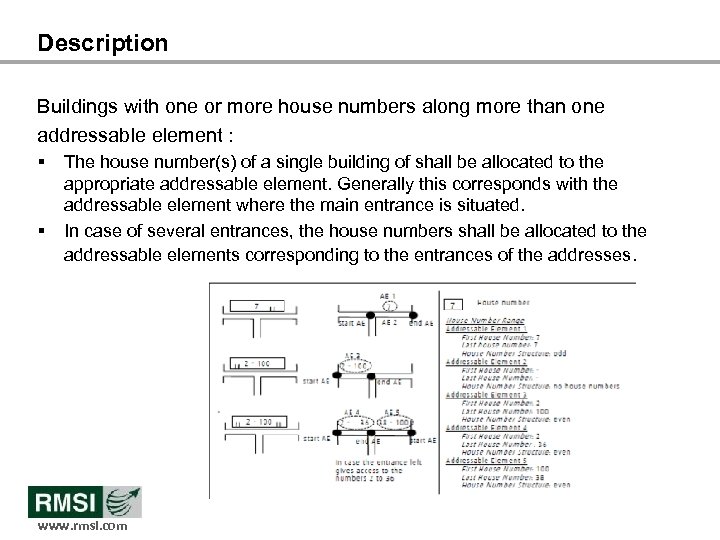
Description Buildings with one or more house numbers along more than one addressable element : § § The house number(s) of a single building of shall be allocated to the appropriate addressable element. Generally this corresponds with the addressable element where the main entrance is situated. In case of several entrances, the house numbers shall be allocated to the addressable elements corresponding to the entrances of the addresses. www. rmsi. com
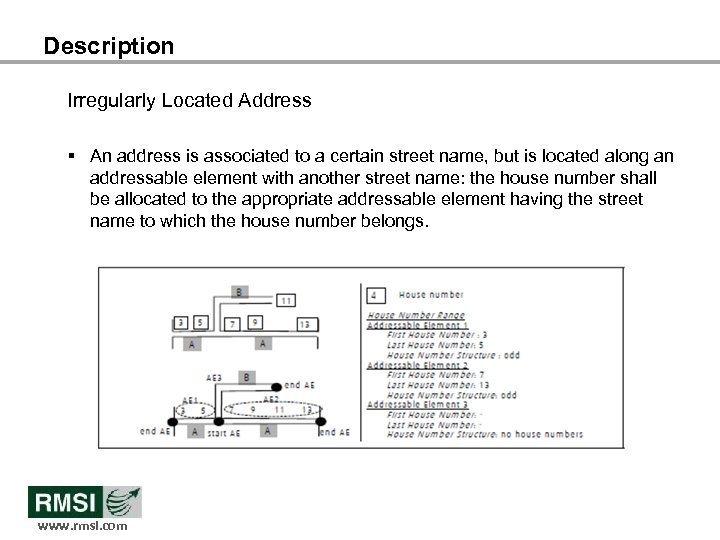
Description Irregularly Located Address § An address is associated to a certain street name, but is located along an addressable element with another street name: the house number shall be allocated to the appropriate addressable element having the street name to which the house number belongs. www. rmsi. com
Description No Real Street Name § If houses are located in a settlement where the streets have no name and the houses carry a plate with the settlement name and house number, then House Number Range shall only contain the house number. The settlement name is considered as street name. www. rmsi. com
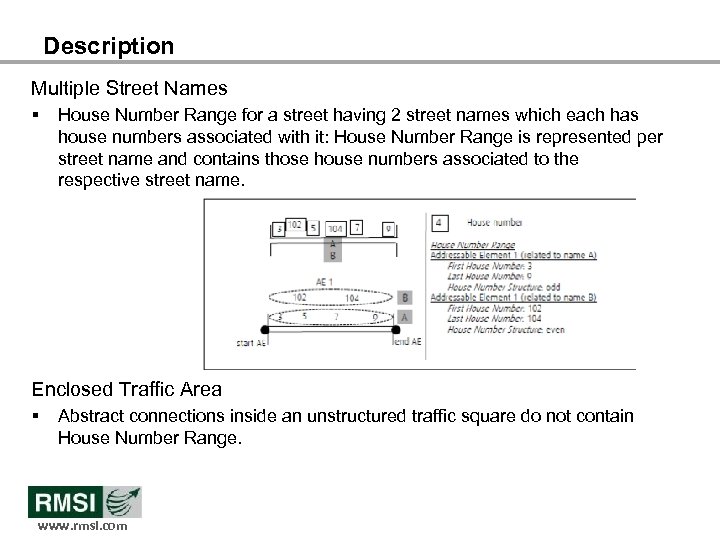
Description Multiple Street Names § House Number Range for a street having 2 street names which each has house numbers associated with it: House Number Range is represented per street name and contains those house numbers associated to the respective street name. Enclosed Traffic Area § Abstract connections inside an unstructured traffic square do not contain House Number Range. www. rmsi. com
General Capturing Rules House Number Range shall be captured for all Road Elements with a Standard Name for Road Element. § § § House Number Range is captured per (part of) addressable element for captured Road Elements and Address Areas. A House Number Range shall not contain more than one variable part: First and Last House number shall always have the same structure and components of which only one may differ. - E. g. 22 W 001 till 22 W 009 are valid start and end house number. - E. g. 22 W 001 till 23 W 009 are invalid start and end house number. www. rmsi. com
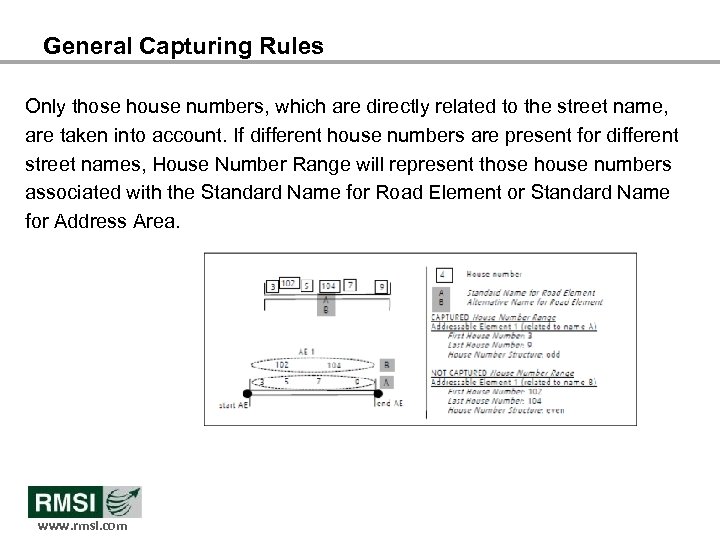
General Capturing Rules Only those house numbers, which are directly related to the street name, are taken into account. If different house numbers are present for different street names, House Number Range will represent those house numbers associated with the Standard Name for Road Element or Standard Name for Address Area. www. rmsi. com
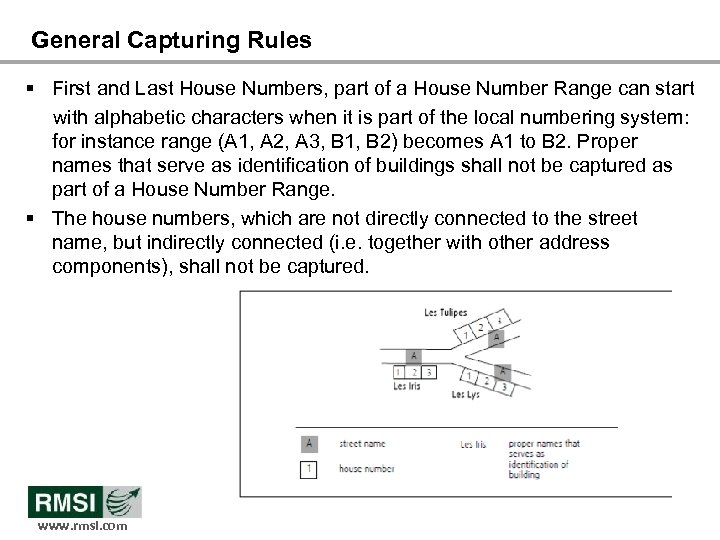
General Capturing Rules § First and Last House Numbers, part of a House Number Range can start with alphabetic characters when it is part of the local numbering system: for instance range (A 1, A 2, A 3, B 1, B 2) becomes A 1 to B 2. Proper names that serve as identification of buildings shall not be captured as part of a House Number Range. § The house numbers, which are not directly connected to the street name, but indirectly connected (i. e. together with other address components), shall not be captured. www. rmsi. com
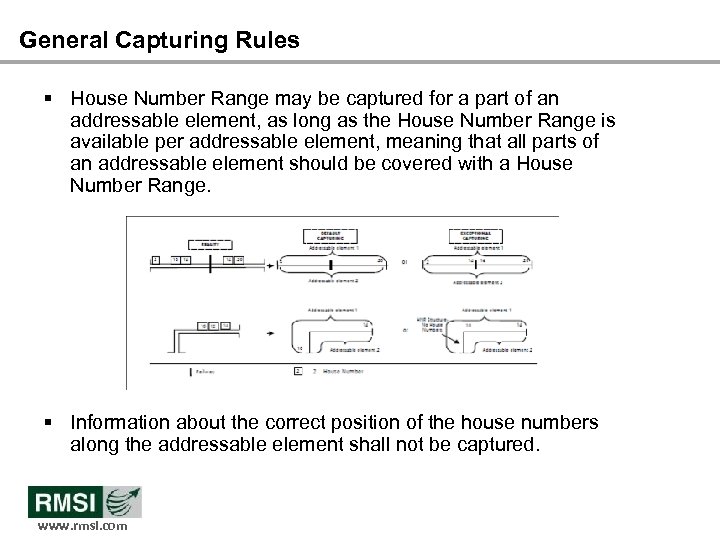
General Capturing Rules § House Number Range may be captured for a part of an addressable element, as long as the House Number Range is available per addressable element, meaning that all parts of an addressable element should be covered with a House Number Range. § Information about the correct position of the house numbers along the addressable element shall not be captured. www. rmsi. com
First House Number Definition: § First House Number is the database representation of the first house number along an addressable element. § A First House Number can contain numerical, alphabetic and graphical characters. www. rmsi. com
General Capturing Rules § First House Number shall be captured for addressable elements having addresses. § The First House Number complies with the first address along an addressable element. This is not necessarily the highest or lowest value within that addressable element. § If only one address is located at an addressable element, then that house number shall be captured as First House Number and Last House Number. § If no address is located at an addressable element, then no First House Number shall be captured. www. rmsi. com
Last House Number Definition: § § Last House Number is the database representation of the last house number along an addressable element. A Last House Number can contain numerical, alphabetic and graphical characters. www. rmsi. com
General Capturing Rules § Last House Number shall be captured for addressable elements having addresses. § The Last House Number complies with the last address along an addressable element. This is not necessarily the highest or lowest value within that addressable element. § If only one address is located at an addressable element, then that house number shall be captured as First House Number and Last House Number. § If no address is located at an addressable element, then no Last House Number shall be captured. www. rmsi. com
House Number Structure Definition: § § House Number Structure is the database representation of the type of house numbering method applied to a side of the street or address area, corresponding with an addressable element. The House Number Structure represents the nature of the House Number Range, whether it is ordered (numerically or alphabetically), not ordered or has no house numbers at all. www. rmsi. com
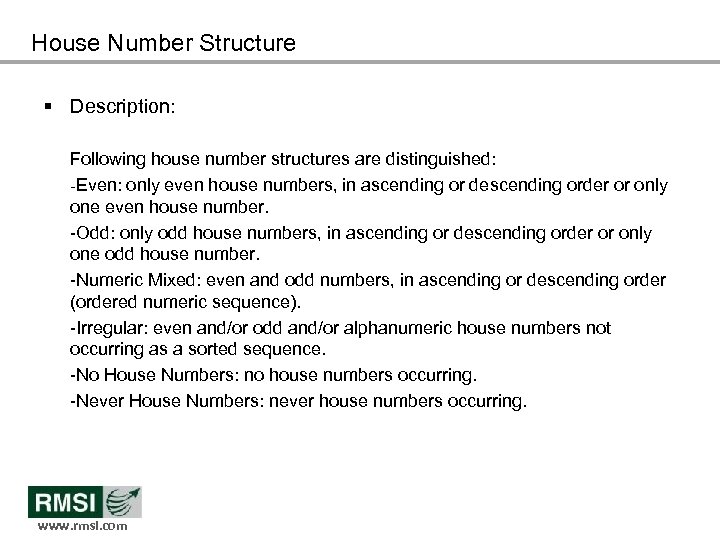
House Number Structure § Description: Following house number structures are distinguished: -Even: only even house numbers, in ascending or descending order or only one even house number. -Odd: only odd house numbers, in ascending or descending order or only one odd house number. -Numeric Mixed: even and odd numbers, in ascending or descending order (ordered numeric sequence). -Irregular: even and/or odd and/or alphanumeric house numbers not occurring as a sorted sequence. -No House Numbers: no house numbers occurring. -Never House Numbers: never house numbers occurring. www. rmsi. com
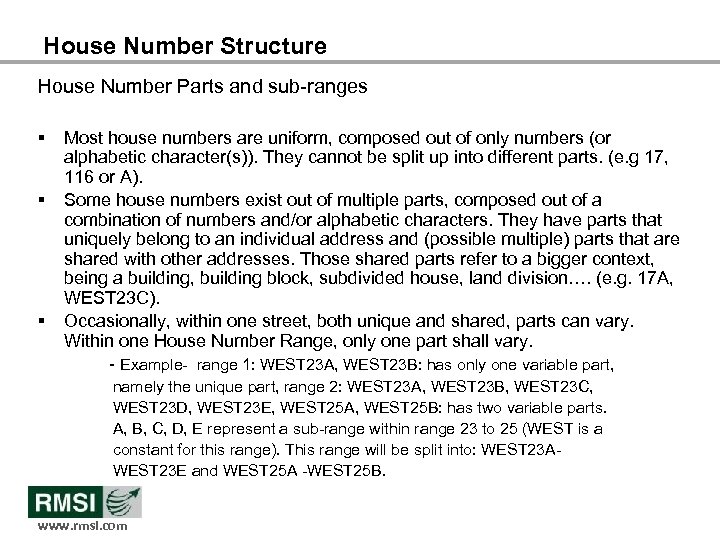
House Number Structure House Number Parts and sub-ranges § § § Most house numbers are uniform, composed out of only numbers (or alphabetic character(s)). They cannot be split up into different parts. (e. g 17, 116 or A). Some house numbers exist out of multiple parts, composed out of a combination of numbers and/or alphabetic characters. They have parts that uniquely belong to an individual address and (possible multiple) parts that are shared with other addresses. Those shared parts refer to a bigger context, being a building, building block, subdivided house, land division…. (e. g. 17 A, WEST 23 C). Occasionally, within one street, both unique and shared, parts can vary. Within one House Number Range, only one part shall vary. - Example- range 1: WEST 23 A, WEST 23 B: has only one variable part, namely the unique part, range 2: WEST 23 A, WEST 23 B, WEST 23 C, WEST 23 D, WEST 23 E, WEST 25 A, WEST 25 B: has two variable parts. A, B, C, D, E represent a sub-range within range 23 to 25 (WEST is a constant for this range). This range will be split into: WEST 23 AWEST 23 E and WEST 25 A -WEST 25 B. www. rmsi. com
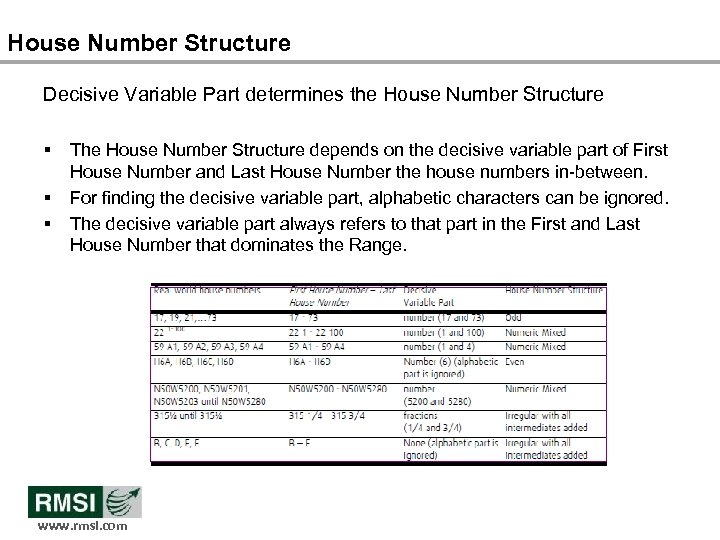
House Number Structure Decisive Variable Part determines the House Number Structure § § § The House Number Structure depends on the decisive variable part of First House Number and Last House Number the house numbers in-between. For finding the decisive variable part, alphabetic characters can be ignored. The decisive variable part always refers to that part in the First and Last House Number that dominates the Range. www. rmsi. com
General Capturing Rules § House Number Structure with values ‘Even’, ‘Odd’, ‘Numeric Mixed’, ‘Irregular’, ‘No House Numbers’ and ‘Never House Numbers’ shall be captured for each captured House Number Range. www. rmsi. com
Intermediate House Number Definition: § Intermediate House Number is the database representation of a house number, which is not the first or last house number of an addressable element. Description: § The House Number Structure, in combination the First House Number and Last House Number, is −in general sufficient to describe a House Number Range. § In some cases also Intermediate House Numbers shall be represented in order to have unambiguous localization of an address at one addressable element. www. rmsi. com
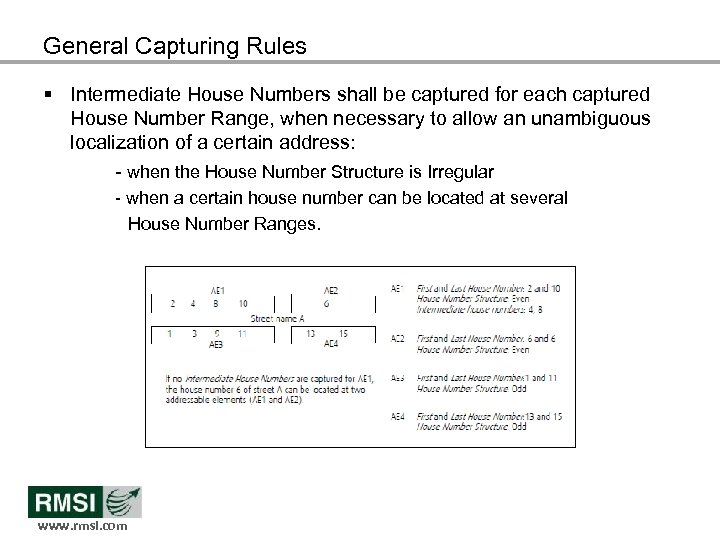
General Capturing Rules § Intermediate House Numbers shall be captured for each captured House Number Range, when necessary to allow an unambiguous localization of a certain address: - when the House Number Structure is Irregular - when a certain house number can be located at several House Number Ranges. www. rmsi. com
Interpolation Flag Definition: § Interpolation Flag is the database representation of the fact whether a house number part of House Number Range is an interpolated value. Description: § In case a real world house number is not known at the begin or end of an addressable element, interpolated house numbers will be present. Interpolation Flag represents the fact that a house number is an interpolated value. www. rmsi. com
General Capturing Rules § Interpolation Flag shall be captured for each interpolated house number part of captured House Number Range. www. rmsi. com
Questions www. rmsi. com
Скачать презентацию KEY ASPECTS OF NAVIGATION — HOUSE NUMBERS
8b57ef5afe47fa2299dc56dac3c88275.ppt