


 Скачать презентацию Kevin Curran Eoghan Furey Tom Lunney Jose Santos
c9e06f4da85c3083ee74a86f066d25ff.ppt
- Количество слайдов: 27
 Kevin Curran, Eoghan Furey, Tom Lunney, Jose Santos, Derek Woods
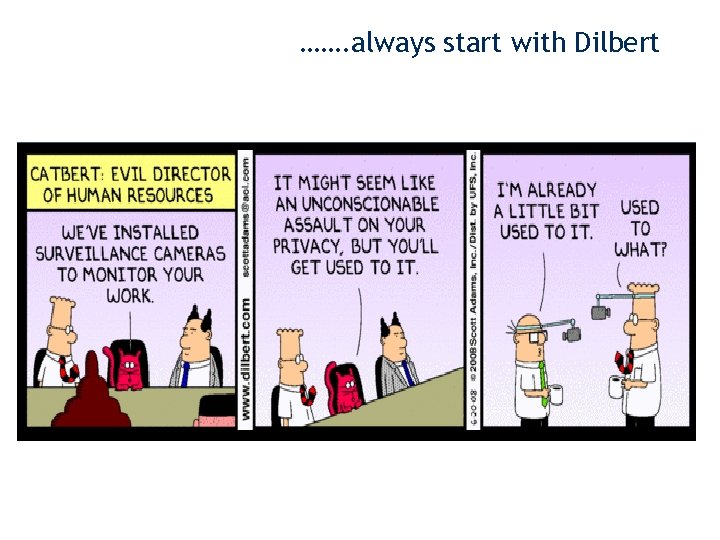 ……. always start with Dilbert
 Fellow Location ‘Awarers’. . I feel your pain Pinpointing indoors with existing systems and the limitations due to working with ‘working’ networks is just not straight forward
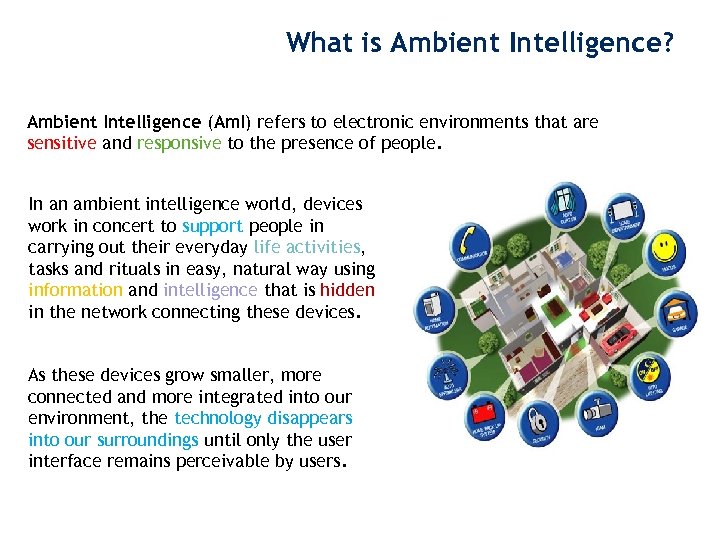 What is Ambient Intelligence? Ambient Intelligence (Am. I) refers to electronic environments that are sensitive and responsive to the presence of people. In an ambient intelligence world, devices work in concert to support people in carrying out their everyday life activities, tasks and rituals in easy, natural way using information and intelligence that is hidden in the network connecting these devices. As these devices grow smaller, more connected and more integrated into our environment, the technology disappears into our surroundings until only the user interface remains perceivable by users.
 How does it differ from before? § Am. I is a “novel anthropomorphic human-machine model of interaction” creating synergies between the user and the environment. The vision for Am. I is to permeate society operating omnipresently, nonintrusively and transparently § The human centered approach characterises a new direction in computing technology to “augment consciousness”. It is in the application of ascribing human characteristics such as sensory perception, emotional insight and cognitive behavioural interaction (correlating to events, responses and user profiling in the machine model) to physical or hidden measures (embedded devices and wireless networks) that the essence of ambient intelligence is encapsulated to provide user proficiency and enhanced hominal-automaton symbiosis.
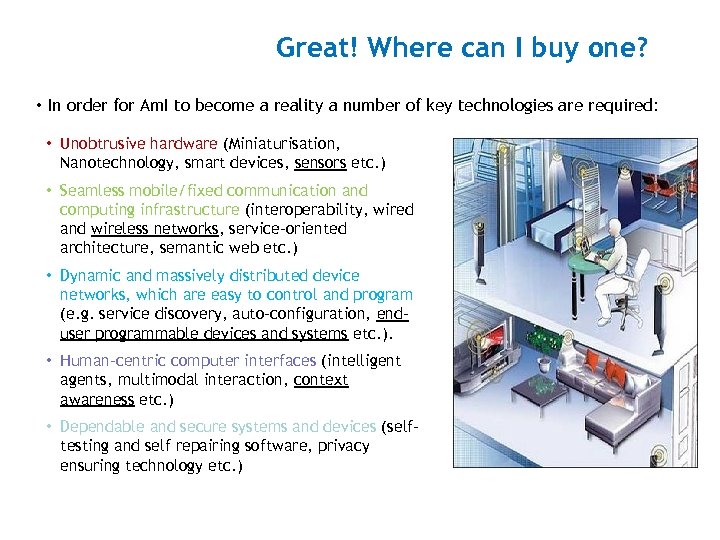 Great! Where can I buy one? • In order for Am. I to become a reality a number of key technologies are required: • Unobtrusive hardware (Miniaturisation, Nanotechnology, smart devices, sensors etc. ) • Seamless mobile/fixed communication and computing infrastructure (interoperability, wired and wireless networks, service-oriented architecture, semantic web etc. ) • Dynamic and massively distributed device networks, which are easy to control and program (e. g. service discovery, auto-configuration, enduser programmable devices and systems etc. ). • Human-centric computer interfaces (intelligent agents, multimodal interaction, context awareness etc. ) • Dependable and secure systems and devices (selftesting and self repairing software, privacy ensuring technology etc. )
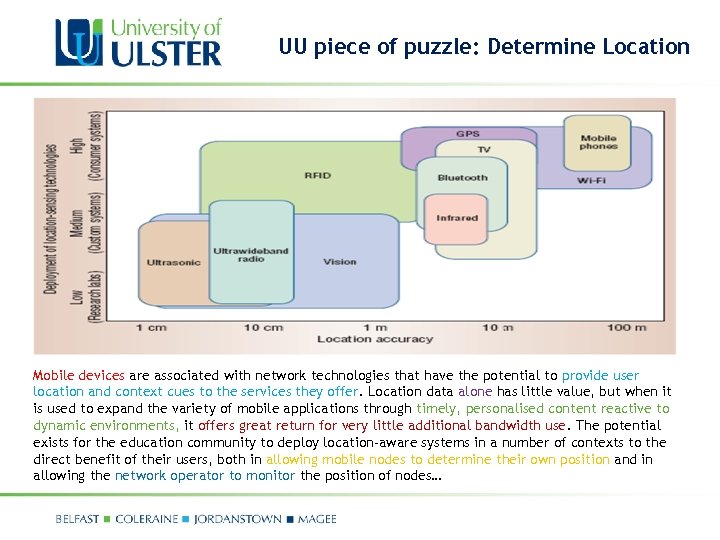 UU piece of puzzle: Determine Location Mobile devices are associated with network technologies that have the potential to provide user location and context cues to the services they offer. Location data alone has little value, but when it is used to expand the variety of mobile applications through timely, personalised content reactive to dynamic environments, it offers great return for very little additional bandwidth use. The potential exists for the education community to deploy location-aware systems in a number of contexts to the direct benefit of their users, both in allowing mobile nodes to determine their own position and in allowing the network operator to monitor the position of nodes…
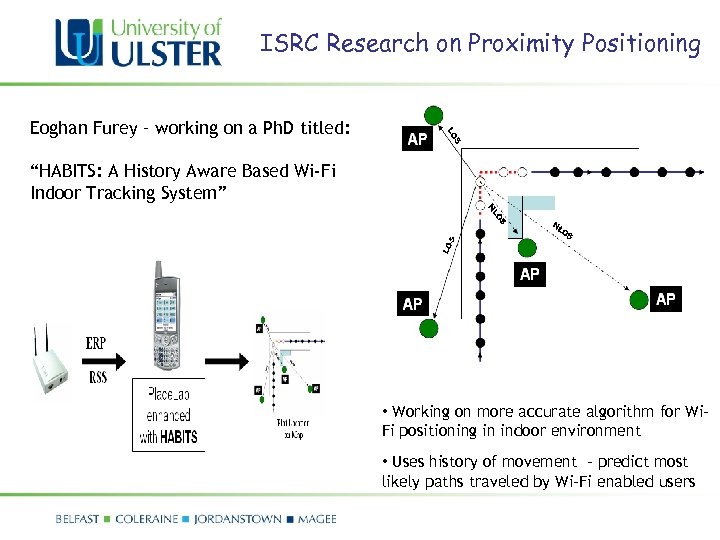
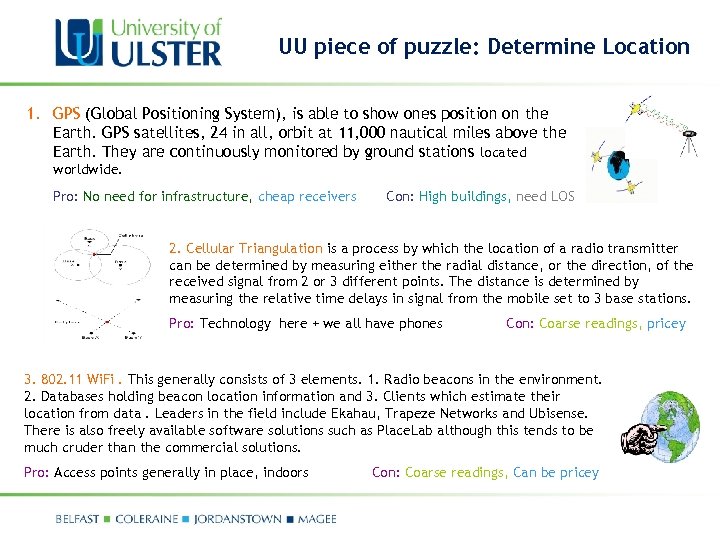 UU piece of puzzle: Determine Location 1. GPS (Global Positioning System), is able to show ones position on the Earth. GPS satellites, 24 in all, orbit at 11, 000 nautical miles above the Earth. They are continuously monitored by ground stations located worldwide. Pro: No need for infrastructure, cheap receivers Con: High buildings, need LOS 2. Cellular Triangulation is a process by which the location of a radio transmitter can be determined by measuring either the radial distance, or the direction, of the received signal from 2 or 3 different points. The distance is determined by measuring the relative time delays in signal from the mobile set to 3 base stations. Pro: Technology here + we all have phones Con: Coarse readings, pricey 3. 802. 11 Wi. Fi. This generally consists of 3 elements. 1. Radio beacons in the environment. 2. Databases holding beacon location information and 3. Clients which estimate their location from data. Leaders in the field include Ekahau, Trapeze Networks and Ubisense. There is also freely available software solutions such as Place. Lab although this tends to be much cruder than the commercial solutions. Pro: Access points generally in place, indoors Con: Coarse readings, Can be pricey
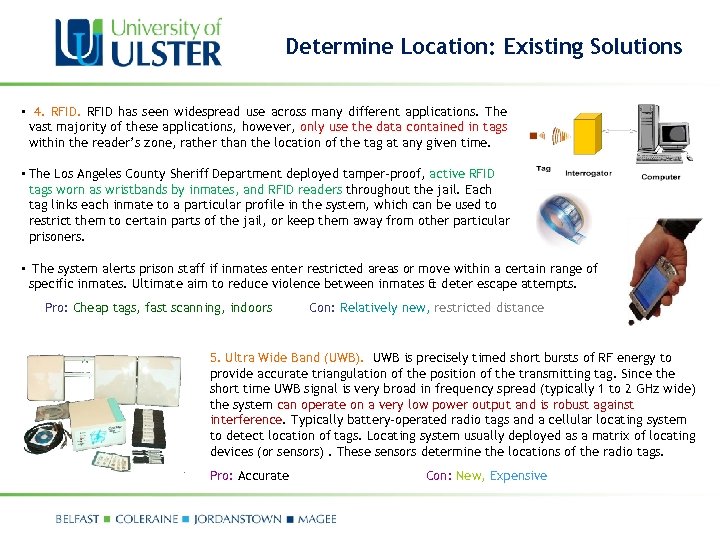 Determine Location: Existing Solutions • 4. RFID has seen widespread use across many different applications. The vast majority of these applications, however, only use the data contained in tags within the reader’s zone, rather than the location of the tag at any given time. • The Los Angeles County Sheriff Department deployed tamper-proof, active RFID tags worn as wristbands by inmates, and RFID readers throughout the jail. Each tag links each inmate to a particular profile in the system, which can be used to restrict them to certain parts of the jail, or keep them away from other particular prisoners. • The system alerts prison staff if inmates enter restricted areas or move within a certain range of specific inmates. Ultimate aim to reduce violence between inmates & deter escape attempts. Pro: Cheap tags, fast scanning, indoors Con: Relatively new, restricted distance 5. Ultra Wide Band (UWB). UWB is precisely timed short bursts of RF energy to provide accurate triangulation of the position of the transmitting tag. Since the short time UWB signal is very broad in frequency spread (typically 1 to 2 GHz wide) the system can operate on a very low power output and is robust against interference. Typically battery-operated radio tags and a cellular locating system to detect location of tags. Locating system usually deployed as a matrix of locating devices (or sensors). These sensors determine the locations of the radio tags. Pro: Accurate Con: New, Expensive
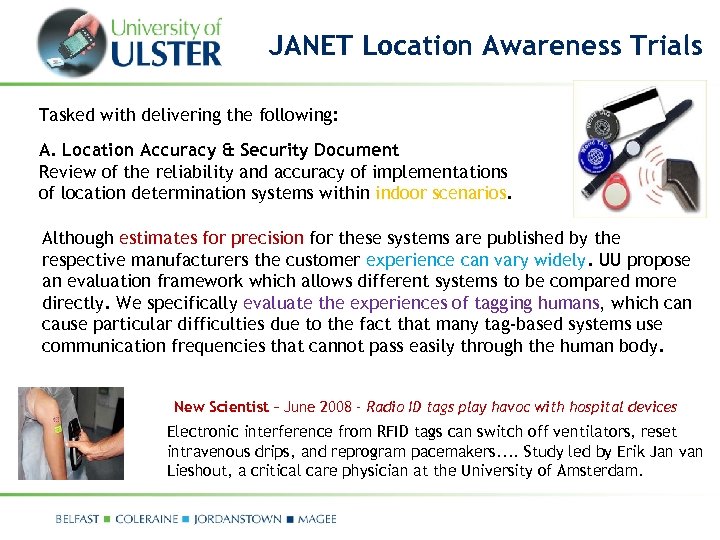 JANET Location Awareness Trials Tasked with delivering the following: A. Location Accuracy & Security Document Review of the reliability and accuracy of implementations of location determination systems within indoor scenarios. Although estimates for precision for these systems are published by the respective manufacturers the customer experience can vary widely. UU propose an evaluation framework which allows different systems to be compared more directly. We specifically evaluate the experiences of tagging humans, which can cause particular difficulties due to the fact that many tag-based systems use communication frequencies that cannot pass easily through the human body. New Scientist – June 2008 - Radio ID tags play havoc with hospital devices Electronic interference from RFID tags can switch off ventilators, reset intravenous drips, and reprogram pacemakers. . Study led by Erik Jan van Lieshout, a critical care physician at the University of Amsterdam.
 A little on Evaluation Framework § Tag State: the tag state may have an impact on accuracy. To conserve power, many tags will enter an idle state after a period of inactivity. When performing evaluations this feature should be disabled. Powered tags should be fitted with fresh batteries. § Interference: depending on the tag communication system, if more than one tag is put in the same general area, they could interfere with each other. This is typically a feature when dealing with passive RFID tags. § Sensor Configuration: The space with the highest precision will typically be that which is well covered by sensors. A fair evaluation should compare systems at a range of areas from where they should be most accurate to where they will perform worst. § Environment: the environment in which the tag is located will have an important impact on the detected precision. The presence of metallic structures or electronic equipment could lead to interference with the location detection hardware § Height: When dealing with location detection systems care should be taken if 2 D coords are required when dealing with systems that offer 3 D coordinates. However, this may cause problems if there is a difference in precision at different heights. If this is the case, care must be taken when positioning the tag on the human body. § Frequency: The frequency of sensor readings is important when gathering evaluation data. . . as the frequency is increased, the cost in terms of power usage increases. An evaluation should use a frequency that will be usable in real world conditions.
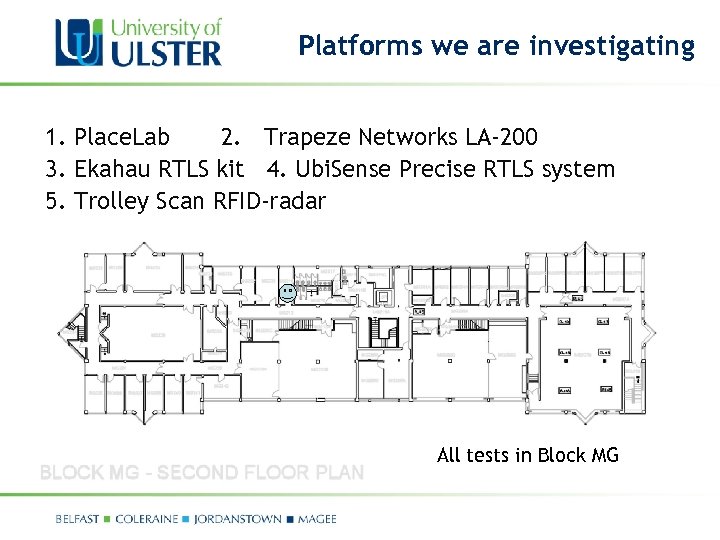 Platforms we are investigating 1. Place. Lab 2. Trapeze Networks LA-200 3. Ekahau RTLS kit 4. Ubi. Sense Precise RTLS system 5. Trolley Scan RFID-radar All tests in Block MG
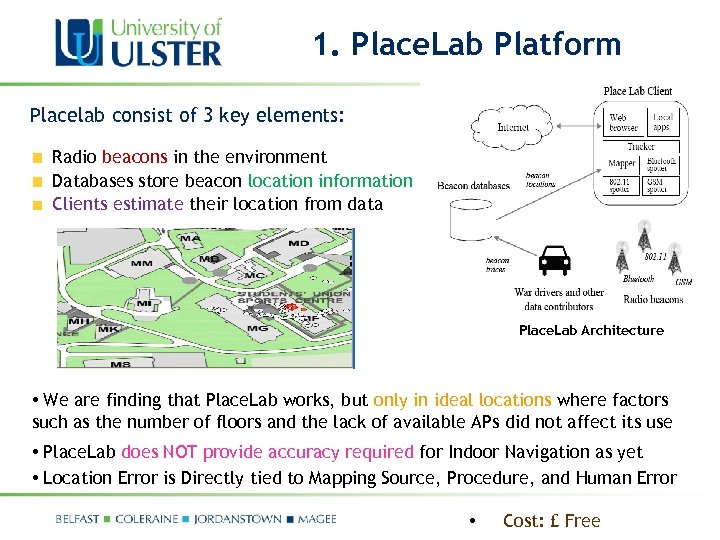 1. Place. Lab Platform Placelab consist of 3 key elements: Radio beacons in the environment Databases store beacon location information Clients estimate their location from data Place. Lab Architecture • We are finding that Place. Lab works, but only in ideal locations where factors such as the number of floors and the lack of available APs did not affect its use • Place. Lab does NOT provide accuracy required for Indoor Navigation as yet • Location Error is Directly tied to Mapping Source, Procedure, and Human Error • Cost: £ Free
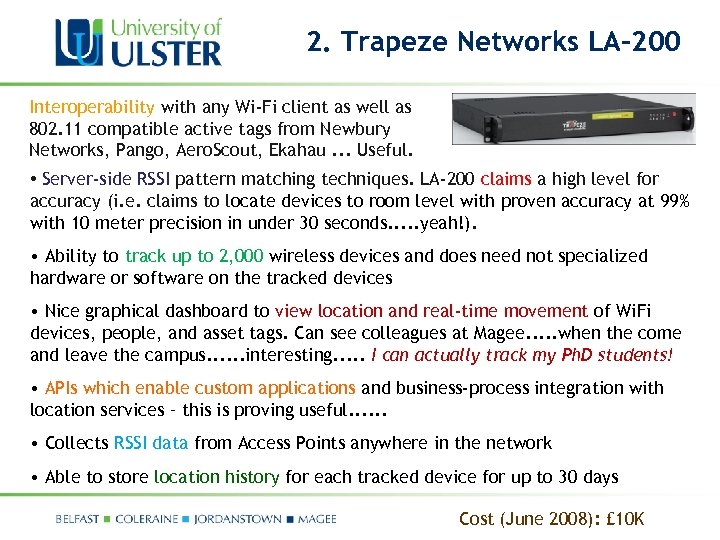 2. Trapeze Networks LA-200 Interoperability with any Wi-Fi client as well as 802. 11 compatible active tags from Newbury Networks, Pango, Aero. Scout, Ekahau. . . Useful. • Server-side RSSI pattern matching techniques. LA-200 claims a high level for accuracy (i. e. claims to locate devices to room level with proven accuracy at 99% with 10 meter precision in under 30 seconds. . . yeah!). • Ability to track up to 2, 000 wireless devices and does need not specialized hardware or software on the tracked devices • Nice graphical dashboard to view location and real-time movement of Wi. Fi devices, people, and asset tags. Can see colleagues at Magee. . . when the come and leave the campus. . . interesting. . . I can actually track my Ph. D students! • APIs which enable custom applications and business-process integration with location services – this is proving useful. . . • Collects RSSI data from Access Points anywhere in the network • Able to store location history for each tracked device for up to 30 days Cost (June 2008): £ 10 K
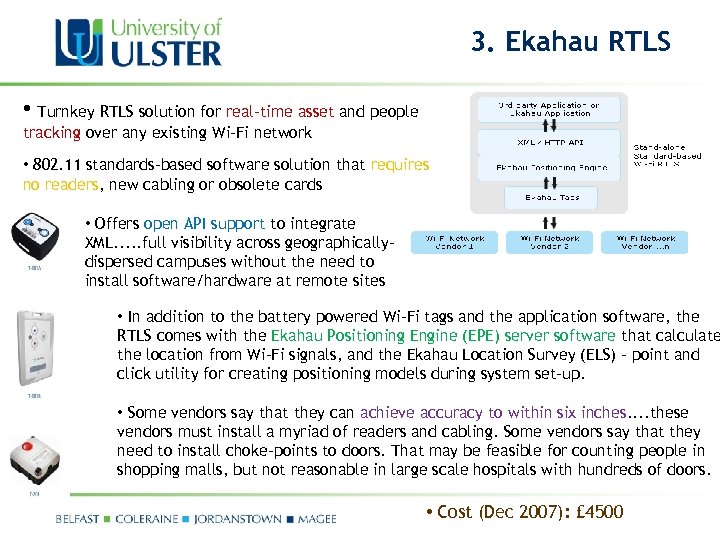 3. Ekahau RTLS • Turnkey RTLS solution for real-time asset and people tracking over any existing Wi-Fi network • 802. 11 standards-based software solution that requires no readers, new cabling or obsolete cards • Offers open API support to integrate XML. . . full visibility across geographicallydispersed campuses without the need to install software/hardware at remote sites • In addition to the battery powered Wi-Fi tags and the application software, the RTLS comes with the Ekahau Positioning Engine (EPE) server software that calculate the location from Wi-Fi signals, and the Ekahau Location Survey (ELS) - point and click utility for creating positioning models during system set-up. • Some vendors say that they can achieve accuracy to within six inches. . these vendors must install a myriad of readers and cabling. Some vendors say that they need to install choke-points to doors. That may be feasible for counting people in shopping malls, but not reasonable in large scale hospitals with hundreds of doors. • Cost (Dec 2007): £ 4500
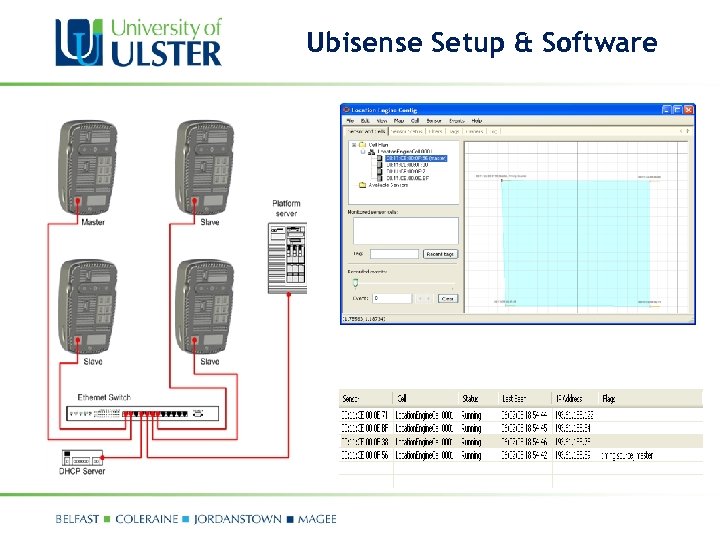
 4. Ubisense RTLS • UK Company. One of the first companies to exploit Ultra-Wide Band for RTLS. • UWB Definition: … precisely timed short bursts of RF energy to provide accurate triangulation of the position of the transmitting tag. Since the short time UWB signal is very broad in frequency spread the system can operate on a very low power output and is robust against interference. • An RTLS solution utilizes battery-operated radio tags and a cellular locating system to detect the presence and location of the tags. The locating system is usually deployed as a matrix of sensors that are installed at a spacing of anywhere from 50 to 1000 feet depending on the site layout. These sensors determine the locations of the radio tags. • Ubisense consists of Tags - designed to be mounted on assets or to be worn by a person; Location Engine includes software needed to install and tune a Ubisense sensor network and track tags in real time, through a series of configuration wizards; Location Platform provides persistent storage and distribution of real-time location events for multiple clients in conjunction with real-time monitoring and notification of userspecified spatial interactions between objects • Cost (June 2008): £ 11, 800
 5. Trolley Scan RFID Radar RFID has seen widespread use across many different applications. The vast majority of these applications however, only use the data contained in tags within the reader’s zone, rather than the location of the tag at any given time. Trolley Scan RFID-radar system claims that it can: • Monitor a zone of up to 100 m deep, to an accuracy of less than half a metre • All tags in reading zone can be scanned within a matter of secs • The transponders are very cheap…. only a few pence to produce • The reader can map out the location of all transponders in the reading zone in one, two or three dimensions and many readers can work in close proximity with minimal interference due to the bandwidth being only 10 k. Hz at UHF freqs However UU already are finding that. . . while practical range of the reader is 100 metres, the actual range with 5 u. W passive stick-type transponders is around 40 metres; umber of transponders in the reading zone is limited to fifty; Only the current range of Ecotag transponders are supported and tags are accurately tracked only when moving under a certain speed. • Cost (June 2008): £ 3, 500
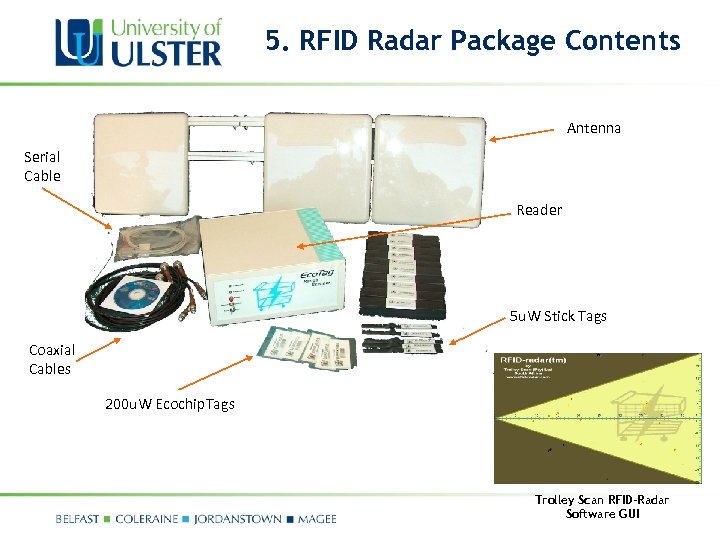 5. RFID Radar Package Contents Antenna Serial Cable Reader 5 u. W Stick Tags Coaxial Cables 200 u. W Ecochip. Tags Trolley Scan RFID-Radar Software GUI
 Initial Test Results: RFID • RFID-radar takes long time (~4 -8 seconds) to determine exact position of tags…due to narrow bandwidth. Better suited to static situations where transponders are relatively stationary Room MG 281 with all calibrated locations
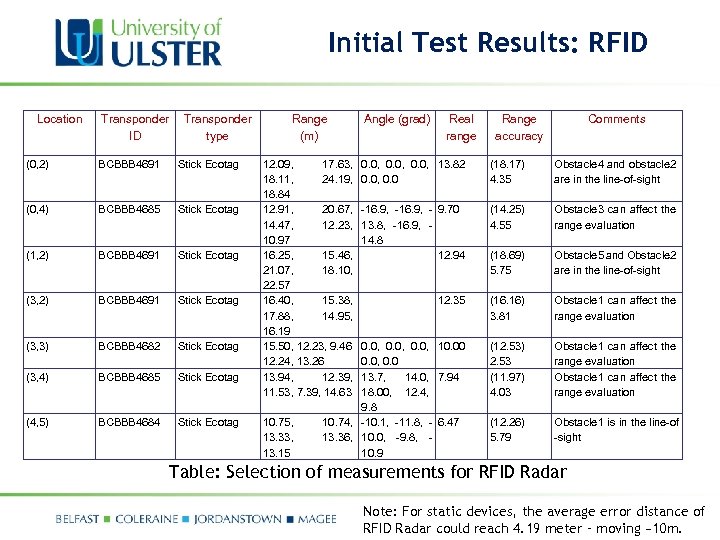 Initial Test Results: RFID Location Transponder ID Transponder type (0, 2) BCBBB 4691 Stick Ecotag (0, 4) BCBBB 4685 Stick Ecotag (1, 2) BCBBB 4691 Stick Ecotag (3, 3) BCBBB 4682 Stick Ecotag (3, 4) BCBBB 4685 Stick Ecotag (4, 5) BCBBB 4684 Stick Ecotag Range (m) 12. 09, 17. 63, 18. 11, 24. 19, 18. 84 12. 91, 20. 67, 14. 47, 12. 23, 10. 97 16. 25, 15. 46, 21. 07, 18. 10, 22. 57 16. 40, 15. 38, 17. 88, 14. 95, 16. 19 15. 50, 12. 23, 9. 46 12. 24, 13. 26 13. 94, 12. 39, 11. 53, 7. 39, 14. 63 10. 75, 13. 33, 13. 15 Angle (grad) Real range Range accuracy Comments 0. 0, 13. 82 0. 0, 0. 0 (18. 17) 4. 35 Obstacle 4 and obstacle 2 are in the line-of-sight -16. 9, - 9. 70 13. 8, -16. 9, 14. 8 12. 94 (14. 25) 4. 55 Obstacle 3 can affect the range evaluation (18. 69) 5. 75 Obstacle 5 and Obstacle 2 are in the line-of-sight 12. 35 (16. 16) 3. 81 Obstacle 1 can affect the range evaluation 0. 0, 10. 00 0. 0, 0. 0 13. 7, 14. 0, 7. 94 18. 00, 12. 4, 9. 8 10. 74, -10. 1, -11. 8, - 6. 47 13. 36, 10. 0, -9. 8, 10. 9 (12. 53) 2. 53 (11. 97) 4. 03 Obstacle 1 can affect the range evaluation (12. 26) 5. 79 Obstacle 1 is in the line-of -sight Table: Selection of measurements for RFID Radar Note: For static devices, the average error distance of RFID Radar could reach 4. 19 meter – moving ~10 m.
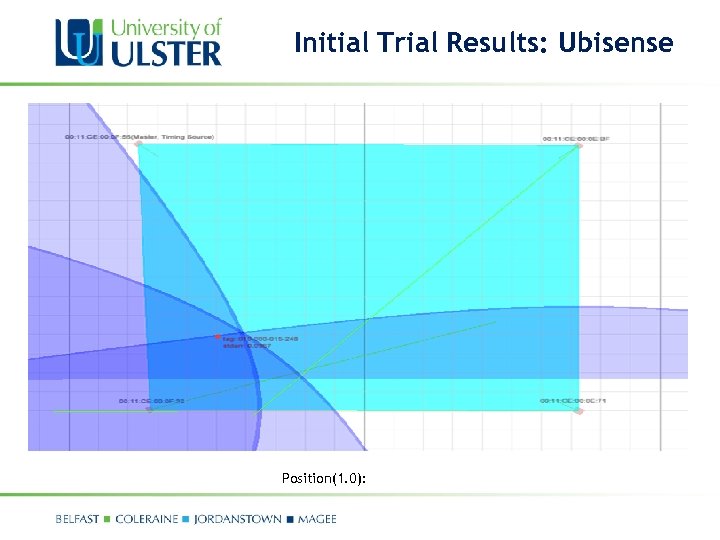
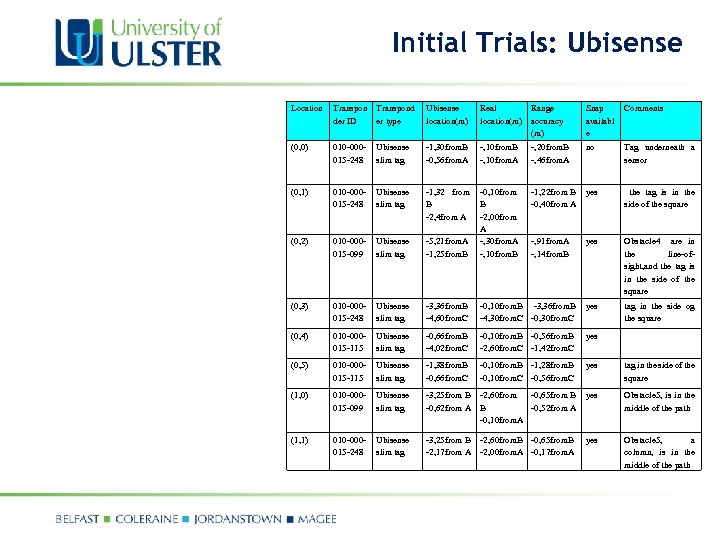
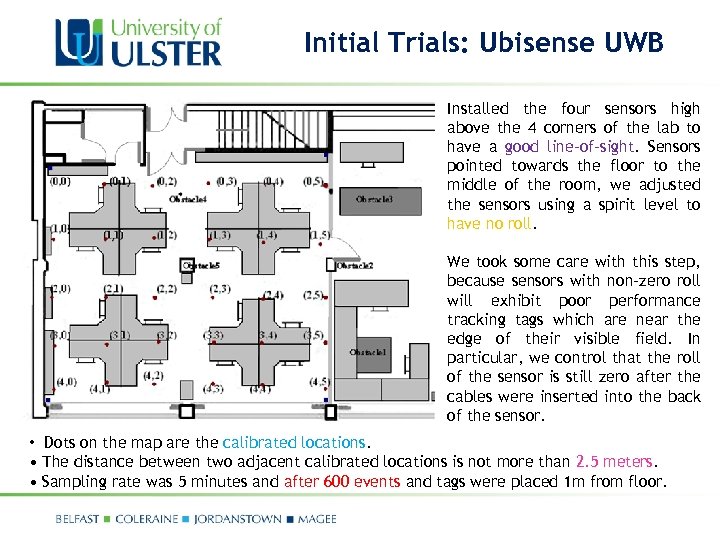 Initial Trials: Ubisense UWB Installed the four sensors high above the 4 corners of the lab to have a good line-of-sight. Sensors pointed towards the floor to the middle of the room, we adjusted the sensors using a spirit level to have no roll. We took some care with this step, because sensors with non-zero roll will exhibit poor performance tracking tags which are near the edge of their visible field. In particular, we control that the roll of the sensor is still zero after the cables were inserted into the back of the sensor. • Dots on the map are the calibrated locations. • The distance between two adjacent calibrated locations is not more than 2. 5 meters. • Sampling rate was 5 minutes and after 600 events and tags were placed 1 m from floor.
 Ubisense Setup & Software
 Initial Trial Results: Ubisense Position(1. 0):
 Initial Trials: Ubisense Location Transpond der ID er type Ubisense location(m) Real location(m) Range accuracy (m) Snap availabl e Comments (0, 0) 010 -000015 -248 Ubisense slim tag -1, 30 from. B -0, 56 from. A -, 10 from. B -, 10 from. A -, 20 from. B -, 46 from. A no Tag underneath a sensor (0, 1) 010 -000015 -248 Ubisense slim tag -1, 32 from B -2, 4 from A -1, 22 from B -0, 40 from A yes the tag is in the side of the square (0, 2) 010 -000015 -099 Ubisense slim tag -5, 21 from. A -1, 25 from. B -0, 10 from B -2, 00 from A -, 30 from. A -, 10 from. B -, 91 from. A -, 14 from. B yes Obstacle 4 are in the line-ofsight, and the tag is in the side of the square (0, 3) 010 -000015 -248 Ubisense slim tag -3, 36 from. B -4, 60 from. C -0, 10 from. B -3, 36 from. B -4, 30 from. C -0, 30 from. C yes tag in the side og the square (0, 4) 010 -000015 -115 Ubisense slim tag -0, 66 from. B -4, 02 from. C -0, 10 from. B -0, 56 from. B -2, 60 from. C -1, 42 from. C yes (0, 5) 010 -000015 -115 Ubisense slim tag -1, 38 from. B -0, 66 from. C -0, 10 from. B -1, 28 from. B -0, 10 from. C -0, 56 from. C yes tag in the side of the square (1, 0) 010 -000015 -099 Ubisense slim tag -3, 25 from B -0, 62 from A -2, 60 from -0, 65 from B B -0, 52 from A -0, 10 from. A yes Obstacle 5, is in the middle of the path (1, 1) 010 -000015 -248 Ubisense slim tag -3, 25 from B -2, 17 from A -2, 60 from. B -0, 65 from. B -2, 00 from. A -0, 17 from. A yes Obstacle 5, a column, is in the middle of the path
 ISRC Research on Proximity Positioning Eoghan Furey – working on a Ph. D titled: “HABITS: A History Aware Based Wi-Fi Indoor Tracking System” • Working on more accurate algorithm for Wi. Fi positioning in indoor environment • Uses history of movement - predict most likely paths traveled by Wi-Fi enabled users
 Conclusion • Systems purchased and all set up at differing times • Initial tests conducted on 4 systems • Currently plan to roll out final phase of testing starting in October • Developer Training to be done on Ubisense system in Dortmond. This however is only for the development of applications and not crucial to the overall tests. • Starting to write up aspects of final report (Wondering a little about format, size and other issues but possibly too early to worry about that? ). . .
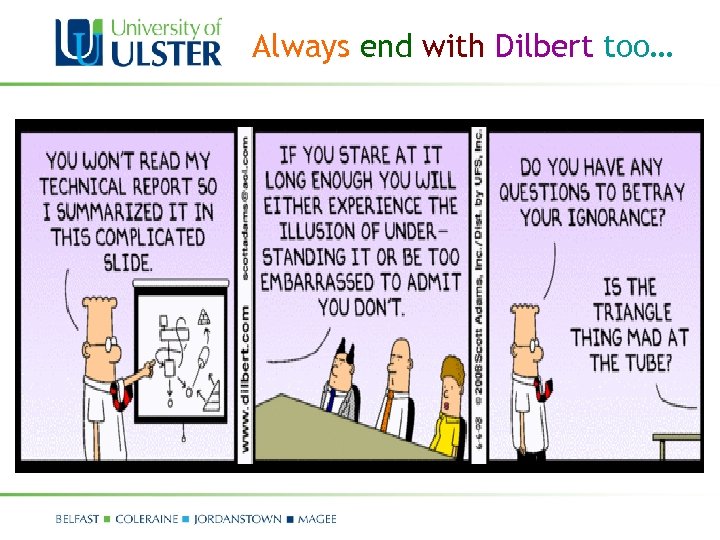 Always end with Dilbert too…