 Скачать презентацию Kerberos Introduction Jim Binkley- jrb cs pdx edu 1
0e626e23186c188854f4ecadfe200d4c.ppt
- Количество слайдов: 50



Kerberos Introduction Jim Binkley- jrb@cs. pdx. edu 1
outline u intro to Kerberos (bark, bark) u protocols – Needham Schroeder – K 4 – K 5 u miscellaneous issues u conclusion 2
Kerberos history u Kerberos came from MIT u part of project Athena, in 1980 s – which also developed the X window system u Kerberos 4 released in 1989 – used DES, therefore export-control prevented export of US release – Australian programmer took un-DES’ed form and produced his own DES, called system ebones u K 4 can be considered dead, but maybe not. . . 3
k-istory, cont u why Kerberos, the name? – because Cerberus was a vicious doggie that guarded the gates of hell – 3 dog heads, and a dragon tail – one had to “authenticate” to pass into hell » or escape. . . – it should be noted however that the hero Hercules kidnapped Cerberus. . . 4
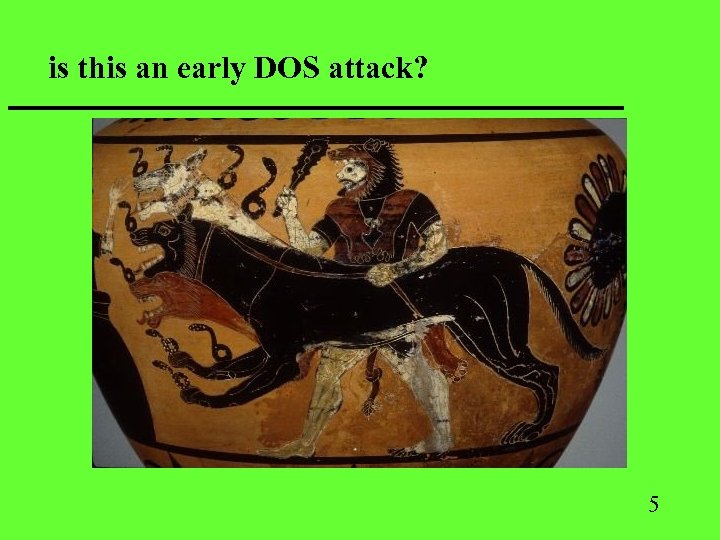
is this an early DOS attack? 5
k-istory, cont u Kerberos 5 intended to fix bugs, make improvements – likely what is used today – RFC 1510 plus supplements document it » K 4 only documented in code – protocol done in ASN. 1 – extensible encryption types – pre-authentication feature 6
k-istory, cont. u MIT reference implementation for K-5 u Heimdal - open source version u Windows 2000 and above from MS – public key extensions u Apple also uses it u IETF has been attempting to formalize it 7
more info u ORA - Kerberos book. Jason Garman – August 2003 – practical setup/debugging info u Network Security, KRS – 2 chapters u MIT Dialogue in Four Scenes: web. mit. edu/Kerberos/www/dialogue. html 8
more info 2: u MIT home page: web. mit. edu/Kerberos/www u Heimdal home page: www. pdc. kth. se/heimdal u paper: Neuman/Ts’o. Kerberos: An Authentication Service for Computer Networks, IEEE Communications, Sept. 1994 u paper: Bellovin/Merritt. Limitations of the Kerberos Authentication System, USENIX, 1991. 9
Basic concepts u Kerberos basically authenticates clients to servers u passwords never sent in the clear – we send “tickets” instead ua ticket is an encrypted session-key with a timeout u a “directory” may be used in an implementation to hold keys – e. g. , MS has an LDAP directory structure 10
terminology u principal - a kerberos user – may be service – may be person ua principal is a name – K 4 form: – user[. instance]@REALM – service. hostname@REALM 11
names, cont. u because K 4 did not allow two hosts with the same name in the same realm u K 5 principal like so: – username[/instance]@REALM – service/FQDN@REALM u e. g. , , – host/foo. com@REALM – host/bar. com@REALM 12
a REALM ua realm is the domain of a KDC – typically an enterprise or one admin domain u realm name usually same as DNS – BUT UPPERCASE – joebob/admin@MYFOO. BAR. COM u name doesn’t have to be DNS though 13
Kerberos services u passwords are not transmitted in the clear – and in fact, session-keys are sent u single-sign-on – user logs in once, and can talk to multiple services without having to reverify with a password (possibly a different password) u mutual authentication – alice/bob both authenticate to each other 14
the man behind the curtain u we must have a KDC – better a *distributed* KDC – KDC had better be a very secure host – not on Inet. . . minimal services, etc. – super Bastion Host. . . u we must issue passwords and both Alice and the KDC must know them 15
KDC has 3 parts u database of principals and keys – MS uses LDAP – Heimdal puts in specialized db u ticket-granting-server - takes care of ticketgranting for Alice/Bob (user/server) exchange u authentication-server - implements single sign-on function – issues TGT (ticket granting ticket) that Alice’s software can use to get individual tickets to talk to other servers 16
cont. u ticket granting service has 2 inputs: – 1. the ticket granting ticket (TGT) – 2. principal name for desired service (bob) u TGS verifies that TGT is valid – by decode with KDC symmetric key 17
a ticket is: u user’s principal - who wants the service u service’s principal - who does the service u when started, and when becomes invalid u list of IP addresses involved u the shared secret key encrypted with a principal’s key u ticket’s usually last hours or a day 18
Fundamental protocol u Needham Schroeder protocol, Xerox, 1978 u Assume Alice, Bob, and KDC – key distribution center u note: Bob may be a service – a printer, file system, telnet server, etc. u Alice, Bob, and KDC all have symmetric secret keys – or passwords that can be turned into symmetric keys u KDC has keys stored on it 19
algorithm underpinnings u 1. a-priori shared secret between KDC and Alice/KDC and Bob – 2 master keys u 2. Alice gets from KDC two session keys – 1. one encrypted for Alice with Alice’s master – 2. one encrypted for Bob with Bob’s master – 3. this is a new Alice/Bob session key u 3. Alice send’s Bob’s key, and Bob decrypts with Bob’s master key 20
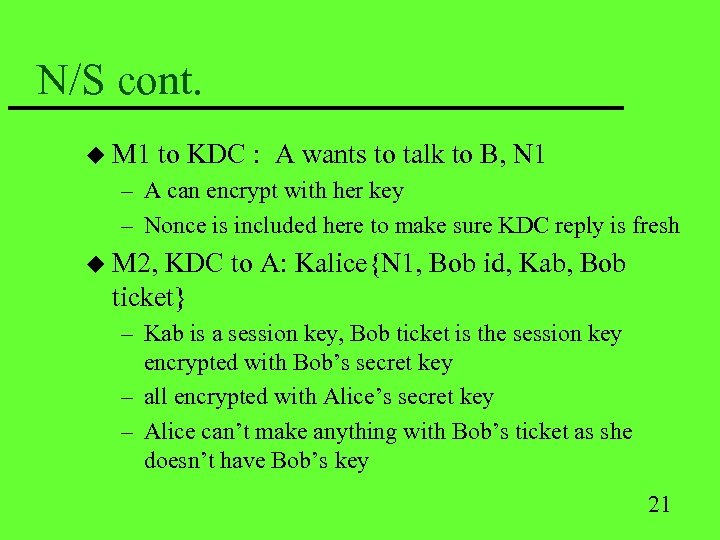
N/S cont. u M 1 to KDC : A wants to talk to B, N 1 – A can encrypt with her key – Nonce is included here to make sure KDC reply is fresh u M 2, KDC to A: Kalice{N 1, Bob id, Kab, Bob ticket} – Kab is a session key, Bob ticket is the session key encrypted with Bob’s secret key – all encrypted with Alice’s secret key – Alice can’t make anything with Bob’s ticket as she doesn’t have Bob’s key 21
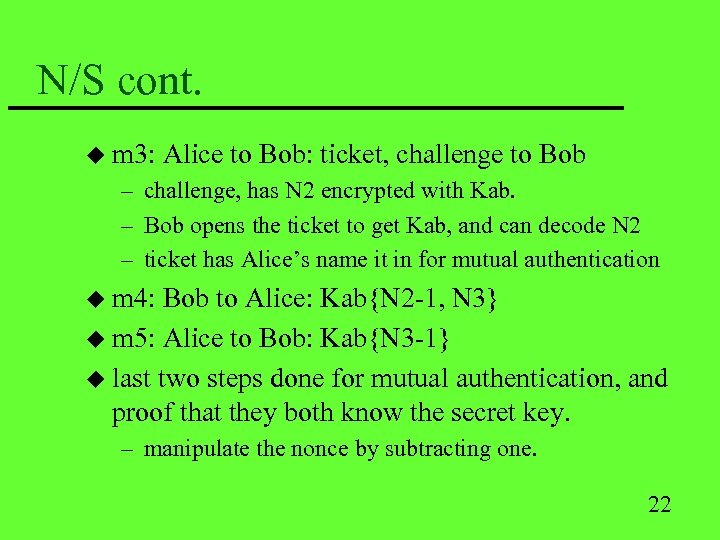
N/S cont. u m 3: Alice to Bob: ticket, challenge to Bob – challenge, has N 2 encrypted with Kab. – Bob opens the ticket to get Kab, and can decode N 2 – ticket has Alice’s name it in for mutual authentication u m 4: Bob to Alice: Kab{N 2 -1, N 3} u m 5: Alice to Bob: Kab{N 3 -1} u last two steps done for mutual authentication, and proof that they both know the secret key. – manipulate the nonce by subtracting one. 22
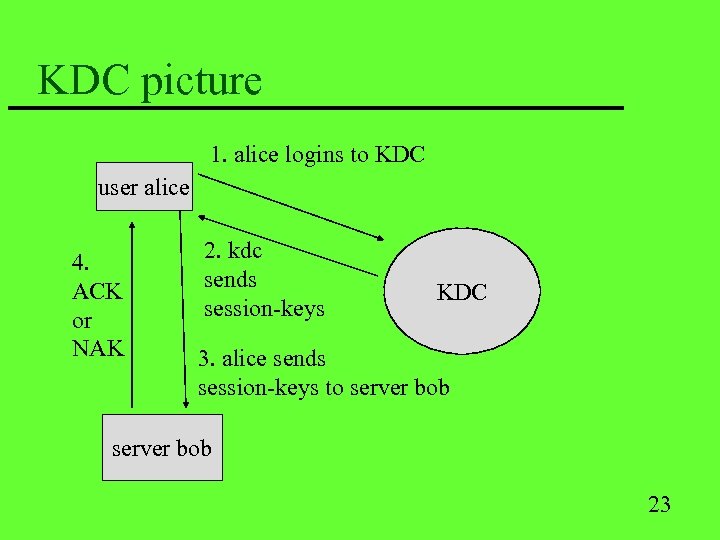
KDC picture 1. alice logins to KDC user alice 4. ACK or NAK 2. kdc sends session-keys KDC 3. alice sends session-keys to server bob 23
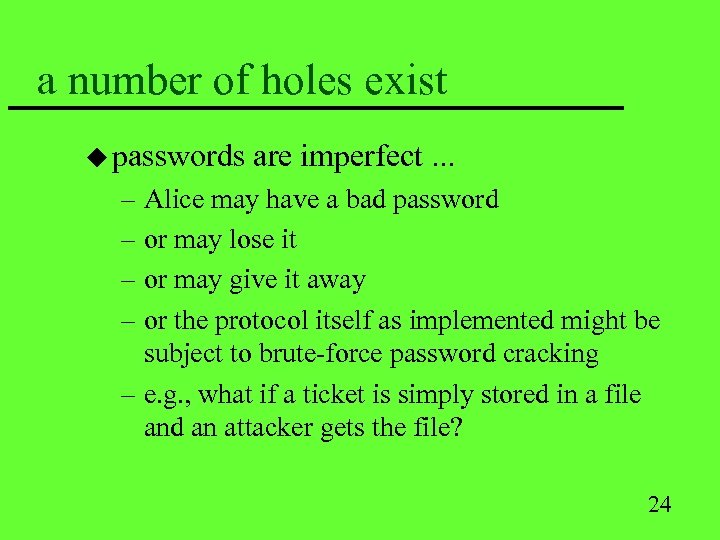
a number of holes exist u passwords are imperfect. . . – Alice may have a bad password – or may lose it – or may give it away – or the protocol itself as implemented might be subject to brute-force password cracking – e. g. , what if a ticket is simply stored in a file and an attacker gets the file? 24
one improvement u Alice 1 st talks to Bob u Bob sends Alice Kbob{Nonce of Bob} u Alice sends this nonce to the KDC u which puts it in Bob’s ticket u this prevents Bad Bertha from using Alice’s old key, once Alice has changed her key u Bob knows that the key Alice used with the KDC is post its own nonce being sent. 25
Kerberos 4 basic protocol u two major changes u 1. we assume shared time, which gets rid of the challenge-response protocol – e. g. , we use NTP u 2. in order to implement single-sign-on, we implement a ticket-granting server – authentication service (Alice to Bob) – ticket granting service (Alice to KDC) 26
K 4 protocol u part 1: authentication server – password from user turned into – ticket granting ticket u part 2: ticket-granting server – TGT and principal info turned into – session key for Alice/Bob 27
authentication server function u client sends AS_REQ: (client principal, client timestamp, krbtgt (ticket granting server principal name), requested lifetime) – sent in plaintext – probably at start of day – probably last 8 -10 hours – krbtgt. hostname@REALM is TGS principal u server must verify that time is within a certain limit, say 5 minutes 28
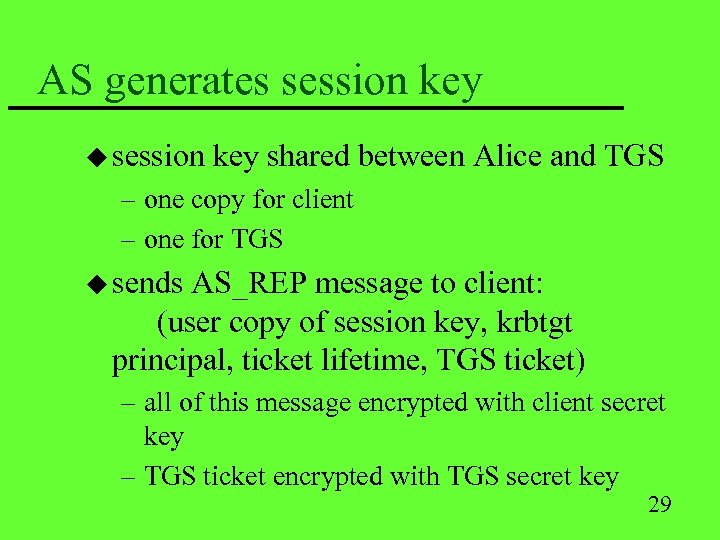
AS generates session key u session key shared between Alice and TGS – one copy for client – one for TGS u sends AS_REP message to client: (user copy of session key, krbtgt principal, ticket lifetime, TGS ticket) – all of this message encrypted with client secret key – TGS ticket encrypted with TGS secret key 29
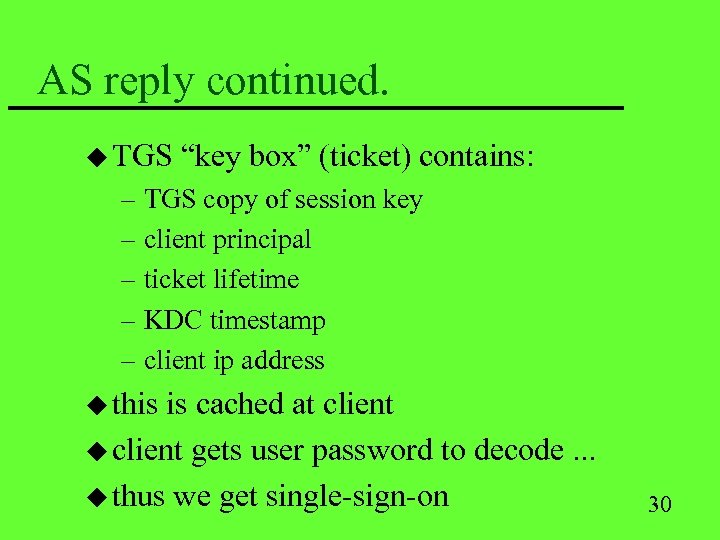
AS reply continued. u TGS “key box” (ticket) contains: – TGS copy of session key – client principal – ticket lifetime – KDC timestamp – client ip address u this is cached at client u client gets user password to decode. . . u thus we get single-sign-on 30
so client now has u 1. a session key u 2. a ticket-granting ticket – which it caches in a file or in memory – memory is probably a better idea, why? 31
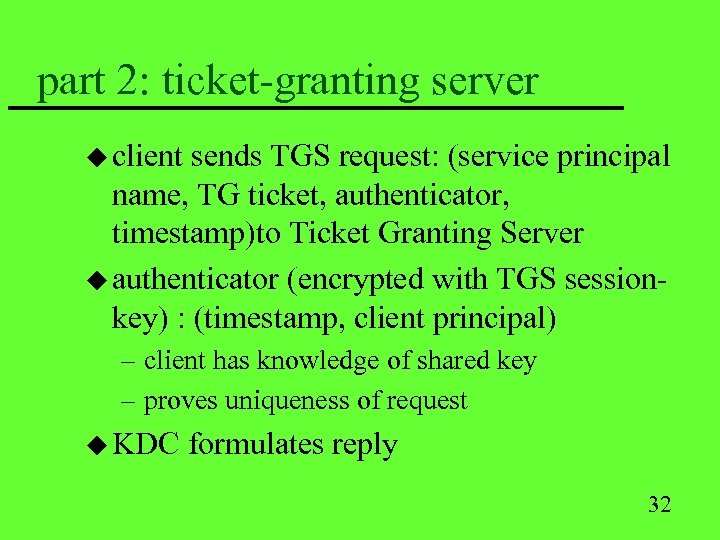
part 2: ticket-granting server u client sends TGS request: (service principal name, TG ticket, authenticator, timestamp)to Ticket Granting Server u authenticator (encrypted with TGS sessionkey) : (timestamp, client principal) – client has knowledge of shared key – proves uniqueness of request u KDC formulates reply 32
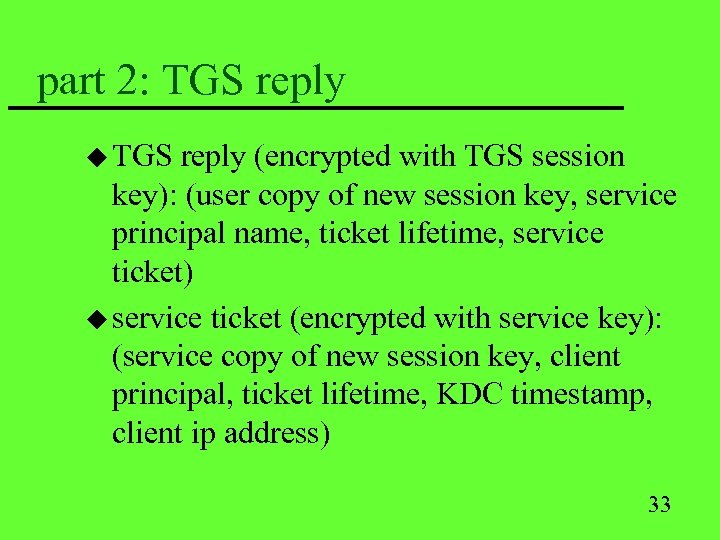
part 2: TGS reply u TGS reply (encrypted with TGS session key): (user copy of new session key, service principal name, ticket lifetime, service ticket) u service ticket (encrypted with service key): (service copy of new session key, client principal, ticket lifetime, KDC timestamp, client ip address) 33
client sends ticket to server u this is not part of the K protocol – or this is app dependent – K system provides library code to help u we might mount a windows file-share – or talk to a telnet daemon at this point 34
K 4: some details: u K 4 u requires us to take password string – e. g. , create a 56 -bit DES key – call this string 2 key() – similar to UNIX password function encryption is possible if app wants – provided in library – kerberos provides this format: (version, message type, length, cybercrud) u in K 4, this is DES in PCBC mode using session key 35
K 4: some details u integrity checking is possible u KRS states that algorithm was an MIT variation on Jueneman MAC – kerberos calls MAC’s “checksums” – not good practice, why? – K 5 uses more commonly accepted algorithms 36
K 5 overview u ASN. 1 (ouch, ouch) – means we can neglect protocol details – except when they bite us. . . u neglecting that all the protocol bits have changed, it can be viewed as similar u but more extensible – K 4 assumed DES!. . . need more variation that 37
K 5 overview u credential forwarding is one feature – user gets to server. A with telnet – now wants to ftp to server. B. . . – with K 4 can’t do that – in K 5, ticket-granting-ticket is sent to remove server upon login 38
ASN. 1 u allows variable length forwarding in a u TAG, LENGTH, VALUE format u can view both as protocol and data definition language u has basic types u and constructed types made from basic types u used in SNMP, certificate formats, LDAP, H 323 u KRS points out IP address takes 15 bytes to encode! 39
K 5 overview continued: u K 4 assumed DES u K 5 allows other choices, including entirely new choices (in case the previous one springs a leak) – as any good crypto protocol should – keys are tagged with type and length – rsa-md 5 -des is required (des is not a good idea) » rsa-md 5 means md 5 from RSA! – check your latest documentation. . . 40
in K 5, one more major protocol change u double encryption in K 4 eliminated – e. g. , TGS reply has service ticket encrypted by service key, encrypted with user key – in K 5, basically concatenated together one after the other u K 5 uses string to key transformation but adds salt: – salt is complete principal name 41
K 5, new ticket option u forwardable ticket – user can ask for ticket to be sent to another host later u renewable tickets – tickets have 2 -tier lifetime scheme – standard lifetime and renewable lifetime – must be resubmitted to KDC in order for renewable in case of troubler u postdated ticket – ticket that can be used later, useful for batch jobs 42
K 5 - preauthentication u K 4 could have dictionary and brute-force attacks made against it – KDC gives ticket granting ticket for any principal in database to any client – offline attack can thus be made against any principal u K 5 makes more difficult with preauthentication feature – client must prove identity before getting ticket u e. g. , done by proving knowledge of shared key between client and KDC 43
misc issues: windows - practical use u you can end up with single sign-on to “Active Directory” u this will give you file shares u printing u some limited support for email depending on email clients? u remember this is an authentication-oriented service u uses HMAC-MD 5 and RC 4 for encryption as default, DES added later 44
UNIX implementation u telnet/ftp may use it – telnet -x can even do encryption u rsh/rlogin/rcp have used it – ironically made better as a consequence u popper in Heimdal (pop server) u don’t assume encryption unless you know better – implementation dependent 45
cross-realm trust u 2 or more domains shares the same encryption keys u 2 principals created in each realm – trust may be 1 -way, A trusts B, but not B trusts A u cross-realm trust is N**2 – may use shared realm to get around this u of course more principals we have. . . the less trust results 46
security and other considerations u all apps should use it - few do – if one does not, the user password is exposed – it could be sniffed if mail app does not use it u dependent on goodness/safeness of said user password – one hopes Alice’s password is not Alice, password, or bob. . . u KDC may be a single point of failure u security of KDC itself is VERY important – root compromise would be bad 47
security and other considerations u Kerberos is single-user/per host system – keys may be stored in /tmp directory u root compromise of client machine gives access to those keys u are we still using DES with K 5? – objectionable especially if encryption is actually used u K 4 may suffer from offline dictionary attacks 48
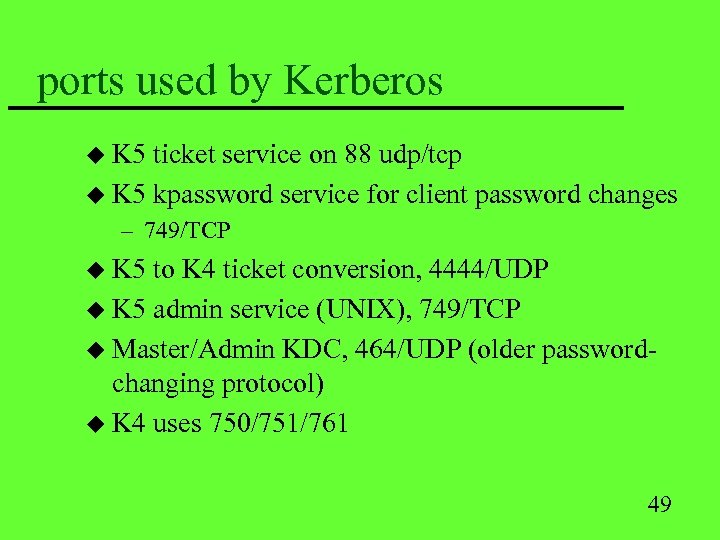
ports used by Kerberos u K 5 ticket service on 88 udp/tcp u K 5 kpassword service for client password changes – 749/TCP u K 5 to K 4 ticket conversion, 4444/UDP u K 5 admin service (UNIX), 749/TCP u Master/Admin KDC, 464/UDP (older passwordchanging protocol) u K 4 uses 750/751/761 49
study questions u what pros/cons exist for putting the KDC on a windows box? u what issues exist re user passwords and Kerberos? u what issues exist re applications and Kerberos in terms of authentication/encryption? 50
Скачать презентацию Kerberos Introduction Jim Binkley- jrb cs pdx edu 1
0e626e23186c188854f4ecadfe200d4c.ppt