


 Скачать презентацию Kentucky Space Facilities for satellite development testing and
c3e4f6ee547f634e063a8bcffa3a81a9.ppt
- Количество слайдов: 1
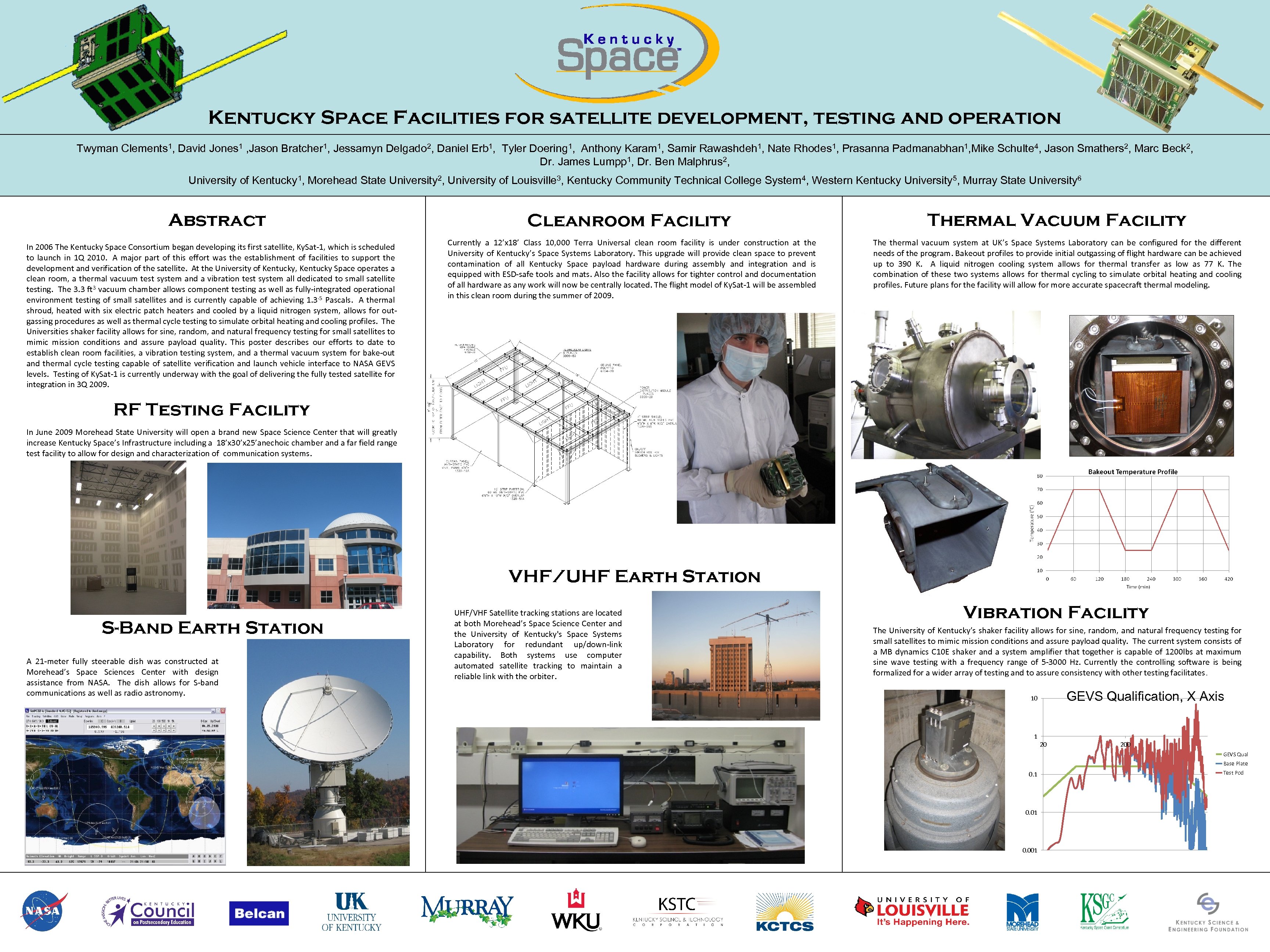 Kentucky Space Facilities for satellite development, testing and operation Twyman Clements 1, David Jones 1 , Jason Bratcher 1, Jessamyn Delgado 2, Daniel Erb 1, Tyler Doering 1, Anthony Karam 1, Samir Rawashdeh 1, Nate Rhodes 1, Prasanna Padmanabhan 1, Mike Schulte 4, Jason Smathers 2, Marc Beck 2, Dr. James Lumpp 1, Dr. Ben Malphrus 2, University of Kentucky 1, Morehead State University 2, University of Louisville 3, Kentucky Community Technical College System 4, Western Kentucky University 5, Murray State University 6 Abstract In 2006 The Kentucky Space Consortium began developing its first satellite, Ky. Sat-1, which is scheduled to launch in 1 Q 2010. A major part of this effort was the establishment of facilities to support the development and verification of the satellite. At the University of Kentucky, Kentucky Space operates a clean room, a thermal vacuum test system and a vibration test system all dedicated to small satellite testing. The 3. 3 ft 3 vacuum chamber allows component testing as well as fully-integrated operational environment testing of small satellites and is currently capable of achieving 1. 3 -5 Pascals. A thermal shroud, heated with six electric patch heaters and cooled by a liquid nitrogen system, allows for outgassing procedures as well as thermal cycle testing to simulate orbital heating and cooling profiles. The Universities shaker facility allows for sine, random, and natural frequency testing for small satellites to mimic mission conditions and assure payload quality. This poster describes our efforts to date to establish clean room facilities, a vibration testing system, and a thermal vacuum system for bake-out and thermal cycle testing capable of satellite verification and launch vehicle interface to NASA GEVS levels. Testing of Ky. Sat-1 is currently underway with the goal of delivering the fully tested satellite for integration in 3 Q 2009. Cleanroom Facility Currently a 12’x 18’ Class 10, 000 Terra Universal clean room facility is under construction at the University of Kentucky’s Space Systems Laboratory. This upgrade will provide clean space to prevent contamination of all Kentucky Space payload hardware during assembly and integration and is equipped with ESD-safe tools and mats. Also the facility allows for tighter control and documentation of all hardware as any work will now be centrally located. The flight model of Ky. Sat-1 will be assembled in this clean room during the summer of 2009. Thermal Vacuum Facility The thermal vacuum system at UK’s Space Systems Laboratory can be configured for the different needs of the program. Bakeout profiles to provide initial outgassing of flight hardware can be achieved up to 390 K. A liquid nitrogen cooling system allows for thermal transfer as low as 77 K. The combination of these two systems allows for thermal cycling to simulate orbital heating and cooling profiles. Future plans for the facility will allow for more accurate spacecraft thermal modeling. RF Testing Facility In June 2009 Morehead State University will open a brand new Space Science Center that will greatly increase Kentucky Space’s Infrastructure including a 18’x 30’x 25’anechoic chamber and a far field range test facility to allow for design and characterization of communication systems. VHF/UHF Earth Station S-Band Earth Station A 21 -meter fully steerable dish was constructed at Morehead’s Space Sciences Center with design assistance from NASA. The dish allows for S-band communications as well as radio astronomy. UHF/VHF Satellite tracking stations are located at both Morehead’s Space Science Center and the University of Kentucky's Space Systems Laboratory for redundant up/down-link capability. Both systems use computer automated satellite tracking to maintain a reliable link with the orbiter. Vibration Facility The University of Kentucky’s shaker facility allows for sine, random, and natural frequency testing for small satellites to mimic mission conditions and assure payload quality. The current system consists of a MB dynamics C 10 E shaker and a system amplifier that together is capable of 1200 lbs at maximum sine wave testing with a frequency range of 5 -3000 Hz. Currently the controlling software is being formalized for a wider array of testing and to assure consistency with other testing facilitates. GEVS Qualification, X Axis 10 1 20 200 GEVS Qual Base Plate 0. 1 0. 001 Test Pod