


 Скачать презентацию Kentucky Department of Education Update on the Implementation
f7813d85ea2eec07ff315d29329b5506.ppt
- Количество слайдов: 39
 Kentucky Department of Education Update on the Implementation of Senate Bill 1 (2009) Interim Joint Committee on Education June 10, 2013
 2 Unbridled Learning Senate Bill 1 (2009) } New academic standards } New assessments } Program Reviews } Improved professional development } New accountability system } Unified plan for improving college/career readiness 2
 Kentucky Core Academic Standards English/language arts and mathematics Ø Senate Bill 1 (2009) required new standards that: § Focus on the “critical knowledge, skills and capacities needed for success in the global economy. ” § “Consider international benchmarks” and “consider standards that have been adopted by national content advisory groups and professional education consortia. ” § Are aligned across all levels – elementary, middle, high and postsecondary. 3
 Kentucky Core Academic Standards English/language arts and mathematics Ø The new standards: § Were developed by education experts and state partners. § Included broad input from Kentucky and other states’ teachers, administrators, higher education officials, business and industry, and the staffs of the Council on Postsecondary Education (CPE) and KDE. § Over 340 teachers and education professionals participated in discussions and negotiations to revise Kentucky’s academic standards. 4
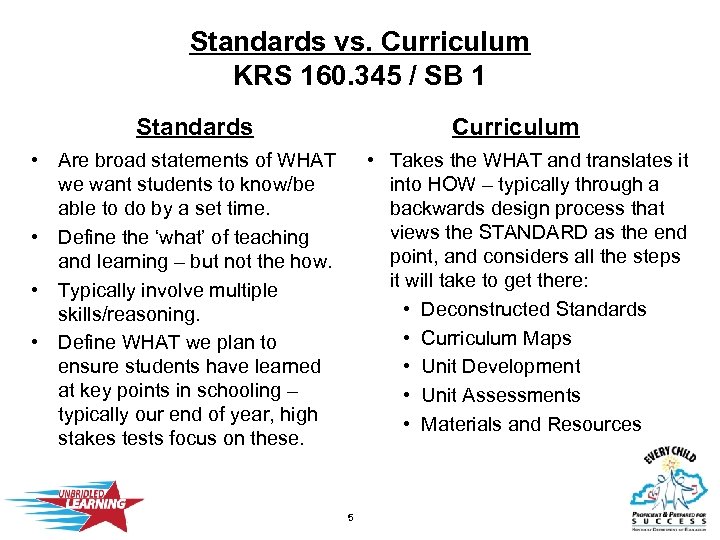 Standards vs. Curriculum KRS 160. 345 / SB 1 Standards Curriculum • Are broad statements of WHAT we want students to know/be able to do by a set time. • Define the ‘what’ of teaching and learning – but not the how. • Typically involve multiple skills/reasoning. • Define WHAT we plan to ensure students have learned at key points in schooling – typically our end of year, high stakes tests focus on these. • Takes the WHAT and translates it into HOW – typically through a backwards design process that views the STANDARD as the end point, and considers all the steps it will take to get there: • Deconstructed Standards • Curriculum Maps • Unit Development • Unit Assessments • Materials and Resources 5
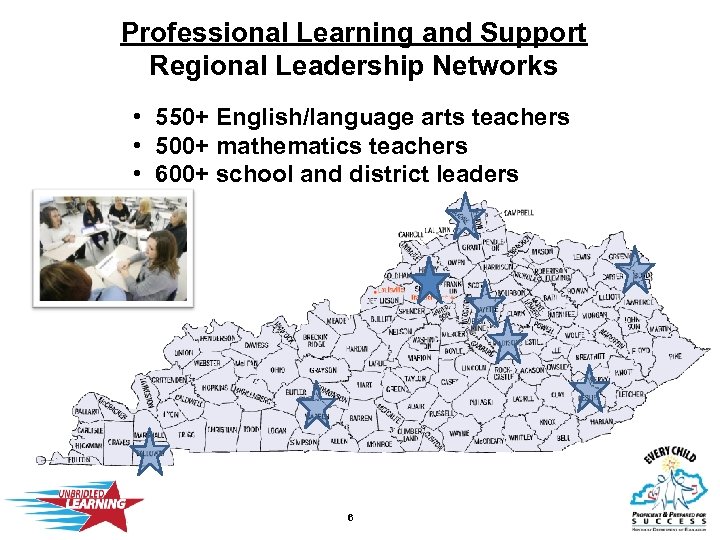 Professional Learning and Support Regional Leadership Networks • 550+ English/language arts teachers • 500+ mathematics teachers • 600+ school and district leaders 6
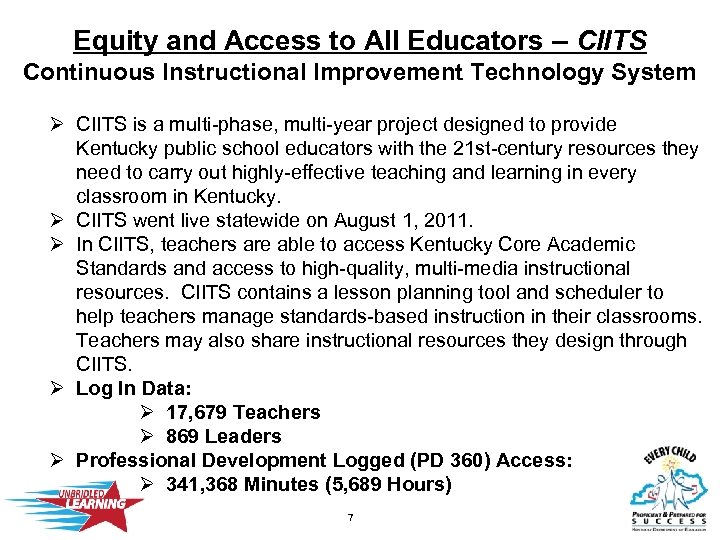 Equity and Access to All Educators – CIITS Continuous Instructional Improvement Technology System Ø CIITS is a multi-phase, multi-year project designed to provide Kentucky public school educators with the 21 st-century resources they need to carry out highly-effective teaching and learning in every classroom in Kentucky. Ø CIITS went live statewide on August 1, 2011. Ø In CIITS, teachers are able to access Kentucky Core Academic Standards and access to high-quality, multi-media instructional resources. CIITS contains a lesson planning tool and scheduler to help teachers manage standards-based instruction in their classrooms. Teachers may also share instructional resources they design through CIITS. Ø Log In Data: Ø 17, 679 Teachers Ø 869 Leaders Ø Professional Development Logged (PD 360) Access: Ø 341, 368 Minutes (5, 689 Hours) 7
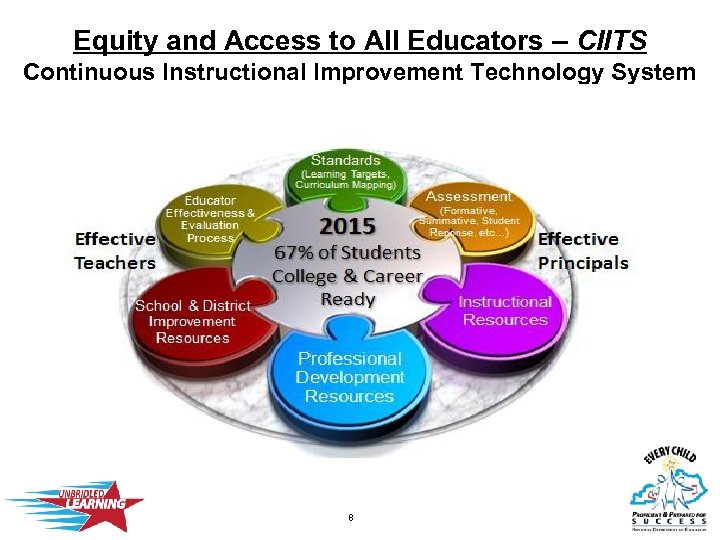 Equity and Access to All Educators – CIITS Continuous Instructional Improvement Technology System 8
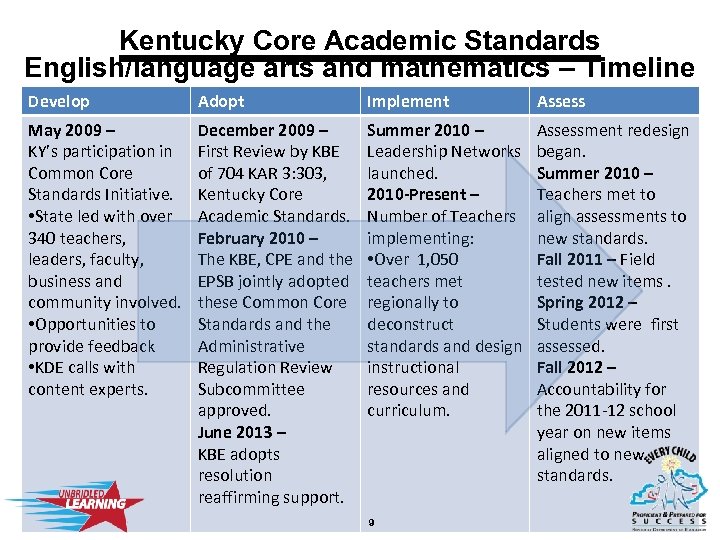 Kentucky Core Academic Standards English/language arts and mathematics – Timeline Develop Adopt Implement Assess May 2009 – KY’s participation in Common Core Standards Initiative. • State led with over 340 teachers, leaders, faculty, business and community involved. • Opportunities to provide feedback • KDE calls with content experts. December 2009 – First Review by KBE of 704 KAR 3: 303, Kentucky Core Academic Standards. February 2010 – The KBE, CPE and the EPSB jointly adopted these Common Core Standards and the Administrative Regulation Review Subcommittee approved. June 2013 – KBE adopts resolution reaffirming support. Summer 2010 – Leadership Networks launched. 2010 -Present – Number of Teachers implementing: • Over 1, 050 teachers met regionally to deconstruct standards and design instructional resources and curriculum. Assessment redesign began. Summer 2010 – Teachers met to align assessments to new standards. Fall 2011 – Field tested new items. Spring 2012 – Students were first assessed. Fall 2012 – Accountability for the 2011 -12 school year on new items aligned to new standards. 9
 Kentucky Department of Education Voices from Kentucky Practitioners 10
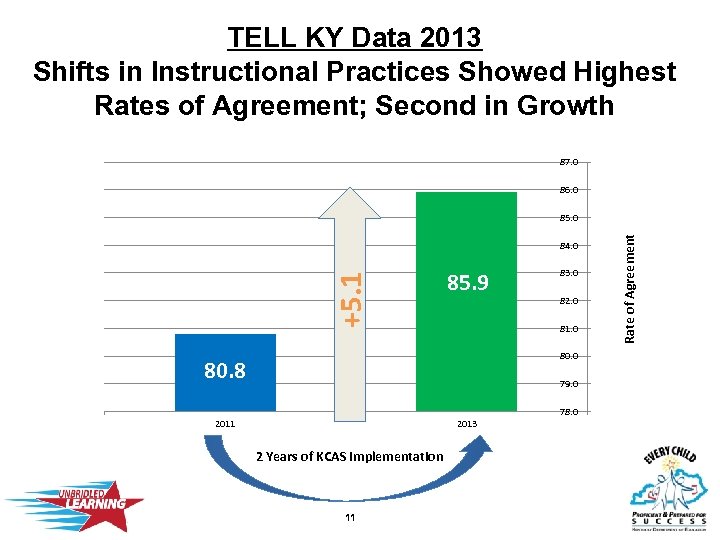 TELL KY Data 2013 Shifts in Instructional Practices Showed Highest Rates of Agreement; Second in Growth 87. 0 86. 0 +5. 1 84. 0 85. 9 83. 0 82. 0 81. 0 80. 8 79. 0 78. 0 2011 2013 2 Years of KCAS Implementation 11 Rate of Agreement 85. 0
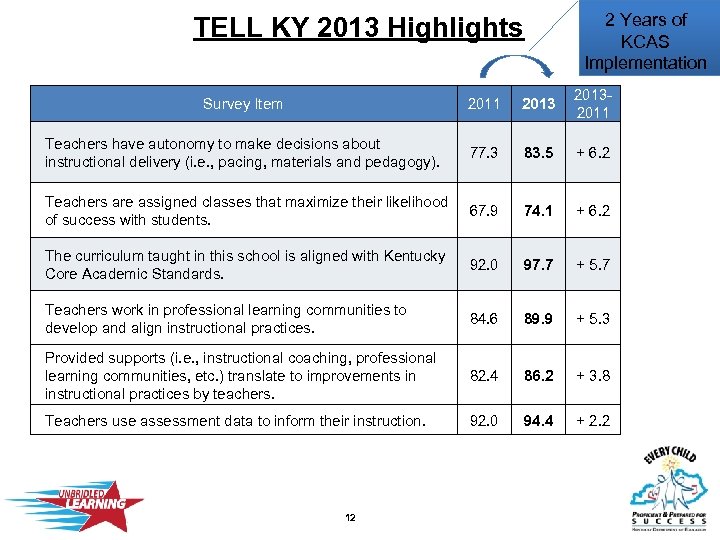 2 Years of KCAS Implementation TELL KY 2013 Highlights Survey Item 2011 20132011 Teachers have autonomy to make decisions about instructional delivery (i. e. , pacing, materials and pedagogy). 77. 3 83. 5 + 6. 2 Teachers are assigned classes that maximize their likelihood of success with students. 67. 9 74. 1 + 6. 2 The curriculum taught in this school is aligned with Kentucky Core Academic Standards. 92. 0 97. 7 + 5. 7 Teachers work in professional learning communities to develop and align instructional practices. 84. 6 89. 9 + 5. 3 Provided supports (i. e. , instructional coaching, professional learning communities, etc. ) translate to improvements in instructional practices by teachers. 82. 4 86. 2 + 3. 8 Teachers use assessment data to inform their instruction. 92. 0 94. 4 + 2. 2 12
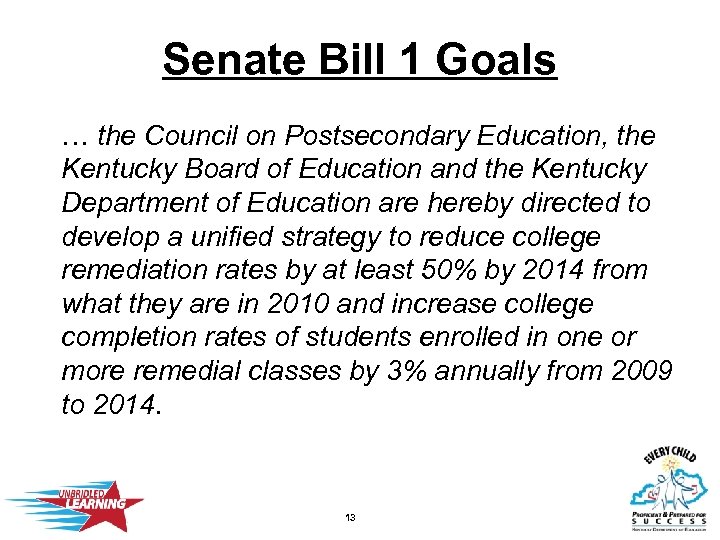 Senate Bill 1 Goals … the Council on Postsecondary Education, the Kentucky Board of Education and the Kentucky Department of Education are hereby directed to develop a unified strategy to reduce college remediation rates by at least 50% by 2014 from what they are in 2010 and increase college completion rates of students enrolled in one or more remedial classes by 3% annually from 2009 to 2014. 13
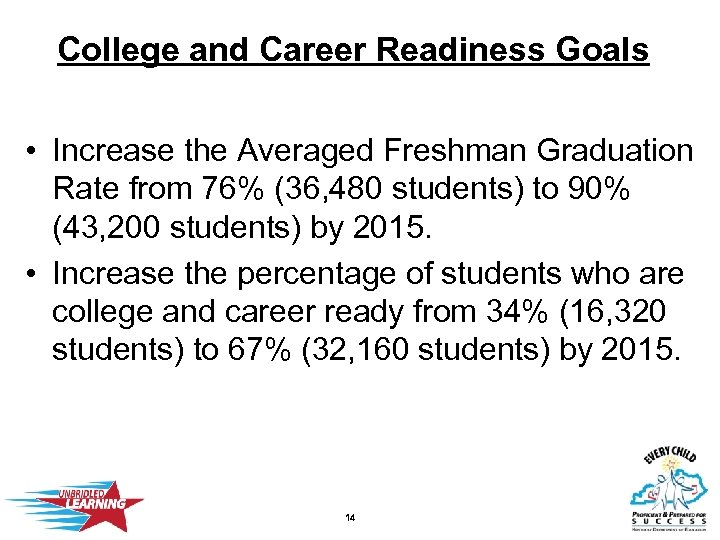 College and Career Readiness Goals • Increase the Averaged Freshman Graduation Rate from 76% (36, 480 students) to 90% (43, 200 students) by 2015. • Increase the percentage of students who are college and career ready from 34% (16, 320 students) to 67% (32, 160 students) by 2015. 14
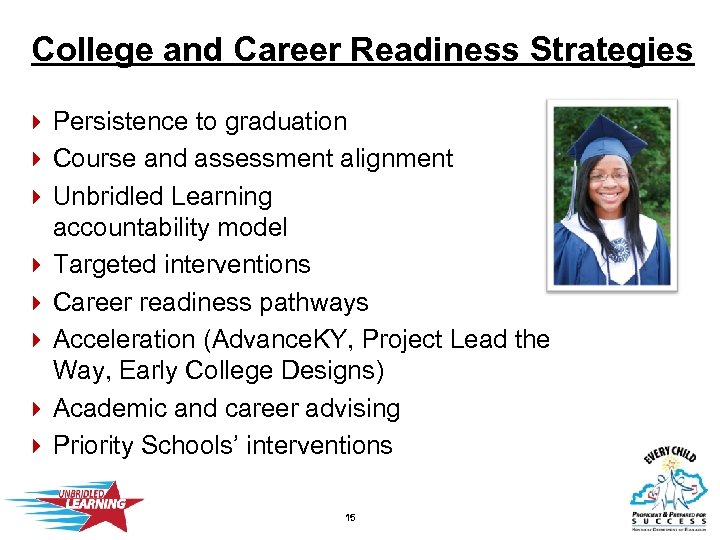 College and Career Readiness Strategies } } } } Persistence to graduation Course and assessment alignment Unbridled Learning accountability model Targeted interventions Career readiness pathways Acceleration (Advance. KY, Project Lead the Way, Early College Designs) Academic and career advising Priority Schools’ interventions 15
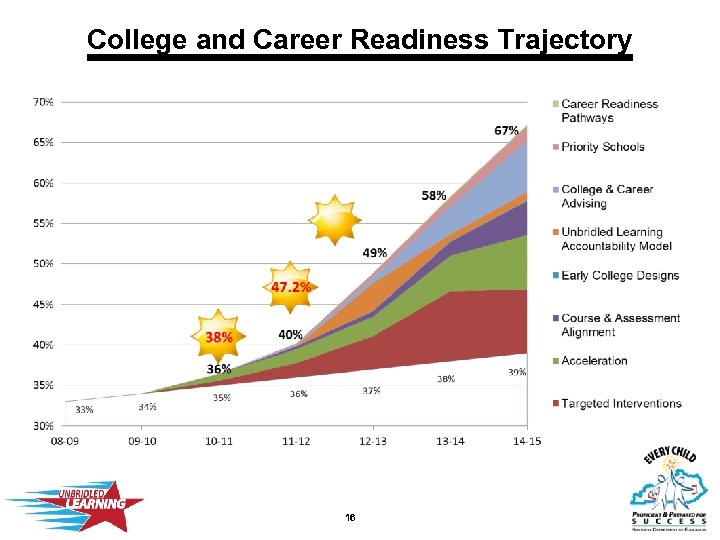 College and Career Readiness Trajectory 16
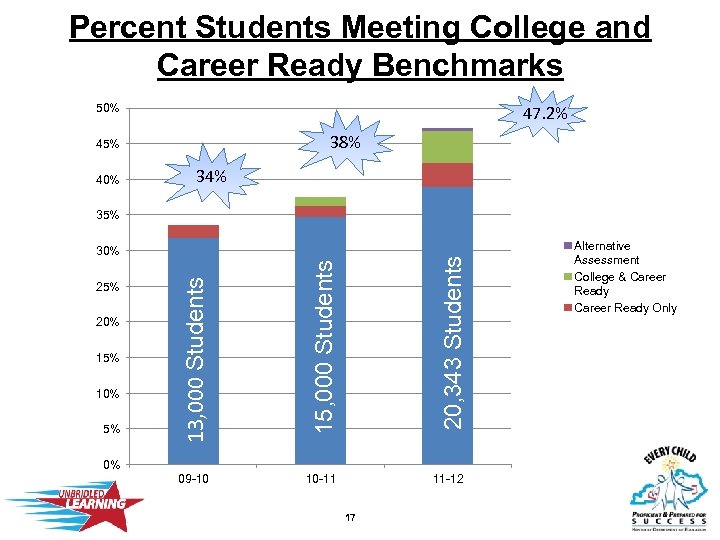 Percent Students Meeting College and Career Ready Benchmarks 50% 47. 2% 38% 45% 40% 34% 35% 10% 5% 20, 343 Students 20% 15, 000 Students 25% 13, 000 Students 30% 10 -11 11 -12 0% 09 -10 17 Alternative Assessment College & Career Ready Only
 Kentucky Department of Education Voices from the Field Student Learning: Then and Now 18
 Kentucky Core Academic Standards Next Generation Science Standards Ø Senate Bill 1 (2009) required new standards that: § Focus on the “critical knowledge, skills and capacities needed for success in the global economy. ” § “Consider international benchmarks” and “consider standards that have been adopted by national content advisory groups and professional education consortia. ” § Are aligned across all levels – elementary, middle, high and postsecondary. 19
 Kentucky Core Academic Standards Next Generation Science Standards Ø Shifts • Three dimensions integrated (Science & Engineering Practices, Core Ideas, Crosscutting Concepts). • Standards stated as student performance expectations, many with assessment boundaries. • Engineering integrated into K-12. • Increased emphasis on the practices of science, not just content. 20
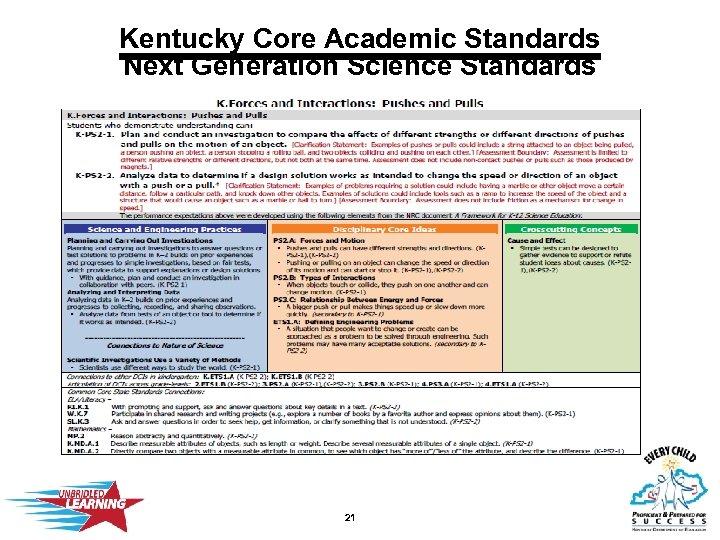 Kentucky Core Academic Standards Next Generation Science Standards 21
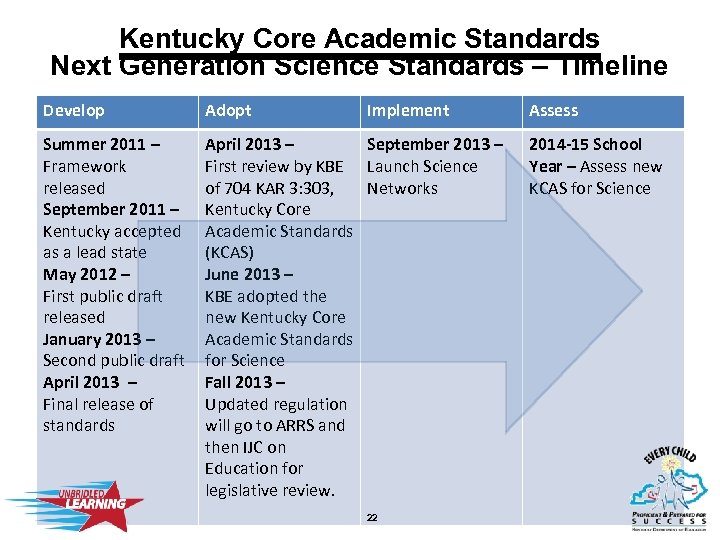 Kentucky Core Academic Standards Next Generation Science Standards – Timeline Develop Adopt Implement Summer 2011 – Framework released September 2011 – Kentucky accepted as a lead state May 2012 – First public draft released January 2013 – Second public draft April 2013 – Final release of standards April 2013 – September 2013 – First review by KBE Launch Science of 704 KAR 3: 303, Networks Kentucky Core Academic Standards (KCAS) June 2013 – KBE adopted the new Kentucky Core Academic Standards for Science Fall 2013 – Updated regulation will go to ARRS and then IJC on Education for legislative review. 22 Assess 2014 -15 School Year – Assess new KCAS for Science
 Kentucky Department of Education ACT Quality. Core® End-of-Course Kentucky Online Testing Update 23
 Background Ø End Of Course Assessments Ø English II Ø Algebra II Ø Biology Ø U. S. History Ø 100% of High Schools Use Score for Grading Ø Addresses student motivation Ø Provides rich set of instructional materials Ø Uses score for local and state purposes 24
 Background Ø In 2012, 34% or 59, 755 students were successfully tested with the ACT online system. Ø Because of the immediate results and other changes to the end-of-course (EOC) assessments, there was an increased interest in the online testing in 2013. Ø 65% of schools were planning to use online testing in 2013. Ø Over 10, 000 students were successfully tested throughout the 2012 -13 school year prior to April 29. 25
 Problem Ø From April 29 to May 3, ACT ran into significant capacity issues while trying to handle online testing from high schools in Alabama, Ohio, and Kentucky. Ø ACT informed KDE on May 3 that they were closing the online system to make repairs. Ø KDE decided to require all schools to move to a paper version of the test. 26
 Impact Ø Some schools were allowed to complete their tests using the repaired online system starting on May 8. These schools either had partially completed tests in the online system, severe scheduling issues or problems with delivery of paper tests. Ø Approximately 2, 000 students in 30 schools are known to have had interrupted online test sessions but were able to complete the tests. 27
 Impact (continued) Ø Schools converting from online tests to paper administration experienced challenges in rescheduling. Ø Local grading policies were reviewed for impact. Some schools revised policies or delayed grade reports. Ø 100% of high school students expected to take EOC tests completed testing in the online system or with paper. 28
 Accountability Ø KDE, Education Measurement, Hum. RRO and ACT psychometricians will evaluate the impact of the testing problems on scores for individual students and schools. Ø KDE will review accountability scores for the affected schools for appropriate use. Ø KDE will contact district staff as this process evolves. 29
 Decisions for the Future Ø Two important issues are being discussed: § Contractual impact for the 2013 testing program § Contractual impact for the 201314 school year 30
 Kentucky Department of Education ACT Quality. Core® End-of-Course Constructed Response (CR) Update 31
 The Call for a New Assessment System • Senate Bill 1 (SB 1), enacted in the 2009 Kentucky General Assembly, required a new public school assessment program beginning in the 2011 -12 school year. • The legislation allowed, with approval by the Kentucky Board of Education (KBE), an end-ofcourse (EOC) assessment program at the high school level. 32
 End-of-Course: Dual Purpose • Instruction • Accountability – Objectives – Student – Syllabus – School – Course Outline – District – Instructional Units – State – Formative Item Pool/Benchmark Assessments 33
 Issues with State-Administered Constructed Response • • • Unable to add instructional value Lack of student motivation Security of CR items Return of CR scores untimely Confusion with two different scores – Scale Score (MC/MC) – Super Scale Score (MC/MC/CR) 34
 Local Administration Instructional Value • Constructed Response administered locally will render more instructional value. – Students, parents, teachers have student work to score and analyze. – Teachers can identify strengths and weaknesses in student writing and content. – Instruction can be based on current data. 35
 Constructed Response Shift to Local Administration • Local staff may obtain CR items from various locations: – Formative Item Bank (ACT System) – Benchmark Assessment (ACT System) – Local Source • Textbook • Locally-developed • Open source 36
 Constructed Response Shift to Local Administration (continued) • Constructed Response will not be part of stateadministered assessment. • Students will take multiple choice sections for state accountability. • Schools will receive Scale Score (MC/MC). • Constructed Response will be administered at the local level. • Local administration and scoring • Inclusion in student’s final exam grade • Instructional value 37
 EOC Results Included in Student Grades • End-of-course (EOC) test results may be used for a percentage of a student’s final grade in the course, as outlined in local policy. If that percentage is less than 20 percent, school districts will submit reports to KDE providing justification. • KDE has developed a collection tool that is to be completed by December 31 of each year. • Percentage used for student’s final grade • Justification • Utilization of Constructed Response items will be added to this survey 38
 Financial Benefit • Potential savings of $2 million annually. 39