


 Скачать презентацию Keeping open the door to mathematically demanding F HE
73ef67d10e5cb4f9472fb05765090ed5.ppt
- Количество слайдов: 25
 Keeping open the door to mathematically demanding F&HE programmes Laura Black Pauline Davis Paul Hernandez-Martinez Graeme Hutcheson Maria Pampaka Su Nicholson Geoff Wake Julian Williams
 Aim We aim to understand how cultures of learning and teaching can support learners in ways that help widen and extend participation in mathematically demanding courses in F & HE. 2
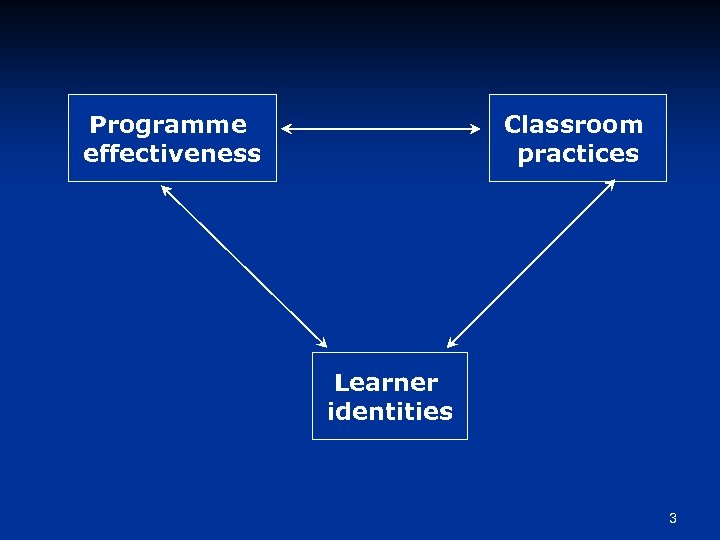 Programme effectiveness Classroom practices Learner identities 3
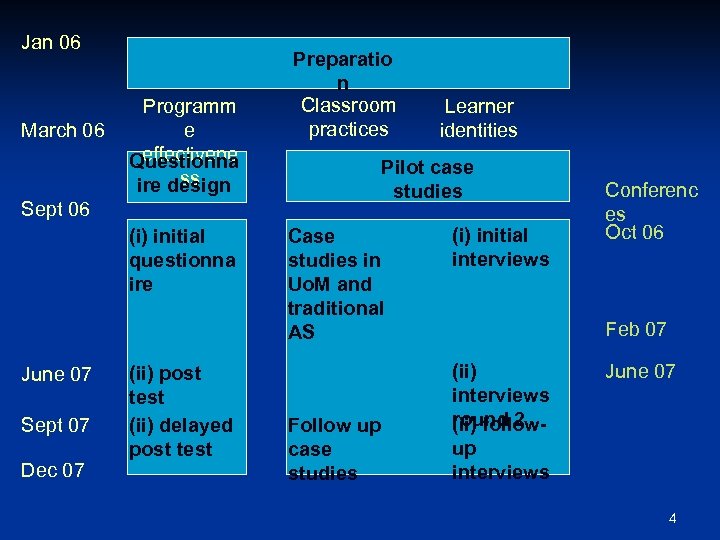 Jan 06 March 06 Programm e effectivene Questionna ss ire design Preparatio n Classroom practices Pilot case studies Sept 06 (i) initial questionna ire June 07 Sept 07 Dec 07 (ii) post test (ii) delayed post test Learner identities Case studies in Uo. M and traditional AS Follow up case studies (i) initial interviews Conferenc es Oct 06 Feb 07 (ii) interviews round 2 (ii) followup interviews June 07 4
 Outcomes Knowledge about how mathematics teaching and learning cultures can support better participation in mathematics n Measurements of the effectiveness of two distinctive programmes of mathematics on learning n Development of theories of learner identities in maths contexts n 5
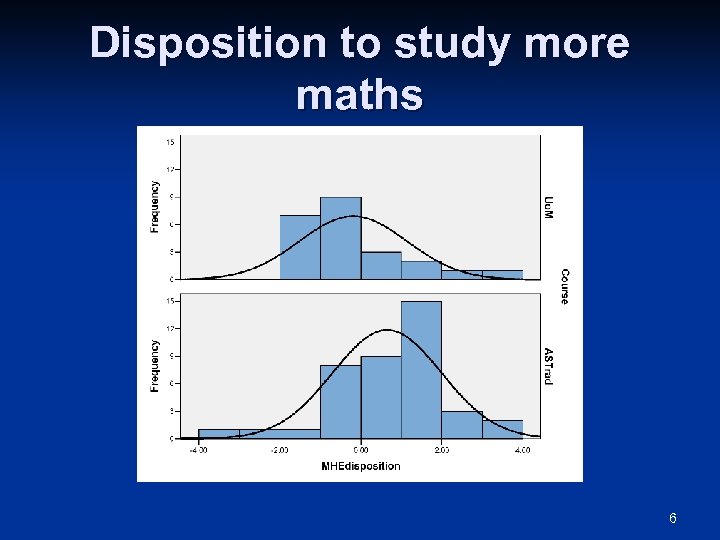 Disposition to study more maths 6
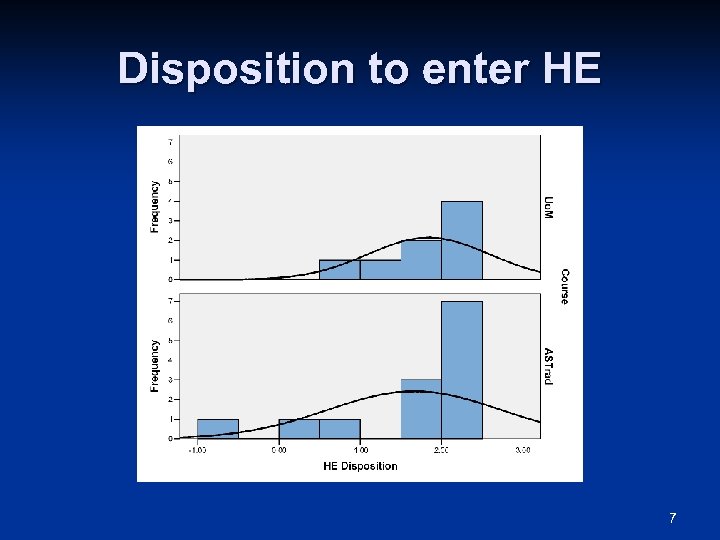 Disposition to enter HE 7
 Identity Questions n What kinds of maths learner identity (and trajectory) are there? n How are identities ‘narrated’? (Bruner, 1996) n What resources/CMs do students use in their identity work? n How does pedagogy impact? 8
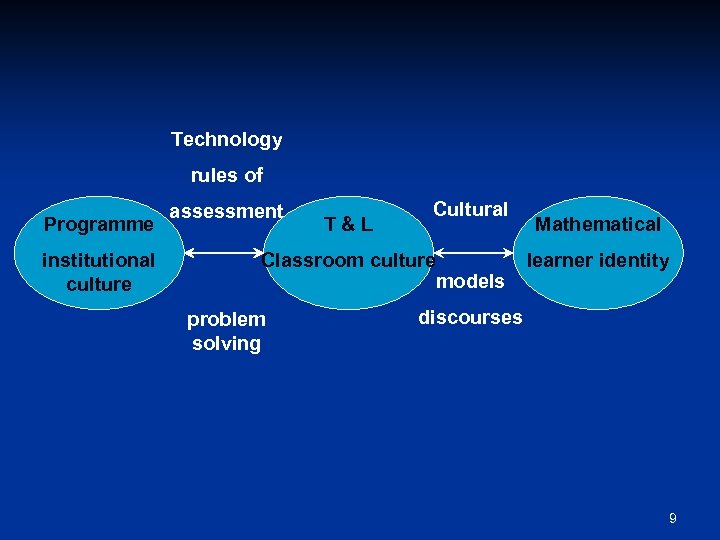 Technology rules of Programme institutional culture assessment T&L Cultural Classroom culture models problem solving Mathematical learner identity discourses 9
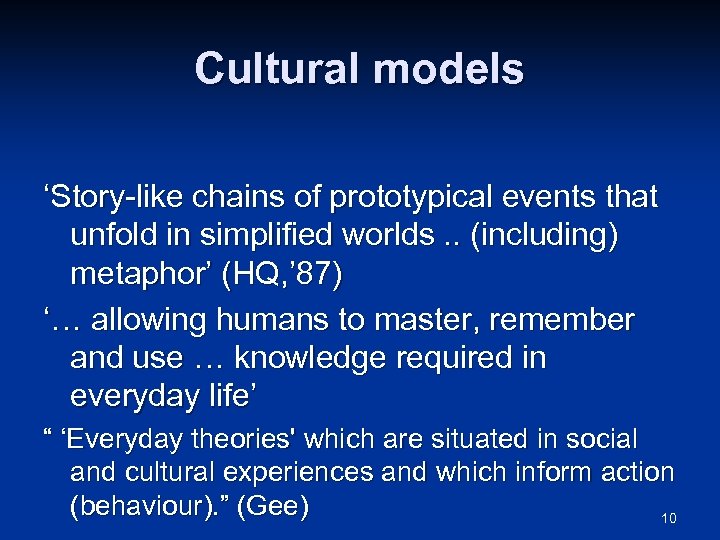 Cultural models ‘Story-like chains of prototypical events that unfold in simplified worlds. . (including) metaphor’ (HQ, ’ 87) ‘… allowing humans to master, remember and use … knowledge required in everyday life’ “ ‘Everyday theories' which are situated in social and cultural experiences and which inform action (behaviour). ” (Gee) 10
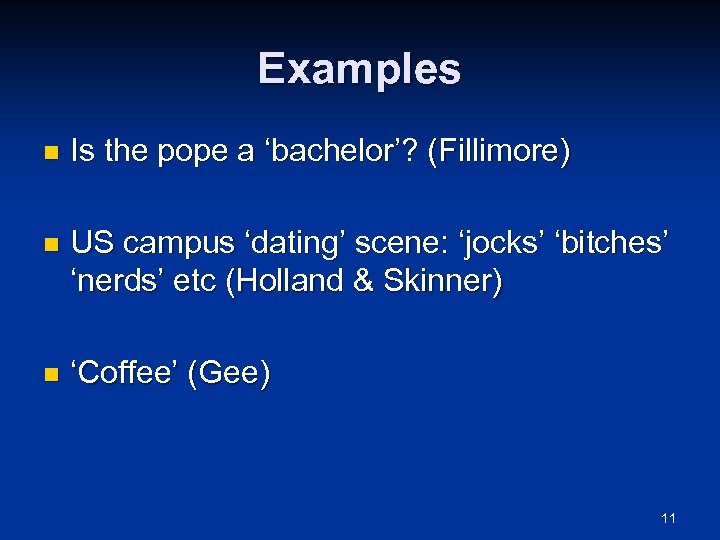 Examples n Is the pope a ‘bachelor’? (Fillimore) n US campus ‘dating’ scene: ‘jocks’ ‘bitches’ ‘nerds’ etc (Holland & Skinner) n ‘Coffee’ (Gee) 11
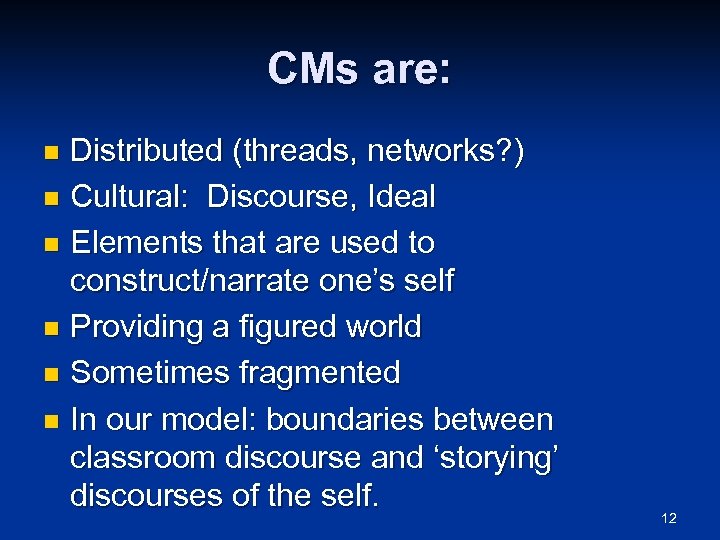 CMs are: Distributed (threads, networks? ) n Cultural: Discourse, Ideal n Elements that are used to construct/narrate one’s self n Providing a figured world n Sometimes fragmented n In our model: boundaries between classroom discourse and ‘storying’ discourses of the self. n 12
 Gemma’s story Draws on some positive cultural models, but others that one might hope for do not seem to be available: e. g. graduate role models n Maths hard but challenging n Models of maths learning may be influential but not necessarily ‘leading’ the story: Orcas n 13
 Lee’s story Lee arrived in AS with stronger grades at GCSE but got ‘dropped’ n Claims maths is hard and ‘boring’ n He appears to have been marginal in his AS maths classes n 14
 Some CMs evident in interviews n Maths is hard but challenging versus maths is hard and dull: cultural models can be ambivalent, i. e. used to tell opposite stories Maths is black and white versus ‘your own’ n Maths is ‘on your own’ versus ‘learning with others/ sociable’ n etc n 15
 Does pedagogy make a difference? n One notable contrast between Lee and Gemma: the sociability of maths for them: for Gemma and her classmates maths is sociable, for Lee maths is isolating Might different pedagogies offer different CMs, or different positionings in relation to CMs? n Over to Pauline n 16
 Identity n We build our identities (i) in practice and (ii) discursively using cultural models; n What models are there of ‘ways of being a mathematician/learner of mathematics? ’ n How can mathematics learner identity be mediated by mathematics classroom social practice? Can we expand the repertoire of cultural models? 17
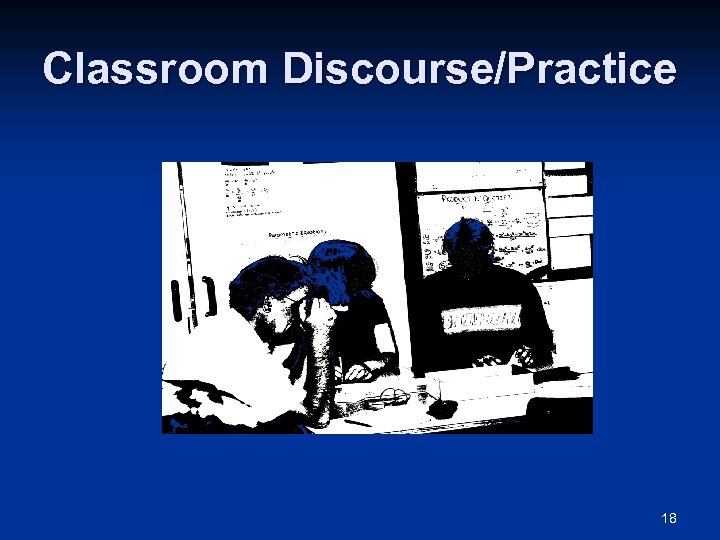 Classroom Discourse/Practice 18
 n We often find student identities are doublediscoursed in a genre adopting a dual register, one of student and the other (sometimes more quietly spoken and ‘hidden’) of everyday teenage talk, indicating tensions between these opposing voices. The micro data shows an alternative discourse where there is flip flopping between themes, maths and non-maths (every-day teenage) talk; n The tenor (or voice) remains broadly the same. n 19
 Cultural models associated with this classroom n Maths as negotiable, not black and white n Maths as fun n Maths as hands on/practical n Maths as sociable 20
 K And like not only you think for yourself but like we can ask other people why they got that and it’s not just like black and white, like you get to a different way to work it out. n J … it sounds daft but you’re having fun while you’re doing it cos you can sit and you can talk to people but… talk about the work but you can… it’s not a thing where you come down and sit in silence and you do it, you can talk to people and 21 can, you know, do practical things n
 : …more fun than just doing examples all the time and we have the whiteboards and like all the games that …[the teacher]. . makes us play and like… it’s just fun, rather than just textbooks and notebooks all the time… K…so it’s quite good, you always know the faces and stuff like that, where in other lessons you don’t even know them, you don’t even know they’re in your lesson, so it’s really good. A 22
 Ownership, understanding/conceptual, fun, joint activity No, it isn’t just about having fun. I mean that obviously, it’s part of it, because, just number crunches on data can be sort of boring, can’t it? So, the fun element is a part of trying to make stats a bit more fun. It’s not my favourite topic of maths, I have to confess…But I also think that if you just write some numbers on the board and put a couple of extreme values for example, then well, what’s the point of them? [ ] So there’s an understanding of why there are these sort of extreme values, so even though it’s been …you saved yourself of data collection…And also I think there is, it’s ownership as well, which I think just makes it… ‘Yeah, OK we haven’t got the full purpose, we haven’t got a comparison, I am not going to do much work afterwards, but it’s their data, they’ve done something with them, they’re finishing of 23 by…you know make it look nice… and using it.
 n 1. The teacher wanted to construct a 'sociable' pedagogy, and part of this involves accepting 'where the kids are coming from' (her identity. . . ). 2. This is arguably an attempt to construct a new/alternative 'cultural model' of 'being a maths person/learner'. … ‘you’re a mathematician…’ n 3. There is data from the students interviews that suggests they at least in part buy into this; they like maths and when thinking of going to university maths "I don’t see why not" (and also it seems 'being accepted socially' might be an important factor in this). 4. There is evidence that the 'outside school' peer discourse is accepted in the classroom, possibly even encouraged. These interactional features (tenor etc) then facilitate mathematical interactions: that is talking mathematics becomes an accepted part of the banter of peer talk (in the classroom). 24
 Hypothesis: n. This acceptance of mathematics into the peer discourse/sociality of the students may be the first sign in a chain of acceptance of a 'mathematical identity'. In other words, the discourse is a sign that, perhaps, they are accepting "being a maths-person" as part of their self/identity. . . themselves. 25