


 Скачать презентацию Keeping Calves Healthy Calf Management Practices Dairy Skills
cbfbc5c66d61a66d03d78ef518a4c5e9.ppt
- Количество слайдов: 36
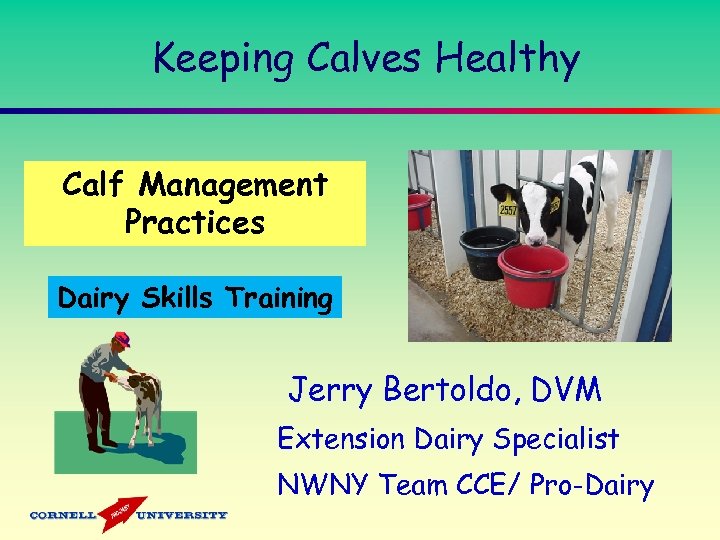 Keeping Calves Healthy Calf Management Practices Dairy Skills Training Jerry Bertoldo, DVM Extension Dairy Specialist NWNY Team CCE/ Pro-Dairy
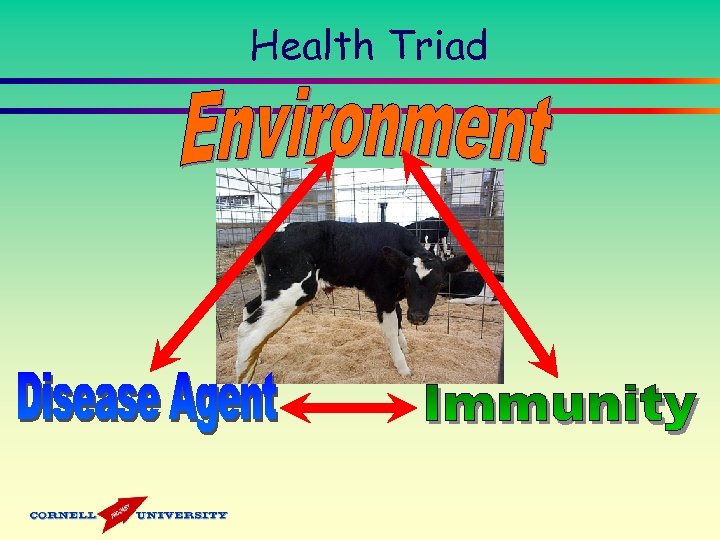 Health Triad
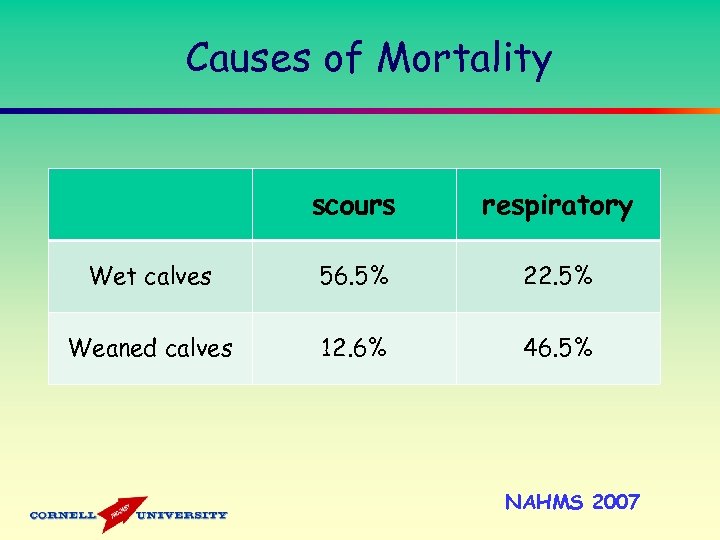 Causes of Mortality scours respiratory Wet calves 56. 5% 22. 5% Weaned calves 12. 6% 46. 5% NAHMS 2007
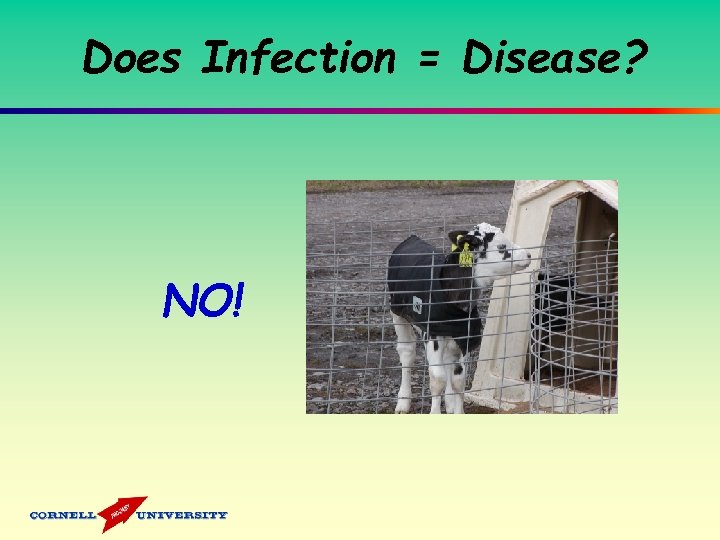 Does Infection = Disease? NO!
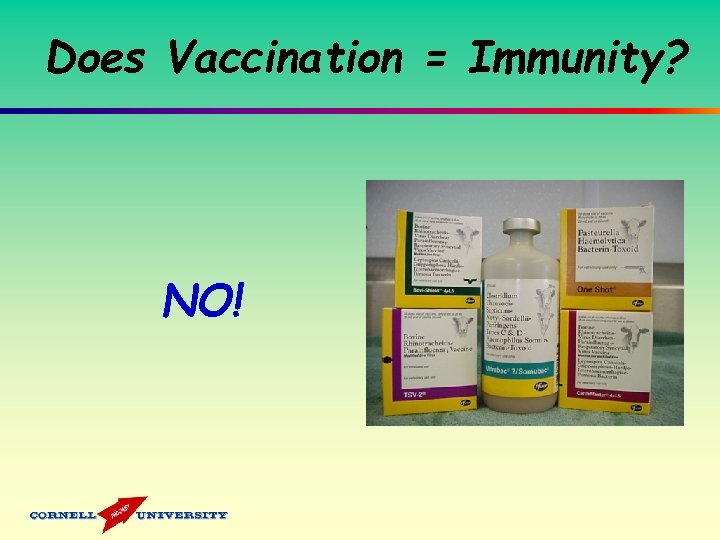 Does Vaccination = Immunity? NO!
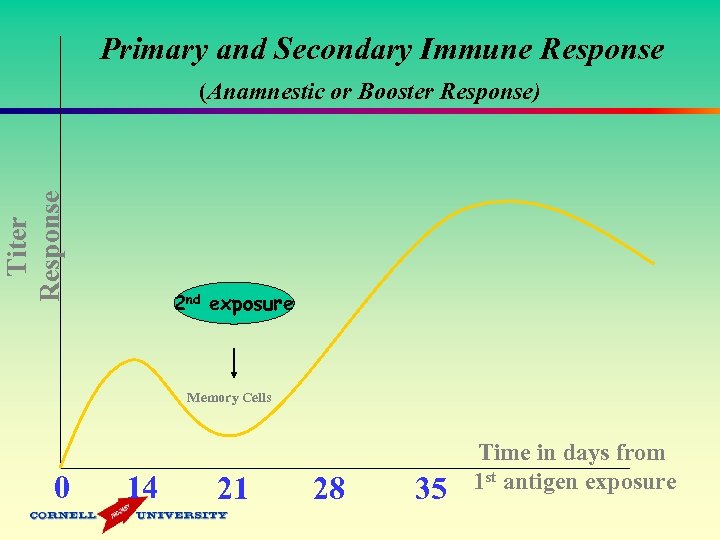 Primary and Secondary Immune Response Titer Response (Anamnestic or Booster Response) 2 nd exposure Memory Cells 0 14 21 28 35 Time in days from 1 st antigen exposure
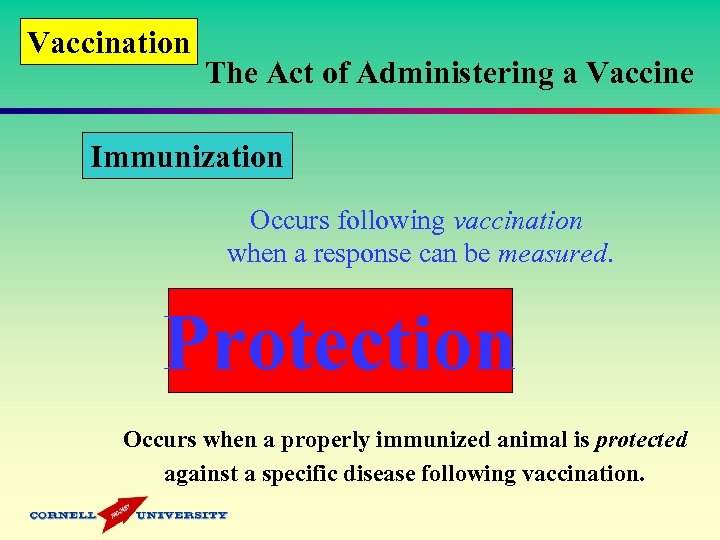 Vaccination The Act of Administering a Vaccine Immunization Occurs following vaccination when a response can be measured. Protection Occurs when a properly immunized animal is protected against a specific disease following vaccination.
 Vaccine use ÜMaternal antibody interference is largely dissipated by 2 months of age ÜVaccination programs should be based on history and risk of disease introduction ÜCalf raisers adopt early administration by necessity
 MLV Vaccines Advantages Disadvantages Ü Rapid protection Ü May cause abortion Ü One dose? Ü No sunlight exposure Ü No adjuvant Ü Better CMI and mucosal Ü “Cleaner” product Ü Less expensive Ü Mix and use rapidly Ü Inactivation with residues Ü Possible viral contamination
 Killed Viral Vaccines Advantages Disadvantages Ü Safe on all pregnancies Ü More hypersensitivity Ü Stability Ü Multiple doses needed for protection Ü Ready to use Ü Use as needed Ü Little or no CMI or mucosal protection Ü More expensive
 Vaccination precautions ÜThe 1 st time use of E. coli, Salmonella, Pasturella, Hemophilus and Moraxella vaccines can be associated with delayed allergic reactions particularly in Holstein and Jersey cattle ÜLimit vaccinating to two bacterial components per time ÜSeparate from next one by 7 days ÜDo not use 5 way Lepto on calves
 GOOD IMMUNITY CAN BE OVERCOME BY POOR MANAGEMENT!!
 Vaccination failures – 5 to 15% ÜMaternal antibody interference ÜAge – under 5 days old ÜStress (cortisol) – too hot, dehorning ÜPoor nutrition ÜImproper vaccine handling ÜFollowing directions – IM, SQ, how deep? ? ?
 Vaccination alternatives ÜIntranasal – Nasalgen, Onset v. Little maternal antibody interference v. Quick response v. Safe at very young age v. Possible wider spectrum of effect ÜOral – Calf Guard, First Defense v. Timing just like colostrum
 Behavioral patterns for wet calves vary by age ÜLying down (73 -81%) with age (55% lying in daylight vs. near 100% at night) ÜStanding (4. 4 -11. 4%) with age ÜEating (1. 4 -5. 5%) levels off after 2 nd wk ÜGrooming (2. 5– 4. 5%) with age ÜInvestigating (0. 2 -2. 9%) with age ÜContacting pen (2. 7 -9. 0%) peaks in 3 rd wk
 Bedding Choices ÜWood shavings ÜStraw ÜSawdust ÜPea gravel ÜSand ÜCrusher fines ÜPaper by-products ÜHarvest by-products
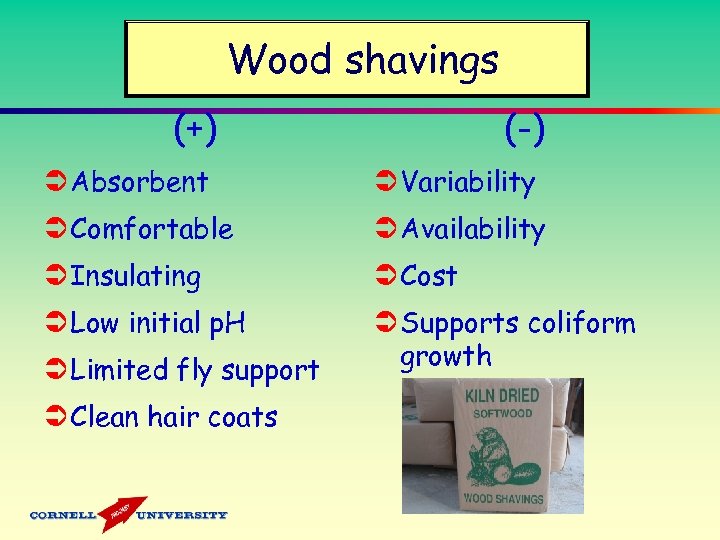 Wood shavings (-) (+) Ü Absorbent Ü Variability Ü Comfortable Ü Availability Ü Insulating Ü Cost Ü Low initial p. H Ü Supports coliform growth Ü Limited fly support Ü Clean hair coats
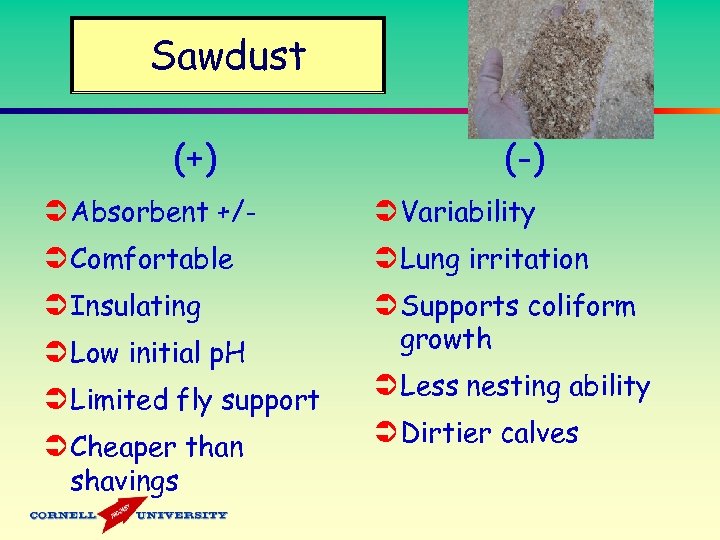 Sawdust (+) (-) Ü Absorbent +/- Ü Variability Ü Comfortable Ü Lung irritation Ü Insulating Ü Supports coliform growth Ü Low initial p. H Ü Limited fly support Ü Cheaper than shavings Ü Less nesting ability Ü Dirtier calves
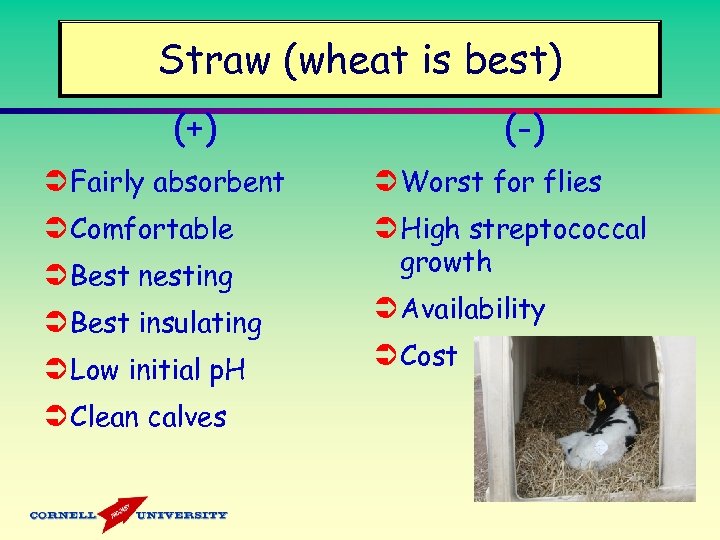 Straw (wheat is best) (-) (+) Ü Fairly absorbent Ü Worst for flies Ü Comfortable Ü High streptococcal growth Ü Best nesting Ü Best insulating Ü Low initial p. H Ü Clean calves Ü Availability Ü Cost
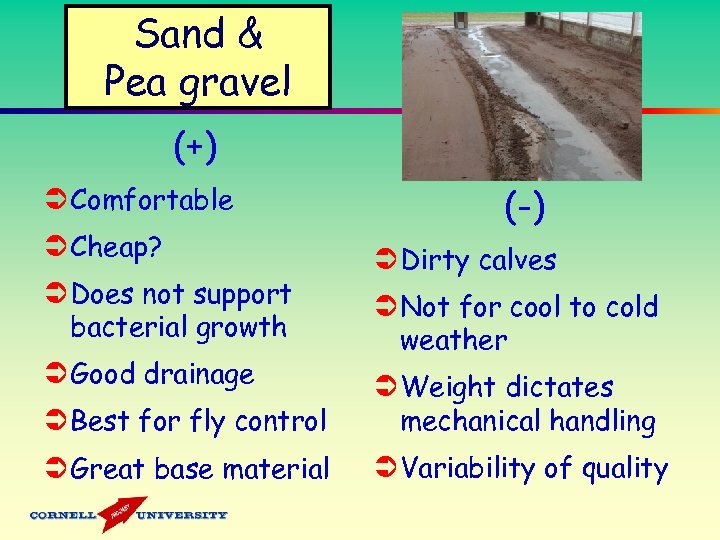 Sand & Pea gravel (+) Ü Comfortable Ü Cheap? Ü Does not support bacterial growth Ü Good drainage (-) Ü Dirty calves Ü Not for cool to cold weather Ü Best for fly control Ü Weight dictates mechanical handling Ü Great base material Ü Variability of quality
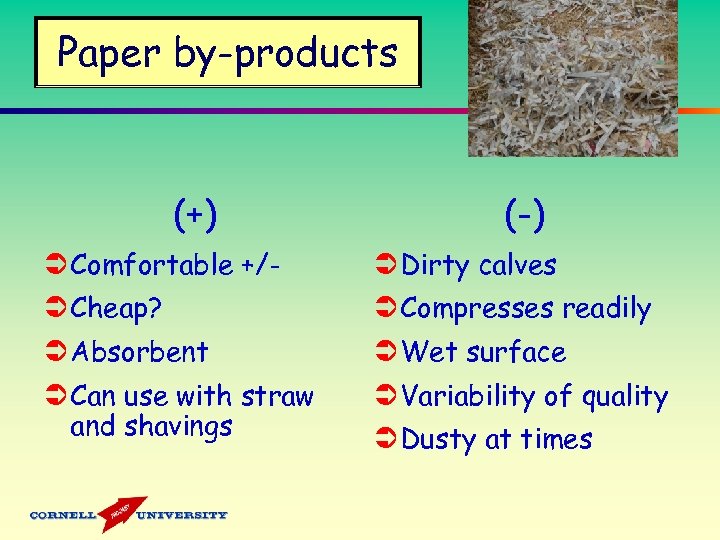 Paper by-products (+) (-) Ü Comfortable +/- Ü Dirty calves Ü Cheap? Ü Compresses readily Ü Absorbent Ü Wet surface Ü Can use with straw and shavings Ü Variability of quality Ü Dusty at times
 Baby calves and parasites ÜNematodes, lice, mange and ringworm can be transmitted from adults or their environment, but are less problematic than flies ÜExposure to sunlight, nutritional status, whether housed in groups or alone and contact with older cattle determines infection ÜFlies are dependent on environment alone
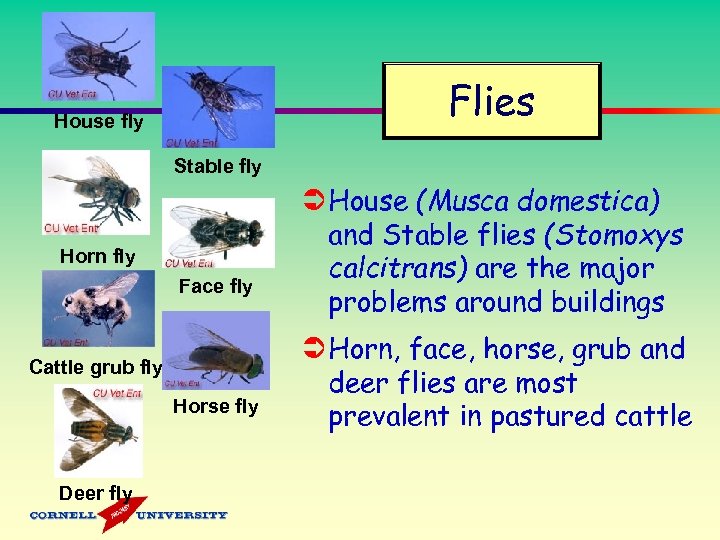 Flies House fly Stable fly Horn fly Face fly Cattle grub fly Horse fly Deer fly Ü House (Musca domestica) and Stable flies (Stomoxys calcitrans) are the major problems around buildings Ü Horn, face, horse, grub and deer flies are most prevalent in pastured cattle
 Diagnostic Work ÜQuantitative bacterial counts on colostrum, waste milk, pasteurized milk and rinse water from cleaned feeding equipment ÜCulture potential contaminated areas such as calf “hot box”, transport vehicle, area under feed and water
 Diagnostic Work Ü Check for water hardness and coliforms Ü Check forages for mycotoxins, p. H and digestibility Ü How many deaths are posted and sampled? Ü Live calf sampling for pathogens Ü Screening for BVD, BLV, mycoplasma, salmonella
 Zoonotic Diseases for man and beast! ÜCrypto ÜCampylobacter ÜSalmonella ÜLepto ÜRingworm ÜMange
 Feed Additives ÜMilk replacer antibiotic (NT) inclusion rates to change v. Early and late wet period strategies ÜBetter to have cocci control in milk replacer than antibiotic ÜMOS products generally give payback ÜProbiotics can be helpful
 Feed Additives ÜAS 700, Aureomycin, Aureo+Bovatec v. Good management or crutch? ÜOrganic/chelated minerals up to 50% v. High iron, hydrogen sulfide or sulfates ÜAnimal source proteins v. Serum, blood meal
 Welfare Issues ÜDepends on your perception ÜEase of identification and visibility by public increases concern ÜDairy world has an acclimated view of many welfare issues ÜIncludes trucking, handling, noise, teat removal, vaccinating
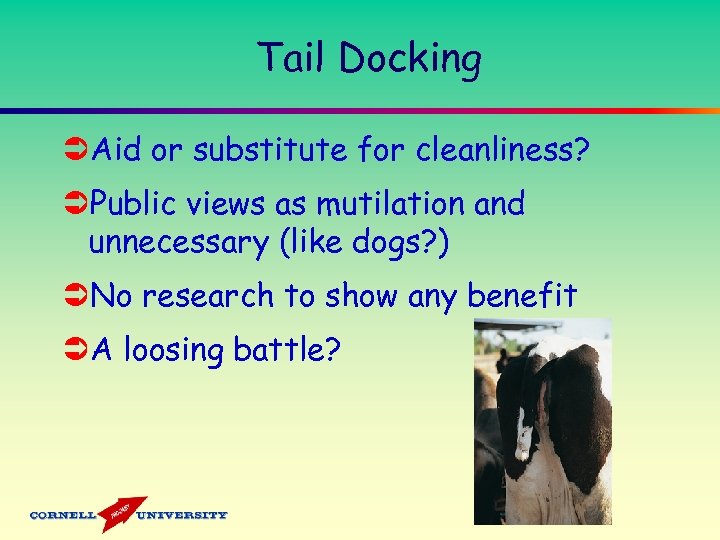 Tail Docking ÜAid or substitute for cleanliness? ÜPublic views as mutilation and unnecessary (like dogs? ) ÜNo research to show any benefit ÜA loosing battle?
 Tail Docking - Banding ÜBest < 21 days of age – shorter sensitivity period ÜClose-up heifers minimal effect ÜLocal/epidural anesthetic of little value ÜCortisol (stress) response no different than restraint response ÜPossible chronic pain – neuromas Ü number of flies on hind quarters
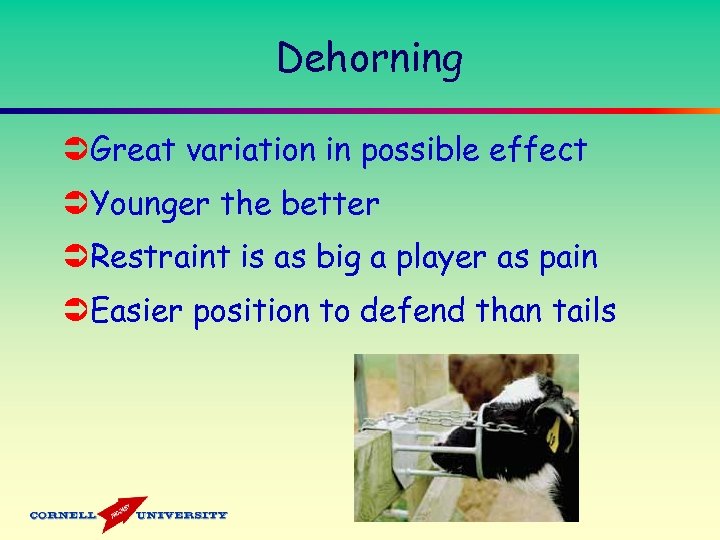 Dehorning ÜGreat variation in possible effect ÜYounger the better ÜRestraint is as big a player as pain ÜEasier position to defend than tails
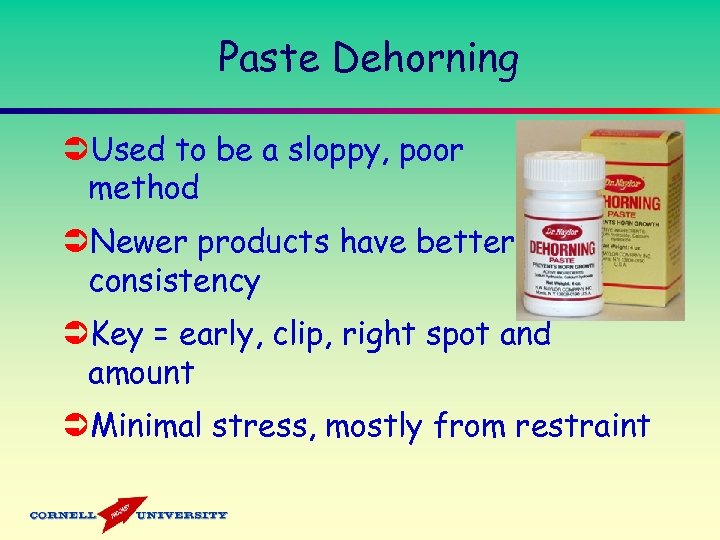 Paste Dehorning ÜUsed to be a sloppy, poor method ÜNewer products have better consistency ÜKey = early, clip, right spot and amount ÜMinimal stress, mostly from restraint
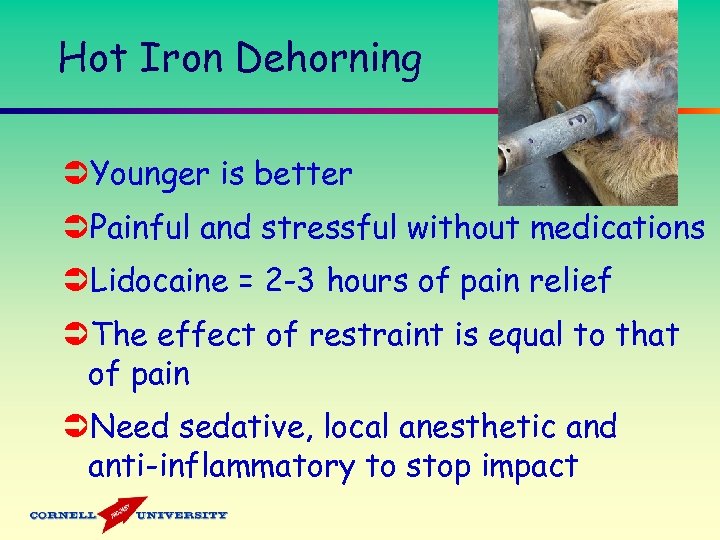 Hot Iron Dehorning ÜYounger is better ÜPainful and stressful without medications ÜLidocaine = 2 -3 hours of pain relief ÜThe effect of restraint is equal to that of pain ÜNeed sedative, local anesthetic and anti-inflammatory to stop impact
 Mediating Pain ÜLittle effort in the industry to deal with post procedural discomfort ÜBanamine (fluniximine) only practical drug ÜIV should be only administration route ÜHalf life is only 8 hours ÜMust be repeated every 24 hours
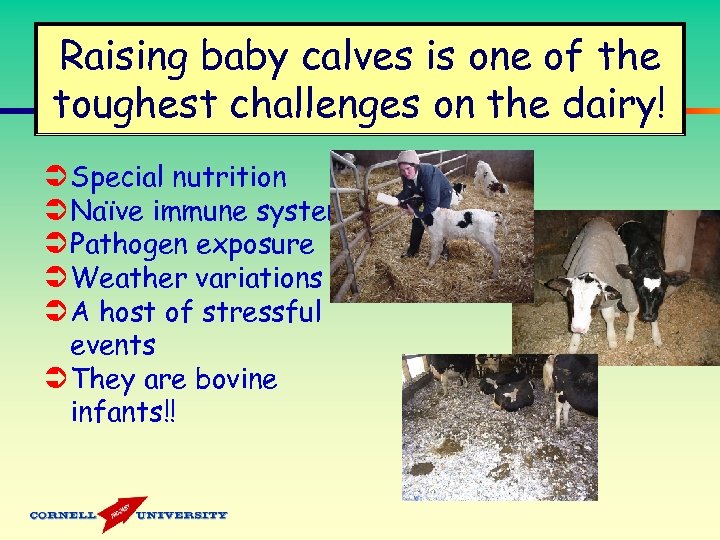 Raising baby calves is one of the toughest challenges on the dairy! Ü Special nutrition Ü Naïve immune system Ü Pathogen exposure Ü Weather variations Ü A host of stressful events Ü They are bovine infants!!