


 Скачать презентацию KDD-07 Invited Innovation Talk August 12 2007
70486a27f910f12ca53440846402c374.ppt
- Количество слайдов: 64
 KDD-07 Invited Innovation Talk • August 12, 2007 Usama Fayyad, Ph. D. Chief Data Officer & Executive VP Yahoo! Inc. Research 0
 1 Thanks and Gratitude • My family: my wife Kristina and my 4 kids; my parents and my sisters • My academic roots: The University of Michigan, Ann Arbor – my Ph. D. committee, • My Mentors and Collaborators including Ramasamy Uthurusamy (then at GM Research Labs), grad student colleagues (Jie Cheng), Internships at GM Research and at NASA’s JPL – Caltech Astronomy (G. Djorgovski, Nick Weir), Pietro Perona and M. C. Burl – JPLNASA Colleagues: Padhraic Smyth, Rich Doyle, Steve Chien, Paul Stolorz, Peter Cheeseman, David Atkinson, many others… – Microsoft Colleagues: Decision Theory Group, Surajit Chadhuri, Jim Gray, Paul Bradley, Bassel Ojjeh, Nick Besbeas, Heikki Mannila, Rick Rashid, many others – Fellows in KDD: Gregpry Piatetsky-Shapiro, Daryl Pregibon, Christos Faloutsos, Geoff Webb, Bob Grossman, Jiawei Han, Eric Tsui, Tharam Dillon, Chengqi Zhang, many colleagues • My Business Partners – Bassel Ojjeh, Nick Besbeas, many VC’s, many advisers and strategic clients including Microsoft SQL Server and sales teams • My Yahoo! Colleagues: – Zod Nazem, Jerry Yang, David Filo, Yahoo! exec team, Prabhakar Raghavan, Pavel Berkhin, Nick Weir, Hunter Madsen, Nitin Sharma, Raghu Ramakrishnan, Y! Research folks, many at Yahoo SDS and current and previous Yahoo! employees Research
 A Data Miner’s Story – Getting to Know the Grand Challenges • Personal Observations of a Data Mining Disciple Usama Fayyad, Ph. D. Chief Data Officer & Executive VP Yahoo! Inc. Research 2
 3 Overview • The setting • Why data mining is a must? • Why data mining is not happening? • A Data Miner’s Story – Grand Challenges: Pragmatic – Grand Challenges: Technical – Some case studies • Concluding Remarks Research
 4 The data gap… • The Machinery Moves on: – Moore’s law: processing “capacity” doubles every 18 months : CPU, cache, memory – It’s more aggressive cousin: Disk storage “capacity” doubles every 9 months • The Demand is exploding: – Every business is an e. Business – Scientific Instruments and Moore’s law – Government • The Internet – the ubiquity of the Web • The Talent Shortage Research
 5 What is Data Mining? Finding interesting structure in data • Structure: refers to statistical patterns, predictive models, hidden relationships • Interesting: ? • Examples of tasks addressed by Data Mining – Predictive Modeling (classification, regression) – Segmentation (Data Clustering ) – Affinity (Summarization) • relations between fields, associations, visualization Research
 6 Beyond Data Analysis • Scaling analysis to large databases – How to deal with data without having to move it out? – Are there abstract primitive accesses to the data, in database systems, that can provide mining algorithms with the information to drive the search for patterns? – How do we minimize--or sometimes even avoid--having to scan the large database in its entirety? • Automated search – Enumerate and create numerous hypotheses – Fast search – Useful data reductions • More emphasis on understandable models – Finding patterns and models that are “interesting” or “novel” to users. • Scaling to high-dimensional data and models. Research
 Data Mining and Databases Many interesting analysis queries are difficult to state precisely • Examples: – which records represent fraudulent transactions? – which households are likely to prefer a Ford over a Toyota? – Who’s a good credit risk in my customer DB? • Yet database contains the information – good/bad customer, profitability – did/did not respond to mailout/survey/. . . Research
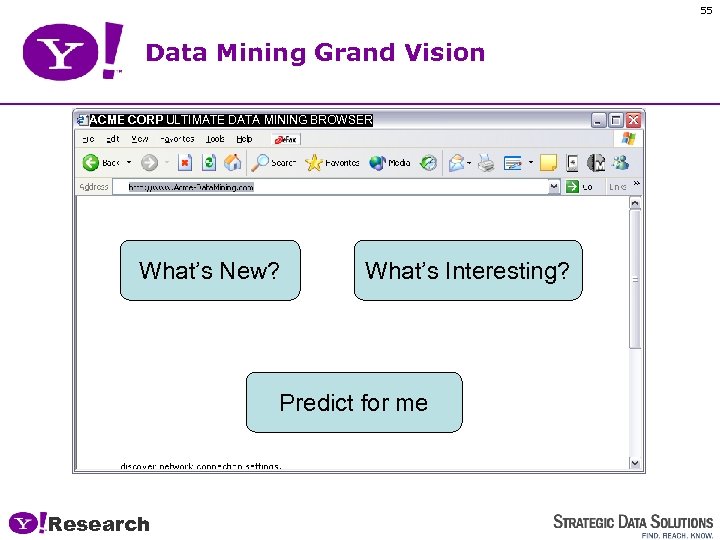
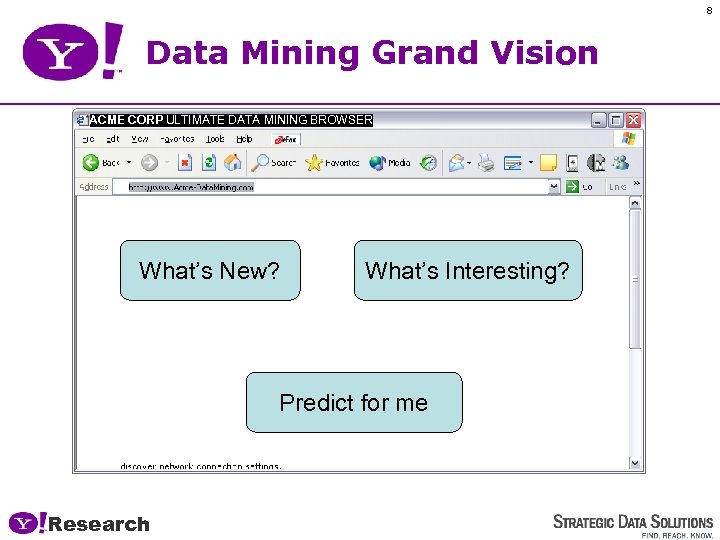 8 Data Mining Grand Vision ACME CORP ULTIMATE DATA MINING BROWSER What’s New? What’s Interesting? Predict for me Research
 9 The myths… • Companies have built up some large and impressive data warehouses • Data mining is pervasive nowadays • Large corporations know how to do it • There are tools and applications that discover valuable information in enterprise databases Research
 10 The truths… • Data is a shambles, – most data mining efforts end up not benefiting from existing data infra-structure • Corporations care a lot about data, and are obsessed with customer behavior and understanding it • They talk a lot about it… • An extremely small number of businesses are successfully mining data • The successful efforts are “one-of”, “lucky strikes” Research
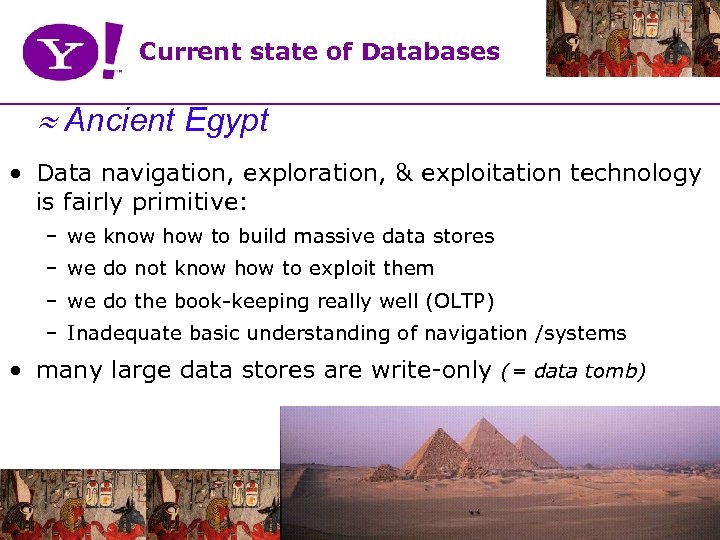 11 Current state of Databases Ancient Egypt • Data navigation, exploration, & exploitation technology is fairly primitive: – we know how to build massive data stores – we do not know how to exploit them – we do the book-keeping really well (OLTP) – Inadequate basic understanding of navigation /systems • many large data stores are write-only (= data tomb) Research
 12 A Data Miner’s Story • Started out in pure research – Professional student – Math and algorithms Research
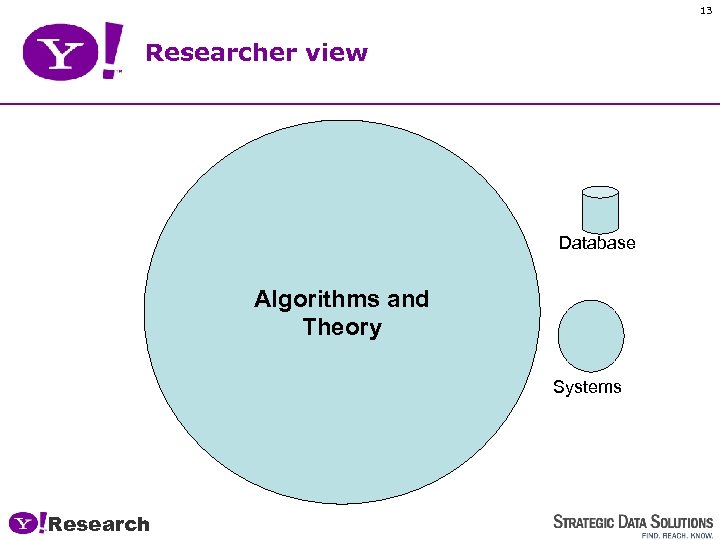 13 Researcher view Database Algorithms and Theory Systems Research
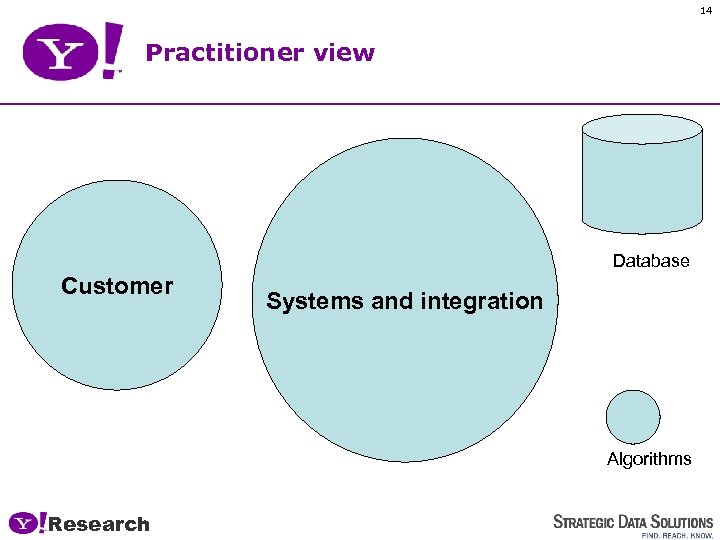 14 Practitioner view Database Customer Systems and integration Algorithms Research
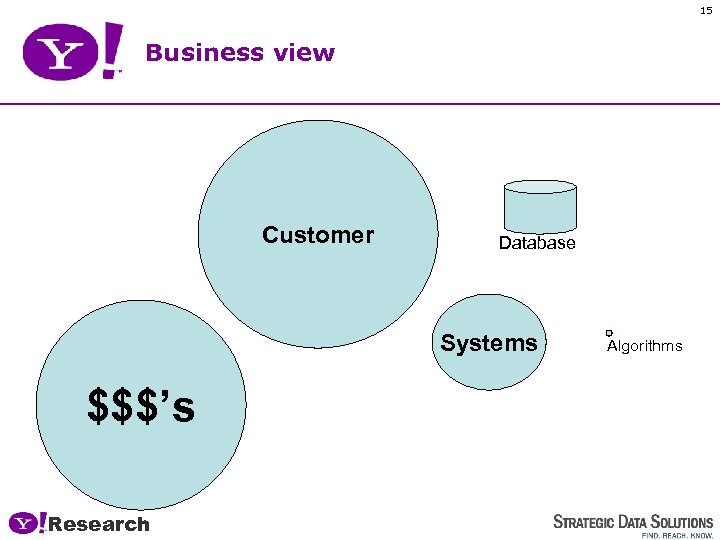 15 Business view Customer Database Systems $$$’s Research Algorithms
 16 A Data Miner’s Story • Started out in pure research • At NASA-JPL did basic research and applied techniques to Science Data Analysis problems – Worked with top scientists is several fields: astronomy, planetary geology, atmospherics, space science, remote sensing imagery – Great results, strong group, lots of funding, high demand… • So why move to Microsoft Research? Research
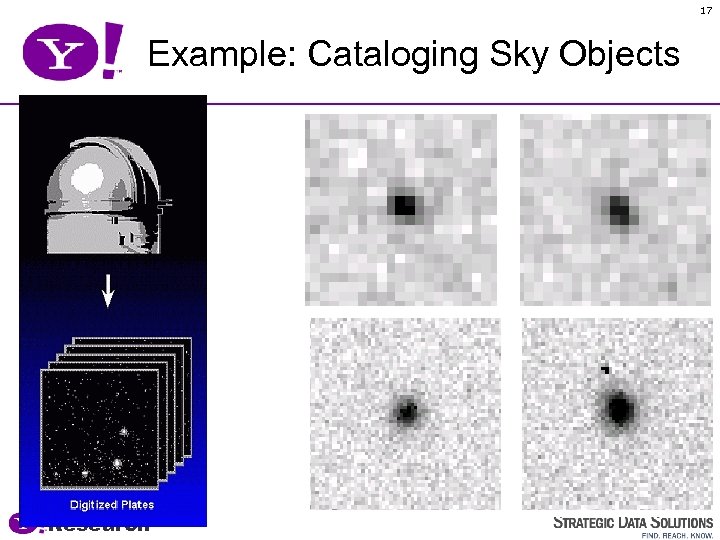 17 Example: Cataloging Sky Objects Research
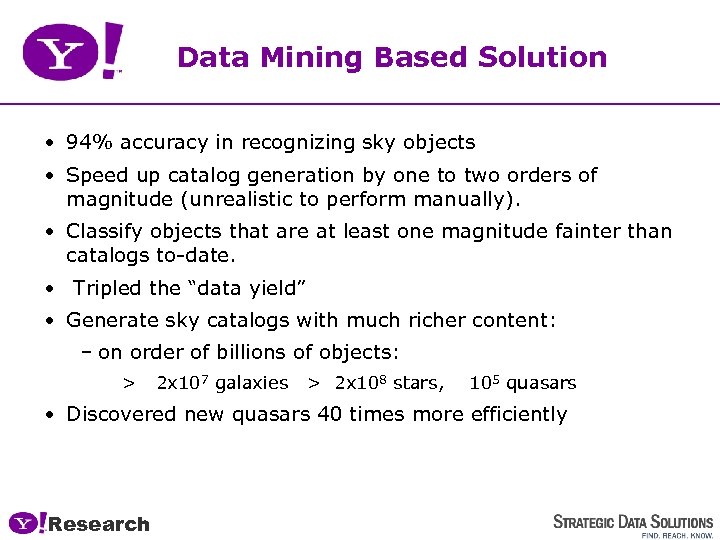 Data Mining Based Solution • 94% accuracy in recognizing sky objects • Speed up catalog generation by one to two orders of magnitude (unrealistic to perform manually). • Classify objects that are at least one magnitude fainter than catalogs to-date. • Tripled the “data yield” • Generate sky catalogs with much richer content: – on order of billions of objects: > 2 x 10⁷ galaxies > 2 x 10⁸ stars, 105 quasars • Discovered new quasars 40 times more efficiently Research
 Research
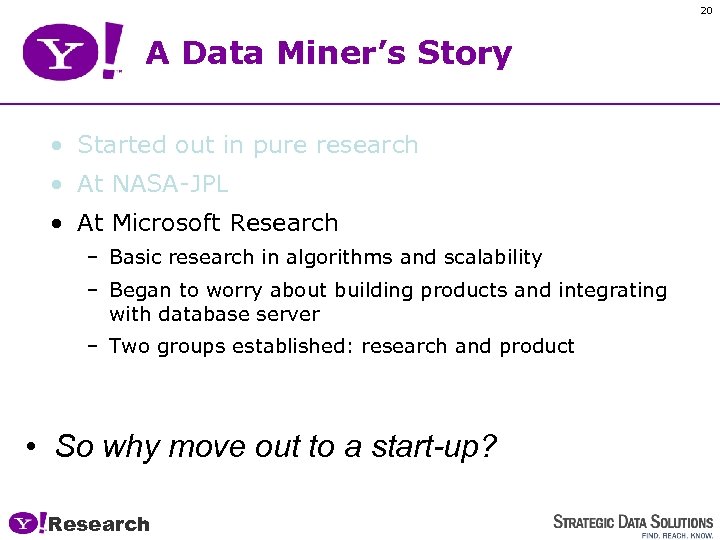 20 A Data Miner’s Story • Started out in pure research • At NASA-JPL • At Microsoft Research – Basic research in algorithms and scalability – Began to worry about building products and integrating with database server – Two groups established: research and product • So why move out to a start-up? Research
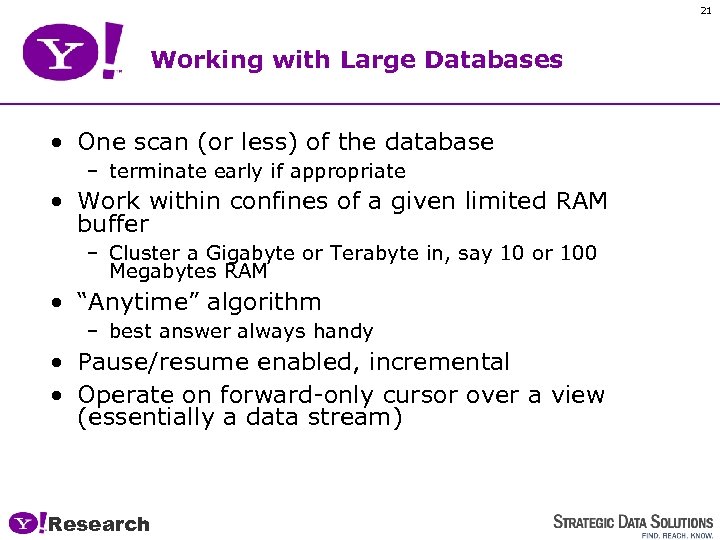 21 Working with Large Databases • One scan (or less) of the database – terminate early if appropriate • Work within confines of a given limited RAM buffer – Cluster a Gigabyte or Terabyte in, say 10 or 100 Megabytes RAM • “Anytime” algorithm – best answer always handy • Pause/resume enabled, incremental • Operate on forward-only cursor over a view (essentially a data stream) Research
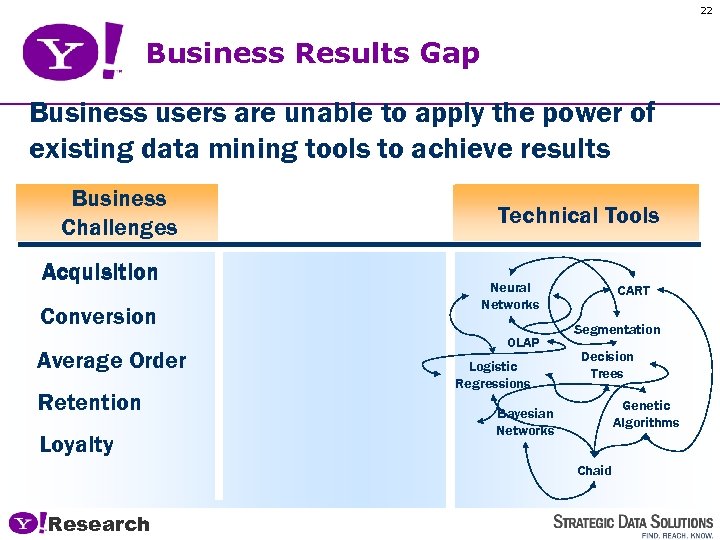 22 Business Results Gap Business users are unable to apply the power of existing data mining tools to achieve results Business Challenges Acquisition Conversion Average Order Retention Loyalty Technologies Technical Tools Neural Networks OLAP Logistic Regressions CART Segmentation Decision Trees Genetic Algorithms Bayesian Networks Chaid Research
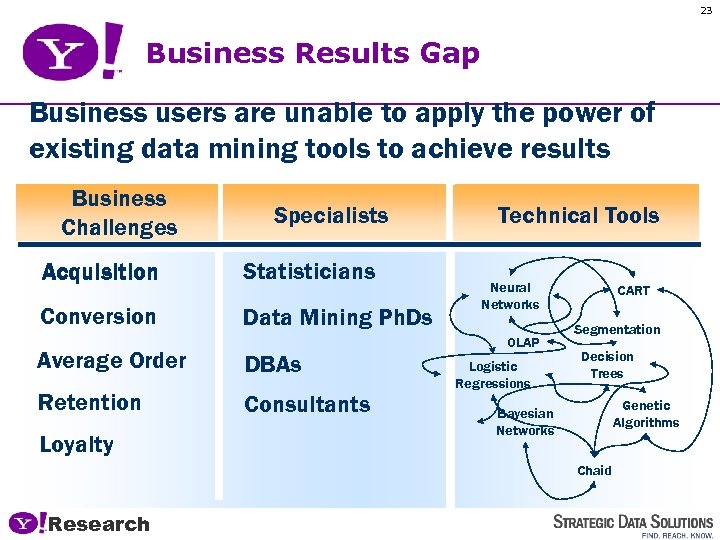 23 Business Results Gap Business users are unable to apply the power of existing data mining tools to achieve results Business Challenges Specialists Acquisition Statisticians Conversion Data Mining Ph. Ds Neural Networks OLAP Average Order DBAs Retention Consultants Loyalty Technologies Technical Tools Logistic Regressions CART Segmentation Decision Trees Genetic Algorithms Bayesian Networks Chaid Research
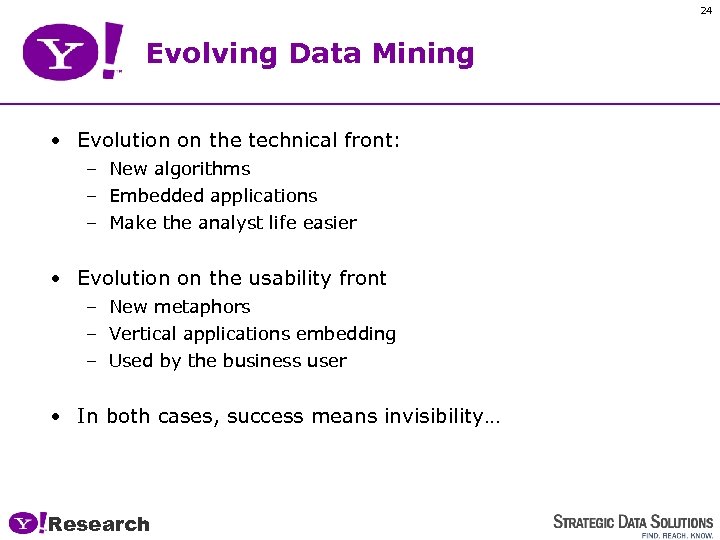 24 Evolving Data Mining • Evolution on the technical front: – New algorithms – Embedded applications – Make the analyst life easier • Evolution on the usability front – New metaphors – Vertical applications embedding – Used by the business user • In both cases, success means invisibility… Research
 25 Grand Challenges • Pragmatic: – Achieving integration and invisibility • Research/Technical: – Solving some serious unaddressed problems Research
 26 Pragmatic Grand Challenge 1 Where is the data? • There is a glut of stored data • Very little of that data is ready for mining • Data warehousing has proven that it will not solve the problem for us • Solution: – integration with operational systems – Take a serious database approach to solving the storage management problem Research
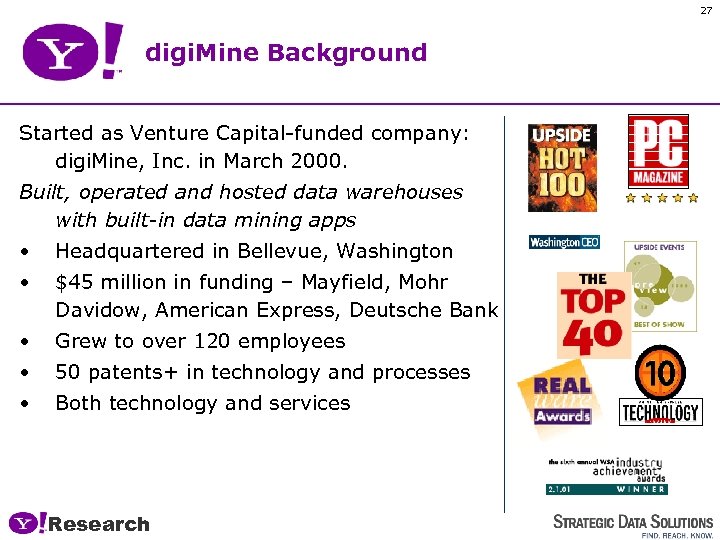 27 digi. Mine Background Started as Venture Capital-funded company: digi. Mine, Inc. in March 2000. Built, operated and hosted data warehouses with built-in data mining apps • Headquartered in Bellevue, Washington • $45 million in funding – Mayfield, Mohr Davidow, American Express, Deutsche Bank • Grew to over 120 employees • 50 patents+ in technology and processes • Both technology and services Research
 28 Sample Customers Research
 29 A Data Miner’s Story • Started out in pure research • At NASA-JPL • At Microsoft Research • At digi. Mine – Lots of VC funding, great team, great press coverage, and fast moving – great customers • So why move to a DMX Group? Research
 30 Why DMX Group? • At digi. Mine, we grew a large “Professional Services” organization • We learned a lot from these engagements • VC-funded companies cannot do much consulting • A fork in the road appeared… – digi. Mine re-focused on a market vertical: behavioral targeting for media and publishers – Renamed to Revenue Science, Inc. • Formed DMX Group… which was eventually acquired by Yahoo! Research
 31 DMX Group Mission • Make enterprise data a working asset in the enterprise: – Data strategy for the business – Implementation of Business Intelligence and data mining capabilities – Business issues around data • What is possible? • How to expose it to business users • How to train people and change processes – Integration with operational systems Research
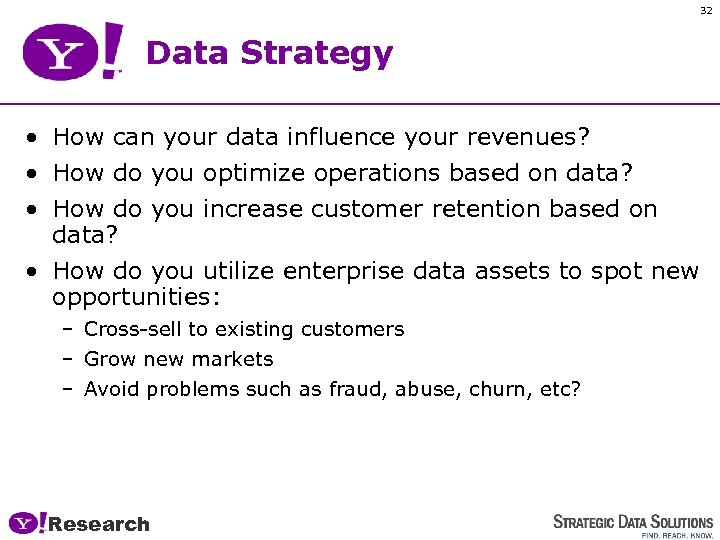 32 Data Strategy • How can your data influence your revenues? • How do you optimize operations based on data? • How do you increase customer retention based on data? • How do you utilize enterprise data assets to spot new opportunities: – Cross-sell to existing customers – Grow new markets – Avoid problems such as fraud, abuse, churn, etc? Research
 33 A Data Miner’s Story • Started out in pure research • At NASA-JPL • At Microsoft Research • At digi. Mine/Revenue Science Inc. • At DMX Group… Research
 34 Pragmatic Grand Challenge 2 Embedding within Operational Systems • We all worry about algorithms, they are fascinating • Most of us know that data mining in practice is mostly data prep work • Go where the data is when the data does not come to you • But how much of the problem is “data mining”? • facts: – The effort in embedding an application is huge, and often not discussed – Without it, all the algorithms are useless Research
 Case Study – Wireless Telco • Churn Modelling and Prediction Research 35
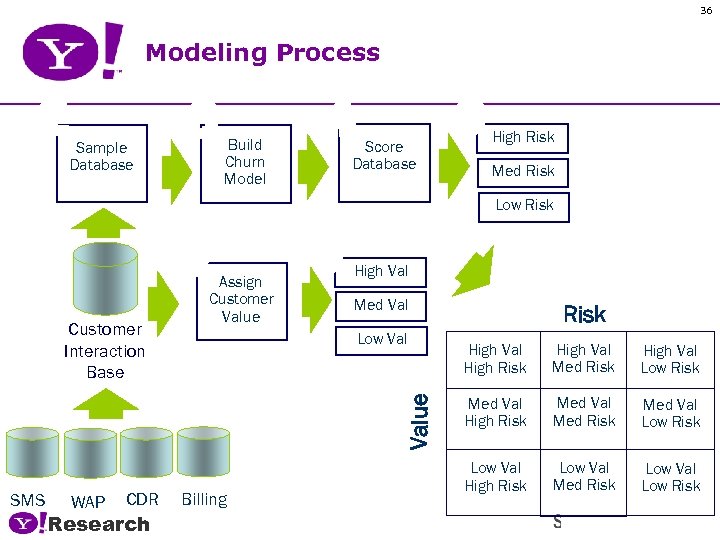 36 Modeling Process 2 Sample Database 3 Build Churn Model 4 Score Database 6 High Risk Med Risk Low Risk 5 6 High Val Med Val Low Value 1 Customer Interaction Base Assign Customer Value SMS WAP CDR Research Billing Risk High Val High Risk High Val Med Risk High Val Low Risk Med Val High Risk Med Val Med Risk Med Val Low Risk Low Val High Risk Low Val Med Risk Low Val Low Risk
 37 LTV and Its Application • A customer’s life-time value (LTV) is the net value that a customer brings in to a business by the end of their service. I. e. their profit contribution. • LTV allows decisions for individual customers that optimize the return-on-investment (ROI). Examples: – Aggressive retention programs, such as equipment upgrade and contract renewal for high LTV. – Differentiated customer care treatment for reactivations by customer with low LTV Research
 38 What is the Required? • Detailed data – Integration of CDR, WIG, SMS, Billing – Maintained at detailed level • Integrated data mining – Algorithms tuned to model thousands of variables and millions of rows – Accurate Forecasts • System Robustness – Massively scalable back end system – Flexible architecture to create new variables quickly and easily • Collaborative Service Model – Service model which guarantees success – Combined IQ Model to optimize science and business knowledge – Low cost to create and maintain models Research
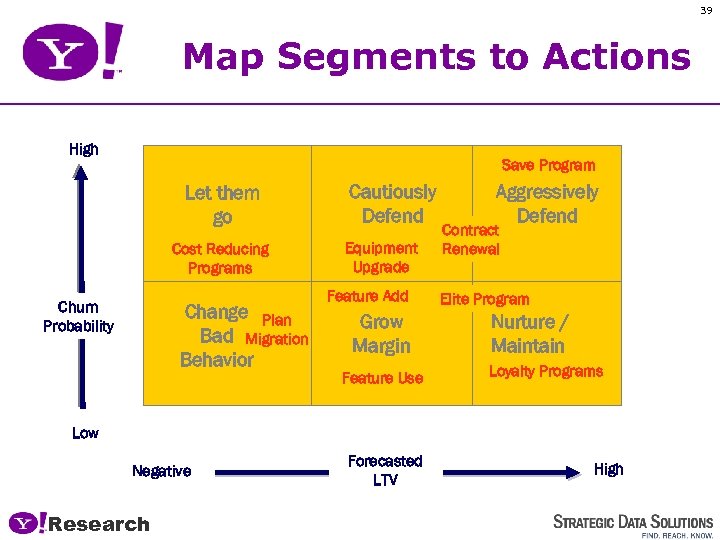 39 Map Segments to Actions High Save Program Let them go Cost Reducing Programs Churn Probability Change Plan Bad Migration Behavior Cautiously Defend Equipment Upgrade Feature Add Grow Margin Feature Use Aggressively Defend Contract Renewal Elite Program Nurture / Maintain Loyalty Programs Low Negative Research Low Forecasted LTV High
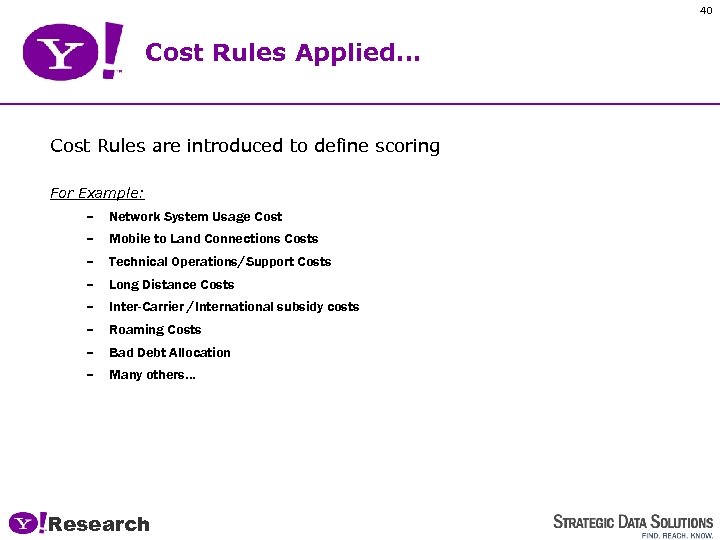 40 Cost Rules Applied… Cost Rules are introduced to define scoring For Example: – Network System Usage Cost – Mobile to Land Connections Costs – Technical Operations/Support Costs – Long Distance Costs – Inter-Carrier /International subsidy costs – Roaming Costs – Bad Debt Allocation – Many others… Research
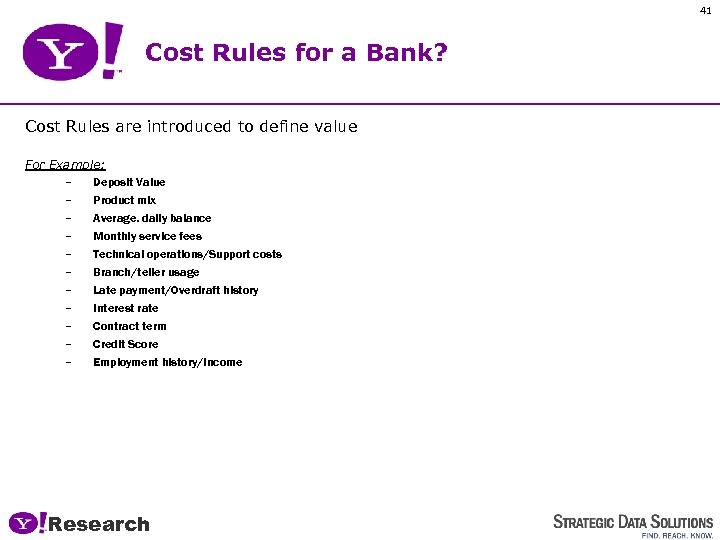 41 Cost Rules for a Bank? Cost Rules are introduced to define value For Example: – Deposit Value – Product mix – Average. daily balance – Monthly service fees – Technical operations/Support costs – Branch/teller usage – Late payment/Overdraft history – Interest rate – Contract term – Credit Score – Employment history/Income Research
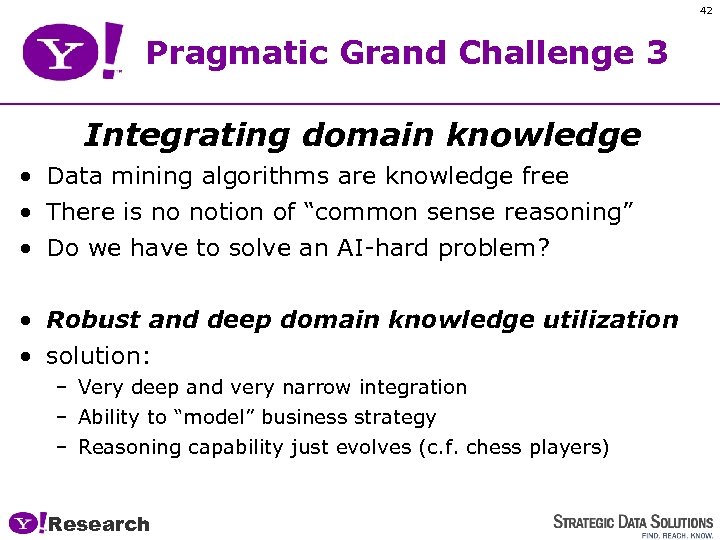 42 Pragmatic Grand Challenge 3 Integrating domain knowledge • Data mining algorithms are knowledge free • There is no notion of “common sense reasoning” • Do we have to solve an AI-hard problem? • Robust and deep domain knowledge utilization • solution: – Very deep and very narrow integration – Ability to “model” business strategy – Reasoning capability just evolves (c. f. chess players) Research
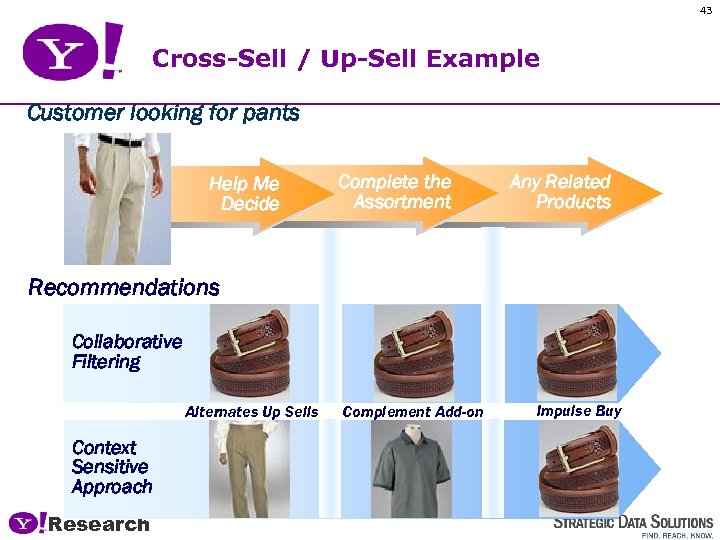 43 Cross-Sell / Up-Sell Example Customer looking for pants Help Me Decide Complete the Assortment Any Related Products Recommendations Collaborative Filtering Alternates Up Sells Context Sensitive Approach Research Complement Add-on Impulse Buy
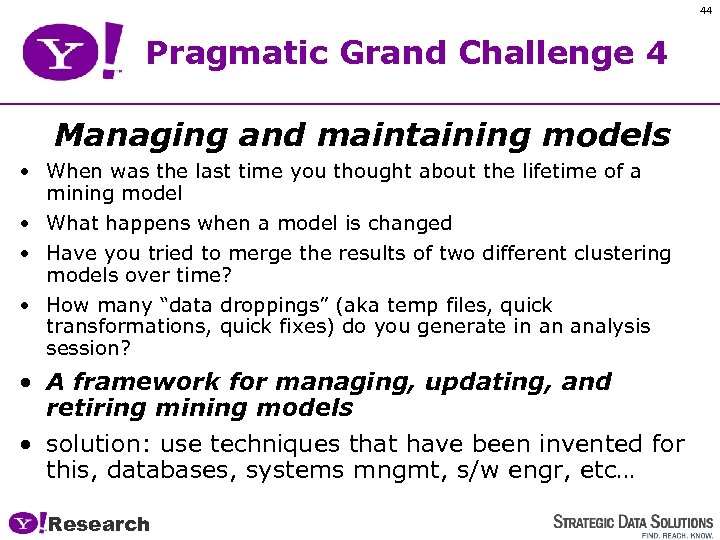 44 Pragmatic Grand Challenge 4 Managing and maintaining models • When was the last time you thought about the lifetime of a mining model • What happens when a model is changed • Have you tried to merge the results of two different clustering models over time? • How many “data droppings” (aka temp files, quick transformations, quick fixes) do you generate in an analysis session? • A framework for managing, updating, and retiring mining models • solution: use techniques that have been invented for this, databases, systems mngmt, s/w engr, etc… Research
![45 Pragmatic Grand Challenge 5 Effectiveness Measurement • How do we measure [honestly] the](https://present5.com/presentation/70486a27f910f12ca53440846402c374/image-46.jpg "45 Pragmatic Grand Challenge 5 Effectiveness Measurement • How do we measure [honestly] the") 45 Pragmatic Grand Challenge 5 Effectiveness Measurement • How do we measure [honestly] the effectiveness of a model in a context? • Return on Investment (ROI) measurement • Evaluation in the context of the application • A framework and methodology for measurement and evaluation – Build the measurement method as part of the design of the model – An engineering recipe for measurements, and a set of metrics Research
45 Pragmatic Grand Challenge 5 Effectiveness Measurement • How do we measure [honestly] the effectiveness of a model in a context? • Return on Investment (ROI) measurement • Evaluation in the context of the application • A framework and methodology for measurement and evaluation – Build the measurement method as part of the design of the model – An engineering recipe for measurements, and a set of metrics Research
 Technical Challenges Research 46
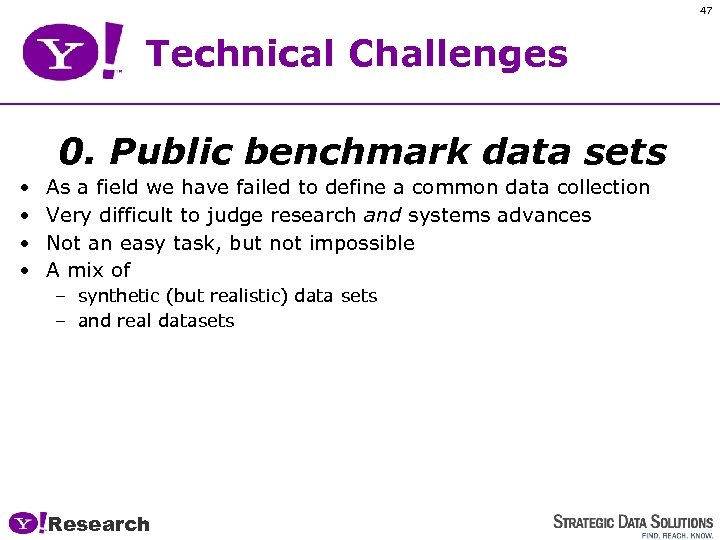 47 Technical Challenges 0. Public benchmark data sets • • As a field we have failed to define a common data collection Very difficult to judge research and systems advances Not an easy task, but not impossible A mix of – synthetic (but realistic) data sets – and real datasets Research
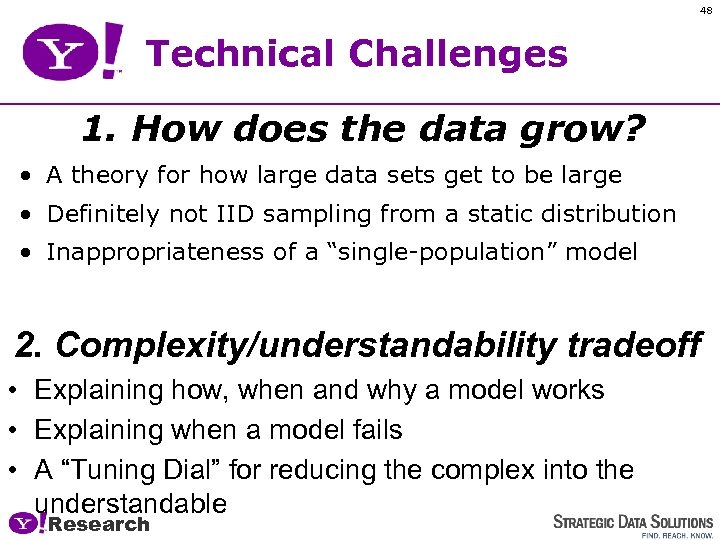 48 Technical Challenges 1. How does the data grow? • A theory for how large data sets get to be large • Definitely not IID sampling from a static distribution • Inappropriateness of a “single-population” model 2. Complexity/understandability tradeoff • Explaining how, when and why a model works • Explaining when a model fails • A “Tuning Dial” for reducing the complex into the understandable Research
 49 Technical Challenges 3. Interestingness • What is an “interesting” pattern or summary? • How do you measure “novelty”? • What is “unusual”? When is it worthy of attention? • Is it low probability events? High summarization ability? Outliers? Good fits? Bad fits? Research
 50 Technical Challenges 4. Scalability Beyond just dealing with a large data set: • Principled feature reduction: what is SVD equivalent? Graceful degradation with dimensionality • Uncovering graphical structure in data – Communities, relations, link analysis, … • Dealing with multiple data types: – Structured, sparse, dense, text, images, video, audio, sequence data, etc. – I have yet to see an algorithm that deals with more than one type. • Integration with DBMS – Appropriate sampling – Appropriate operator abstractions • Taking care of “minor details” – Initialization? – Determining k Research
 51 Technical Challenges 5. A theory for what we do • What are the fundamental abstractions? • What are the basics operations? What are the basic components of an algorithm? • What is it that we are optimizing? • What is hard? What is doable? Why? • What is a “data summary”? • When are two attributes “similar”? Can you measure efficiently? • How do we extract the right representation? Research
 52 A new theory is needed • What are the fundamental problems? • What do partial models or summaries of data really mean? • What are the implications of post hoc data analysis? When is it/is it not reasonable to conclude a task is appropriate? • A new algebra for dealing with highly-summarized views of the world • Effect of sparse spaces on dimensionality. What is the true dimensionality of data? What are the limits? • A theory for adaptive sampling Research
 Summary • Pragmatic and Technical Grand Challenges Research 53
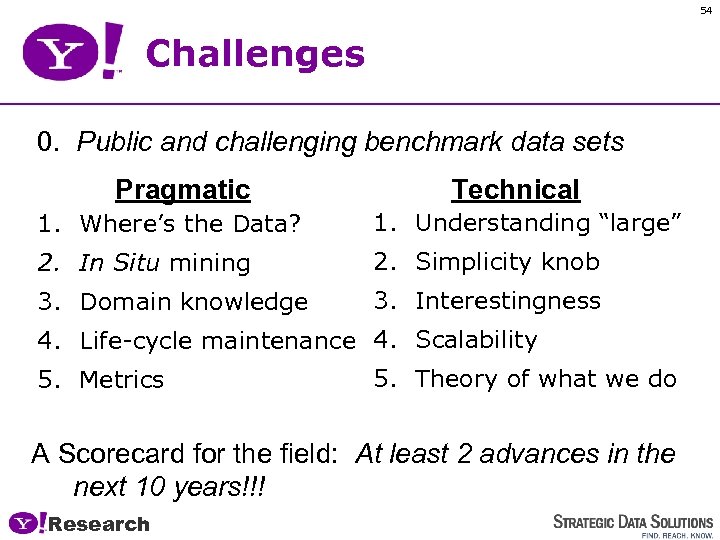 54 Challenges 0. Public and challenging benchmark data sets Pragmatic Technical 1. Where’s the Data? 1. Understanding “large” 2. In Situ mining 2. Simplicity knob 3. Domain knowledge 3. Interestingness 4. Life-cycle maintenance 4. Scalability 5. Metrics 5. Theory of what we do A Scorecard for the field: At least 2 advances in the next 10 years!!! Research
 55 Data Mining Grand Vision ACME CORP ULTIMATE DATA MINING BROWSER What’s New? What’s Interesting? Predict for me Research
 56 In the meantime, there is an understanding gap • The technical community speaks of tech problems • The business strategic thinking hit an “understandability wall” • Traditionally, the thinking of business strategy never included data • A new generation of business challenges are born Research
 57 Data Strategy • Is the mapping of the capabilities enabled by data in driving the business • The Integration of data-driven capabilities in revenue-driving activities • The Integration of data-derived metrics to feedback into the measurement of the success of the business • Evolving to an operational state where planning includes data, measurability, and data-driven feedback loops Research
 58 A Data Miner’s Story • Started out in pure research • At NASA-JPL • At Microsoft Research • At digi. Mine/Revenue Science Inc. • At DMX Group • So why join Yahoo! ? Research
 Yahoo! Case Study • Evolving the Data Strategy as Chief Data Officer Research 59
 60 Yahoo! is the #1 Destination on the Web 73% of the U. S. Internet population uses Yahoo! – About 500 million users per month globally! • Global network of content, commerce, media, search and access products • 100+ properties including mail, TV, news, shopping, finance, autos, travel, games, movies, health, etc. • 25 terabytes of data collected each day… and growing • Representing thousands of cataloged consumer behaviors More people visited Yahoo! in the past month than: • • • Use coupons Vote Recycle Exercise regularly Have children living at home Wear sunscreen regularly Data is used to develop content, consumer, category and campaign insights for our key content partners and large advertisers Research Sources: Mediamark Research, Spring 2004 and com. Score Media Metrix, February 2005.
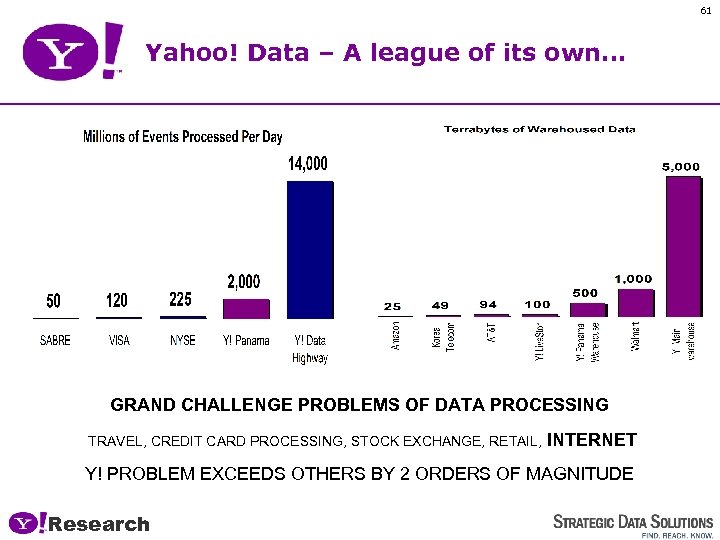 61 Yahoo! Data – A league of its own… GRAND CHALLENGE PROBLEMS OF DATA PROCESSING TRAVEL, CREDIT CARD PROCESSING, STOCK EXCHANGE, RETAIL, INTERNET Y! PROBLEM EXCEEDS OTHERS BY 2 ORDERS OF MAGNITUDE Research
 62 To be continued… • Will cover the Yahoo! case study on Tuesday’s Invited talk • Will include – Strategic Importance of Data – Evolving the data strategy – Evolving towards the need to invent the new sciences of the Internet Hope the Data Miner’s Story continues… Perhaps to a happy ending? Research
 Thank You! Research & Questions? • Usama_fayyad@yahoo. com 63