


 Скачать презентацию KCOM Kaiser Clinical Ontology Modeling Peter Hendler and
0a4b534ab9a2391cb548420c3158ed0a.ppt
- Количество слайдов: 99
 KCOM Kaiser Clinical Ontology Modeling Peter Hendler and Michael Rossman With some copyrighted material from Matthew Horridge
 Why Do This? • Last year we stressed the cost savings and simplicity added if different healthcare systems use a similar (canonical) base model • This year we will show significant additional advantages if the model is created using Web Ontology Language OWL and Description Logics (DL)
 Quick Review Why Canonical Models
 Clinical Models Why Do We Need Them? §Electronic health care systems have evolved separately over the decades §Most were created in isolation to solve one particular domain problem (Pharmacy, Lab, Radiology, Clinical Notes, Scheduling, Billing, Admissions Discharges and Transfers or Clinical Decision Support) §As a result they all have their own models, and they can not share clinical data without complex expensive interfaces being built 4
 Clinical Models How Do These Systems Interoperate? §All systems have a “data model” whether it is explicitly designed or is just the result of how the systems store data §You must map the “data model” from one system to the “data model” for the other system if they are to share data. §This requires too many expensive interfaces that goes up by N squared for N systems. §Every mapping or interface results in the loss of some meaning 5
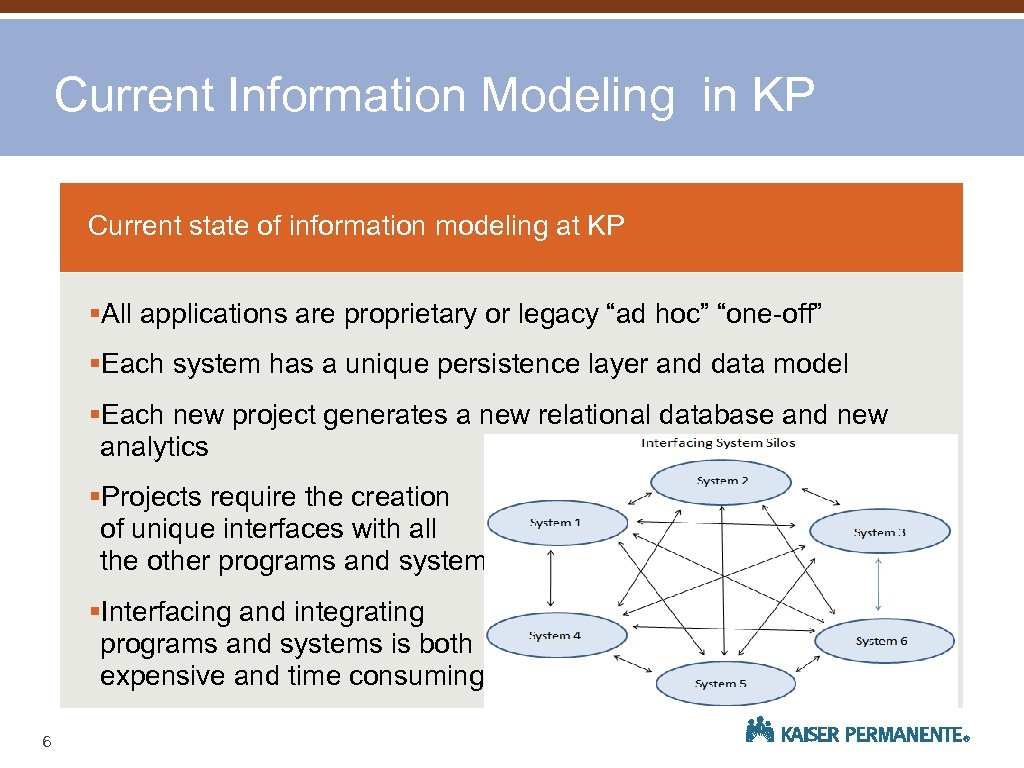 Current Information Modeling in KP Current state of information modeling at KP §All applications are proprietary or legacy “ad hoc” “one-off” §Each system has a unique persistence layer and data model §Each new project generates a new relational database and new analytics §Projects require the creation of unique interfaces with all the other programs and systems §Interfacing and integrating programs and systems is both expensive and time consuming 6
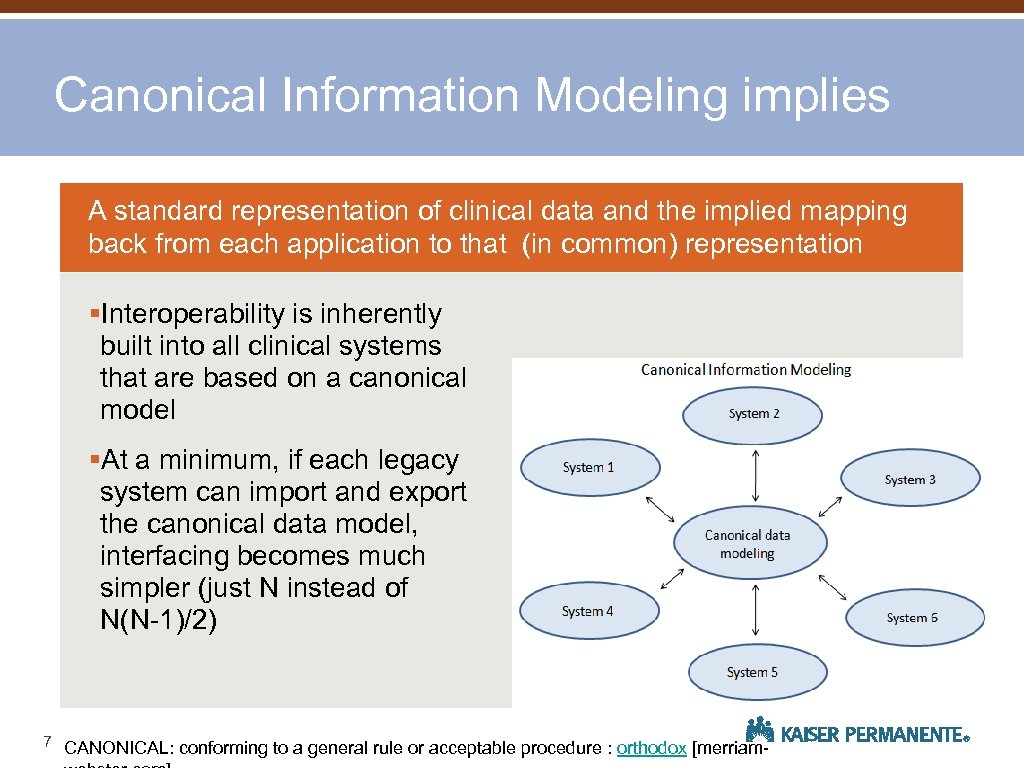 Canonical Information Modeling implies A standard representation of clinical data and the implied mapping back from each application to that (in common) representation §Interoperability is inherently built into all clinical systems that are based on a canonical model §At a minimum, if each legacy system can import and export the canonical data model, interfacing becomes much simpler (just N instead of N(N-1)/2) 7 CANONICAL: conforming to a general rule or acceptable procedure : orthodox [merriam-
 Why Do This in OWL? • How are relevant research and outcome studies done now?
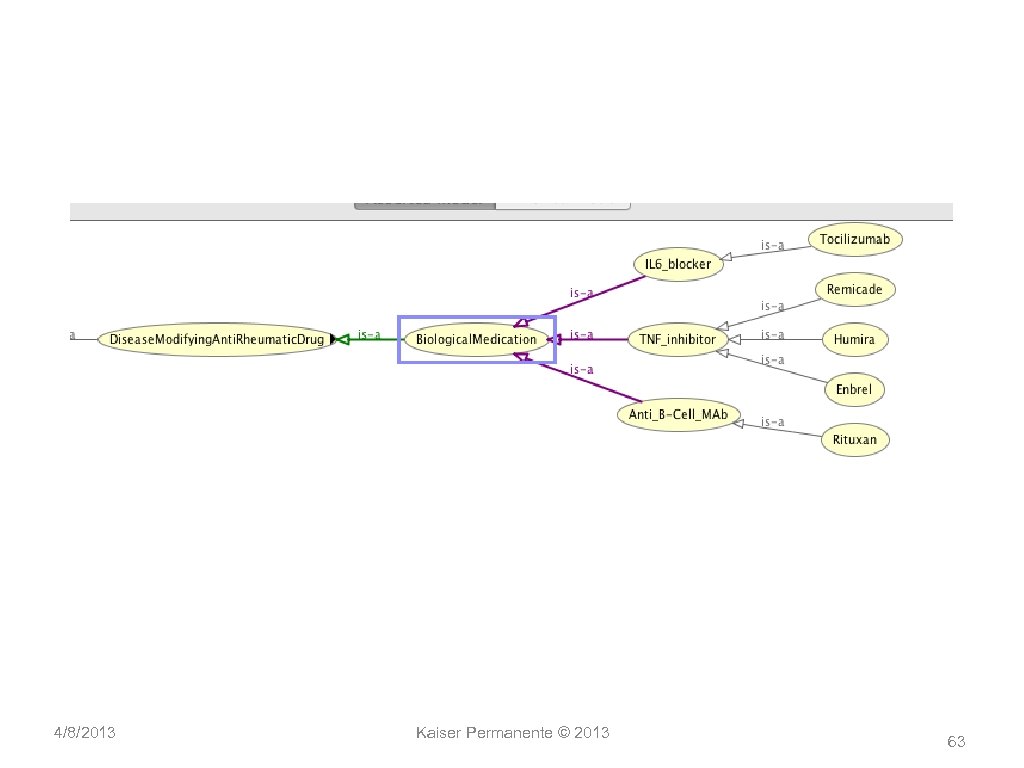
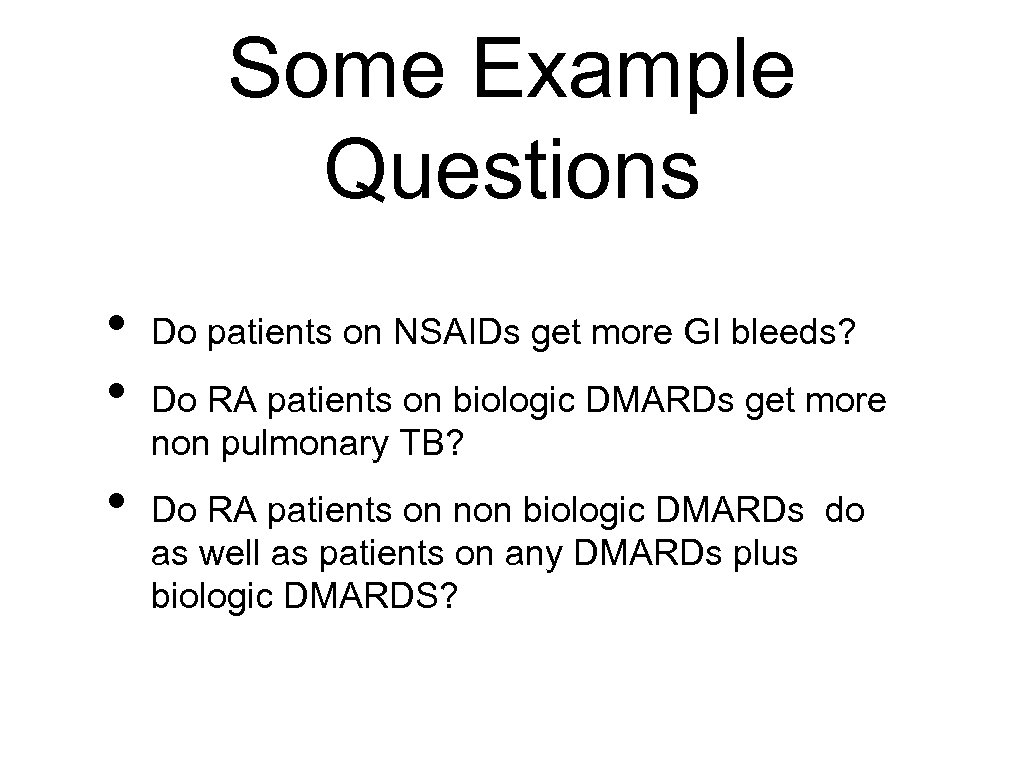 Some Example Questions • • • Do patients on NSAIDs get more GI bleeds? Do RA patients on biologic DMARDs get more non pulmonary TB? Do RA patients on non biologic DMARDs do as well as patients on any DMARDs plus biologic DMARDS?
 And how are these questions answered today?
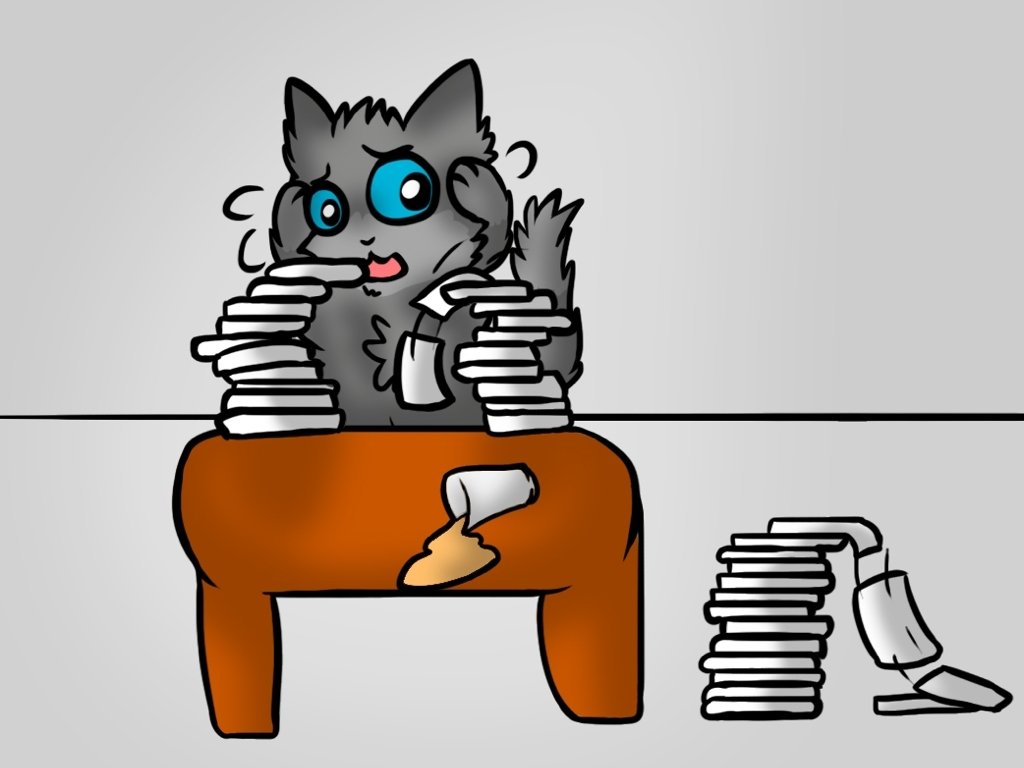
 By Manual Chart Review Kat • This does not change with an Electronic Health Record of unstructured data. • Whether paper or electronic, non structured text and non Ontological terminologies (like ICD) require individual reading and evaluation by a reviewer
 By using OWL in KCOM, these queries can be automated!
 Outline • Three kinds of modeling kats • Why use SNOMED / CMT, and OWL? • What happens when you model the HL 7 RIM backbone in OWL? • Very Short Intro to OWL and Protege
 Outline • • • How does KCOM address these problems? The generalizable part of the model valid for all sub specialty domains The specialized parts of the Rheumatoid Arthritis Assessment Model (RAAM) The “Clinical Stories” used to create KCOM Walk through one semantic query
 Three Kinds of Modelers
 This is often the cause of communication problems between IT people with different training backgrounds and different ways of looking at things.
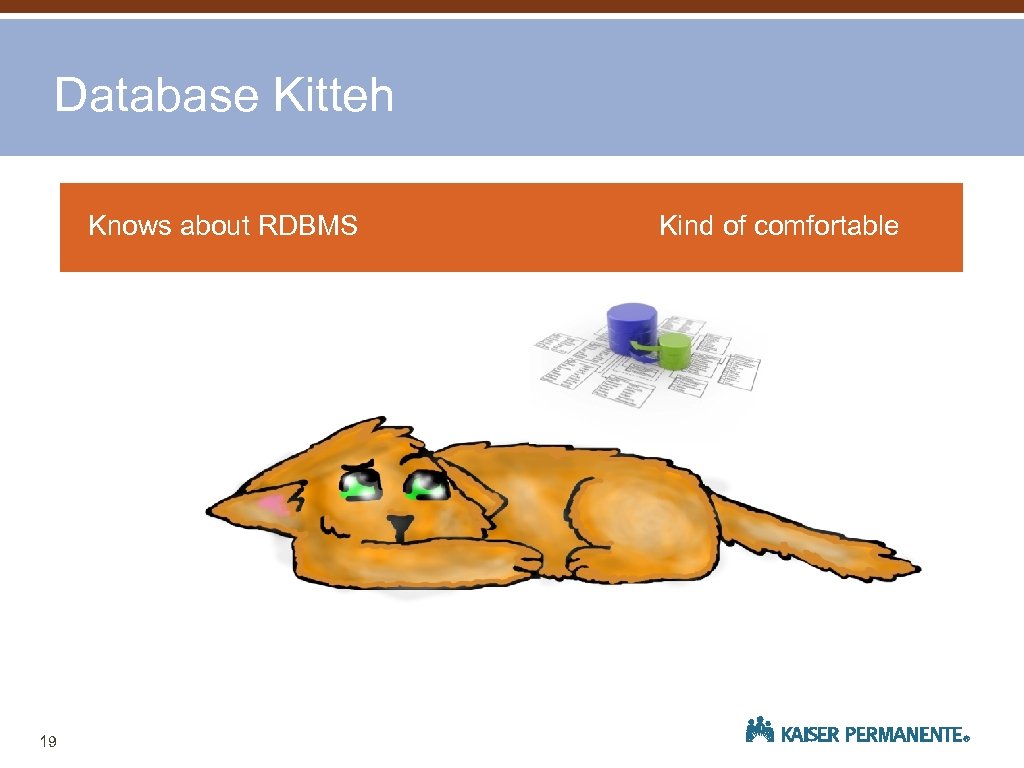 Database Kitteh Knows about RDBMS 19 Kind of comfortable
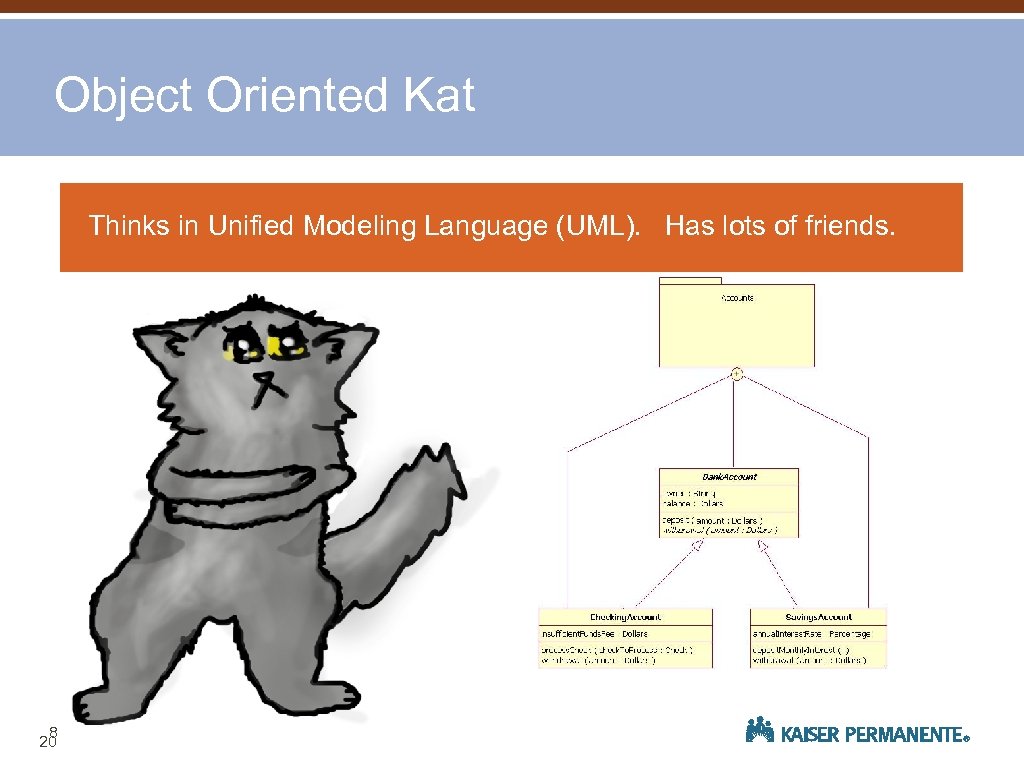 Object Oriented Kat Thinks in Unified Modeling Language (UML). Has lots of friends. 8 20
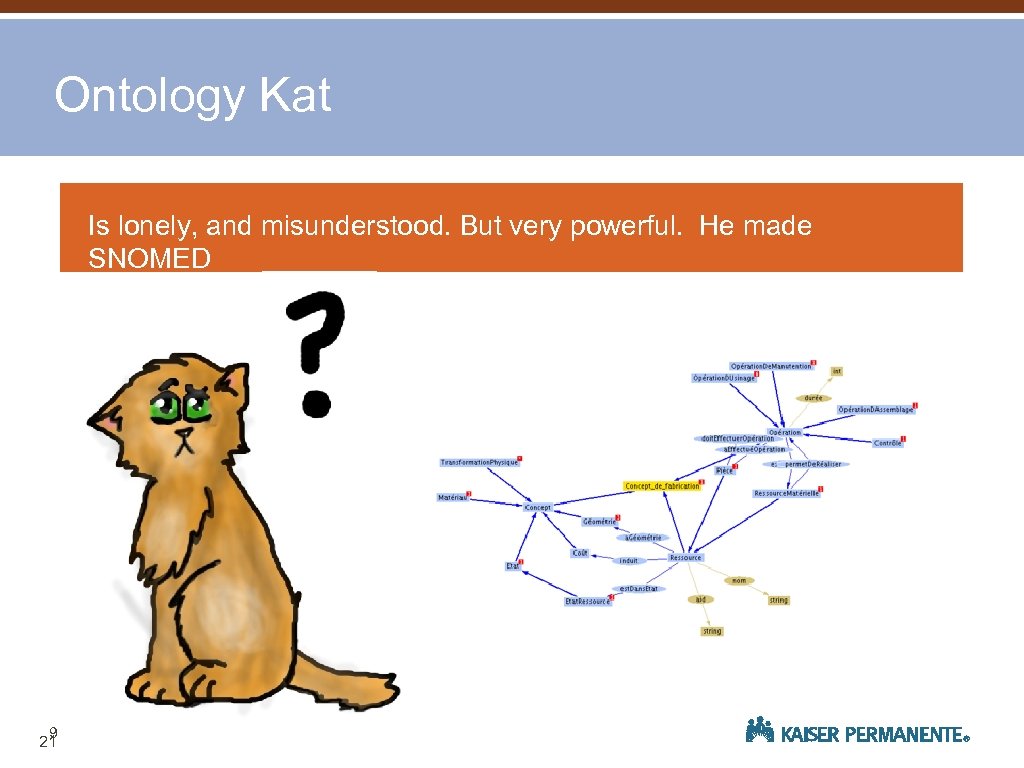 Ontology Kat Is lonely, and misunderstood. But very powerful. He made SNOMED 9 21
 Why Use SNOMED / CMT, OWL?
 Medical Terminology • SNOMED • Ontology Description Logic • Concerned with clinical meaning, not billing • Fine grained enough to be clinically meaningful • Can be used for Outcomes measurements • Can be used by machines to make inferences
 Inferences possible with SNOMED • Strep throat is caused by streptococcus • Pneumococcal pneumonia is caused by pneumococcus • Streptococcus and pneumococcus are both sub types of gram positive cocci • Therefore both pneumococcal pneumonia and strep throat are gram positive cocci infections.
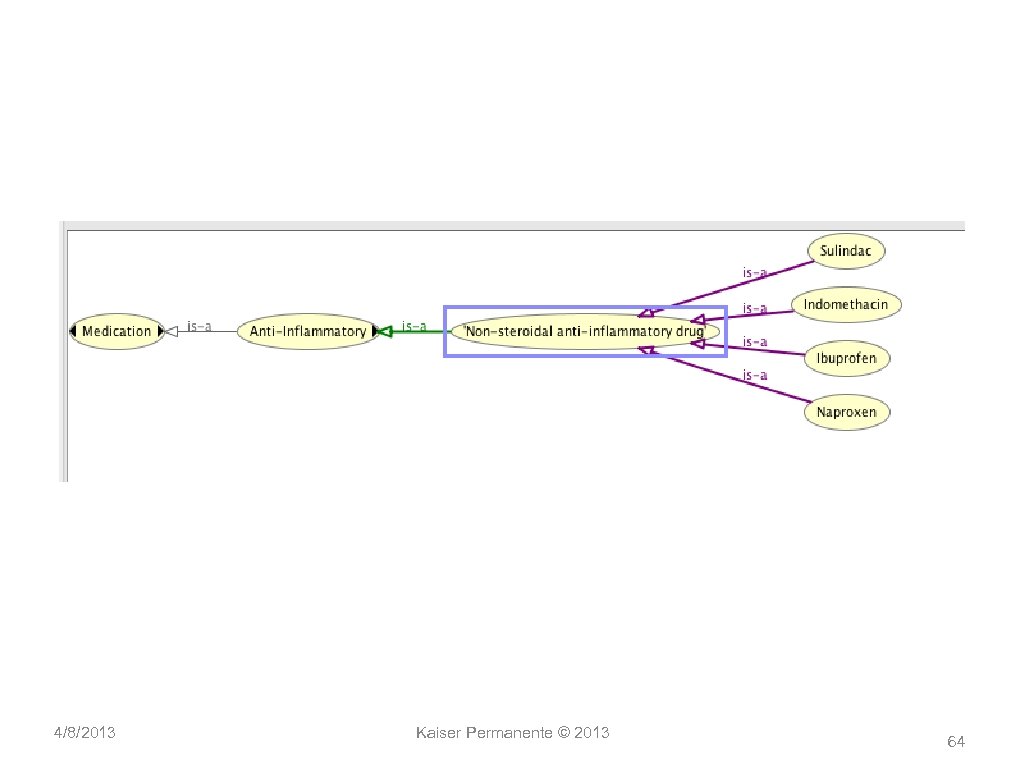
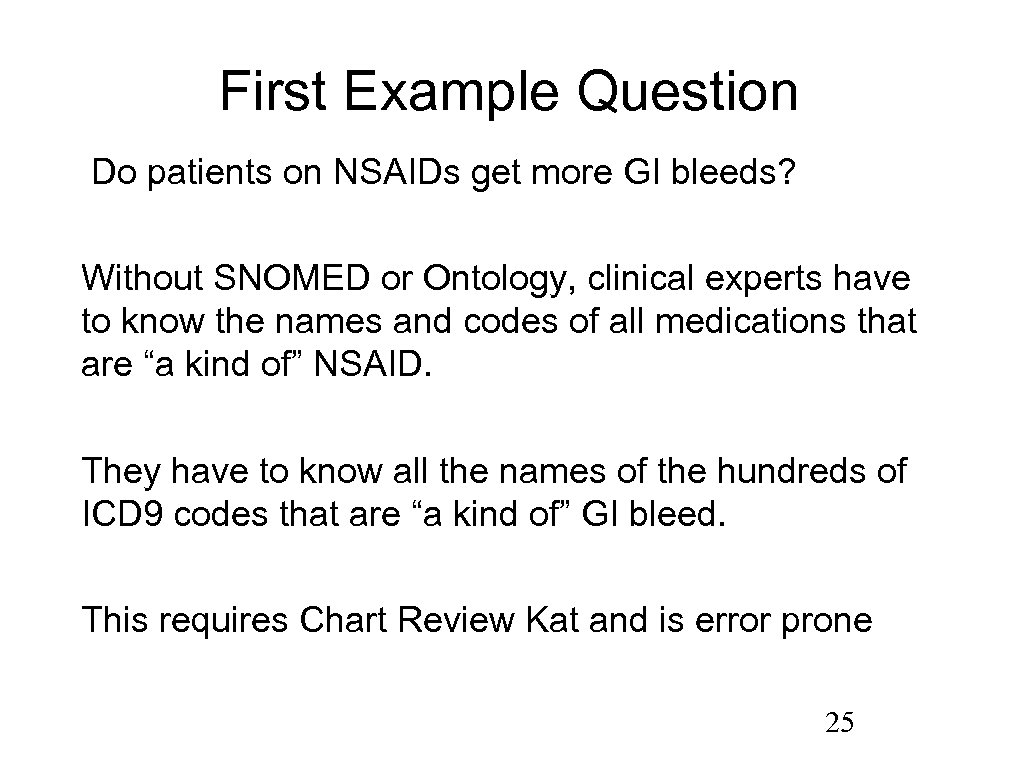 First Example Question Do patients on NSAIDs get more GI bleeds? Without SNOMED or Ontology, clinical experts have to know the names and codes of all medications that are “a kind of” NSAID. They have to know all the names of the hundreds of ICD 9 codes that are “a kind of” GI bleed. This requires Chart Review Kat and is error prone 25
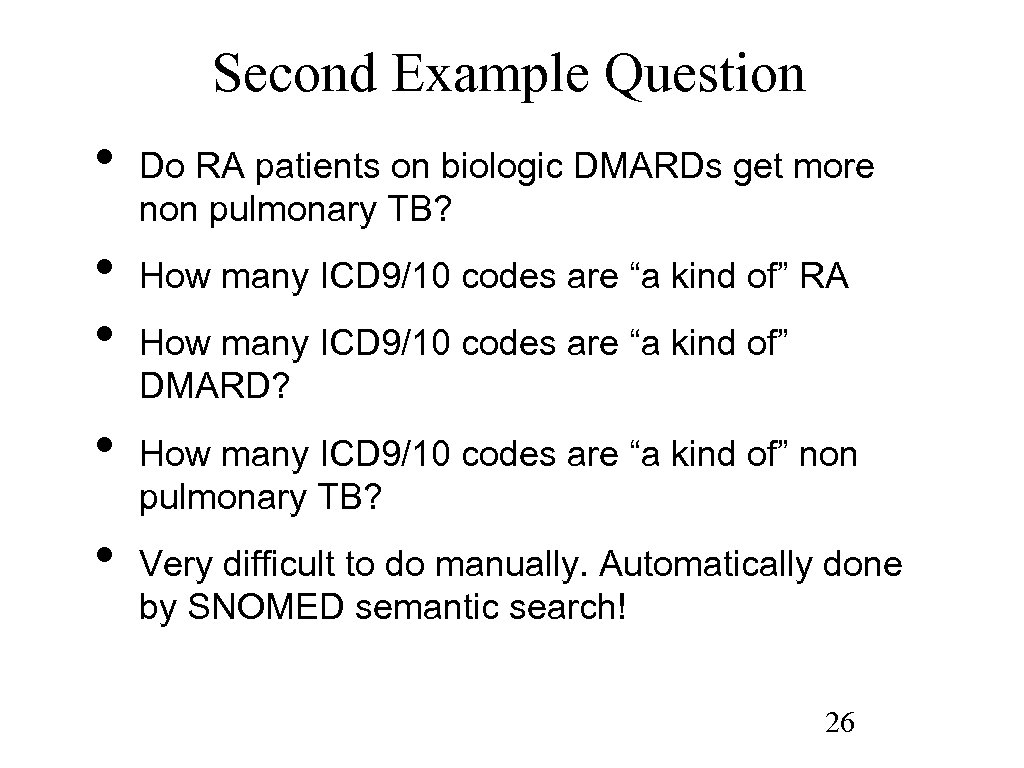 Second Example Question • • • Do RA patients on biologic DMARDs get more non pulmonary TB? How many ICD 9/10 codes are “a kind of” RA How many ICD 9/10 codes are “a kind of” DMARD? How many ICD 9/10 codes are “a kind of” non pulmonary TB? Very difficult to do manually. Automatically done by SNOMED semantic search! 26
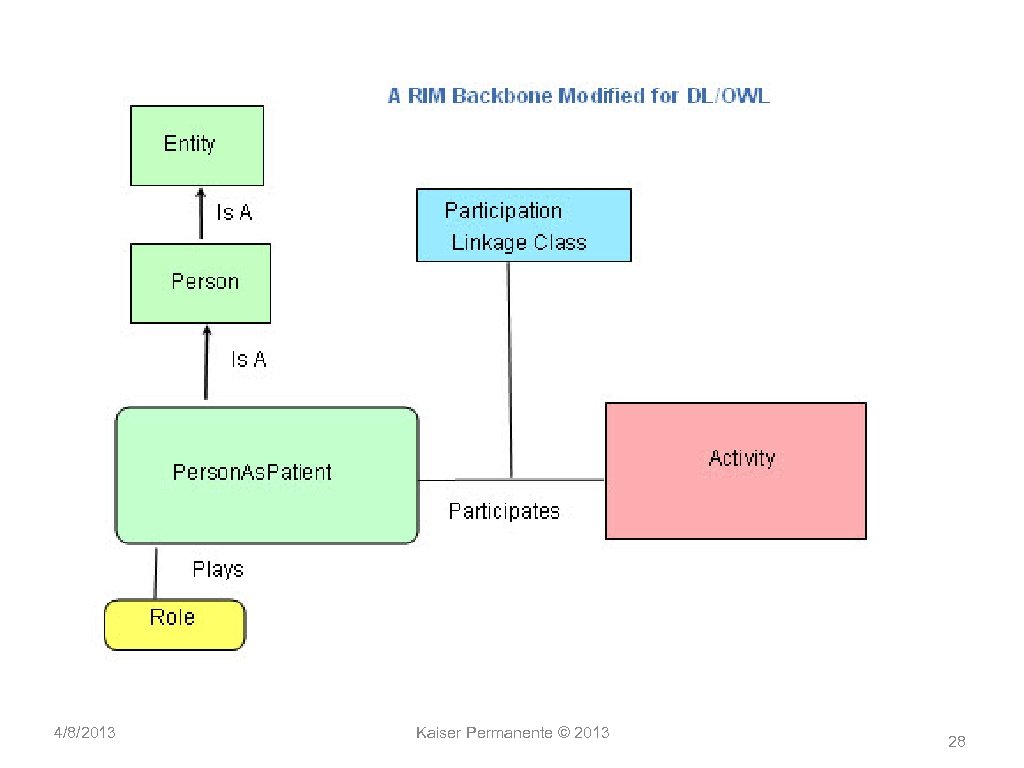
 What happens when you model the HL 7 RIM backbone in OWL?
 4/8/2013 Kaiser Permanente © 2013 28
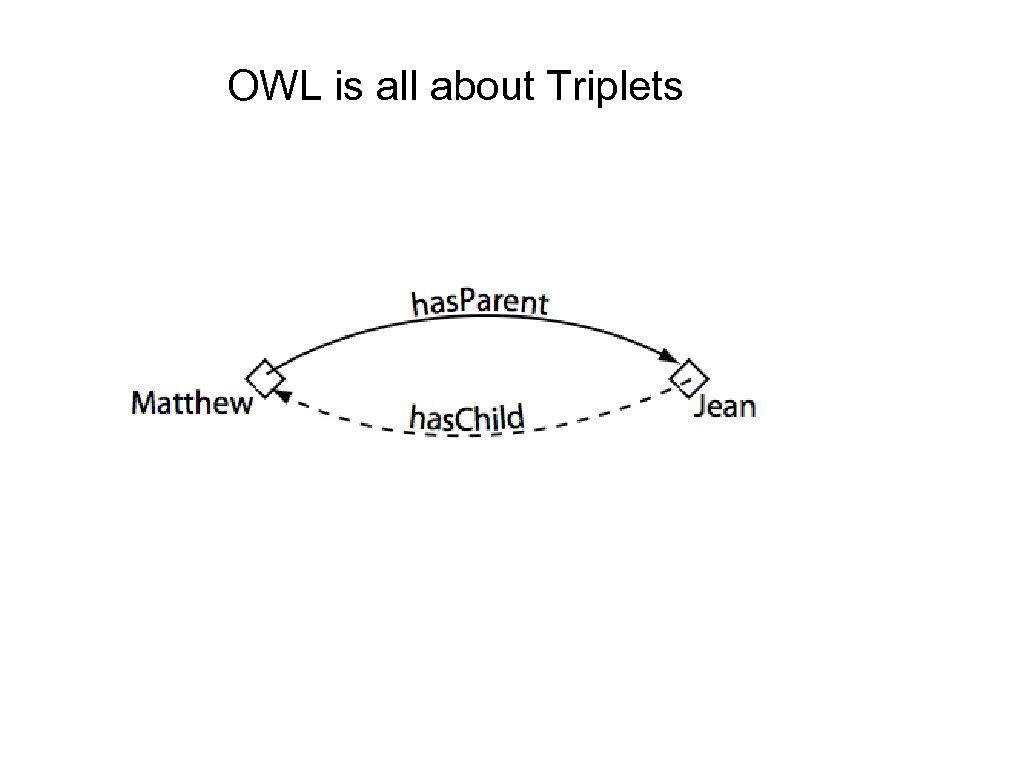
 A Very Short Intro To OWL and Protege It’s all about triples
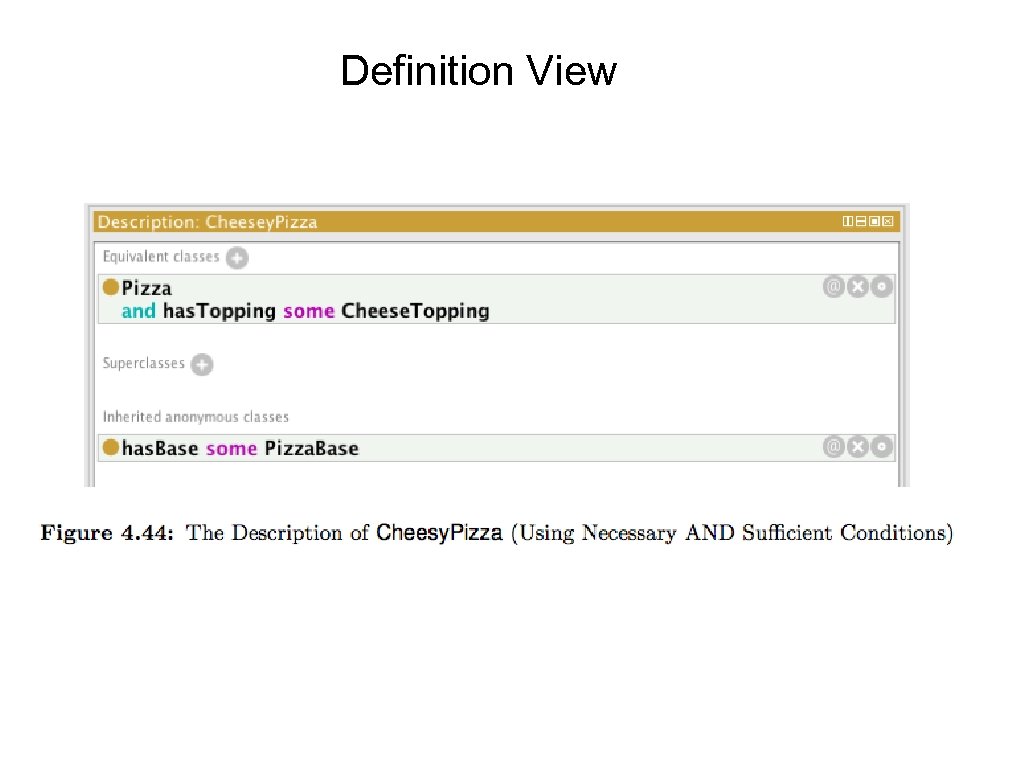
 Protege • Three main views • Taxonomy: Only “Is A” • OWL-Viz: Only “Is A” • Definition: Where the triplets are defined
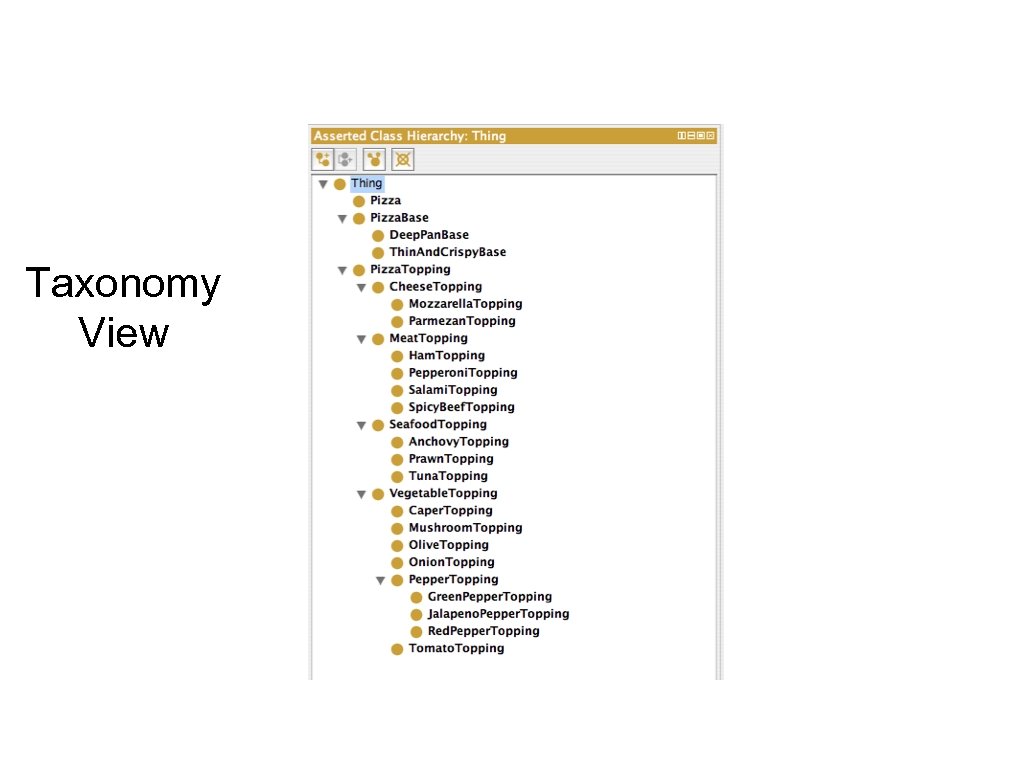 Taxonomy View
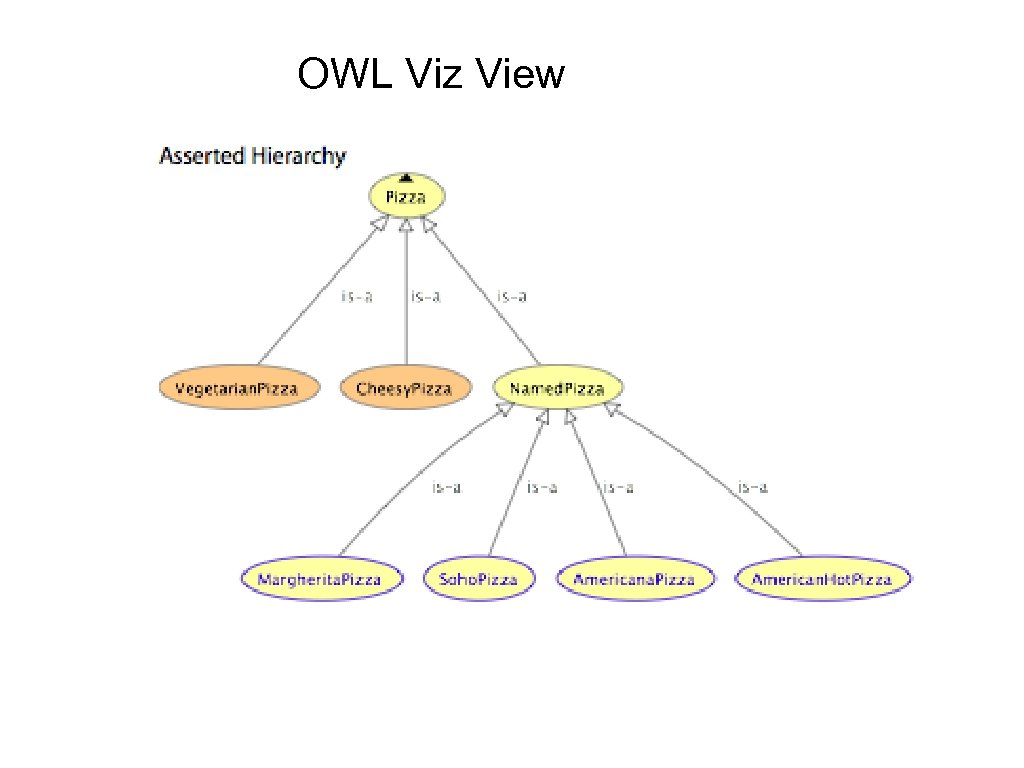 OWL Viz View
 Definition View
 OWL is all about Triplets
 Domain and Range
 Subclasses
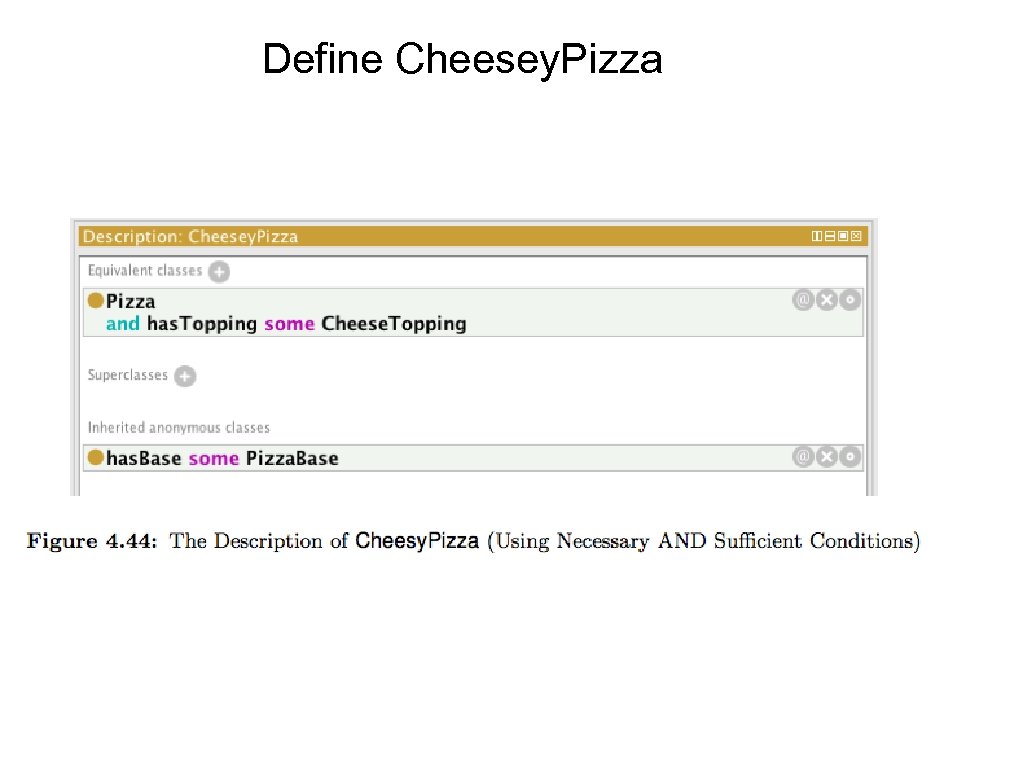 Define Cheesey. Pizza
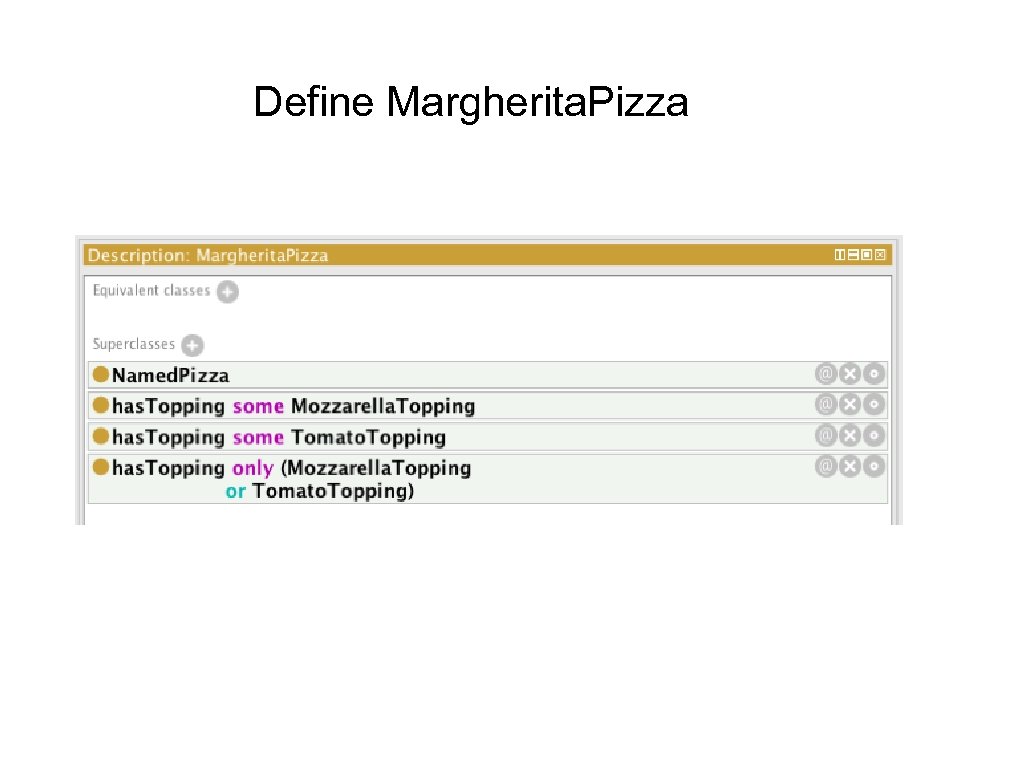 Define Margherita. Pizza
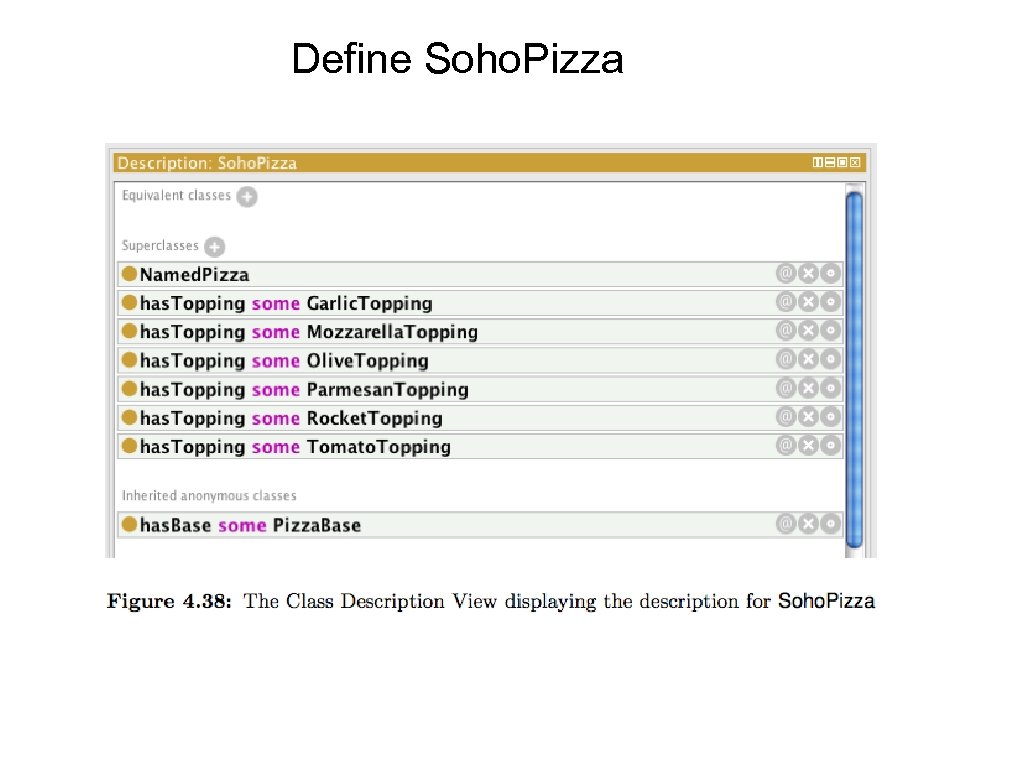 Define Soho. Pizza
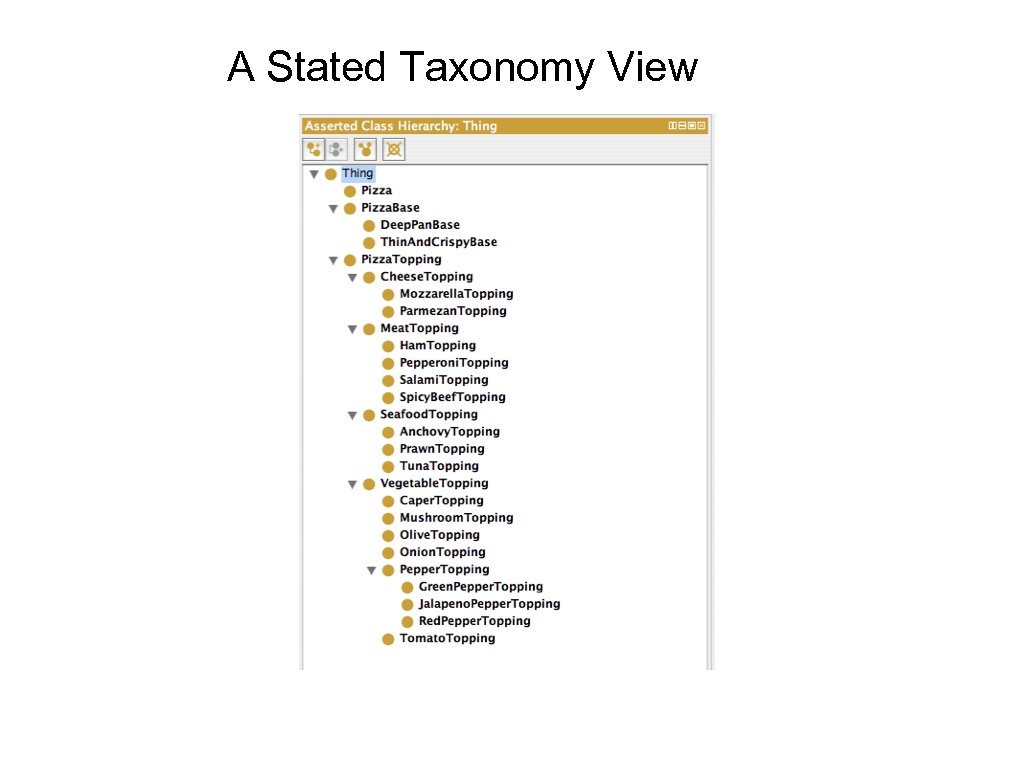 A Stated Taxonomy View
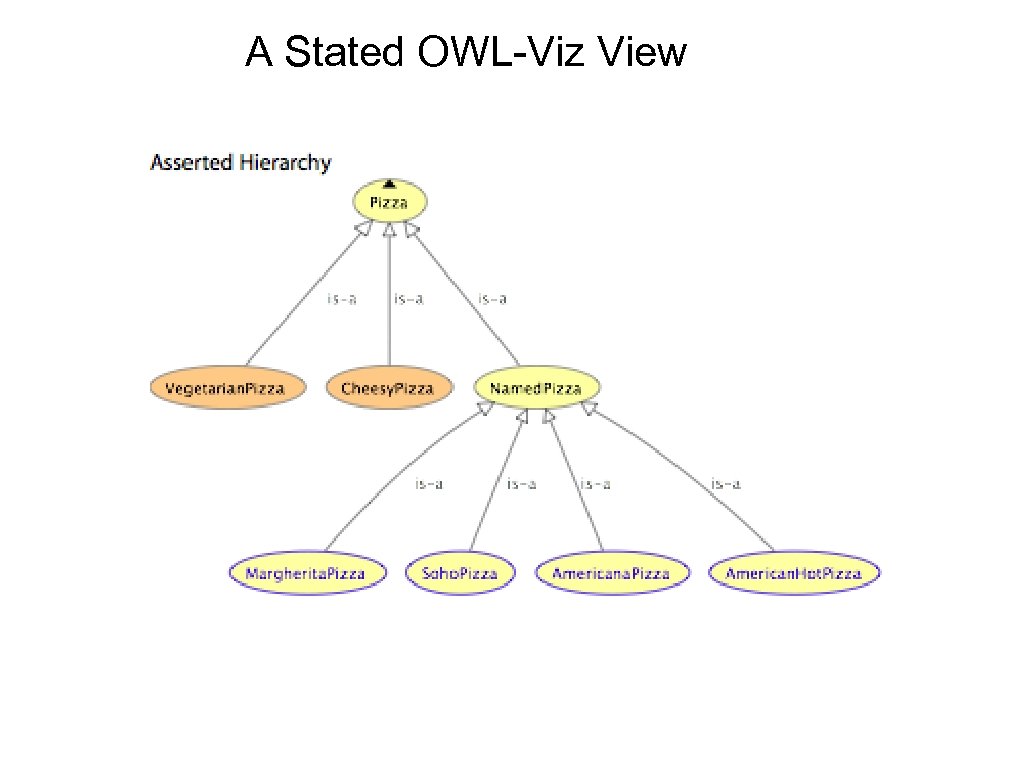 A Stated OWL-Viz View
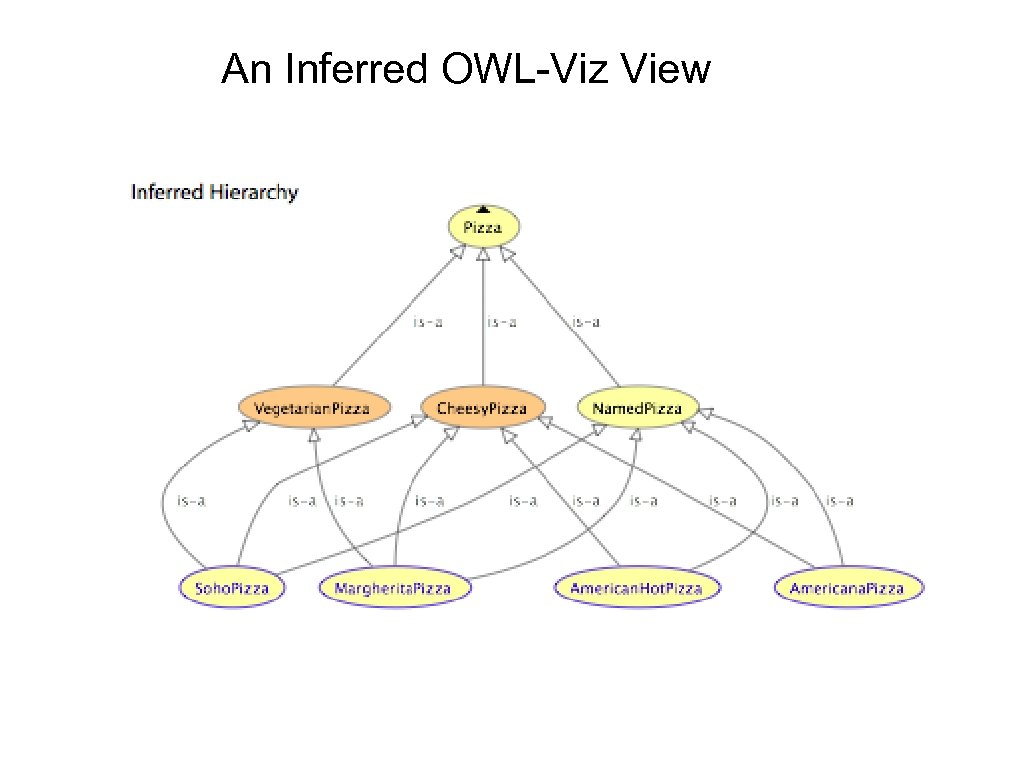 An Inferred OWL-Viz View
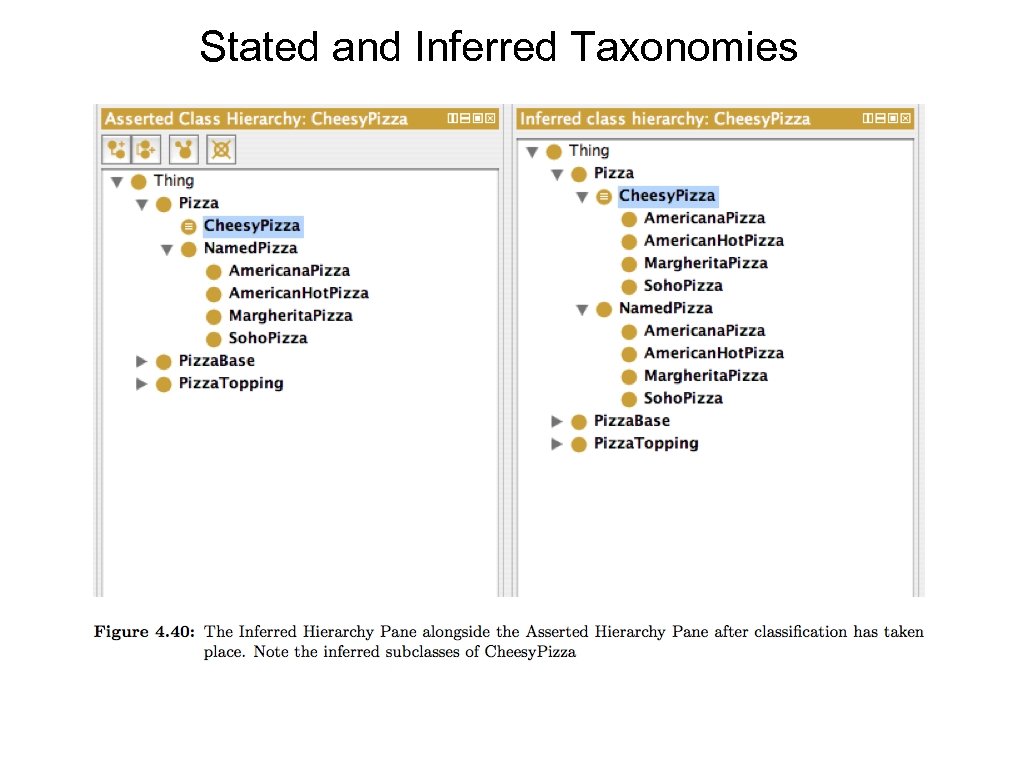 Stated and Inferred Taxonomies
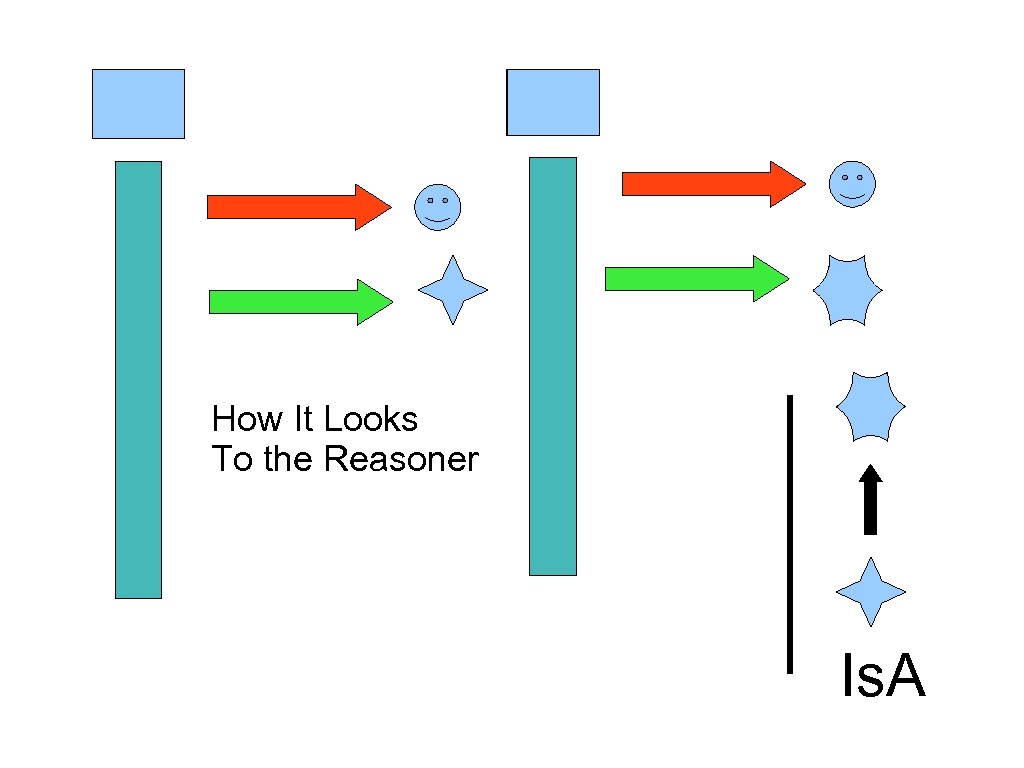
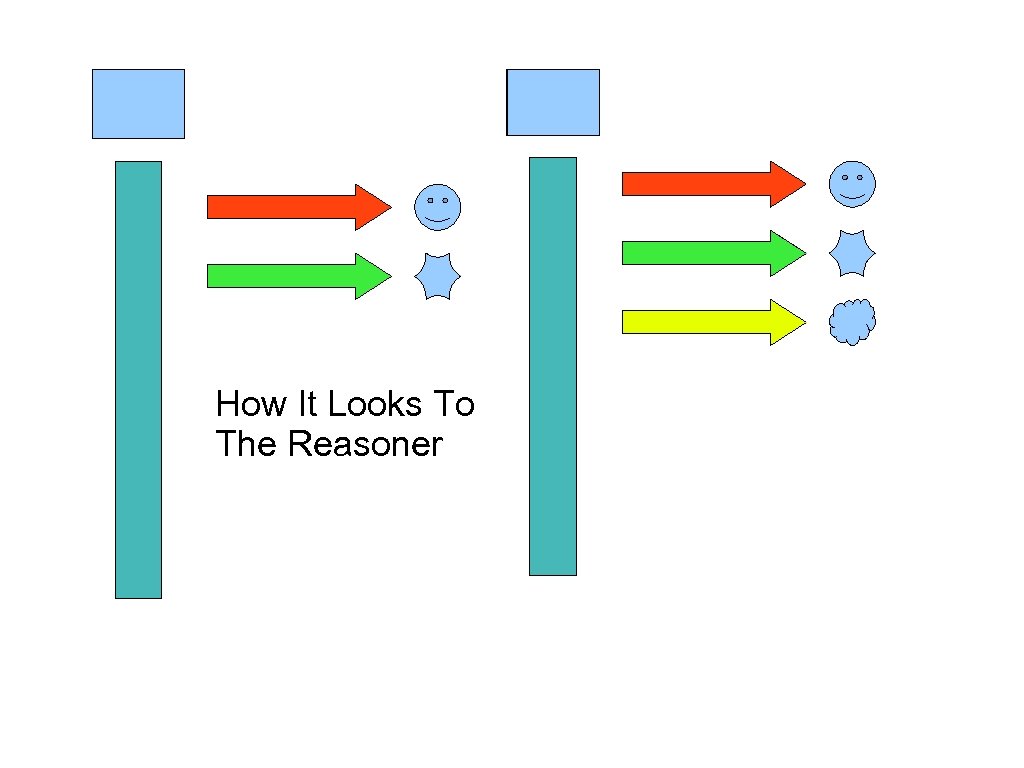 How It Looks To The Reasoner Is. A
 How It Looks To the Reasoner Is. A
 They could be Myocardial Infarction and Acute Myocardial Infarction The right side is the child of (subsumed by) the left side Or they could be Pneumonitis and Infectious Pneumonitis To the Reasoner it doesn’t matter, as long as it can keep track of all the symbols. It is manipulating symbols but the result makes perfect sense and results in clinically useful 46 inferences
 What Does RAAM Model?
 4/8/2013 Kaiser Permanente © 2013 48
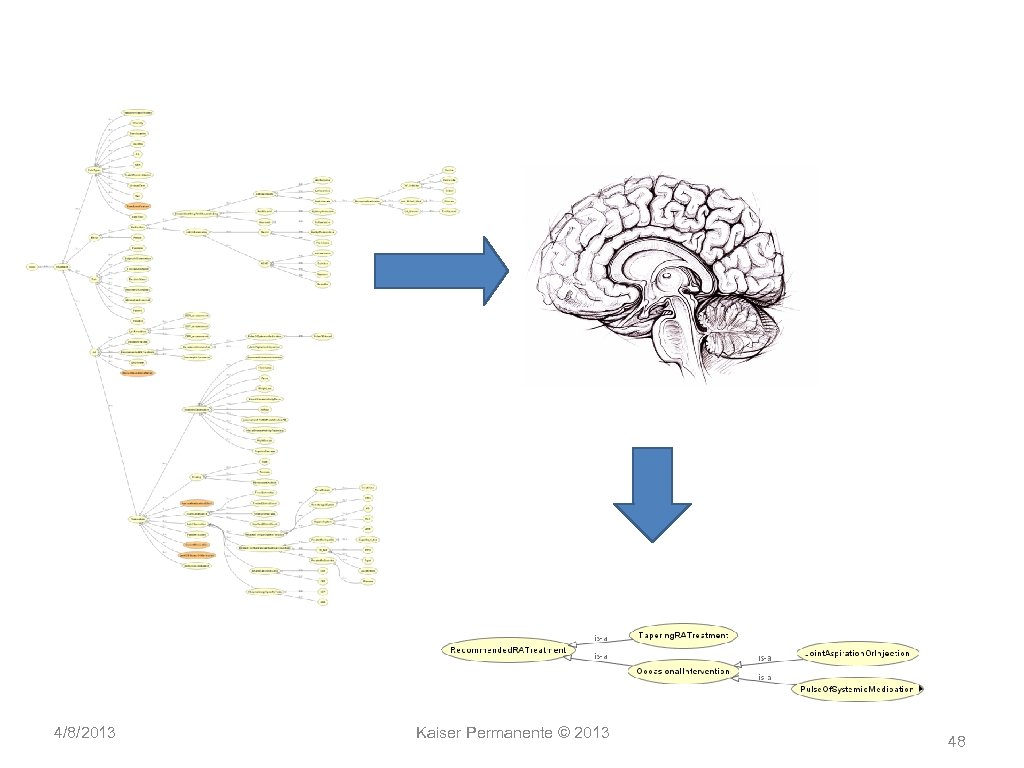
 What Goes In and Out of The Brain Not trying to model the rules, or what happens in the brain of the expert who makes the decisions Only modeling the data that a human expert clinician specialist brain needs to make it’s own assessment Once the brain has made the assessment then we model the decision This is “Decision Support” in a new way, no rules or suggested solutions, just support the decision maker with data 49
 The Reasoner Completely Understands the Entire Model Semantics üDetects Inconsistencies üMakes Logical Inferences üClassifies Clinical Data Automatically 4/8/2013 Kaiser Permanente © 2013 50
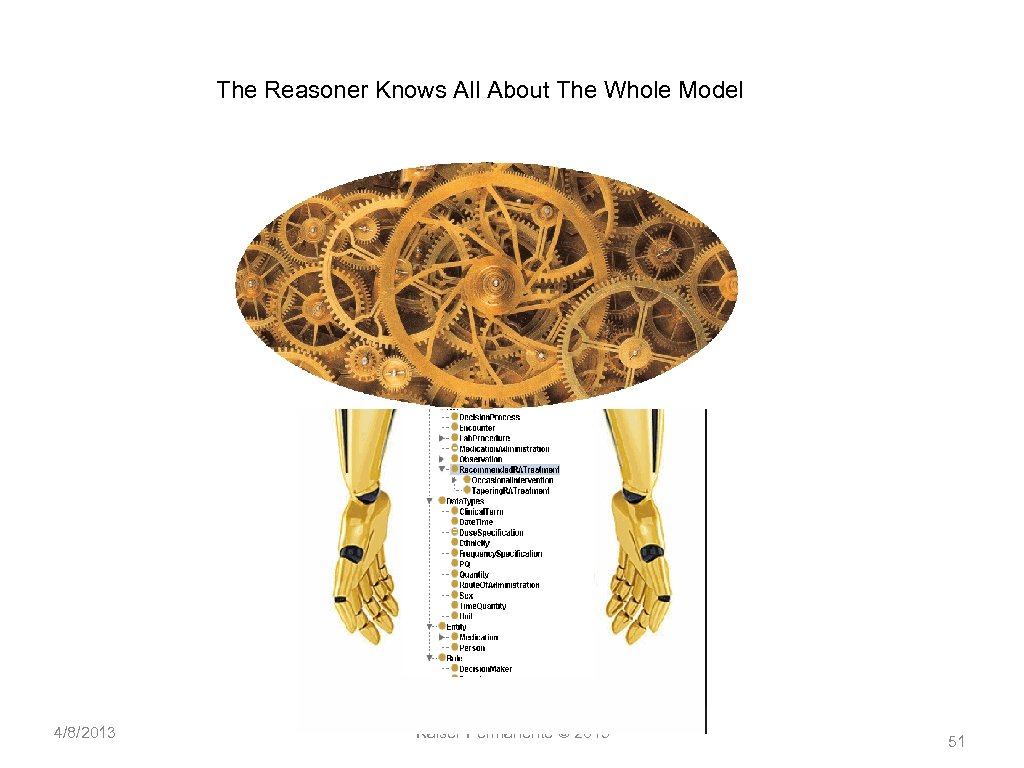 The Reasoner Knows All About The Whole Model 4/8/2013 Kaiser Permanente © 2013 51
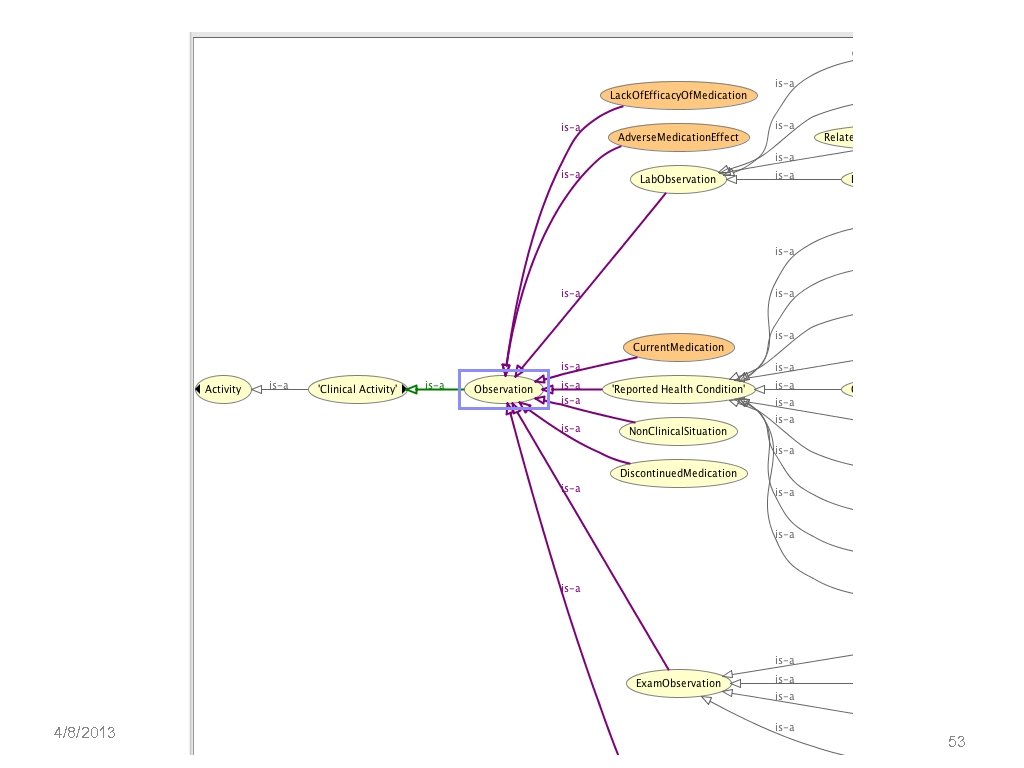
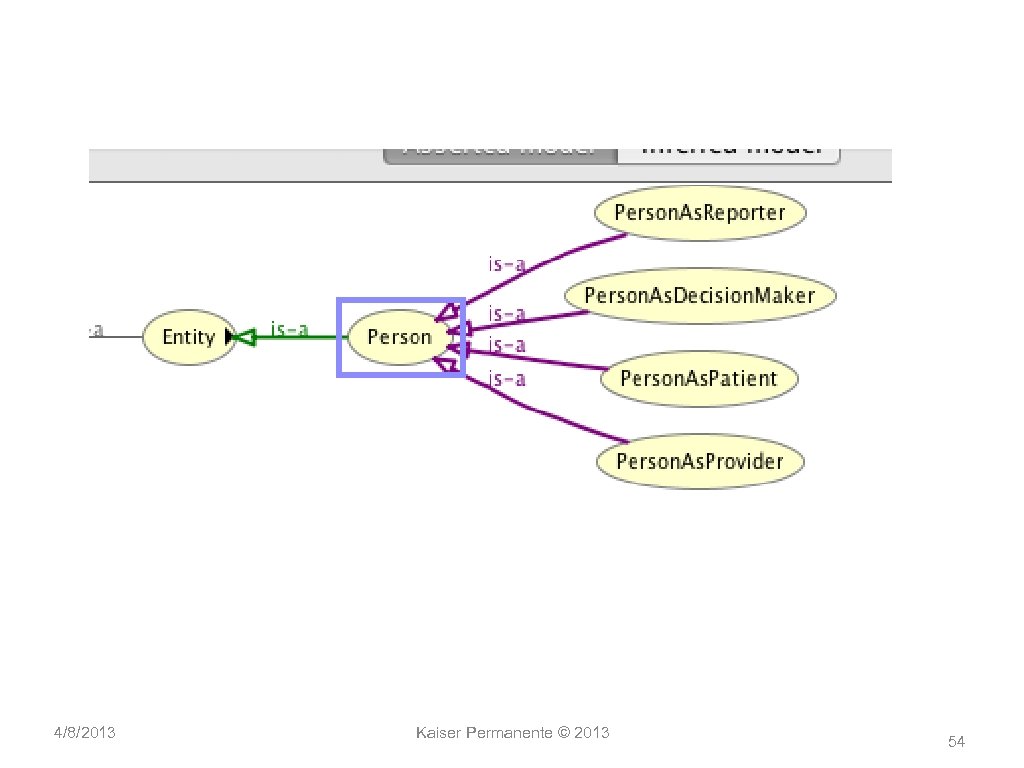
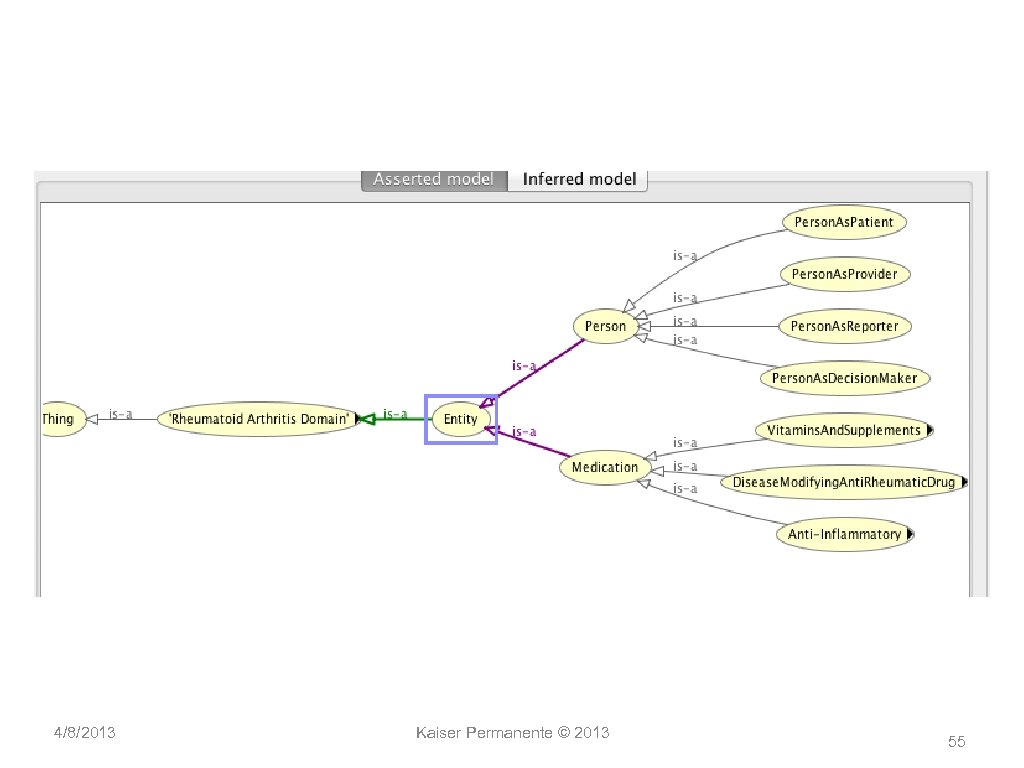
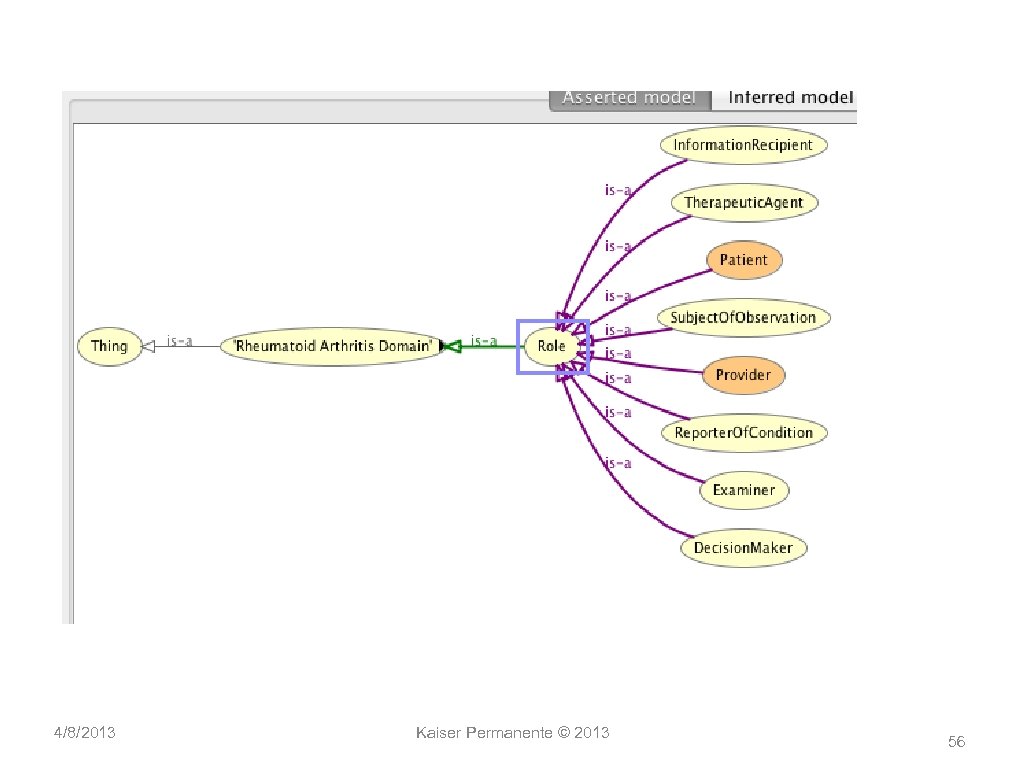
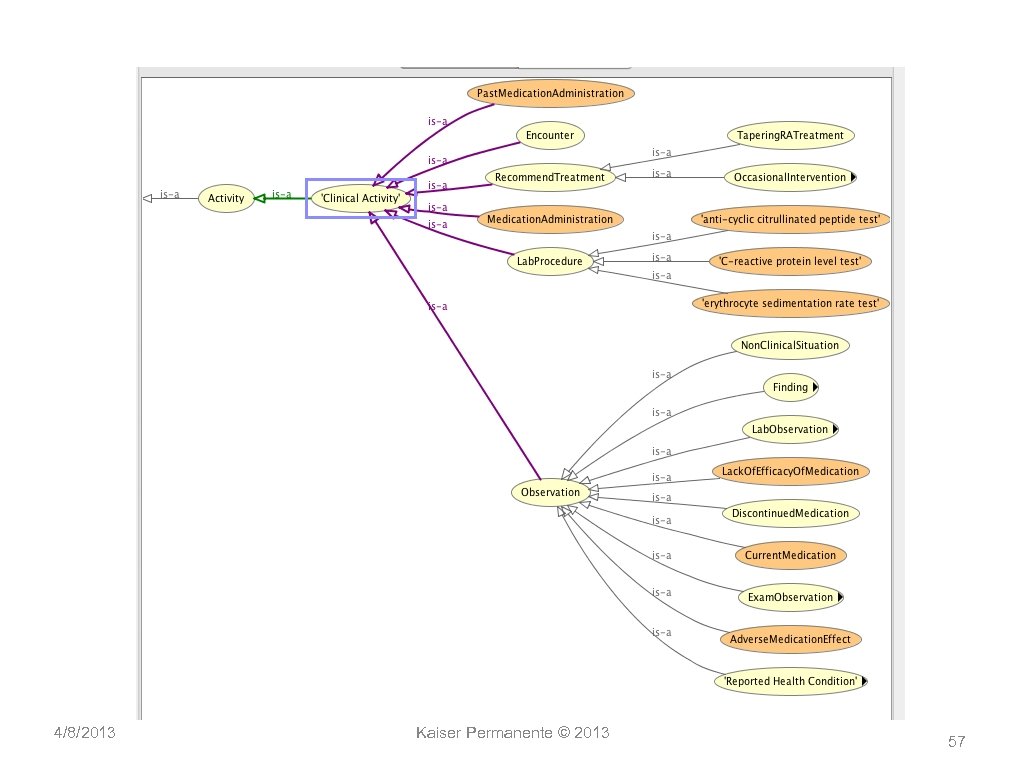
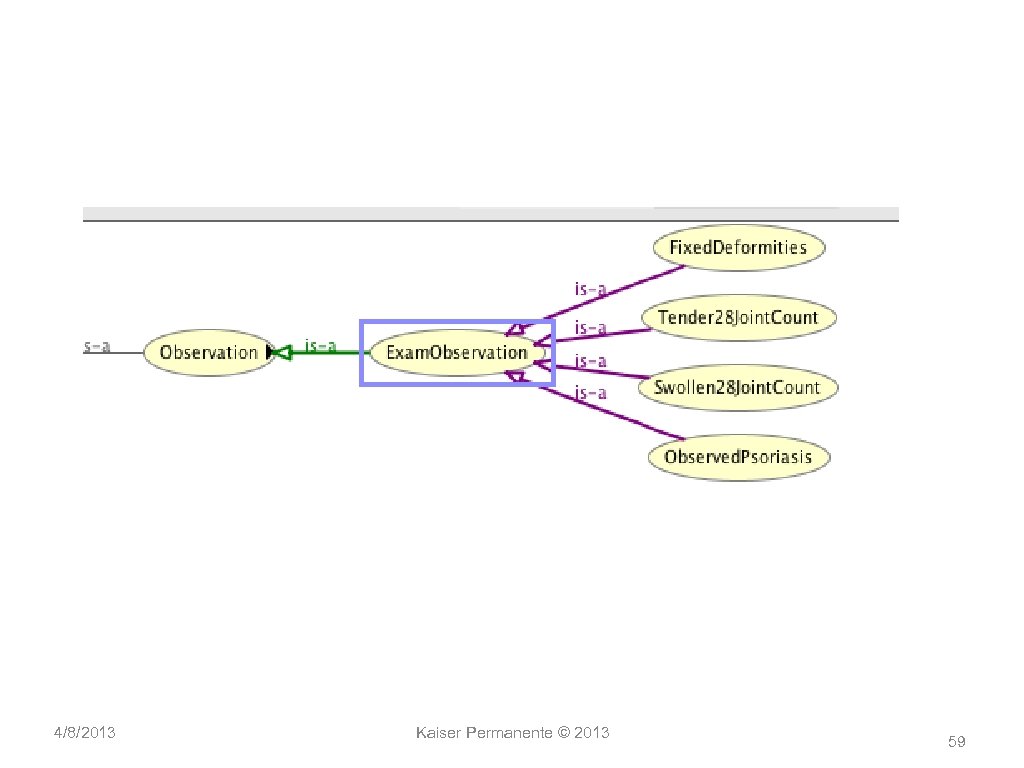
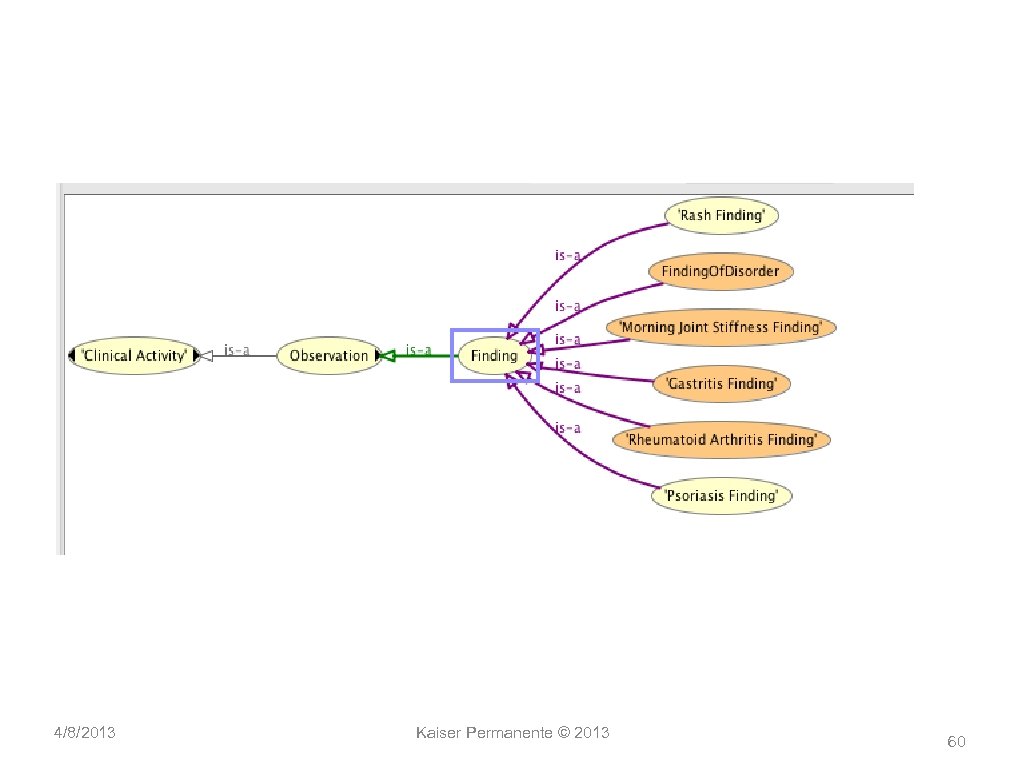
 The generalizable part of the model valid for all sub specialty domains Some example views into the model
 4/8/2013 Kaiser Permanente © 2013 53
 4/8/2013 Kaiser Permanente © 2013 54
 4/8/2013 Kaiser Permanente © 2013 55
 4/8/2013 Kaiser Permanente © 2013 56
 4/8/2013 Kaiser Permanente © 2013 57
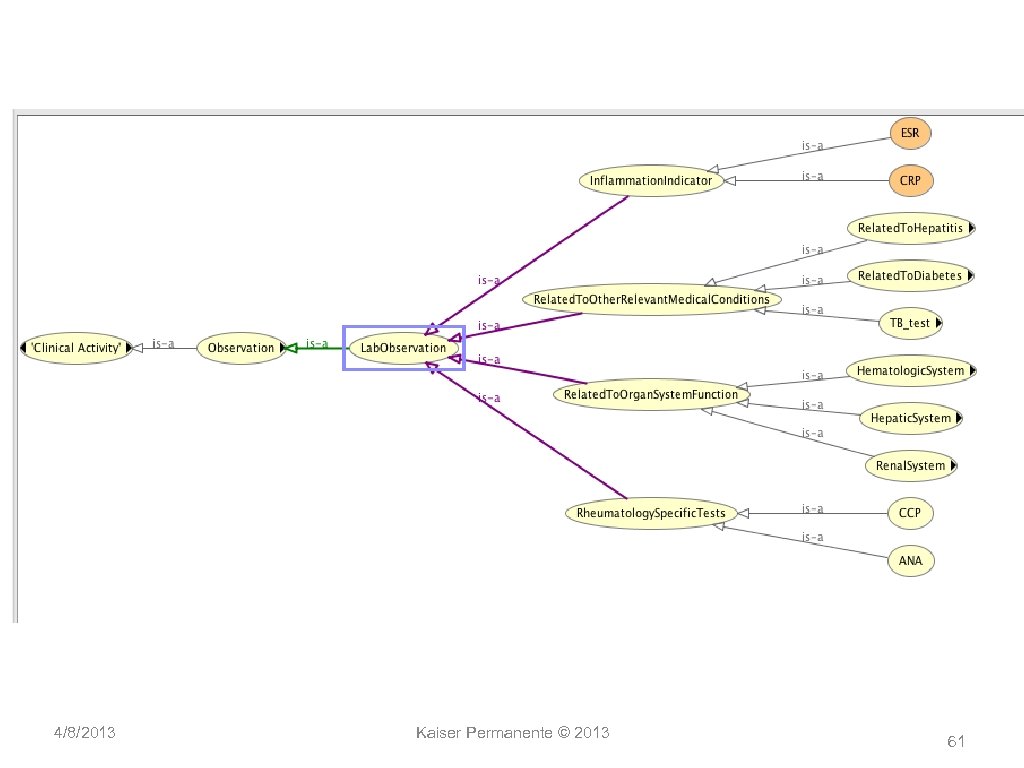
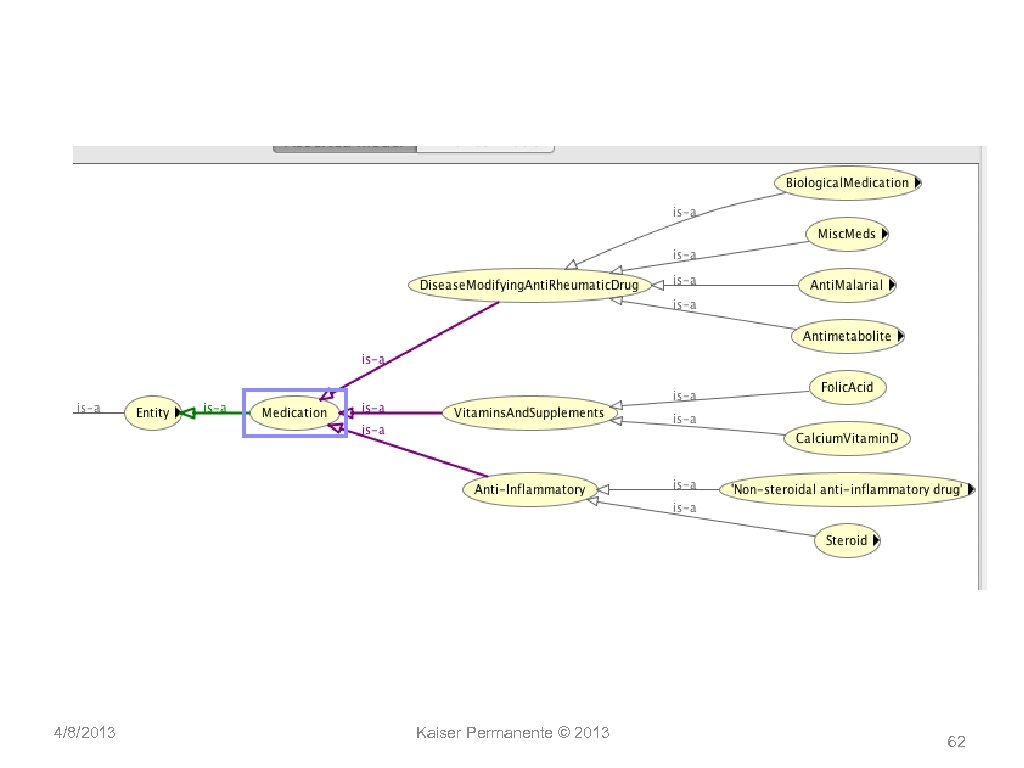
 The Medical Specialty Domain Specific Part
 4/8/2013 Kaiser Permanente © 2013 59
 4/8/2013 Kaiser Permanente © 2013 60
 4/8/2013 Kaiser Permanente © 2013 61
 4/8/2013 Kaiser Permanente © 2013 62
 4/8/2013 Kaiser Permanente © 2013 63
 4/8/2013 Kaiser Permanente © 2013 64
 How KCOM is bound to SNOMED
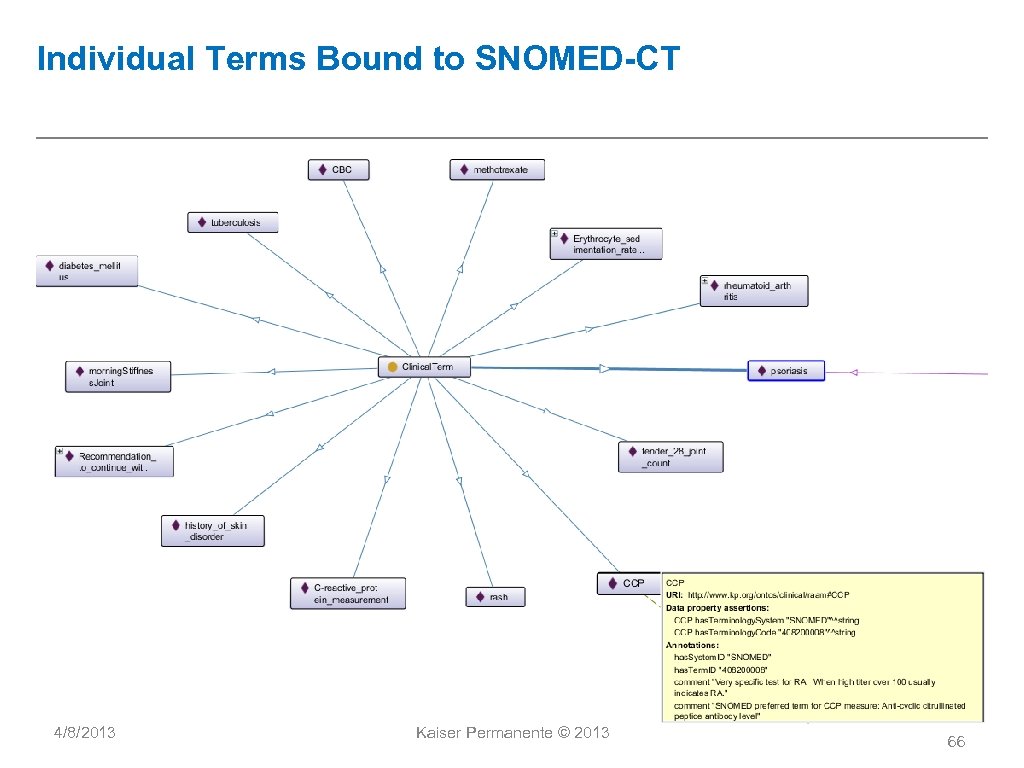 Individual Terms Bound to SNOMED-CT 4/8/2013 Kaiser Permanente © 2013 66
 The Clinical Stories Used to Design KCOM
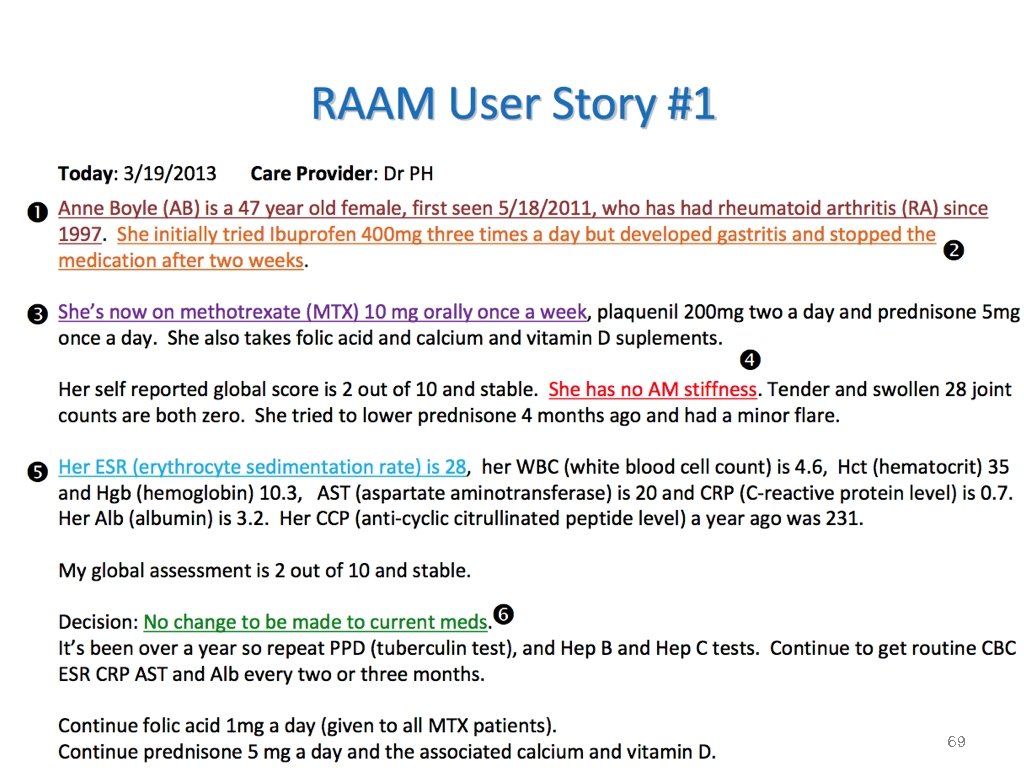
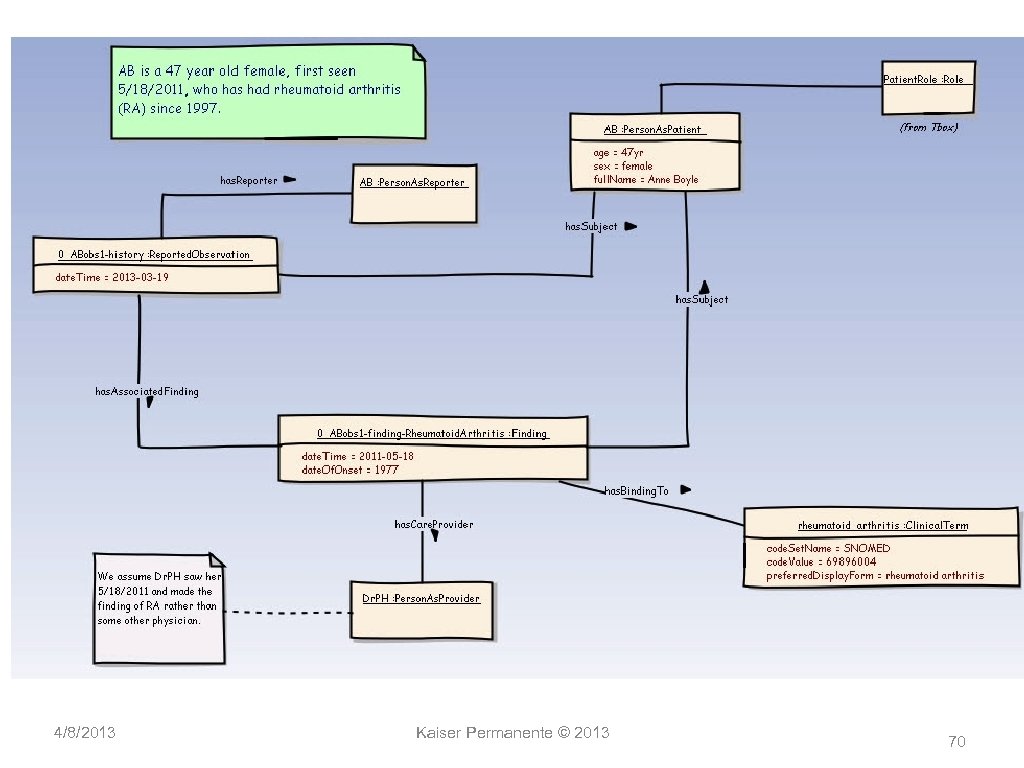
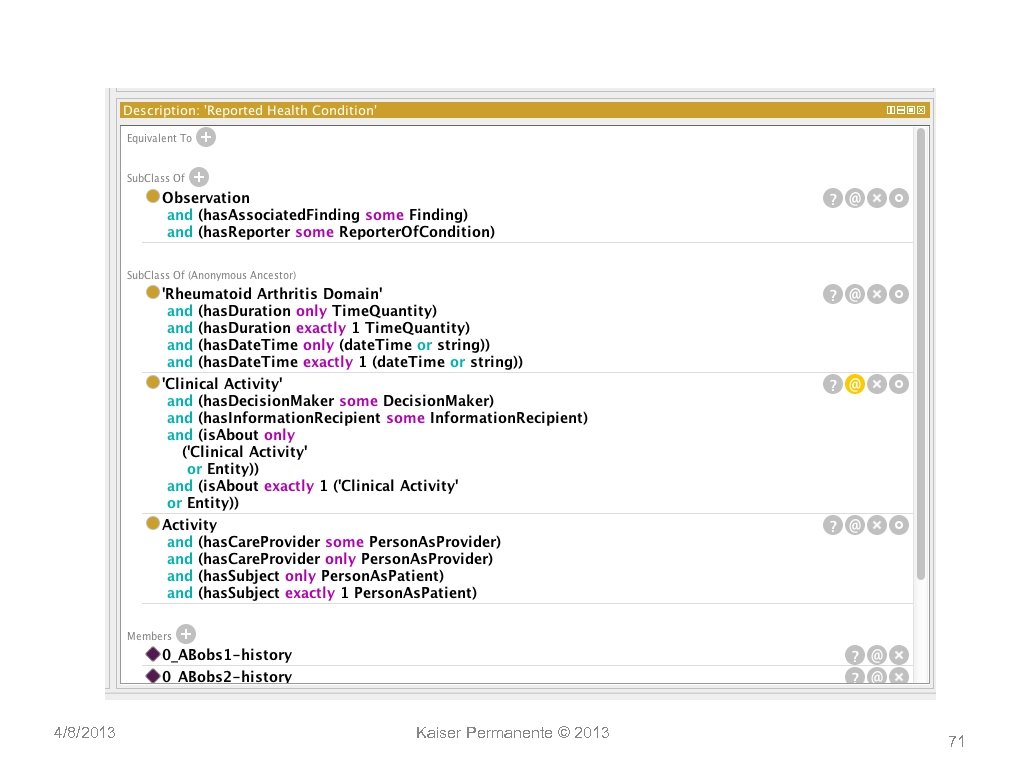
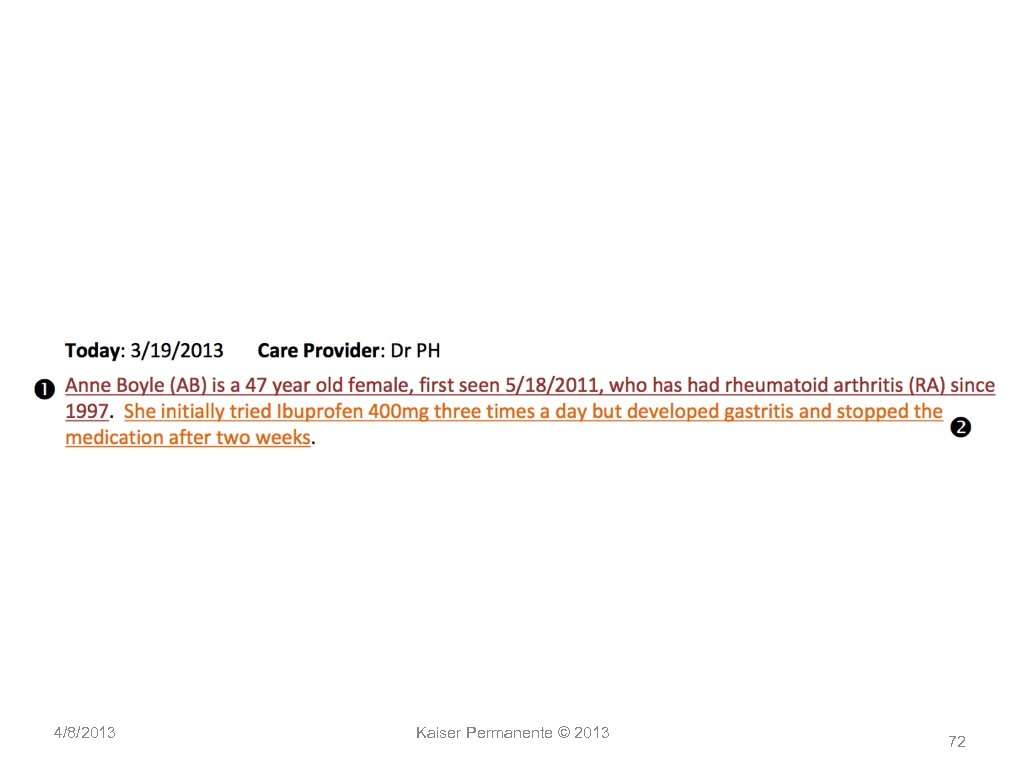
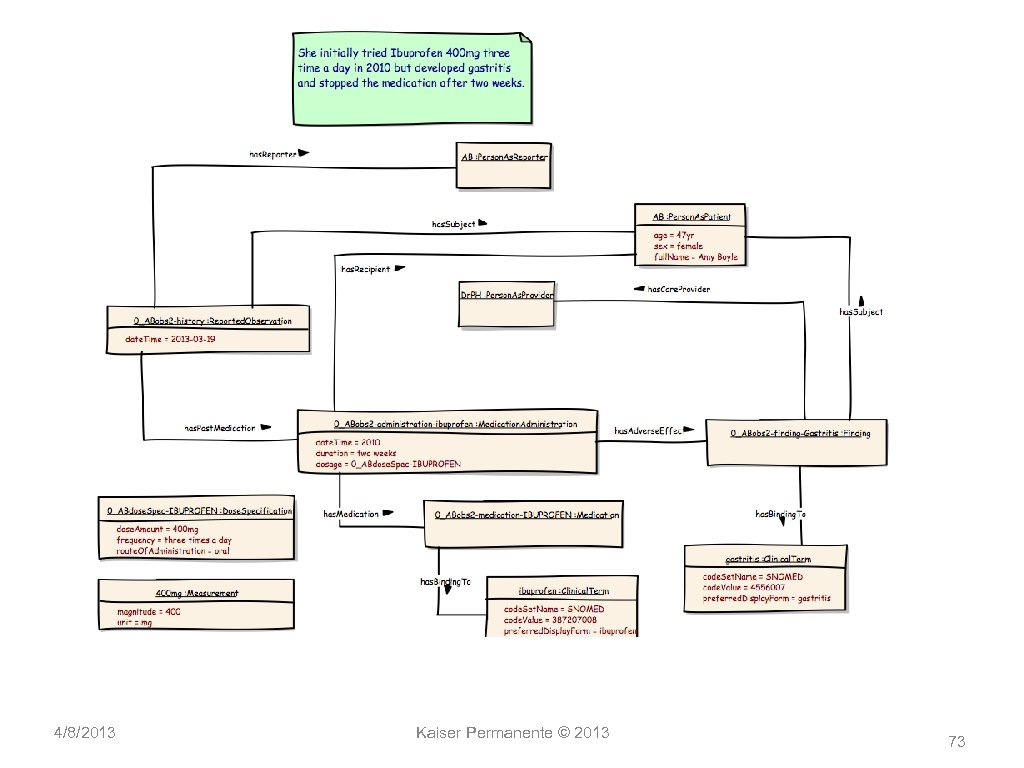
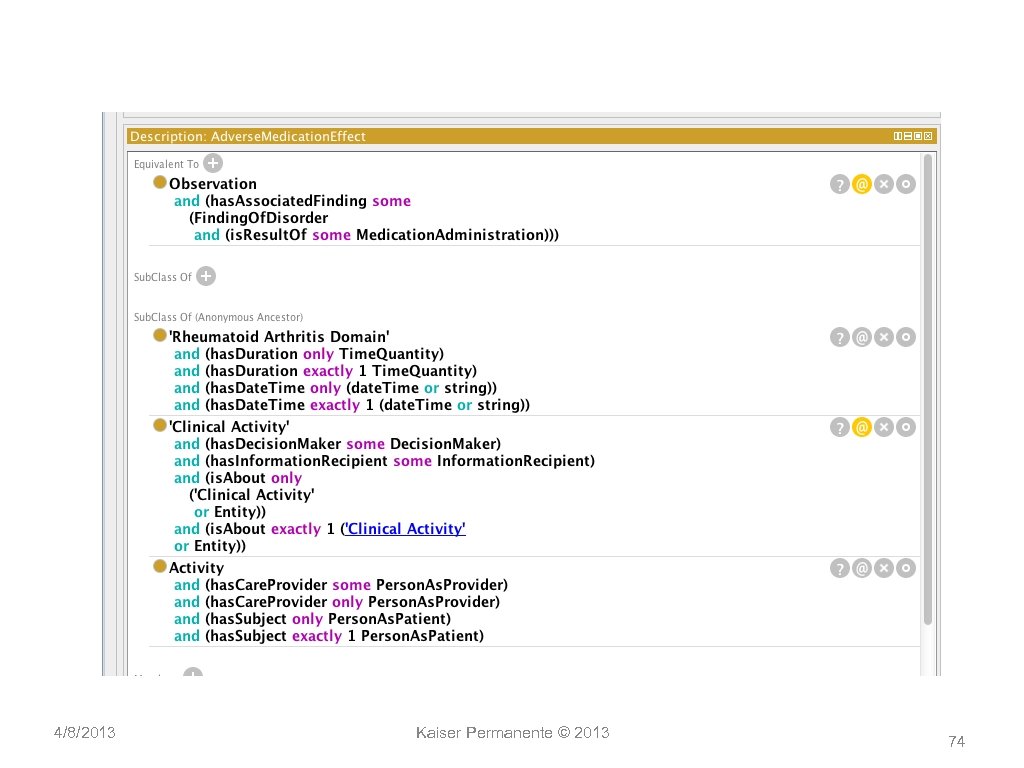
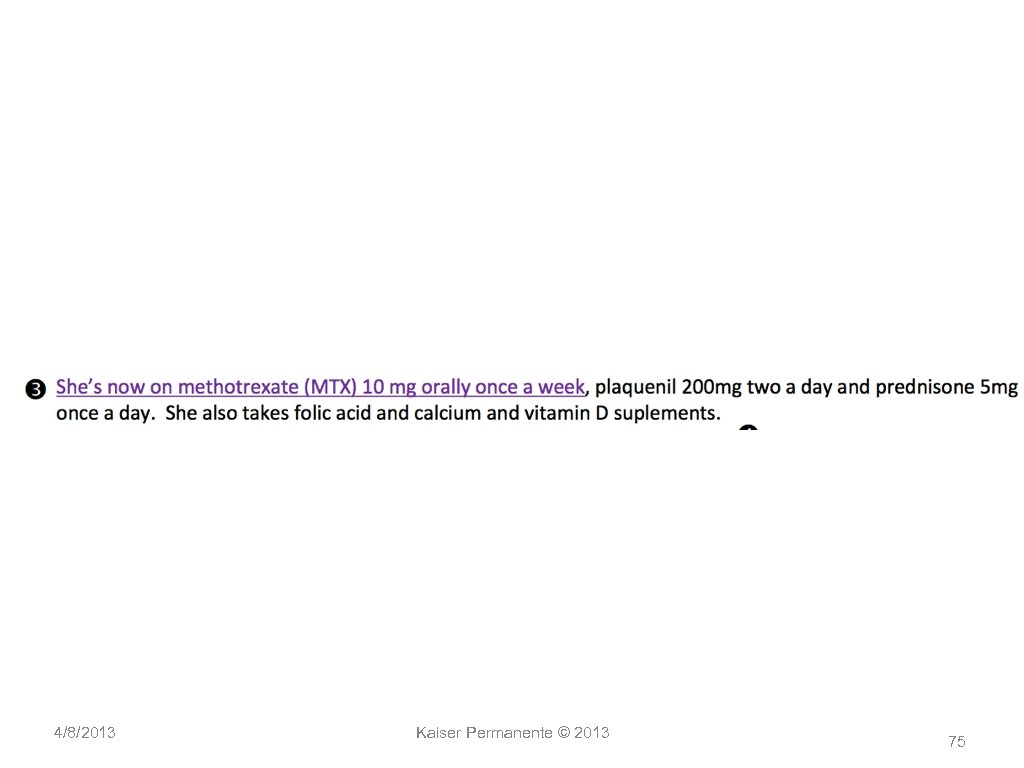
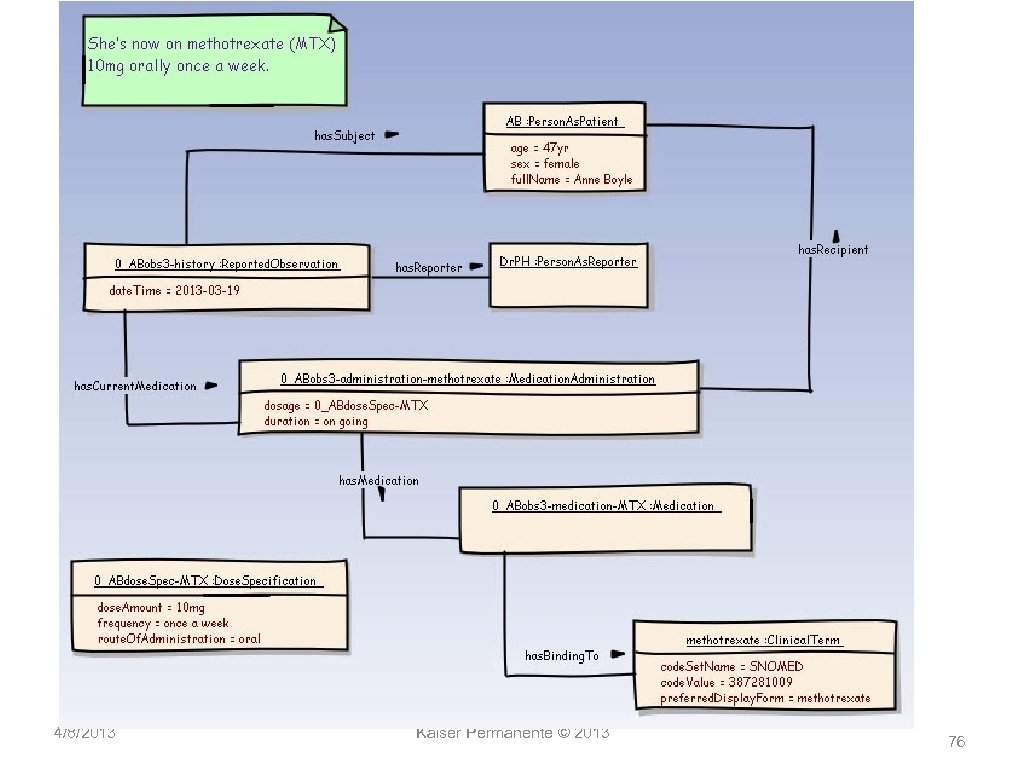
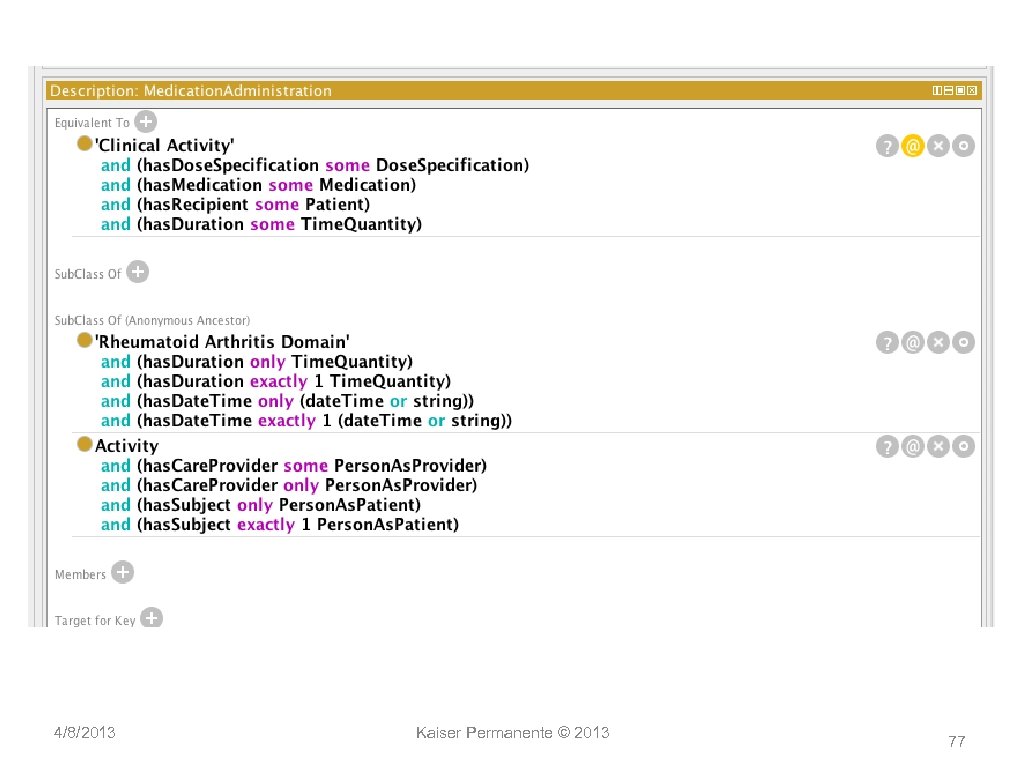
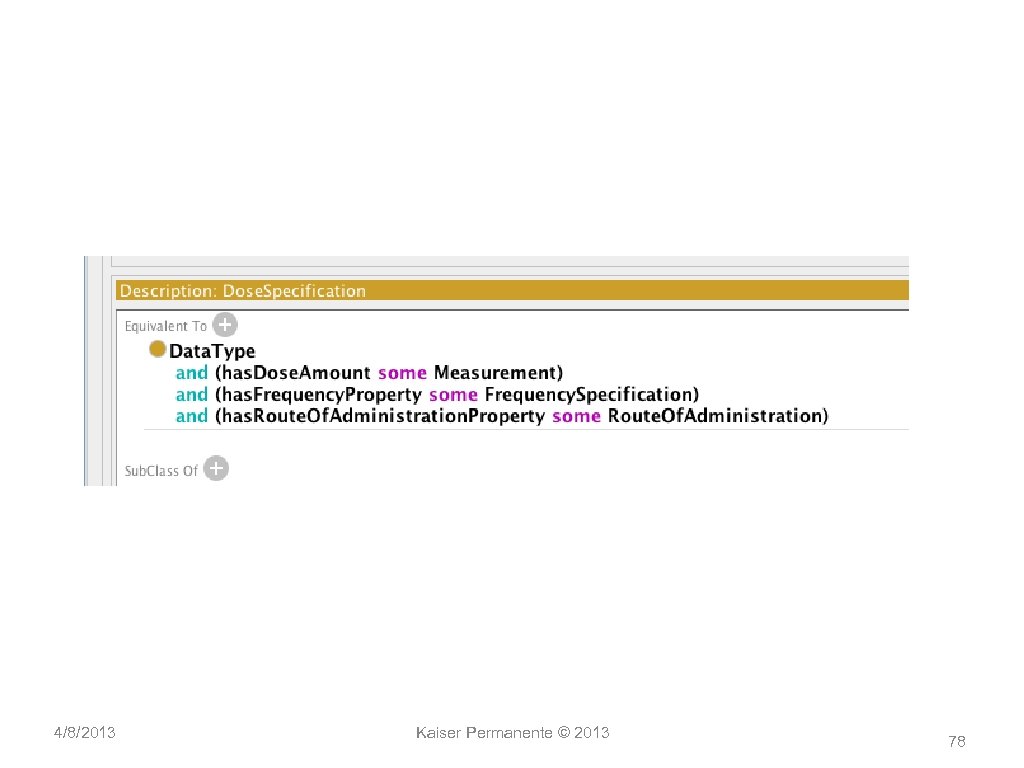
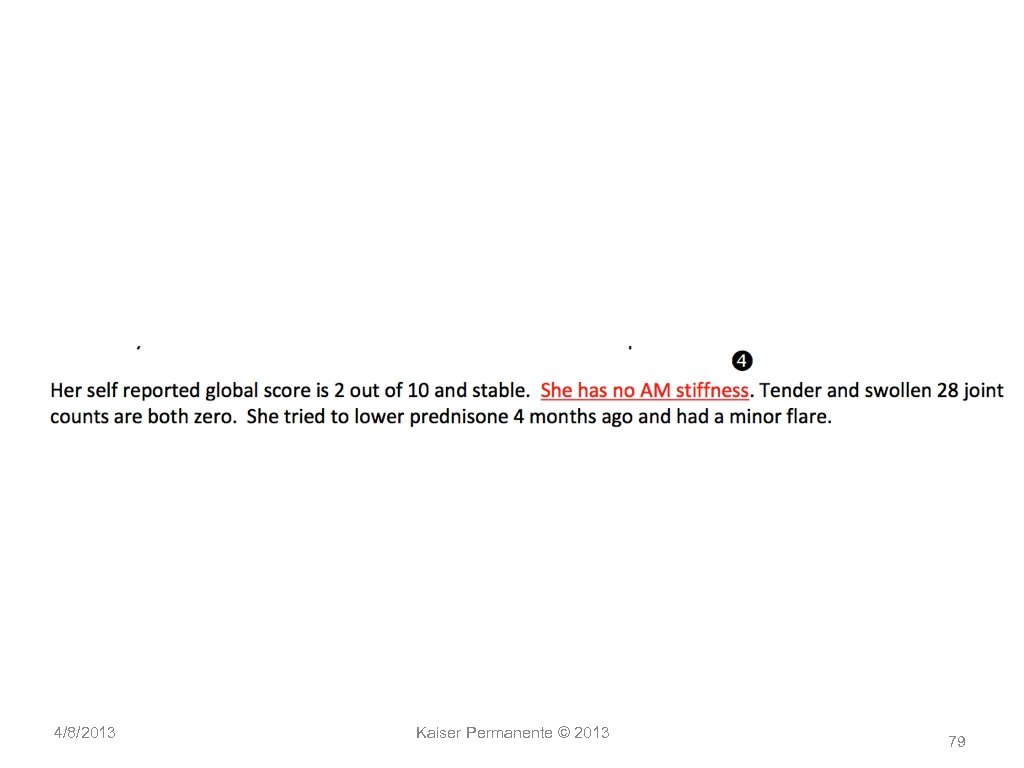
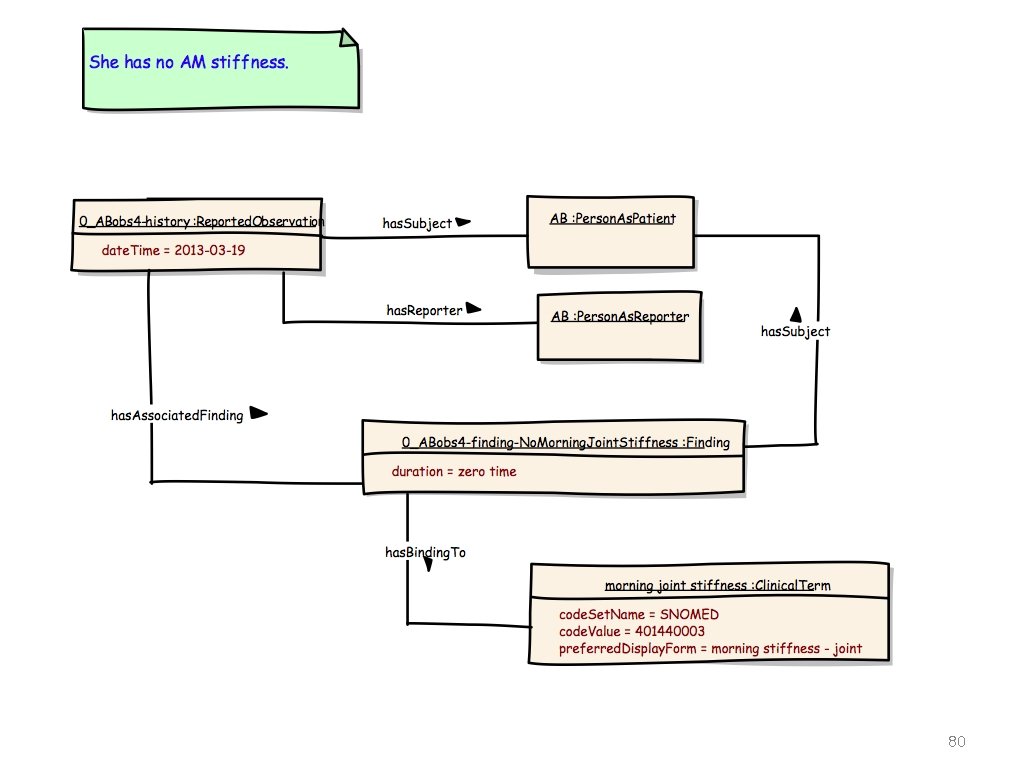
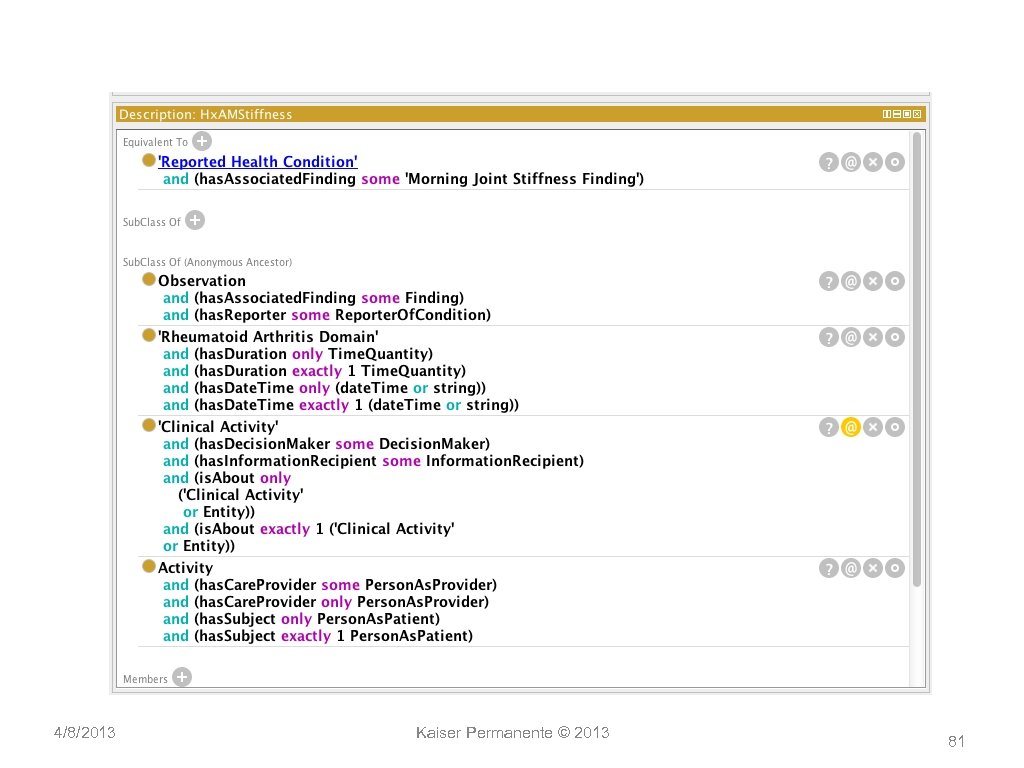
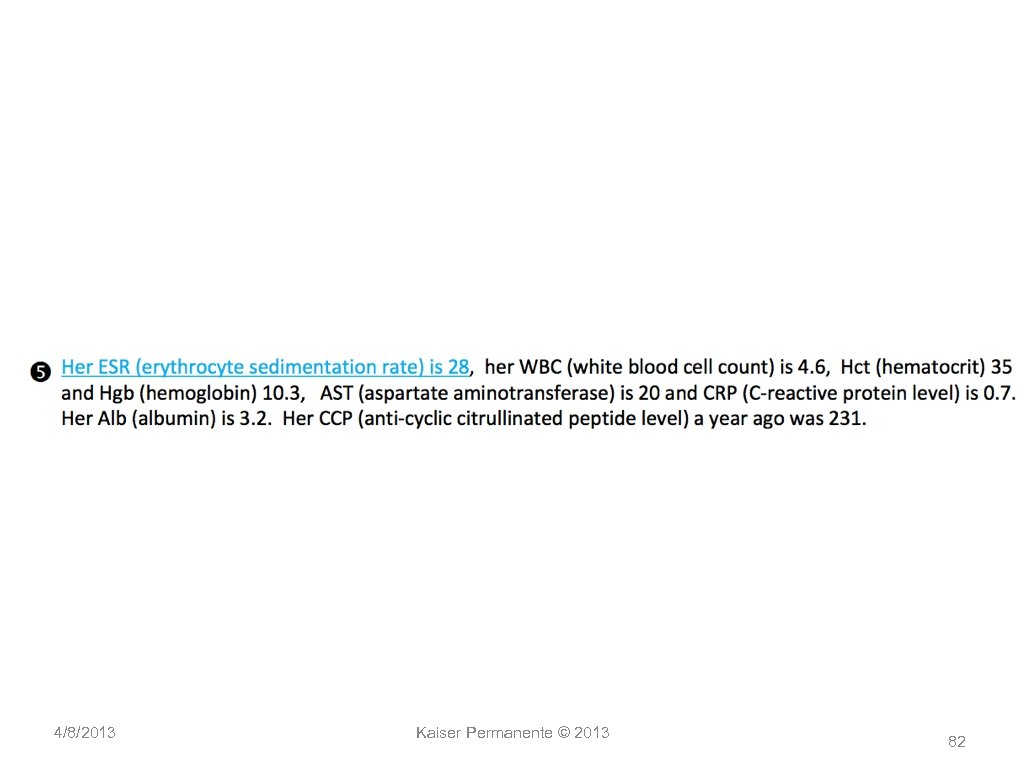
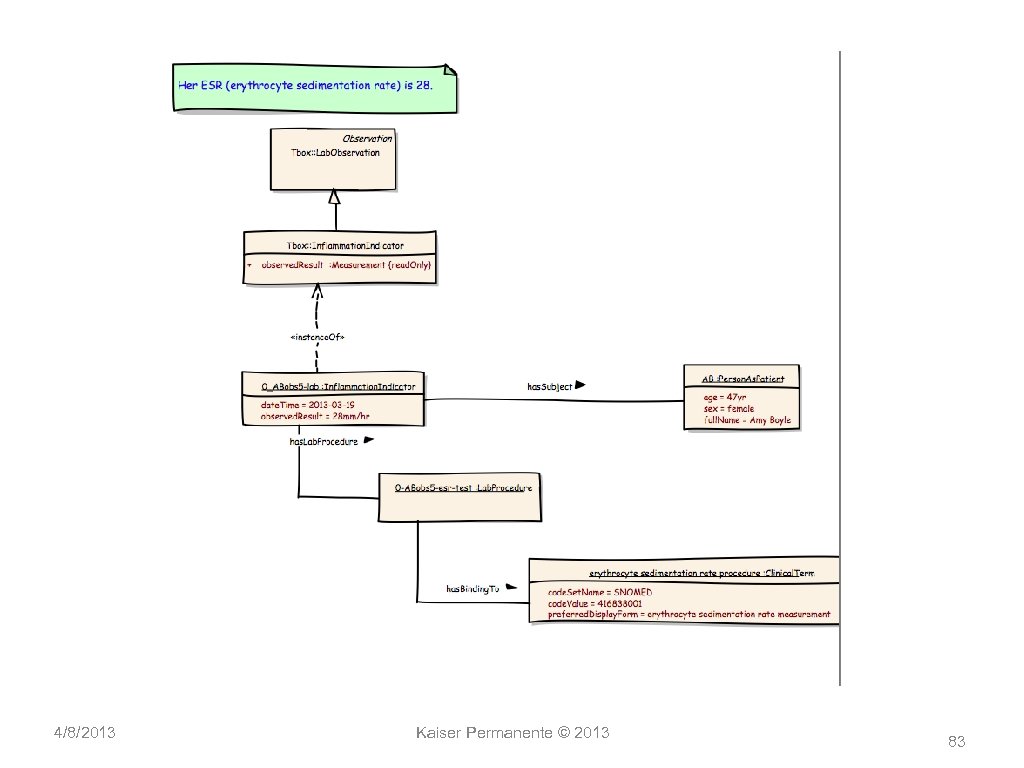
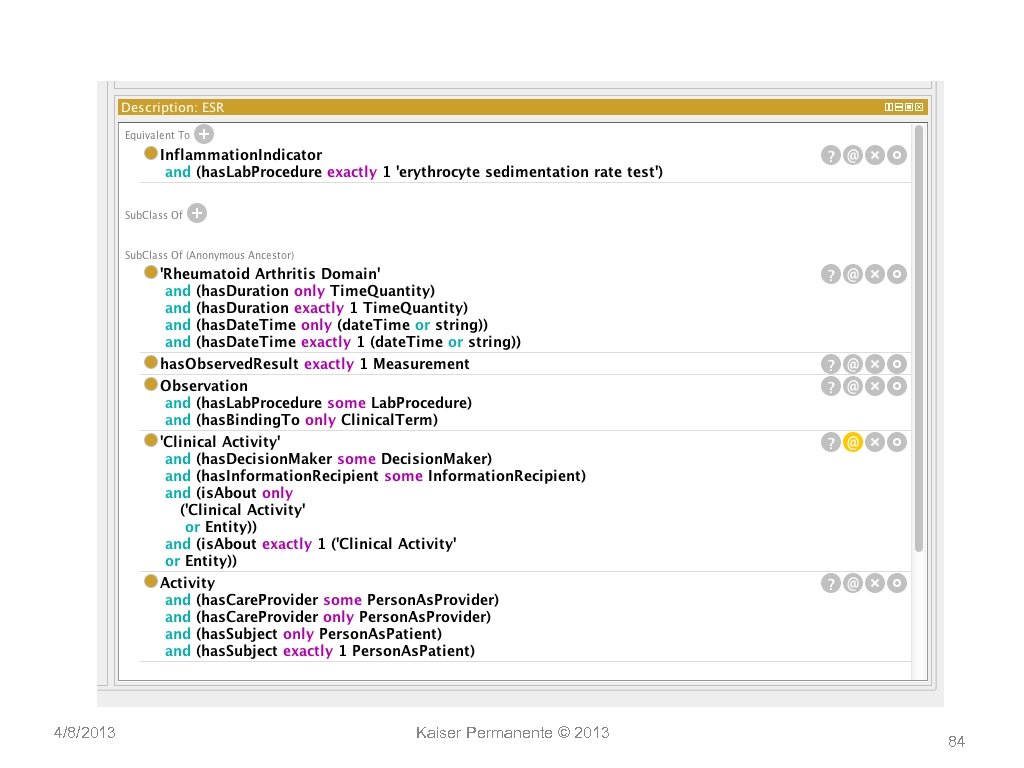
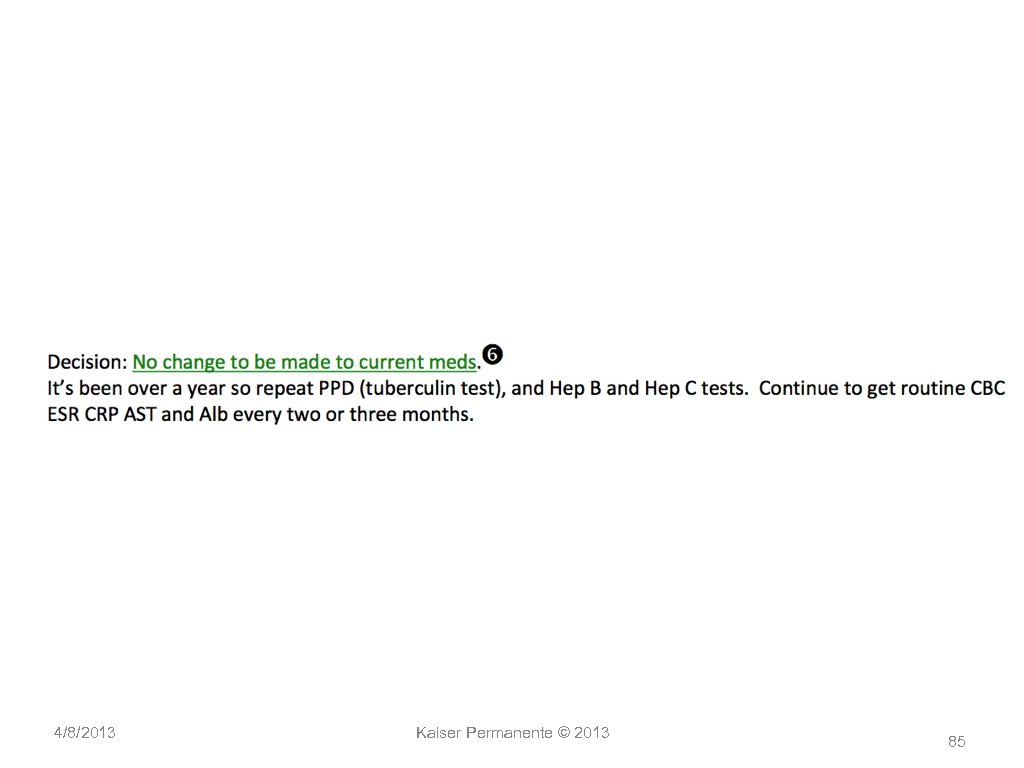
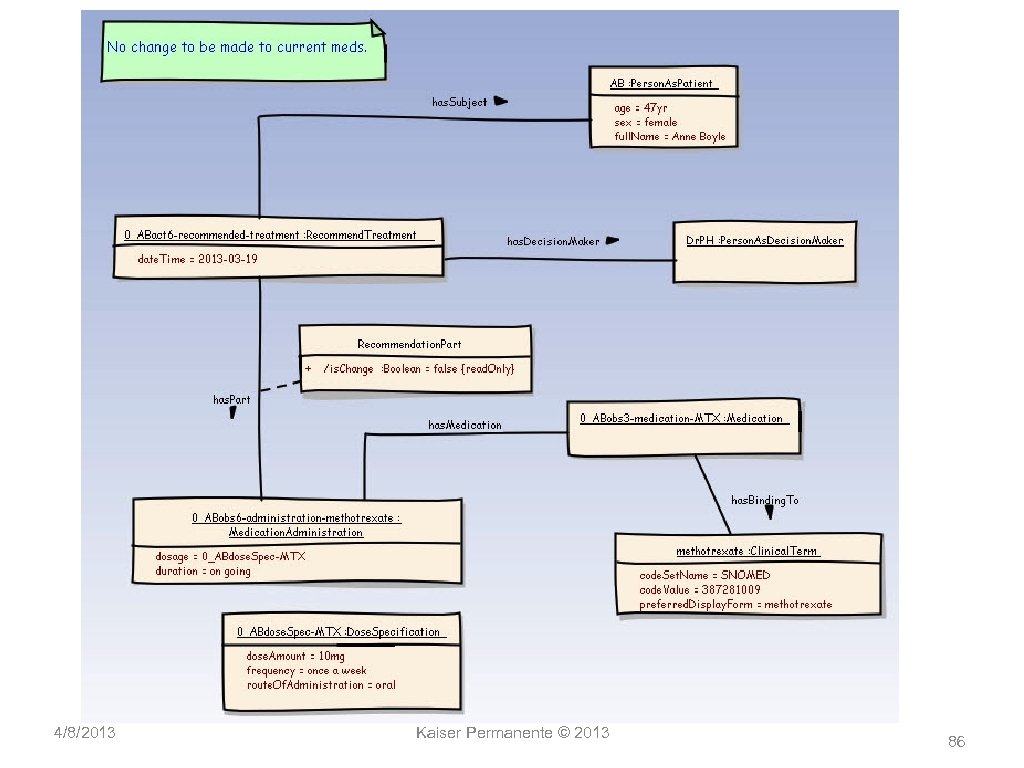
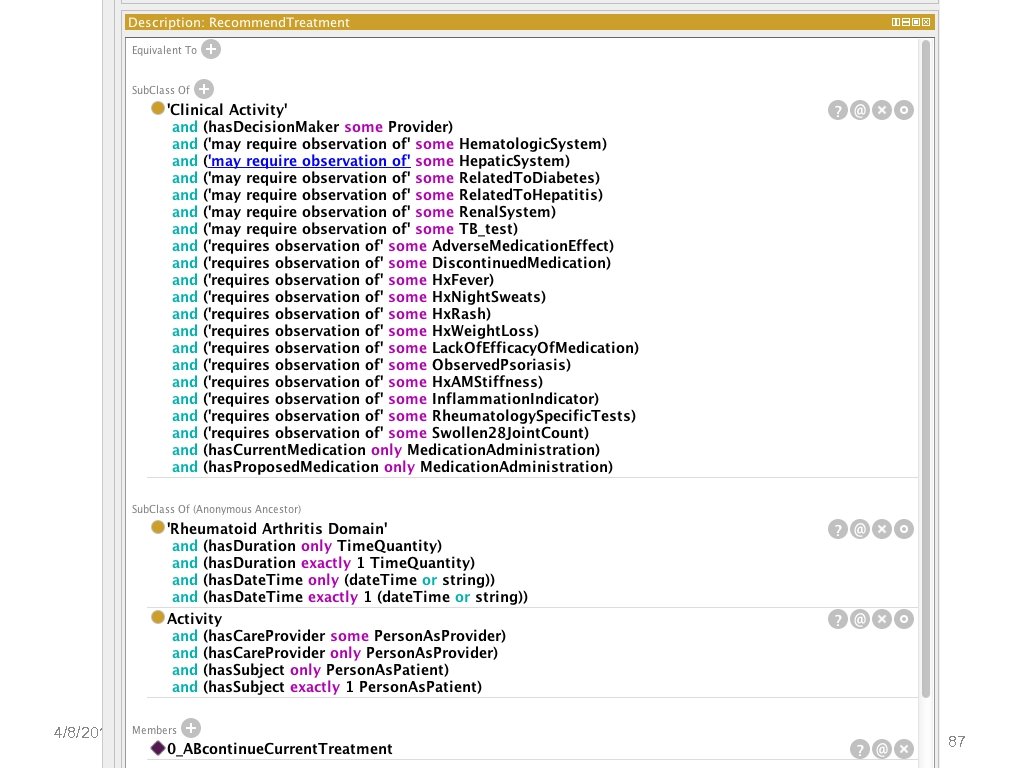
 • • Based on clinical cases When KCOM was first designed, we took six examples of clinical notes from Rheumatoid Arthritis Assessments They covered various clinical scenarios We will select six specific clinical statements from case number one and explore them in depth We will look at them in English, UML and finally in KCOM OWL
 4/8/2013 Kaiser Permanente © 2013 69
 4/8/2013 Kaiser Permanente © 2013 70
 4/8/2013 Kaiser Permanente © 2013 71
 4/8/2013 Kaiser Permanente © 2013 72
 4/8/2013 Kaiser Permanente © 2013 73
 4/8/2013 Kaiser Permanente © 2013 74
 4/8/2013 Kaiser Permanente © 2013 75
 4/8/2013 Kaiser Permanente © 2013 76
 4/8/2013 Kaiser Permanente © 2013 77
 4/8/2013 Kaiser Permanente © 2013 78
 4/8/2013 Kaiser Permanente © 2013 79
 4/8/2013 Kaiser Permanente © 2013 80
 4/8/2013 Kaiser Permanente © 2013 81
 4/8/2013 Kaiser Permanente © 2013 82
 4/8/2013 Kaiser Permanente © 2013 83
 4/8/2013 Kaiser Permanente © 2013 84
 4/8/2013 Kaiser Permanente © 2013 85
 4/8/2013 Kaiser Permanente © 2013 86
 4/8/2013 Kaiser Permanente © 2013 87
 And One Semantic Query Example
 2 Compare the number of gastrointestinal bleeds in RA patients in the following groups. Those who have and have not taken NSAIDs
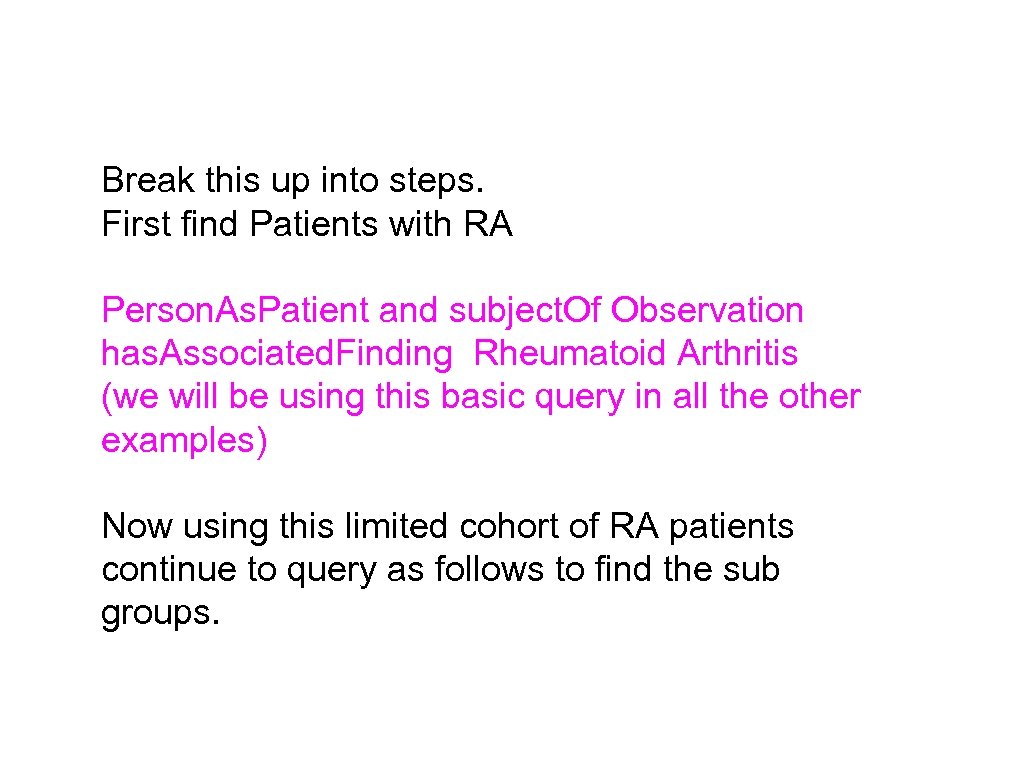 Break this up into steps. First find Patients with RA Person. As. Patient and subject. Of Observation has. Associated. Finding Rheumatoid Arthritis (we will be using this basic query in all the other examples) Now using this limited cohort of RA patients continue to query as follows to find the sub groups.
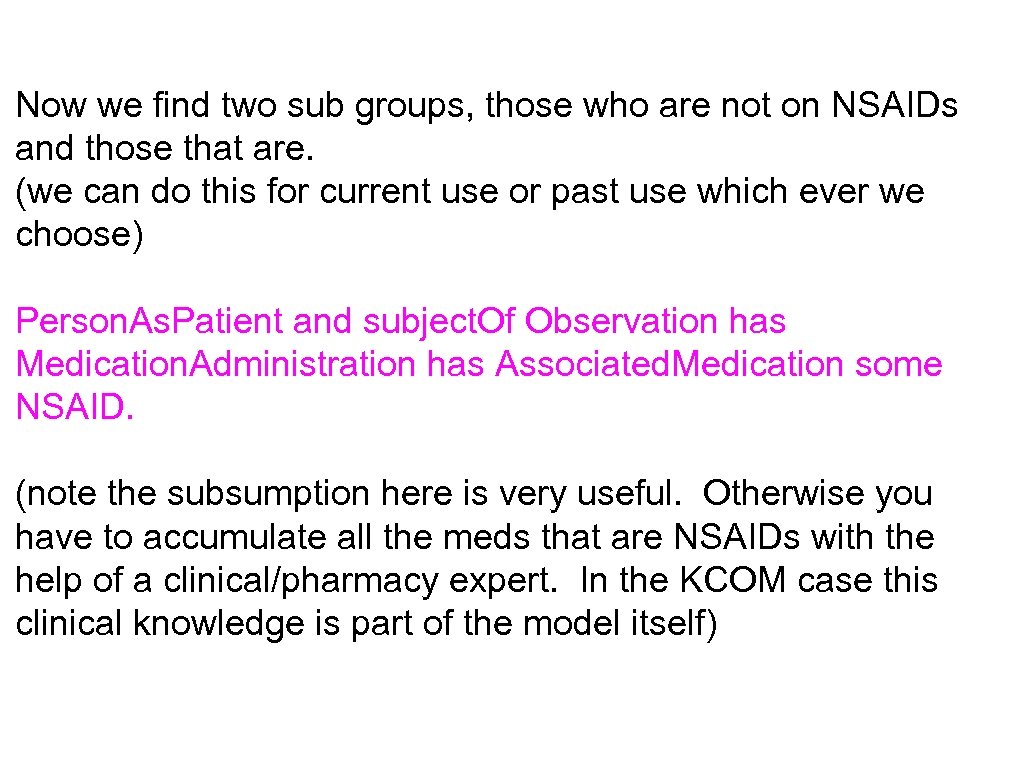 Now we find two sub groups, those who are not on NSAIDs and those that are. (we can do this for current use or past use which ever we choose) Person. As. Patient and subject. Of Observation has Medication. Administration has Associated. Medication some NSAID. (note the subsumption here is very useful. Otherwise you have to accumulate all the meds that are NSAIDs with the help of a clinical/pharmacy expert. In the KCOM case this clinical knowledge is part of the model itself)
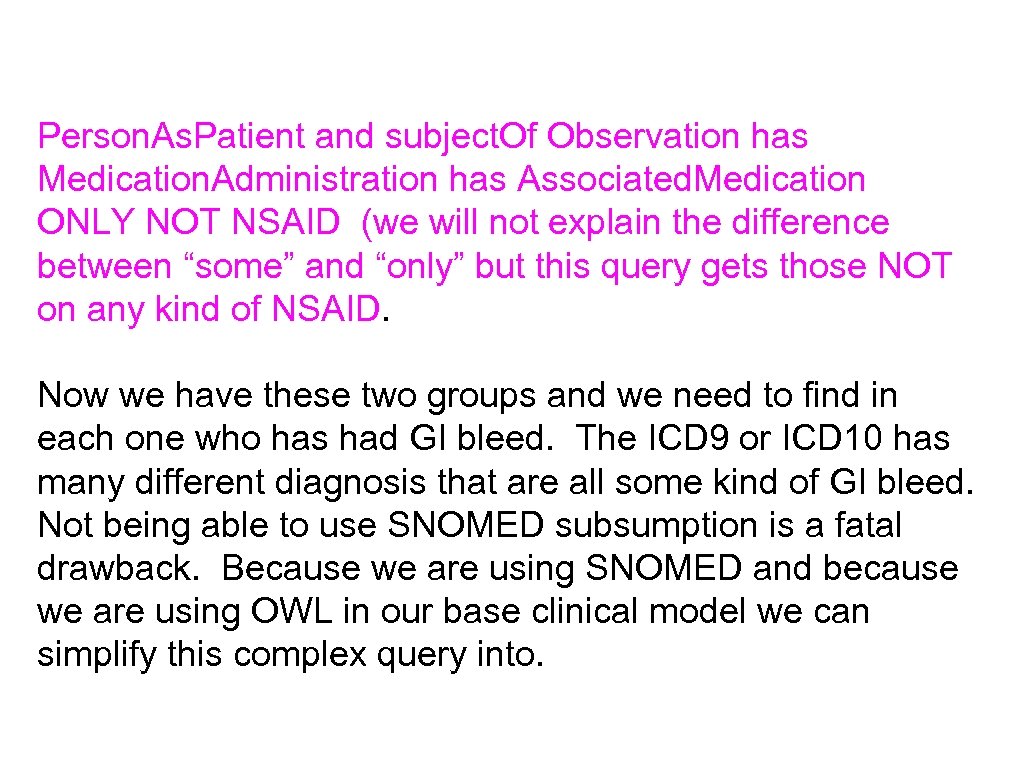 Person. As. Patient and subject. Of Observation has Medication. Administration has Associated. Medication ONLY NOT NSAID (we will not explain the difference between “some” and “only” but this query gets those NOT on any kind of NSAID. Now we have these two groups and we need to find in each one who has had GI bleed. The ICD 9 or ICD 10 has many different diagnosis that are all some kind of GI bleed. Not being able to use SNOMED subsumption is a fatal drawback. Because we are using SNOMED and because we are using OWL in our base clinical model we can simplify this complex query into.
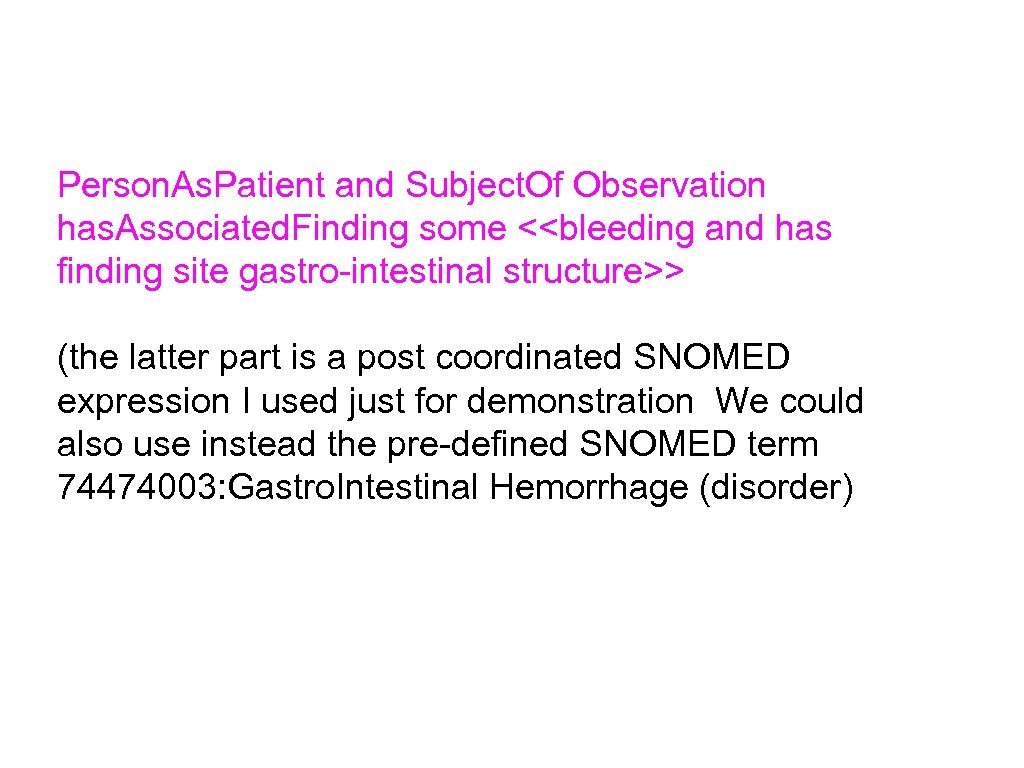 Person. As. Patient and Subject. Of Observation has. Associated. Finding some <
 It is important to point out. There are too many ICD 9 and ICD 10 codes that are all a kind of “Gastrointestinal Hemorrhage” and unless you happen to know all of them, you will miss some patients. This SNOMED Description Logic Subsumption query will catch all of them even if you don’t know what they are called. Even a clinical expert could not be expected to recall every possible kind of ICD 9 or 10 term that is some kind of gastrointestinal bleed.
 Conclusions • Last year we stressed the advantages (in time money and simplicity) of using standard (canonical) models to integrate clinical systems
 Conclusions • This year we show that by using models based on Description Logic (OWL) and SNOMED we are able to use Semantic Searching to automate important and complex queries that would otherwise need manual chart reviewers and take much more time and expense.
 Does Ontology Kat Work Well With OWL?
 Abbreviations • • RAAM: Rheumatoid Arthritis Assessment Model RDBMS: Relational Data. Base Management System OO: Object Oriented KCOM: Kaiser Clinical Ontology/OWL Model DMARD: Disease Modifying Anti. Rheumatic Drug NSAID: Non Steroidal Anti. Inflammatory Drug OWL: Web Ontology Language DL: Description Logics