 Скачать презентацию KBI ACTIVE PASSIVE VOICE CONDITIONALS
070307f49ec38c980fb0b10f451b4ec4.ppt
- Количество слайдов: 30



KBI ~ ACTIVE / PASSIVE VOICE ~ CONDITIONALS (IF…) En Abu Bakar Bin Hushim
GROUP 4 1) 2) 3) 4) 5) 6) 7) TOO YING CHENG SIAU HUI LAI POH YEE LEONG SEK YIEN LAU CHEE KHIEW SEOW HAN LUN WONG WENG KHENG 4 PC/PJ/MT/KT (Ambilan Nov 2010)

ACTIVE VOICE & PASSIVE VOICE Active Voice A feature of sentences in which the subject performs the action of the verb and the direct object is the goal or the recipient: The mechanic fixed the car. Passive Voice A feature of sentences in which the object or goal of the action functions as the sentence subject and the main verb phrase includes the verb to be and the past participle: The car was fixed by the mechanic.
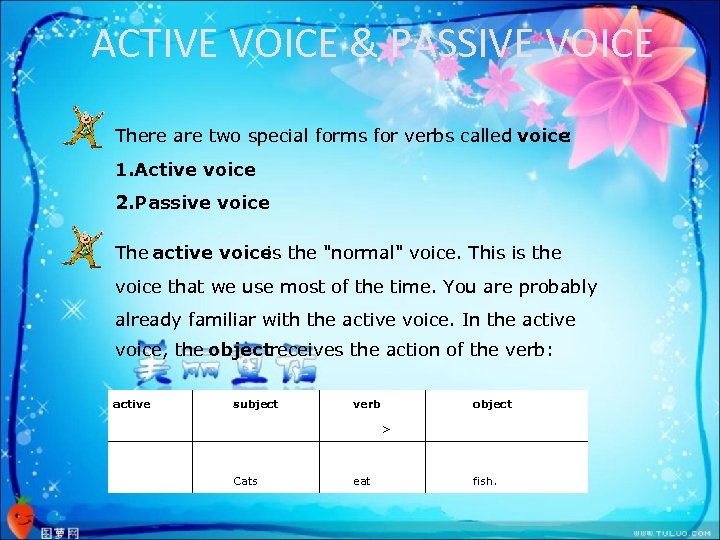
ACTIVE VOICE & PASSIVE VOICE There are two special forms for verbs called voice : 1. Active voice 2. Passive voice The active voice is the "normal" voice. This is the voice that we use most of the time. You are probably already familiar with the active voice. In the active voice, the object receives the action of the verb: active subject verb Cats object > eat fish.
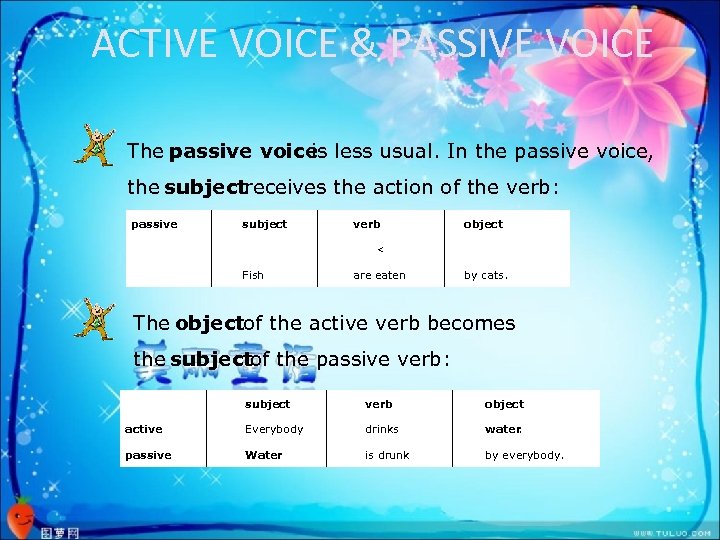
ACTIVE VOICE & PASSIVE VOICE The passive voice is less usual. In the passive voice, the subject receives the action of the verb: passive subject verb < Fish are eaten object by cats. The object of the active verb becomes the subject of the passive verb: subject verb object active Everybody drinks water. passive Water is drunk by everybody.
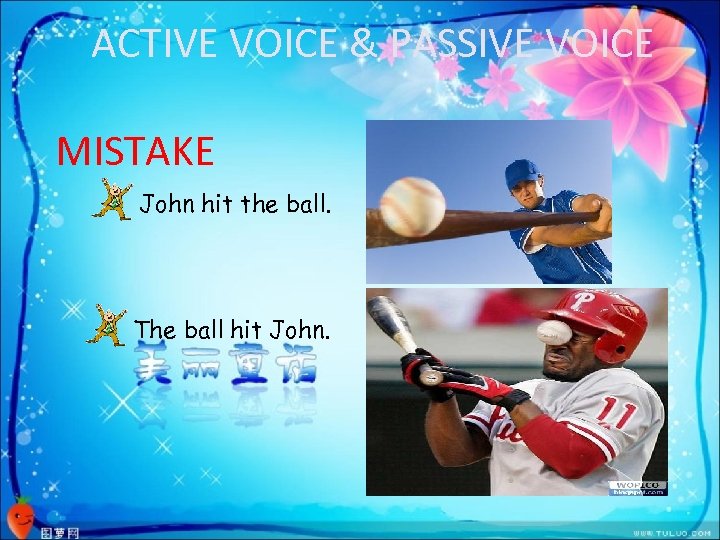
ACTIVE VOICE & PASSIVE VOICE MISTAKE John hit the ball. The ball hit John.
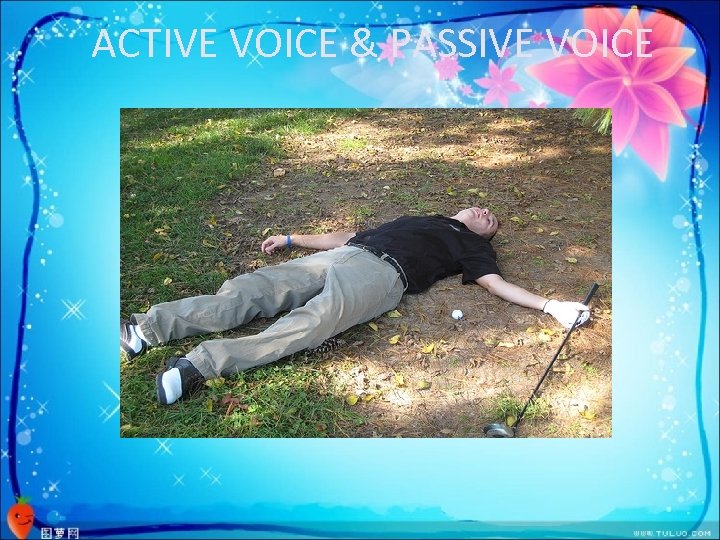
ACTIVE VOICE & PASSIVE VOICE
EXERCISES • EXERCISES 1 • EXERCISES 2 NEXT
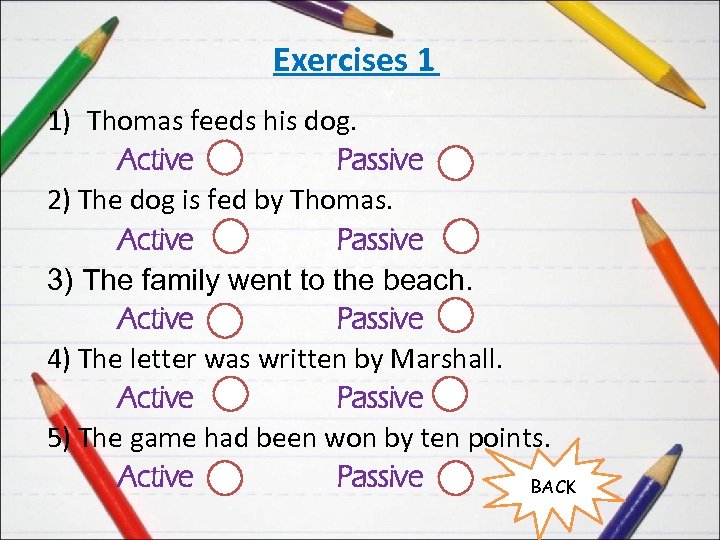
Exercises 1 1) Thomas feeds his dog. Active Passive 2) The dog is fed by Thomas. Active Passive 3) The family went to the beach. Active Passive 4) The letter was written by Marshall. Active Passive 5) The game had been won by ten points. Active Passive BACK
Exercises 2 Rewrite the passive voice sentences as active voice sentences. 1. Passive: The dog was hit by the car. Active: The car hit the dog. _________________
2. Passive: The house will be built by the construction crew in five months. The construction crew will build Active: _________________ the house in five months. _________________
3. Passive: Julie answered the question. Active: The question was answered by Julie. _________________________________
4. Passive: The dolphins have learned many tricks. Active: Many tricks had been learned by the _________________ dolphins. _________________ BACK

CONTITIONALS ( IF ) Conditional Sentences are also known as Conditional Clauses or If Clauses. They are used to express that the action in the main clause (without if) can only take place if a certain condition (in the clause with if) is fulfilled. There are three types of Conditional Sentences.
CONTITIONALS ( IF ) Conditional Sentence Type 1 → It is possible and also very likely that the condition will be fulfilled. Form: if + Simple Present, will-Future Example: If I find her address, I’ll send her an invitation.
CONTITIONALS ( IF ) Conditional Sentence Type 2 → It is possible but very unlikely, that the condition will be fulfilled. Form: if + Simple Past, Conditional I (= would + Infinitive) Example: If I found her address, I would send her an invitation.
CONTITIONALS ( IF ) Conditional Sentence Type 3 → It is impossible that the condition will be fulfilled because it refers to the past. Form: if + Past Perfect, Conditional II (= would + have + Past Participle) Example: If I had found her address, I would have sent her an invitation.
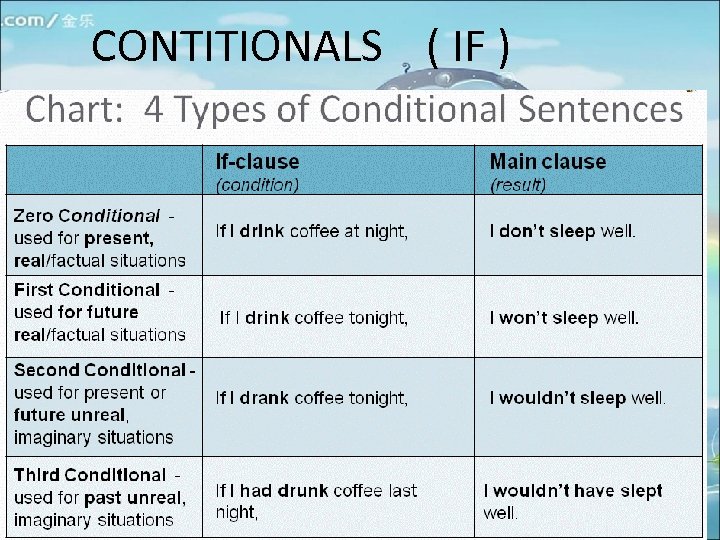
CONTITIONALS ( IF )
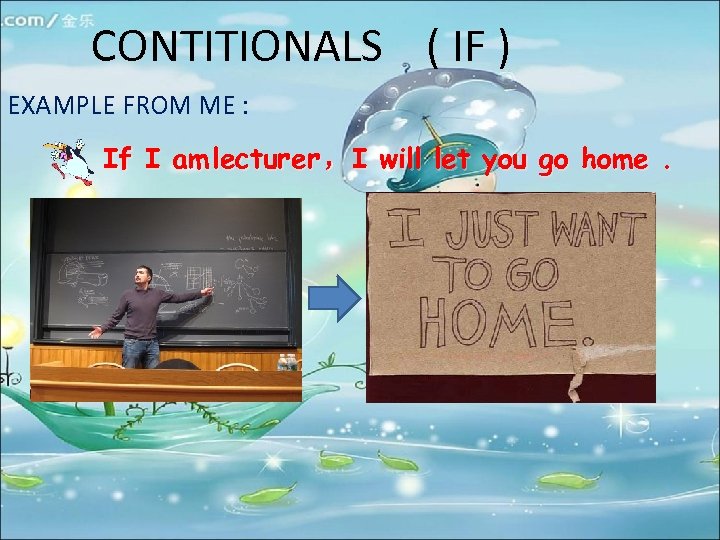
CONTITIONALS ( IF ) EXAMPLE FROM ME : If I am lecturer ,I will let you go home.
Exercise will help 1. ) If you have any problems, I ____ (help)you.
Exercise won’t fall 2. ) If he is careful, he ____ (fall).
Exercise will ring 3. ) If there is a fire, the alarm ____ (ring).
Exercise won’t speak 4. ) If Molly comes to your party, I ____ (speak) with her because she is not my friend.
Exercise wouldn’t miss 5. ) If you left now, you ____ (miss) the train.

Thank You

CONGRATULATION NEXT

KEEP GOING TRY AGAIN
Скачать презентацию KBI ACTIVE PASSIVE VOICE CONDITIONALS
070307f49ec38c980fb0b10f451b4ec4.ppt