


 Скачать презентацию KAZAKHSTAN-RUSSIAN MEDICAL UNIVERSITY INDEPENDENT WORK Theme THE CORPUSCULAR
the corpuscular elements of blood.pptx
- Количество слайдов: 10
 KAZAKHSTAN-RUSSIAN MEDICAL UNIVERSITY INDEPENDENT WORK Theme: THE CORPUSCULAR ELEMENTS OF BLOOD Esbalanova A. T. Kosbatyrova N. B. 203 “b” general medicine Almaty, 2012
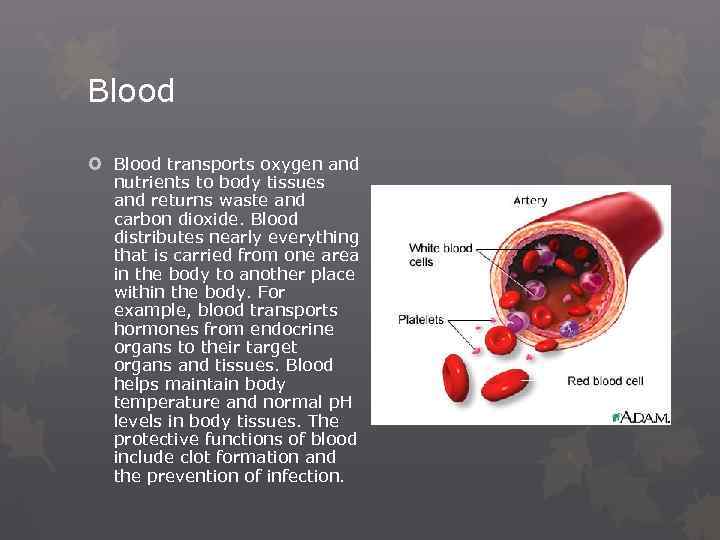 Blood transports oxygen and nutrients to body tissues and returns waste and carbon dioxide. Blood distributes nearly everything that is carried from one area in the body to another place within the body. For example, blood transports hormones from endocrine organs to their target organs and tissues. Blood helps maintain body temperature and normal p. H levels in body tissues. The protective functions of blood include clot formation and the prevention of infection.
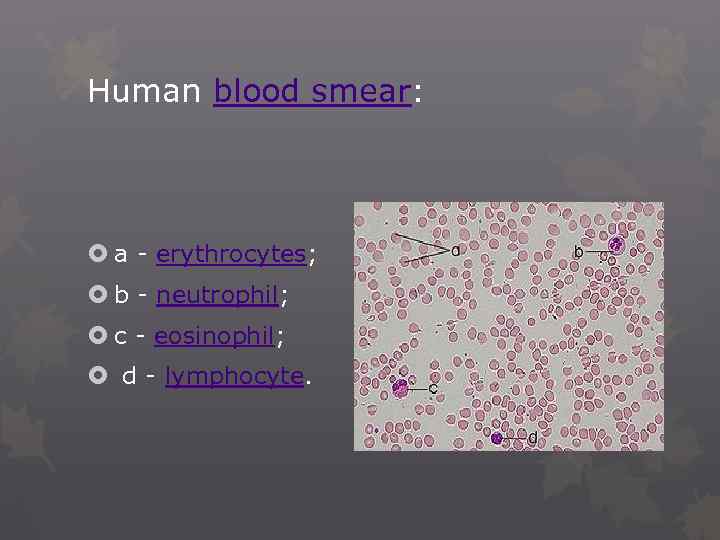 Human blood smear: a - erythrocytes; b - neutrophil; c - eosinophil; d - lymphocyte.
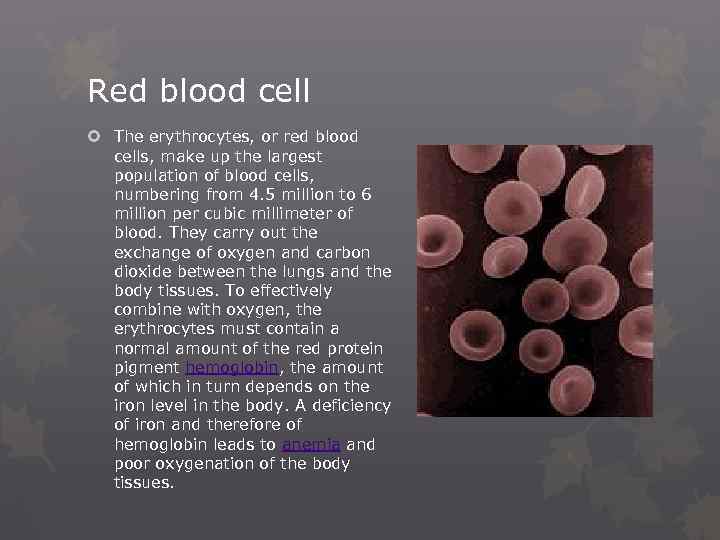 Red blood cell The erythrocytes, or red blood cells, make up the largest population of blood cells, numbering from 4. 5 million to 6 million per cubic millimeter of blood. They carry out the exchange of oxygen and carbon dioxide between the lungs and the body tissues. To effectively combine with oxygen, the erythrocytes must contain a normal amount of the red protein pigment hemoglobin, the amount of which in turn depends on the iron level in the body. A deficiency of iron and therefore of hemoglobin leads to anemia and poor oxygenation of the body tissues.
 Erythrocytes are constantly developing from stem cells, the undifferentiated, self-regenerating cells that give rise to both erythrocytes and leukocytes in the bone marrow. In the fetus, red blood cells are produced in the spleen. As they mature, the erythrocytes lose their nuclei, become disk-shaped, and begin to produce hemoglobin. After circulating for about 120 days, the erythrocytes wear out and undergo destruction by the spleen. Although all red blood cells are essentially similar, certain structures on their surfaces vary from person to person. These serve as the basis for the classification into blood groups. There are four major blood groups, whose compatibility or incompatibility is an important consideration in successful blood transfusion.
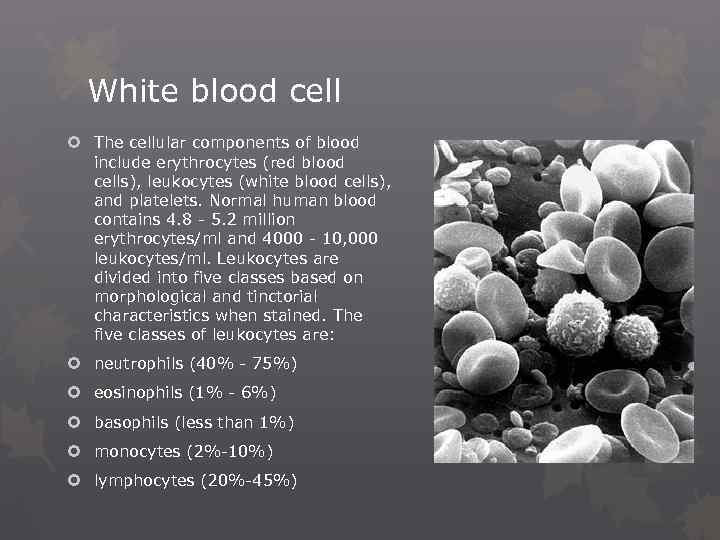 White blood cell The cellular components of blood include erythrocytes (red blood cells), leukocytes (white blood cells), and platelets. Normal human blood contains 4. 8 - 5. 2 million erythrocytes/ml and 4000 - 10, 000 leukocytes/ml. Leukocytes are divided into five classes based on morphological and tinctorial characteristics when stained. The five classes of leukocytes are: neutrophils (40% - 75%) eosinophils (1% - 6%) basophils (less than 1%) monocytes (2%-10%) lymphocytes (20%-45%)
 Neutrophils Within 12 hours of being discharged from the marrow into the bloodstream, neutrophils migrate into the extravascular tissue. Tissue neutrophils are activated by chemoattractants at the site of injury. Neutrophils ingest bacteria by phagocytosis and then release enzymes (such as lysozyme) to destroy the bacteria. Eosinophils migrate from the marrow through the blood into the extravascular tissue, and they survive there for weeks. Again, chemoattractants direct the movement of eosinophils, and like neutrophils, eosinophils are phagocytic. They do not ingest organisms, but they do exert cytotoxic effects on them.
 Basophils are morphologically similar to mast cells, and along with other granulocytes, basophils are motile cells with phagocytic properties. They may migrate into extravascular tissues where they may be stimulated by complexes of antigens that are bound to Ig. E. Monocytes are larger than other leukocytes, and they mature into macrophages once they are released into the bloodstream. Monocytes then migrate to tissues, particularly the liver, lymph nodes, and lungs, where they may stay for days or years. Here, the monocytes are actively phagocytic, and they ingest particulate matter. Monocytes are also important to the immune response. They ingest and process antigens and are involved in antigen presentation, by B- and T-lymphocytes. Lymphocytes Two main types of lymphocytes are B-cells and T-cells. B-cells are characterized by the presence of immunoglobulins on their surface, and upon stimulation with antigen, they are transformed into plasma cells. Plasma cells are then able to secrete antibodies specific to the antigen. T-cells take part in cell mediated immune response, which does not depend on the presence of circulating antibodies.
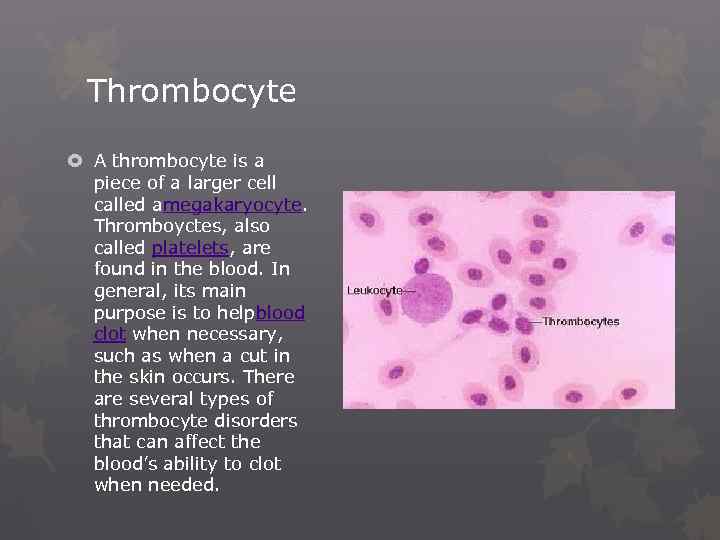 Thrombocyte A thrombocyte is a piece of a larger cell called amegakaryocyte. Thromboyctes, also called platelets, are found in the blood. In general, its main purpose is to helpblood clot when necessary, such as when a cut in the skin occurs. There are several types of thrombocyte disorders that can affect the blood’s ability to clot when needed.
 The production of thrombocytes is generally controlled by the liver and bone marrow. When more thrombocytes are needed in the body, the liver produces a hormone called thrombopoietin that stimulates the bone marrow to produce more megokaryocytes, which can then be broken up into hundreds of smaller thrombocyte pieces. In general, a thrombocyte only lasts in the body for about seven to ten days, at which point it is usually destroyed by the spleen. One of the primary roles of thrombocytes is to help blood clot. Thrombocytes are suited to this function well because these typically have sticky proteins on the outer surfaces and the ability to stretch and change shape. This means that when it comes in contact with broken blood vessels, the sticky proteins are usually able to attach to the cells in the broken vessel walls and to other thrombocytes. Together, these thrombocytes usually then bend and stretch to form a plug in the broken vessel. This process can happen both inside the body, such as to help stop internal bleeding, and outside the body, such as to help stop bleeding from a cut.