


 Скачать презентацию KAZAKHSTAN-RUSSIAN MEDICAL UNIVERSITY INDEPENDENT WORK Theme The
brain.pptx
- Количество слайдов: 8
 KAZAKHSTAN-RUSSIAN MEDICAL UNIVERSITY { INDEPENDENT WORK Theme: The Brain Esbalanova A. T. Kosbatyrova N. B. 203 “b” general medicine Almaty, 2012
 Introduction Your brain is a thinking organ that learns and grows by interacting with the world through perception and action. Mental stimulation improves brain function and actually protects against cognitive decline, as does physical exercise. The human brain is able to continually adapt and rewire itself. Even in old age, it can grow neurons. Severe mental decline is usually caused by disease, whereas most age-related losses in memory or motor skills simply result from inactivity and a lack of mental exercise and stimulation. In other words, use it or lose it.
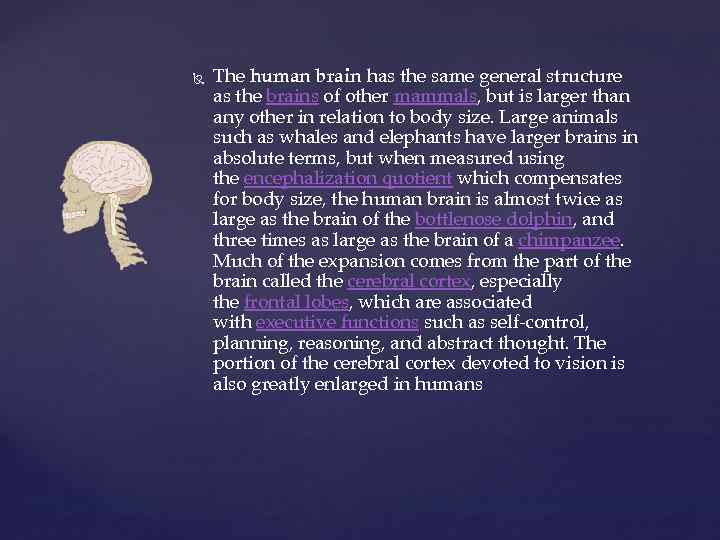 The human brain has the same general structure as the brains of other mammals, but is larger than any other in relation to body size. Large animals such as whales and elephants have larger brains in absolute terms, but when measured using the encephalization quotient which compensates for body size, the human brain is almost twice as large as the brain of the bottlenose dolphin, and three times as large as the brain of a chimpanzee. Much of the expansion comes from the part of the brain called the cerebral cortex, especially the frontal lobes, which are associated with executive functions such as self-control, planning, reasoning, and abstract thought. The portion of the cerebral cortex devoted to vision is also greatly enlarged in humans
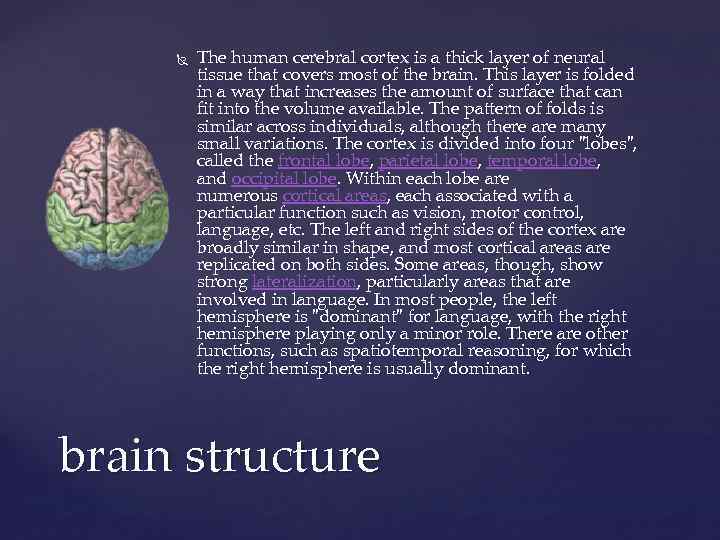 The human cerebral cortex is a thick layer of neural tissue that covers most of the brain. This layer is folded in a way that increases the amount of surface that can fit into the volume available. The pattern of folds is similar across individuals, although there are many small variations. The cortex is divided into four "lobes", called the frontal lobe, parietal lobe, temporal lobe, and occipital lobe. Within each lobe are numerous cortical areas, each associated with a particular function such as vision, motor control, language, etc. The left and right sides of the cortex are broadly similar in shape, and most cortical areas are replicated on both sides. Some areas, though, show strong lateralization, particularly areas that are involved in language. In most people, the left hemisphere is "dominant" for language, with the right hemisphere playing only a minor role. There are other functions, such as spatiotemporal reasoning, for which the right hemisphere is usually dominant. brain structure
 Despite being protected by the thick bones of the skull, suspended in cerebrospinal fluid, and isolated from the bloodstream by the blood–brain barrier, the human brain is susceptible to many types of damage and disease. The most common forms of physical damage are closed head injuries such as a blow to the head, a stroke, or poisoning by a variety of chemicals that can act as neurotoxins. Infection of the brain, though serious, is rare due to the biological barriers which protect it. The human brain is also susceptible to degenerative disorders, such as Parkinson's disease, multiple sclerosis, and Alzheimer's disease. A number of psychiatric conditions, such as schizophrenia and depression, are thought to be associated with brain dysfunctions, although the nature of such brain anomalies is not well understood.
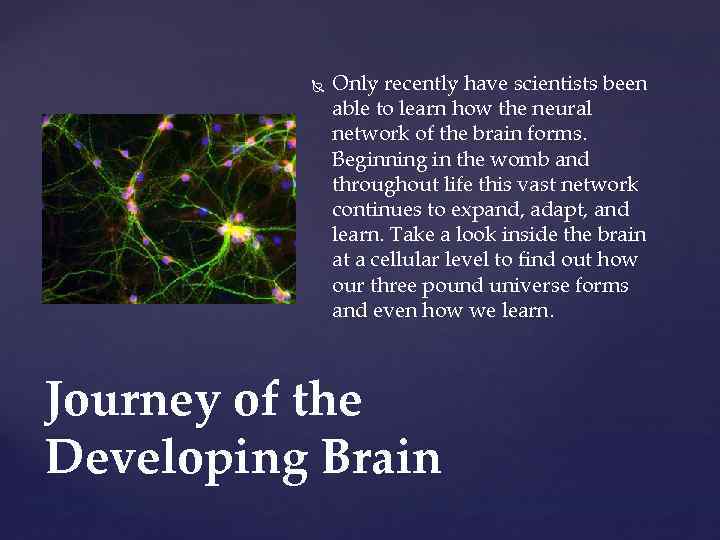 Only recently have scientists been able to learn how the neural network of the brain forms. Beginning in the womb and throughout life this vast network continues to expand, adapt, and learn. Take a look inside the brain at a cellular level to find out how our three pound universe forms and even how we learn. Journey of the Developing Brain
 Step back a half-billion years ago, to when the first nerve cells developed. The original need for a nervous system was to coordinate movement, so an organism could go find food, instead of waiting for the food to come to it. Jellyfish and sea anemone, the first animals to create nerve cells, had a tremendous advantage over the sponges that waited brainlessly for dinner to arrive. After millions of generations of experimentation, nervous systems evolved some amazing ways of going out to eat. But behind all the myriad forms of life today, the primary directive remains. Movement. In fact, a diminished ability to move is a good measure of aging. Inflexibility heralds death, while a flexible body and fluid mind are the hallmarks of youth. Evolving Brains Inspired Movement
 Elastic comes from the Greek word for "drive" or "propulsion. " It is the tendency of a material to return to its original shape after being stretched. Elasticity is the basic animal drive that powers your muscles, giving you strength and balance – flexibility, mobility, and grace. Plastic derives from the Greek word meaning "molded" or "formed. " It is the tendency of the brain to shape itself according to experience. Plasticity is the basic mental drive that networks your brain, giving you cognition and memory – fluidity, versatility, and adaptability. Elasticy and plasticity