

Kazakhstan in global monetary system Darganova Ksenia Zhumabekova

Kazakhstan in global monetary system Darganova Ksenia Zhumabekova Kristina Banking Institute 2014
History Kazakhstan left the rouble zone one of the last of countries of the Former Soviet Union. The national currency of Kazakhstan came into circulation on 15 November 1993 with exchange rate of 1 Tenge – 500 Roubles of USSR. The name ‘tenge’ comes from medieval Turkic silver coins ‘denge’ or ‘tanga’, from which the Russian coin ‘denga’ comes from too and of course the current Russian word ‘dengi’ for money. The modern tenge continued traditions of big cities of medieval Kazakhstan, Otrar and Taraz, where money was coined already in 13th century.
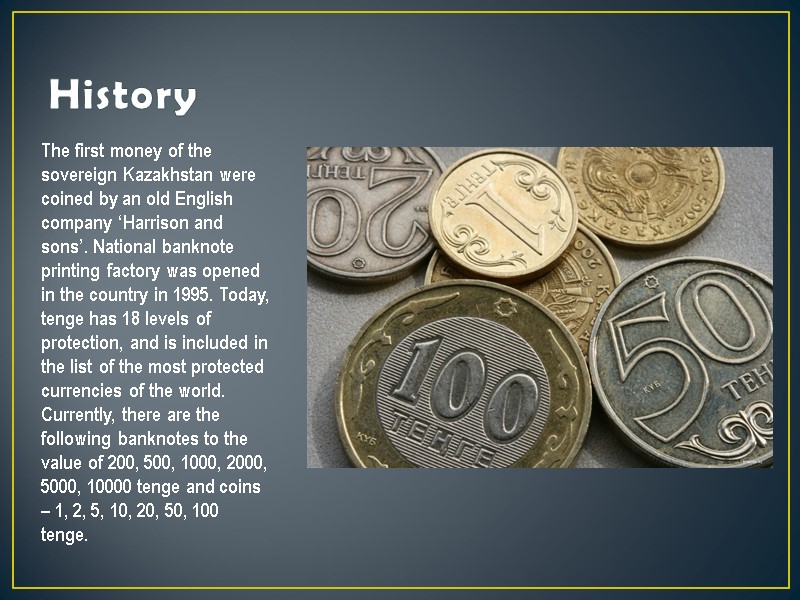
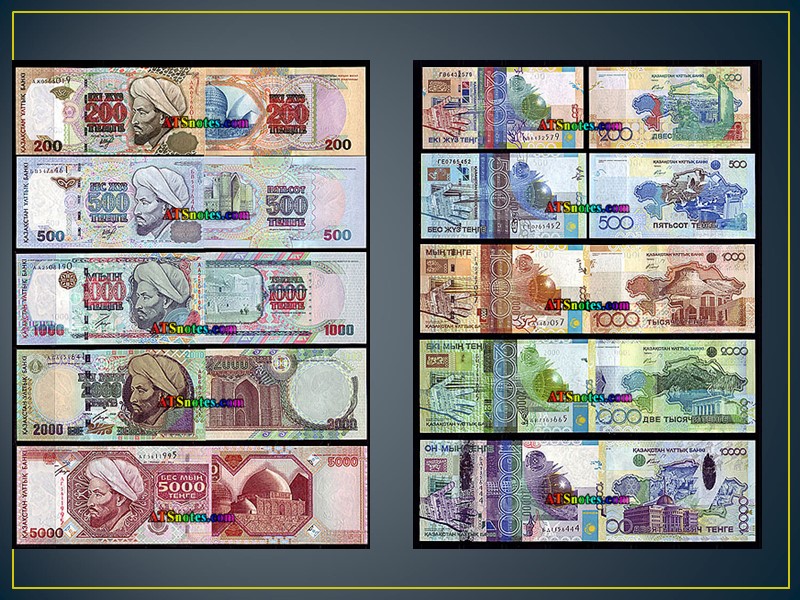
History The first money of the sovereign Kazakhstan were coined by an old English company ‘Harrison and sons’. National banknote printing factory was opened in the country in 1995. Today, tenge has 18 levels of protection, and is included in the list of the most protected currencies of the world. Currently, there are the following banknotes to the value of 200, 500, 1000, 2000, 5000, 10000 tenge and coins – 1, 2, 5, 10, 20, 50, 100 tenge.
National Bank of Kazakhstan The Republic of Kazakhstan has a two-tier banking system. The National Bank of the Republic of Kazakhstan (hereinafter - the National Bank) is the central bank of Kazakhstan and presents the upper (first) tier of the banking system of Kazakhstan. All other banks present lower (second) tier of the banking system, excluding the Development Bank of Kazakhstan, that has peculiar legal status. The National Bank represents, within the limits of its authority, the interests of the Republic of Kazakhstan in the relationship with the central banks, with banks of other countries, in the international banks and other financial-credit organizations. The National Bank should not be guided by the aim of gaining profit in performing its tasks. The National Bank is the entity that reports to the President of the Republic of Kazakhstan, but within the limits of authority granted by the legislation, is independent in its activity. The National Bank coordinates its activity with the Government of the Republic of Kazakhstan, in its activity takes into consideration the economic policy of the Government and facilitates its implementation, if doing so is not in conflict with the realization of its main functions and implementation of monetary policy. The National Bank is a common centralized system with the vertical administrative scheme. The highest administrative authority of the National Bank is the Board, the authority of the executive management is the Board of Directors.
National Bank of Kazakhstan The primary goal of the National Bank is to ensure the stability of prices in the Republic of Kazakhstan. To accomplish the main goal, the National Bank is assigned the following tasks: development and implementation of the state’s monetary policy; ensuring the functioning of payment systems; implementation of foreign exchange regulation and foreign exchange control; promotion of the stability of financial system; regulation, control and supervision of the financial market and financial institutions and also other parties, within its competence; ensuring a due level of protection of the rights and legitimate interests of consumers of financial services; carrying out statistics activities in the area of monetary statistics and external sector statistics.
The structure of National Bank of Kazakhstan The headquarter with 25 departments (one department is in Astana), 4 independent divisions; 16 territorial branches and one branch in the city of Almaty: cash operations and valuables storage center; the Representative Office of the National Bank in the Russian Federation;
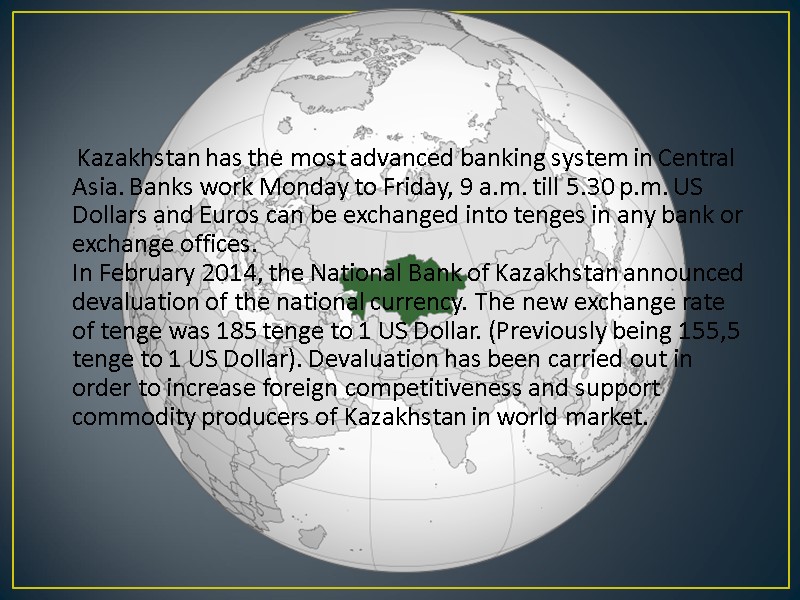
Kazakhstan has the most advanced banking system in Central Asia. Banks work Monday to Friday, 9 a.m. till 5.30 p.m. US Dollars and Euros can be exchanged into tenges in any bank or exchange offices. In February 2014, the National Bank of Kazakhstan announced devaluation of the national currency. The new exchange rate of tenge was 185 tenge to 1 US Dollar. (Previously being 155,5 tenge to 1 US Dollar). Devaluation has been carried out in order to increase foreign competitiveness and support commodity producers of Kazakhstan in world market.
The relationship between Kazakhstan and the IMF One of the central places in the system of regulation of international monetary relations belongs to the International Monetary Fund, which was established by the International Monetary and Financial Conference of the United Nations, 1944. in Bretton Woods (USA), and today it is composed of 188 states. Kazakhstan became a member of the International Monetary Fund in 1992. For independent Kazakhstan in 1992 was very important, and went down in history as the year of the republic independent access to the world stage.
The relationship between Kazakhstan and the IMF Membership in the IMF imposes on Kazakhstan and other CIS countries the obligation to meet the requirements. For example, in Art. VIII of the IMF deals with the general obligations of IMF members. The general obligations include: • - Avoidance of restrictions on current payments. This principle lies in the fact that no Member State shall not impose restrictions on the making of payments and transfers for current international transactions without the approval of the Fund; • - Avoidance of discriminatory currency practices; • - Currency Convertibility residues stored abroad; • - Provision of information; • -consultations between Member States under existing international agreements; • -Obyazatelstvo cooperation policy with respect to reserve assets; • - General obligations of States parties in relation to the Special Drawing Rights
The relationship between Kazakhstan and the IMF In the Republic of Kazakhstan in relation to IMF loans the borrower is always the National Bank of Kazakhstan. These funds are used to support the balance of payments, as the IMF does not offer the Member States of financing the budget and finance practices only to improve the country's international reserves. This is a standard and traditional task of the IMF. Due to the favorable economic situation May 24, 2000, the National Bank of the Republic of Kazakhstan to prepay its obligations under the credit lines of the IMF in the amount of 295.8 million. Kazakhstan was the only country in the CIS and Eastern Europe, to prepay their debts to the IMF, demonstrating the international economic organizations , financial institutions, foreign creditors their ability to service the loans.
The relationship between Kazakhstan and the IMF In this regard, in August 2003. IMF Resident Representative in Kazakhstan has been withdrawn from the country. In a statement released by the IMF in the spring of 2003, it was noted that the Fund's decision not to send its permanent representative republic based "on the impressive achievements in the field of economic stabilization, extremely favorable medium and long-term forecasts of the economy of Kazakhstan, as well as a very low probability that the country in the future will require loans to fund " As of 2005 cooperation between Kazakhstan and the IMF reached a new level - the IMF proposed Kazakhstan to act as a donor country. This proposal was preceded by a thorough analysis of the IMF Kazakhstan's foreign policy, its position in the world community, as well as the situation of payments and trade balance. The proposal suggests that the fund appreciates the balance of payments in the near future. Kazakhstan, taking on such a responsibility, not only to become a member of the fund, but also a country that is making its assistance to the development of the world community.
The relationship between Kazakhstan and the IMF Today reached an understanding with the IMF on the main directions of economic policy of our country and the continuation of cooperation with such important institutions as the IMF is an additional factor contributing to the better investors and creditors with respect to the country, increasing their trust. For Kazakhstan, as for the other countries, the fundamental role played by arrangement with the IMF, as the credit, reached mutual understanding on safety mechanisms Fund is an act of recognition and support for economic policy and a positive effect on its credit rating. It should also be noted that during the 20 years of its independence, Kazakhstan has become a member of many international organizations. And this cooperation is another sure step to increase the country's prestige in the world and the proof of the desire of Kazakhstan to actively participate in solving the world's problems.

 Скачать презентацию Kazakhstan in global monetary system Darganova Ksenia Zhumabekova
37128-int_banking.ppt
- Количество слайдов: 14