


 Скачать презентацию Kazakh National Medical University named after S D
com skills мерей тлеуберды.ppt
- Количество слайдов: 19
 Kazakh National Medical University named after S. D. Asfendiyarov IWS Theme: Breaking bad news. Incurable patients. Palliative care. Euthanasia. Student: Merey Tileuberdi Teacher: Zarina Kuzmina
 Idea • To know how to tell the patient the bad news • How to take care of patients with incurable diseases • Information about euthanasia
 Breaking bad news • • Comes in various forms It is regrettable Patients judge on doctor’s performance Burnout, fatigue, personal difficulties, behavioral beliefs, and prior clinical experiences affect on doctor’s ability to tell the bad news
 Prepare for the consultation • • • Make an appointment Transmit in person, not over the telephone Protected time Make yourself as fully conversant Do what you feel is right for that person at that time
 Communication • • • Use language that the patient will understand Find the patient’s starting point A warning shot to prepare them may be helpful Break the consultation into stages Make sure that they understand the nature of risk • Agree a plan for further follow up
 Concluding the consultation • Finish with a summary and plan for the next steps • Try to leave on a positive note • Record the consultation • Reflect on what went well and what if anything you would have liked to have done better • Emotional experience for the doctor
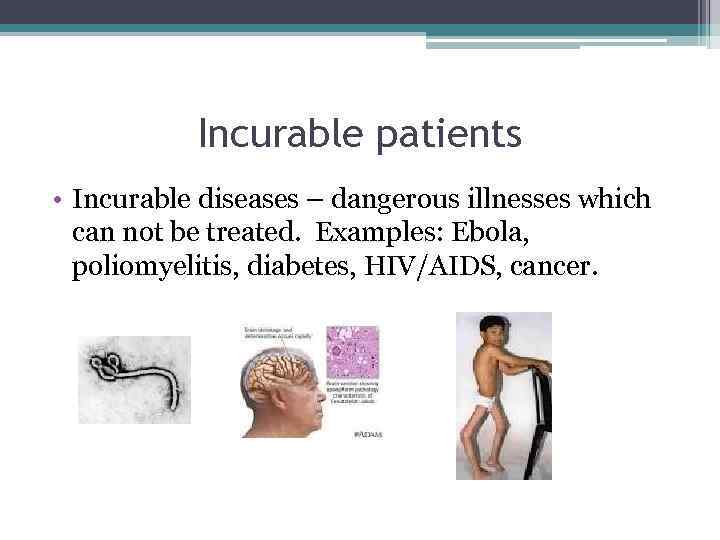 Incurable patients • Incurable diseases – dangerous illnesses which can not be treated. Examples: Ebola, poliomyelitis, diabetes, HIV/AIDS, cancer.
 Incurable patients • • • Are able to understand their condition Don’t prefer talking about disease Need a support Should not be alone Have a courage and wisdom
 Palliative care • Palliative care is an approach that improves the quality of life of patients and their families facing the problem associated with life-threatening illness, through the prevention and relief of suffering by means of early identification and impeccable assessment and treatment of pain and other problems, physical, psychosocial, and spiritual.
 Palliative care • Goal – to improve quality of life for both the patient and the family • Provided by: team of doctors, nurses and other specialists who work together • Focuses on symptoms: pain, shortness of breath, fatigue, constipation, nausea, loss of appetite, difficulty sleeping and depression • Helps you gain the strength to carry on with daily life
 Palliative care • Term derived Latin palliare, "to cloak“ Palliative care is effective if: 1. If it is possible to create and maintain the patient comfortable and safe conditions; 2. If the patient as much as possible will feel their independence; 3. If the patient does not feel pain; 4. If, despite the impending loss of life, providing patient support system to help him live as actively and creatively, to the extent possible for him
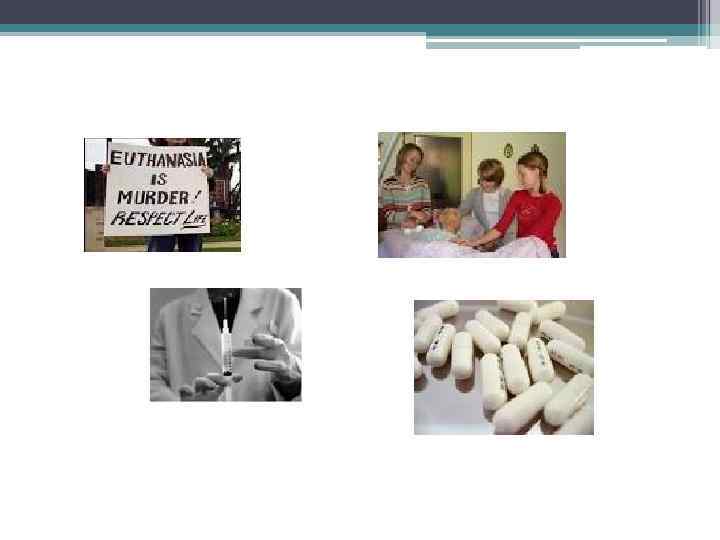
 Euthanasia • Is the practice of intentionally ending a life in order to relieve pain and suffering • From Greek “eu” – good, “thanatos” – death • Jurisdictions: Australia, Canada, India, Mexico, Netherlands, New Zealand, Switzerland, United Kingdom, United States • 3 ways: voluntary, non-voluntary, or involuntary
 Types of euthanasia • Voluntary - euthanasia conducted with the consent of the patient • Non-voluntary - euthanasia conducted where the consent of the patient is unavailable. Ex: child euthanasia, which is legal only in Netherlands • Involuntary - euthanasia conducted against the will of the patient
 Classification of euthanasia • Voluntary, non-voluntary and involuntary euthanasia can all be further divided into passive or active variants • Active euthanasia – the use of lethal substances or forces. • Passive euthanasia – refusing from common treatments, such as antibiotics, which are necessary for continuance of life.
 Euthanasia pros • ill people should have the right to end their suffering with a quick, dignified, and compassionate death • improves quality of life • it won’t target vulnerable • the alternatives are horrifying • the Hippocratic oath
 Euthanasia cons • • • Will target the poor Insurance companies to terminate Doctors have responsibilities Pressure on the elderly Undermines medical excellence
 Literature • Breaking Bad News Regional Guidelines, National Council for Hospice and Specialist Palliative Care Services (2003) • Schildmann J, Cushing A, Doyal L, et al; Breaking bad news: experiences, views and difficulties of pre-registration house officers. Palliat Med. 2005 Mar; 19(2): 93 -8. • Barnett MM; Effect of breaking bad news on patients' perceptions of doctors. J R Soc Med. 2002 Jul; 95(7): 343 -7. • Kubler-Ross, E. About death and fatality/ E. Kubler-Ross. – Kiev: Sophia, 2001 – p 318 • Draper, Heather (1998). "Euthanasia". In Chadwick, Ruth. Encyclopedia of Applied Ethics 2. Academic Press. p. 176 • Euthanasia and Law in the Netherlands - Page 186, John Griffiths, Alex Bood, Heleen Weyers - 1998
 Thank you for attention!!!