


 Скачать презентацию KAZAKH NATIONAL AGRARIAN UNIVERSITY Department Automation and information
Маликов Бж-217.pptx
- Количество слайдов: 22
 KAZAKH NATIONAL AGRARIAN UNIVERSITY Department: Automation and information technologies DATABASE SYSTEMS CREATED BY: MALIKOV CHECKED BY: SEIDALIEVA S. G.
 1. Bases of database systems: concept, characteristic, architecture. 2. Data Models 3. Database Management System 4. Basic terminology in Databases 5. Types of Relationships 6. External, conceptual, and internal views 7. Database Management Applications
 § A database is a structured collection of records or data. A computer database is a kind of software to organize the storage of data. Databases help you organize this related information in a logical fashion for easy access and retrieval. To develop a database, there are several models used such as Hierarchical model, Network model, Relational model, Object-Oriented model etc. Though discussing about these models in details is beyond the level of this course unit, for the sake of completion, some models are briefed below.
 Hierarchical model. In a hierarchical model, data is organized into an inverted tree-like structure. This structure arranges the various data elements in a hierarchy and helps to establish logical relationships among data elements of multiple files. Each unit in the model is a record which is also known as a node. Each record has a single parent. § Network model. The network model tends to store records with links to other records. Each record in the database can have multiple parents, i. e. , the relationships among data elements can have a many to many relationships. So this model is an expansion to the hierarchical structure, allowing many-to-many relationships in a tree-like structure that allows multiple parents. § § The network model provides greater advantage than the hierarchical model in that it promotes greater flexibility and data accessibility.
 Object–Oriented model. . It provides full-featured database programming capability, while containing native language compatibility. It adds the database functionality to object programming languages. This approach is the analogical of the application and database development into a constant data model and language environment. Applications require less code, use more natural data modeling, and code bases are easier to maintain. Object developers can write complete database applications with a decent amount of additional effort. But object-oriented databases are more expensive to develop. §Relational model. The relational § model for the database management is a database model based on relations. The basic data structure of the relational model is a table where information about a particular entity (say, a student) is represented in columns and rows. The columns enumerate the various attributes (i. e. characteristics) of an entity (e. g. student name, address, registration _number). The rows (also called records) represent instances of an entity (e. g. specific student).
 § A Database Management System (DBMS) is computer housekeeping tasks such as updating data, deleting obsolete records, and backing up the database. § Obtaining subsets of data software designed for the purpose of managing databases based on a variety of data models. A DBMS is a complex set of software programs that controls the organization, storage, management, and retrieval of data in a database. DBMS are categorized according to their data structures or types, sometime DBMS is also known as a Database Manager. Data management tasks fall into one of four general categories as given below: § Entering data into the database. § There are several advantages in DBMS such as reduced data redundancy and inconsistency, enhanced data integrity, improved security etc.
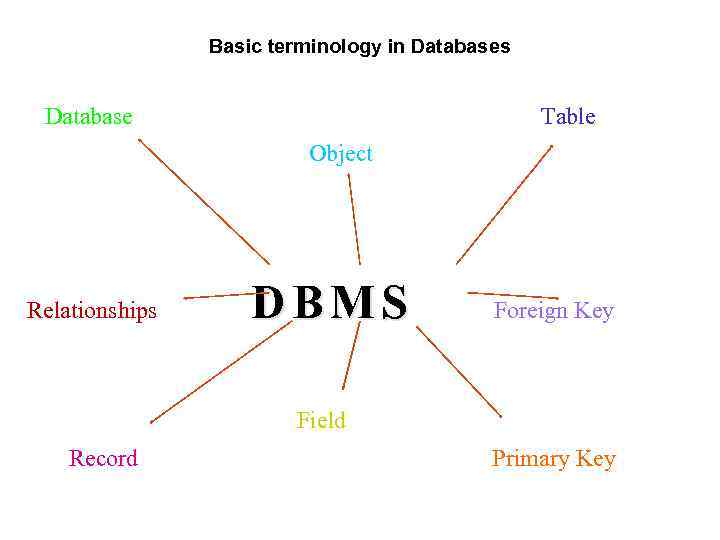 Basic terminology in Databases Database Table Object Relationships DBMS Foreign Key Field Record Primary Key
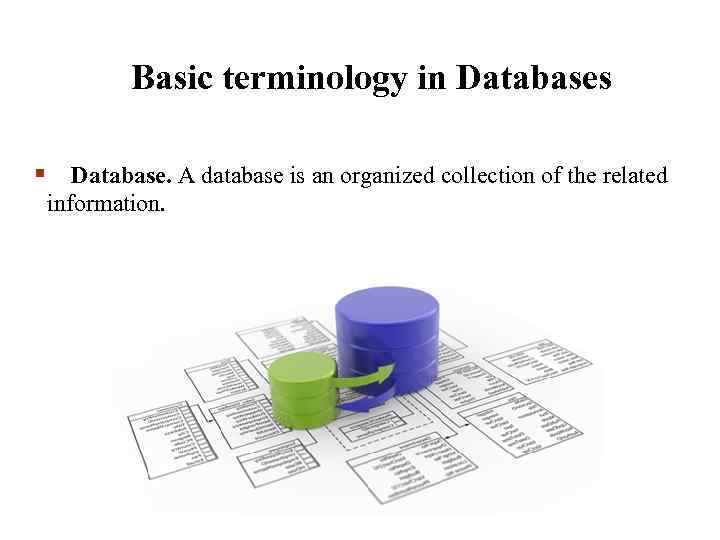 Basic terminology in Databases § Database. A database is an organized collection of the related information.
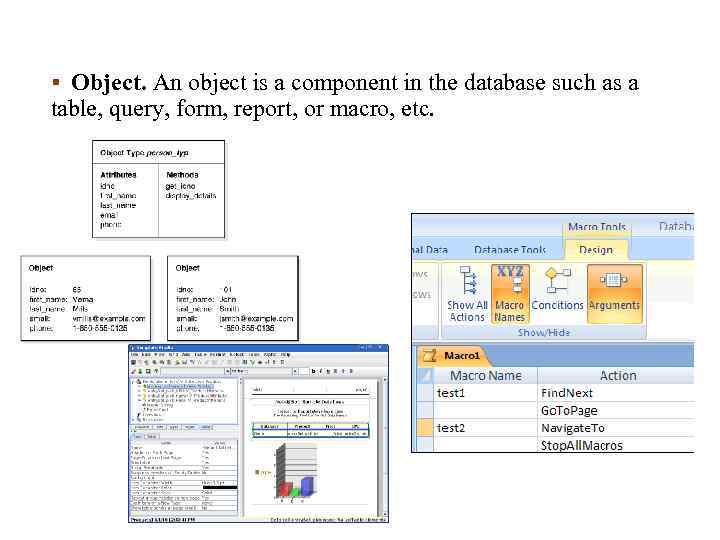 § Object. An object is a component in the database such as a table, query, form, report, or macro, etc.
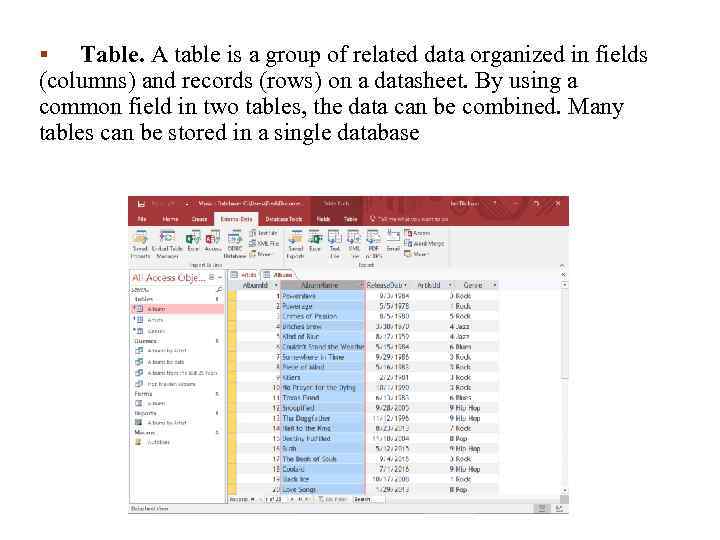 Table. A table is a group of related data organized in fields (columns) and records (rows) on a datasheet. By using a common field in two tables, the data can be combined. Many tables can be stored in a single database §
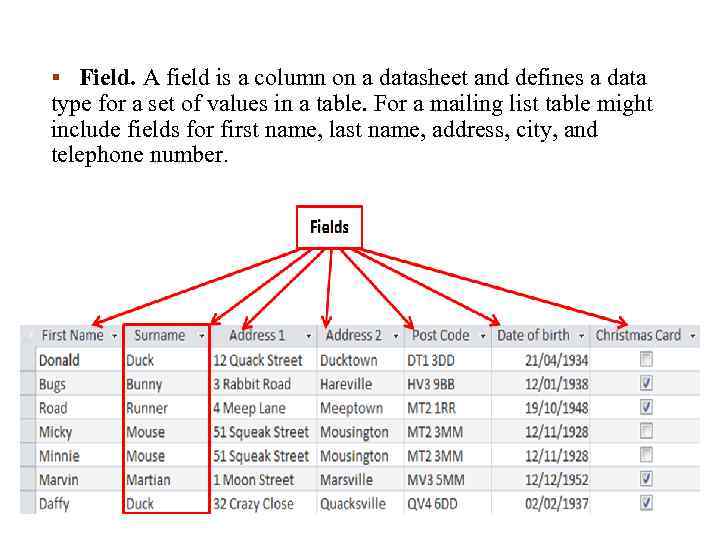 § Field. A field is a column on a datasheet and defines a data type for a set of values in a table. For a mailing list table might include fields for first name, last name, address, city, and telephone number.
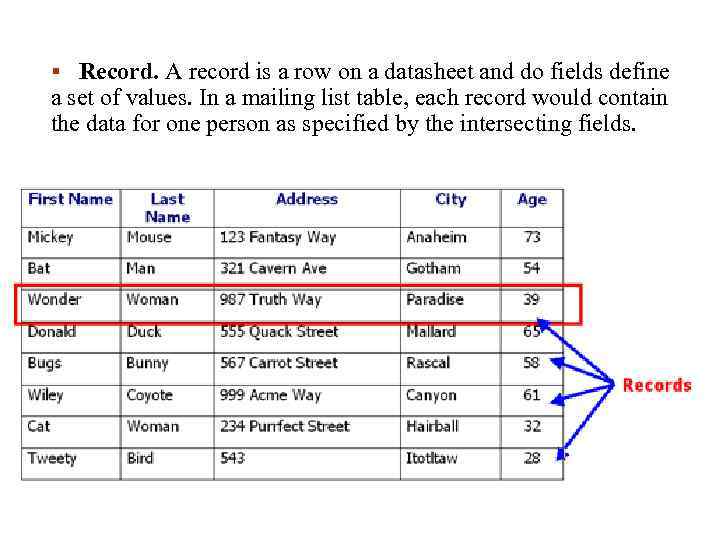 § Record. A record is a row on a datasheet and do fields define a set of values. In a mailing list table, each record would contain the data for one person as specified by the intersecting fields.
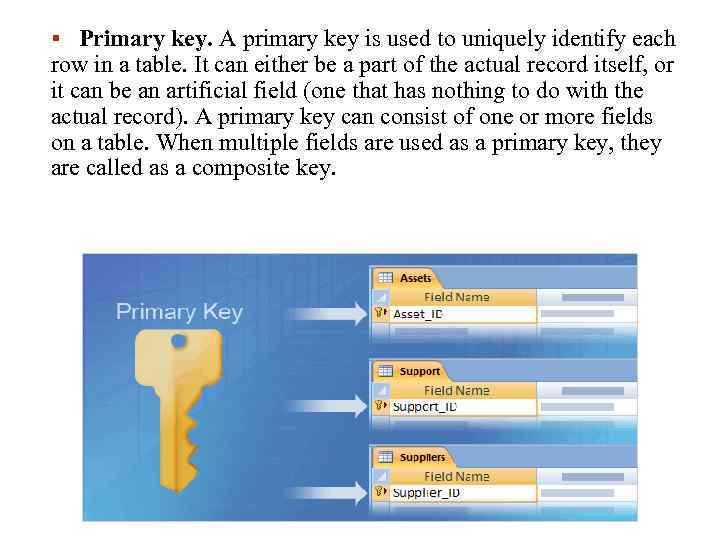 § Primary key. A primary key is used to uniquely identify each row in a table. It can either be a part of the actual record itself, or it can be an artificial field (one that has nothing to do with the actual record). A primary key can consist of one or more fields on a table. When multiple fields are used as a primary key, they are called as a composite key.
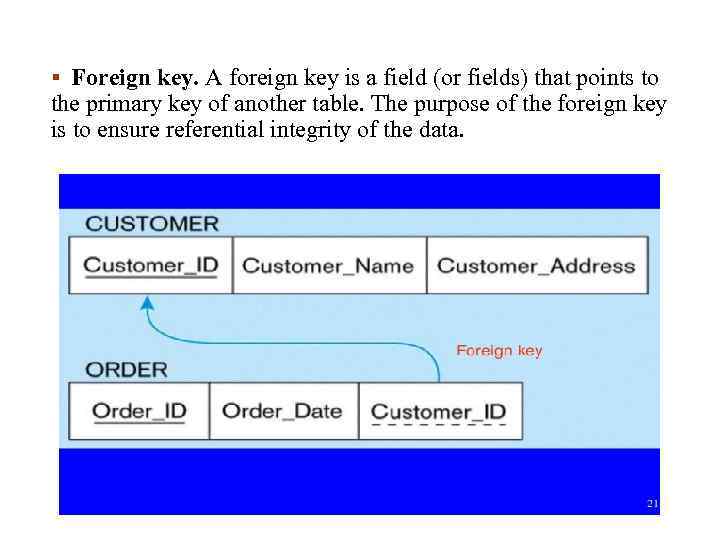 § Foreign key. A foreign key is a field (or fields) that points to the primary key of another table. The purpose of the foreign key is to ensure referential integrity of the data.
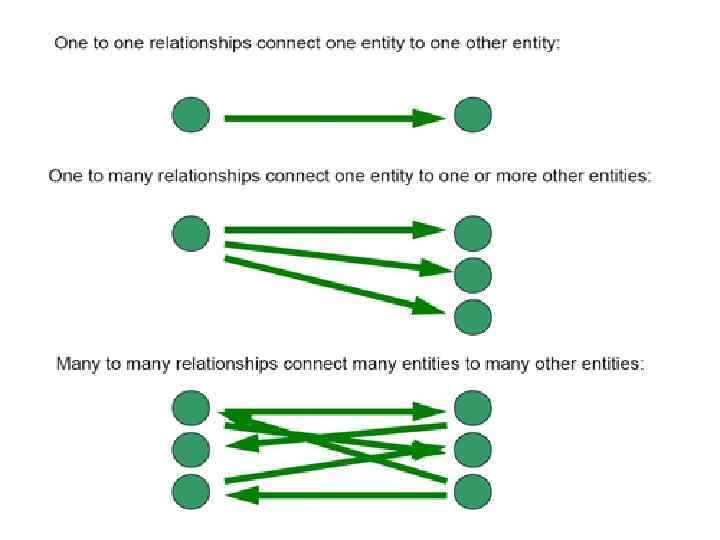
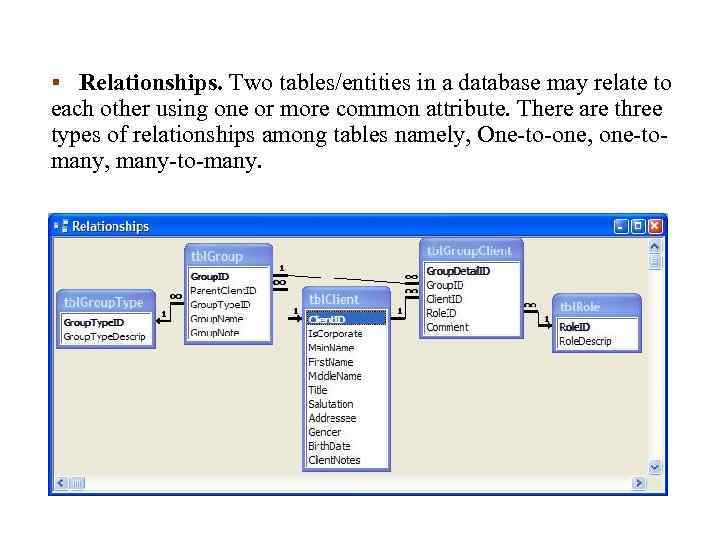 § Relationships. Two tables/entities in a database may relate to each other using one or more common attribute. There are three types of relationships among tables namely, One-to-one, one-tomany, many-to-many.
 A database management system provides three views of the database data: The external level defines how each group of end-users sees the organization of data in the database. A single database can have any number of views at the external level. § § The conceptual level unifies the various external views into a compatible global view. It provides the synthesis of all the external views. It is out of the scope of the various database end-users, and is rather of interest to database application developers and database administrators. § The internal level (or physical level) is the internal organization of data inside a DBMS. It is concerned with cost, performance, scalability and other operational matters. It deals with storage layout of the data, using storage structures such as indexes to enhance performance.
 Database languages are special-purpose languages, which do one or more of the following: § Data definition language – defines data types such as creating, altering, or dropping and the relationships among them § Data manipulation language – performs tasks such as inserting, updating, or deleting data occurrences § Query language – allows searching for information and computing derived information.
 There are several different database management applications which are not only meant for entering and retrieving information but also they facilitate simultaneous updates and queries from multiple users. § Some of the database management applications are listed below: § My. SQL IBM DB 2 Oracle Sybase Microsoft Access
 Databases today are essential to every business. Whenever you visit a major Web site — Google, Yahoo!, Amazon. com, or thousands of smaller sites that provide information — there is a database behind the scenes serving up the information you request. Corporations maintain all their important records in databases. In this presentation we learned a lot of information concerning databases. And we supplemented our vocabulary with different terms.
 § DATABASE SYSTEMS. The Complete Book. Second Edition. Hector Garcia-Molina, Jeffrey D. Ullman, Jennifer Widom. Department of Computer Science, Stanford University. Upper Saddle River, New Jersey 07458.
 § https: //en. wikipedia. org/wiki/Database § https: //raima. com/database-terminology/ § https: //en. wikipedia. org/wiki/One-to-one_(data_model) § https: //en. wikipedia. org/wiki/One-to-many_(data_model) § https: //en. wikipedia. org/wiki/Many-to-many_(data_model)