 Скачать презентацию Kaliningrad Regional Government Modern Marketing Kaliningrad December 2013
Kaliningrad_dec2013.ppt
- Количество слайдов: 76



Kaliningrad Regional Government Modern Marketing Kaliningrad December 2013 Poul Breum – Denmark pb@astraconsult. dk
Kaliningrad Regional Government MARKETING - the process of Planning and Executing the conception of • Pricing, • Distribution, and • Promotion of Ideas, Goods, and Services more efficient than other Supplier, in order to create exchanges that satisfy Individual and Organisational wishes and demands. …to satisfy Individual and Organisational wishes and demands Poul Breum – Denmark pb@astraconsult. dk 2
Kaliningrad Regional Government Introduction to Marketing When you enter the Danish bank JYSKE BANK, you will be welcomed by - A Host or Hostess will welcome you and help answering your questions - You will enjoy a cop of coffee in the Coffee Bar or read a newspaper in the Oasis - Meeting with the bank-advisors will take place in one of 8 Themed Rooms, ex. The Journey, The Exchange, or The Scores Space – all about foodbold! - All rooms have Flat Panel Displays with online connections to all departments in the bank. Only to show, that here is people meeting… - Sayings on the wall: ‘I have money enough rest of my days, unless I buy something’. - In the Trial Bar can you scan different product packages and get an introduction… The idea behind the setup is the 3 B’s: Bank (but another sort), Butique (were you find visible products), and Bibliotek (= Library, where you get knowledge) Jyske Bank wants to be very significantly in its marketing: - Experience economy - Consumer involvement - Innovative - Relationship marketing. Poul Breum – Denmark pb@astraconsult. dk
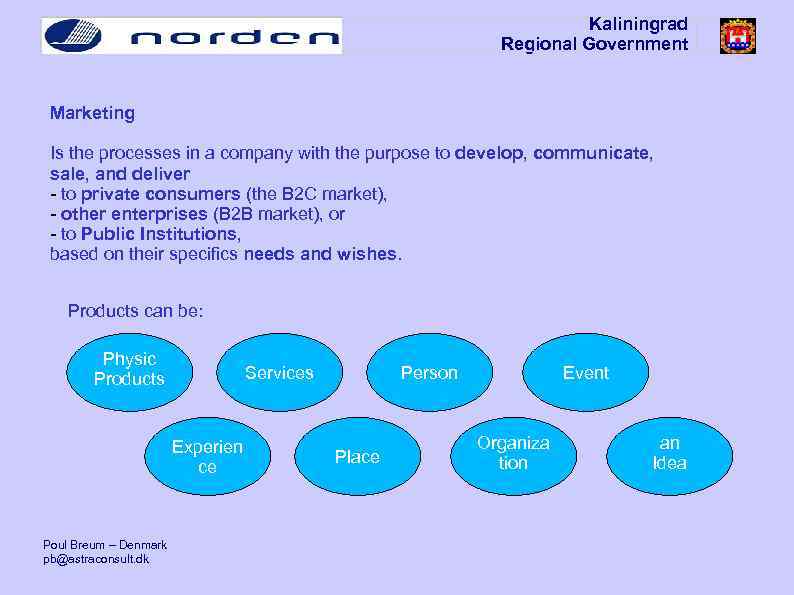
Kaliningrad Regional Government Marketing Is the processes in a company with the purpose to develop, communicate, sale, and deliver - to private consumers (the B 2 C market), - other enterprises (B 2 B market), or - to Public Institutions, based on their specifics needs and wishes. Products can be: Physic Products Services Experien ce Poul Breum – Denmark pb@astraconsult. dk Person Place Event Organiza tion an Idea
Kaliningrad Regional Government The Company’s Marketing Mix Elements, which is important for the company’s sales: Demand determinants: elements, important for the demand of the company’s products. Some are external: - purchasing power - reaction from competitors - change in season and fashion. Some are internal – can be decided by the company itself: - what type of Product - How to define the selling Price - what Place or market to focus on and how? - how to Promote and attract the customers? = the Company’s Marketing Mix Poul Breum – Denmark pb@astraconsult. dk
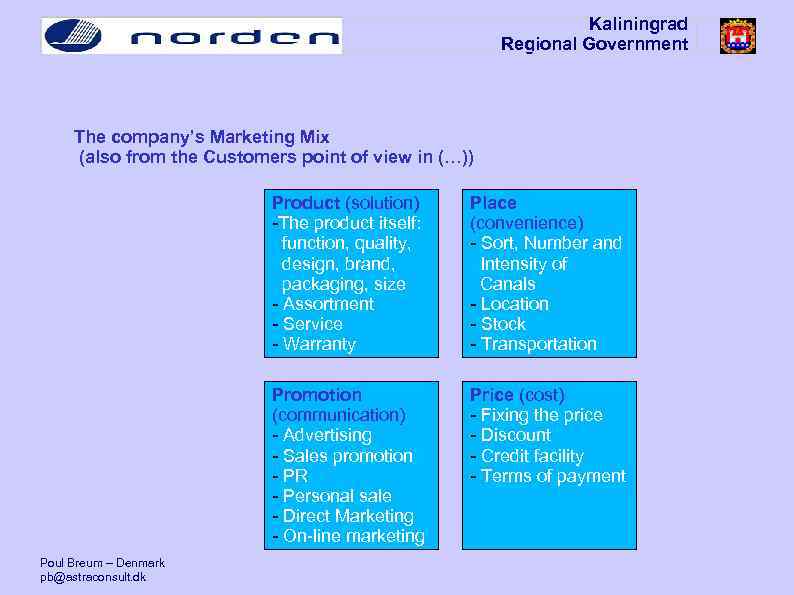
Kaliningrad Regional Government The company’s Marketing Mix (also from the Customers point of view in (…)) Product (solution) -The product itself: function, quality, design, brand, packaging, size - Assortment - Service - Warranty Promotion (communication) - Advertising - Sales promotion - PR - Personal sale - Direct Marketing - On-line marketing Poul Breum – Denmark pb@astraconsult. dk Place (convenience) - Sort, Number and Intensity of Canals - Location - Stock - Transportation Price (cost) - Fixing the price - Discount - Credit facility - Terms of payment
Kaliningrad Regional Government Target Group The group of people/industry, that the company have chosen to address its marketing mix against Poul Breum – Denmark pb@astraconsult. dk
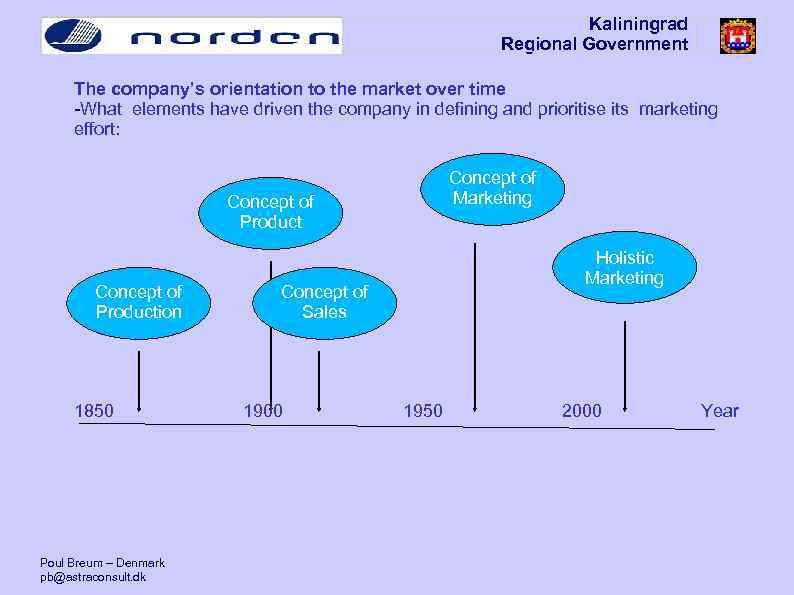
Kaliningrad Regional Government The company’s orientation to the market over time -What elements have driven the company in defining and prioritise its marketing effort: Concept of Marketing Concept of Production 1850 Poul Breum – Denmark pb@astraconsult. dk Holistic Marketing Concept of Sales 1900 1950 2000 Year
Kaliningrad Regional Government Concept of Production Focusing on optimising the internal Production Processes in order to create acceptable Quality, Availability, low Cost, and relative cheap Price ( ex. Ford). To day typically Chinese companies. Concept of Product Focusing on developing and optimising the Product in order to satisfy the demand for high Quality, Performance, and specialised functions (needs). Typically innovative companies, but too focused on own advantages (ex. Kodak). Sales Concept Focusing on own aggressive promotion and sales effort in order to create bigger market. More based on own situation than on customers need (ex. Coca Cola). Concept of Marketing The company’s product development and marketing are focused on the customers needs and behaviour. The company analyses the needs of the customers and target the marketing toward to defined target groups. The purpose of marketing is to define customers needs and wishes through coordinated actions in order to realise the defined objectives. Focus on: Customer orientation (customer satisfaction), Coordinated activities (all departments are focused on customer satisfaction), and Achievement of the objectives (through customer satisfaction). High customer satisfaction – a win-win situation. (ex. LEGO, Maersk) Poul Breum – Denmark pb@astraconsult. dk
Kaliningrad Regional Government The Holistic Concept of Marketing The company involves conditions in the Society (political, economical, social, and technical), the Relations to Customers (the canal of distribution, suppliers and partner), Integration (product, canal of distribution, communication), and Internal Marketing (management, marketing, other departments) - Society related marketing: in the 1990’s many become ‘political consumers’, who takes Political and Ethical considerations when choosing products (environment (pollution), nature, treatment of workers (‘code of conduct’), possibility to recycle of products, etc. ). - Relation related marketing (one – one marketing): Continuing interaction between the company and its customers In order to adjust individual customers need and wishes – also called Customer Relationship Management (CRM), using key account managers. The company try to optimize the cooperation between customers, suppliers and other partners (ex. Toyota). - Internal marketing: Through ongoing information, communication and dialog between owner, top-management and employers in order to create ownership to Company affairs. - Integrated marketing: that the company optimize its ability to develop, communicate and deliver value for its customers. In this way the customer will maximise its benefits working With the company. ‘You keep promises’. The customer become a PRO-SUMENT, e. g. both Producer and consumer and part in the process – as in consumer involvement and Experience economy (ex. Tailor, haircutter, Volvo). Poul Breum – Denmark pb@astraconsult. dk
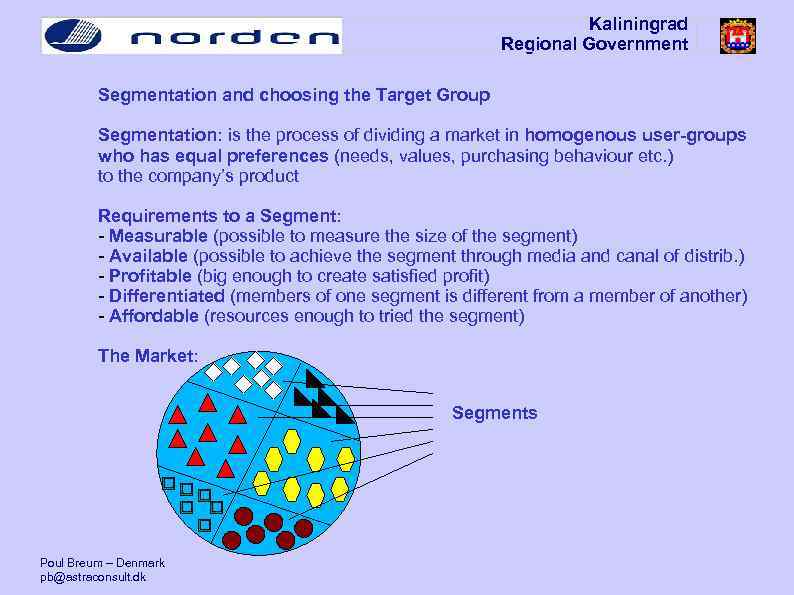
Kaliningrad Regional Government Segmentation and choosing the Target Group Segmentation: is the process of dividing a market in homogenous user-groups who has equal preferences (needs, values, purchasing behaviour etc. ) to the company’s product Requirements to a Segment: - Measurable (possible to measure the size of the segment) - Available (possible to achieve the segment through media and canal of distrib. ) - Profitable (big enough to create satisfied profit) - Differentiated (members of one segment is different from a member of another) - Affordable (resources enough to tried the segment) The Market: Segments Poul Breum – Denmark pb@astraconsult. dk
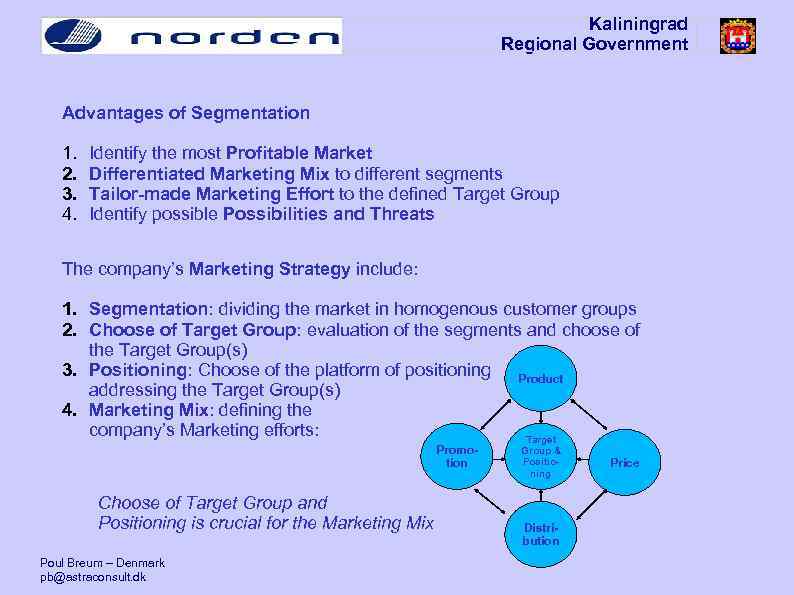
Kaliningrad Regional Government Advantages of Segmentation 1. 2. 3. 4. Identify the most Profitable Market Differentiated Marketing Mix to different segments Tailor-made Marketing Effort to the defined Target Group Identify possible Possibilities and Threats The company’s Marketing Strategy include: 1. Segmentation: dividing the market in homogenous customer groups 2. Choose of Target Group: evaluation of the segments and choose of the Target Group(s) 3. Positioning: Choose of the platform of positioning Product addressing the Target Group(s) 4. Marketing Mix: defining the company’s Marketing efforts: Target Promotion Choose of Target Group and Positioning is crucial for the Marketing Mix Poul Breum – Denmark pb@astraconsult. dk Group & Positioning Distribution Price
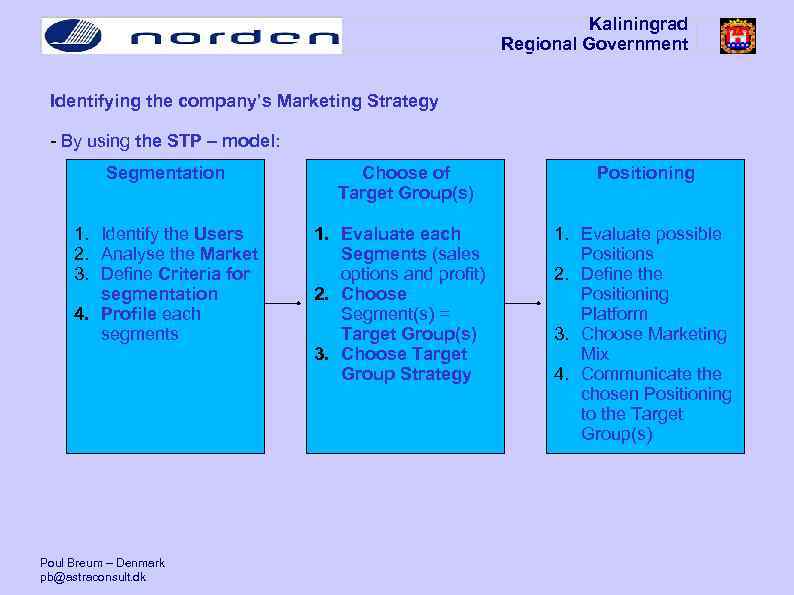
Kaliningrad Regional Government Identifying the company’s Marketing Strategy - By using the STP – model: Segmentation 1. Identify the Users 2. Analyse the Market 3. Define Criteria for segmentation 4. Profile each segments Poul Breum – Denmark pb@astraconsult. dk Choose of Target Group(s) 1. Evaluate each Segments (sales options and profit) 2. Choose Segment(s) = Target Group(s) 3. Choose Target Group Strategy Positioning 1. Evaluate possible Positions 2. Define the Positioning Platform 3. Choose Marketing Mix 4. Communicate the chosen Positioning to the Target Group(s)
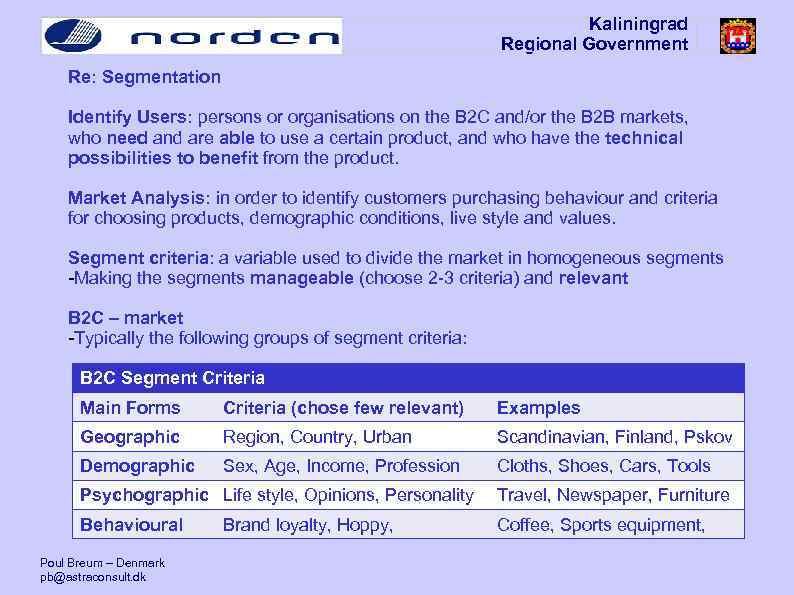
Kaliningrad Regional Government Re: Segmentation Identify Users: persons or organisations on the B 2 C and/or the B 2 B markets, who need and are able to use a certain product, and who have the technical possibilities to benefit from the product. Market Analysis: in order to identify customers purchasing behaviour and criteria for choosing products, demographic conditions, live style and values. Segment criteria: a variable used to divide the market in homogeneous segments -Making the segments manageable (choose 2 -3 criteria) and relevant B 2 C – market -Typically the following groups of segment criteria: B 2 C Segment Criteria Main Forms Criteria (chose few relevant) Examples Geographic Region, Country, Urban Scandinavian, Finland, Pskov Demographic Sex, Age, Income, Profession Cloths, Shoes, Cars, Tools Psychographic Life style, Opinions, Personality Travel, Newspaper, Furniture Behavioural Coffee, Sports equipment, Poul Breum – Denmark pb@astraconsult. dk Brand loyalty, Hoppy,
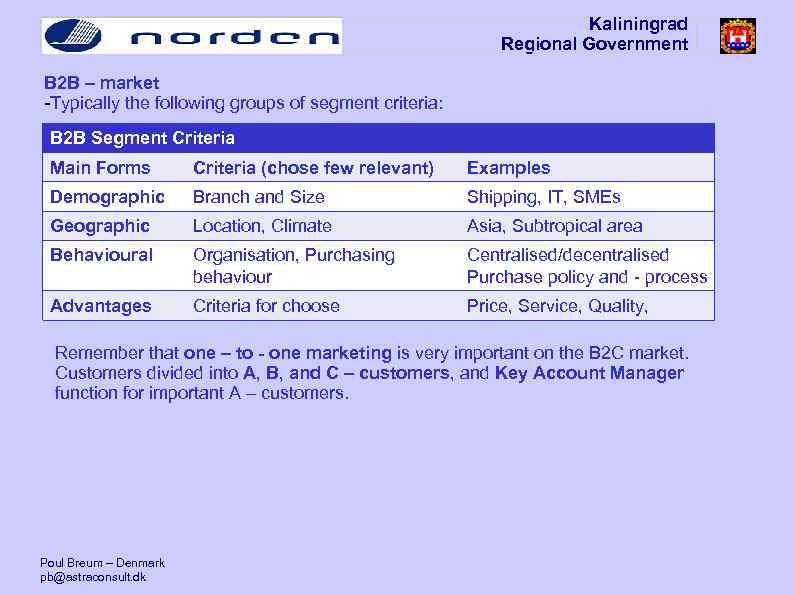
Kaliningrad Regional Government B 2 B – market -Typically the following groups of segment criteria: B 2 B Segment Criteria Main Forms Criteria (chose few relevant) Examples Demographic Branch and Size Shipping, IT, SMEs Geographic Location, Climate Asia, Subtropical area Behavioural Organisation, Purchasing behaviour Centralised/decentralised Purchase policy and - process Advantages Criteria for choose Price, Service, Quality, Remember that one – to - one marketing is very important on the B 2 C market. Customers divided into A, B, and C – customers, and Key Account Manager function for important A – customers. Poul Breum – Denmark pb@astraconsult. dk
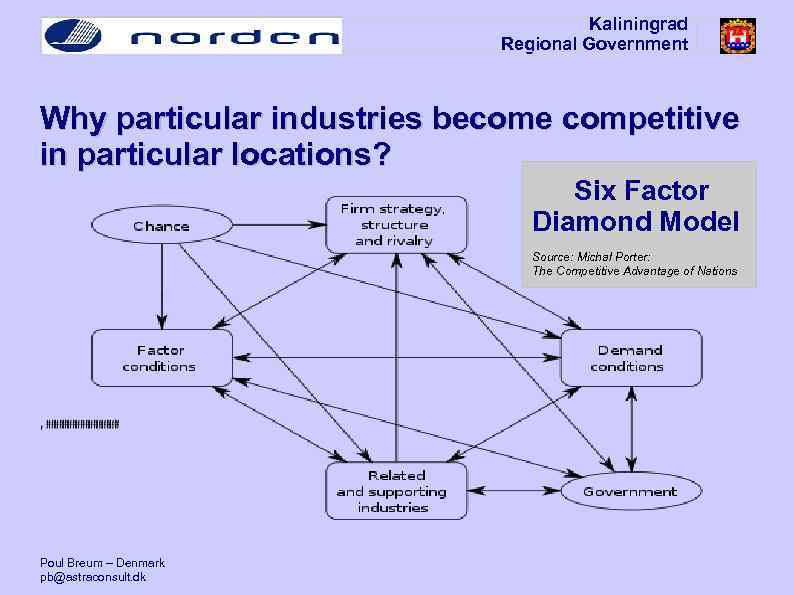
Kaliningrad Regional Government Why particular industries become competitive in particular locations? Six Factor Diamond Model Source: Michal Porter: The Competitive Advantage of Nations Poul Breum – Denmark pb@astraconsult. dk
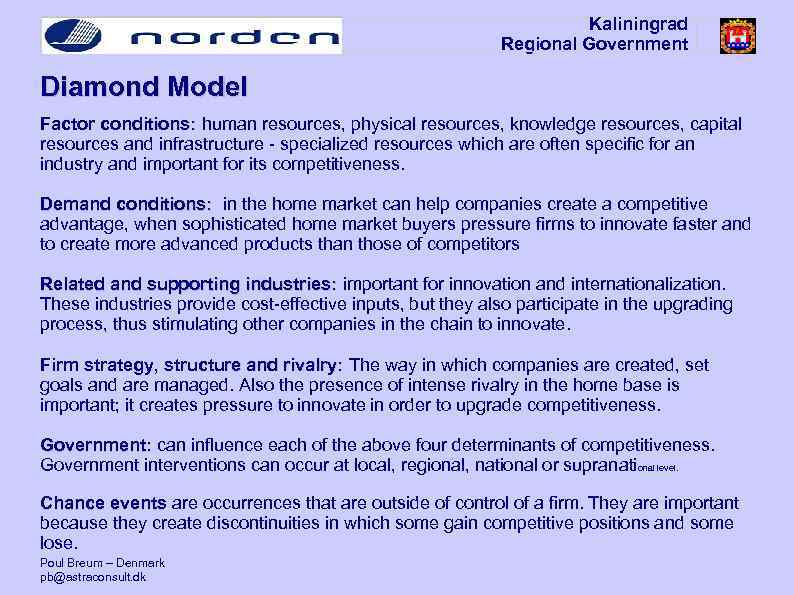
Kaliningrad Regional Government Diamond Model Factor conditions: human resources, physical resources, knowledge resources, capital resources and infrastructure - specialized resources which are often specific for an industry and important for its competitiveness. Demand conditions: in the home market can help companies create a competitive advantage, when sophisticated home market buyers pressure firms to innovate faster and to create more advanced products than those of competitors Related and supporting industries: important for innovation and internationalization. These industries provide cost-effective inputs, but they also participate in the upgrading process, thus stimulating other companies in the chain to innovate. Firm strategy, structure and rivalry: The way in which companies are created, set goals and are managed. Also the presence of intense rivalry in the home base is important; it creates pressure to innovate in order to upgrade competitiveness. Government: can influence each of the above four determinants of competitiveness. Government interventions can occur at local, regional, national or supranational level. Chance events are occurrences that are outside of control of a firm. They are important because they create discontinuities in which some gain competitive positions and some lose. Poul Breum – Denmark pb@astraconsult. dk
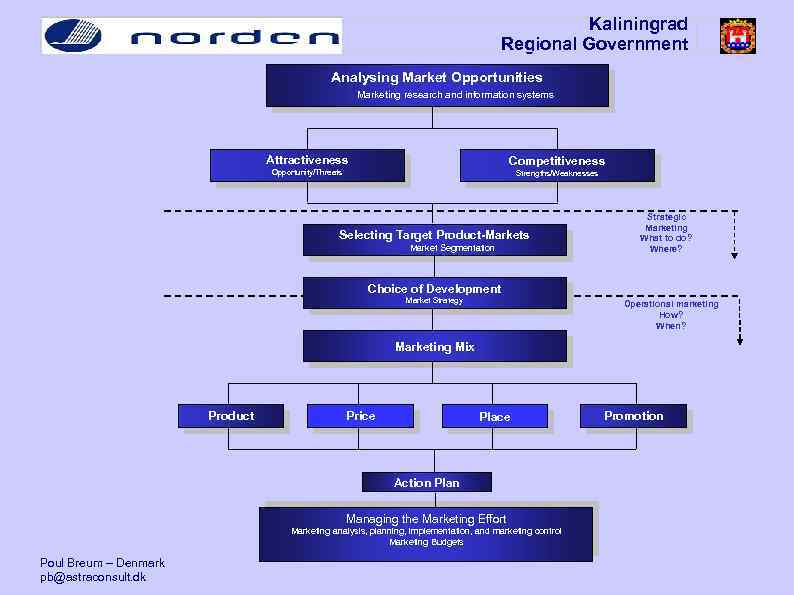
Kaliningrad Regional Government Analysing Market Opportunities Marketing research and information systems Attractiveness Competitiveness Opportunity/Threats Strengths/Weaknesses Strategic Marketing What to do? Where? Selecting Target Product-Markets Market Segmentation Choice of Development Market Strategy Operational marketing How? When? Marketing Mix Product Price Promotion Place Action Plan Managing the Marketing Effort Marketing analysis, planning, implementation, and marketing control Marketing Budgets Poul Breum – Denmark pb@astraconsult. dk 18
Kaliningrad Regional Government Market Intelligence - The intelligence Process - Needs Assessment of Information (why – purpose? ) - Gathering of Information - Analysing of Information - Communication of Information Poul Breum – Denmark pb@astraconsult. dk
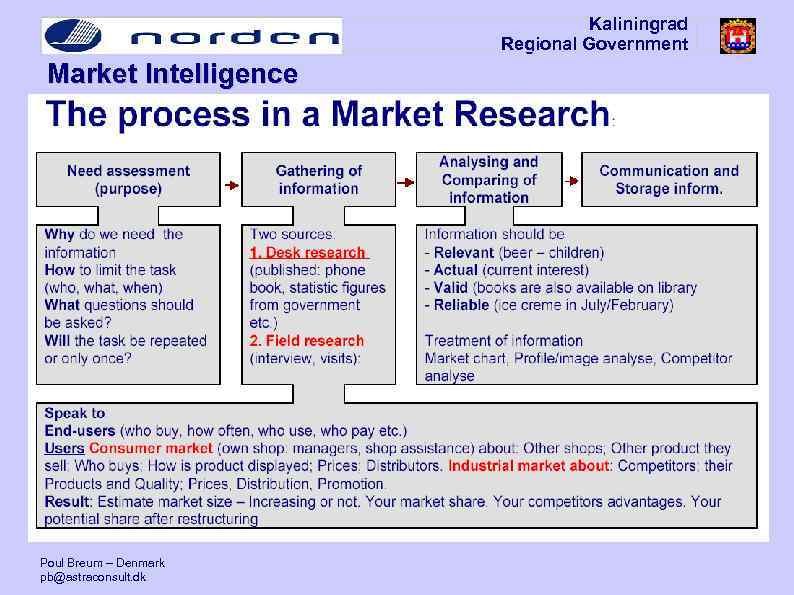
Kaliningrad Regional Government Market Intelligence Poul Breum – Denmark pb@astraconsult. dk
Kaliningrad Regional Government Market Intelligence - Gathering market information - Why? To get information about: - Customer and Segments features and size - Product features and size - Competitors features and size - Enabling Environment. To see if the options represent Opportunities or Threats. To see if the options represents Strength or Weaknesses. - Internal Capability and Competitiveness. The Market Research should give you a picture of the market Poul Breum – Denmark pb@astraconsult. dk
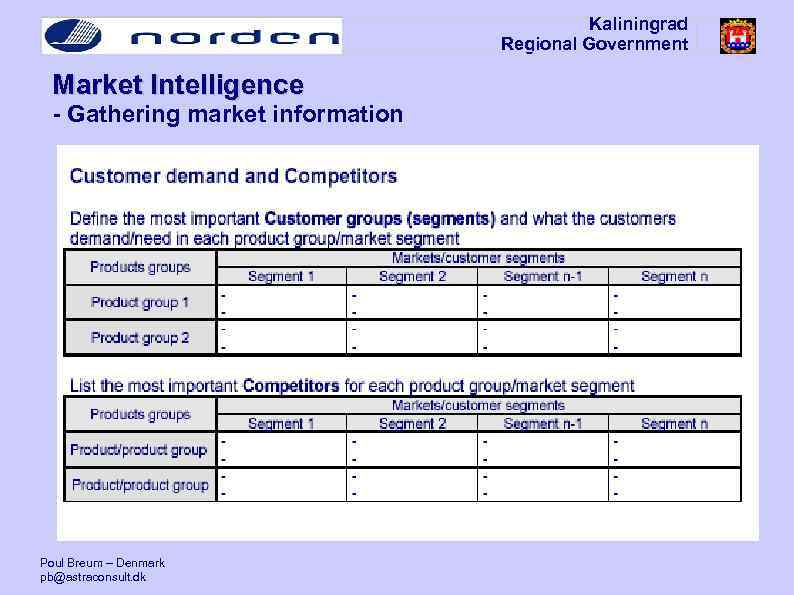
Kaliningrad Regional Government Market Intelligence - Gathering market information Poul Breum – Denmark pb@astraconsult. dk
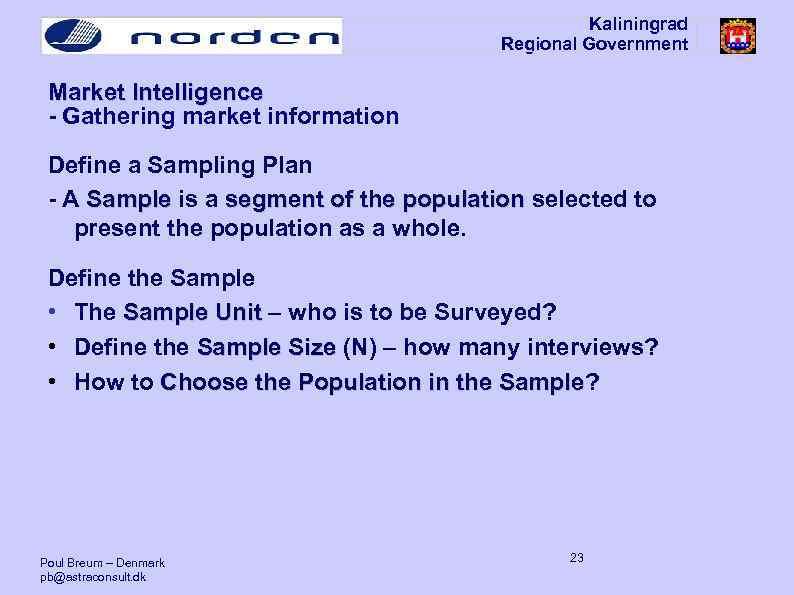
Kaliningrad Regional Government Market Intelligence - Gathering market information Define a Sampling Plan - A Sample is a segment of the population selected to present the population as a whole. Define the Sample • The Sample Unit – who is to be Surveyed? • Define the Sample Size (N) – how many interviews? • How to Choose the Population in the Sample? Sample Poul Breum – Denmark pb@astraconsult. dk 23
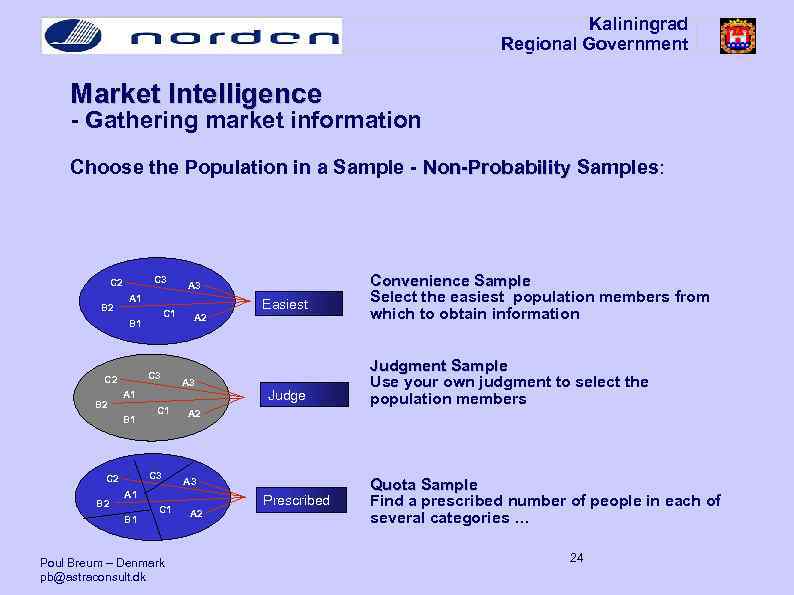
Kaliningrad Regional Government Market Intelligence - Gathering market information Choose the Population in a Sample - Non-Probability Samples: C 3 C 2 B 2 A 1 C 1 B 1 C 3 C 2 B 2 A 3 A 1 B 1 C 3 C 2 B 2 A 3 B 1 Poul Breum – Denmark pb@astraconsult. dk Judge Judgment Sample Use your own judgment to select the population members A 2 A 3 A 1 C 1 Easiest Convenience Sample Select the easiest population members from which to obtain information A 2 Prescribed Quota Sample Find a prescribed number of people in each of several categories … 24
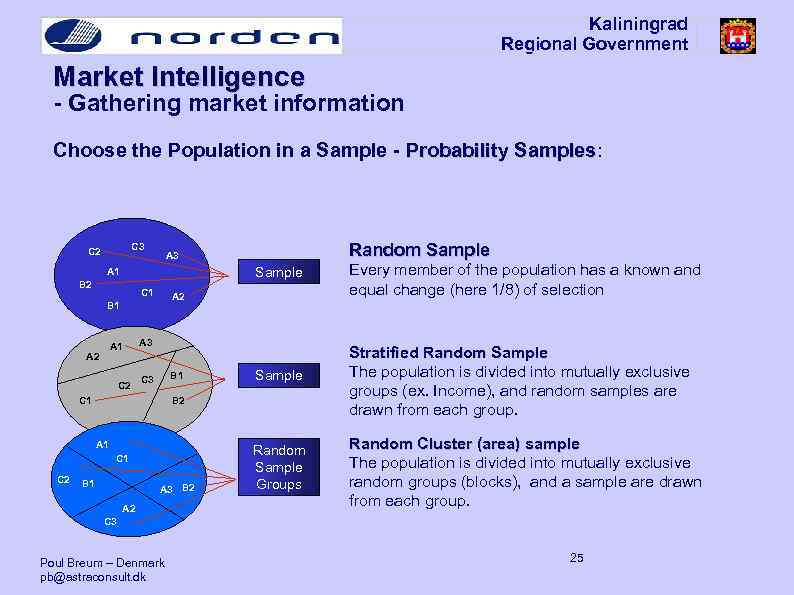
Kaliningrad Regional Government Market Intelligence - Gathering market information Choose the Population in a Sample - Probability Samples: Samples C 3 C 2 Sample A 1 B 2 C 1 A 2 B 1 A 2 C 2 A 3 B 1 C 3 C 1 B 1 A 3 B 2 A 2 Every member of the population has a known and equal change (here 1/8) of selection Sample Stratified Random Sample The population is divided into mutually exclusive groups (ex. Income), and random samples are drawn from each group. Random Sample Groups Random Cluster (area) sample The population is divided into mutually exclusive random groups (blocks), and a sample are drawn from each group. B 2 A 1 C 2 Random Sample A 3 C 3 Poul Breum – Denmark pb@astraconsult. dk 25
Kaliningrad Regional Government Market Intelligence - Gathering market information The chose of Sample method depends on: • Cost limitation • Time limitation • Demand for accuracy, and • Statistical limitations Poul Breum – Denmark pb@astraconsult. dk 26
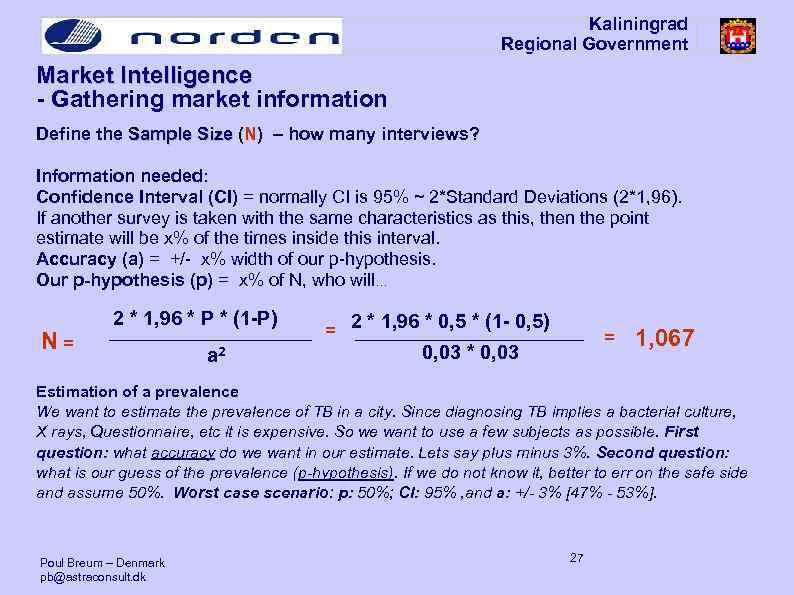
Kaliningrad Regional Government Market Intelligence - Gathering market information Define the Sample Size (N) – how many interviews? Information needed: Confidence Interval (CI) = normally CI is 95% ~ 2*Standard Deviations (2*1, 96). If another survey is taken with the same characteristics as this, then the point estimate will be x% of the times inside this interval. Accuracy (a) = +/- x% width of our p-hypothesis. Our p-hypothesis (p) = x% of N, who will… N= 2 * 1, 96 * P * (1 -P) a 2 = 2 * 1, 96 * 0, 5 * (1 - 0, 5) = 0, 03 * 0, 03 1, 067 Estimation of a prevalence We want to estimate the prevalence of TB in a city. Since diagnosing TB implies a bacterial culture, X rays, Questionnaire, etc it is expensive. So we want to use a few subjects as possible. First question: what accuracy do we want in our estimate. Lets say plus minus 3%. Second question: what is our guess of the prevalence (p-hypothesis). If we do not know it, better to err on the safe side and assume 50%. Worst case scenario: p: 50%; CI: 95% , and a: +/- 3% [47% - 53%]. Poul Breum – Denmark pb@astraconsult. dk 27
Kaliningrad Regional Government Market Intelligence - Analysing of market information Profile/image analysis Profile: The Picture the Company wants or believes the market have of the company Image: The Picture which the Market has formed of the Company Makes it possible to identify and analyse: • How the Markets (customers) priorities the Importance of Parameters to their choice of Products. • How the Markets (customers) see the Company’s performance – compared with main Competitors • How the Managements priorities the Importance of Parameters • The conformity between the Company’s wanted Profile and the Markets Image of the Company Poul Breum – Denmark pb@astraconsult. dk 28
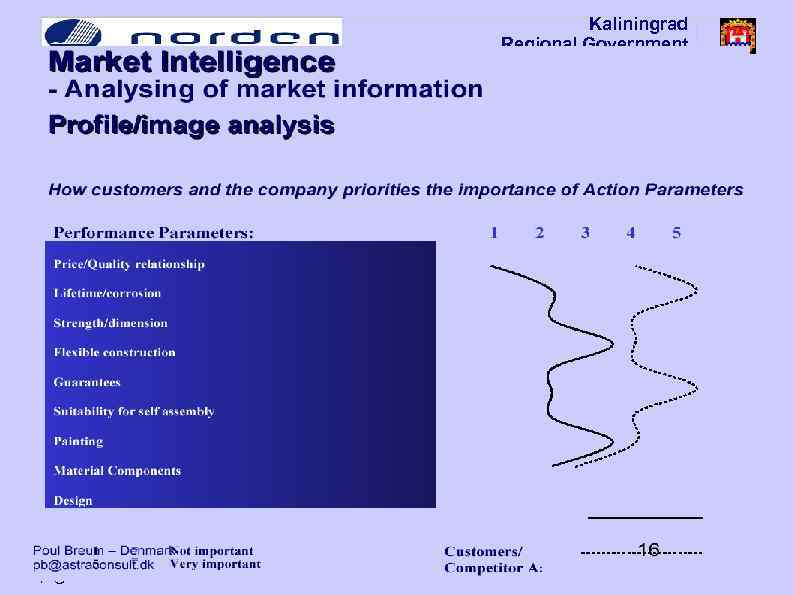
Kaliningrad Regional Government Poul Breum – Denmark pb@astraconsult. dk 29
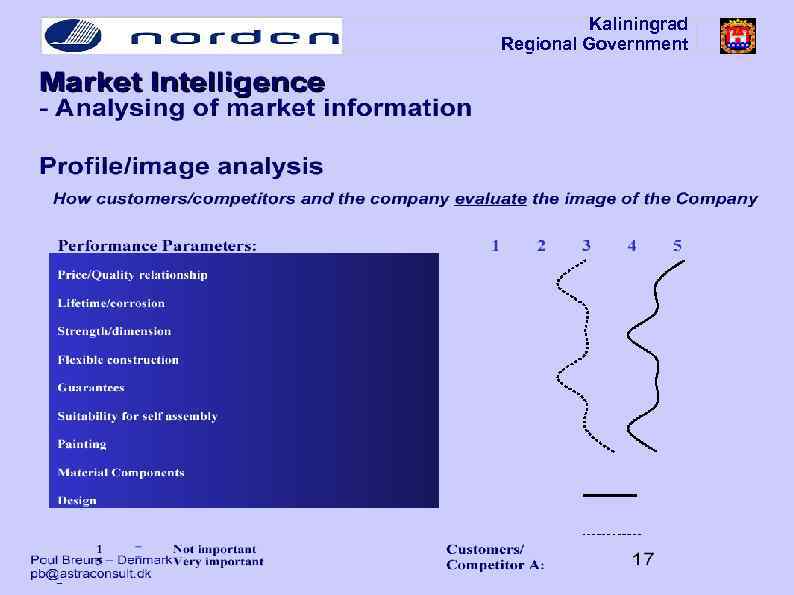
Kaliningrad Regional Government How customers/competitors and the company evaluate the image of the Company Poul Breum – Denmark pb@astraconsult. dk 30
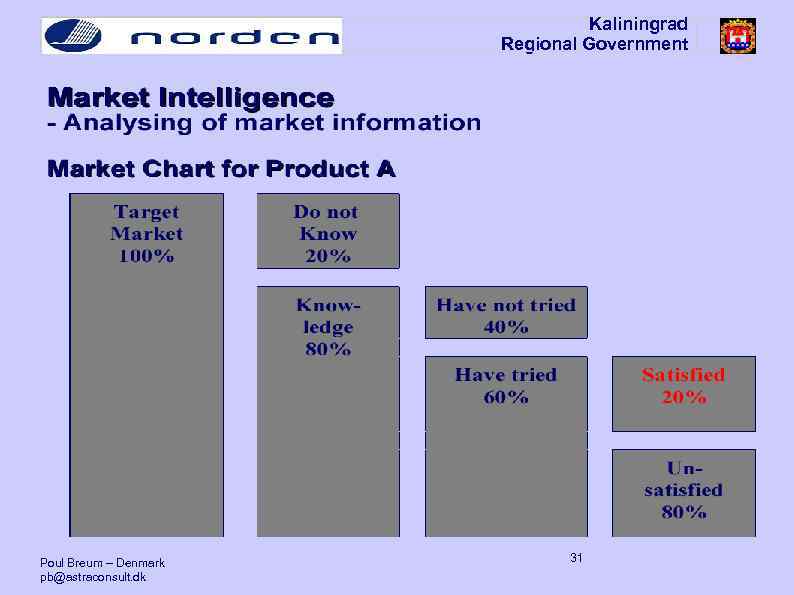
Kaliningrad Regional Government Poul Breum – Denmark pb@astraconsult. dk 31
Kaliningrad Regional Government Poul Breum – Denmark pb@astraconsult. dk
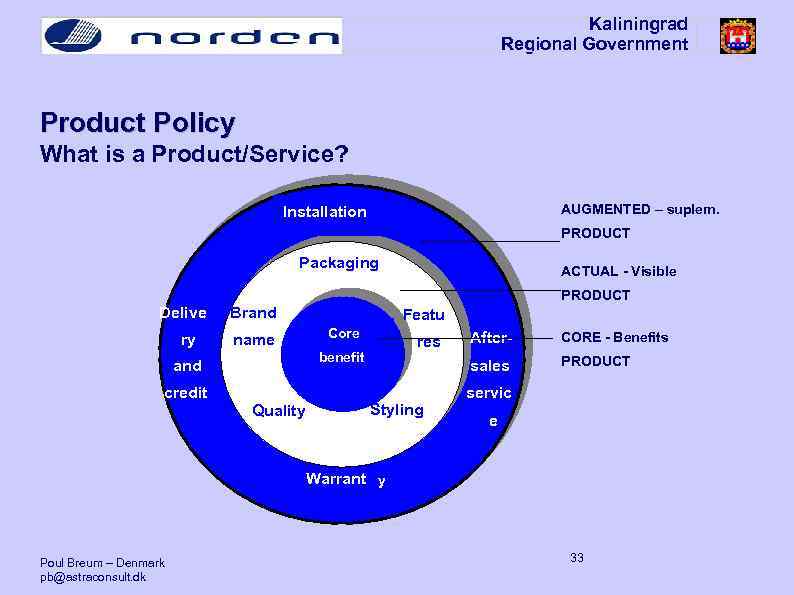
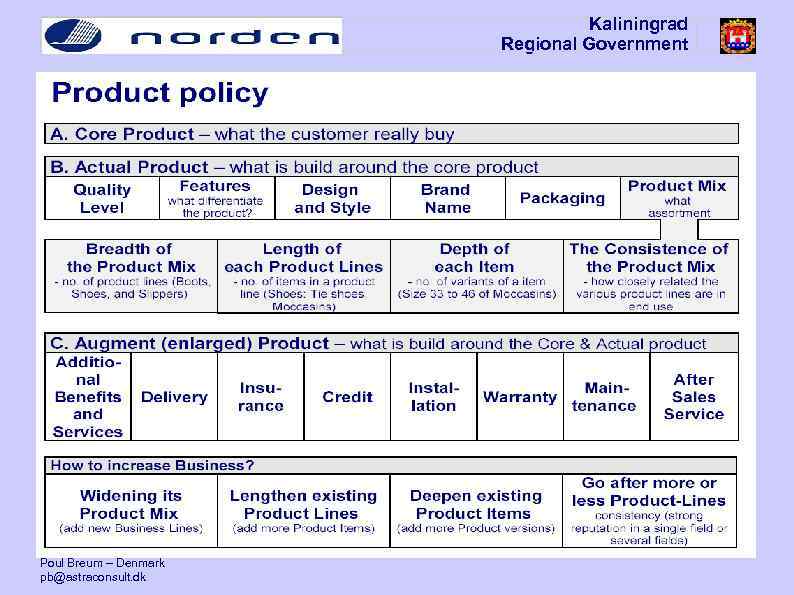
Kaliningrad Regional Government Product Policy What is a Product/Service? AUGMENTED – suplem. Installation PRODUCT Packaging ACTUAL - Visible PRODUCT Delive ry Brand name Featu Core benefit and credit Quality Styling After- CORE - Benefits sales res PRODUCT servic e Warrant y Poul Breum – Denmark pb@astraconsult. dk 33
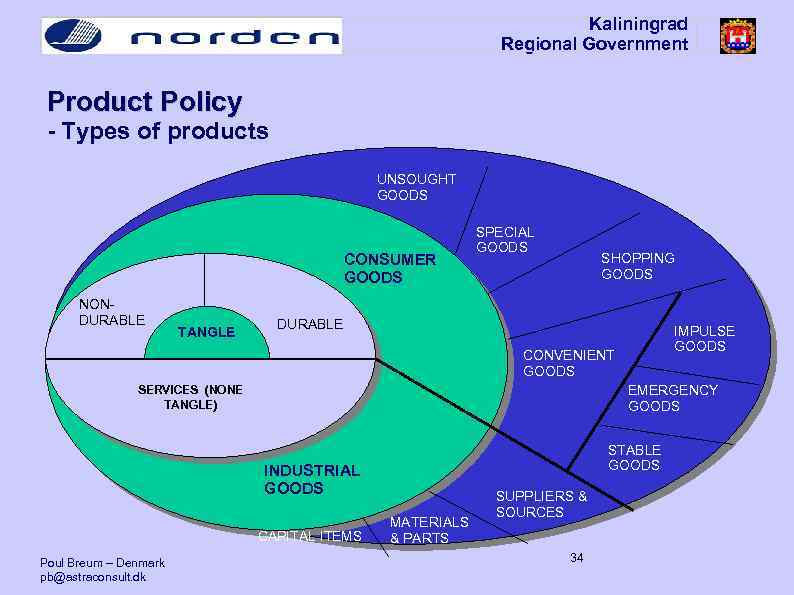
Kaliningrad Regional Government Product Policy - Types of products UNSOUGHT GOODS CONSUMER GOODS NONDURABLE TANGLE SPECIAL GOODS SHOPPING GOODS DURABLE IMPULSE GOODS CONVENIENT GOODS EMERGENCY GOODS SERVICES (NONE TANGLE) STABLE GOODS INDUSTRIAL GOODS CAPITAL ITEMS Poul Breum – Denmark pb@astraconsult. dk MATERIALS & PARTS SUPPLIERS & SOURCES 34
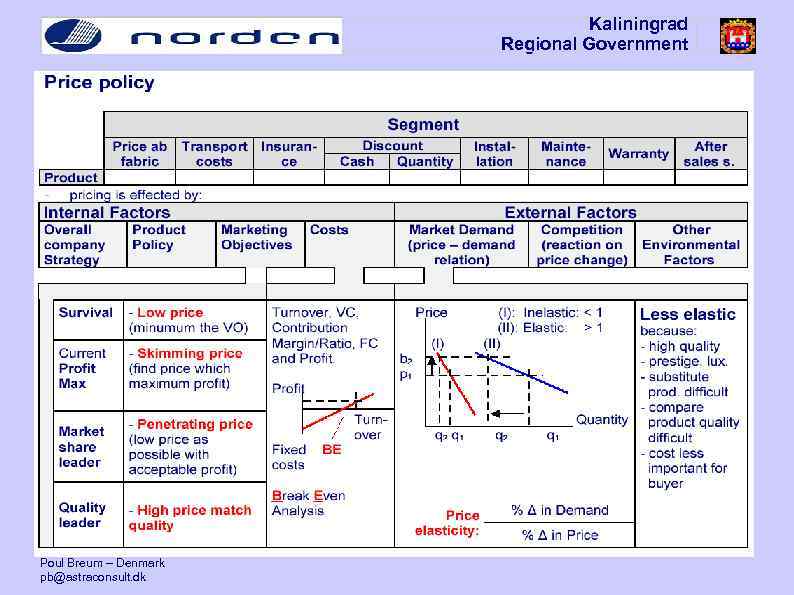
Kaliningrad Regional Government Poul Breum – Denmark pb@astraconsult. dk
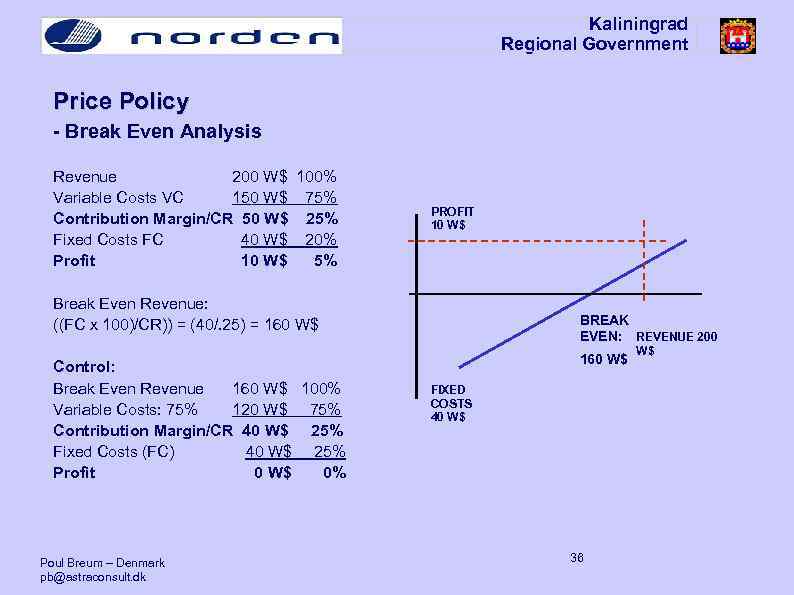
Kaliningrad Regional Government Price Policy - Break Even Analysis Revenue 200 W$ 100% Variable Costs VC 150 W$ 75% Contribution Margin/CR 50 W$ 25% Fixed Costs FC 40 W$ 20% Profit 10 W$ 5% PROFIT 10 W$ Break Even Revenue: ((FC x 100)/CR)) = (40/. 25) = 160 W$ Control: Break Even Revenue 160 W$ 100% Variable Costs: 75% 120 W$ 75% Contribution Margin/CR 40 W$ 25% Fixed Costs (FC) 40 W$ 25% Profit 0 W$ 0% Poul Breum – Denmark pb@astraconsult. dk BREAK EVEN: REVENUE 200 160 W$ FIXED COSTS 40 W$ 36 W$
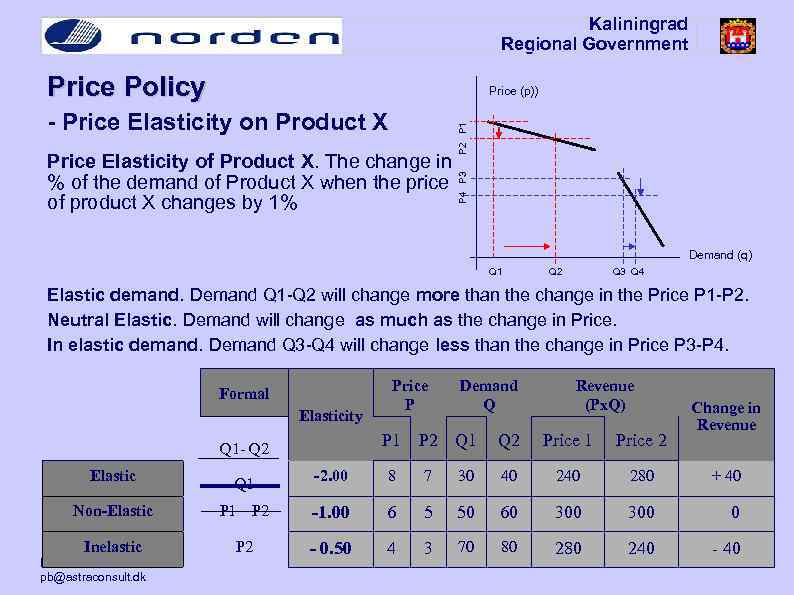
Kaliningrad Regional Government Price Policy Price Elasticity of Product X. The change in % of the demand of Product X when the price of product X changes by 1% P 4 P 3 - Price Elasticity on Product X P 2 P 1 Price (p)) Demand (q) Q 1 Q 2 Q 3 Q 4 Elastic demand. Demand Q 1 -Q 2 will change more than the change in the Price P 1 -P 2. Neutral Elastic. Demand will change as much as the change in Price. In elastic demand. Demand Q 3 -Q 4 will change less than the change in Price P 3 -P 4. Formal Elasticity Q 1 Demand Q P 1 P 2 Q 1 - Q 2 Elastic Price P Revenue (Px. Q) Q 2 Price 1 Price 2 Change in Revenue -2. 00 8 7 30 40 280 + 40 Non-Elastic P 1 – P 2 -1. 00 6 5 50 60 300 0 Inelastic P 2 - 0. 50 4 3 70 80 280 37 240 - 40 Poul Breum – Denmark pb@astraconsult. dk
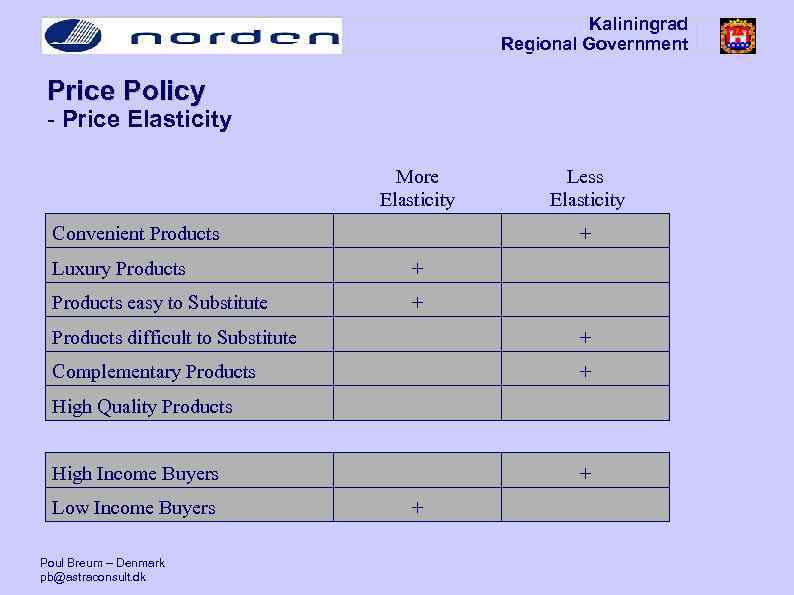
Kaliningrad Regional Government Price Policy - Price Elasticity More Elasticity Convenient Products Less Elasticity + Luxury Products + Products easy to Substitute + Products difficult to Substitute + Complementary Products + High Quality Products High Income Buyers Low Income Buyers Poul Breum – Denmark pb@astraconsult. dk + +
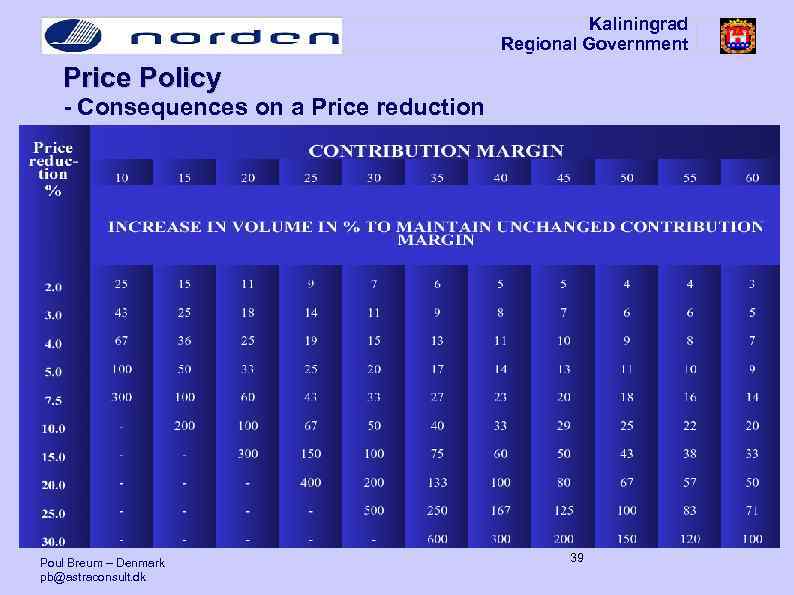
Kaliningrad Regional Government Price Policy - Consequences on a Price reduction Poul Breum – Denmark pb@astraconsult. dk 39
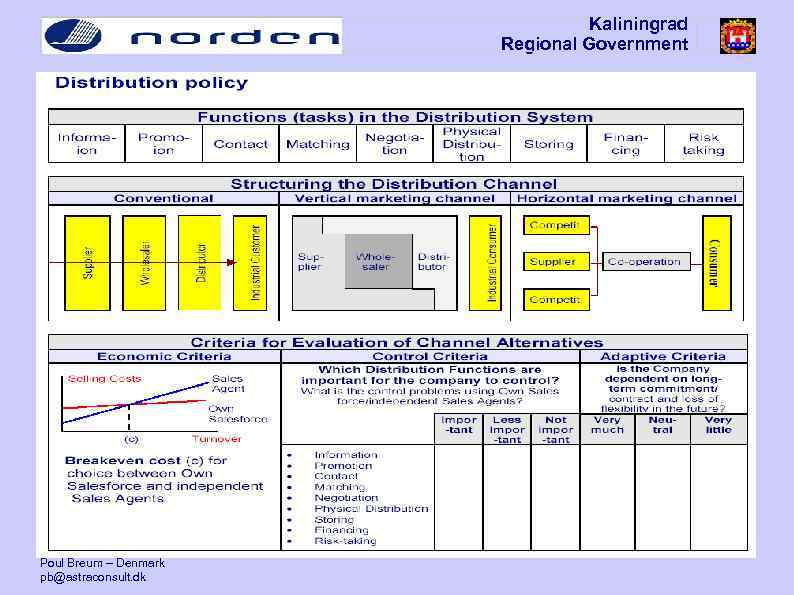
Kaliningrad Regional Government Poul Breum – Denmark pb@astraconsult. dk
Kaliningrad Regional Government Promotion Policy - Profiling the Company - Create a positive Image Company Image • The customer's picture/impression of the company – wrong or right Company Profile • How the management wants the customer to see the company (for example as regards action parameters such as quality, price, service, packing, product range, etc. ) • The company’s strategic decision The Profile must be TRUTH – not to disappoint the customers The purpose of profiling the company is to attract the Customers to the Company. This can be done by influencing customers Directly or Indirectly. Poul Breum – Denmark pb@astraconsult. dk 41
Kaliningrad Regional Government Promotion Policy - Profiling the Company - Create a positive Image Indirect influence • Newspaper, radio or TV; • Through other people (customers, competitors, etc. ) Direct influence • Physical framework of the Company • Personal Contact • Sales Materials • The Product Poul Breum – Denmark pb@astraconsult. dk 42
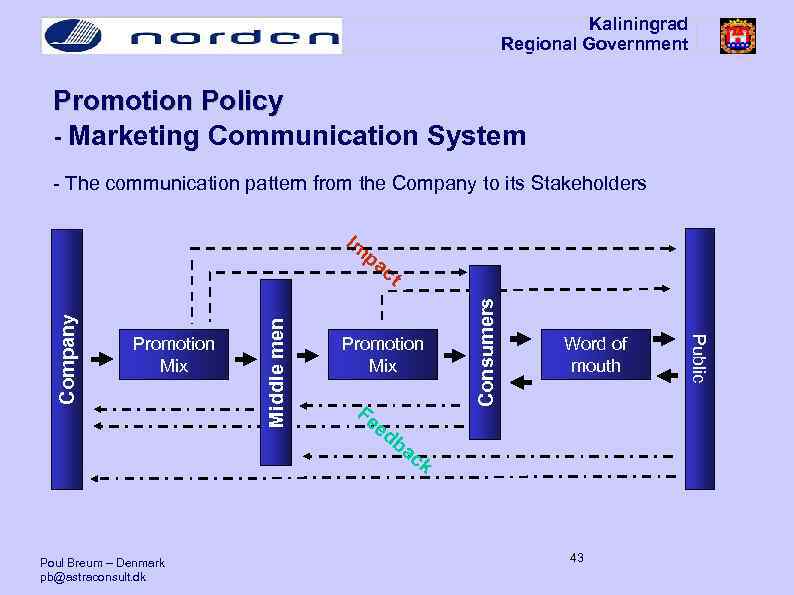
Kaliningrad Regional Government Promotion Policy - Marketing Communication System - The communication pattern from the Company to its Stakeholders Im pa Promotion Mix Fe e Consumers Middle men Promotion Mix Word of mouth db ac k Poul Breum – Denmark pb@astraconsult. dk 43 Public Company ct
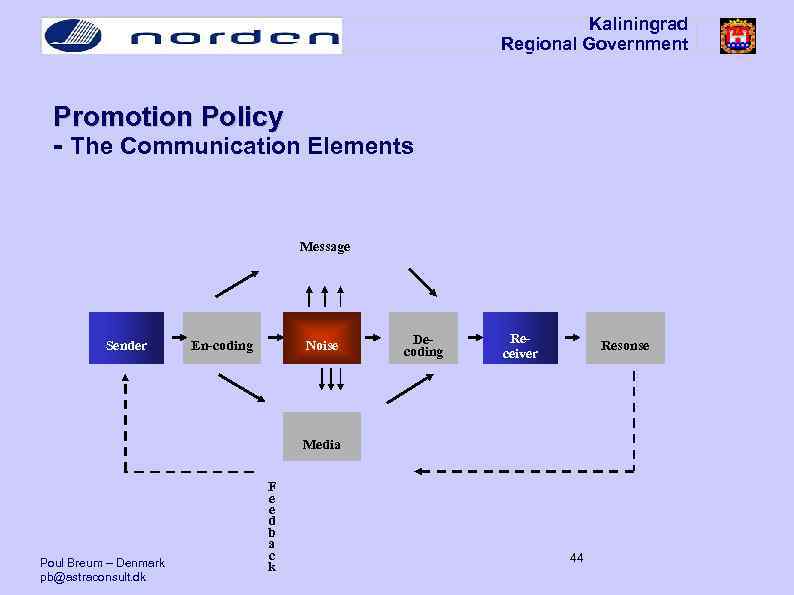
Kaliningrad Regional Government Promotion Policy - The Communication Elements Message Sender En-coding Noise Decoding Receiver Resonse Media Poul Breum – Denmark pb@astraconsult. dk F e e d b a c k 44
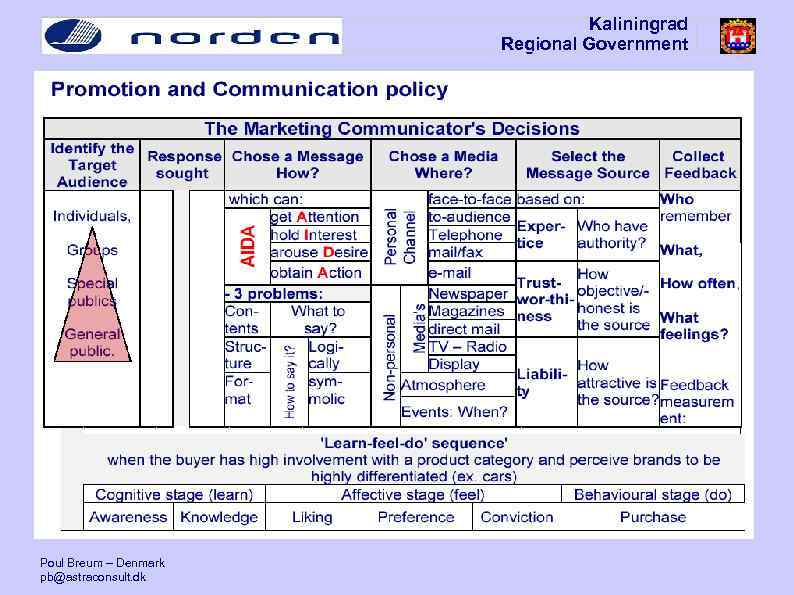
Kaliningrad Regional Government Poul Breum – Denmark pb@astraconsult. dk
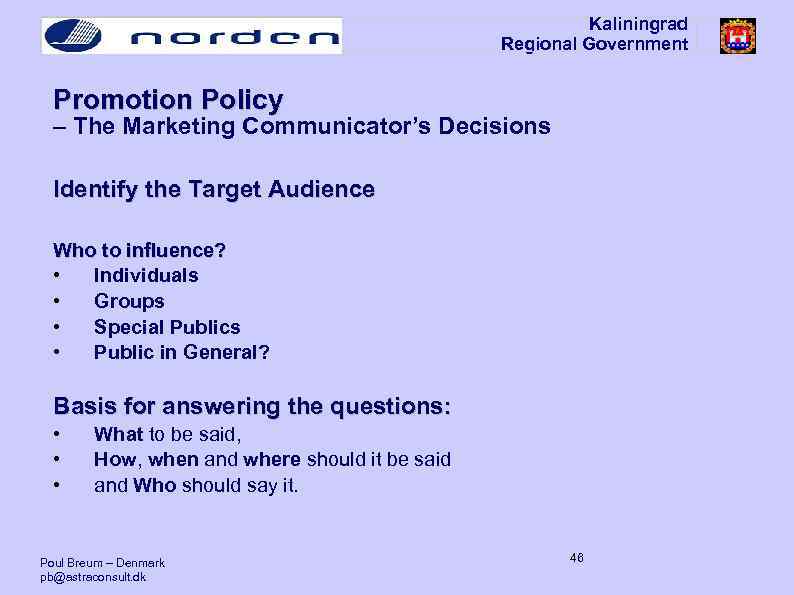
Kaliningrad Regional Government Promotion Policy – The Marketing Communicator’s Decisions Identify the Target Audience Who to influence? • Individuals • Groups • Special Publics • Public in General? Basis for answering the questions: • • • What to be said, How, when and where should it be said and Who should say it. Poul Breum – Denmark pb@astraconsult. dk 46
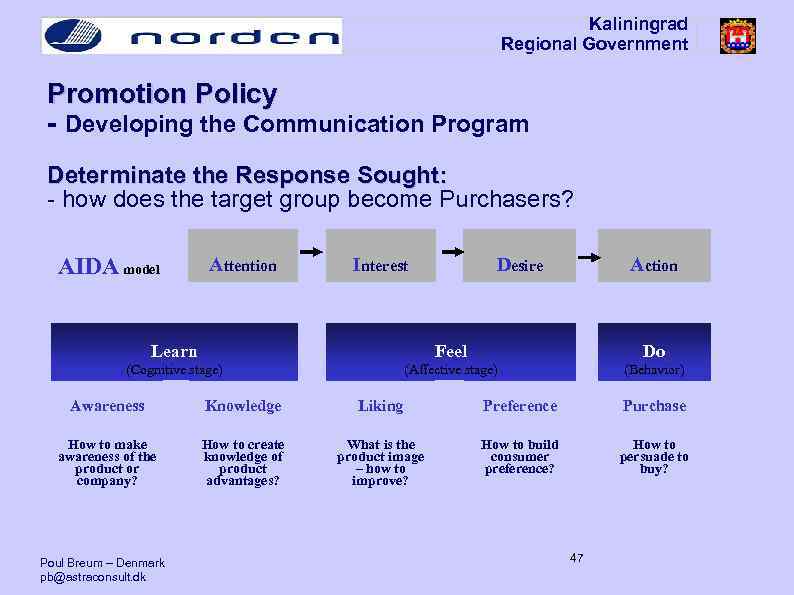
Kaliningrad Regional Government Promotion Policy - Developing the Communication Program Determinate the Response Sought: - how does the target group become Purchasers? AIDA model Attention Interest Desire Action Learn Feel Do (Cognitive stage) (Affective stage) (Behavior) Awareness Knowledge Liking Preference Purchase How to make awareness of the product or company? How to create knowledge of product advantages? What is the product image – how to improve? How to build consumer preference? How to persuade to buy? Poul Breum – Denmark pb@astraconsult. dk 47
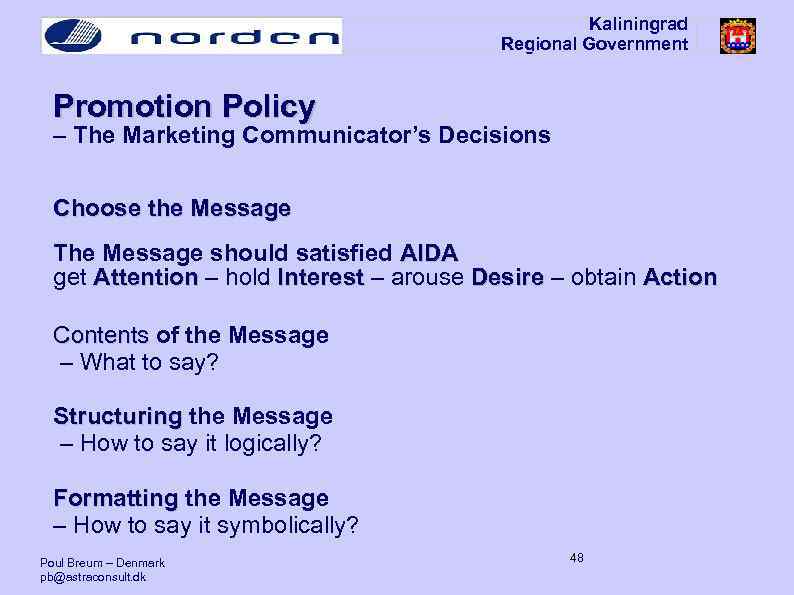
Kaliningrad Regional Government Promotion Policy – The Marketing Communicator’s Decisions Choose the Message The Message should satisfied AIDA get Attention – hold Interest – arouse Desire – obtain Action Contents of the Message – What to say? Structuring the Message – How to say it logically? Formatting the Message – How to say it symbolically? Poul Breum – Denmark pb@astraconsult. dk 48
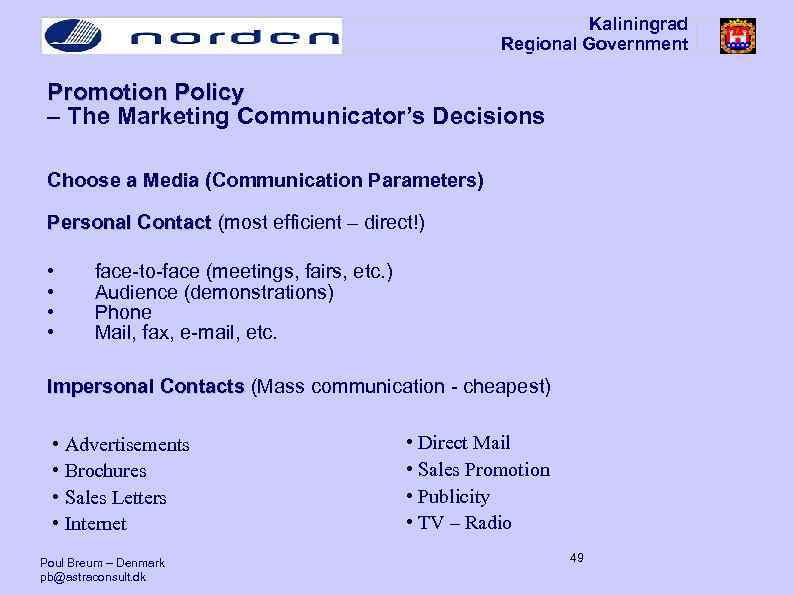
Kaliningrad Regional Government Promotion Policy – The Marketing Communicator’s Decisions Choose a Media (Communication Parameters) Personal Contact (most efficient – direct!) • • face-to-face (meetings, fairs, etc. ) Audience (demonstrations) Phone Mail, fax, e-mail, etc. Impersonal Contacts (Mass communication - cheapest) • Advertisements • Brochures • Sales Letters • Internet Poul Breum – Denmark pb@astraconsult. dk • Direct Mail • Sales Promotion • Publicity • TV – Radio 49
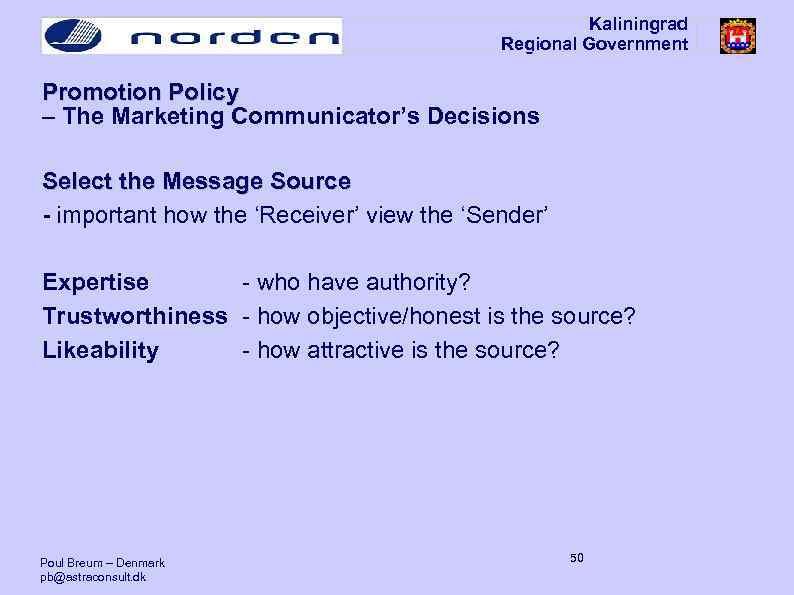
Kaliningrad Regional Government Promotion Policy – The Marketing Communicator’s Decisions Select the Message Source - important how the ‘Receiver’ view the ‘Sender’ Expertise - who have authority? Trustworthiness - how objective/honest is the source? Likeability - how attractive is the source? Poul Breum – Denmark pb@astraconsult. dk 50
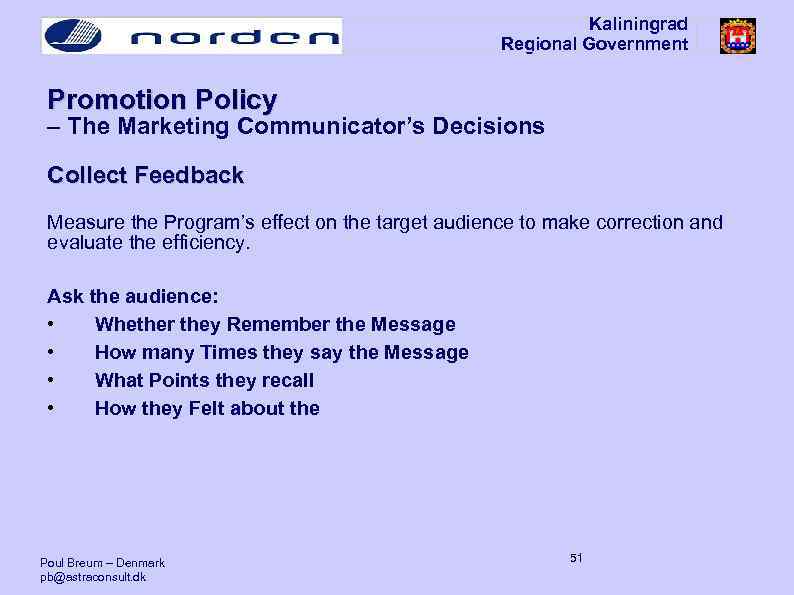
Kaliningrad Regional Government Promotion Policy – The Marketing Communicator’s Decisions Collect Feedback Measure the Program’s effect on the target audience to make correction and evaluate the efficiency. Ask the audience: • Whether they Remember the Message • How many Times they say the Message • What Points they recall • How they Felt about the Poul Breum – Denmark pb@astraconsult. dk 51
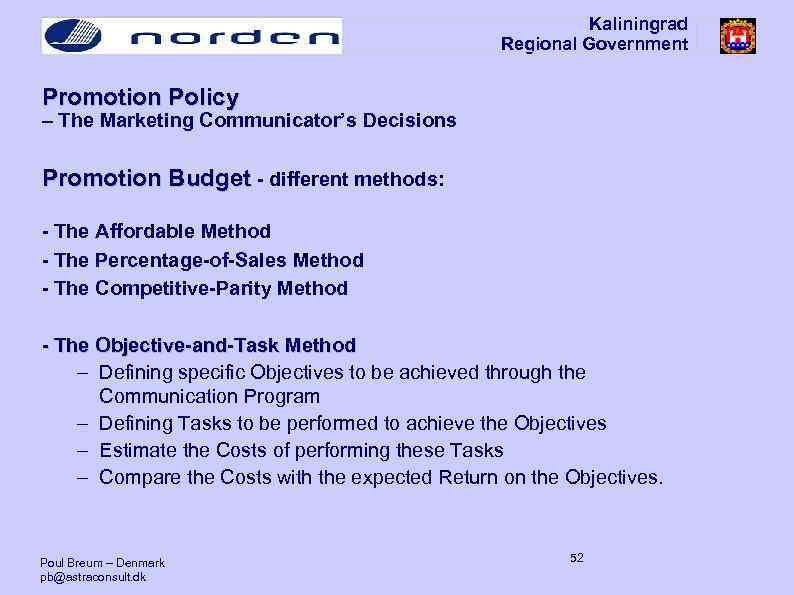
Kaliningrad Regional Government Promotion Policy – The Marketing Communicator’s Decisions Promotion Budget - different methods: - The Affordable Method - The Percentage-of-Sales Method - The Competitive-Parity Method - The Objective-and-Task Method – Defining specific Objectives to be achieved through the Communication Program – Defining Tasks to be performed to achieve the Objectives – Estimate the Costs of performing these Tasks – Compare the Costs with the expected Return on the Objectives. Poul Breum – Denmark pb@astraconsult. dk 52
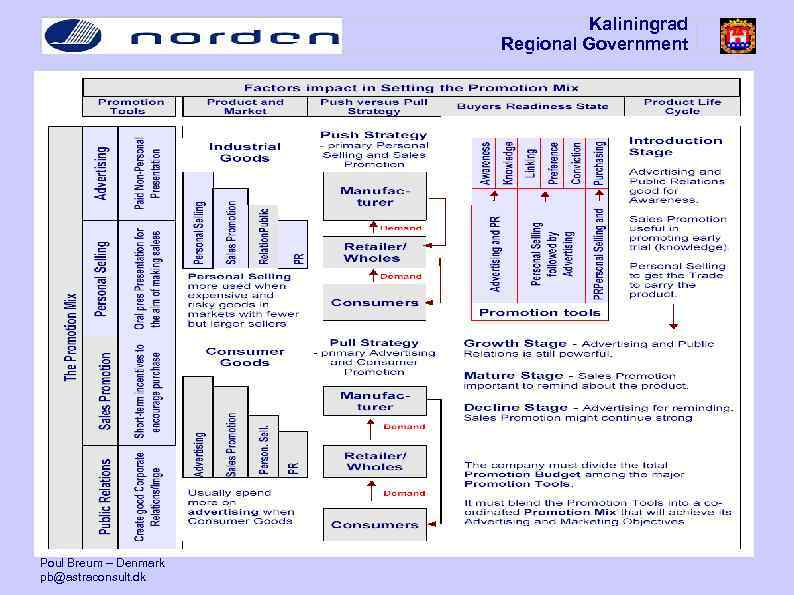
Kaliningrad Regional Government Poul Breum – Denmark pb@astraconsult. dk
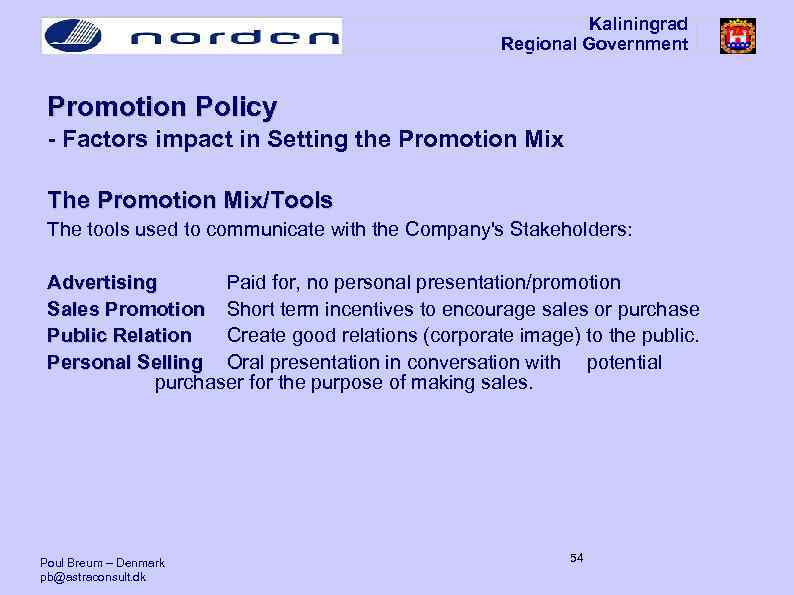
Kaliningrad Regional Government Promotion Policy - Factors impact in Setting the Promotion Mix The Promotion Mix/Tools The tools used to communicate with the Company's Stakeholders: Advertising Paid for, no personal presentation/promotion Sales Promotion Short term incentives to encourage sales or purchase Public Relation Create good relations (corporate image) to the public. Personal Selling Oral presentation in conversation with potential purchaser for the purpose of making sales. Poul Breum – Denmark pb@astraconsult. dk 54
Kaliningrad Regional Government Promotion Policy - Factors impact in Setting the Promotion Mix Factors to consider when setting the Promotion Mix • Type of Product or Market • Choice of ‘Push or Pull’ strategy • Buyer’s Readiness stage • The Products stage in the Life Cycle Poul Breum – Denmark pb@astraconsult. dk 55
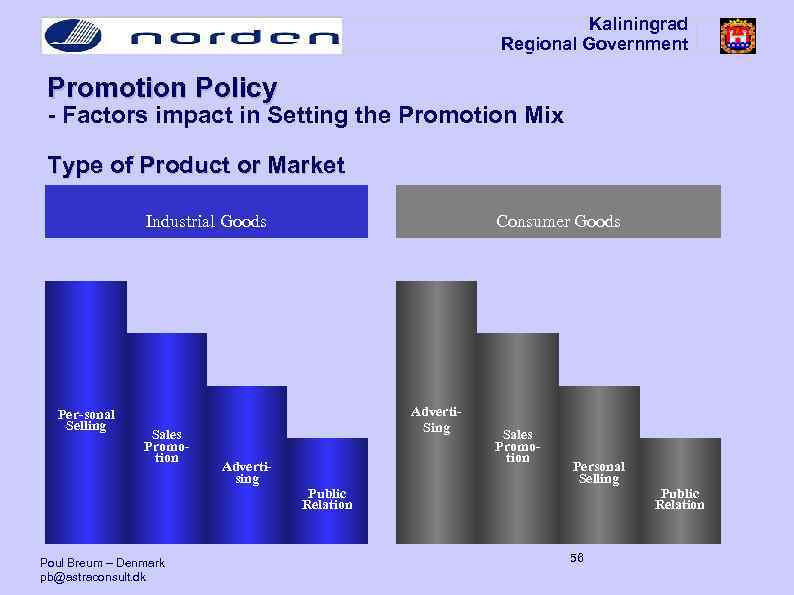
Kaliningrad Regional Government Promotion Policy - Factors impact in Setting the Promotion Mix Type of Product or Market Industrial Goods Per-sonal Selling Sales Promotion Poul Breum – Denmark pb@astraconsult. dk Consumer Goods Adverti. Sing Advertising Public Relation Sales Promotion Personal Selling 56 Public Relation
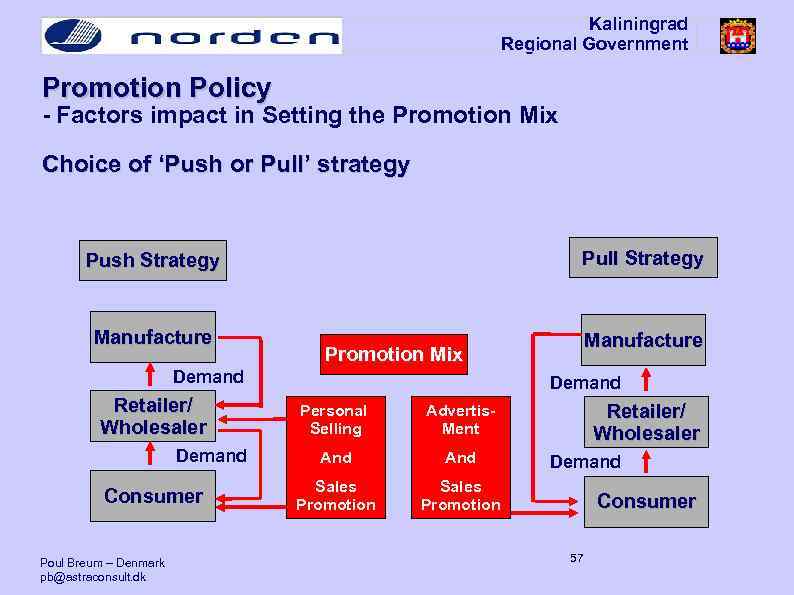
Kaliningrad Regional Government Promotion Policy - Factors impact in Setting the Promotion Mix Choice of ‘Push or Pull’ strategy Push Strategy Pull Strategy Manufacture Promotion Mix Demand Retailer/ Wholesaler Demand Consumer Poul Breum – Denmark pb@astraconsult. dk Demand Personal Selling And Sales Promotion Retailer/ Wholesaler Advertis. Ment Sales Promotion Demand Consumer 57
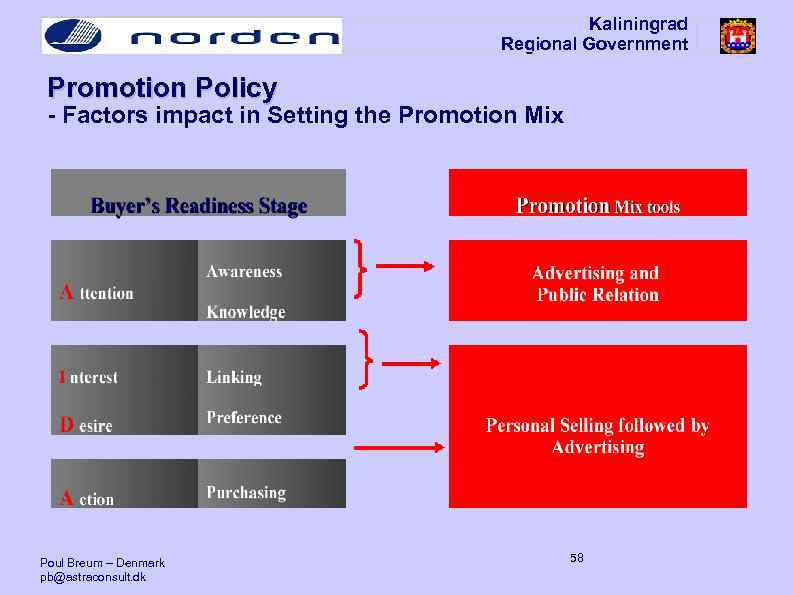
Kaliningrad Regional Government Promotion Policy - Factors impact in Setting the Promotion Mix Buyer’s Readiness stage Poul Breum – Denmark pb@astraconsult. dk 58
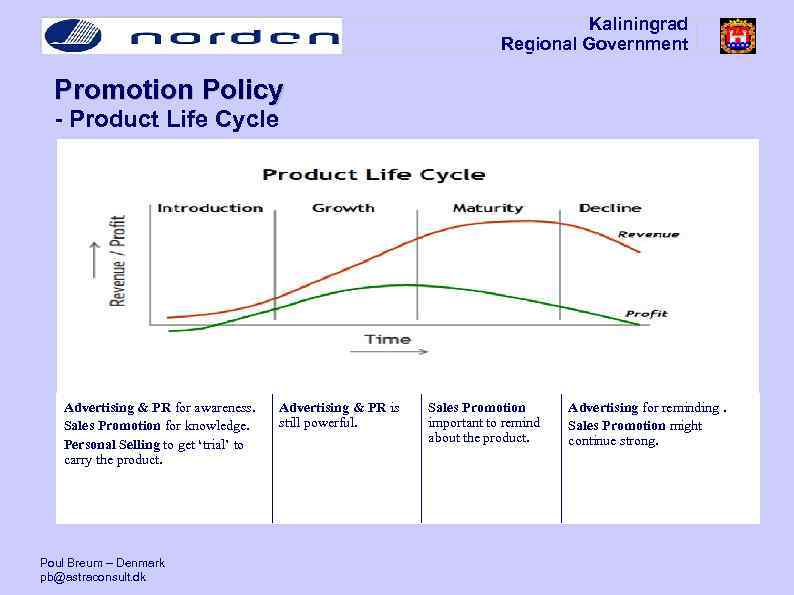
Kaliningrad Regional Government Promotion Policy - Product Life Cycle Advertising & PR for awareness. Sales Promotion for knowledge. Personal Selling to get ‘trial’ to carry the product. Poul Breum – Denmark pb@astraconsult. dk Advertising & PR is still powerful. Sales Promotion important to remind about the product. Advertising for reminding. Sales Promotion might continue strong.
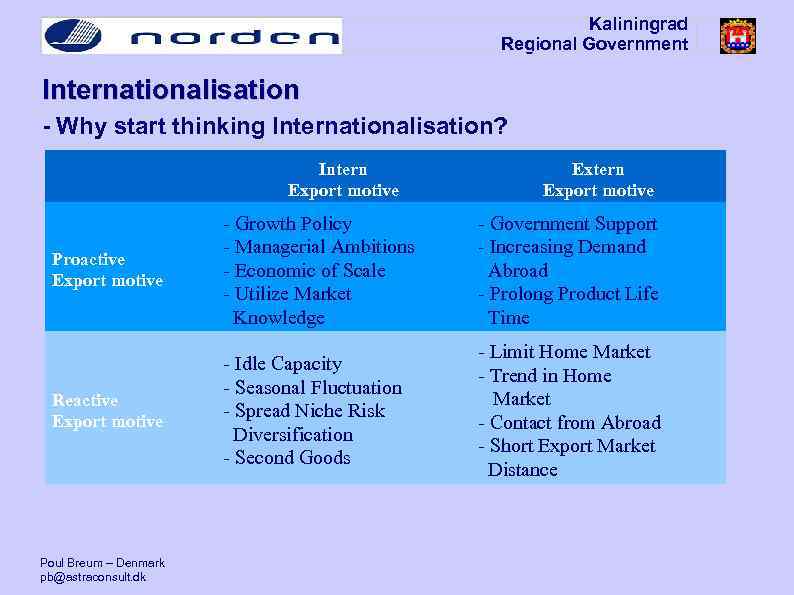
Kaliningrad Regional Government Internationalisation - Why start thinking Internationalisation? Intern Export motive Extern Export motive Proactive Export motive - Growth Policy - Managerial Ambitions - Economic of Scale - Utilize Market Knowledge - Government Support - Increasing Demand Abroad - Prolong Product Life Time Reactive Export motive - Idle Capacity - Seasonal Fluctuation - Spread Niche Risk Diversification - Second Goods - Limit Home Market - Trend in Home Market - Contact from Abroad - Short Export Market Distance Poul Breum – Denmark pb@astraconsult. dk
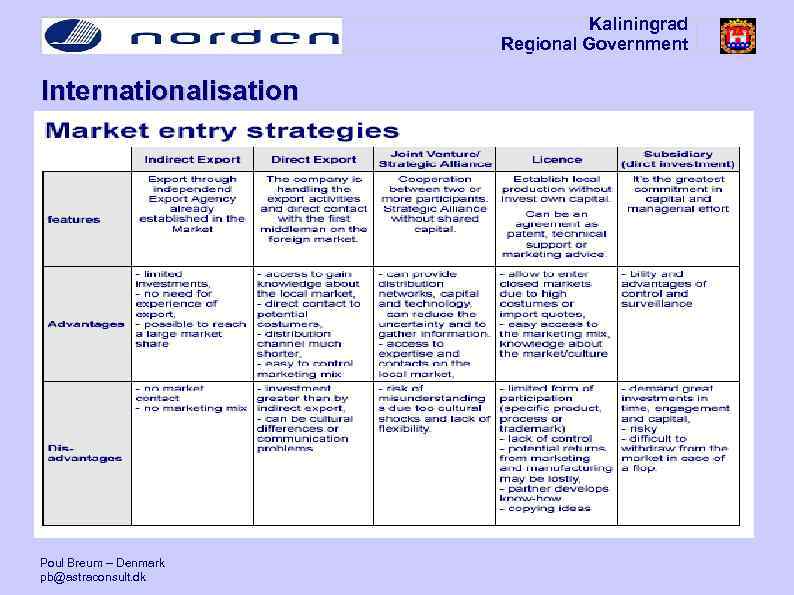
Kaliningrad Regional Government Internationalisation Poul Breum – Denmark pb@astraconsult. dk
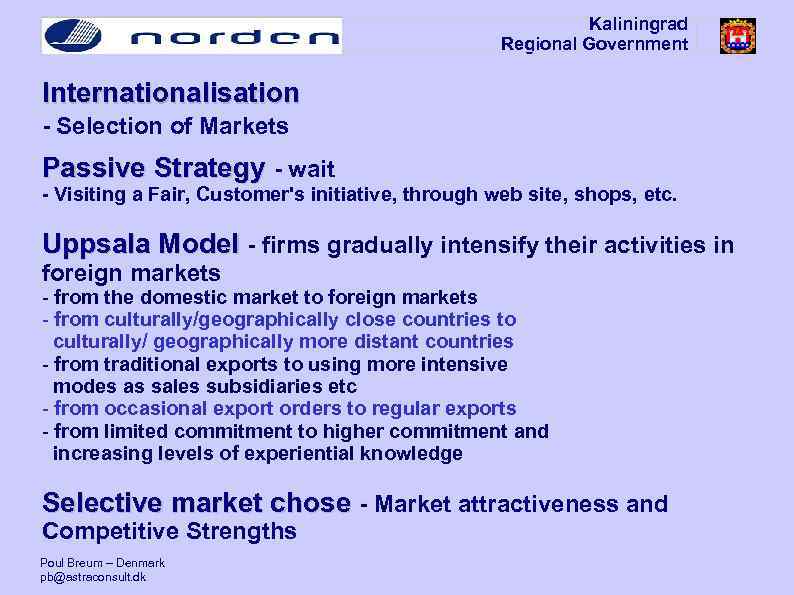
Kaliningrad Regional Government Internationalisation - Selection of Markets Passive Strategy - wait - Visiting a Fair, Customer's initiative, through web site, shops, etc. Uppsala Model - firms gradually intensify their activities in foreign markets - from the domestic market to foreign markets - from culturally/geographically close countries to culturally/ geographically more distant countries - from traditional exports to using more intensive modes as sales subsidiaries etc - from occasional export orders to regular exports - from limited commitment to higher commitment and increasing levels of experiential knowledge Selective market chose - Market attractiveness and Competitive Strengths Poul Breum – Denmark pb@astraconsult. dk
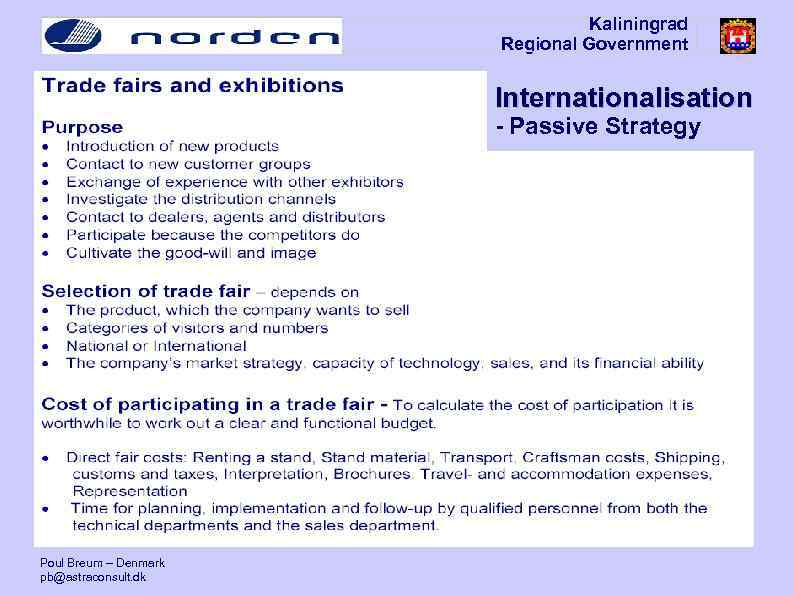
Kaliningrad Regional Government Internationalisation - Passive Strategy Poul Breum – Denmark pb@astraconsult. dk
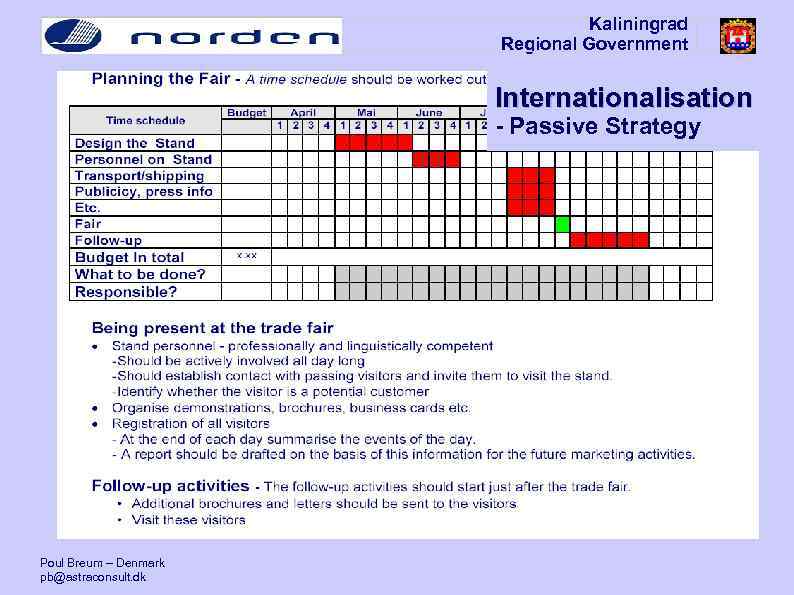
Kaliningrad Regional Government Internationalisation - Passive Strategy Poul Breum – Denmark pb@astraconsult. dk
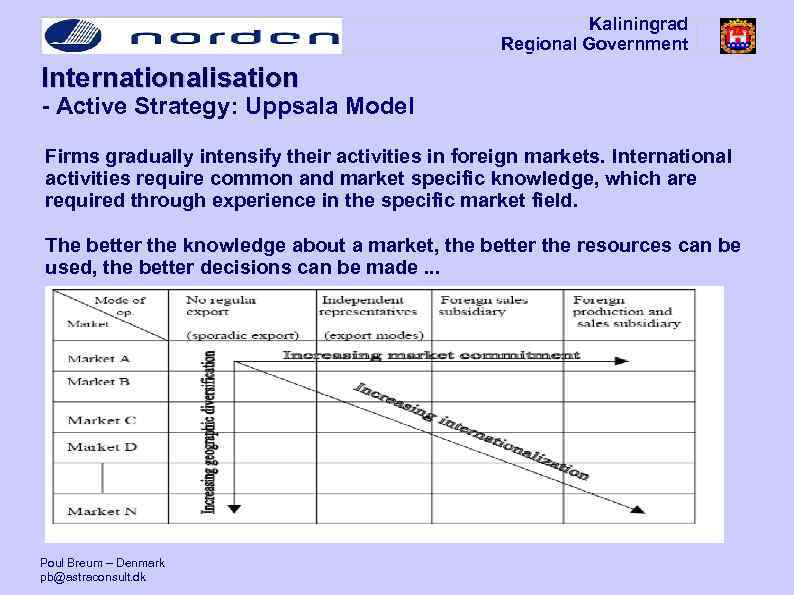
Kaliningrad Regional Government Internationalisation - Active Strategy: Uppsala Model Firms gradually intensify their activities in foreign markets. International activities require common and market specific knowledge, which are required through experience in the specific market field. The better the knowledge about a market, the better the resources can be used, the better decisions can be made. . . Poul Breum – Denmark pb@astraconsult. dk
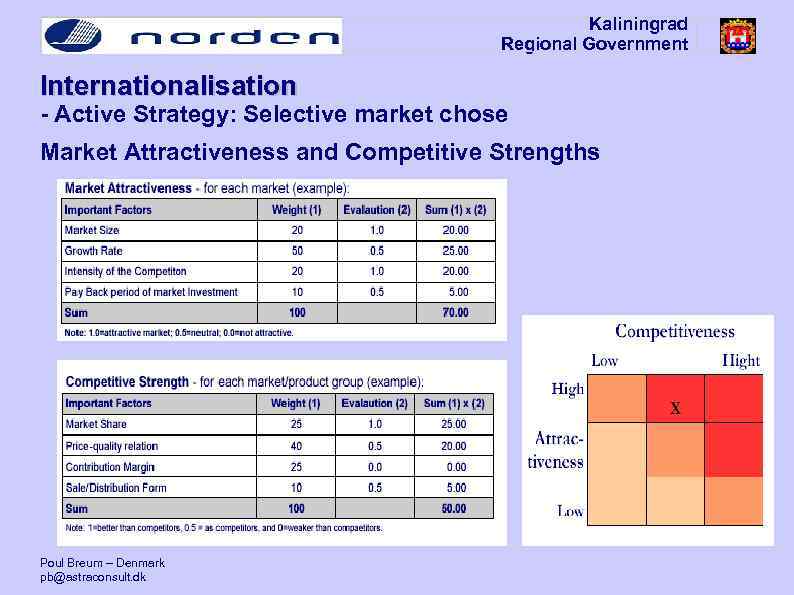
Kaliningrad Regional Government Internationalisation - Active Strategy: Selective market chose Market Attractiveness and Competitive Strengths Poul Breum – Denmark pb@astraconsult. dk
Kaliningrad Regional Government Internationalisation - Guide to Maintaining and Following up on International Partners Keeping Agreements made. . . Immediate Reporting/feedback. . . Personal Visits to the Partner Annual Customer calls with the Agent Immediate Response to orders/inquiries Forward any new Price List, Promotion Material, etc. and other relevant Internal Information Annual Agent/distributor Meetings Participation in the partner’s Trade Fairs Punctual Payment of Commissions and any Outlays Annual Agreements about Turnover and Market Promotion and other Support Goodwill and Service Activities of all kinds Poul Breum – Denmark pb@astraconsult. dk
Kaliningrad Regional Government Internationalisation - Setting Export Goals - Goals should be SMART - Specific: Who is involved? What to accomplish? Where? When? Which constrains/assumptions? and Why? - Measurable: How to measure progress, success or failure? - Attainable: Figure out ways to make the Goals come true. A Develop attitudes, abilities, skills, and financial capacity to reach the Goals. - Realistic: The goal must represent an objective toward which one is both willing and able to work - Timely: A goal should be grounded within a time frame. Poul Breum – Denmark pb@astraconsult. dk
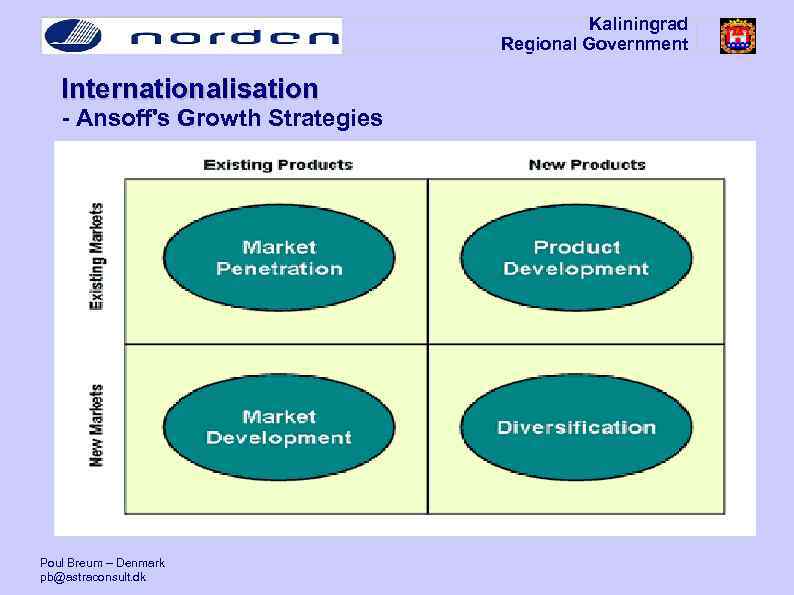
Kaliningrad Regional Government Internationalisation - Ansoff's Growth Strategies Poul Breum – Denmark pb@astraconsult. dk
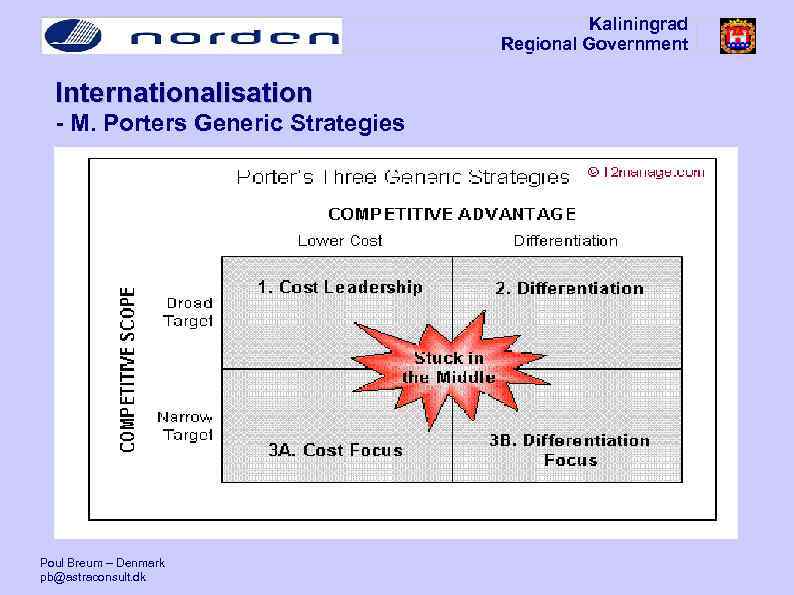
Kaliningrad Regional Government Internationalisation - M. Porters Generic Strategies Poul Breum – Denmark pb@astraconsult. dk
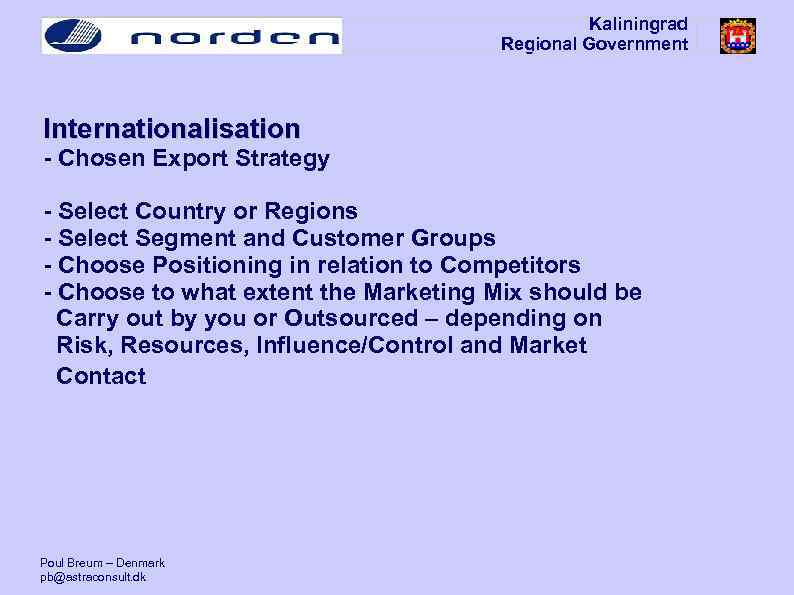
Kaliningrad Regional Government Internationalisation - Chosen Export Strategy - Select Country or Regions - Select Segment and Customer Groups - Choose Positioning in relation to Competitors - Choose to what extent the Marketing Mix should be Carry out by you or Outsourced – depending on Risk, Resources, Influence/Control and Market Contact Poul Breum – Denmark pb@astraconsult. dk
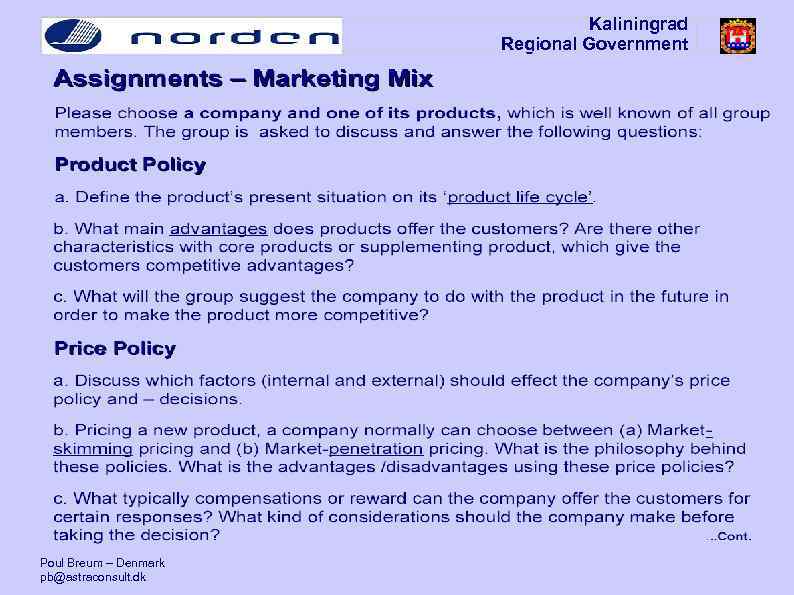
Kaliningrad Regional Government Poul Breum – Denmark pb@astraconsult. dk
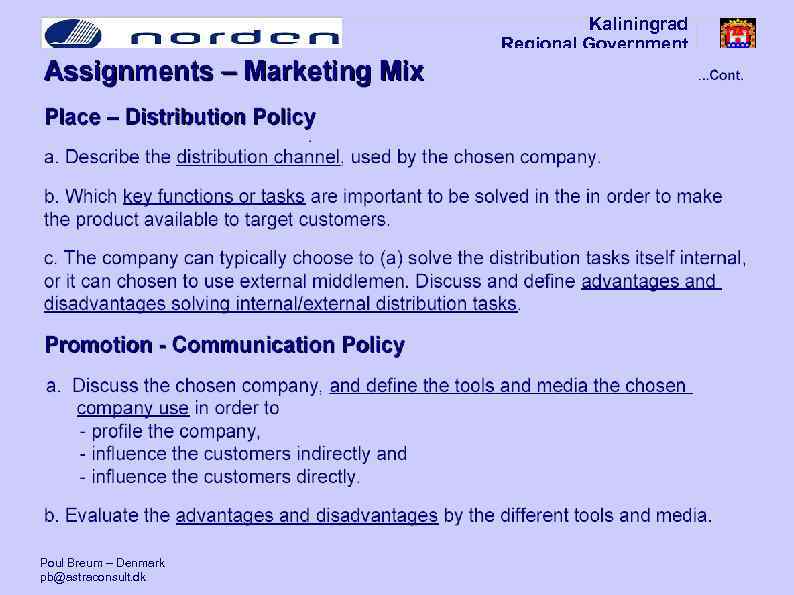
Kaliningrad Regional Government Poul Breum – Denmark pb@astraconsult. dk
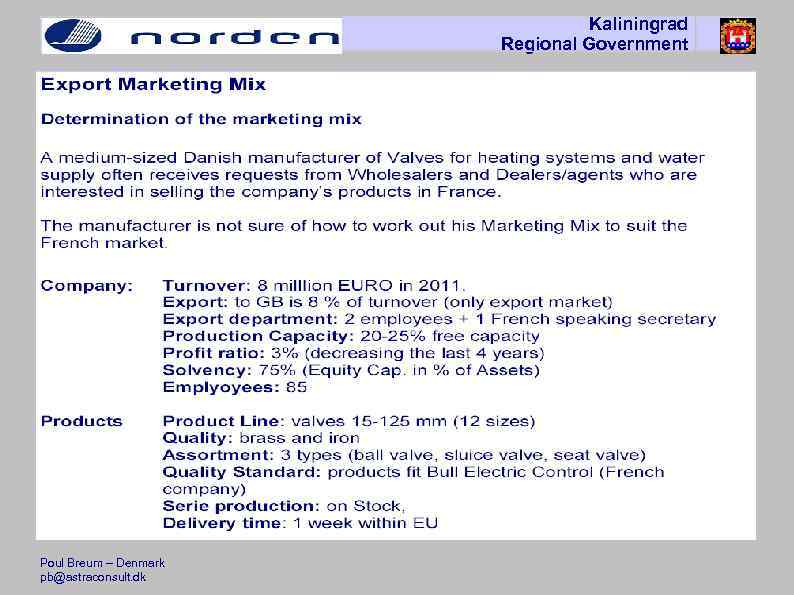
Kaliningrad Regional Government Poul Breum – Denmark pb@astraconsult. dk
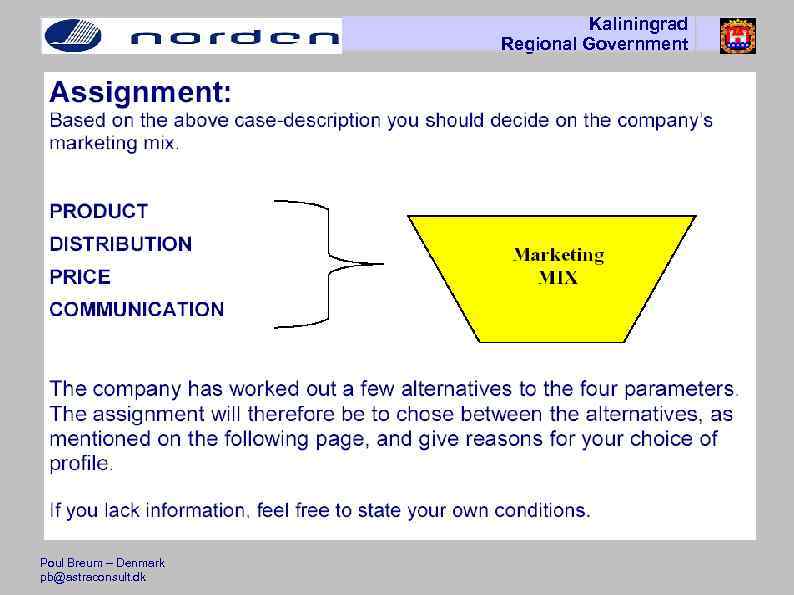
Kaliningrad Regional Government Poul Breum – Denmark pb@astraconsult. dk
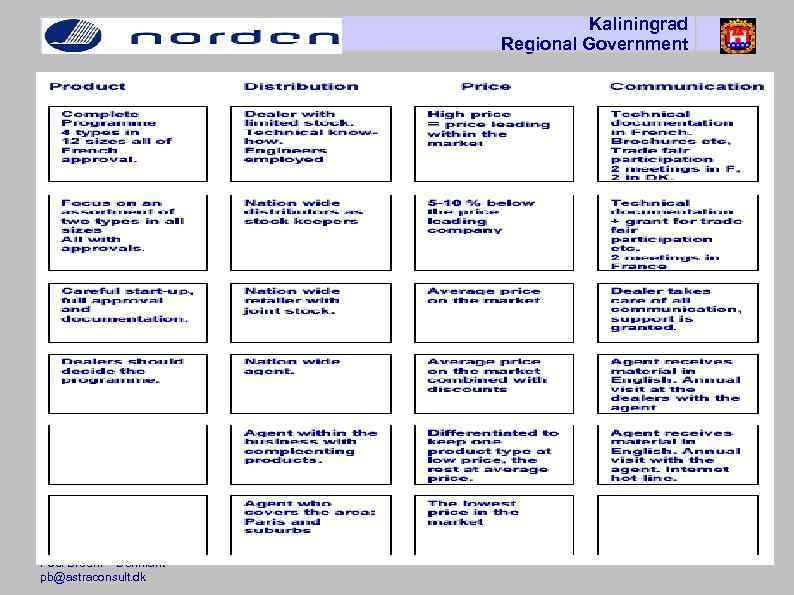
Kaliningrad Regional Government Poul Breum – Denmark pb@astraconsult. dk
Скачать презентацию Kaliningrad Regional Government Modern Marketing Kaliningrad December 2013
Kaliningrad_dec2013.ppt