 Скачать презентацию Kaizen Kai zen Change for the better
c8fa7b2695823e4575ab376fec86d159.ppt
- Количество слайдов: 95



Kaizen Kai + zen (Change for the better) 1 © 2009 RLM & Associates LLC 6 3/15/2018
Kaizen Defined • Continuous, incremental improvement of an activity to create more value with less waste. A process of continually making incremental, ongoing changes and not as a single, separate event. 3/15/2018 © 2009 RLM & Associates LLC 2
Kaizen • Small-scale improvements are easier and faster. • The risks are lower because they generally have limited effect. • The accumulated effect is often greater than a single large improvement 3/15/2018 © 2009 RLM & Associates LLC 3

Change Management • The Lean journey is paved by kaizen events • Lean concepts are simple -- sustaining is hard • Lean as a business strategy and supported by top mgt. 3/15/2018 © 2009 RLM & Associates LLC 4
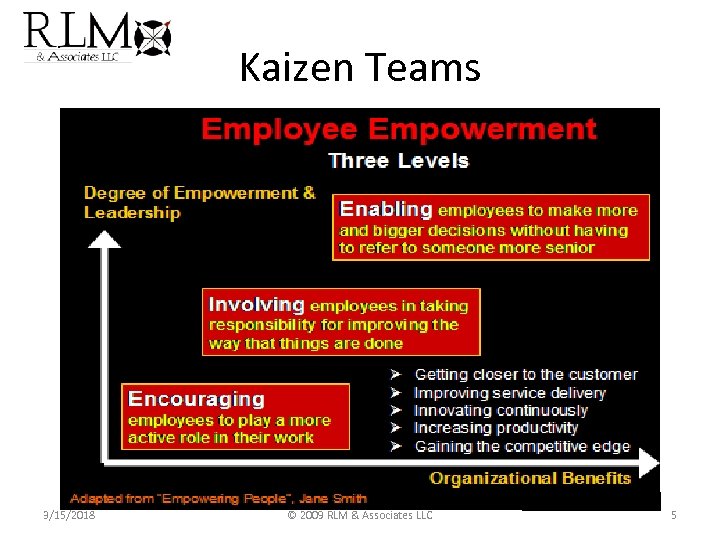
Kaizen Teams 3/15/2018 © 2009 RLM & Associates LLC 5
Kaizen Teams • Daily work teams – Multi-skilled, cross-trained team working in a cell – TPM team (mgt, engr, maint. , operators) – Do not disband • Kaizen team – Multi-skilled, cross-trained and cross-functional – Led by a facilitator – Trained in problem solving, conflict resolution, etc 3/15/2018 © 2009 RLM & Associates LLC 6
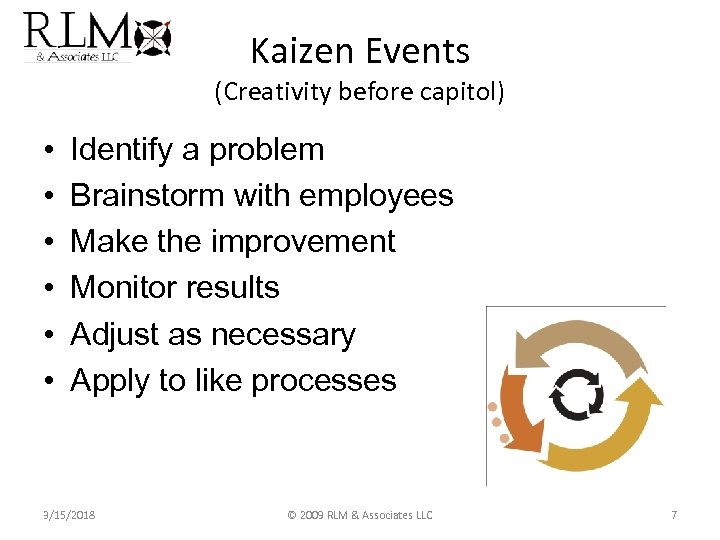
Kaizen Events (Creativity before capitol) • • • Identify a problem Brainstorm with employees Make the improvement Monitor results Adjust as necessary Apply to like processes 3/15/2018 © 2009 RLM & Associates LLC 7
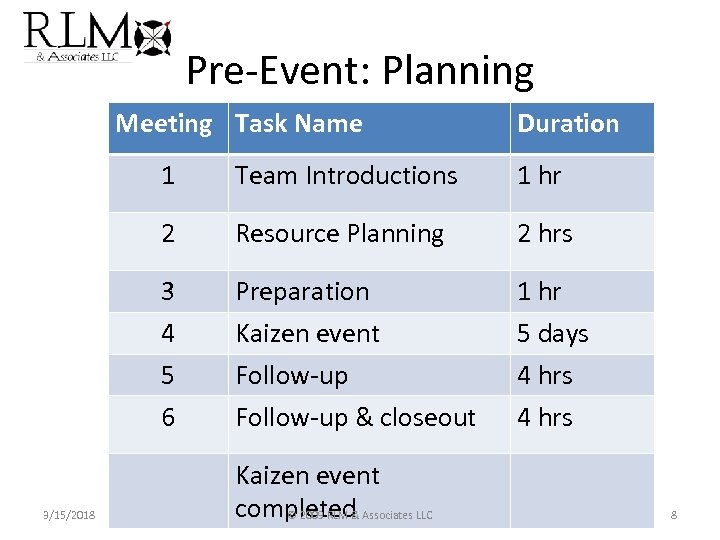
Pre-Event: Planning Meeting Task Name Duration 1 1 hr 2 Resource Planning 2 hrs 3 4 5 6 3/15/2018 Team Introductions Preparation Kaizen event Follow-up & closeout 1 hr 5 days 4 hrs Kaizen event completed © 2009 RLM & Associates LLC 8
Pre-Event: People • Project Leader • Lean Champion • Team Members 3/15/2018 © 2009 RLM & Associates LLC 9
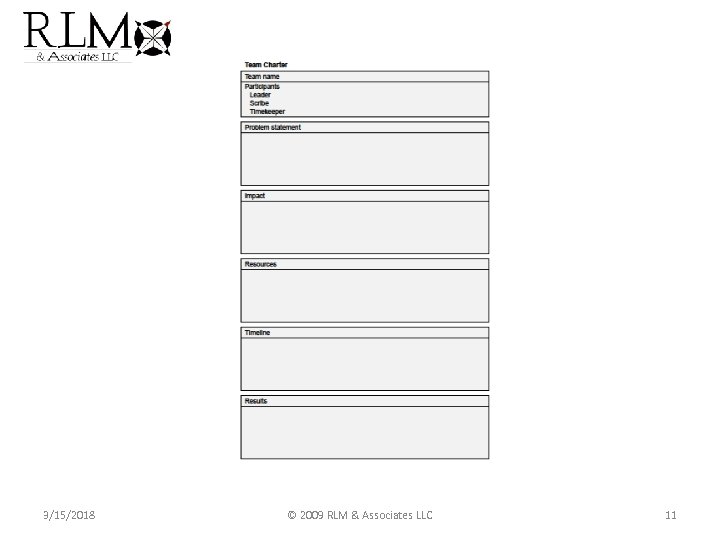
Day 1 • • Team Introductions Project Scope Overview with goals Team Charter Determine current state map Brainstorm ideas for future state map Set up plant walk-through 3/15/2018 © 2009 RLM & Associates LLC 10
3/15/2018 © 2009 RLM & Associates LLC 11
Day 2 • • • Communicate, Communicate! Select Metrics Select method for improvement Build team consensus and select actual tasks Organize tasks – A Tasks - the team can do without permission – B Tasks - requiring help from maint. , IT, accounting – C Tasks - requiring management approval 3/15/2018 © 2009 RLM & Associates LLC 12
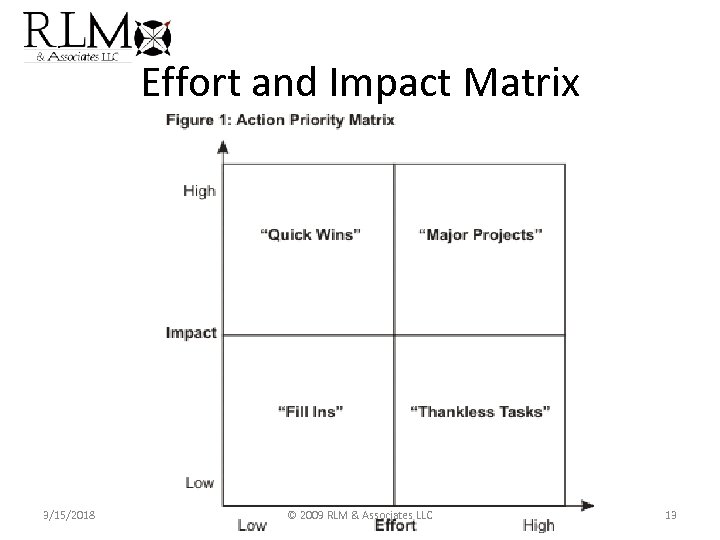
Effort and Impact Matrix 3/15/2018 © 2009 RLM & Associates LLC 13
Day 3 • • Identify items or material you need Discuss possible obstacles to implementation Communicate with target area people Start implementation of ideas 3/15/2018 © 2009 RLM & Associates LLC 14
Day 4 • Continue with improvement implementation • Work in teams of at least two • Identify action items to address in order to complete kaizen event effort 3/15/2018 © 2009 RLM & Associates LLC 15
Day 5 • • Complete the Kaizen event Develop a 30 -day action item follow-up list Document improvements Calculate savings 3/15/2018 © 2009 RLM & Associates LLC 16
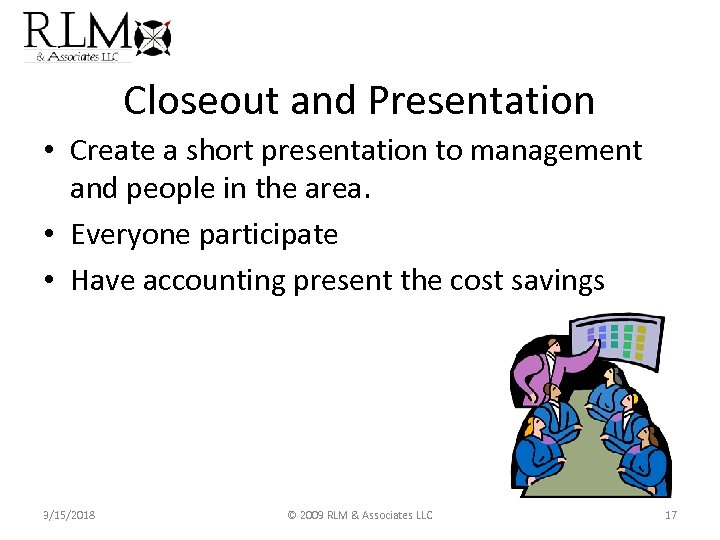
Closeout and Presentation • Create a short presentation to management and people in the area. • Everyone participate • Have accounting present the cost savings 3/15/2018 © 2009 RLM & Associates LLC 17
Follow-up • Ensure that all assigned tasks have been completed (infrastructure) • Help build the habits and discipline of lean and reinforces the concepts. 3/15/2018 © 2009 RLM & Associates LLC 18
Project Closeout • Captures the total qualitative, quantitative, and financial improvements • Collect lessons learned • Update your VSM • Have official celebration to reward and recognize the team’s efforts 3/15/2018 © 2009 RLM & Associates LLC 19
Points to Consider for Implementing JIT and Changing Layouts 1. Study the process thoroughly first 2. Don’t under estimate the cost of changes 3. Know your people capabilities because of additional duties 4. Training is Vital 5. Identify Goals and Objectives 6. Be creative 7. Don’t be afraid to make mistakes 8. Involve everyone concerned 9. Educate your people about the goals and objectives 10. Keep it as simple as possible 11. Stress flexibility of tools and equipment 12. Keep areas open, avoiding walls and barriers 3/15/2018 © 2009 RLM & Associates LLC 20
Kanban Order to Produce 21 © 2009 RLM & Associates LLC 3/15/2018
Kanban • Agenda – Introduction – Kanban video – Benefits – Push vs. Pull systems – Kanban process – Visual factory – Tiny Tag factory activity 3/15/2018 © 2009 RLM & Associates LLC 22
Introduction to Kanban • Kanban – A signal to indicate when more parts are needed – Card, empty bin, In-process Kanban on plant floor • Kanban System - a pull system that uses colorcoded cards attached to parts or part containers to regulate the upstream production and delivery flow. 3/15/2018 © 2009 RLM & Associates LLC 23
Kanban Video 3/15/2018 © 2009 RLM & Associates LLC 24
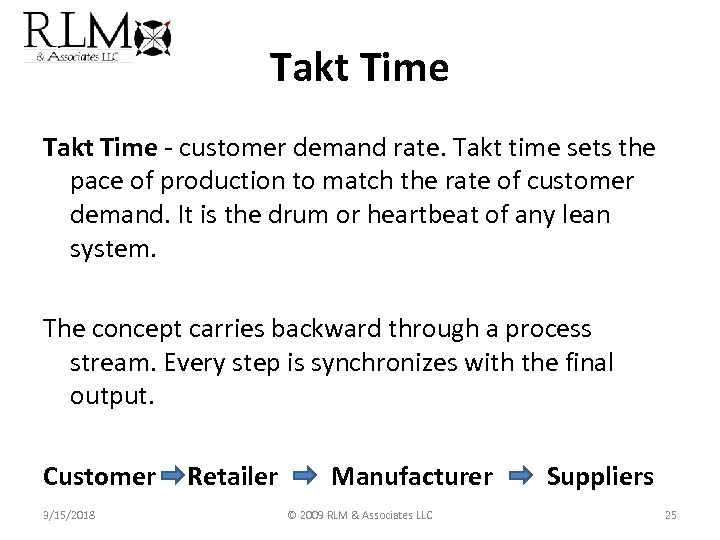
Takt Time - customer demand rate. Takt time sets the pace of production to match the rate of customer demand. It is the drum or heartbeat of any lean system. The concept carries backward through a process stream. Every step is synchronizes with the final output. Customer 3/15/2018 Retailer Manufacturer © 2009 RLM & Associates LLC Suppliers 25
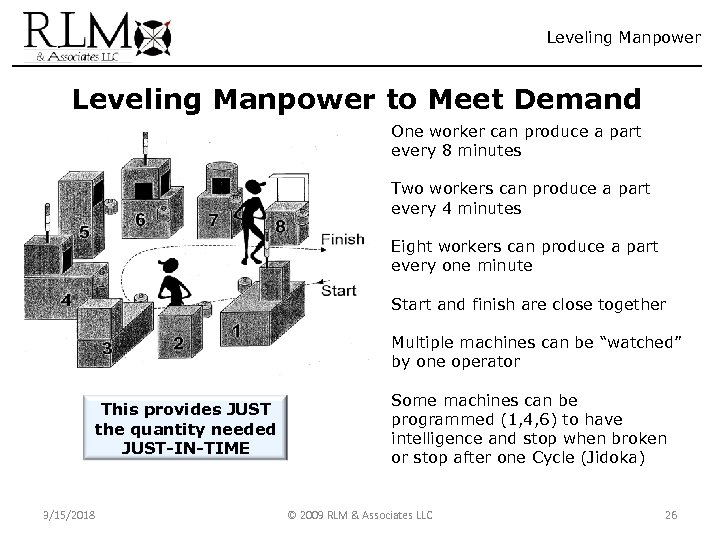
Leveling Manpower to Meet Demand One worker can produce a part every 8 minutes Two workers can produce a part every 4 minutes Eight workers can produce a part every one minute Start and finish are close together Multiple machines can be “watched” by one operator This provides JUST the quantity needed JUST-IN-TIME 3/15/2018 Some machines can be programmed (1, 4, 6) to have intelligence and stop when broken or stop after one Cycle (Jidoka) © 2009 RLM & Associates LLC 26
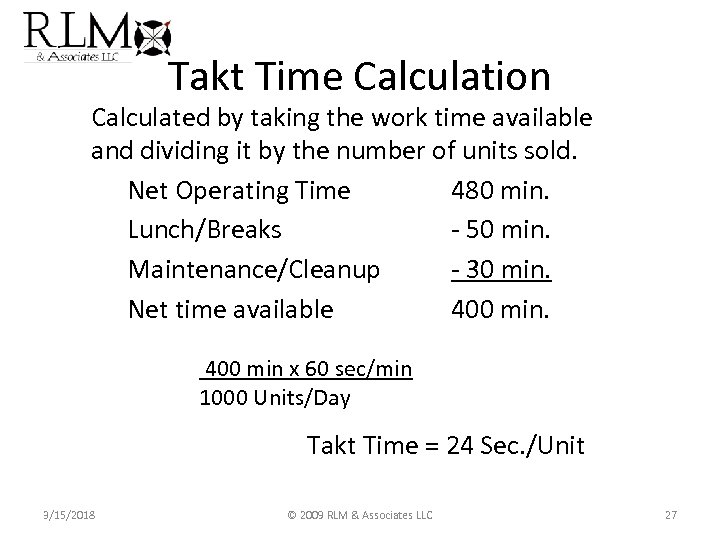
Takt Time Calculation Calculated by taking the work time available and dividing it by the number of units sold. Net Operating Time 480 min. Lunch/Breaks - 50 min. Maintenance/Cleanup - 30 min. Net time available 400 min x 60 sec/min 1000 Units/Day Takt Time = 24 Sec. /Unit 3/15/2018 © 2009 RLM & Associates LLC 27
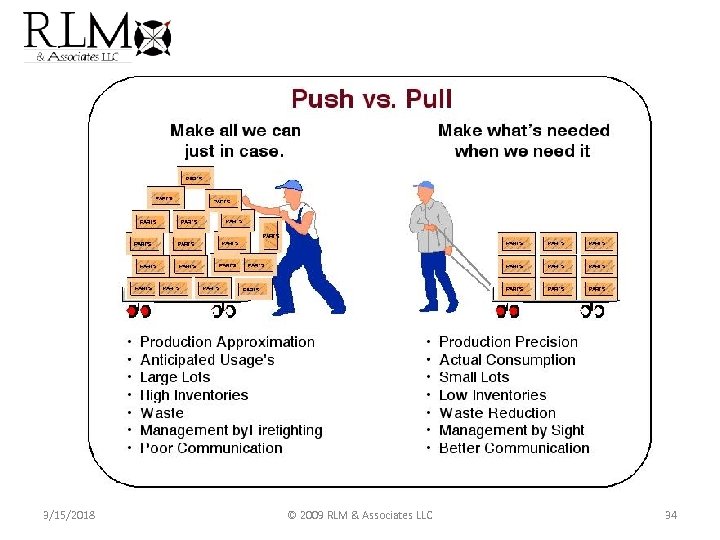
Pull versus Push Production Strategy 3/15/2018 © 2009 RLM & Associates LLC 28
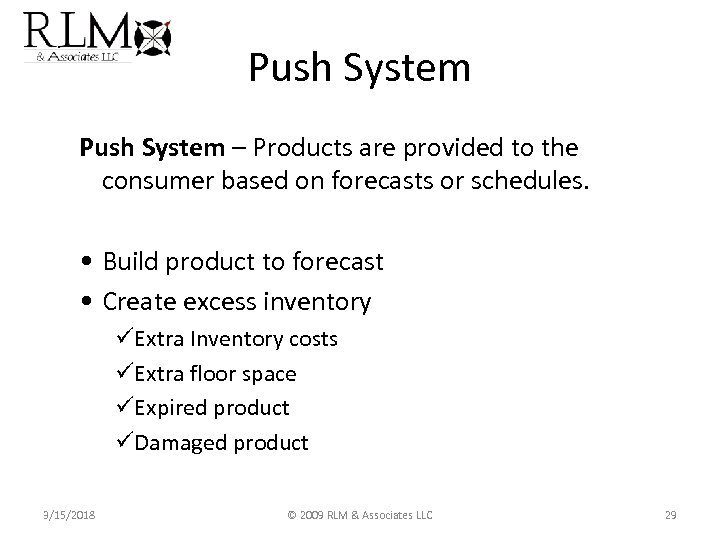
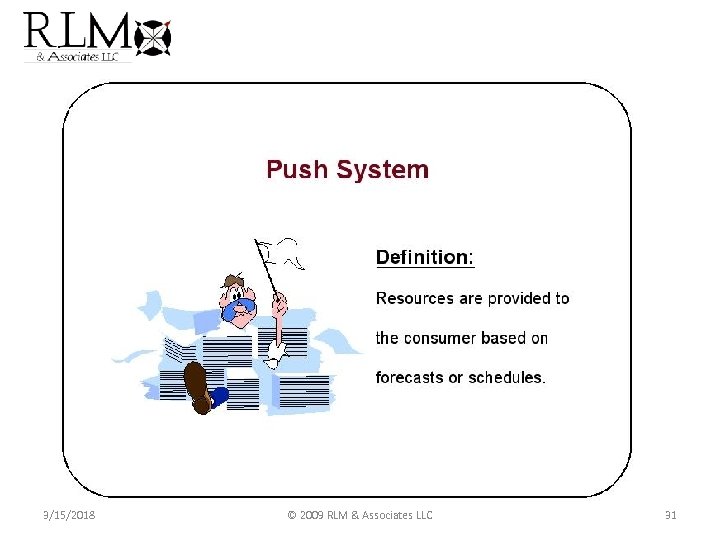
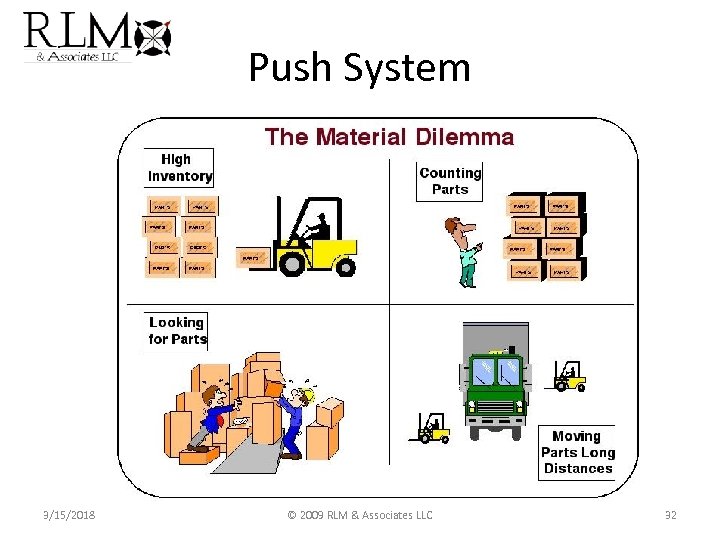
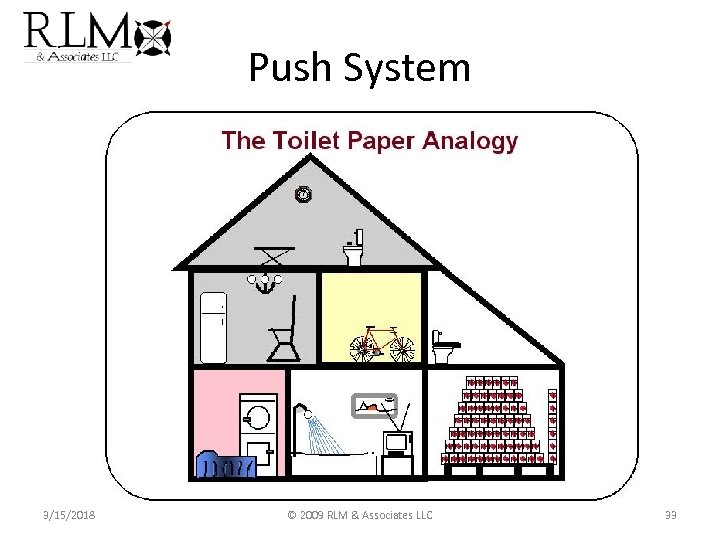
Push System – Products are provided to the consumer based on forecasts or schedules. • Build product to forecast • Create excess inventory üExtra Inventory costs üExtra floor space üExpired product üDamaged product 3/15/2018 © 2009 RLM & Associates LLC 29
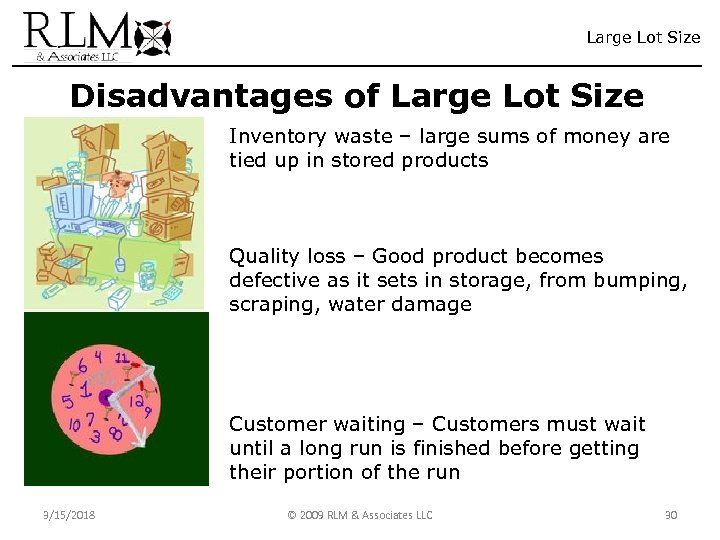
Large Lot Size Disadvantages of Large Lot Size Inventory waste – large sums of money are tied up in stored products Quality loss – Good product becomes defective as it sets in storage, from bumping, scraping, water damage Customer waiting – Customers must wait until a long run is finished before getting their portion of the run 3/15/2018 © 2009 RLM & Associates LLC 30
3/15/2018 © 2009 RLM & Associates LLC 31
Push System 3/15/2018 © 2009 RLM & Associates LLC 32
Push System 3/15/2018 © 2009 RLM & Associates LLC 33
3/15/2018 © 2009 RLM & Associates LLC 34
3/15/2018 © 2009 RLM & Associates LLC 35
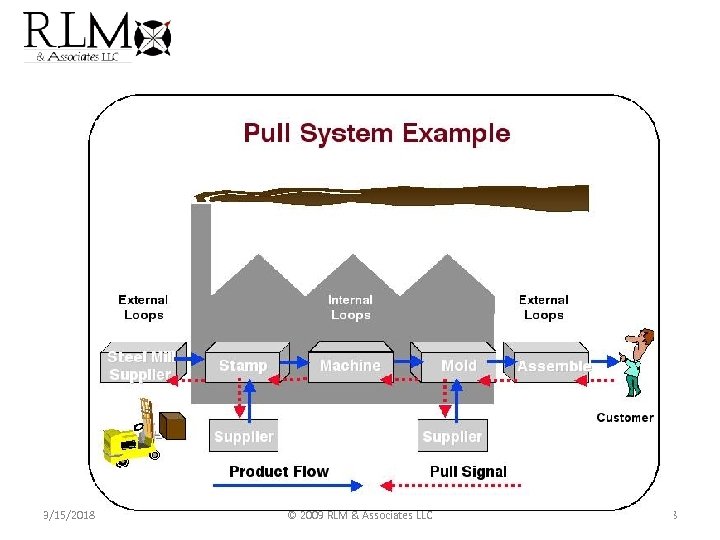
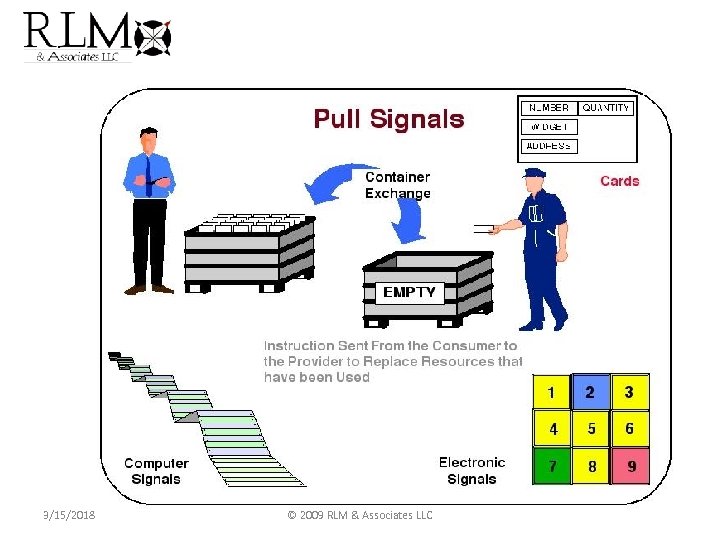
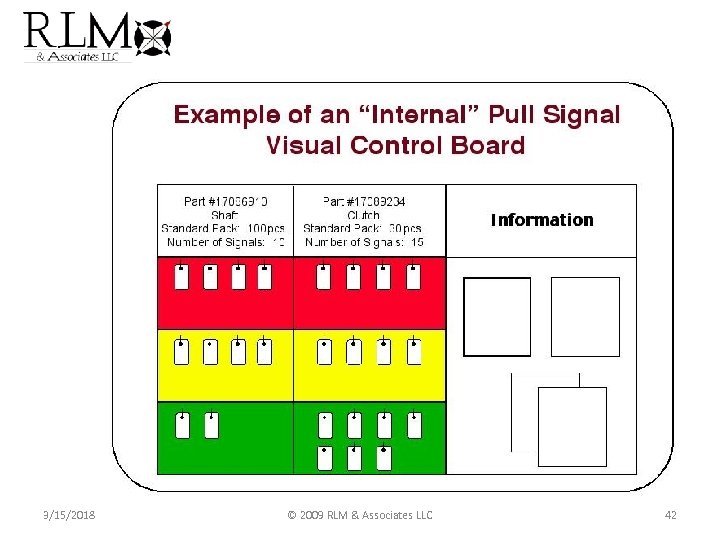
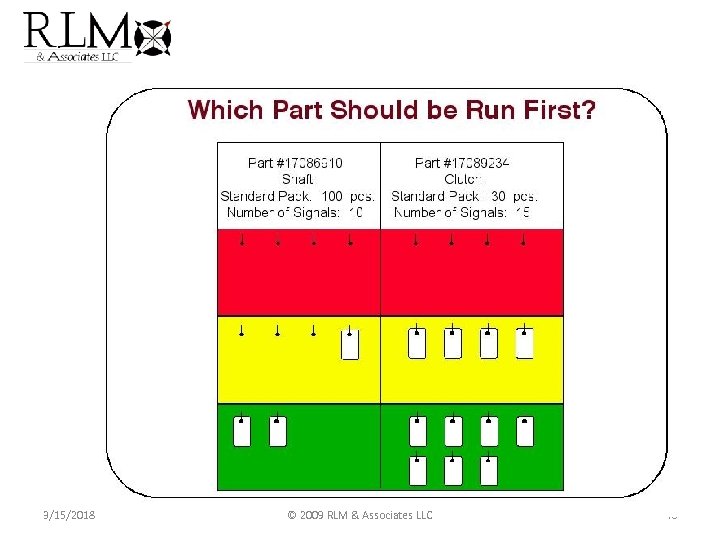
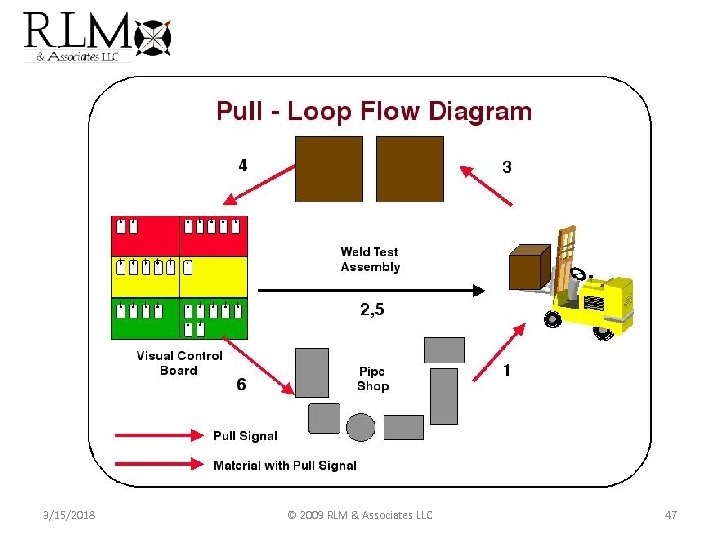
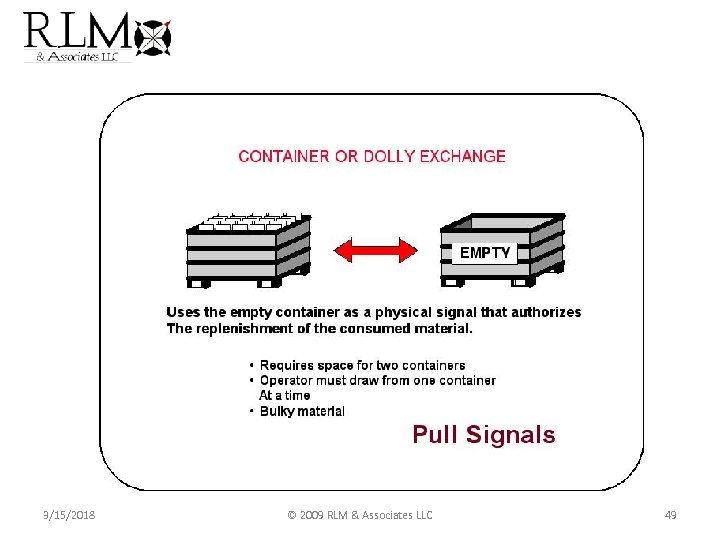
Pull System 3/15/2018 © 2009 RLM & Associates LLC 36
3/15/2018 © 2009 RLM & Associates LLC 37
3/15/2018 © 2009 RLM & Associates LLC 38
3/15/2018 © 2009 RLM & Associates LLC 39
3/15/2018 © 2009 RLM & Associates LLC 40
3/15/2018 © 2009 RLM & Associates LLC 41
3/15/2018 © 2009 RLM & Associates LLC 42
3/15/2018 © 2009 RLM & Associates LLC 43
3/15/2018 © 2009 RLM & Associates LLC 44
3/15/2018 © 2009 RLM & Associates LLC 45
3/15/2018 © 2009 RLM & Associates LLC 46
3/15/2018 © 2009 RLM & Associates LLC 47
3/15/2018 © 2009 RLM & Associates LLC 48
3/15/2018 © 2009 RLM & Associates LLC 49
3/15/2018 © 2009 RLM & Associates LLC 50
3/15/2018 © 2009 RLM & Associates LLC 51
? 3/15/2018 © 2009 RLM & Associates LLC 52
handout 3/15/2018 © 2009 RLM & Associates LLC 53
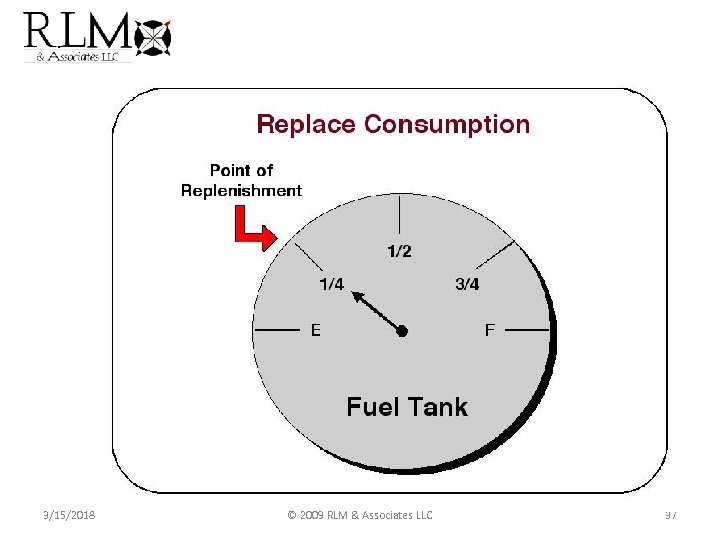
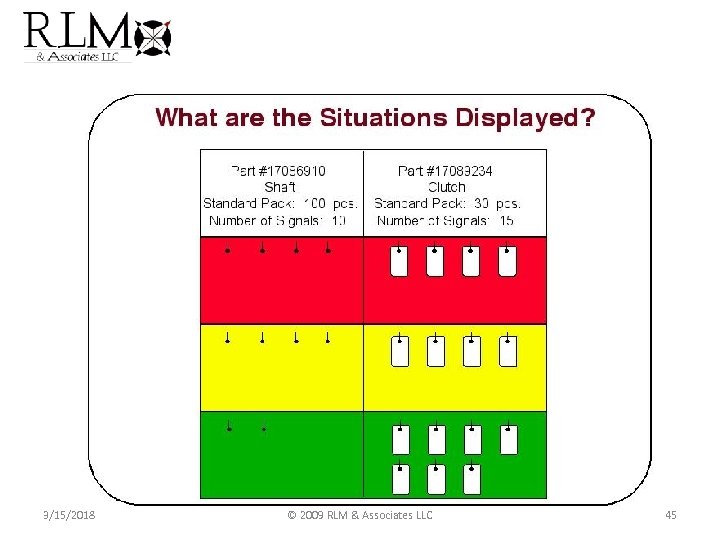
How many pull signals • What should be considered in establishing maximum inventory levels? – Long change over times – Long lead times – Machine downtime – Schedule increases / decreases – Large process or transfer or batch sizes – Poor quality – Long cycle times 3/15/2018 © 2009 RLM & Associates LLC 54
How will the pull system change your job? • The pull system provides more time for constructive activities that will make your job and working conditions better tomorrow because with pull you only run the parts that are needed shut down time can be spent on: – Preventive maintenance – Quality improvements – House keeping – Team meetings 3/15/2018 © 2009 RLM & Associates LLC 55
• Implementation of a pull system is affected by many factors: – The process itself – Cost and availability of transportation – Relationship and logistics with supplier – Level scheduling – Containerization – Supplier and customer floor space 3/15/2018 © 2009 RLM & Associates LLC 56
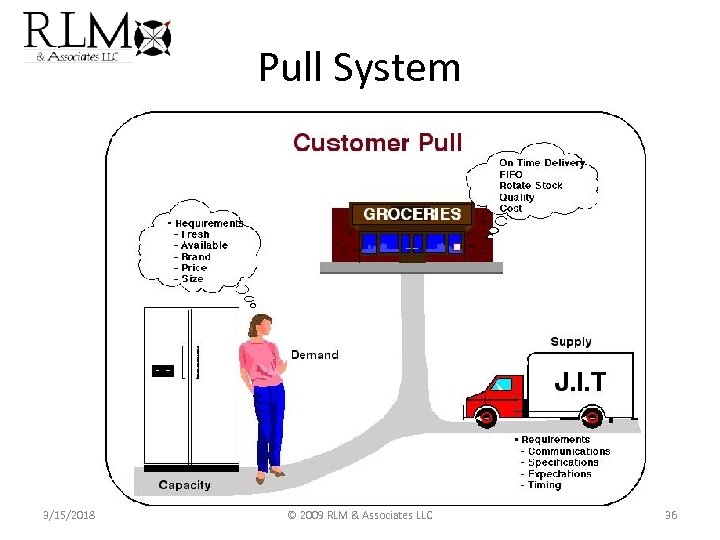
Benefits of a Pull System • Increases employee involvement • Allows decision making at appropriate levels • Allows manufacture of only what is needed by customer • Improves communication with customer through visual controls • Provides a common system for moving material through the plant 3/15/2018 © 2009 RLM & Associates LLC 57
Benefits continued • • • Eliminates scheduling complexities Reduces lead time and WIP inventory Highlights quality issues quickly Organizes the workplace Leads to lower unit cost Supports continuous improvement 3/15/2018 © 2009 RLM & Associates LLC 58
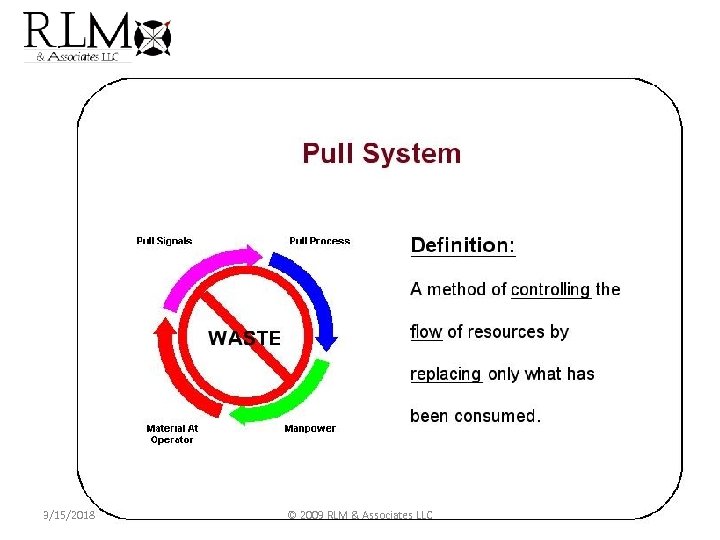
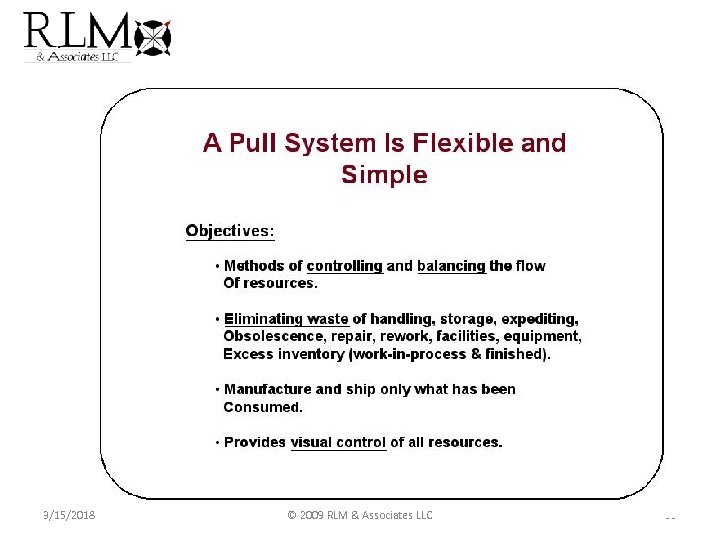
Pull System Eliminating waste of: • • 3/15/2018 Handling Storage Expediting Obsolescence Shelf life, expiration Facilities Excess inventory (work-in-process and finished). © 2009 RLM & Associates LLC 59
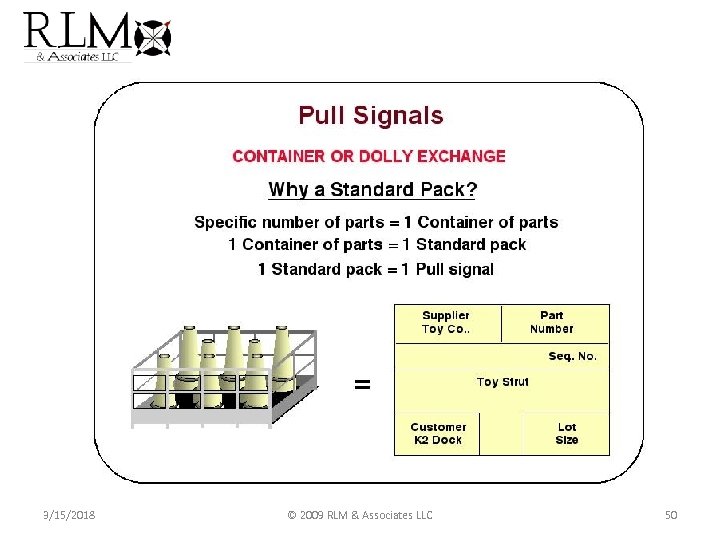
Pull System Conclusion • Pull System is a flexible and simple method of controlling/balancing the flow of resources. – Produce exactly what the customer wants – Minimum inventory – Small lots – Simplifies production scheduling and MRP –Management by sight/signals –The Pull takes place throughout the supply chain, not just inside your production facility 3/15/2018 © 2009 RLM & Associates LLC 60
Pull at your company • Identify the opportunity for Kanbans – In your department – With your suppliers – With your customers 3/15/2018 © 2009 RLM & Associates LLC 61
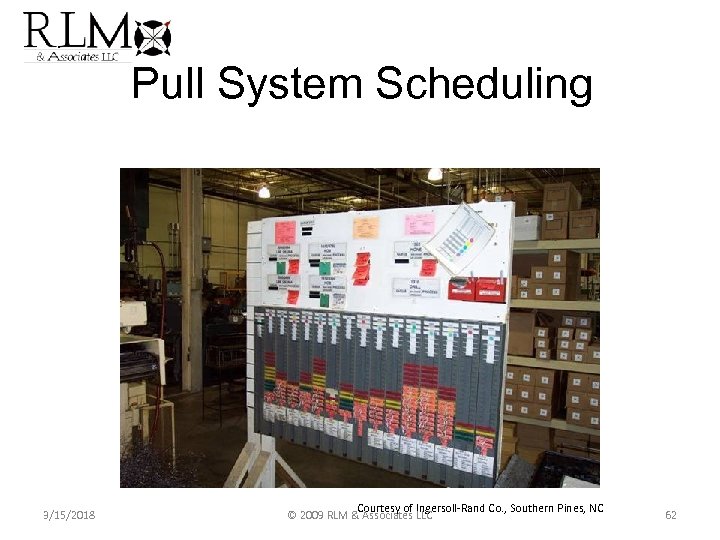
Pull System Scheduling 3/15/2018 Courtesy of Ingersoll-Rand Co. , Southern Pines, NC © 2009 RLM & Associates LLC 62
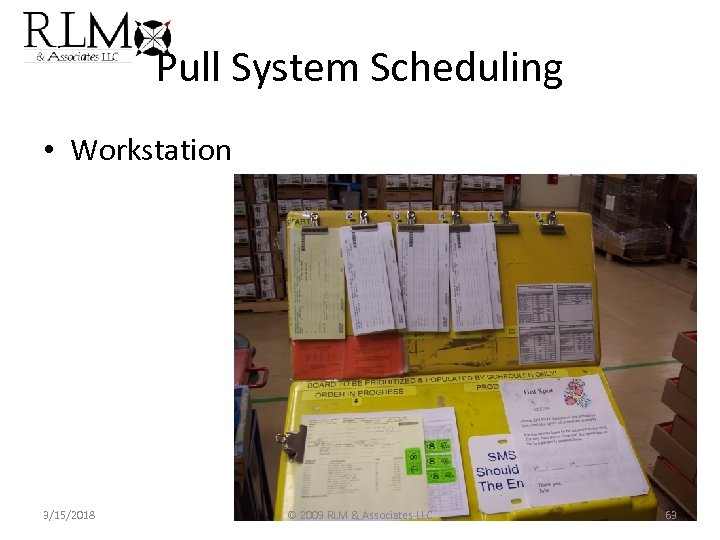
Pull System Scheduling • Workstation 3/15/2018 © 2009 RLM & Associates LLC 63
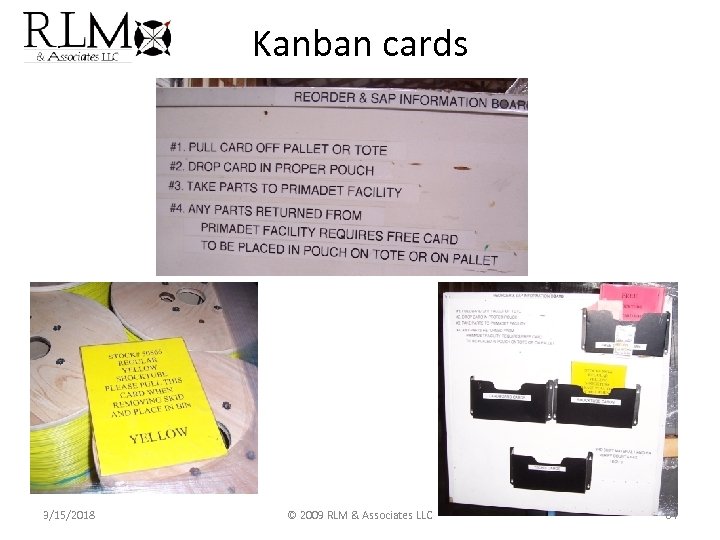
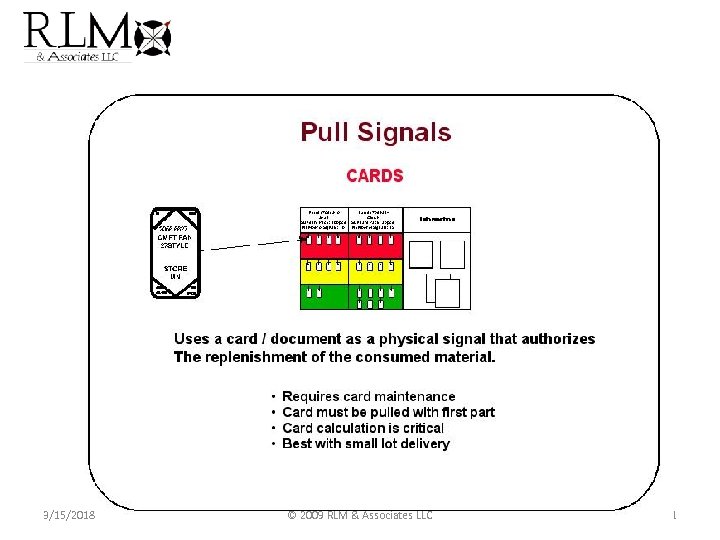
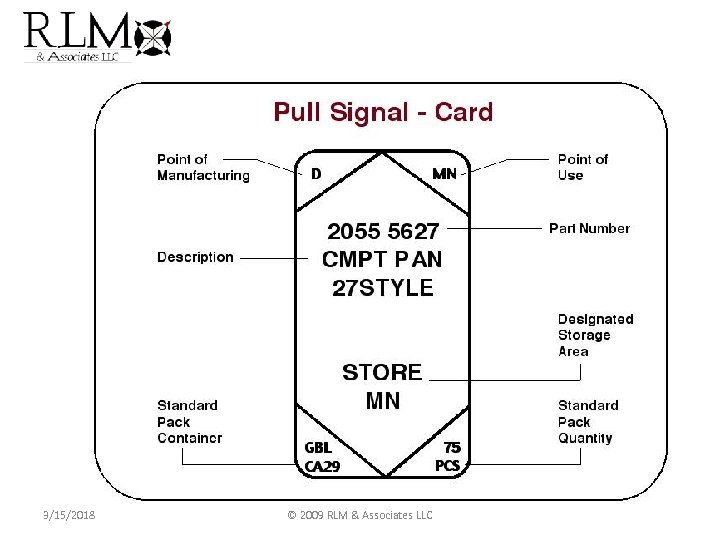
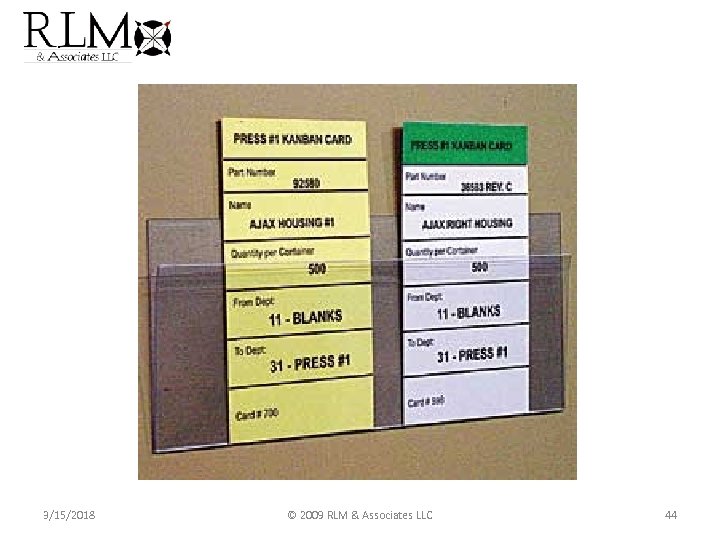
Kanban cards 3/15/2018 © 2009 RLM & Associates LLC 64
Kanban Cards • Production Kanban – describes how many of what item a particular operation needs to produce. • Withdrawal Kanban – is used to pull items from a preceding operation or a supermarket. 3/15/2018 © 2009 RLM & Associates LLC 65
Supermarket System • A stocking system in which materials are stored by the operation that produces them until they are retrieved by the operation that needs them. When the store is full, production stops 3/15/2018 © 2009 RLM & Associates LLC 66
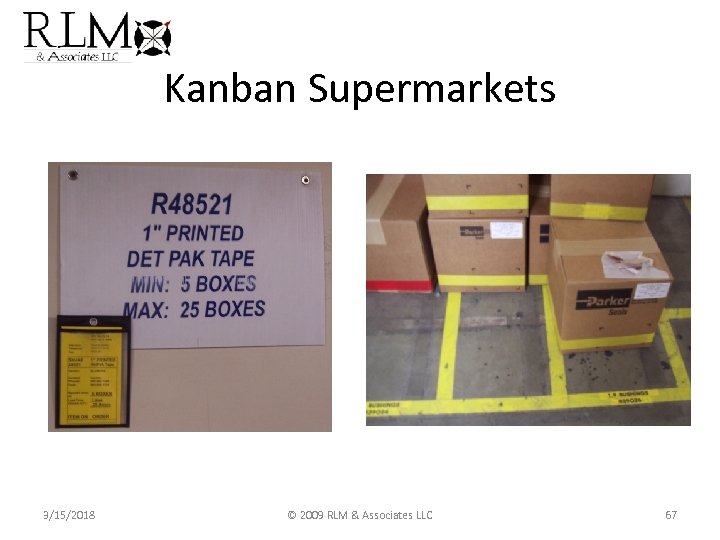
Kanban Supermarkets 3/15/2018 © 2009 RLM & Associates LLC 67
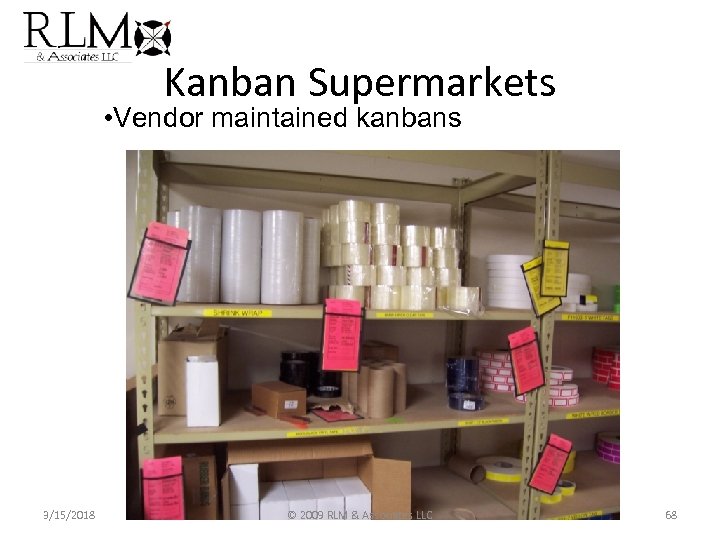
Kanban Supermarkets • Vendor maintained kanbans 3/15/2018 © 2009 RLM & Associates LLC 68
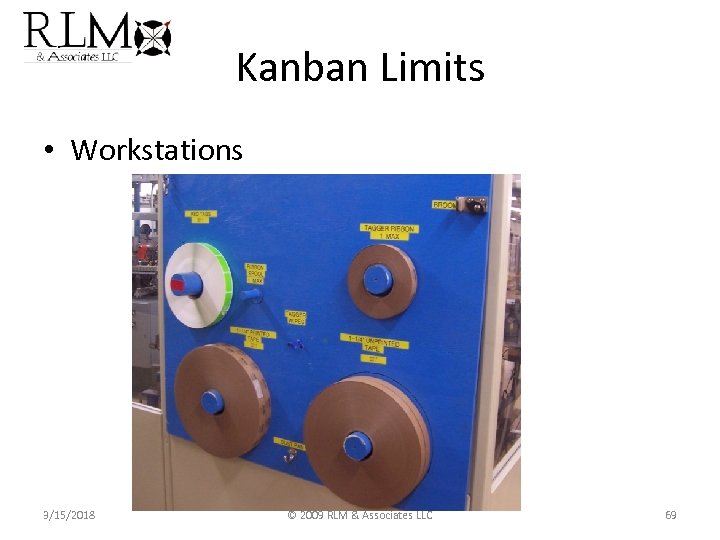
Kanban Limits • Workstations 3/15/2018 © 2009 RLM & Associates LLC 69
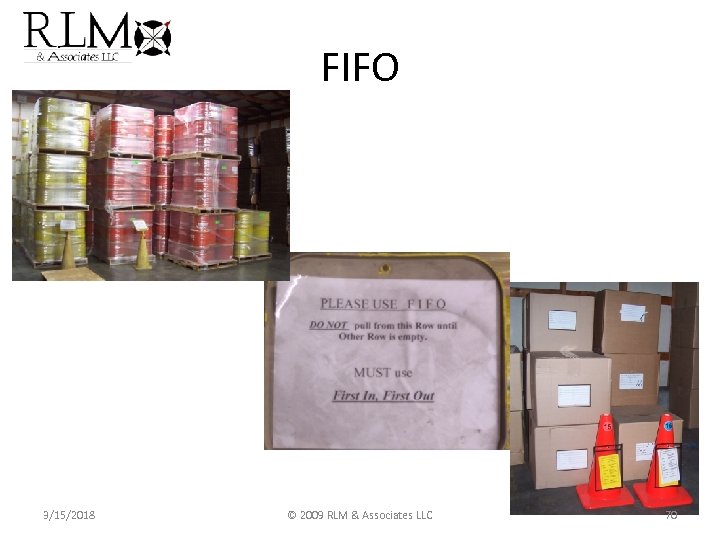
FIFO 3/15/2018 © 2009 RLM & Associates LLC 70
Visual Factory Management Definition: Innovative method of providing valuable information to everyone! Employee involvement and management support is CRUCIAL!!!! 3/15/2018 Be colorful with signs, displays and visuals © 2009 RLM & Associates LLC 71
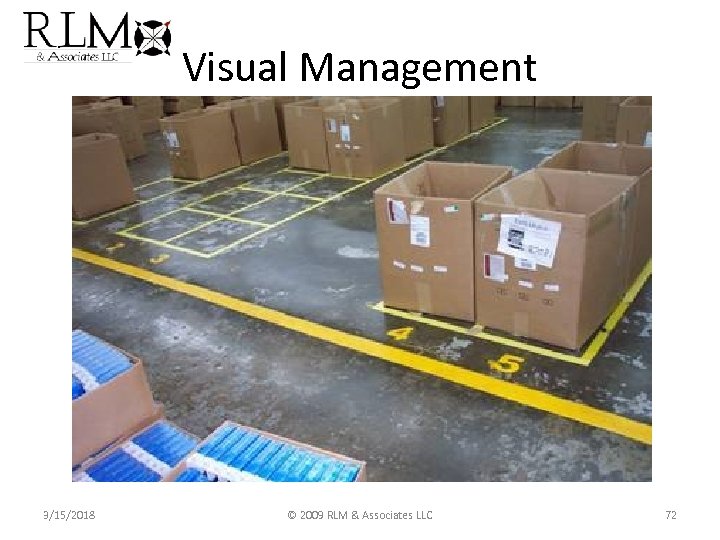
Visual Management 3/15/2018 © 2009 RLM & Associates LLC 72
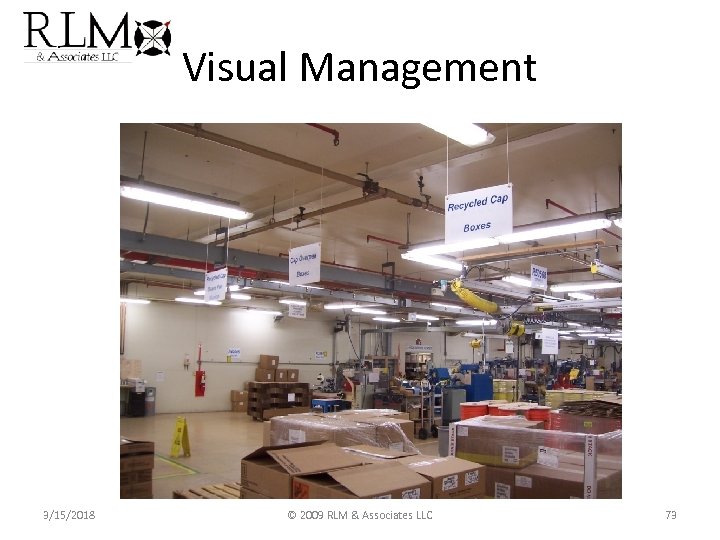
Visual Management 3/15/2018 © 2009 RLM & Associates LLC 73
Visual Controls Benefits of Visual Controls 1. Cleaner and Safer Workplace 2. Decreased Inventories 3. Less Wasted Time 4. Improved Morale 5. Improved Product Quality 3/15/2018 © 2009 RLM & Associates LLC 74
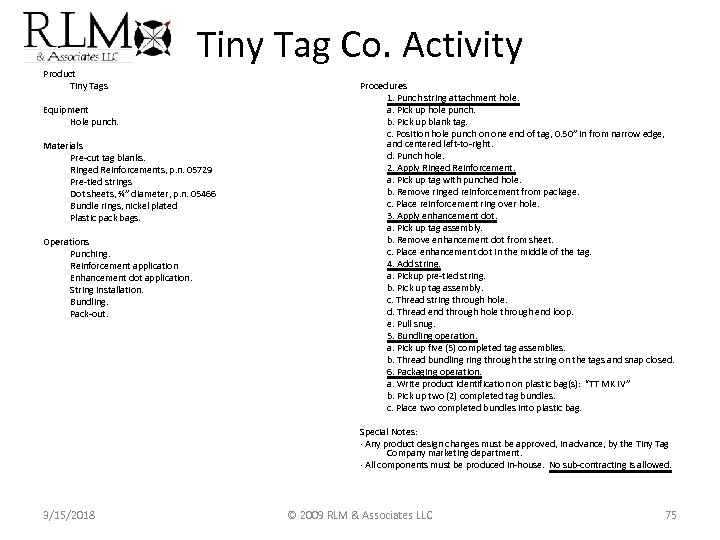
Product Tiny Tags Tiny Tag Co. Activity Equipment Hole punch. Materials Pre-cut tag blanks. Ringed Reinforcements, p. n. 05729 Pre-tied strings Dot sheets, ¾” diameter, p. n. 05466 Bundle rings, nickel plated Plastic pack bags. Operations Punching. Reinforcement application Enhancement dot application. String installation. Bundling. Pack-out. Procedures 1. Punch string attachment hole. a. Pick up hole punch. b. Pick up blank tag. c. Position hole punch on one end of tag, 0. 50” in from narrow edge, and centered left-to-right. d. Punch hole. 2. Apply Ringed Reinforcement. a. Pick up tag with punched hole. b. Remove ringed reinforcement from package. c. Place reinforcement ring over hole. 3. Apply enhancement dot. a. Pick up tag assembly. b. Remove enhancement dot from sheet. c. Place enhancement dot in the middle of the tag. 4. Add string. a. Pickup pre-tied string. b. Pick up tag assembly. c. Thread string through hole. d. Thread end through hole through end loop. e. Pull snug. 5. Bundling operation. a. Pick up five (5) completed tag assemblies. b. Thread bundling ring through the string on the tags and snap closed. 6. Packaging operation. a. Write product identification on plastic bag(s): “TT MK IV” b. Pick up two (2) completed tag bundles. c. Place two completed bundles into plastic bag. Special Notes: · Any product design changes must be approved, in advance, by the Tiny Tag Company marketing department. · All components must be produced in-house. No sub-contracting is allowed. 3/15/2018 © 2009 RLM & Associates LLC 75
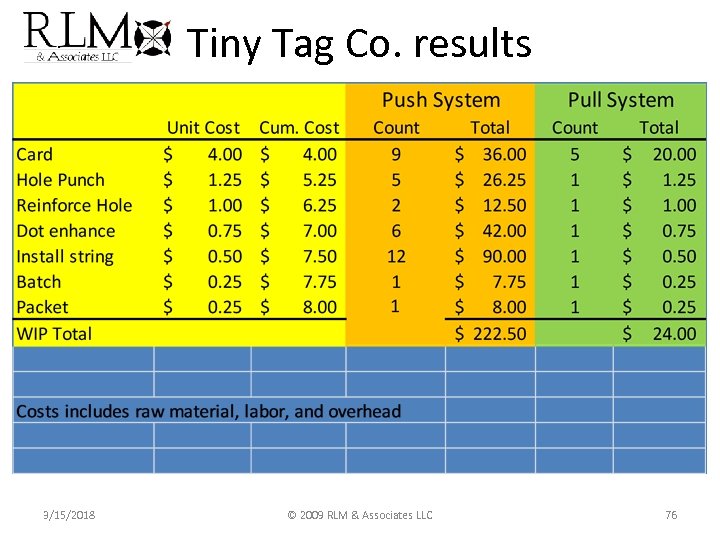
Tiny Tag Co. results 3/15/2018 © 2009 RLM & Associates LLC 76
Standard Work 77 © 2009 RLM & Associates LLC 3/15/2018
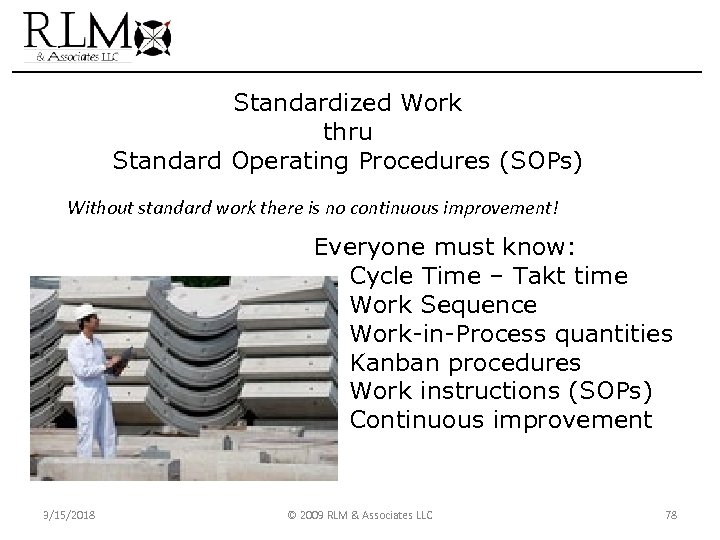
Standardized Work thru Standard Operating Procedures (SOPs) Without standard work there is no continuous improvement! Everyone must know: Cycle Time – Takt time Work Sequence Work-in-Process quantities Kanban procedures Work instructions (SOPs) Continuous improvement 3/15/2018 © 2009 RLM & Associates LLC 78
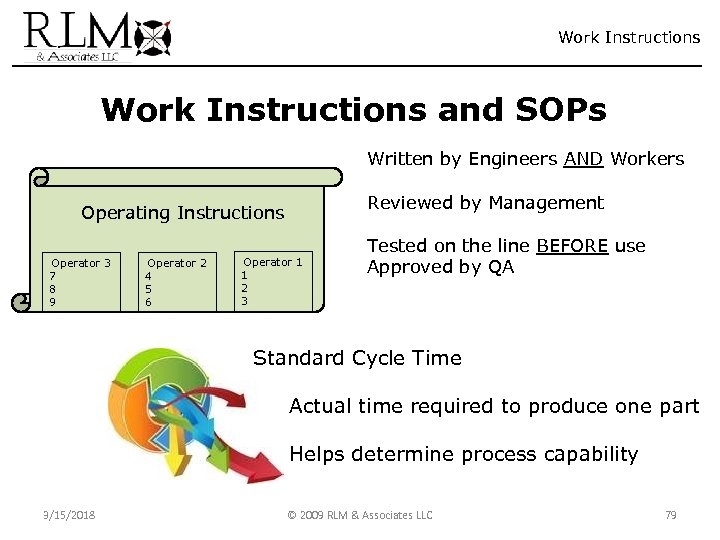
Work Instructions and SOPs Written by Engineers AND Workers Reviewed by Management Operating Instructions Operator 3 7 8 9 Operator 2 4 5 6 Operator 1 1 2 3 Tested on the line BEFORE use Approved by QA Standard Cycle Time Actual time required to produce one part Helps determine process capability 3/15/2018 © 2009 RLM & Associates LLC 79
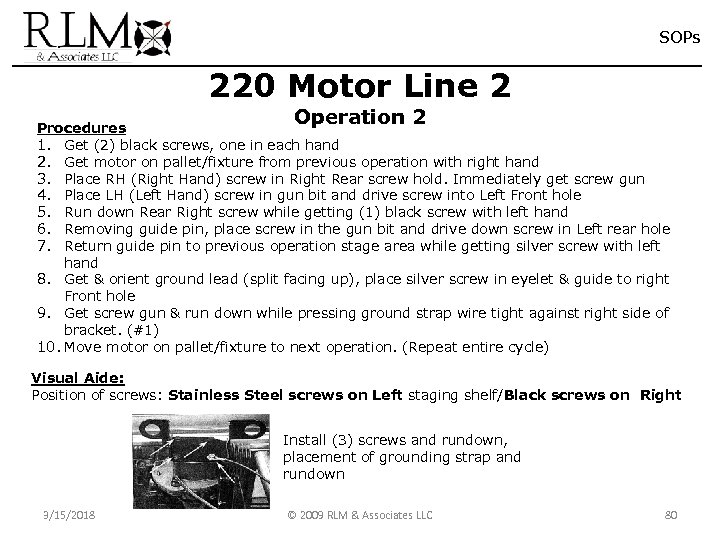
SOPs 220 Motor Line 2 Operation 2 Procedures 1. Get (2) black screws, one in each hand 2. Get motor on pallet/fixture from previous operation with right hand 3. Place RH (Right Hand) screw in Right Rear screw hold. Immediately get screw gun 4. Place LH (Left Hand) screw in gun bit and drive screw into Left Front hole 5. Run down Rear Right screw while getting (1) black screw with left hand 6. Removing guide pin, place screw in the gun bit and drive down screw in Left rear hole 7. Return guide pin to previous operation stage area while getting silver screw with left hand 8. Get & orient ground lead (split facing up), place silver screw in eyelet & guide to right Front hole 9. Get screw gun & run down while pressing ground strap wire tight against right side of bracket. (#1) 10. Move motor on pallet/fixture to next operation. (Repeat entire cycle) Visual Aide: Position of screws: Stainless Steel screws on Left staging shelf/Black screws on Right Install (3) screws and rundown, placement of grounding strap and rundown 3/15/2018 © 2009 RLM & Associates LLC 80
Yellow Belt Training Wrap-up Lean & Six Sigma Value Stream Mapping Mistake Proofing 5 S SMED TPM Kaizen Kanban 81 © 2009 RLM & Associates LLC 3/15/2018
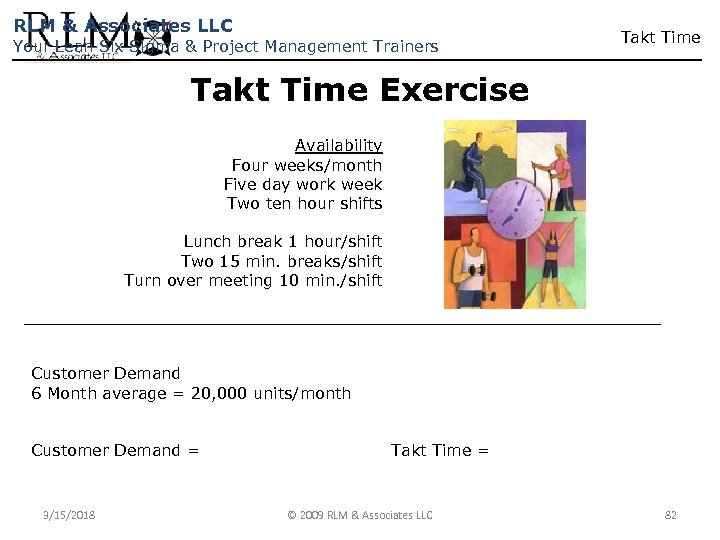
RLM & Associates LLC Your Lean Six Sigma & Project Management Trainers Takt Time Exercise Availability Four weeks/month Five day work week Two ten hour shifts Lunch break 1 hour/shift Two 15 min. breaks/shift Turn over meeting 10 min. /shift Customer Demand 6 Month average = 20, 000 units/month Customer Demand = 3/15/2018 Takt Time = © 2009 RLM & Associates LLC 82
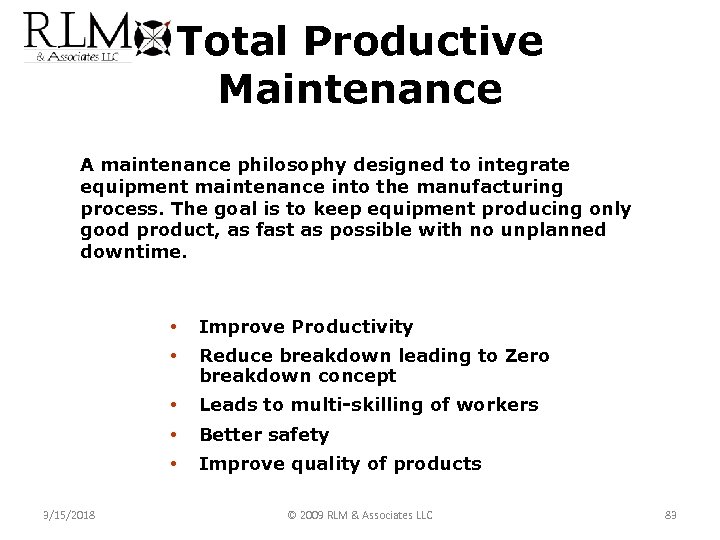
Total Productive Maintenance A maintenance philosophy designed to integrate equipment maintenance into the manufacturing process. The goal is to keep equipment producing only good product, as fast as possible with no unplanned downtime. • • Reduce breakdown leading to Zero breakdown concept • Leads to multi-skilling of workers • Better safety • 3/15/2018 Improve Productivity Improve quality of products © 2009 RLM & Associates LLC 83
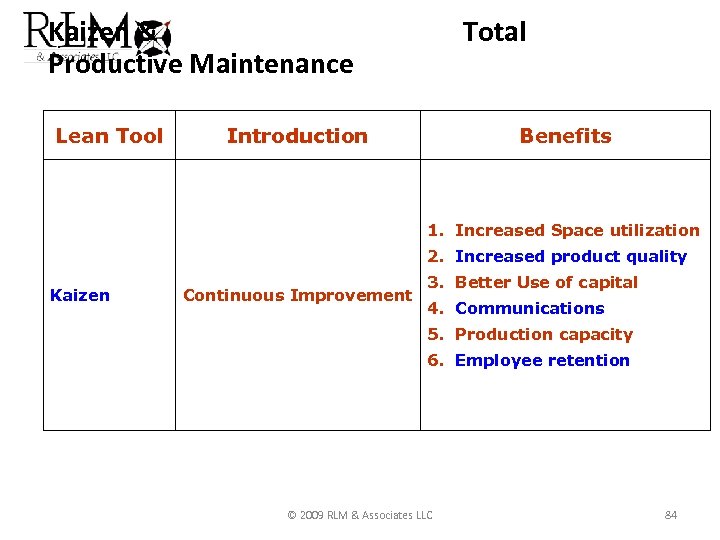
Kaizen & Productive Maintenance Lean Tool Total Introduction Benefits 1. Increased Space utilization 2. Increased product quality Kaizen Continuous Improvement 3. Better Use of capital 4. Communications 5. Production capacity 6. Employee retention © 2009 RLM & Associates LLC 84
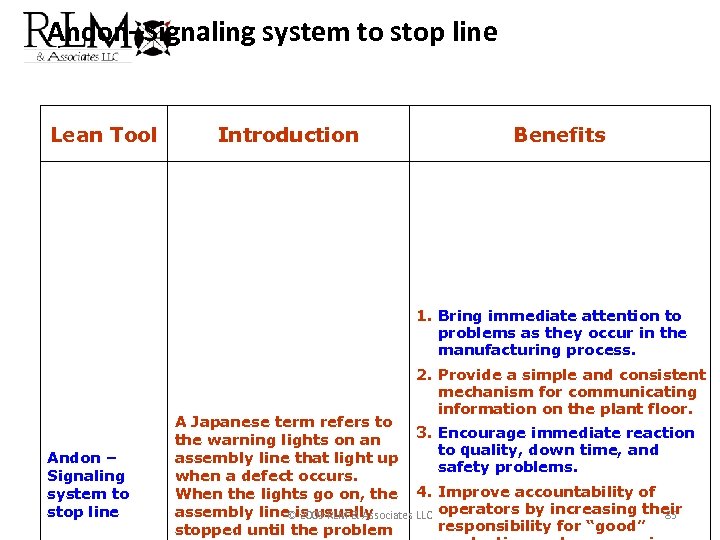
Andon–Signaling system to stop line Lean Tool Introduction Benefits 1. Bring immediate attention to problems as they occur in the manufacturing process. 2. Provide a simple and consistent mechanism for communicating information on the plant floor. Andon – Signaling system to stop line A Japanese term refers to 3. the warning lights on an assembly line that light up when a defect occurs. When the lights go on, the 4. assembly line is usually © 2009 RLM & Associates LLC stopped until the problem Encourage immediate reaction to quality, down time, and safety problems. Improve accountability of operators by increasing their 85 responsibility for “good”
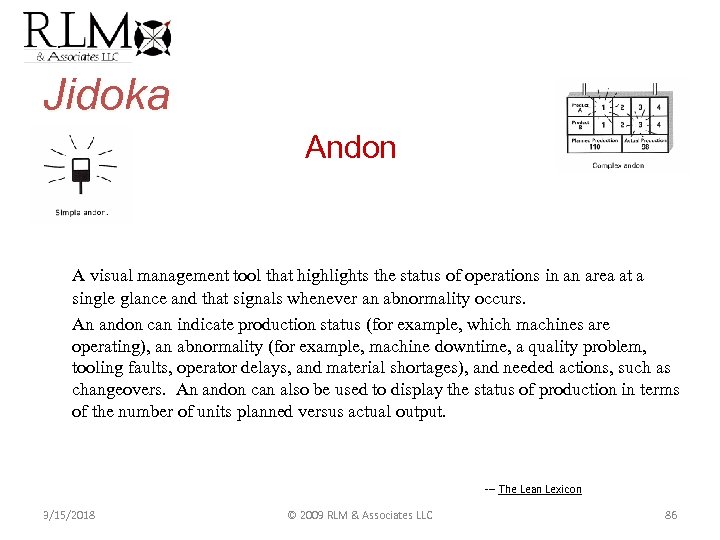
Jidoka Andon A visual management tool that highlights the status of operations in an area at a single glance and that signals whenever an abnormality occurs. An andon can indicate production status (for example, which machines are operating), an abnormality (for example, machine downtime, a quality problem, tooling faults, operator delays, and material shortages), and needed actions, such as changeovers. An andon can also be used to display the status of production in terms of the number of units planned versus actual output. --- The Lean Lexicon 3/15/2018 © 2009 RLM & Associates LLC 86
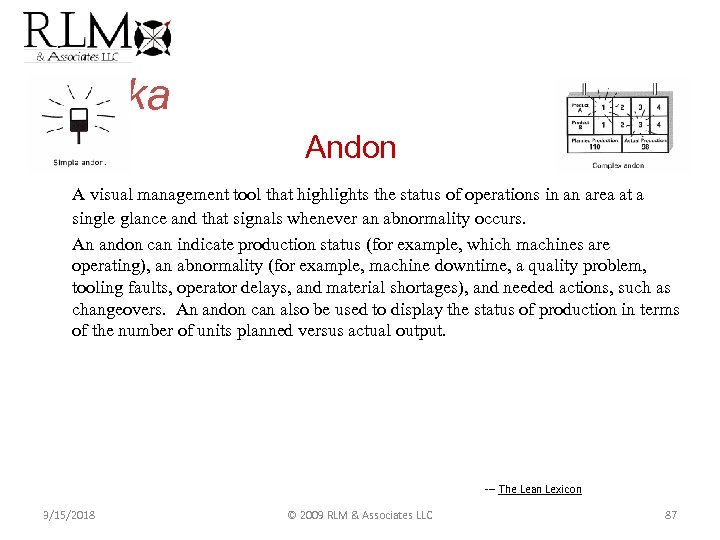
Jidoka Andon A visual management tool that highlights the status of operations in an area at a single glance and that signals whenever an abnormality occurs. An andon can indicate production status (for example, which machines are operating), an abnormality (for example, machine downtime, a quality problem, tooling faults, operator delays, and material shortages), and needed actions, such as changeovers. An andon can also be used to display the status of production in terms of the number of units planned versus actual output. --- The Lean Lexicon 3/15/2018 © 2009 RLM & Associates LLC 87
RLM & Associates LLC Your Lean Six Sigma & Project Management Trainers Lean Six Sigma DMAIC Workshop Yellow Belt Part 4 σ 6 lt Be w llo e Y 3/15/2018 © 2009 RLM & Associates LLC 88
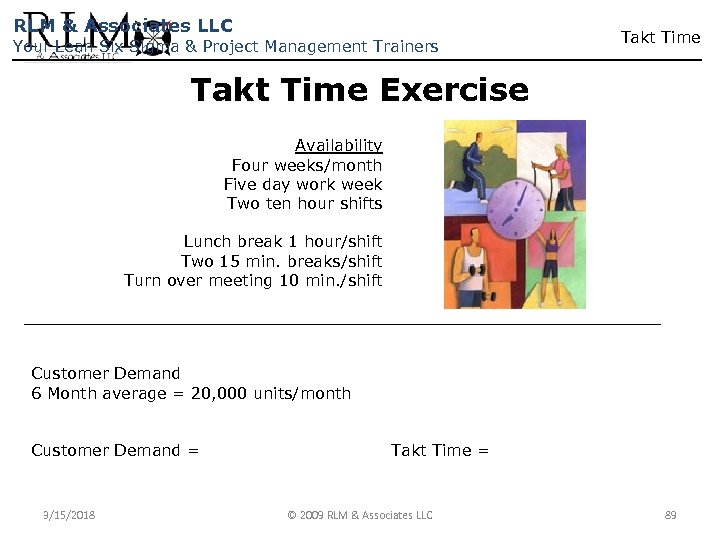
RLM & Associates LLC Your Lean Six Sigma & Project Management Trainers Takt Time Exercise Availability Four weeks/month Five day work week Two ten hour shifts Lunch break 1 hour/shift Two 15 min. breaks/shift Turn over meeting 10 min. /shift Customer Demand 6 Month average = 20, 000 units/month Customer Demand = 3/15/2018 Takt Time = © 2009 RLM & Associates LLC 89
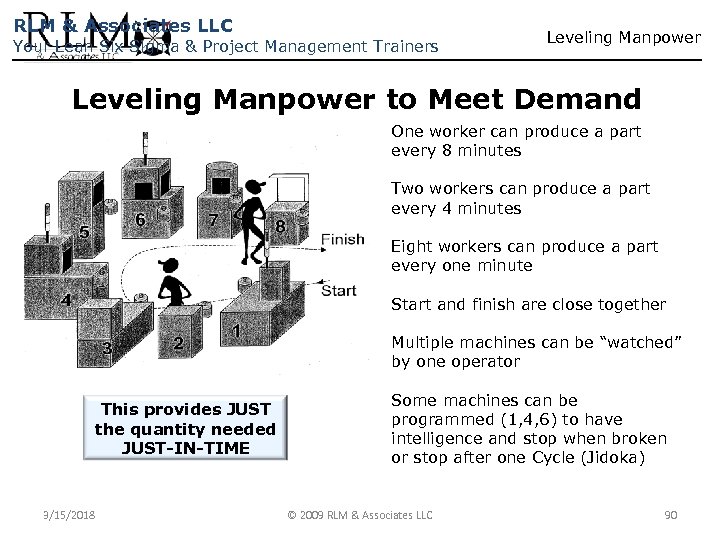
RLM & Associates LLC Your Lean Six Sigma & Project Management Trainers Leveling Manpower to Meet Demand One worker can produce a part every 8 minutes Two workers can produce a part every 4 minutes Eight workers can produce a part every one minute Start and finish are close together Multiple machines can be “watched” by one operator This provides JUST the quantity needed JUST-IN-TIME 3/15/2018 Some machines can be programmed (1, 4, 6) to have intelligence and stop when broken or stop after one Cycle (Jidoka) © 2009 RLM & Associates LLC 90
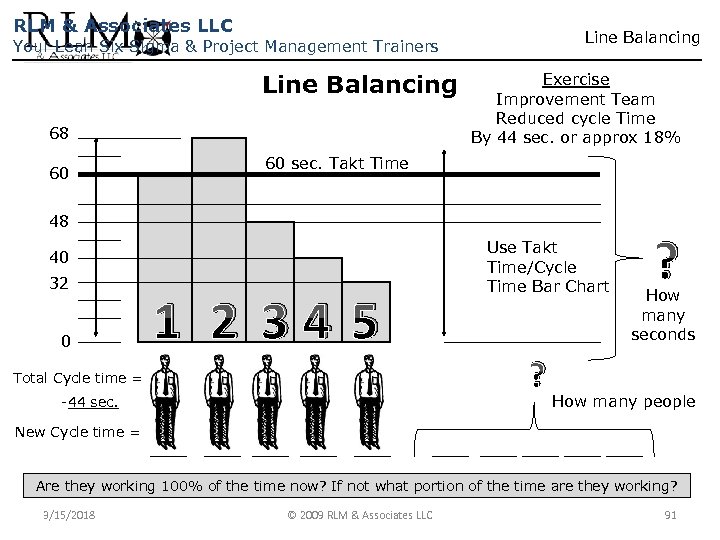
RLM & Associates LLC Line Balancing Your Lean Six Sigma & Project Management Trainers Line Balancing 68 60 Exercise Improvement Team Reduced cycle Time By 44 sec. or approx 18% 60 sec. Takt Time 48 40 32 0 1 2 34 5 Total Cycle time = -44 sec. Use Takt Time/Cycle Time Bar Chart ? ? How many seconds How many people New Cycle time = Are they working 100% of the time now? If not what portion of the time are they working? 3/15/2018 © 2009 RLM & Associates LLC 91
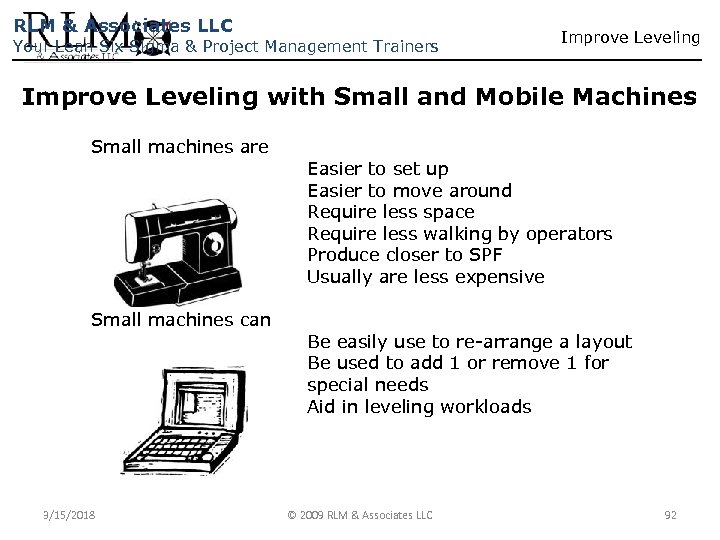
RLM & Associates LLC Your Lean Six Sigma & Project Management Trainers Improve Leveling with Small and Mobile Machines Small machines are Small machines can 3/15/2018 Easier to set up Easier to move around Require less space Require less walking by operators Produce closer to SPF Usually are less expensive Be easily use to re-arrange a layout Be used to add 1 or remove 1 for special needs Aid in leveling workloads © 2009 RLM & Associates LLC 92
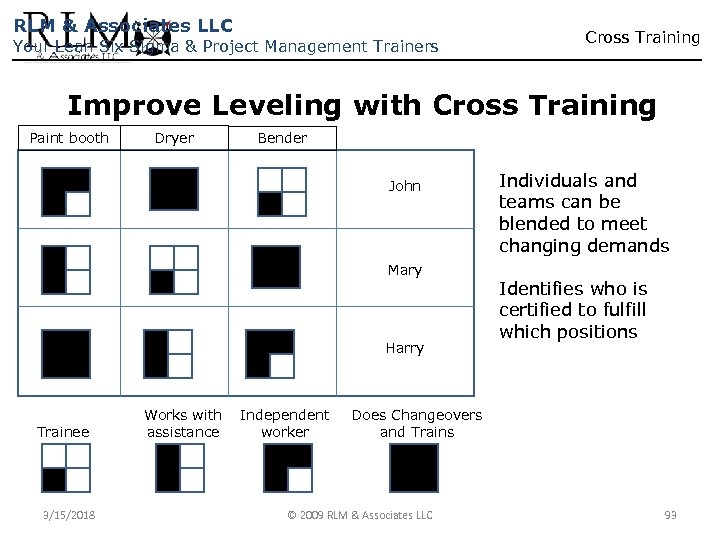
RLM & Associates LLC Your Lean Six Sigma & Project Management Trainers Cross Training Improve Leveling with Cross Training Paint booth Dryer Bender John Mary Harry Trainee 3/15/2018 Works with Independent assistance worker Individuals and teams can be blended to meet changing demands Identifies who is certified to fulfill which positions Does Changeovers and Trains © 2009 RLM & Associates LLC 93
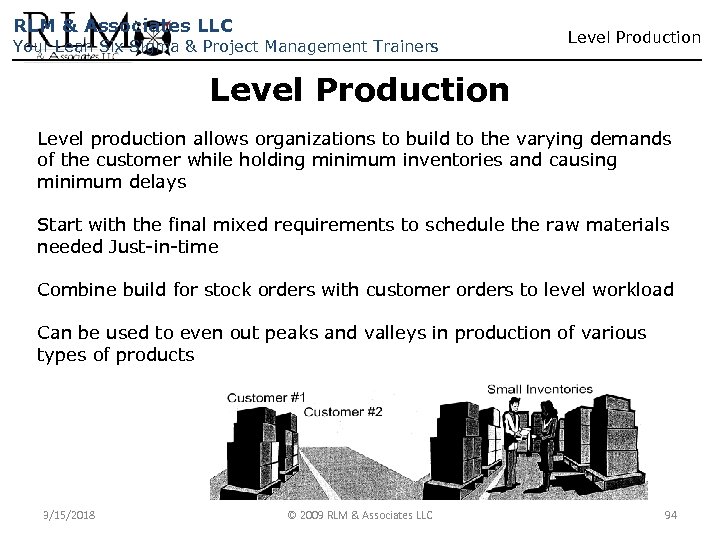
RLM & Associates LLC Your Lean Six Sigma & Project Management Trainers Level Production Level production allows organizations to build to the varying demands of the customer while holding minimum inventories and causing minimum delays Start with the final mixed requirements to schedule the raw materials needed Just-in-time Combine build for stock orders with customer orders to level workload Can be used to even out peaks and valleys in production of various types of products 3/15/2018 © 2009 RLM & Associates LLC 94
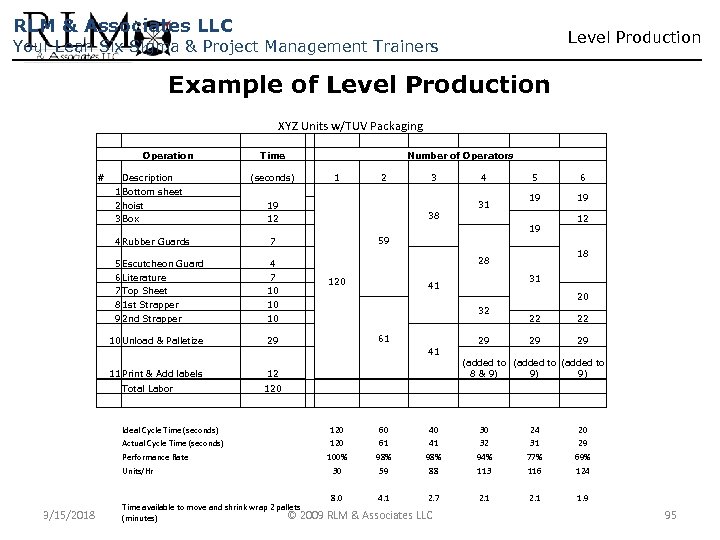
RLM & Associates LLC Level Production Your Lean Six Sigma & Project Management Trainers Example of Level Production XYZ Units w/TUV Packaging Operation # Description Time (seconds) 1 Bottom sheet 1 2 3 4 2 hoist 19 3 Box 12 4 Rubber Guards 7 5 Escutcheon Guard 4 6 Literature 7 7 Top Sheet 10 8 1 st Strapper 10 9 2 nd Strapper 10 29 31 10 Unload & Palletize 5 6 19 19 Number of Operators 38 19 12 59 18 28 120 31 41 20 32 61 29 22 22 29 29 41 11 Print & Add labels Total Labor 12 (added to 8 & 9) 9) 9) 120 Ideal Cycle Time (seconds) 120 60 40 30 24 20 Actual Cycle Time (seconds) 120 61 41 32 31 29 100% 98% 94% 77% 69% 30 59 88 113 116 124 8. 0 4. 1 2. 7 Time available to move and shrink wrap 2 pallets © 2009 RLM & Associates LLC (minutes) 2. 1 1. 9 Performance Rate Units/Hr 3/15/2018 95
Скачать презентацию Kaizen Kai zen Change for the better
c8fa7b2695823e4575ab376fec86d159.ppt