 Скачать презентацию Kahuku ADRC Project Caroline St Laurent Bree Shimizu
69e70d91b5c23fddc2626d41727f0d21.ppt
- Количество слайдов: 62



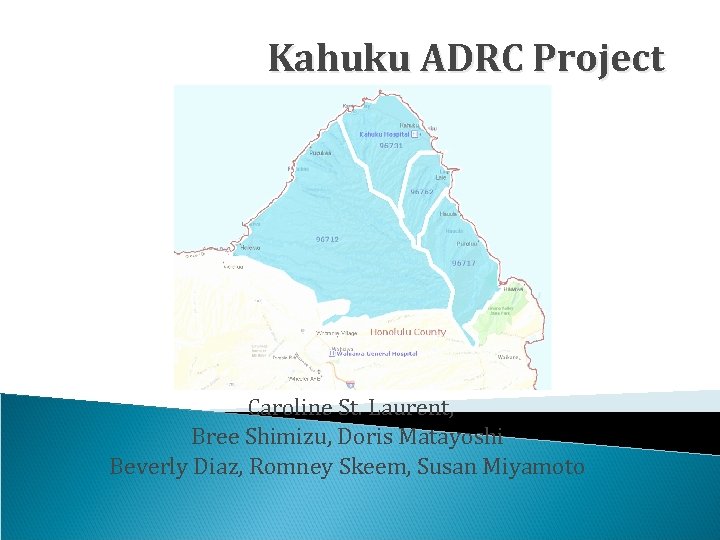
Kahuku ADRC Project Caroline St. Laurent, Bree Shimizu, Doris Matayoshi Beverly Diaz, Romney Skeem, Susan Miyamoto
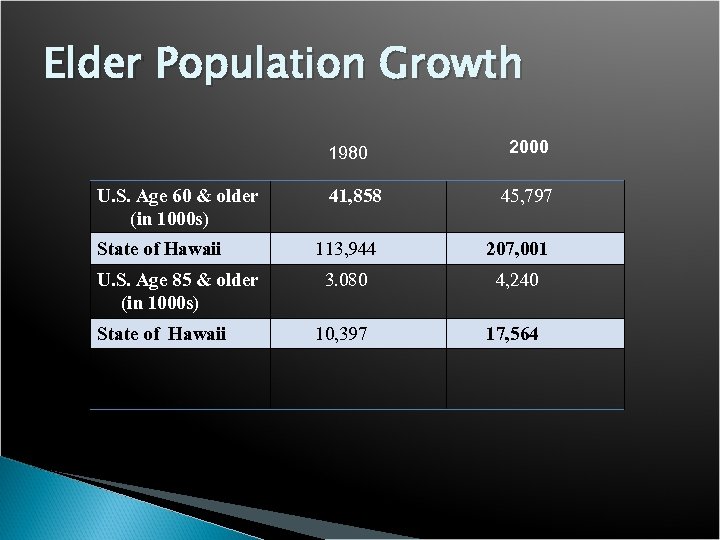
Elder Population Growth 1980 U. S. Age 60 & older (in 1000 s) State of Hawaii U. S. Age 85 & older (in 1000 s) State of Hawaii 2000 41, 858 45, 797 113, 944 207, 001 3. 080 4, 240 10, 397 17, 564
Problems Elders Face in General Chronic heath conditions increase as age increases Acute physical/mental illnesses also increase Therefore, as the elder population ages, ◦ the numbers will grow ◦ and the severity of their illnesses will also increase
Needs for elder Eldercare services in the community Access to network sources and referral agencies Access to special needs in transportation Person-to-person interaction and communication
Older Americans Act—Title III (1965) Established framework • Guaranteed Access Network 1. Comprehensive planning 2. Coordinating 3. Delivery of services for elders in need • Mandated age criteria of 60 years old – regardless of income and need
Title III -continued Opportunity to receive services such as access to senior centers, congregate dining –home delivered meals Information and referral lines Respite care for family caregivers
Title III -continued Opportunity to receive services such as access to senior centers, congregate dining –home delivered meals Information and referral lines Respite care for family caregivers
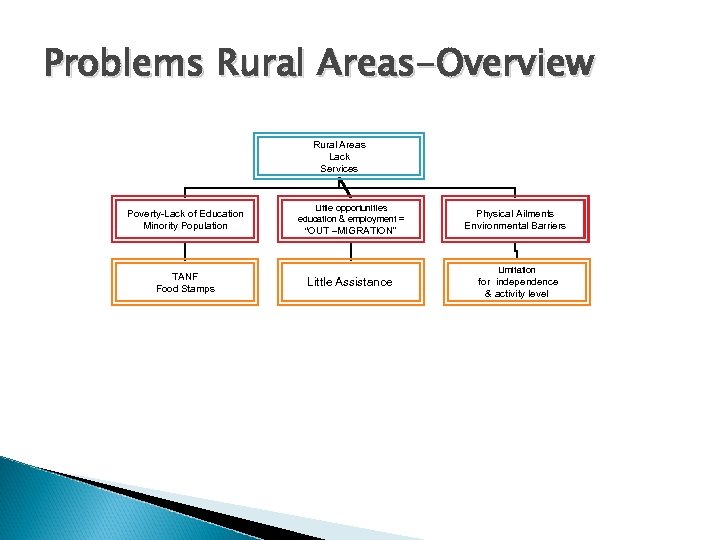
Problems Rural Areas-Overview Rural Areas Lack Services Poverty-Lack of Education Minority Population Little opportunities education & employment = “OUT –MIGRATION” TANF Food Stamps Little Assistance Physical Ailments Environmental Barriers Limitation for independence & activity level
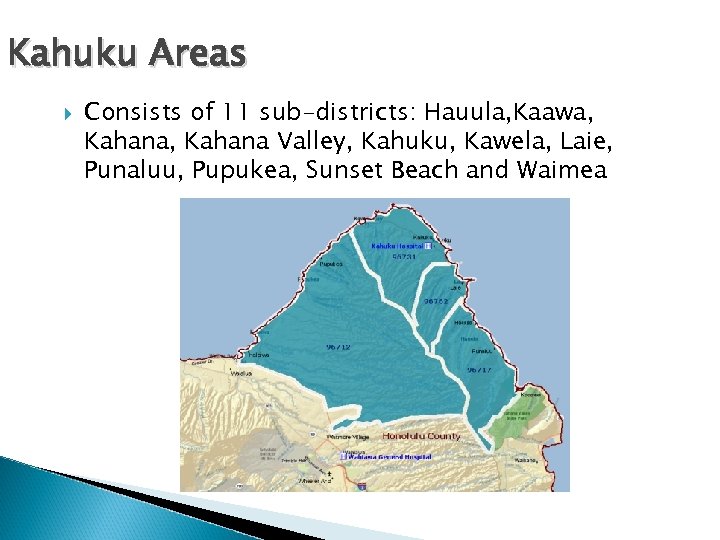
Kahuku Areas Consists of 11 sub-districts: Hauula, Kaawa, Kahana Valley, Kahuku, Kawela, Laie, Punaluu, Pupukea, Sunset Beach and Waimea
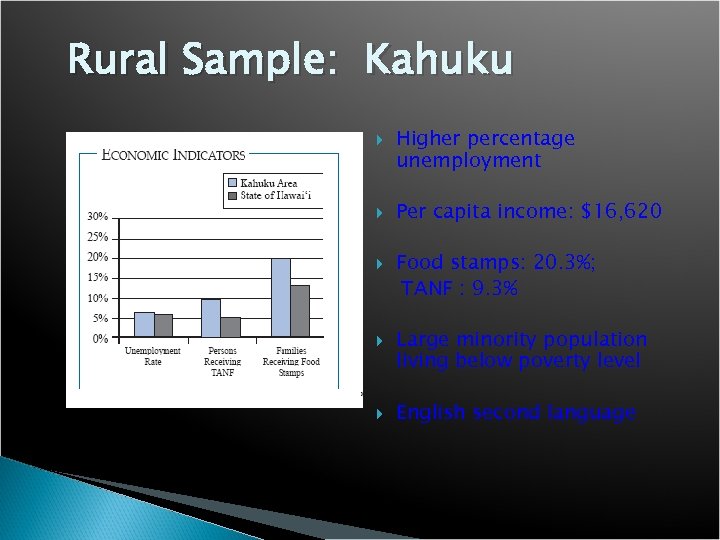
Rural Sample: Kahuku Higher percentage unemployment Per capita income: $16, 620 Food stamps: 20. 3%; TANF : 9. 3% Large minority population living below poverty level English second language
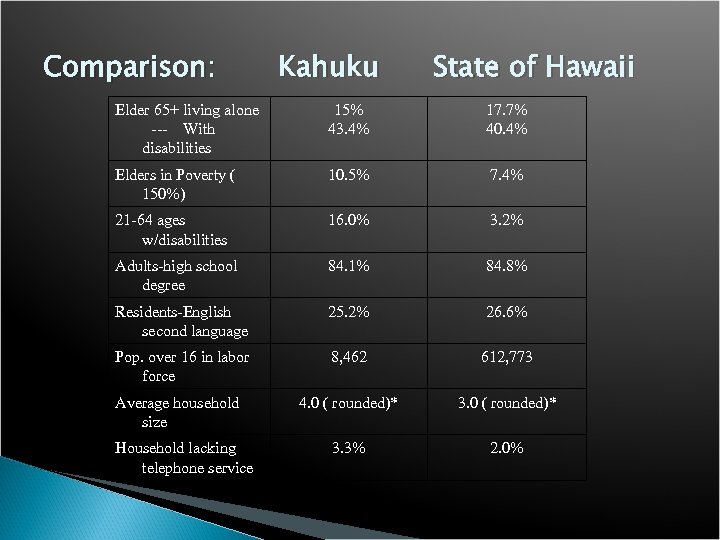
Comparison: Kahuku State of Hawaii Elder 65+ living alone --- With disabilities 15% 43. 4% 17. 7% 40. 4% Elders in Poverty ( 150%) 10. 5% 7. 4% 21 -64 ages w/disabilities 16. 0% 3. 2% Adults-high school degree 84. 1% 84. 8% Residents-English second language 25. 2% 26. 6% Pop. over 16 in labor force 8, 462 612, 773 4. 0 ( rounded)* 3. 3% 2. 0% Average household size Household lacking telephone service
Question “ Will a one stop service such as the Aging and Disability Resource Center Program ( ADRC) improve the availability of services and consequently the well-being of the elderly population at risk? ”
Why is there a need? Kahuku Medical Center Referred Agencies Only facility on the North Shore Provides Referral Service ◦ ◦ Honolulu Gerontology Program Bathing Services Elderly Affairs Division Castle Home Care ◦ ◦ Nursing Home without Walls Foster Care Program DOH Medicaid Division Volunteer Legal Services
Inconveniences Rural Agencies are located in the Honolulu District Long waitlist No follow up assistance Length of time Currently no organized programs
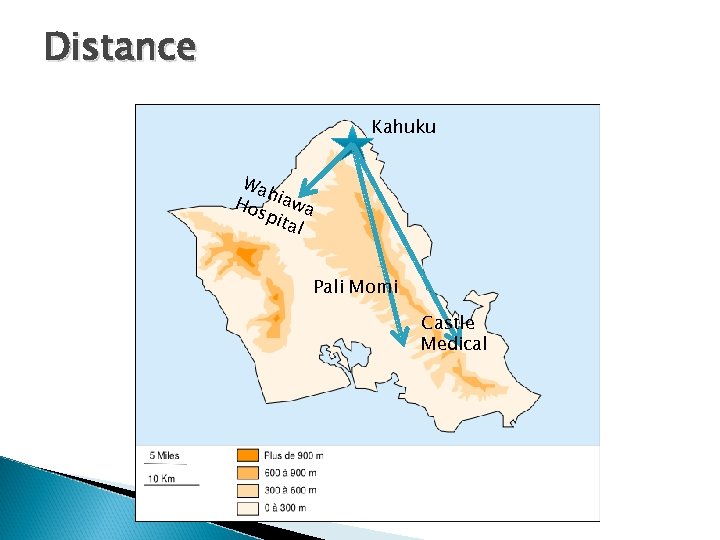
Distance Kahuku Wa h Ho iawa spi tal Pali Momi Castle Medical
Complexities of searching Programs have different eligibility requirements Unnecessary selections made
What does an ADRC have to offer? Synchronization of services Intake Coordinator Screening tool to assess Financial capacity Functional capacity Direction of appropriate services
Knowledge is key Why have an ADRC? Benefits caregiver and the care recipient Prompt response to services Opportunity to make choices Well organized More self directive Promotes their dignity
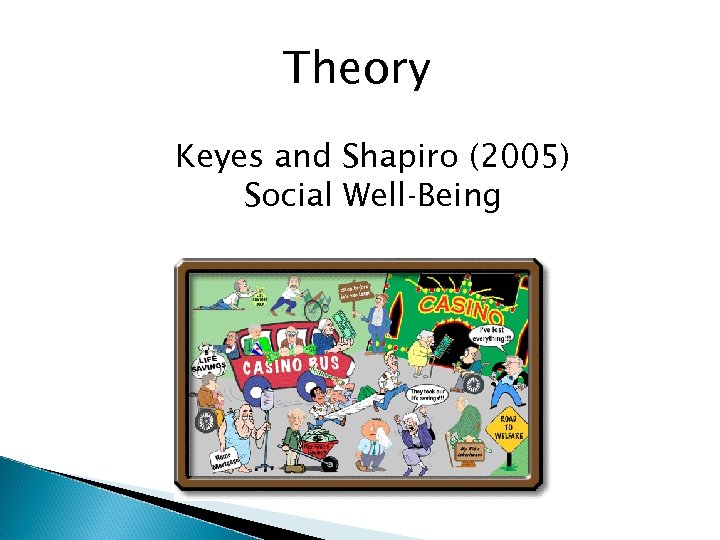
Theory Keyes and Shapiro (2005) Social Well-Being
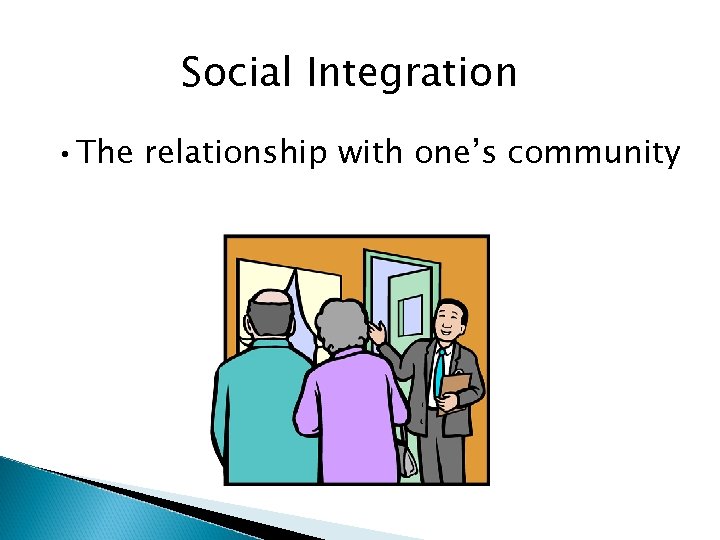
Social Integration • The relationship with one’s community
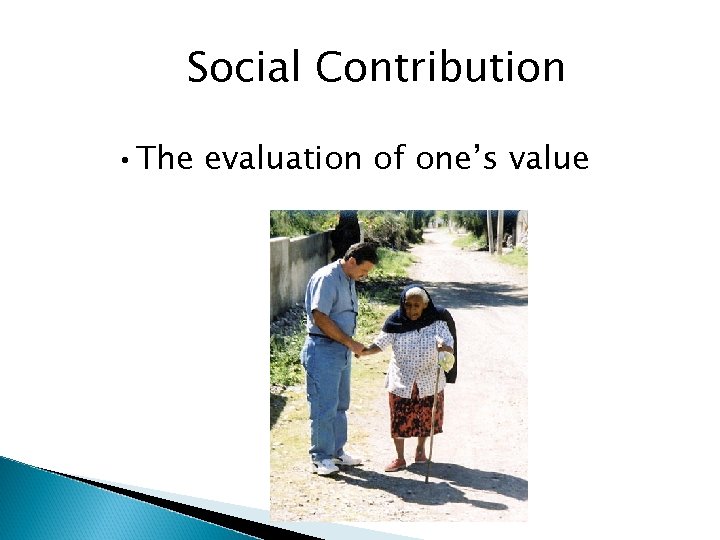
Social Contribution • The evaluation of one’s value
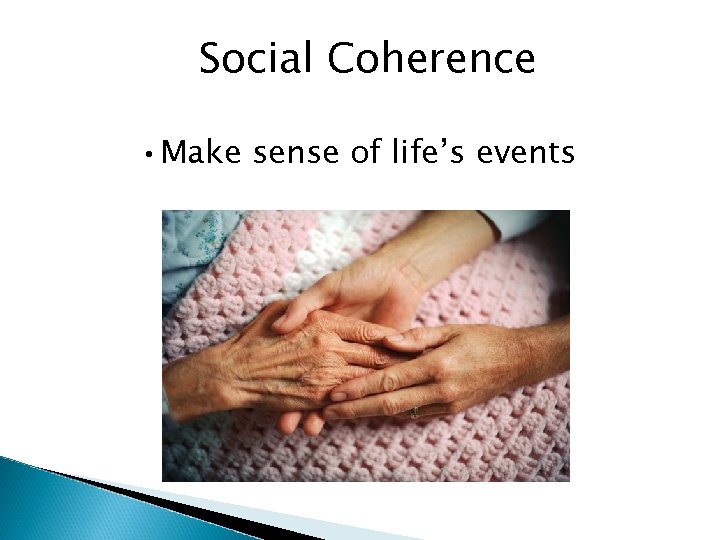
Social Coherence • Make sense of life’s events
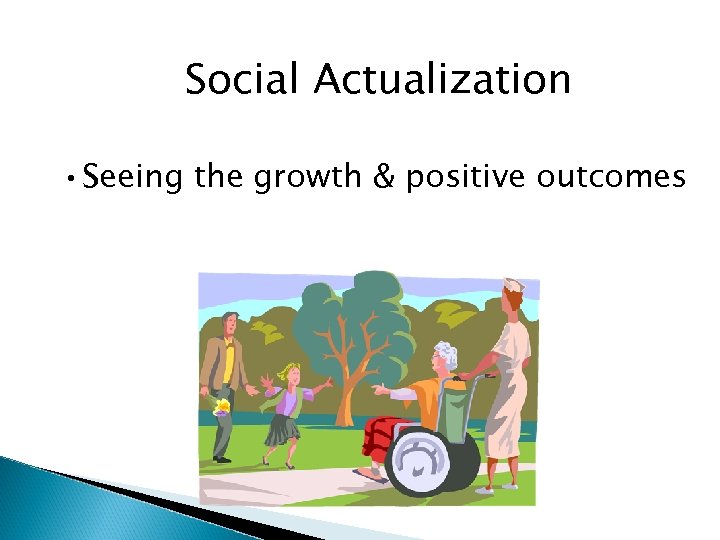
Social Actualization • Seeing the growth & positive outcomes
Social Acceptance • Learning to trust and accept others
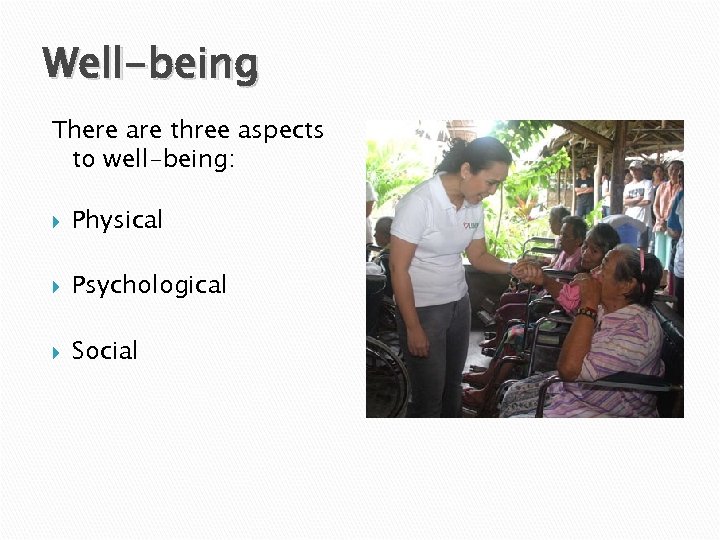
Well-being There are three aspects to well-being: Physical Psychological Social
Physical Well-being “Physical functioning, role limitation due to physical health problems, bodily pain, general health, and vitality” (Oswald, Salemi, Michel, & Sprott, 2008, p. 919). Low blood pressure Chronic and acute illness Weakness Pain and fatigue
Psychological Well-being “Indicators of positive mental health such as morale, happiness, and life satisfaction” (Ellison & Fan 2007, p. 248). Spiritual fulfillment Depression Life accomplishments Anxiety Good coping skills Dementia
Social Well-being “An individuals’ perception of his or her integration into society, of his/her acceptance of other people, of the coherence of society and social events, of a sense of contribution to society and the belief in the growth potential of the society in which one resides” (Keyes & Shapiro, 2004; Keyes & Shapiro, 2005; Brim, Ryff, Kessler, 2004; Keyes, Shomotkin and Ryhff, 2002; Keyes, 1998; Keyes, 1996). Community Events Political Involvement Neighborhood Boards
Method Wellbeing Index Pre-test Post-test Survey elderly 60+ years in Kahuku area (Hau`ula to Kahuku and Lāi`ei to Wai`mea)
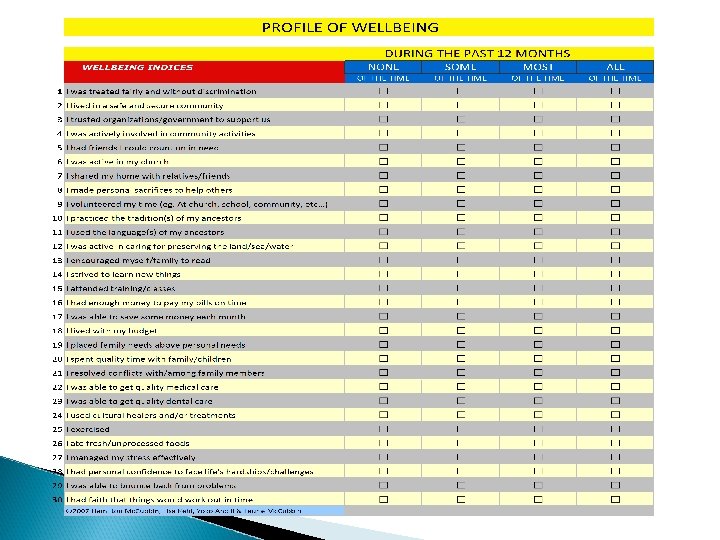
Statistics Quasi experimental Design ◦ Pretest ◦ Post test ◦ No comparison group Measures used ◦ Demographic information ◦ Social well being measure, before and after program Hypothesis ◦ Significant changes in Social Well being after the program
Statistics continued Analyis Data collection Entering data Data transferred into an SPSS file The dominant statistics involve chi-square analyses Before and after exposure Mean scores ◦ Analysis of covariance controlling for: Pretest scores Demographic information
ADRC’s History National Initiative launched in 2003 Administration on Aging (Ao. A) and the Centers for Medicare and Medicaid Services Forty-three states and territories have received three-year grants
Concept Commonly referred to as a “one stop shop”, Restructure services and supports for older adults and younger persons with disabilities Enhance their access to community resources and the long term care system Integrated points of entry into the longterm care system Address many of the frustrations consumers and their families experience when trying to Access needed information, services, and supports
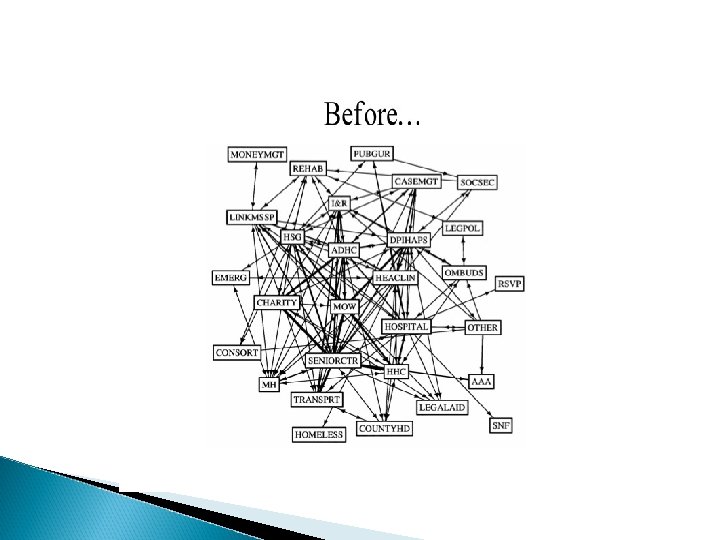
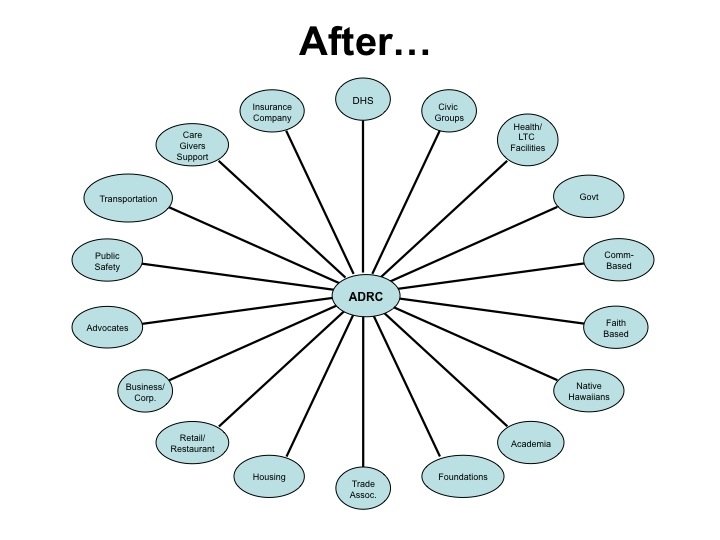
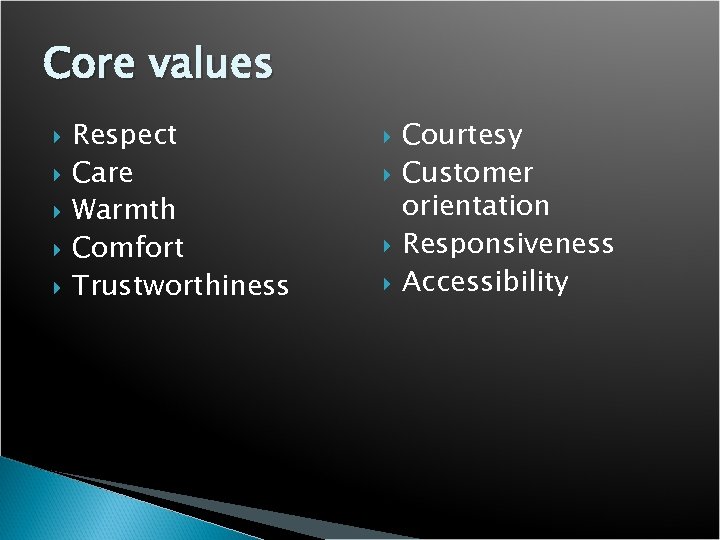
Core values Respect Care Warmth Comfort Trustworthiness Courtesy Customer orientation Responsiveness Accessibility
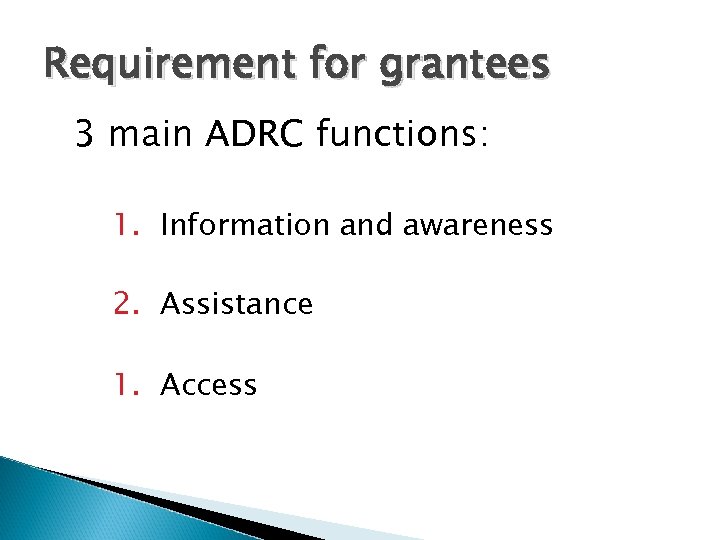
Requirement for grantees 3 main ADRC functions: 1. Information and awareness 2. Assistance 1. Access
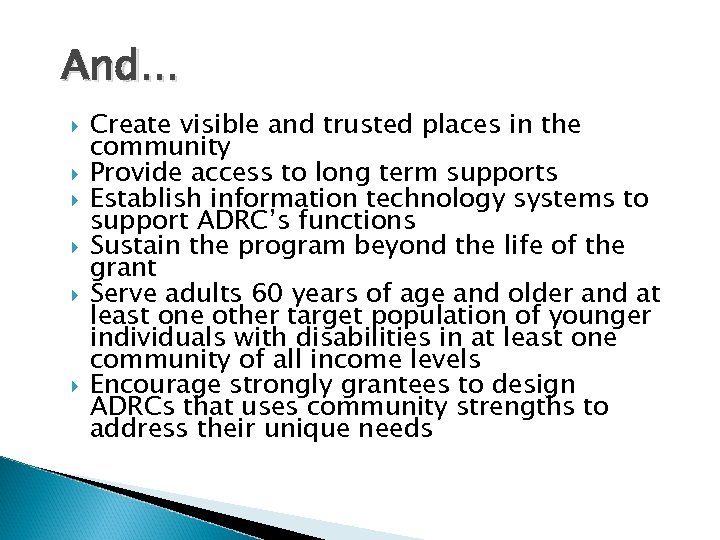
And. . . Create visible and trusted places in the community Provide access to long term supports Establish information technology systems to support ADRC’s functions Sustain the program beyond the life of the grant Serve adults 60 years of age and older and at least one other target population of younger individuals with disabilities in at least one community of all income levels Encourage strongly grantees to design ADRCs that uses community strengths to address their unique needs
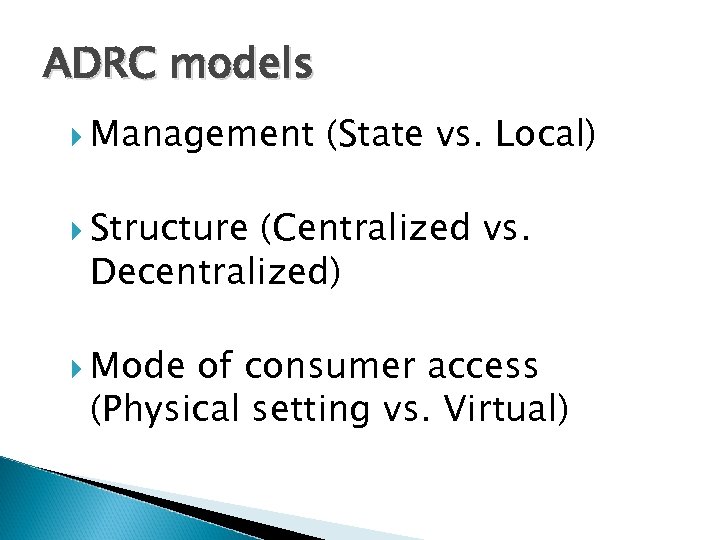
ADRC models Management (State vs. Local) Structure (Centralized vs. Decentralized) Mode of consumer access (Physical setting vs. Virtual)
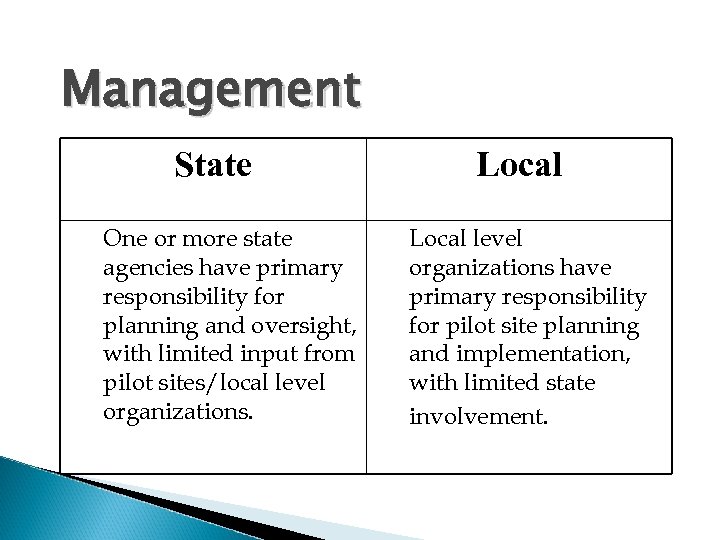
Management State One or more state agencies have primary responsibility for planning and oversight, with limited input from pilot sites/local level organizations. Local level organizations have primary responsibility for pilot site planning and implementation, with limited state involvement.
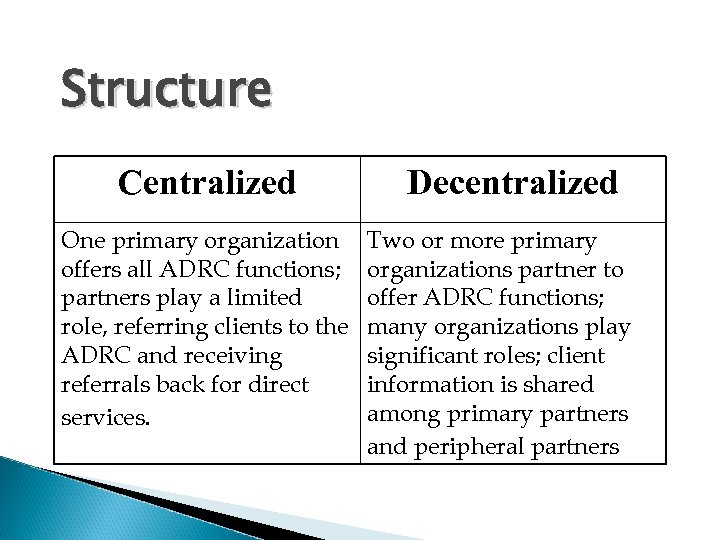
Structure Centralized One primary organization offers all ADRC functions; partners play a limited role, referring clients to the ADRC and receiving referrals back for direct services. Decentralized Two or more primary organizations partner to offer ADRC functions; many organizations play significant roles; client information is shared among primary partners and peripheral partners
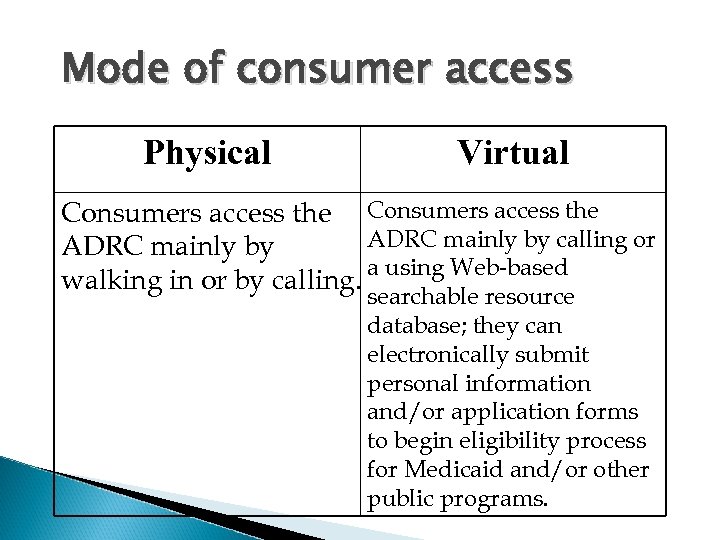
Mode of consumer access Physical Virtual Consumers access the ADRC mainly by calling or ADRC mainly by a using Web-based walking in or by calling. searchable resource database; they can electronically submit personal information and/or application forms to begin eligibility process for Medicaid and/or other public programs.
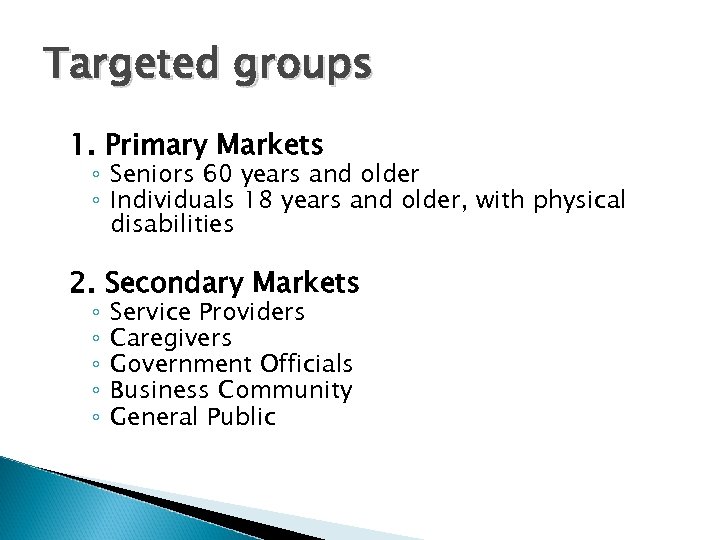
Targeted groups 1. Primary Markets ◦ Seniors 60 years and older ◦ Individuals 18 years and older, with physical disabilities 2. Secondary Markets ◦ ◦ ◦ Service Providers Caregivers Government Officials Business Community General Public
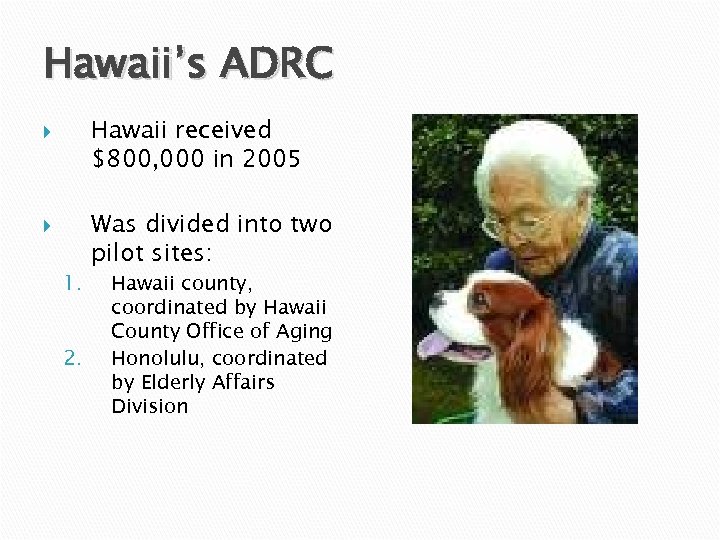
Hawaii’s ADRC Hawaii received $800, 000 in 2005 1. 2. Was divided into two pilot sites: Hawaii county, coordinated by Hawaii County Office of Aging Honolulu, coordinated by Elderly Affairs Division
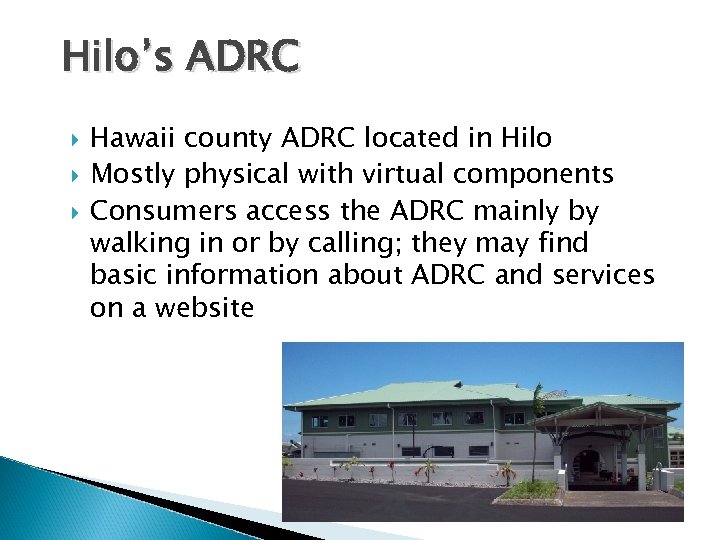
Hilo’s ADRC Hawaii county ADRC located in Hilo Mostly physical with virtual components Consumers access the ADRC mainly by walking in or by calling; they may find basic information about ADRC and services on a website
Honolulu’s ADRC Virtual Website in construction Backed up by the Elderly Affairs Division system and services already in place Telephone line Community outreach workers Community partners
Honolulu’s virtual ADRC Website: local service provider directory, educational information, decision support tools Mgmt Info System: data collection, client intake, tracking, reporting and follow-up Telephone Help Line Information, referral, personalized assistance, community outreach and education Partnerships: CMS, Ao. A, State, City/County, ADRC Advisory Board members, local aging and disability providers
Kahuku Identified as one of the areas with pockets of population hard to reach Smaller physical ADRC satellite was proposed Collaboration with the Kahuku Medical Center Provided a small office space and one of the workers is present at the site 4 days a week at this time
Kahuku Part of the virtual ADRC Have a physical site where people will come, feel safe and comfortable, and be able to find help Face-to-face service Same services: intake, assessment, eligibility screening and determination, information and options counseling, short term case management and follow-up, help people plan ahead for their long term services and support needs, etc.
Why the need for a Hilo ADRC? To provide information. To provide available options rather than nursing facility placement. To prolong community placement or living with family. So, to answer the question, “why was Mayor Kim invested in this program? ”
What is the target population? Targeted to serve the entire countypopulation of 173, 000. Serves: Elders 60+ y/o, 55+ y/o for employment training, 18+ y/o for individuals with disabilities
Funding National initiative ADRC grant awarded $800, 000 to the City and County of Honolulu and Hawaii. Subsidies awarded by the state legislature Concern that the governor may not release other funds due to budget cuts. $100, 000 awarded by the state grant. Total budget to fund program estimates $650, 000
Reason for ADRC site in Hilo Using a renovated building structure as a resource and county paying for the lease. Other sites office of aging are considering: Kona and Honokaa pending on funds. Core services for LTC or home options. One of the small networks in the county to have a co infusion model if model is a success.
Challenges Concern on continuing funding. County of Hawaii needs to pick up the fallen cost. Renovation problems related to existing building.
Grand opening November 15, 2008 Hilo ADRC 101 Aupuni St. Suite Hilo, HI 96720 Website: www. hcoahawaii. org 808 -961 -8600 Hours: 7: 45 am to 4: 30 pm
Conclusion A physical one stop shop (ADRC) in Kahuku will… eliminate fragmentation enhance the wellbeing of the elderly empower the community
References ADRC. (2008). About the National ADRC Initiative. Retrieved November 16, 2008, from http: //www. adrc -tae. org/tiki-index. php? page_ref_id=745 ADRC. (2008). Hawaii. Retrieved November 16, 2008 from http: //www. adrc-tae. org/tikiindex. php? page=HIProfile&stabrev=HI ADRC. (2008). The Aging and Disability Resource Center (ADRC) Demonstration Grant Initiative Interim Outcomes Report. Executive Summary Background. Retrieved November 16, 2008 from http: //www. adrc-tae. org/documents/Interim. Report. doc#_Toc 150921730 ADRC. (2008). The Aging and Disability Resource Center (ADRC) Demonstration Grant Initiative Interim Outcomes Report. Exhibit 2: Summary of Grant Requirements. Retrieved November 16, 2008 from http: //www. adrc-tae. org/documents/Interim. Report. doc#_Toc 150921730 ADRC. (2008). The Aging and Disability Resource Center (ADRC) Demonstration Grant Initiative Interim Outcomes Report. Executive Summary Model Structures. Retrieved November 16, 2008 from http: //www. adrc-tae. org/documents/Interim. Report. doc#_Toc 150921730 ADRC. (2008). The Aging and Disability Resource Center (ADRC) Demonstration Grant Initiative Interim Outcomes Report. Executive Summary Service Populations. Retrieved November 16, 2008 from http: //www. adrc-tae. org/documents/Interim. Report. doc#_Toc 150921730 Adults with Bachelor's Degree or higher: U. S. Census Bureau. (2000). Census 2000. [Online: ] http: //www. census. gov/ census 2000/ states/ hi. html (September 30, 2002). Adults with high school diploma or higher: U. S. Census Bureau. (2000). Census 2000. [Online: ] http: //www. census. gov/ census 2000/ states/ hi. html (September 30, 2002).
References continued Aging And Disability Resource Center, & The Lewin Group. (2006, November). The Aging and Disability Resource Center (ADRC) Demonstration Grant Initiative. Retrieved October 6, 2008, from U. S. Department of Health and Human Services Web Site: http: //www. adrc-tae. org Average household size: U. S. Census Bureau. (2000). Census 2000. [Online: ] http: //www. census. gov/ census 2000/ states/ hi. html (September 30, 2002). Brim, O. , Ryff, C. , & Kessler, R. (2005). How healthy are we: A national study of well-being at midlife. Chicago: University of Chicago Press. descriptive Epidemiology. ” Pp. 350 -372 in How healthy are we: A national study of well-being at midlife, ed. Orville Brim, Carol Ryff, and Ronald Kessler. Chicago: University of Chicago Press. Ellison, C. , & Fan, D. (2008). Daily spiritual experiences and psychological well-being among US aults. Social Indicators Research, 88(2), 247 -271. Retrieved November 15, 2008, from Academic Search Premeire database. Families receiving food stamps: State of Hawai‘i, Department of Human Services. (1999). TANF and food stamps data. Unpublished raw data, And U. S. Census Bureau. (2000). Census 2000. [Online: ] http: //www. census. gov/ census 2000/ states/ hi. html (September 30, 2002). Hawaii ADRC. (2008). Documents Provided by Hawaii ADRC Orientation Training word document. Retrieved November 16, 2008 from http: //www. adrc-tae. org/tikiindex. php? page=Hawaii. Page. Public Hawaii ADRC. (2008). Documents Provided by Hawaii Marketing Plan for ADRC. Retrieved November 16, 2008 from http: //www. adrc-tae. org/tiki-index. php? page=Hawaii. Page. Public Hooyman, N. and Asuman Kiyak, H. (2008). Social gerontology: A multidisciplinary perspective (8 th ed. ). Boston, MA: Pearson Education, Inc.
References continued Households lacking telephone service: U. S. Census Bureau. (2000). Census 2000. [Online: ] http: //www. census. gov/ census 2000/ states/ hi. html (September 30, 2002). Individuals age 65 & older living alone: U. S. Census Bureau. (2000). Census 2000. [Online: ] http: //www. census. gov/ census 2000/ states/ hi. html (September 30, 2002). Individuals age 65 & older living in poverty: U. S. Census Bureau. (2000). Census 2000. [Online: ] http: //www. census. gov/ census 2000/ states/ hi. html (September 30, 2002). Individuals age 65 & older with a disability: U. S. Census Bureau. (2000). Census 2000. [Online: ] http: //www. census. gov/ census 2000/ states/ hi. html (September 30, 2002). Jürg Oswald & Souzan Salemi & Beat A. Michel & Haiko Sprott (2008). Use of the short-form-36 health survey to detect a subgroup of fibromyalgia patients with psychological dysfunction. Clinical Rheumatology 27(7), 919– 921. Retrieved November 15, 2008, from Academic Search Premeire database. Keyes, C. & Shapiro, A. (2004). Social well-being in the United States: a descriptive epidemiology. In Orville Brim, Carol Ryff, and Ronald Kessler (Eds. ), How healthy are we: A national study of well-being at midlife (Pp. 350 -372). Chicago: University of Chicago Press. Keyes, C. & Shapiro, A. (2005). Social well-being in the United States: a descriptive Epidemiology. In Orville Brim, Carol Ryff, and Ronald Kessler (Eds. ), How healthy are we: A national study of well-being at midlife (Pp. 350 -372). Chicago: University of Chicago Press.
References continued Keyes, C. (1996). Social functioning and social well-being: studies of the social nature of personal wellness. Dissertation Abstracts International: Section B: the Sciences and Engineering. 56, 12 -B. Keyes, C. (1998) Social well-being. Social Psychology Quarterly 61, 121 -140. Keyes, C. and Shapiro, A. (2005). “Social well-being in the United States: a descriptive Epidemiology. ” Pp. 350 -372 in How healthy are we: A national study of well-being at midlife, ed. Orville Brim, Carol Ryff, and Ronald Kessler. Chicago: University of Chicago Press. Keyes, C. , Shomotkin, D. , & Ryff, C. (2002) Optimizing well-being: the empirical encounter of two traditions. Journal of Personality and Social Psychology 82(6), 1007 -1022. Kretzmann, J. and Mcknight, J. (1993). Building communities from the inside out: A path toward finding and mobilizing a community’s assets. Chicago: Kretzmann and Mc. Knight Marks, N. , Jun, H. , & Song, J. (2007). Death of Parents and Adult Psychological and Physical Well-Being. Journal of Family Issues, 28(12), 1611 -1638. Retrieved November 15, 2008, from http: //jfi. sagepub. com. eres. library. manoa. hawaii. edu/cgi/content/ abstract/28/12/1611 National Conference Of State Legislators. (2008). A Guide to Long-Term Care for State Policy Makers: Aging and Disability Resource Centers. Retrieved November 7, 2008, from National Conference of State Legislators Web Site: http: //ncsl. org/programs/health/forum/LTC Number of families: U. S. Census Bureau. (2000). Census 2000. [Online: ] http: //www. census. gov/ census 2000/ states/ hi. html (September 30, 2002). Per capita income: U. S. Census Bureau. (2000). Census 2000. [Online: ] http: //www. census. gov/ census 2000/ states/ hi. html (September 30, 2002).
References continued Persons receiving Temporary Assistance to Needy Families (TANF): State of Hawai‘i, Department of Human Services. (1999). TANF and food stamps data. Unpublished raw data, And U. S. Census Bureau. (2000). Census 2000. [Online: ] http: //www. census. gov/ census 2000/ states/ hi. html (September 30, 2002). Population ages 21 -64 with disabilities: U. S. Census Bureau. (2000). Census 2000. [Online: ] http: //www. census. gov/ census 2000/ states/ hi. html (September 30, 2002). Population over age 16 in the labor force: U. S. Census Bureau. (2000). Census 2000. [Online: ] http: //www. census. gov/ census 2000/ states/ hi. html (September 30, 2002). Residents over age 5 with language other than English at home: U. S. Census Bureau. (2000). Census 2000. [Online: ] http: //www. census. gov/ census 2000/ states/ hi. html (September 30, 2002). Steenhuysen, J. (2008, March 27) “Older Americans Wealthier, Living longer” Reuters. , Retrieved November 7, 2008 from http: //www. reuters. com/article/top. News/id. USN 2740398720080327? feed. Type=RSS&feed. Name=top. Ne ws&rpc=22&sp=true U. S. Census (2000), Census, retrieved November 7, 2008 from http: www// factfinder. census. gov/home/saff/main. html.
Скачать презентацию Kahuku ADRC Project Caroline St Laurent Bree Shimizu
69e70d91b5c23fddc2626d41727f0d21.ppt