 Скачать презентацию K-16 Building Need and Utilization Study Committee S
ff7cb43c50339e22911fd7d559d43583.ppt
- Количество слайдов: 30



K-16 Building Need and Utilization Study Committee S. C. House Ways & Means Committee The Hon. Brian White, Chairman, and Members The Hon. Roland Smith, The Hon. Gilda Cobb-Hunter, The Hon. Harry B. Chip Limehouse, The Hon. Kenny Bingham, The Hon. James H. “Jimmy” Merrill, and The Hon. Jackie Hayes FACILITIES NEED AND UTILIZATION IN SC PUBLIC COLLEGES & UNIVERSITIES RICHARD C. SUTTON, EXECUTIVE DIRECTOR SC COMMISSION ON HIGHER EDUCATION 16 JANUARY 2014
Some Key Financial Issues in SC Public Higher Education Declining state recurring appropriations Over-reliance on non-recurring funding and high tuition/high scholarship model Rising tuition/fees Substantial increase in institutional debt loads Substantial increase in student debt loads Insufficient incentives for timely degree completion & improved affordability Bottom Line: Unsustainable funding model
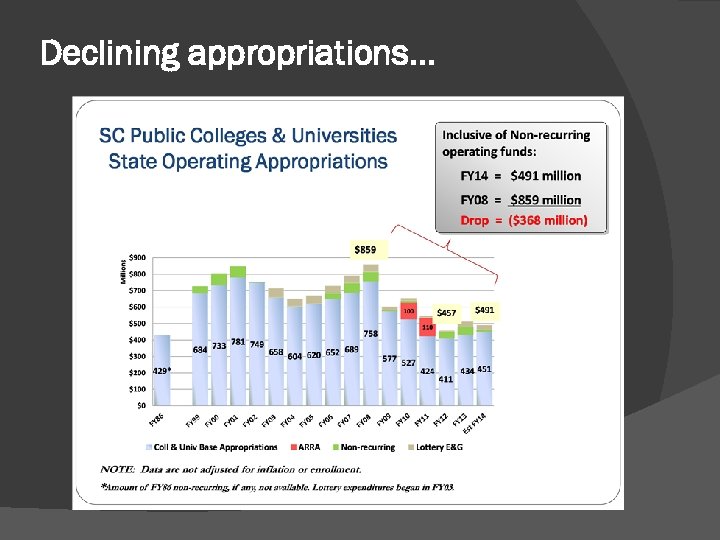
Declining appropriations…
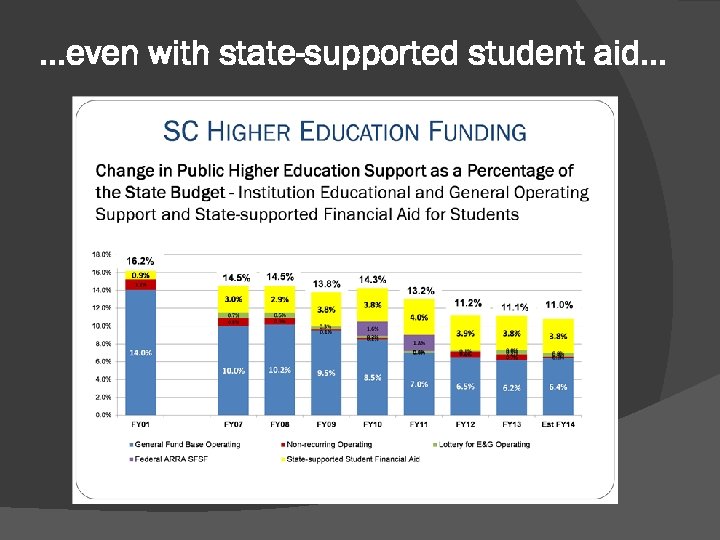
…even with state-supported student aid…
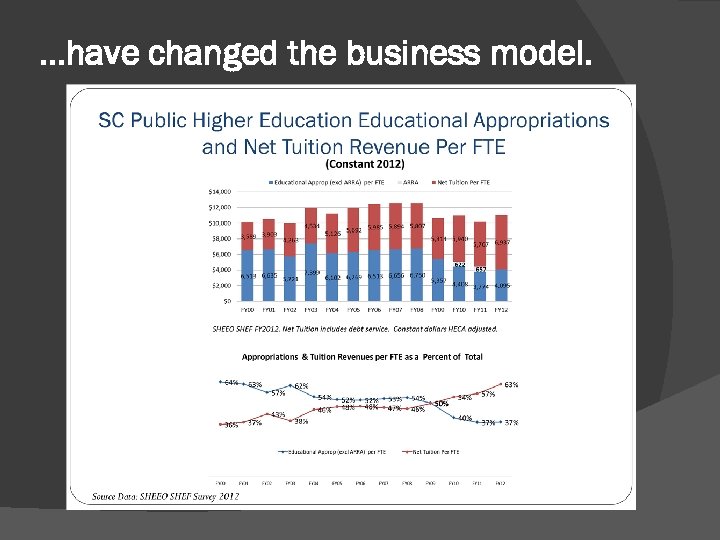
…have changed the business model.
Purpose of Today’s Hearing Not to solve all of the problems facing public higher education Not to solve all of the challenges facing SC in a highly competitive global economy Rather, to focus on facilities capital (what one 19 thcentury economist called the means of production) to determine whether they are reasonable, efficient, and necessary to the education of SC’s intellectual capital —its people, its workforce, its future.
Outline of Today’s Presentation How many buildings do SC colleges own? What are they for? How big are they? How old are they? Once we build them, how do we maintain them? Does facilities construction have any relationship to student enrollment? Does facilities construction have any relationship to overall revenues/expenditures?
Data Assumptions & Qualifications Focus on high-level, aggregate data Includes all 33 public institutions Excludes leased/borrowed/donated space Concentrates on E&G (educational and general operating) facilities Data drawn from multiple sources Not always completely aligned, but comparable and consistent Not cherry-picked or skewed to favor any side Accurate, balanced, and on-point, as best we can
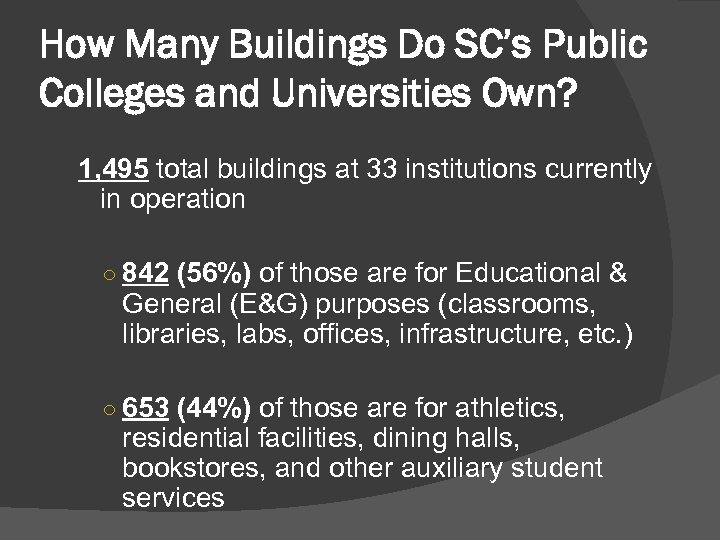
How Many Buildings Do SC’s Public Colleges and Universities Own? 1, 495 total buildings at 33 institutions currently in operation ○ 842 (56%) of those are for Educational & General (E&G) purposes (classrooms, libraries, labs, offices, infrastructure, etc. ) ○ 653 (44%) of those are for athletics, residential facilities, dining halls, bookstores, and other auxiliary student services
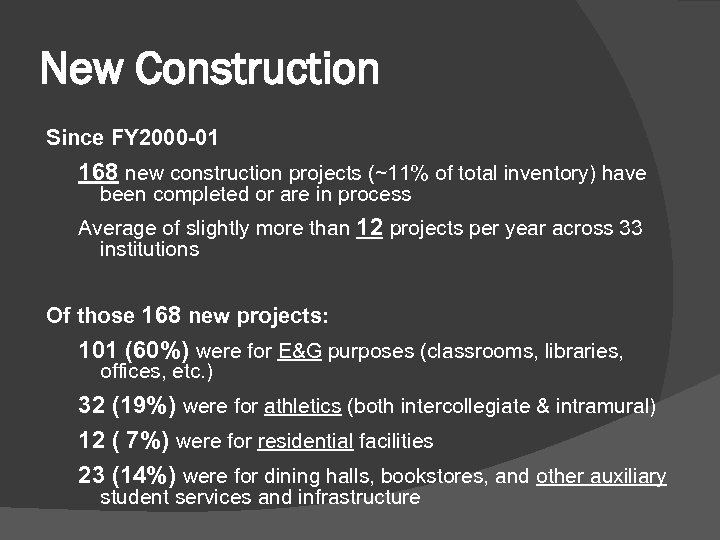
New Construction Since FY 2000 -01 168 new construction projects (~11% of total inventory) have been completed or are in process Average of slightly more than 12 projects per year across 33 institutions Of those 168 new projects: 101 (60%) were for E&G purposes (classrooms, libraries, offices, etc. ) 32 (19%) were for athletics (both intercollegiate & intramural) 12 ( 7%) were for residential facilities 23 (14%) were for dining halls, bookstores, and other auxiliary student services and infrastructure
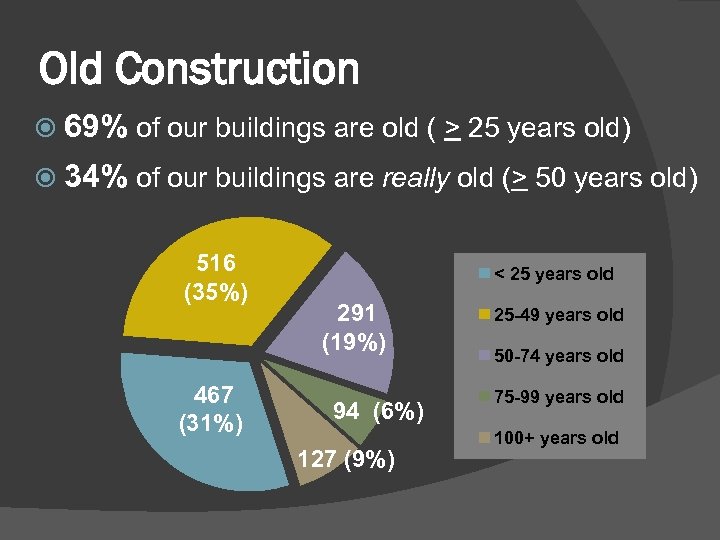
Old Construction 69% of our buildings are old ( > 25 years old) 34% of our buildings are really old (> 50 years old) 516 (35%) 467 (31%) < 25 years old 291 (19%) 94 (6%) 127 (9%) 25 -49 years old 50 -74 years old 75 -99 years old 100+ years old
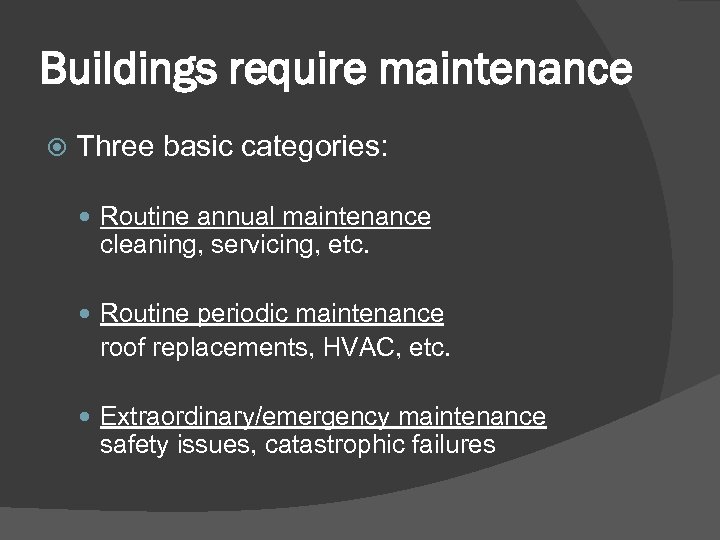
Buildings require maintenance Three basic categories: Routine annual maintenance cleaning, servicing, etc. Routine periodic maintenance roof replacements, HVAC, etc. Extraordinary/emergency maintenance safety issues, catastrophic failures
Deferred Maintenance When any of these is not performed as scheduled, it then becomes “deferred” maintenance Deferred maintenance is typically more expensive and potentially more complicated depending on nature and severity of service deferred/required Many valid reasons for deferring maintenance (part of a more comprehensive project, institutional priorities, lack of appropriate funding)
Maintenance Needs CHE Formula – Based on life-cycle analysis of systems in E&G buildings and E&G infrastructure Includes system renewal/replacement and annual maintenance needs Totals $1. 2 B OVER 20 YEARS (~$64 M per year)
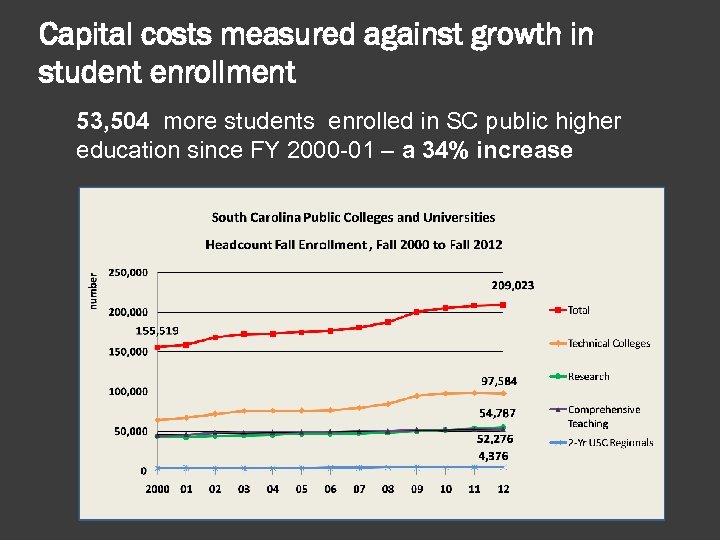
Capital costs measured against growth in student enrollment 53, 504 more students enrolled in SC public higher education since FY 2000 -01 – a 34% increase
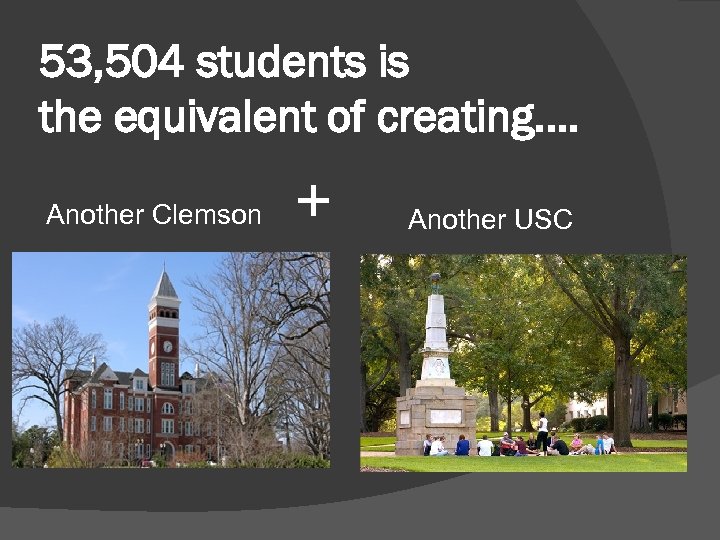
53, 504 students is the equivalent of creating…. Another Clemson + Another USC
Or the equivalent of adding… an entirely new comprehensive 4 -yr sector
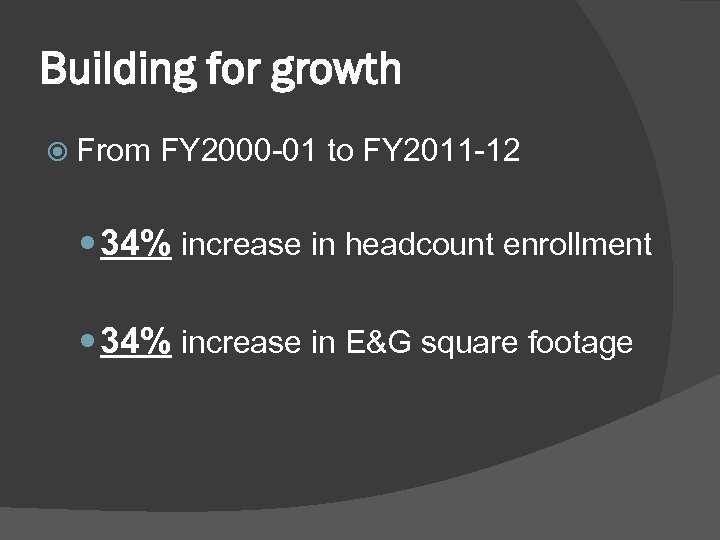
Building for growth From FY 2000 -01 to FY 2011 -12 34% increase in headcount enrollment 34% increase in E&G square footage
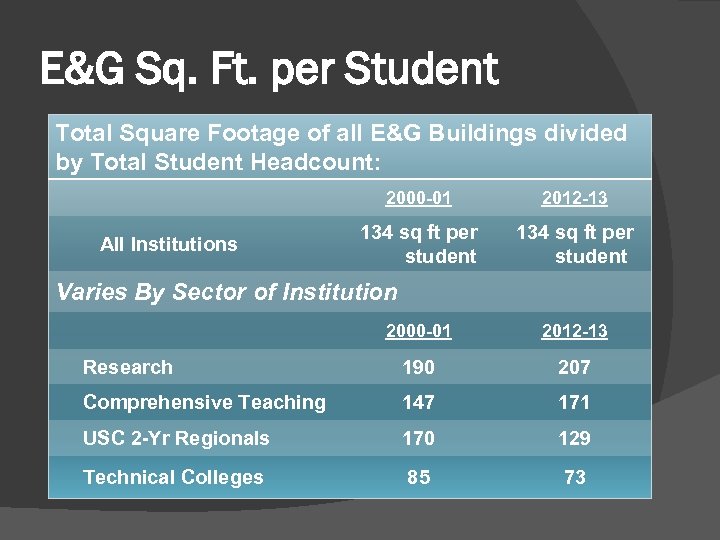
E&G Sq. Ft. per Student Total Square Footage of all E&G Buildings divided by Total Student Headcount: 2000 -01 All Institutions 2012 -13 134 sq ft per student Varies By Sector of Institution 2000 -01 2012 -13 Research 190 207 Comprehensive Teaching 147 171 USC 2 -Yr Regionals 170 129 Technical Colleges 85 73
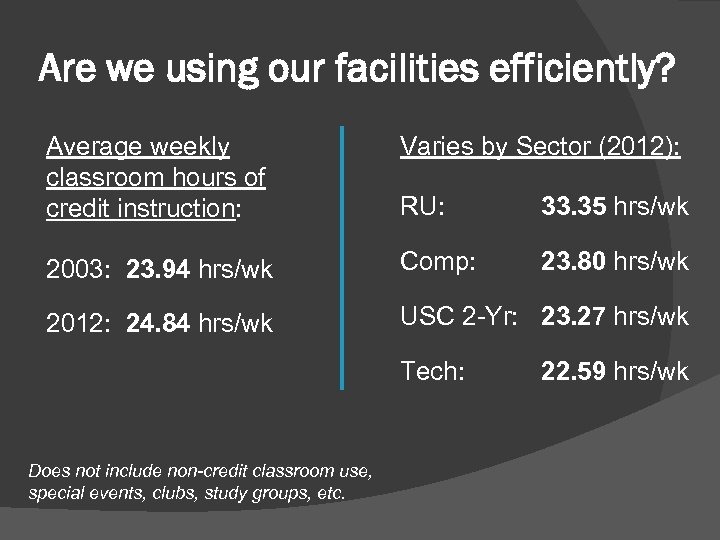
Are we using our facilities efficiently? Average weekly classroom hours of credit instruction: Varies by Sector (2012): RU: 33. 35 hrs/wk 2003: 23. 94 hrs/wk Comp: 23. 80 hrs/wk 2012: 24. 84 hrs/wk USC 2 -Yr: 23. 27 hrs/wk Tech: Does not include non-credit classroom use, special events, clubs, study groups, etc. 22. 59 hrs/wk
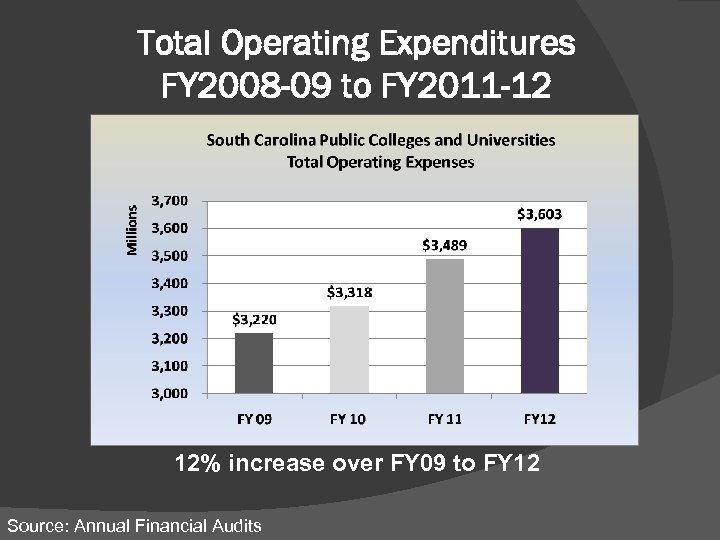
Total Operating Expenditures FY 2008 -09 to FY 2011 -12 12% increase over FY 09 to FY 12 Source: Annual Financial Audits
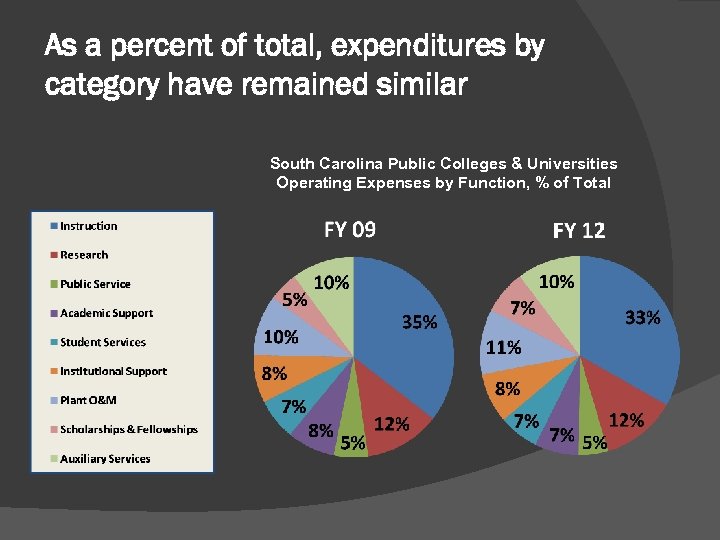
As a percent of total, expenditures by category have remained similar South Carolina Public Colleges & Universities Operating Expenses by Function, % of Total
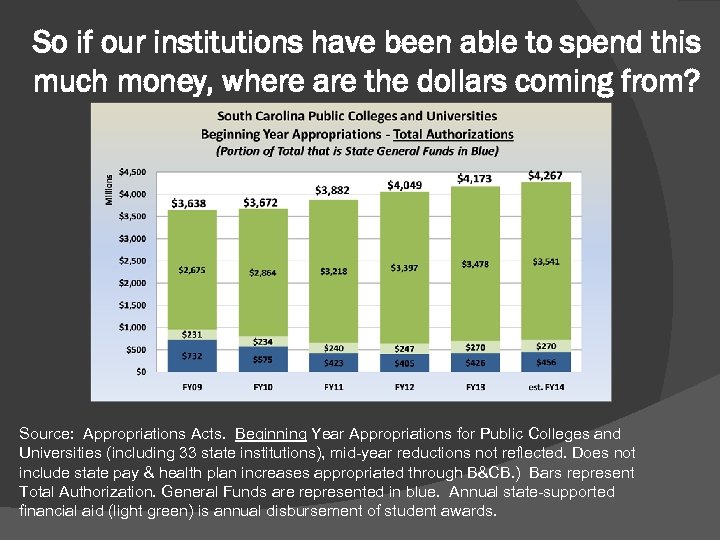
So if our institutions have been able to spend this much money, where are the dollars coming from? $3, 881 $3, 638 $4, 049 $4, 174 $4, 267 $3, 673 Source: Appropriations Acts. Beginning Year Appropriations for Public Colleges and Universities (including 33 state institutions), mid-year reductions not reflected. Does not include state pay & health plan increases appropriated through B&CB. ) Bars represent Total Authorization. General Funds are represented in blue. Annual state-supported financial aid (light green) is annual disbursement of student awards.
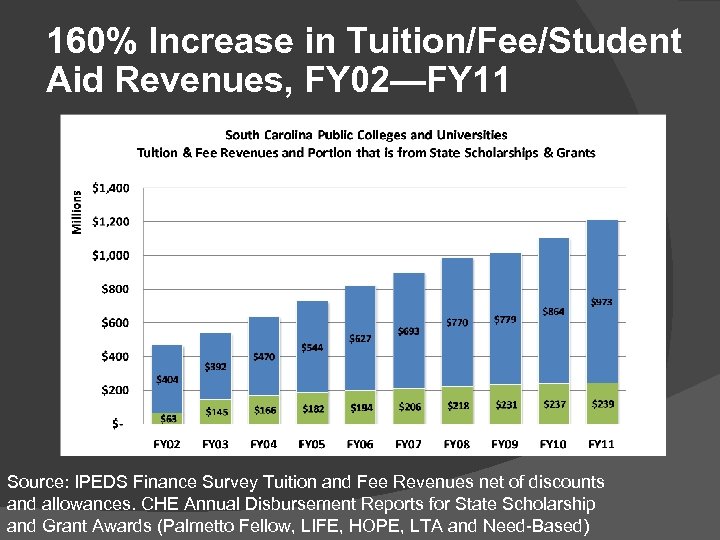
160% Increase in Tuition/Fee/Student Aid Revenues, FY 02—FY 11 Source: IPEDS Finance Survey Tuition and Fee Revenues net of discounts and allowances. CHE Annual Disbursement Reports for State Scholarship and Grant Awards (Palmetto Fellow, LIFE, HOPE, LTA and Need-Based)
Operating Revenues by Category* Source: IPEDS Peer Analysis Tool, Finance Survey. Operating revenues and state, federal and local appropriations. For Clemson and SC State, PSA is included. Capital and non-operating revenues except appropriations are not included.
Concluding Thought #1: Facilities and Enrollment are Inter-related New E&G facilities construction is actually well aligned with enrollment growth over past decade Expansion on existing campuses far more reasonable and cost-effective to accommodate growth Well-designed construction projects are good for the state, prepare for future, create jobs
Concluding Thought #2: Re. Design the HE Business Model Debt loads are growing and need to be monitored closely in funding decisions Tuition/fees will continue to increase unless recurring state appropriations are restored State scholarship funding needs to be re-designed Planned integration is preferable to forced consolidation
Concluding Thought #3: Build a New Compact among All Stakeholders All parties—not just state government & universities—must share responsibility for mutual success. If SC doesn’t re-value higher education upwards, it will lose the long-term global economic game. The consequences for the state will be debilitating. If SC doesn’t find better ways to educate its citizens beyond bricks-&-mortar modalities, we will sacrifice generations of learners (both young and old) If SC doesn’t design a better process to support higher education, this conversation will not have contributed to a broader purpose
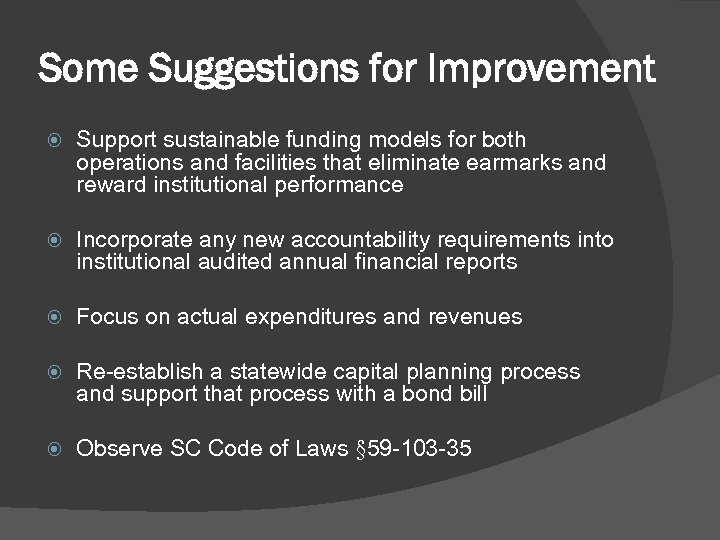
Some Suggestions for Improvement Support sustainable funding models for both operations and facilities that eliminate earmarks and reward institutional performance Incorporate any new accountability requirements into institutional audited annual financial reports Focus on actual expenditures and revenues Re-establish a statewide capital planning process and support that process with a bond bill Observe SC Code of Laws § 59 -103 -35
Thanks for your attention Comments & Questions?
Скачать презентацию K-16 Building Need and Utilization Study Committee S
ff7cb43c50339e22911fd7d559d43583.ppt