 Скачать презентацию K-12 Finance Depth Breadth and Causes of a
6c1e9e03282cb6b8d72cdd428a48cad2.ppt
- Количество слайдов: 65



K-12 Finance: Depth, Breadth, and Causes of a Looming Finance Crisis 1. 2. 3. 4. 5. What is the Basic Education Finance Task Force? What is the financial outlook for school districts? What are the funding shortfalls? What solutions are proposed? What are some implications for school finance redesign? Office of Superintendent of Public Instruction
Basic Education Finance Task Force Office of Superintendent of Public Instruction 2
Basics of the Basic Education Finance Task Force • SB 5627: This act is intended to make provisions for some significant steps towards a new basic education funding system by establishing a joint task force to address the details and next steps beyond the 2007 -2009 biennium necessary to implement a new comprehensive K-12 finance formula or formulas. The formula(s) will provide Washington schools with stable and adequate funding as the expectations for the K-12 system continue to evolve. Office of Superintendent of Public Instruction 3
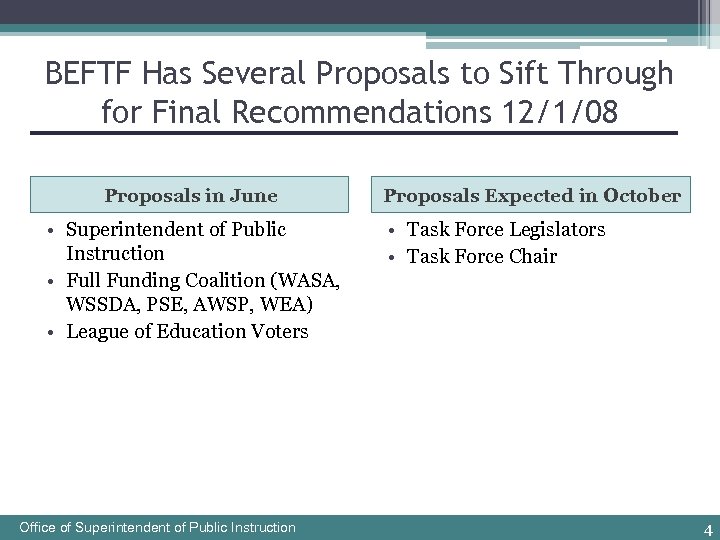
BEFTF Has Several Proposals to Sift Through for Final Recommendations 12/1/08 Proposals in June • Superintendent of Public Instruction • Full Funding Coalition (WASA, WSSDA, PSE, AWSP, WEA) • League of Education Voters Office of Superintendent of Public Instruction Proposals Expected in October • Task Force Legislators • Task Force Chair 4
Financial Outlook for Districts Office of Superintendent of Public Instruction 5
K-12 Financial Outlook Why do school districts’ budget problems seem deeper and more widespread than in past years? 1. In the recent past, how were districts balancing budgets? 2. What is the magnitude of the problem for 2008 -09 school year and beyond? Office of Superintendent of Public Instruction 6
State Underfunding Pushes Costs Onto Maxed-Out Local Funds • Local Funds are typically levy and local effort assistance (LEA) dollars ▫ Includes Federal and I-728 funds in this analysis ▫ Common elements: discretionary, not state basic education, do not inflate with staffing-based costs • Local Funds are commonly thought to employ “enhancement” staff and programs • In reality, Local Funds cover major state-funding shortfalls • Local Funds increases barely cover compensation increases for levy, federal, and I-728 employees • State and local funds increase too slowly to cover compensation plus all of the other emergencies and pressures to improve student achievement Office of Superintendent of Public Instruction 7
How Have Districts Balanced Their Budgets in the Last Few Years? 2000 -2008 2009 and Beyond • Reduction in pension rates saved $364 million • 2003 -05 COLA suspension (3. 1%) saved $187 million • Increases in I-728 revenue and federal funding totaled $614 million • Increase in levy authority to recognize I-732 suspension and I-728 delay • Pension rates increase • I-728 and federal dollars flatten • Local funds continue to support COLAs • Other costs continue to increase faster than inflation ▫ Health benefits ▫ Fuel • Levy authority increases an average of 5% • Levies approved to utilize 92% of authority Appendix slides quantify these statements. Office of Superintendent of Public Instruction 8
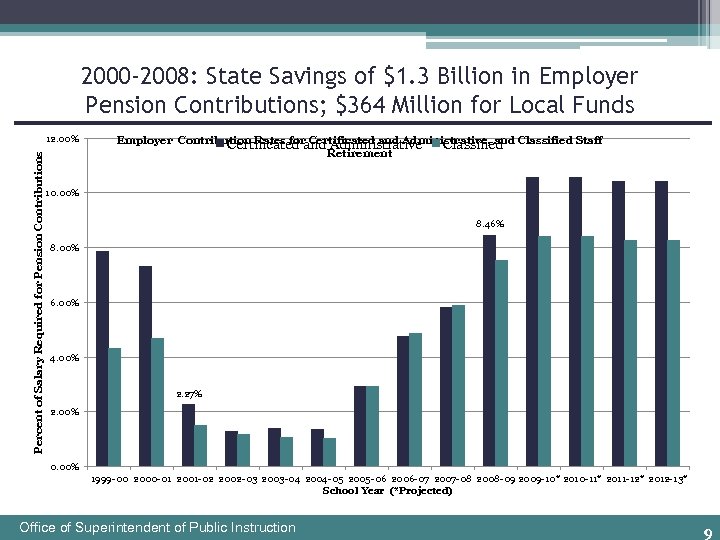
2000 -2008: State Savings of $1. 3 Billion in Employer Pension Contributions; $364 Million for Local Funds Percent of Salary Required for Pension Contributions 12. 00% Employer Contribution Rates for Certificated and Administrative, and Classified Staff Certificated and Administrative Classified Retirement 10. 00% 8. 46% 8. 00% 6. 00% 4. 00% 2. 27% 2. 00% 0. 00% 1999 -00 2000 -01 2001 -02 2002 -03 2003 -04 2004 -05 2005 -06 2006 -07 2007 -08 2008 -09 2009 -10* 2010 -11* 2011 -12* 2012 -13* School Year (*Projected) Office of Superintendent of Public Instruction 9
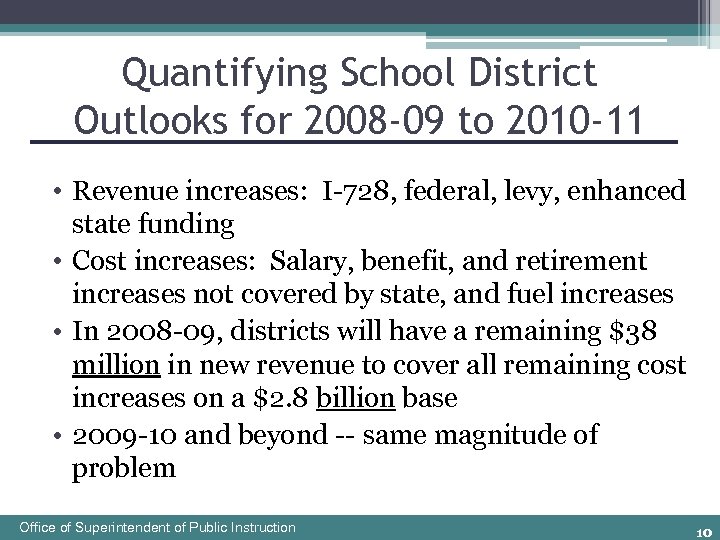
Quantifying School District Outlooks for 2008 -09 to 2010 -11 • Revenue increases: I-728, federal, levy, enhanced state funding • Cost increases: Salary, benefit, and retirement increases not covered by state, and fuel increases • In 2008 -09, districts will have a remaining $38 million in new revenue to cover all remaining cost increases on a $2. 8 billion base • 2009 -10 and beyond -- same magnitude of problem Office of Superintendent of Public Instruction 10
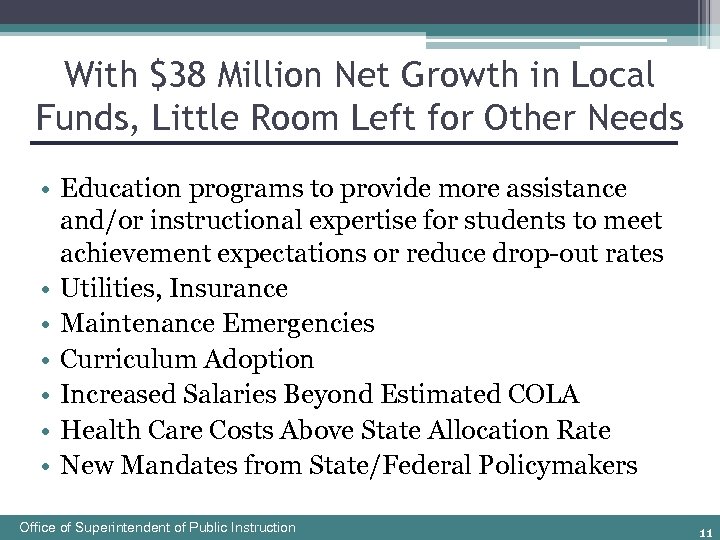
With $38 Million Net Growth in Local Funds, Little Room Left for Other Needs • Education programs to provide more assistance and/or instructional expertise for students to meet achievement expectations or reduce drop-out rates • Utilities, Insurance • Maintenance Emergencies • Curriculum Adoption • Increased Salaries Beyond Estimated COLA • Health Care Costs Above State Allocation Rate • New Mandates from State/Federal Policymakers Office of Superintendent of Public Instruction 11
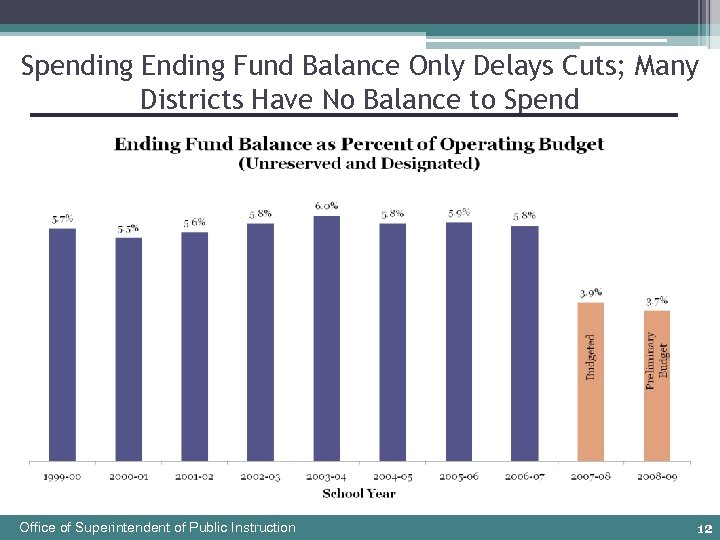
Spending Ending Fund Balance Only Delays Cuts; Many Districts Have No Balance to Spend Office of Superintendent of Public Instruction 12
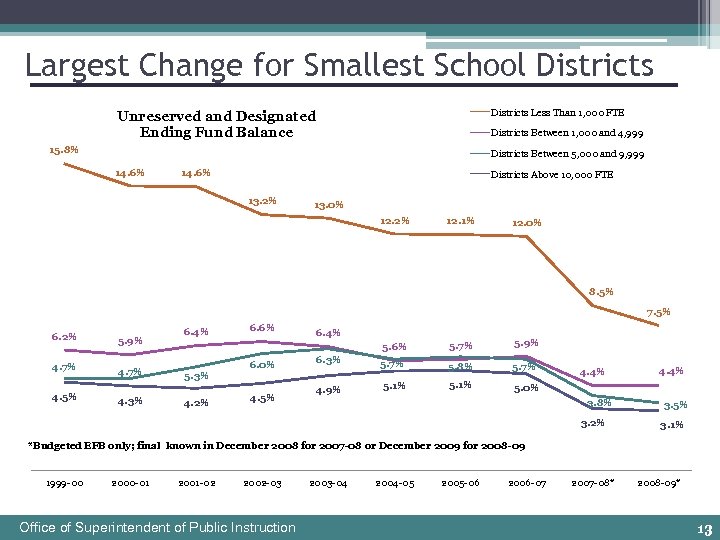
Largest Change for Smallest School Districts Less Than 1, 000 FTE Unreserved and Designated Ending Fund Balance Districts Between 1, 000 and 4, 999 15. 8% Districts Between 5, 000 and 9, 999 14. 6% Districts Above 10, 000 FTE 13. 2% 13. 0% 12. 2% 12. 1% 12. 0% 8. 5% 7. 5% 6. 2% 4. 7% 4. 5% 5. 9% 4. 7% 4. 3% 6. 4% 6. 6% 6. 4% 5. 6% 6. 0% 6. 3% 5. 3% 4. 2% 4. 5% 4. 9% 5. 7% 5. 8% 5. 7% 5. 1% 5. 0% 4. 4% 3. 8% 3. 2% 4. 4% 3. 5% 3. 1% *Budgeted EFB only; final known in December 2008 for 2007 -08 or December 2009 for 2008 -09 1999 -00 2000 -01 2001 -02 2002 -03 Office of Superintendent of Public Instruction 2003 -04 2004 -05 2005 -06 2006 -07 2007 -08* 2008 -09* 13
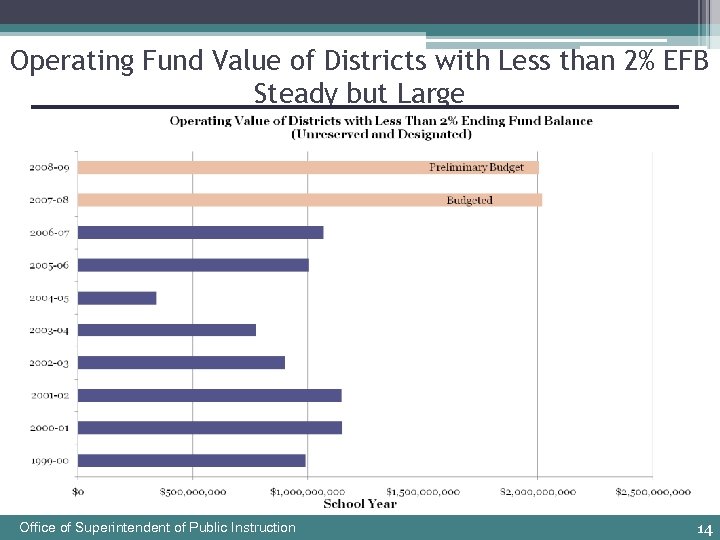
Operating Fund Value of Districts with Less than 2% EFB Steady but Large Office of Superintendent of Public Instruction 14
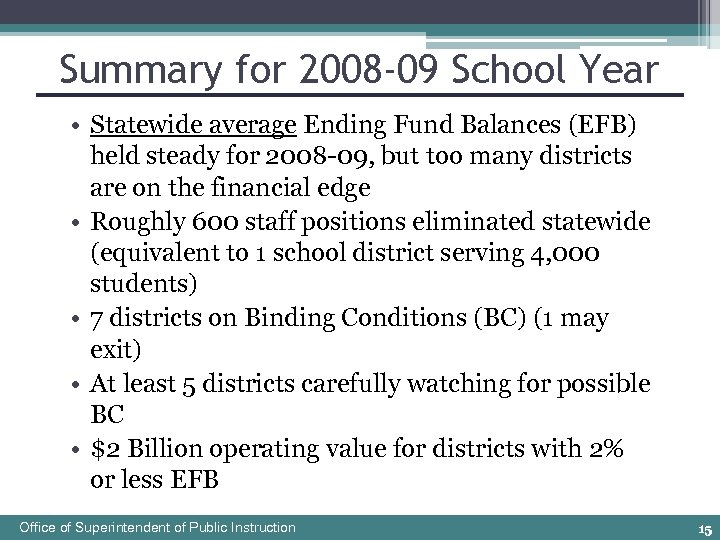
Summary for 2008 -09 School Year • Statewide average Ending Fund Balances (EFB) held steady for 2008 -09, but too many districts are on the financial edge • Roughly 600 staff positions eliminated statewide (equivalent to 1 school district serving 4, 000 students) • 7 districts on Binding Conditions (BC) (1 may exit) • At least 5 districts carefully watching for possible BC • $2 Billion operating value for districts with 2% or less EFB Office of Superintendent of Public Instruction 15
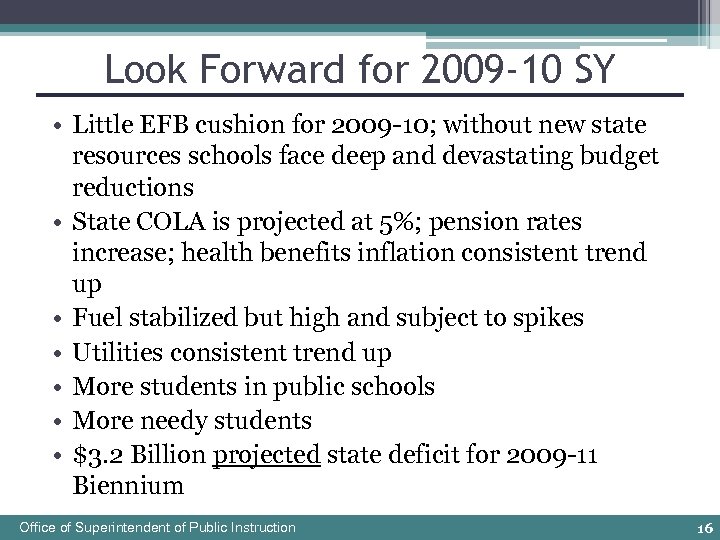
Look Forward for 2009 -10 SY • Little EFB cushion for 2009 -10; without new state resources schools face deep and devastating budget reductions • State COLA is projected at 5%; pension rates increase; health benefits inflation consistent trend up • Fuel stabilized but high and subject to spikes • Utilities consistent trend up • More students in public schools • More needy students • $3. 2 Billion projected state deficit for 2009 -11 Biennium Office of Superintendent of Public Instruction 16
What Are the State Funding Shortfalls That Drive District Budget Reductions? What Solutions are Proposed? Office of Superintendent of Public Instruction 17
State Underfunding is Not Disputed • Questions to answer: ▫ What is the appropriate definition of basic education? ▫ Will that definition fix the shortfalls between district reality and state funding? Office of Superintendent of Public Instruction 18
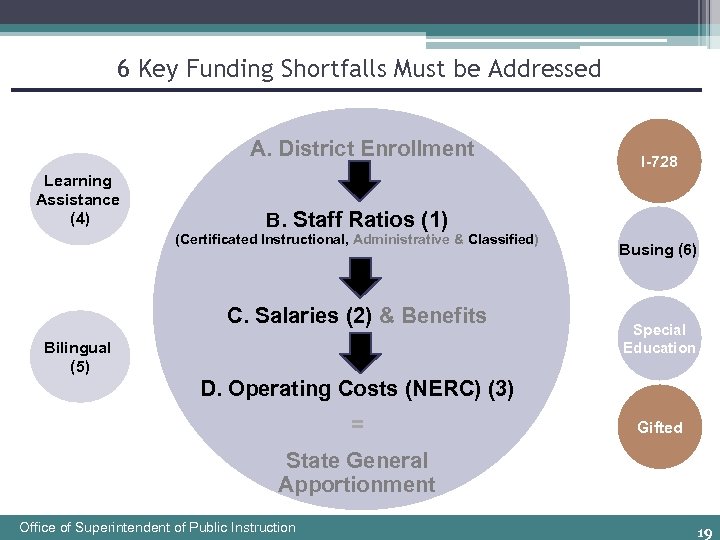
6 Key Funding Shortfalls Must be Addressed A. District Enrollment Learning Assistance (4) I-728 B. Staff Ratios (1) (Certificated Instructional, Administrative & Classified) C. Salaries (2) & Benefits Bilingual (5) Busing (6) Special Education D. Operating Costs (NERC) (3) = Gifted State General Apportionment Office of Superintendent of Public Instruction 19
Resource Level vs. Funding Formula • Formula(s) must: ▫ Drive the right resource ▫ Account for district differences ▫ Provide stable and ample funding for decades • More critical that BEFTF recommendations specifically identify the resource that must be driven by a formula ▫ Re-defining the basic education resource that represents ample funding of a stable, general and uniform public school system is the fundamental change required ▫ Without a specific set of resource recommendations, future Legislatures can implement the TF formula design but at an inadequate funding level Office of Superintendent of Public Instruction 20
Foundation Staffing Ratios (1) A. Certificated Instructional Staff B. Classified Staff Office of Superintendent of Public Instruction 21
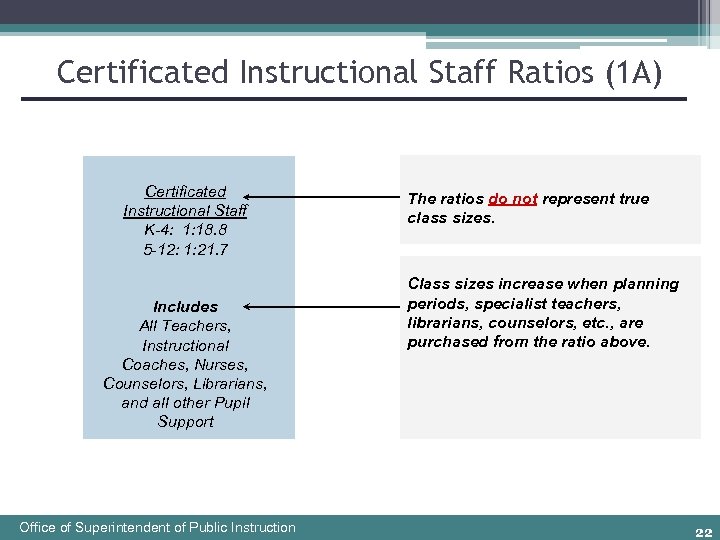
Certificated Instructional Staff Ratios (1 A) Certificated Instructional Staff K-4: 1: 18. 8 5 -12: 1: 21. 7 Includes All Teachers, Instructional Coaches, Nurses, Counselors, Librarians, and all other Pupil Support Office of Superintendent of Public Instruction The ratios do not represent true class sizes. Class sizes increase when planning periods, specialist teachers, librarians, counselors, etc. , are purchased from the ratio above. 22
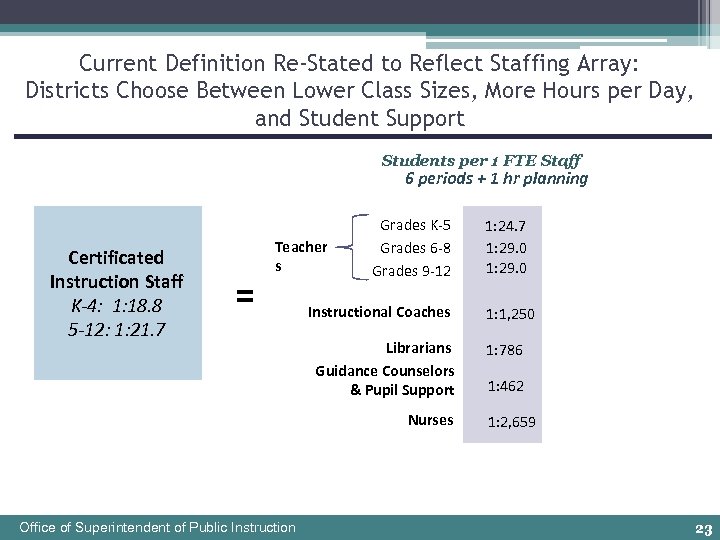
Current Definition Re-Stated to Reflect Staffing Array: Districts Choose Between Lower Class Sizes, More Hours per Day, and Student Support Students per 1 FTE Staff 6 periods + 1 hr planning Certificated Instruction Staff K-4: 1: 18. 8 5 -12: 1: 21. 7 = Teacher s Grades K-5 Grades 6 -8 Grades 9 -12 Instructional Coaches Librarians Guidance Counselors & Pupil Support Nurses Office of Superintendent of Public Instruction 1: 24. 7 1: 29. 0 1: 1, 250 1: 786 1: 462 1: 2, 659 23
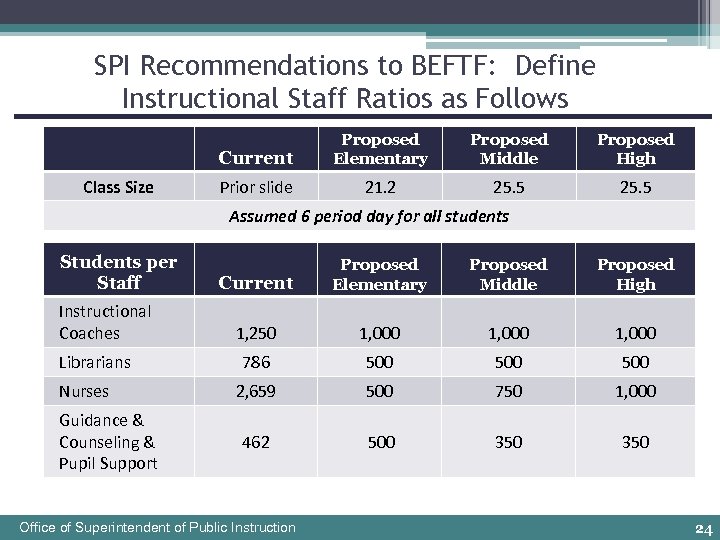
SPI Recommendations to BEFTF: Define Instructional Staff Ratios as Follows Current Class Size Proposed Elementary Proposed Middle Proposed High Prior slide 21. 2 25. 5 Assumed 6 period day for all students Students per Staff Instructional Coaches Librarians Nurses Guidance & Counseling & Pupil Support Current Proposed Elementary Proposed Middle Proposed High 1, 250 1, 000 786 500 500 2, 659 500 750 1, 000 462 500 350 Office of Superintendent of Public Instruction 24
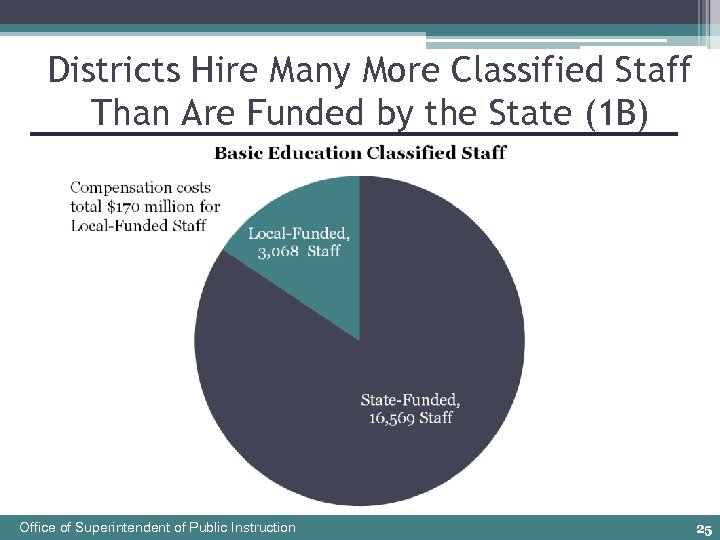
Districts Hire Many More Classified Staff Than Are Funded by the State (1 B) Office of Superintendent of Public Instruction 25
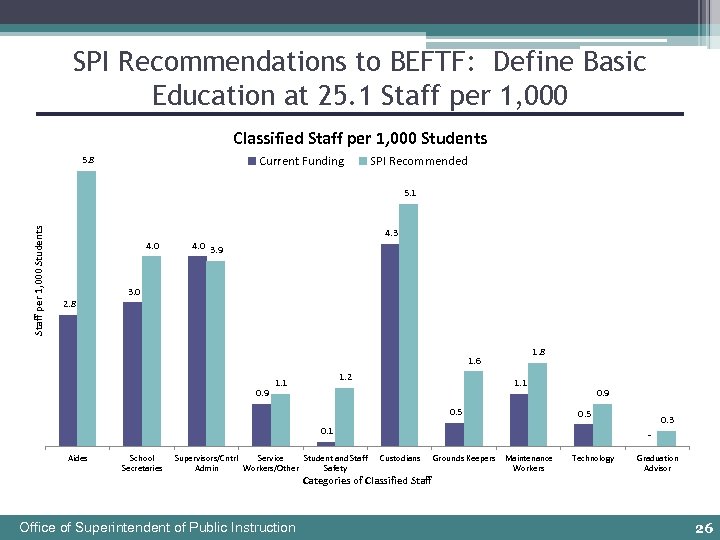
SPI Recommendations to BEFTF: Define Basic Education at 25. 1 Staff per 1, 000 Classified Staff per 1, 000 Students Current Funding 5. 8 SPI Recommended Staff per 1, 000 Students 5. 1 4. 0 4. 3 4. 0 3. 9 3. 0 2. 8 1. 6 0. 9 1. 2 1. 1 0. 5 0. 9 0. 5 0. 1 Aides School Secretaries Supervisors/Cntrl Service Student and Staff Admin Workers/Other Safety Office of Superintendent of Public Instruction 0. 3 - Custodians Categories of Classified Staff Grounds Keepers Maintenance Workers Technology Graduation Advisor 26
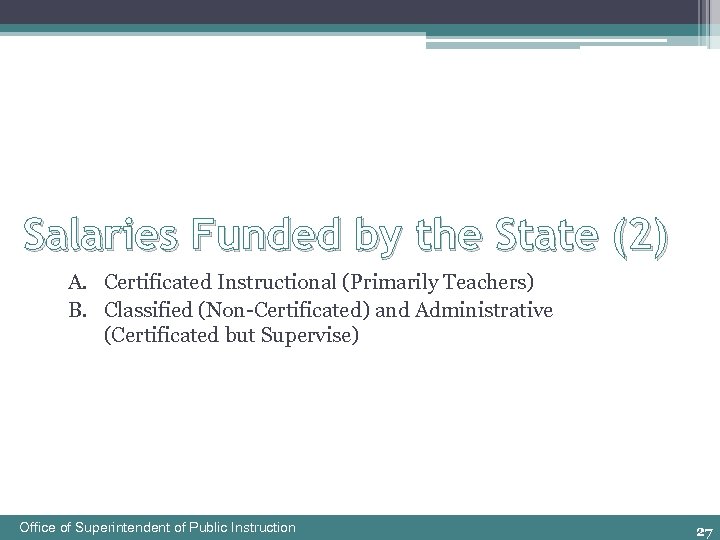
Salaries Funded by the State (2) A. Certificated Instructional (Primarily Teachers) B. Classified (Non-Certificated) and Administrative (Certificated but Supervise) Office of Superintendent of Public Instruction 27
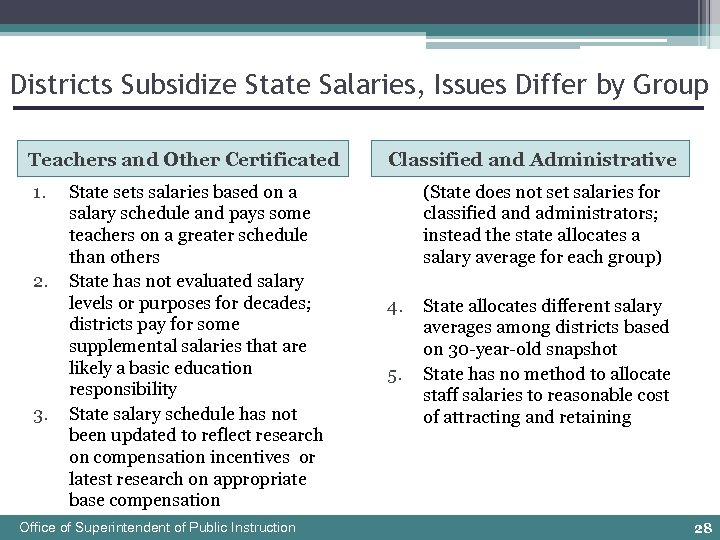
Districts Subsidize State Salaries, Issues Differ by Group Teachers and Other Certificated 1. 2. 3. State sets salaries based on a salary schedule and pays some teachers on a greater schedule than others State has not evaluated salary levels or purposes for decades; districts pay for some supplemental salaries that are likely a basic education responsibility State salary schedule has not been updated to reflect research on compensation incentives or latest research on appropriate base compensation Office of Superintendent of Public Instruction Classified and Administrative (State does not set salaries for classified and administrators; instead the state allocates a salary average for each group) 4. 5. State allocates different salary averages among districts based on 30 -year-old snapshot State has no method to allocate staff salaries to reasonable cost of attracting and retaining 28
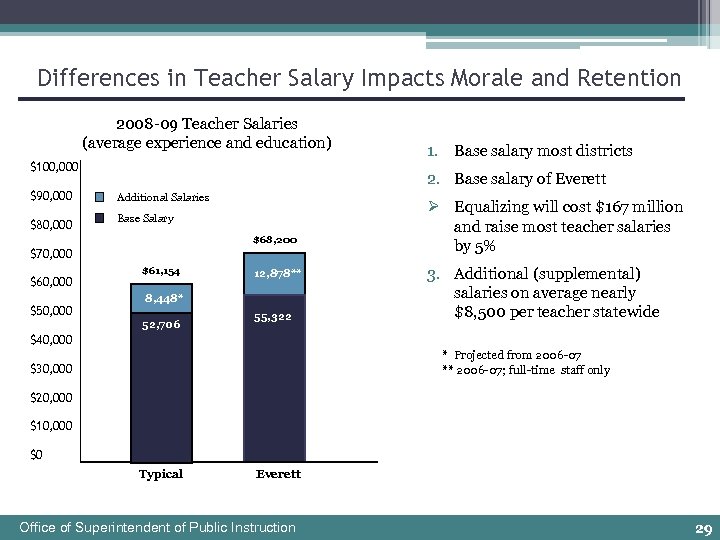
Differences in Teacher Salary Impacts Morale and Retention 2008 -09 Teacher Salaries (average experience and education) $100, 000 $90, 000 $80, 000 2. Base salary of Everett Additional Salaries Base Salary $68, 200 $70, 000 $60, 000 $50, 000 1. Base salary most districts $61, 154 12, 878** 8, 448* 52, 706 55, 322 Ø Equalizing will cost $167 million and raise most teacher salaries by 5% 3. Additional (supplemental) salaries on average nearly $8, 500 per teacher statewide $40, 000 * Projected from 2006 -07 ** 2006 -07; full-time staff only $30, 000 $20, 000 $10, 000 $0 Typical Everett Office of Superintendent of Public Instruction 29
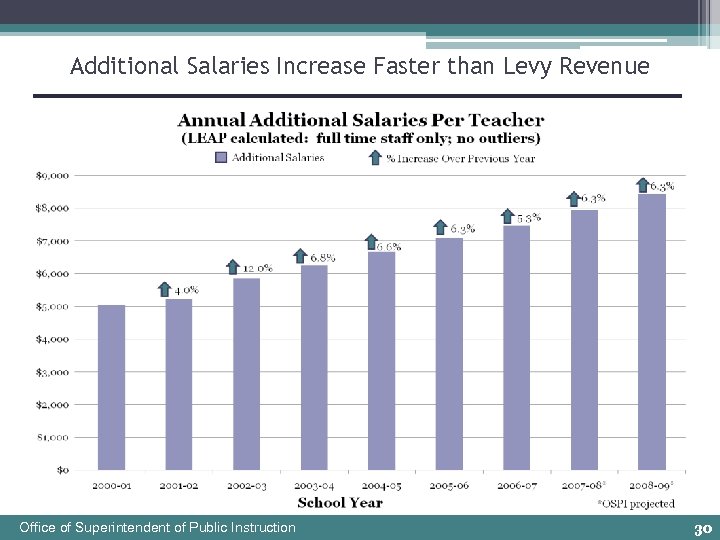
Additional Salaries Increase Faster than Levy Revenue Office of Superintendent of Public Instruction 30
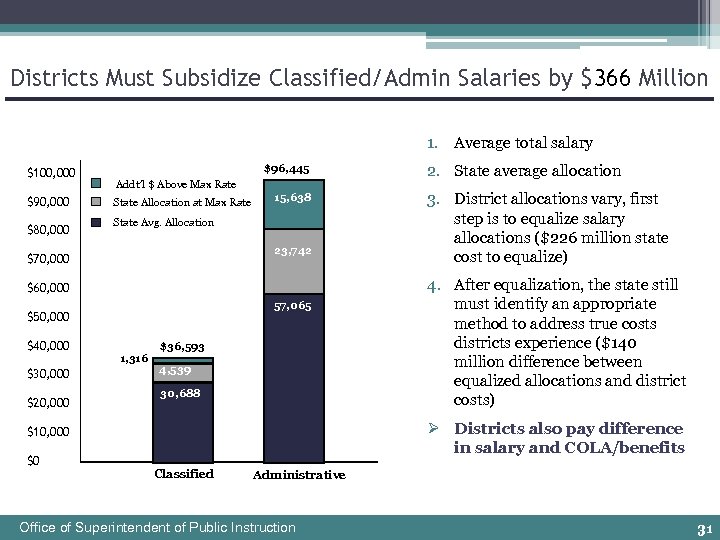
Districts Must Subsidize Classified/Admin Salaries by $366 Million 1. Average total salary $100, 000 $90, 000 $80, 000 $96, 445 Addt’l $ Above Max Rate State Allocation at Max Rate 15, 638 State Avg. Allocation 23, 742 $70, 000 $60, 000 57, 065 $50, 000 $40, 000 $30, 000 $20, 000 1, 316 $36, 593 4, 539 30, 688 3. District allocations vary, first step is to equalize salary allocations ($226 million state cost to equalize) 4. After equalization, the state still must identify an appropriate method to address true costs districts experience ($140 million difference between equalized allocations and district costs) Ø Districts also pay difference in salary and COLA/benefits $10, 000 $0 2. State average allocation Classified Administrative Office of Superintendent of Public Instruction 31
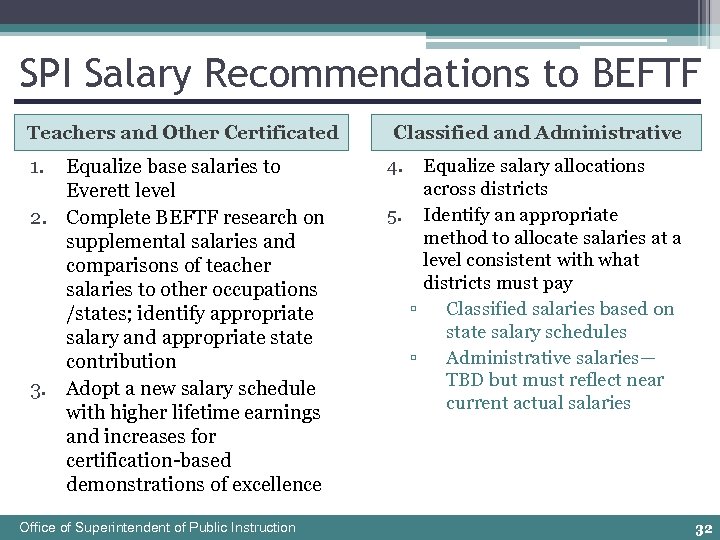
SPI Salary Recommendations to BEFTF Teachers and Other Certificated 1. Equalize base salaries to Everett level 2. Complete BEFTF research on supplemental salaries and comparisons of teacher salaries to other occupations /states; identify appropriate salary and appropriate state contribution 3. Adopt a new salary schedule with higher lifetime earnings and increases for certification-based demonstrations of excellence Office of Superintendent of Public Instruction Classified and Administrative 4. Equalize salary allocations across districts 5. Identify an appropriate method to allocate salaries at a level consistent with what districts must pay ▫ Classified salaries based on state salary schedules ▫ Administrative salaries— TBD but must reflect near current actual salaries 32
Non-Employee Related Costs (NERC) (3) Office of Superintendent of Public Instruction 33
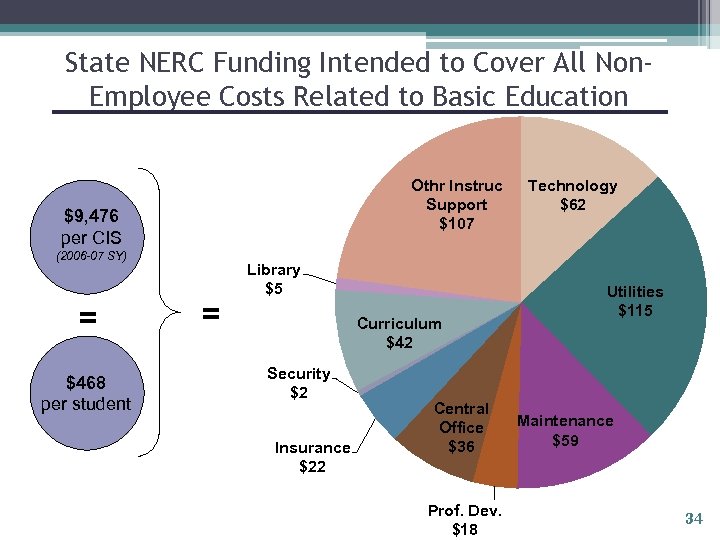
State NERC Funding Intended to Cover All Non. Employee Costs Related to Basic Education Othr Instruc Support $107 $9, 476 per CIS (2006 -07 SY) = $468 per student = Library $5 Curriculum $42 Security $2 Insurance $22 Central Office $36 Prof. Dev. $18 Technology $62 Utilities $115 Maintenance $59 34
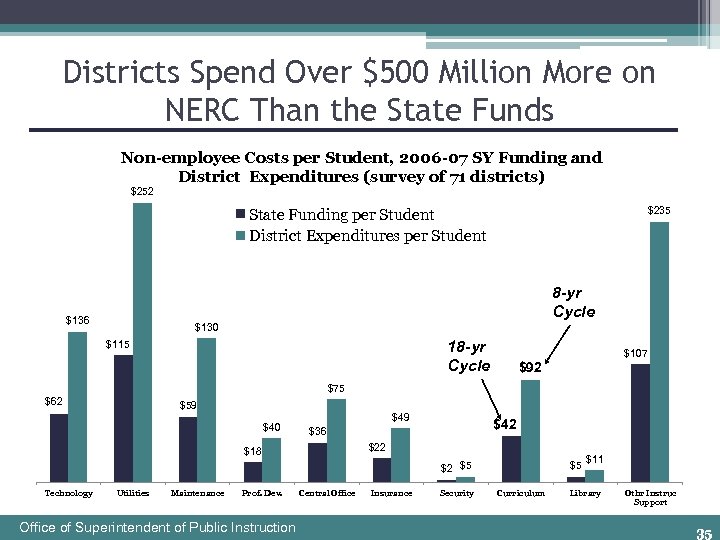
Districts Spend Over $500 Million More on NERC Than the State Funds Non-employee Costs per Student, 2006 -07 SY Funding and District Expenditures (survey of 71 districts) $252 $235 State Funding per Student District Expenditures per Student 8 -yr Cycle $136 $130 18 -yr Cycle $115 $107 $92 $75 $62 $59 $40 $49 $42 $36 $22 $18 $5 $2 $5 Technology Utilities Maintenance Prof. Dev. Office of Superintendent of Public Instruction Central Office Insurance Security Curriculum $11 Library Othr Instruc Support 35
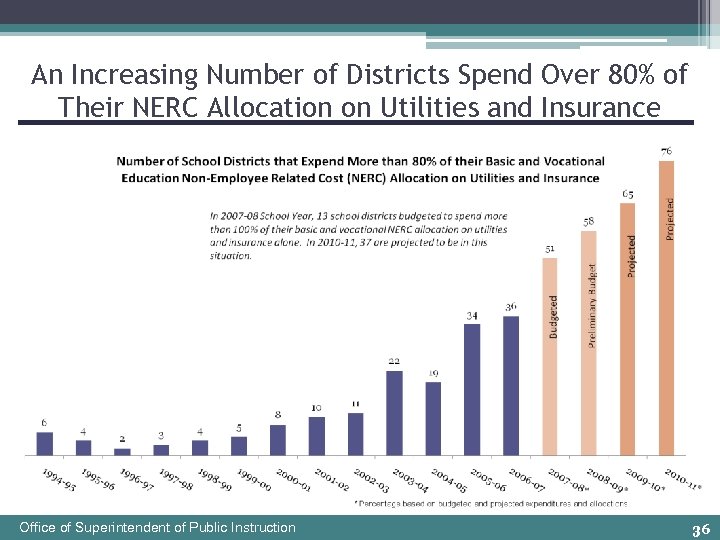
An Increasing Number of Districts Spend Over 80% of Their NERC Allocation on Utilities and Insurance Office of Superintendent of Public Instruction 36
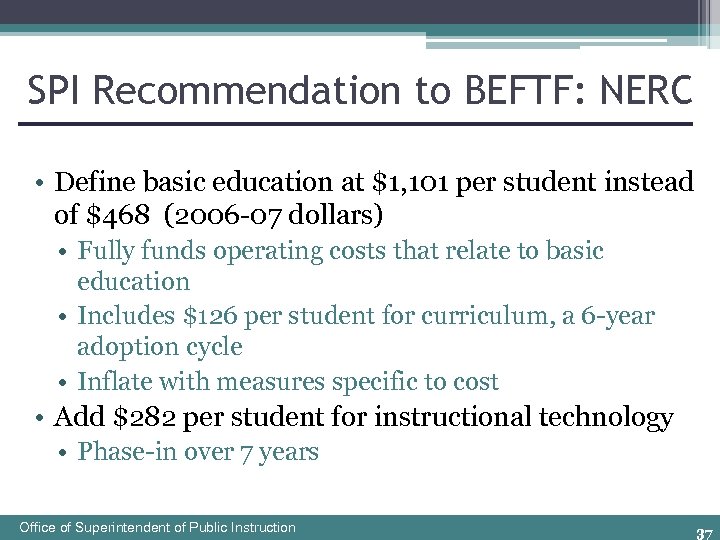
SPI Recommendation to BEFTF: NERC • Define basic education at $1, 101 per student instead of $468 (2006 -07 dollars) • Fully funds operating costs that relate to basic education • Includes $126 per student for curriculum, a 6 -year adoption cycle • Inflate with measures specific to cost • Add $282 per student for instructional technology • Phase-in over 7 years Office of Superintendent of Public Instruction 37
Learning Assistance Program (4) Office of Superintendent of Public Instruction 38
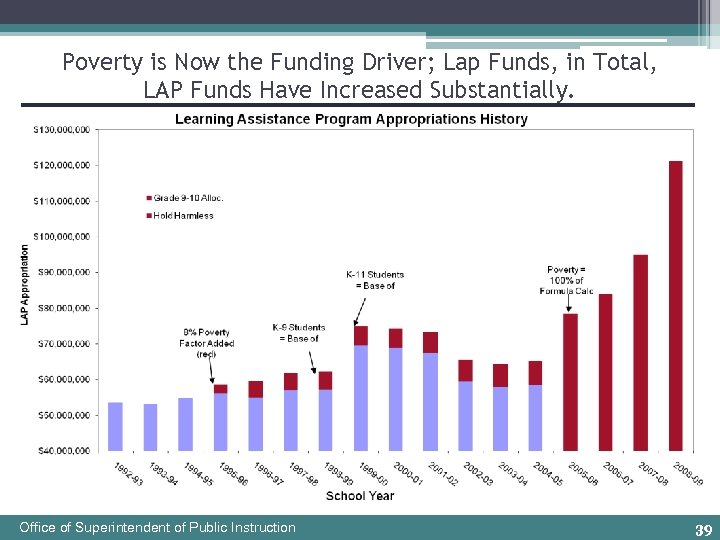
Poverty is Now the Funding Driver; Lap Funds, in Total, LAP Funds Have Increased Substantially. Office of Superintendent of Public Instruction 39
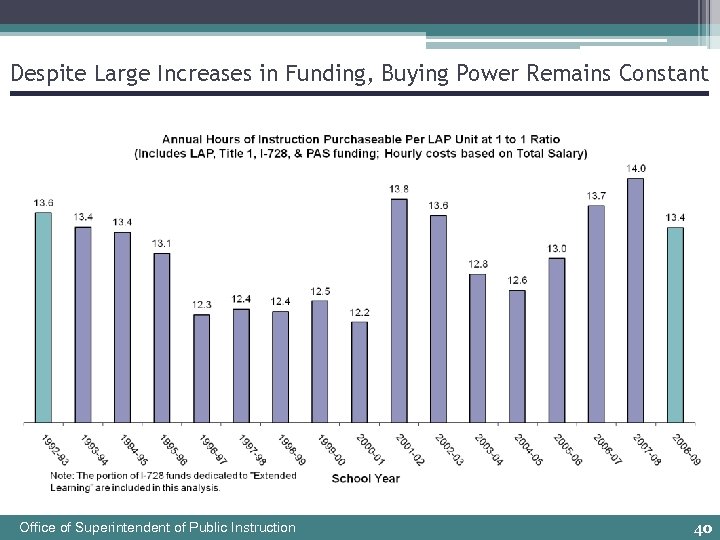
Despite Large Increases in Funding, Buying Power Remains Constant Office of Superintendent of Public Instruction 40
Current LAP Funding Must be Redefined • LAP/Title 1/I-728/PAS buying-power (teacher hours) is roughly the same as in 1992 -93 • Learning Assistance Program (LAP) allocates 3. 46 staff units per 1, 000 poverty students (1 staff per 289 poverty students) • This equates to a teacher spending 30 minutes per day with groups of 28 struggling students ▫ No resource for materials, program support or professional development Office of Superintendent of Public Instruction 41
SPI Recommendation to BEFTF: LAP Redefine the LAP formula with 6 formula components based on successful programs: 1. Reduce class sizes for severe poverty districts Immediate class size reduction for poorest students; general staffing ratios may be implemented slowly 2. Hire teachers for small group tutoring (10% of students + more as poverty increases) Groups of 15 students for 1 teacher, 30 to 50 minutes per day 3. Hire teachers for intensive tutoring (1% of students + poverty) Groups of 3 students for 1 teacher, 30 to 50 minutes per day 4. Add program administrative support 5. Provide professional development for the teacher staffing units driven by parts 1, 2, 3, and 4 6. Buy instructional materials Office of Superintendent of Public Instruction 42
LAP Recommendations Continued • • LAP must remain a “basic education” program Must be a staffing model or risk losing teacher buying power • Must be based on a model of service proven successful • Categorical allocation from state to school district ▫ Districts can implement a different model, hire different mix of staff ▫ Districts decide how to allocate among schools ▫ Must serve struggling students • $325 M increase over current funding ▫ I-728 currently pays for a portion of this now Office of Superintendent of Public Instruction 43
Support for English Language Learners (5) Office of Superintendent of Public Instruction 44
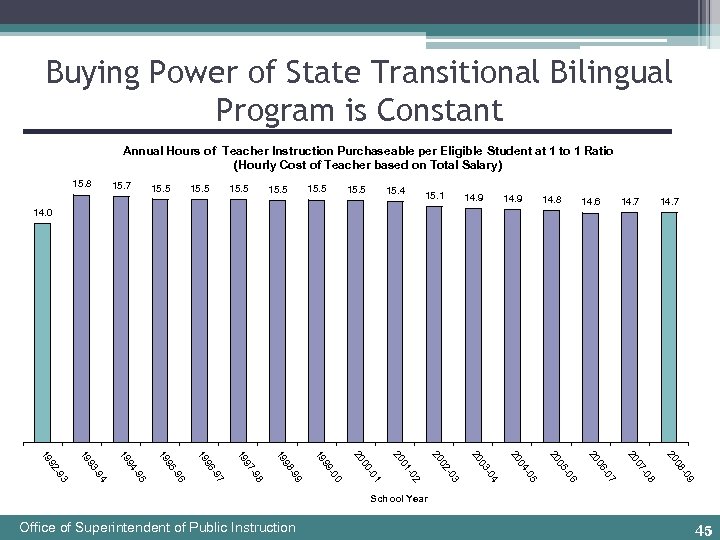
Buying Power of State Transitional Bilingual Program is Constant Annual Hours of Teacher Instruction Purchaseable per Eligible Student at 1 to 1 Ratio (Hourly Cost of Teacher based on Total Salary) 15. 8 15. 4 14. 8 14. 6 14. 7 9 -0 8 -0 7 -0 6 -0 05 5 -0 04 4 -0 03 3 -0 02 2 -0 01 20 1 -0 00 20 0 -0 99 19 9 -9 98 19 8 -9 97 19 7 -9 96 19 6 -9 95 19 5 -9 94 19 4 -9 93 19 3 -9 92 19 08 14. 9 07 14. 9 14. 0 06 15. 1 20 15. 5 20 15. 7 School Year Office of Superintendent of Public Instruction 45
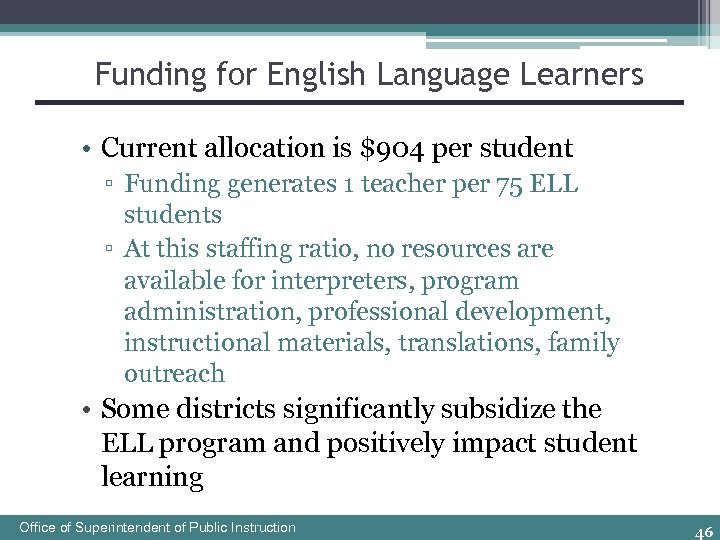
Funding for English Language Learners • Current allocation is $904 per student ▫ Funding generates 1 teacher per 75 ELL students ▫ At this staffing ratio, no resources are available for interpreters, program administration, professional development, instructional materials, translations, family outreach • Some districts significantly subsidize the ELL program and positively impact student learning Office of Superintendent of Public Instruction 46
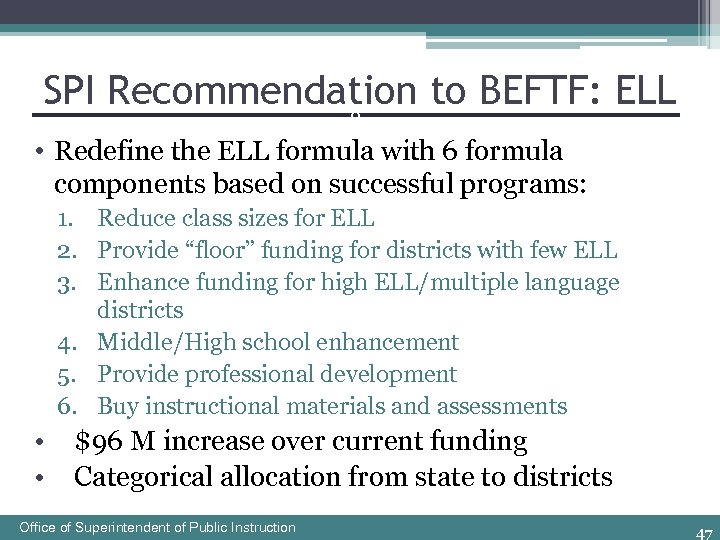
SPI Recommendation to BEFTF: ELL 0 • Redefine the ELL formula with 6 formula components based on successful programs: 1. Reduce class sizes for ELL 2. Provide “floor” funding for districts with few ELL 3. Enhance funding for high ELL/multiple language districts 4. Middle/High school enhancement 5. Provide professional development 6. Buy instructional materials and assessments • • $96 M increase over current funding Categorical allocation from state to districts Office of Superintendent of Public Instruction 47
Pupil Transportation (6) Office of Superintendent of Public Instruction 48
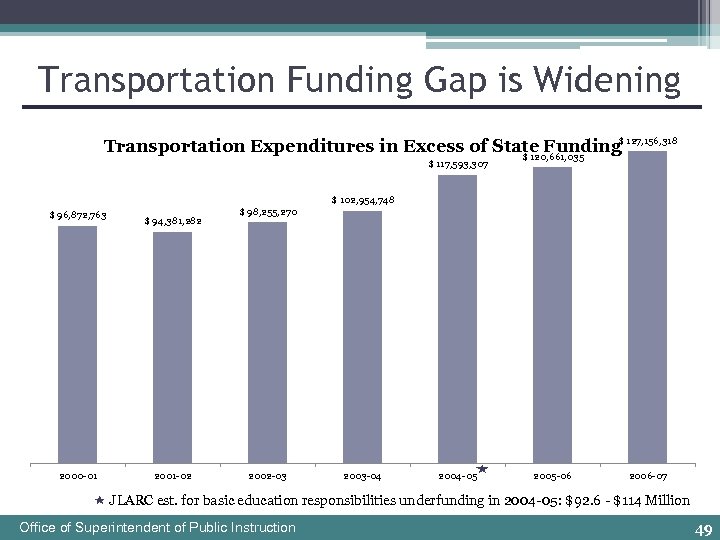
Transportation Funding Gap is Widening Transportation Expenditures in Excess of State Funding$ 127, 156, 318 $ 120, 661, 035 $ 117, 593, 307 $ 102, 954, 748 $ 96, 872, 763 2000 -01 $ 94, 381, 282 2001 -02 $ 98, 255, 270 2002 -03 2003 -04 2004 -05 2005 -06 2006 -07 JLARC est. for basic education responsibilities underfunding in 2004 -05: $92. 6 - $114 Million Office of Superintendent of Public Instruction 49
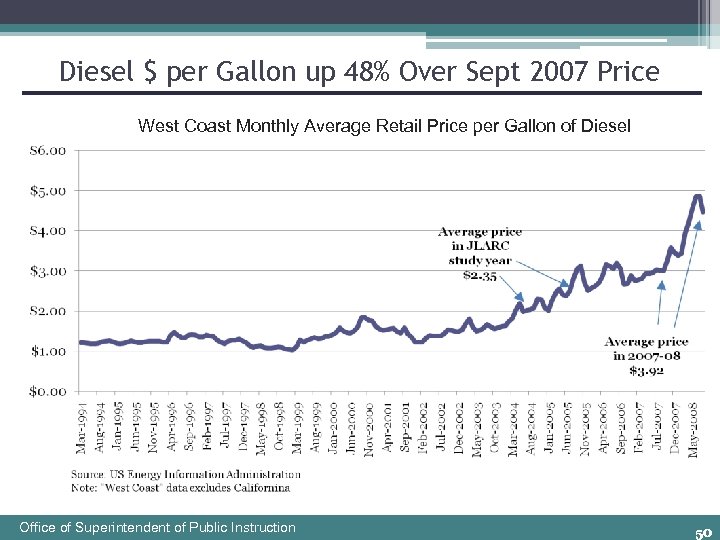
Diesel $ per Gallon up 48% Over Sept 2007 Price West Coast Monthly Average Retail Price per Gallon of Diesel Office of Superintendent of Public Instruction 50
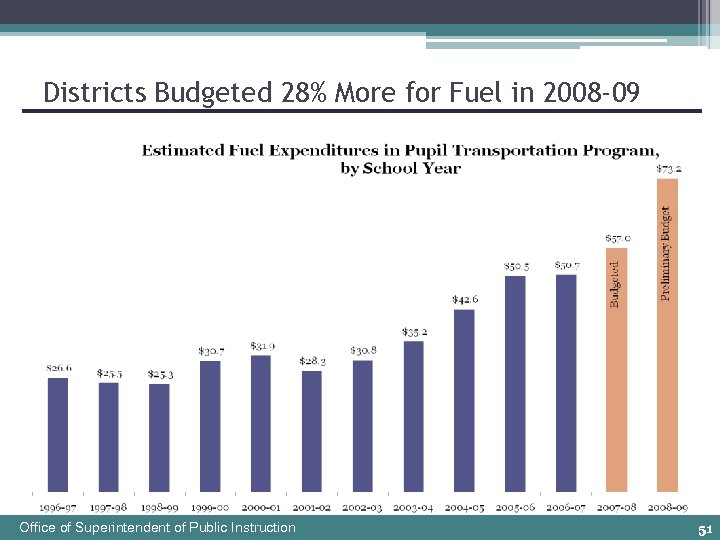
Districts Budgeted 28% More for Fuel in 2008 -09 Office of Superintendent of Public Instruction 51
Proposed Transportation Solutions and Timeline • Oct 1: 2 -3 formula options fully developed and presented to Advisory Committee • Nov 15: Final report to OFM/Legislature • Early December: Actual funding gap is known for basic education (to/from) transportation, 2007 -08 school year • Jan 15: OSPI completes modeling of district-bydistrict impact of 2 -3 formula options Office of Superintendent of Public Instruction 52
Implications for Next Steps in K-12 Finance Office of Superintendent of Public Instruction 53
Last Thoughts • Very few opportunities to redefine Basic Education • Basic Education shortfalls are so large, fixes will take many years ▫ Requires prioritization ▫ Much of the early investments do not buy new programs • Recommendations must address the resource level needed, but formula structure will drive district practice for decades ▫ General apportionment allocation vs. Categorical allocation • BEFTF needs specific recommendations ▫ What needs to be purchased and why? ▫ What is the formula that would drive this resource or where does it fit into a formula? ▫ What is the phase-in priority? Office of Superintendent of Public Instruction 54
Minimum Outcomes Needed from the BEFTF 1. Improve funding ratios for Certificated Instructional and Classified Staff 2. Salary Policy and Funding a) First, equalize classified and administrator allocations b) Then, allocate classified/administrator based on common-sense methods that cover actual costs c) Address state underfunding of teacher compensation d) Compensate teachers for excellence Office of Superintendent of Public Instruction 55
Minimum Outcomes Needed from the BEFTF 3. Improve funding level for NERC, inflate with common sense measures 4. Improve funding for LAP Staffing formula driven by instructional programming reality and informed by research 5. Improve funding for ELL Staffing formula driven by instructional reality and diverse community needs and informed by research 6. Implement a new formula with adequate funding for pupil transportation 7. Special Education New $ driven via components 1 -3 Office of Superintendent of Public Instruction 56
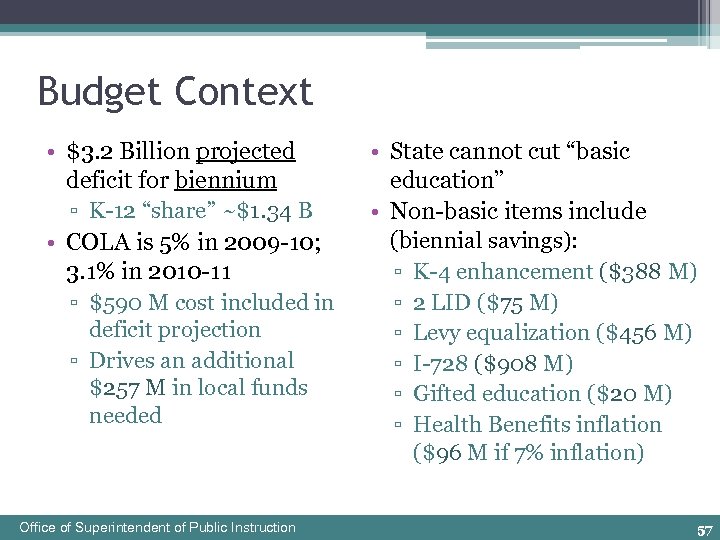
Budget Context • $3. 2 Billion projected deficit for biennium ▫ K-12 “share” ~$1. 34 B • COLA is 5% in 2009 -10; 3. 1% in 2010 -11 ▫ $590 M cost included in deficit projection ▫ Drives an additional $257 M in local funds needed • State cannot cut “basic education” • Non-basic items include (biennial savings): ▫ K-4 enhancement ($388 M) ▫ 2 LID ($75 M) ▫ Levy equalization ($456 M) ▫ I-728 ($908 M) ▫ Gifted education ($20 M) ▫ Health Benefits inflation ($96 M if 7% inflation) Office of Superintendent of Public Instruction 57
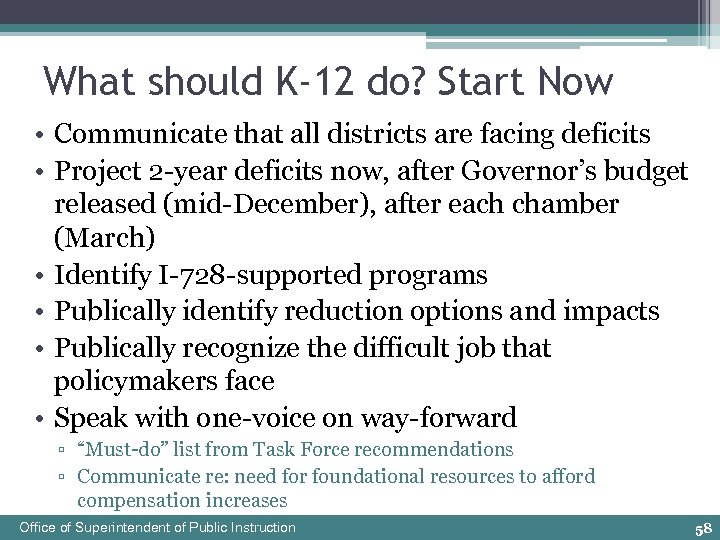
What should K-12 do? Start Now • Communicate that all districts are facing deficits • Project 2 -year deficits now, after Governor’s budget released (mid-December), after each chamber (March) • Identify I-728 -supported programs • Publically identify reduction options and impacts • Publically recognize the difficult job that policymakers face • Speak with one-voice on way-forward ▫ “Must-do” list from Task Force recommendations ▫ Communicate re: need for foundational resources to afford compensation increases Office of Superintendent of Public Instruction 58
For More Information • Jennifer Priddy: (360) 725 -6292, or by email, jennifer. priddy@k 12. wa. us • Superintendent Bergeson's BEFTF Proposal: http: //www. k 12. wa. us/Communications/Basic. E d. Funding. Task. Force. aspx • Basic Education Finance Task Force: http: //www. leg. wa. gov/Joint/Committees/BEF/ Office of Superintendent of Public Instruction 59
Appendix Office of Superintendent of Public Instruction 60
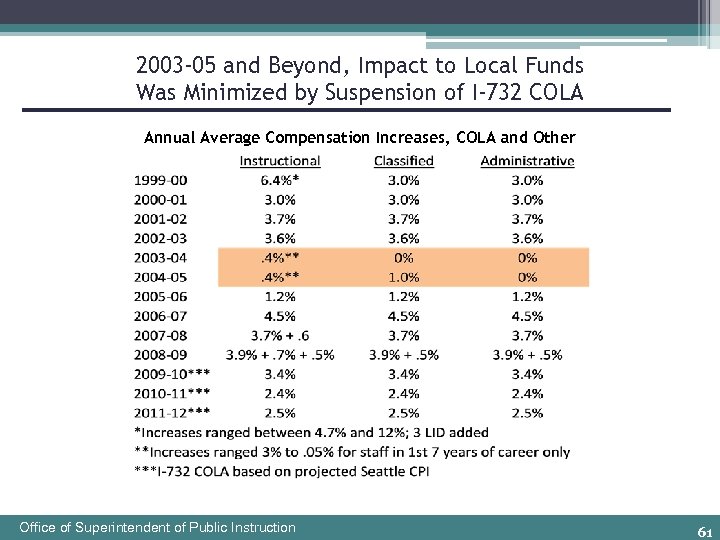
2003 -05 and Beyond, Impact to Local Funds Was Minimized by Suspension of I-732 COLA Annual Average Compensation Increases, COLA and Other Office of Superintendent of Public Instruction 61
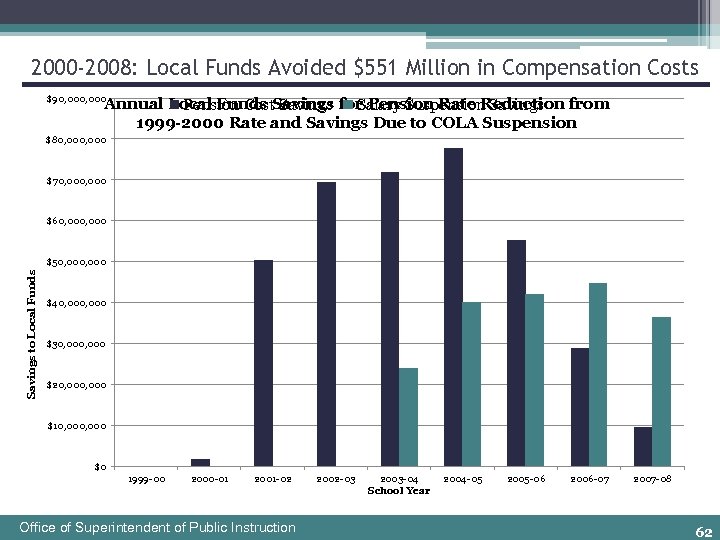
2000 -2008: Local Funds Avoided $551 Million in Compensation Costs $90, 000 Annual Local Funds Savings for Pension Rate Reduction from Pension Cost Savings Salary Suspension Savings 1999 -2000 Rate and Savings Due to COLA Suspension $80, 000 $70, 000 $60, 000 Savings to Local Funds $50, 000 $40, 000 $30, 000 $20, 000 $10, 000 $0 1999 -00 2000 -01 2001 -02 Office of Superintendent of Public Instruction 2002 -03 2003 -04 School Year 2004 -05 2005 -06 2006 -07 2007 -08 62
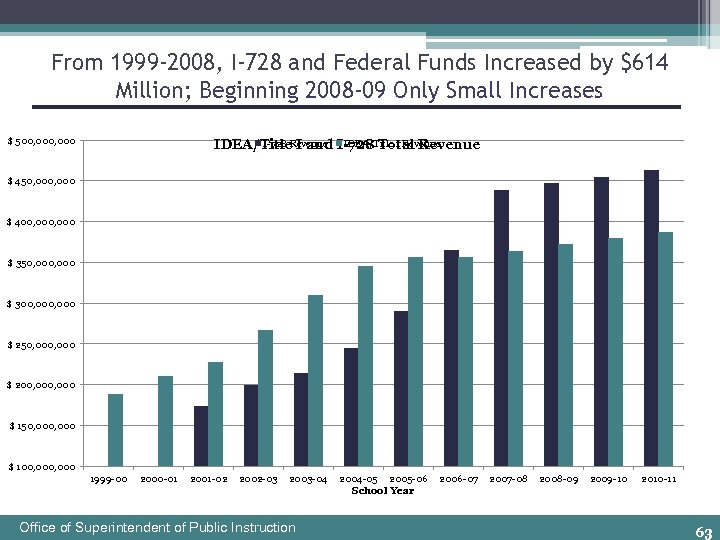
From 1999 -2008, I-728 and Federal Funds Increased by $614 Million; Beginning 2008 -09 Only Small Increases $ 500, 000 I-728 Revenue IDEA/Title I and I-728 Total Revenue $ 450, 000 $ 400, 000 $ 350, 000 $ 300, 000 $ 250, 000 $ 200, 000 $ 150, 000 $ 100, 000 1999 -00 2000 -01 2001 -02 2002 -03 2003 -04 Office of Superintendent of Public Instruction 2004 -05 2005 -06 School Year 2006 -07 2007 -08 2008 -09 2009 -10 2010 -11 63
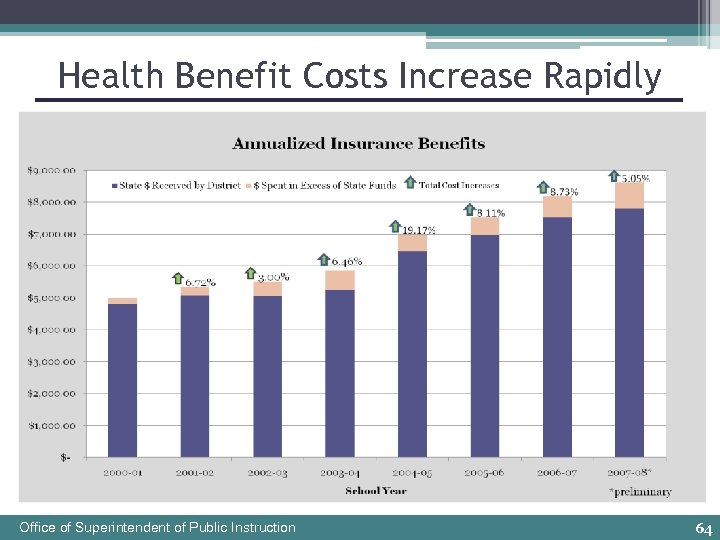
Health Benefit Costs Increase Rapidly Office of Superintendent of Public Instruction 64
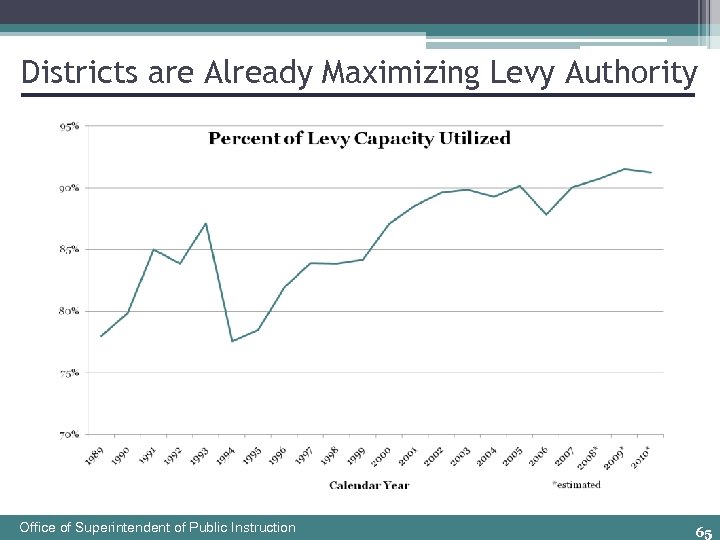
Districts are Already Maximizing Levy Authority Office of Superintendent of Public Instruction 65
Скачать презентацию K-12 Finance Depth Breadth and Causes of a
6c1e9e03282cb6b8d72cdd428a48cad2.ppt