 Скачать презентацию Justice the quality of being just or fair
6476aebf2e10c1450100861ff2dcebe1.ppt
- Количество слайдов: 53



Justice the quality of being just or fair the administration of law; the act of determining rights and assigning rewards or punishments Justice is the ideal, morally correct state of things and persons. equitable: implying justice dictated by reason, conscience, and a natural sense of what is fair to all the quality of being just; righteousness, equitableness, or moral rightness the moral principle determining just conduct. the administering of deserved punishment or reward Justice concerns the proper ordering of things and persons within a society
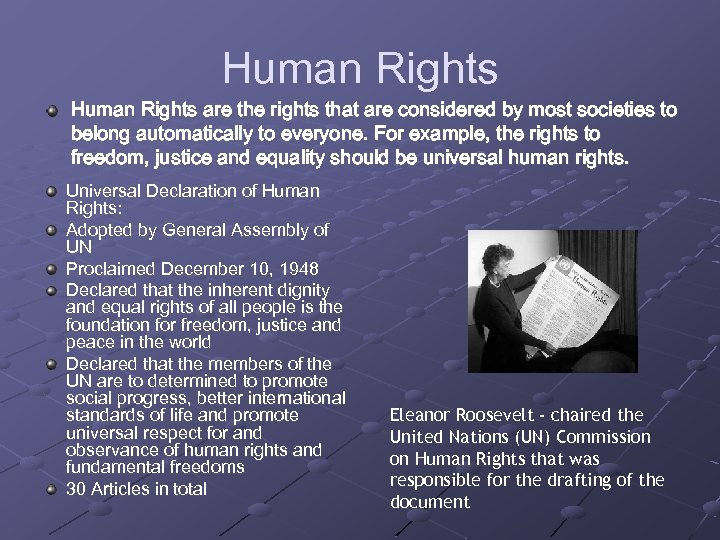
Human Rights are the rights that are considered by most societies to belong automatically to everyone. For example, the rights to freedom, justice and equality should be universal human rights. Universal Declaration of Human Rights: Adopted by General Assembly of UN Proclaimed December 10, 1948 Declared that the inherent dignity and equal rights of all people is the foundation for freedom, justice and peace in the world Declared that the members of the UN are to determined to promote social progress, better international standards of life and promote universal respect for and observance of human rights and fundamental freedoms 30 Articles in total Eleanor Roosevelt - chaired the United Nations (UN) Commission on Human Rights that was responsible for the drafting of the document
Article 1: All humans are born free and equal in dignity and rights. . . should act towards each other in a spirit of brotherhood Article 2: Everyone is entitled to the rights and freedoms in this Declaration, regardless of race, colour, sex, language, religion, political or other opinion, national or social origin, property, birth or other status, political, or international status of the country or territory to which a person belongs Article 3: Everyone has the right to life, liberty and the security of person Article 4: No one shall be held in slavery Article 5: No one shall be subjected to torture or to cruel, inhuman or degrading treatment or punishment.
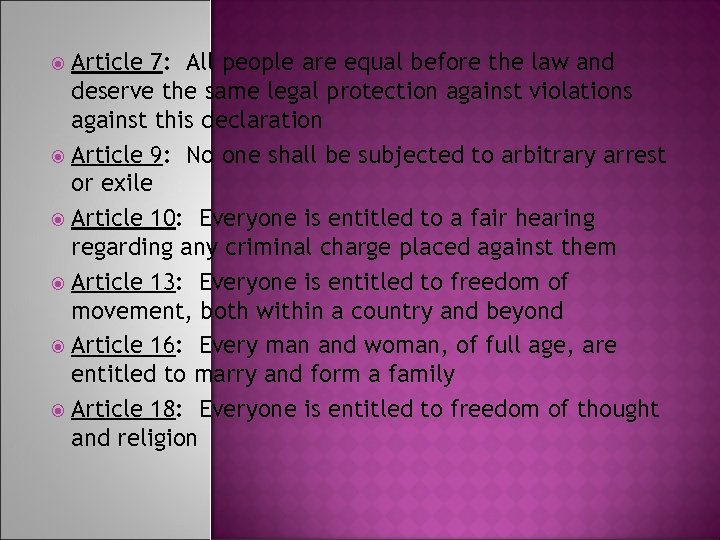
Article 7: All people are equal before the law and deserve the same legal protection against violations against this declaration Article 9: No one shall be subjected to arbitrary arrest or exile Article 10: Everyone is entitled to a fair hearing regarding any criminal charge placed against them Article 13: Everyone is entitled to freedom of movement, both within a country and beyond Article 16: Every man and woman, of full age, are entitled to marry and form a family Article 18: Everyone is entitled to freedom of thought and religion
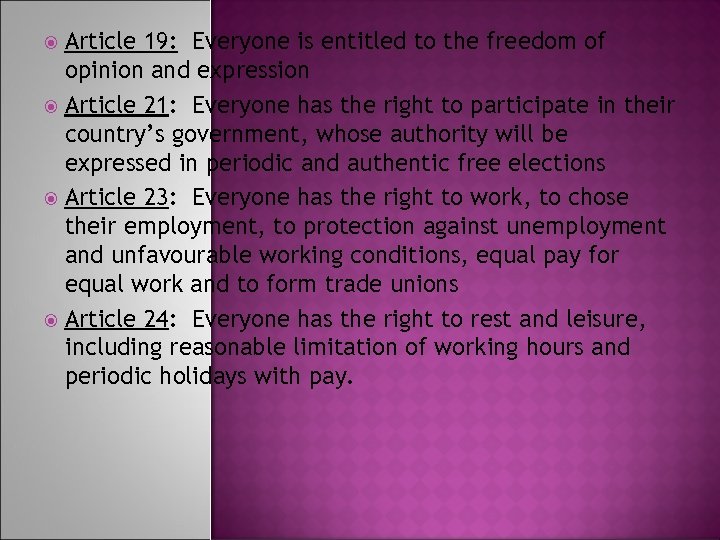
Article 19: Everyone is entitled to the freedom of opinion and expression Article 21: Everyone has the right to participate in their country’s government, whose authority will be expressed in periodic and authentic free elections Article 23: Everyone has the right to work, to chose their employment, to protection against unemployment and unfavourable working conditions, equal pay for equal work and to form trade unions Article 24: Everyone has the right to rest and leisure, including reasonable limitation of working hours and periodic holidays with pay.
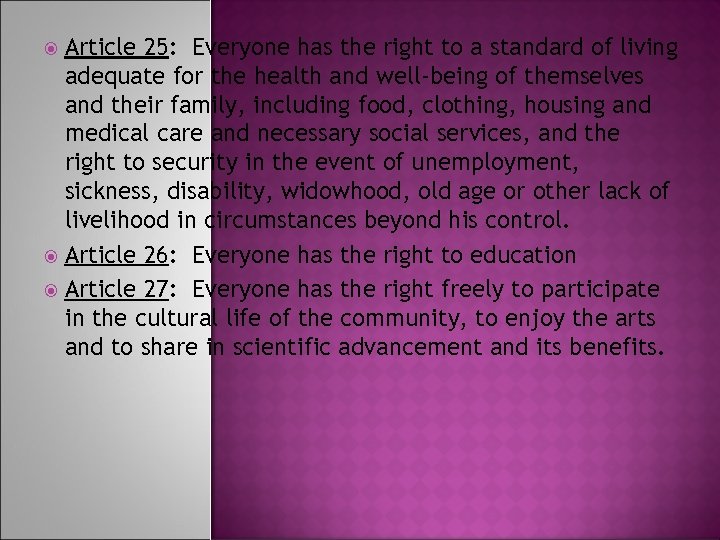
Article 25: Everyone has the right to a standard of living adequate for the health and well-being of themselves and their family, including food, clothing, housing and medical care and necessary social services, and the right to security in the event of unemployment, sickness, disability, widowhood, old age or other lack of livelihood in circumstances beyond his control. Article 26: Everyone has the right to education Article 27: Everyone has the right freely to participate in the cultural life of the community, to enjoy the arts and to share in scientific advancement and its benefits.
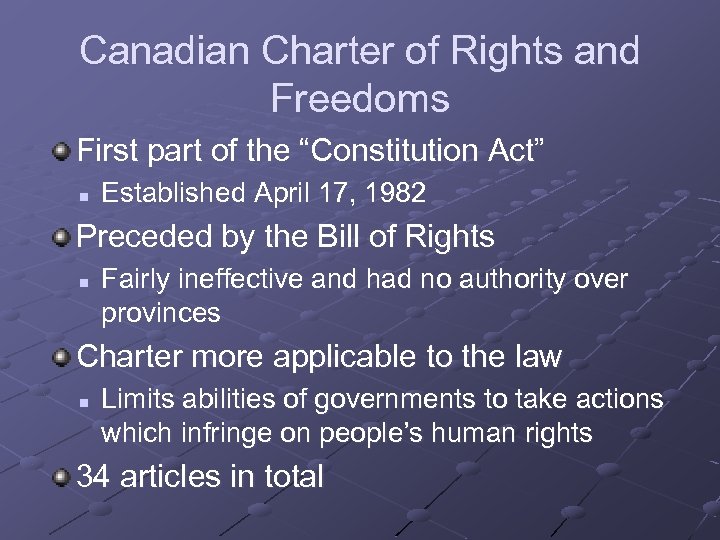
Canadian Charter of Rights and Freedoms First part of the “Constitution Act” n Established April 17, 1982 Preceded by the Bill of Rights n Fairly ineffective and had no authority over provinces Charter more applicable to the law n Limits abilities of governments to take actions which infringe on people’s human rights 34 articles in total
Article 2: Everyone has the following fundamental freedoms: n a) freedom of conscience and religion; n b) freedom of thought, belief, opinion and expression, including freedom of the press and other media of communication; n c) freedom of peaceful assembly; n d) freedom of association. Article 3: Every Canadian citizen has the right to vote Article 4: No government shall last more than 5 years Article 6: Every citizen of Canada has the right to enter, remain in and leave Canada
Article 8: Everyone has the right to be secure from unreasonable search Article 9: Everyone has the right to not be arbitrarily detained or imprisoned Article 12: Everyone has the right to not be subjected to cruel or unusual punishment Article 15: Everyone is equal under the law Article 16: English and French are the official languages of Canada, and have equal rights to be used in governmental proceedings
Article 23: Everyone is entitled to education in both the majority and minority language of the province Article 24: Everyone whose rights under this Act have been violated has a right to judicial proceedings Article 25: The rights outlined in this Charter are not meant to take away from the rights of the Aboriginal peoples of Canada (including those rights outlines by treaties) Article 26: This charter should not deny the existence of any other rights or freedoms that exist in Canada Article 27: This charter shall be interpreted in a way that also preserves and enhances the multicultural heritage of Canada Article 28: The rights outlined in this charter apply equally to men and women
Apartheid in South Africa In 1652 the Dutch came to settle in South Africa and claimed the land as their own. They subjugated many Africans and forced them to work as servants and slaves. In 1806, Great Britain took the colony from the Dutch; When diamonds and gold were discovered, the British forced South African Natives off the mineralrich land. In 1948 the racist Nationalist Party was elected to power and the government established an official policy called “apartheid. ” This was an attempt to completely separate the small number of British and Dutch from the South African Native majority.
In 1958, the government separated the groups by making native South Africans live on reserves, or homelands. Shanty towns were also created – overcrowded towns full of poorly built shacks on the edges of cities. These shanty towns became centers for groups who resisted the white government. Thousands resisted apartheid by refusing to work, refusing to buy white products, going into “white only” areas, and marching in nonviolent demonstrations. Most native men had to leave their homeland to find work in mines or factories while women raised whatever crops they could.
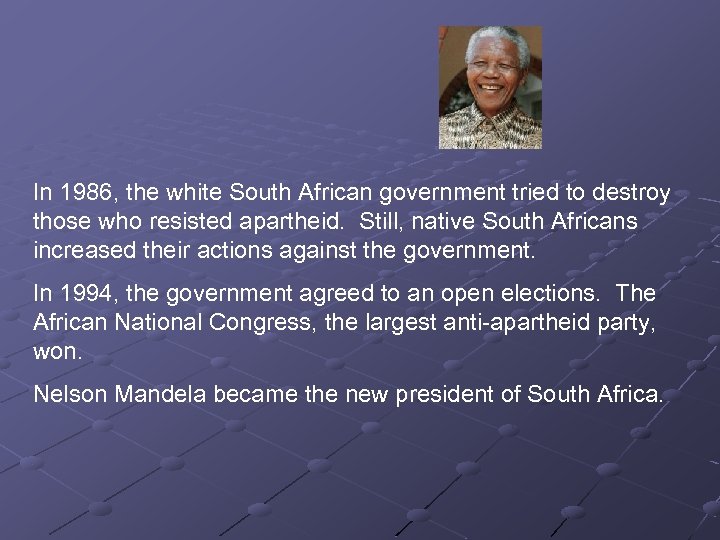
In 1986, the white South African government tried to destroy those who resisted apartheid. Still, native South Africans increased their actions against the government. In 1994, the government agreed to an open elections. The African National Congress, the largest anti-apartheid party, won. Nelson Mandela became the new president of South Africa.
Israel and Palestine Conflict: Background Ground Zero for Judaism, Islam, and Christianity. Judaism: Israel = Biblical “Promised Land” n Occupied by Moses and Hebrews around 1000 B. C. Invaded and occupied by Philistines n Greeks and Romans call it “Land of Philistines”, which becomes Palestine. Region of Jesus Christ’s birth, ministry, and death. “Ownership” changes hands frequently. Muslims capture in 640 n built Dome of the Rock in Jerusalem in 691 Spot where Mohammed stopped on his way to heaven. n Holiest site in Islam outside Saudi Arabia. Ottoman Turks control from 1500’s-1900’s.
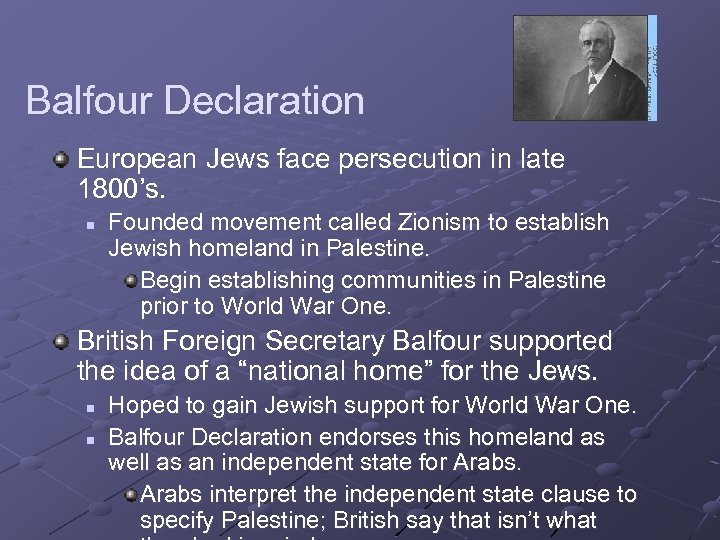
Balfour Declaration European Jews face persecution in late 1800’s. n Founded movement called Zionism to establish Jewish homeland in Palestine. Begin establishing communities in Palestine prior to World War One. British Foreign Secretary Balfour supported the idea of a “national home” for the Jews. n n Hoped to gain Jewish support for World War One. Balfour Declaration endorses this homeland as well as an independent state for Arabs interpret the independent state clause to specify Palestine; British say that isn’t what
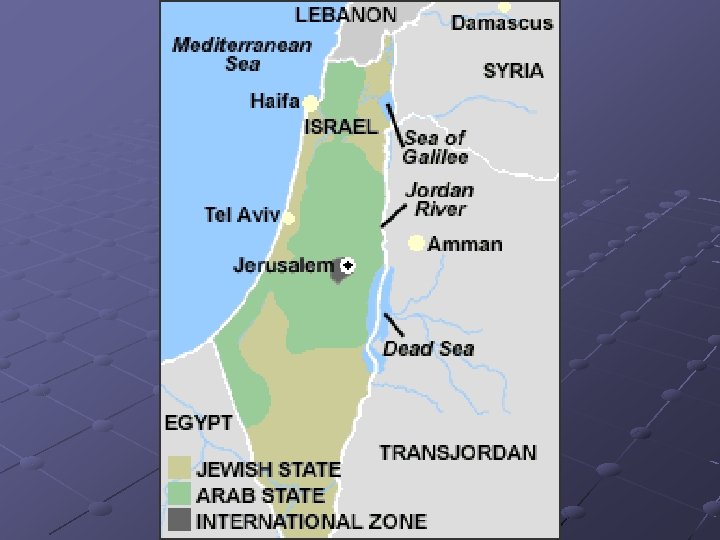
The British Mandate Ottoman Turks on losing side of WW I; British gain control of Palestine in 1920. n 90 k Jews Palestinians and Jews begin arming themselves and conducting terrorist attacks against their counterparts. Rise of Nazism brings flood of new Jewish settlers to Palestine from Europe in 1930’s. UN votes to divide Palestine into Jewish and Arab states in 1947, giving the Jews 55% of the land west of the Jordan River and designating Jerusalem as an international enclave.
Arab-Israeli War of 1948 14 May 1948: Zionist leader David Ben-Gurion declares that Israel is an independent state. Egypt, Syria, Transjordan, Lebanon, and Iraq invade on 15 May. Fighting continues until Jan 1949. Israel prevails and gains territory in Galilee to the north and the Negev Desert to the south. Jerusalem is divided between Israel and Jordan. Fate of 700 k Palestinian refugees is left undecided.
Arab-Israeli War of 1956 USSR signs arms agreement with Egypt in 1955. Israelis feel threatened by arms build up and launch pre-emptive strike against Egypt. n Attack and seize the Sinai and Gaza Strip. Relinquished in 1957. French and British retake Suez Canal which Egypt had seized several months earlier. UN establishes peace keeping force in Sinai that is still in place today.
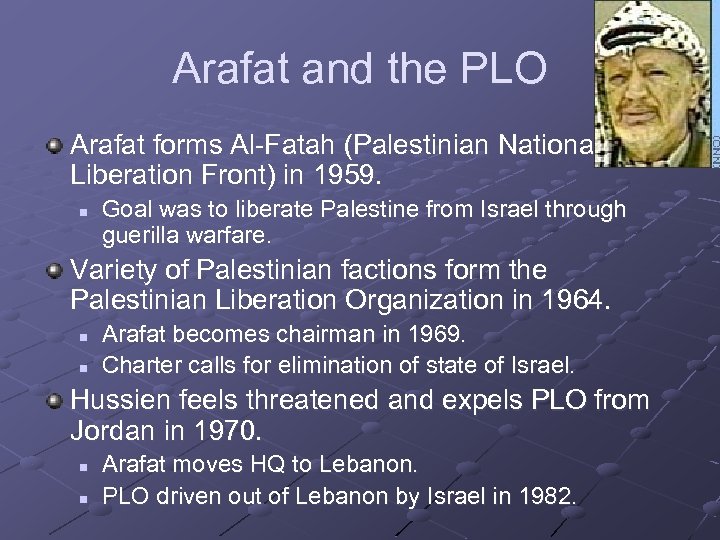
Arafat and the PLO Arafat forms Al-Fatah (Palestinian National Liberation Front) in 1959. n Goal was to liberate Palestine from Israel through guerilla warfare. Variety of Palestinian factions form the Palestinian Liberation Organization in 1964. n n Arafat becomes chairman in 1969. Charter calls for elimination of state of Israel. Hussien feels threatened and expels PLO from Jordan in 1970. n n Arafat moves HQ to Lebanon. PLO driven out of Lebanon by Israel in 1982.
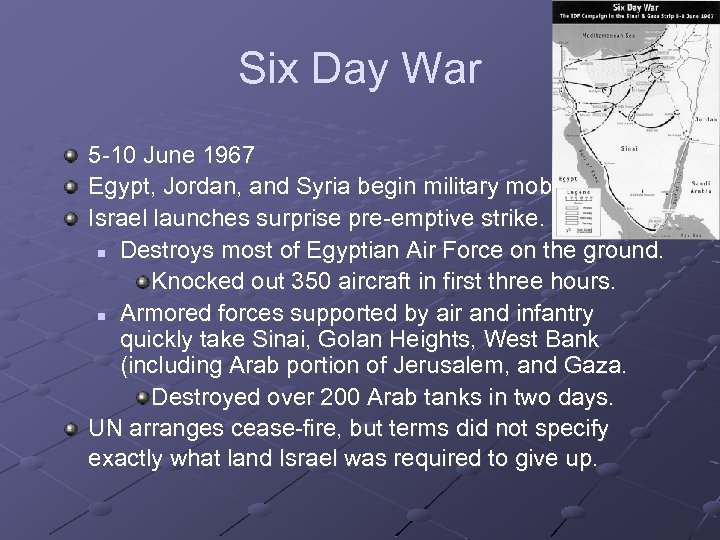
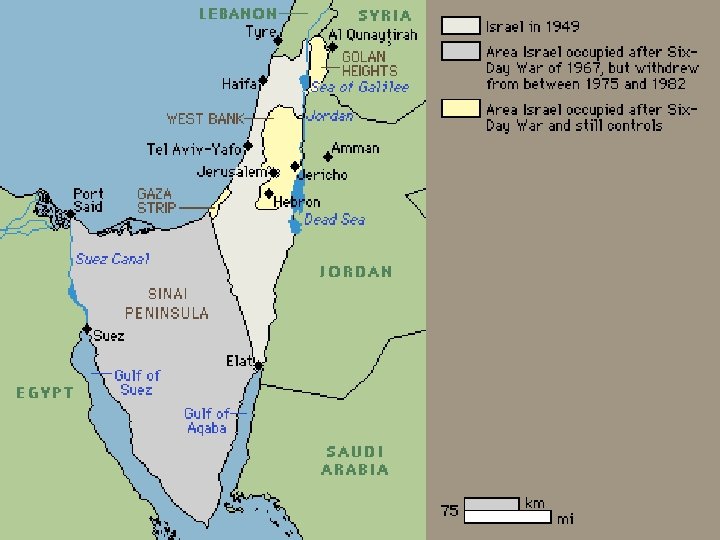
Six Day War 5 -10 June 1967 Egypt, Jordan, and Syria begin military mobilization. Israel launches surprise pre-emptive strike. n Destroys most of Egyptian Air Force on the ground. Knocked out 350 aircraft in first three hours. n Armored forces supported by air and infantry quickly take Sinai, Golan Heights, West Bank (including Arab portion of Jerusalem, and Gaza. Destroyed over 200 Arab tanks in two days. UN arranges cease-fire, but terms did not specify exactly what land Israel was required to give up.
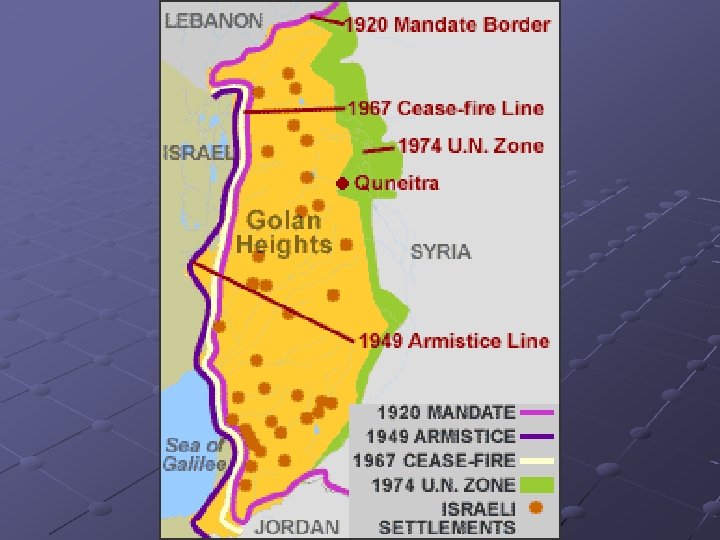
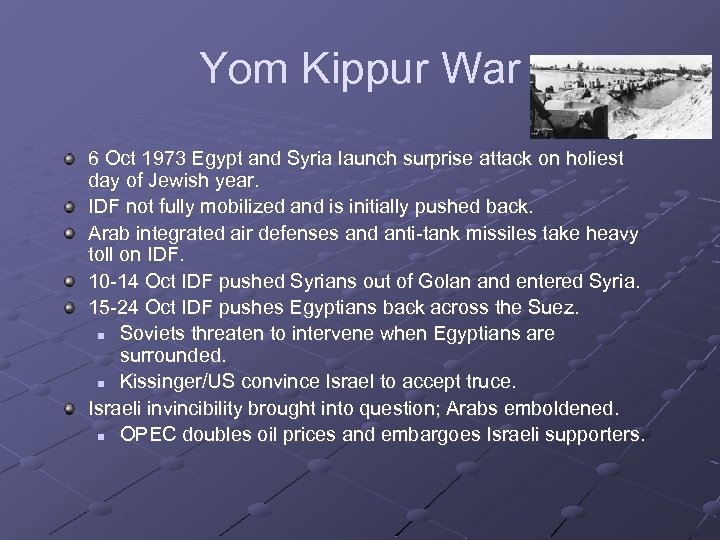
Yom Kippur War 6 Oct 1973 Egypt and Syria launch surprise attack on holiest day of Jewish year. IDF not fully mobilized and is initially pushed back. Arab integrated air defenses and anti-tank missiles take heavy toll on IDF. 10 -14 Oct IDF pushed Syrians out of Golan and entered Syria. 15 -24 Oct IDF pushes Egyptians back across the Suez. n Soviets threaten to intervene when Egyptians are surrounded. n Kissinger/US convince Israel to accept truce. Israeli invincibility brought into question; Arabs emboldened. n OPEC doubles oil prices and embargoes Israeli supporters.
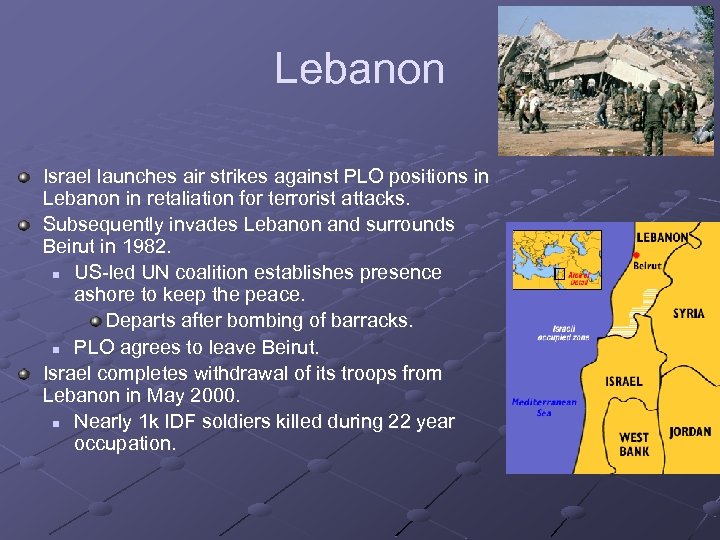
Lebanon Israel launches air strikes against PLO positions in Lebanon in retaliation for terrorist attacks. Subsequently invades Lebanon and surrounds Beirut in 1982. n US-led UN coalition establishes presence ashore to keep the peace. Departs after bombing of barracks. n PLO agrees to leave Beirut. Israel completes withdrawal of its troops from Lebanon in May 2000. n Nearly 1 k IDF soldiers killed during 22 year occupation.
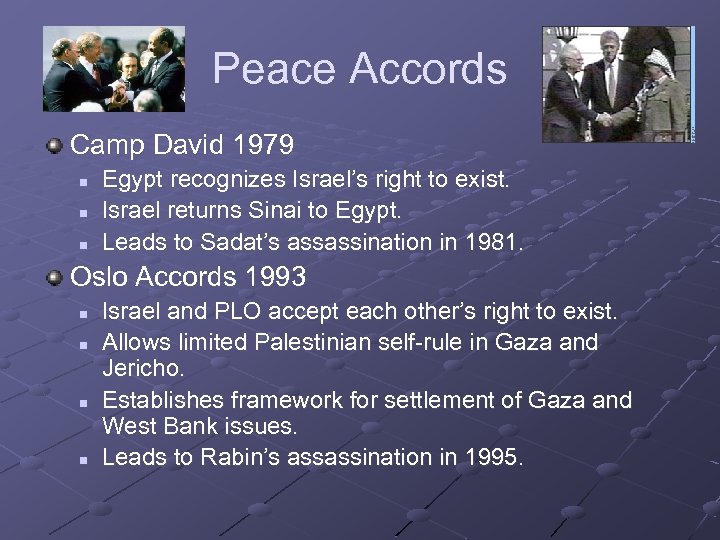
Peace Accords Camp David 1979 n n n Egypt recognizes Israel’s right to exist. Israel returns Sinai to Egypt. Leads to Sadat’s assassination in 1981. Oslo Accords 1993 n n Israel and PLO accept each other’s right to exist. Allows limited Palestinian self-rule in Gaza and Jericho. Establishes framework for settlement of Gaza and West Bank issues. Leads to Rabin’s assassination in 1995.
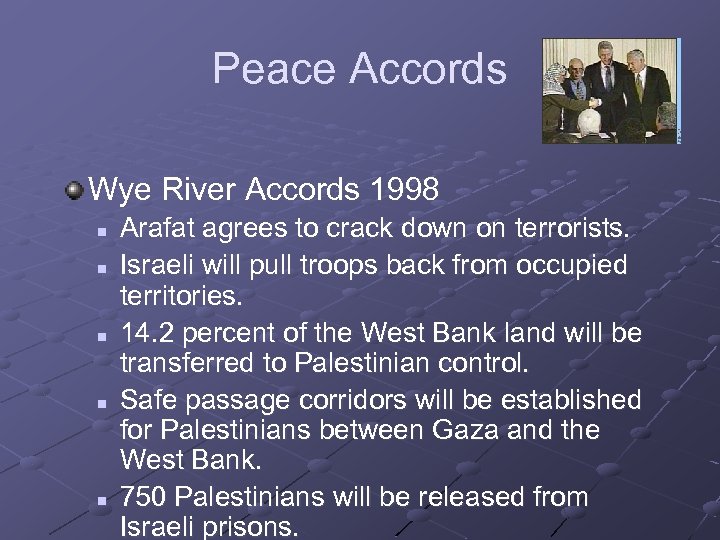
Peace Accords Wye River Accords 1998 n n n Arafat agrees to crack down on terrorists. Israeli will pull troops back from occupied territories. 14. 2 percent of the West Bank land will be transferred to Palestinian control. Safe passage corridors will be established for Palestinians between Gaza and the West Bank. 750 Palestinians will be released from Israeli prisons.
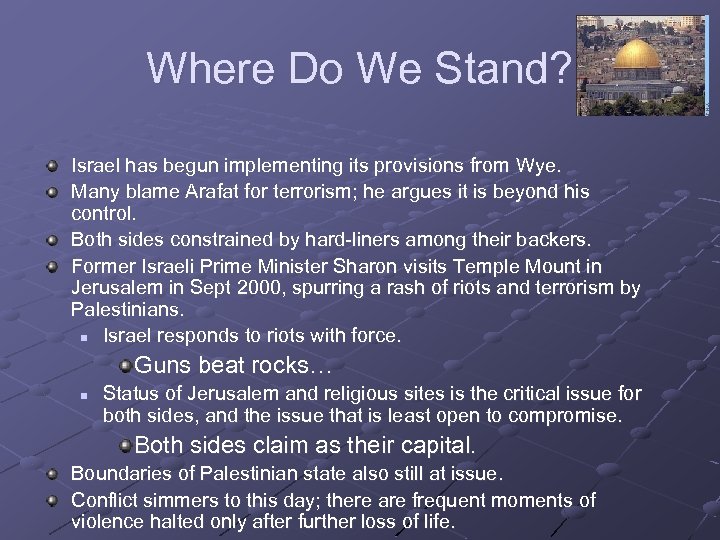
Where Do We Stand? Israel has begun implementing its provisions from Wye. Many blame Arafat for terrorism; he argues it is beyond his control. Both sides constrained by hard-liners among their backers. Former Israeli Prime Minister Sharon visits Temple Mount in Jerusalem in Sept 2000, spurring a rash of riots and terrorism by Palestinians. n Israel responds to riots with force. Guns beat rocks… n Status of Jerusalem and religious sites is the critical issue for both sides, and the issue that is least open to compromise. Both sides claim as their capital. Boundaries of Palestinian state also still at issue. Conflict simmers to this day; there are frequent moments of violence halted only after further loss of life.
Genocide United Nations definition: n Intent to destroy in whole or in part a national, ethnic, racial or religious group Genocide occurs in 8 stages n n n Stages can occur simultaneously Earlier ones must occur before later ones, but earlier ones can continue over time Things can be done at each stage to combat genocide from occurring
Classification Societies are distinguished into “us” and “them” n By ethnicity, race, religion or nationality The main way of preventing genocide at this early stage is to develop opportunities in a society for people to work and live together who are from different ethnic, social, national or religious backgrounds
Symbolization Give names or symbols to the classified groups Distinguish by name, dress (e. g. Yellow stars during Holocaust) Classification and symbolization are universally human and can be imposed on a group by themselves n Not always a problem to have a symbol representing a group, only when it results in discrimination Can combat this by legally forbidding hate symbols and literature
Dehumanization is when one group treats another group as second class citizens or worse n may be compared with animals, parasites, insects or diseases When a group of people is thought of as “less than human” it is easier for the group in control to murder them. Hate propaganda in print and on hate radios is used to make the victims seem like villains.
Organization Always organized, usually by the state, though sometimes informally or by terrorist groups Special army units or militias are often trained and armed Plans are made for murder
Polarization Extremists drive the groups apart. Hate groups broadcast propaganda that reinforces prejudice and hate. Laws may forbid intermarriage or social interaction between the groups Moderates are targeted and intimidated into silence Moderate leaders are those best able to prevent genocide and they are often the first to be assassinated.
Preparation Victims are identified and separated n Segregated into confined living quarters, concentration camps or restricted to faminestruck region and starved Death lists are drawn up. Members of victim groups are forced to wear or carry identifying At this stage, an international Genocide Alert must be called
Extermination begins, and quickly becomes the mass killing legally called "genocide. “ n Called "extermination" by the killers because they do not believe their victims to be fully human Sometimes the genocide results in revenge killings by groups against each other, creating the downward cycle of mutual genocide where the victims actually organize and commit a second genocide on the perpetrators.
Denial is among the surest indicators of further genocidal massacres. The perpetrators try to cover up the evidence and intimidate the witnesses. n n Deny that they committed any crimes, and often blame what happened on the victims They block investigations of the crimes, and continue to govern until driven from power by force, when they flee into exile. Leaders of the genocide continue to deny the crime unless they are captured and a tribunal is established to try them
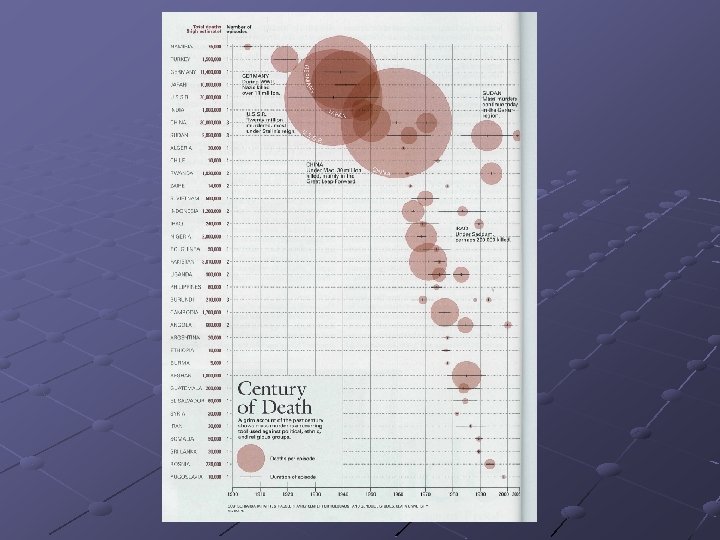
“More than 50 million people were systematically murdered in the past 100 years- the century of mass murder. ” “In sheer numbers, these and other killings make the 20 th century the bloodiest period in human history. ” National Geo. 2006
Genocide in History There are many cases of Genocide which have existed throughout our history dating back to biblical times. Genocides From 1500 -1950 n The Native Canadian people (Mi’kmaw, Beothuk) The Congo 1820 -1920 Ottoman Empire (1932– 1933) Holodomor World War II n Mao Zedong n n
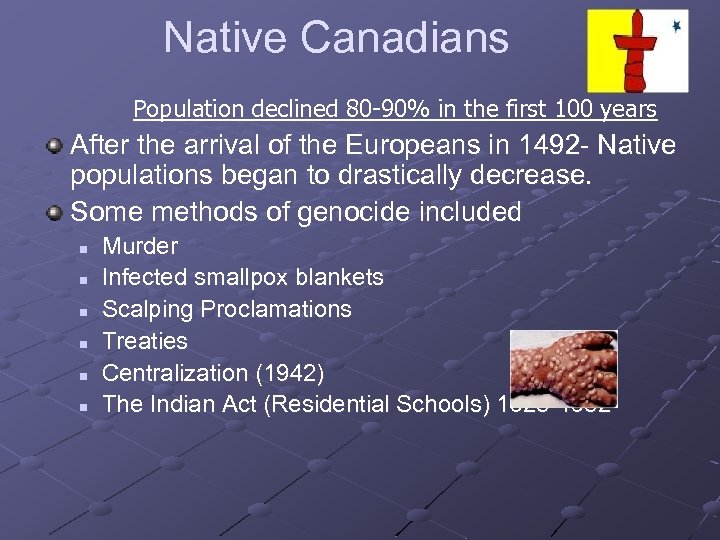
Native Canadians Population declined 80 -90% in the first 100 years After the arrival of the Europeans in 1492 - Native populations began to drastically decrease. Some methods of genocide included n n n Murder Infected smallpox blankets Scalping Proclamations Treaties Centralization (1942) The Indian Act (Residential Schools) 1928 -1982
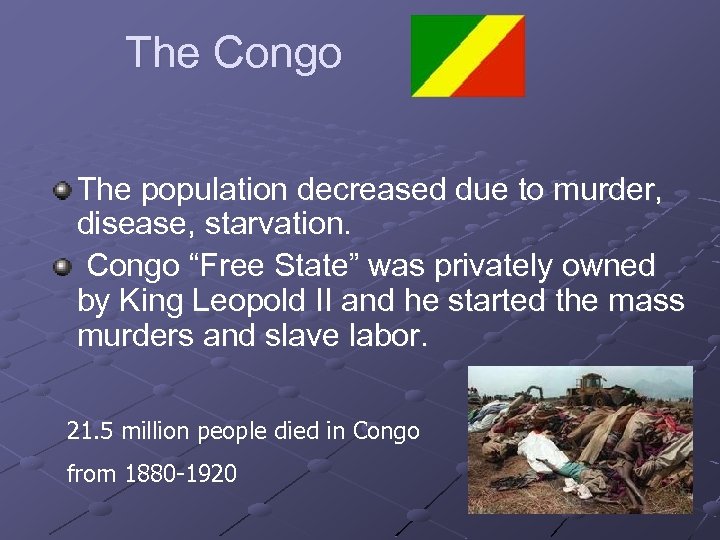
The Congo The population decreased due to murder, disease, starvation. Congo “Free State” was privately owned by King Leopold II and he started the mass murders and slave labor. 21. 5 million people died in Congo from 1880 -1920
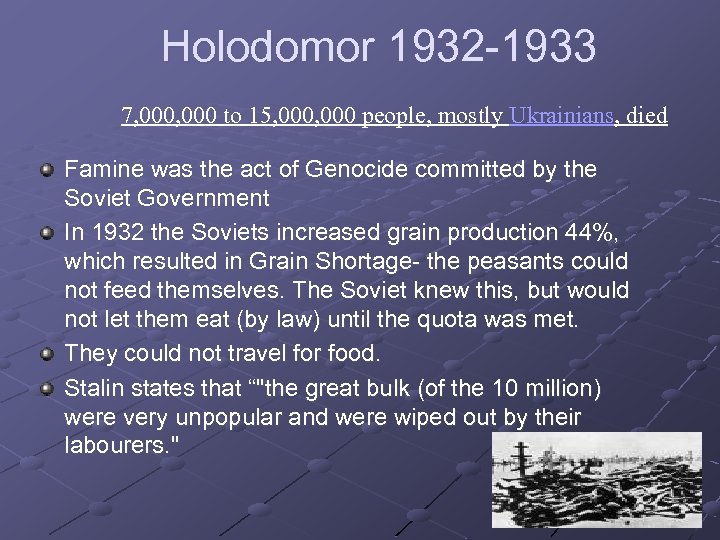
Holodomor 1932 -1933 7, 000 to 15, 000 people, mostly Ukrainians, died Famine was the act of Genocide committed by the Soviet Government In 1932 the Soviets increased grain production 44%, which resulted in Grain Shortage- the peasants could not feed themselves. The Soviet knew this, but would not let them eat (by law) until the quota was met. They could not travel for food. Stalin states that “"the great bulk (of the 10 million) were very unpopular and were wiped out by their labourers. "
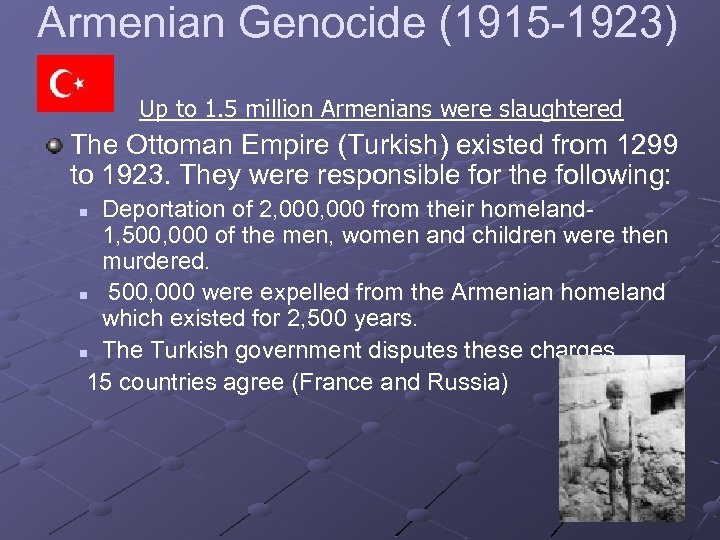
Armenian Genocide (1915 -1923) Up to 1. 5 million Armenians were slaughtered The Ottoman Empire (Turkish) existed from 1299 to 1923. They were responsible for the following: Deportation of 2, 000 from their homeland- 1, 500, 000 of the men, women and children were then murdered. n 500, 000 were expelled from the Armenian homeland which existed for 2, 500 years. n The Turkish government disputes these charges 15 countries agree (France and Russia) n
WORLD WAR II 1939 -1945 Over 11 million People were killed. During the Holocaust the Nazis’ killed 6 million Jews, 3 million POW’s, 2 million Poles and 400, 000 other “undesirables”(slaves, homosexuals and communists) The holocaust was most predominant from previous genocides because of the cruelty, scale and efficiency of the mass murders. People were killed by: open-air shootings, by killing squads, extermination camps (gas chambers, mass shootings)
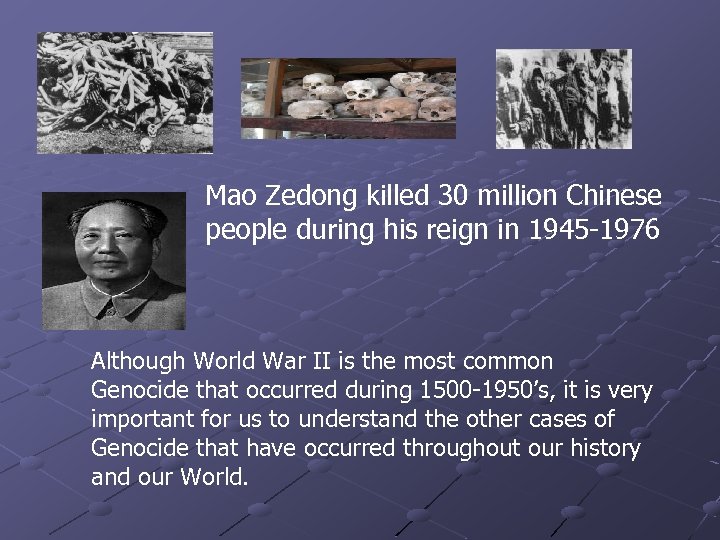
Mao Zedong killed 30 million Chinese people during his reign in 1945 -1976 Although World War II is the most common Genocide that occurred during 1500 -1950’s, it is very important for us to understand the other cases of Genocide that have occurred throughout our history and our World.
Cambodia 1975 -1979 The Khmer Rouge killed 1. 7 million The communist party Khmer Rouge ruled Cambodia from 1975 -1979. They were responsible forced labour, starvation, and execution. This was one of the most lethal regimes of the 20 th century. This communist party killed “suspect ethnic groups”- Chinese, Vietnamese, Buddhist monks, and refugees.
Saddam Hussein’s Baath Party In 1987 -1991 (approx) the Baath Party killed 100, 000 Kurds. (The Kurds are people of Indo-European origin who live mainly in the mountains and uplands where Turkey, Iraq, and Iran meet, in an area known as "Kurdistan" for hundreds of years) The Gulf War (1990) It is estimated that 300, 000 people are buried in 260 mass graves. 1991 -2003 - Estimates of 500, 000 to 1. 2 million people were killed through bombings. After the September 11, 2001 attacks- the US invaded Iraq-2003 Saddam was captured.
RWANDA 1994 The Rwandan Genocide was the slaughter of an estimated 800, 000 to 1, 000 Tutsis and moderate Hutus, mostly carried out by two extremist Hutu militia groups (Interahamwe and Impuzamugambi) during a period of 100 days from April 6 th through mid-July 1994. The Western and First World Countries did nothing to help this situation. Prior to the attacks the UN did not respond to reports of the Hutu plans. This Genocide was ended when the Tutsi rebel movement (Rwandese Political Front) lead by Paul Kagame seized power of the Hutu Government.
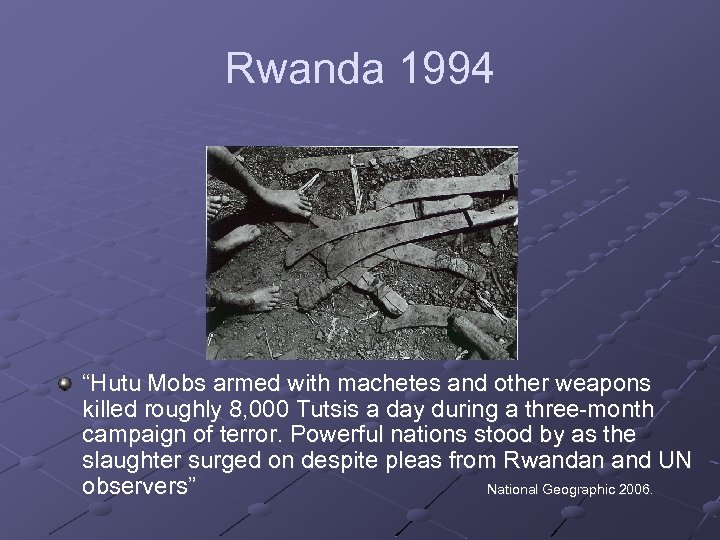
Rwanda 1994 “Hutu Mobs armed with machetes and other weapons killed roughly 8, 000 Tutsis a day during a three-month campaign of terror. Powerful nations stood by as the slaughter surged on despite pleas from Rwandan and UN observers” National Geographic 2006.
Sudan Civil War 1983 Sudan signed a peace agreement in 2002 - where they were accused of genocide. Since the civil war began in 1983: 2, 000 people have been killed n 4, 000 people have been displaced. Mukesh Kapila ( UN coordinator) has stated that "This is n more than just a conflict. It is an organised attempt [by Khartoum] to do away with a group of people. The only difference between Rwanda [in 1994] and Darfur now is the numbers of dead, murdered, tortured and raped involved“.
Sudan Cont… In 2004, it became widely known that a nomadic group was trying to get rid of 80 African groups in the Darfur region. This was is very similar to Rwanda. However professional/intellectuals are not being attacked- it is a fight between the nomads and farmers for land. There is risk of famine and a threat to international security.
 Скачать презентацию Justice the quality of being just or fair
6476aebf2e10c1450100861ff2dcebe1.ppt