


 Скачать презентацию Just-in-Time Lecture www pitt edu super China Earthquake 12
76b039f2d8b14b1ca0ffe1a93e0f1477.ppt
- Количество слайдов: 44
 Just-in-Time Lecture www. pitt. edu/~super/ China Earthquake: 12 May 2008
 Mission Statement The Global Disaster Health Network is designed to translate the best possible scholarly information to educators worldwide. What are the Disaster Supercourse & JIT lecture?
 What is the Disaster Supercourse? What is a JIT lecture? http: //www. pitt. edu/~super 1
 Lecture objectives q To provide the best possible scientific information about the China earthquake, 12 May 2008 q To teach how the science can help Chinese to be prepared for primary & secondary prevention of consequences of earthquake
 Lecture Objectives In this lecture you will find: q How the vulnerability conditions can change a natural hazard to a disaster?
 What is the Earthquake? The shaking of earth caused by waves moving on and below the earth's surface and causing: surface faulting, tremors vibration, liquefaction, landslides, aftershocks and/or tsunamis.
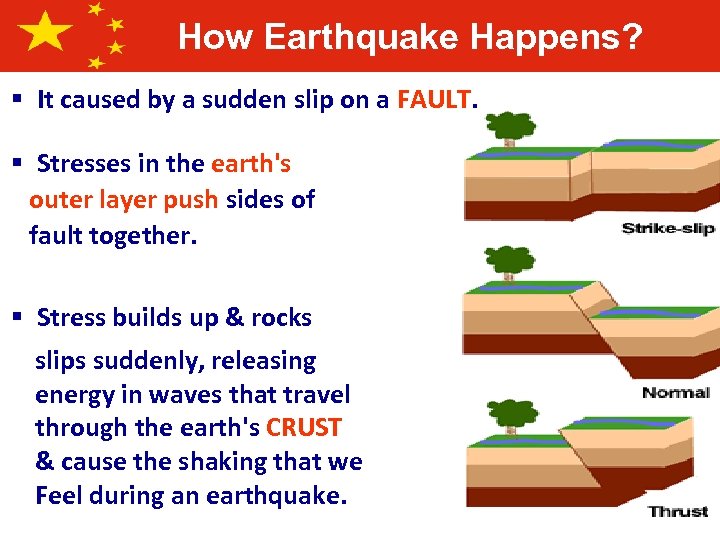 How Earthquake Happens? § It caused by a sudden slip on a FAULT. § Stresses in the earth's outer layer push sides of fault together. § Stress builds up & rocks slips suddenly, releasing energy in waves that travel through the earth's CRUST & cause the shaking that we Feel during an earthquake.
 Earthquake Strength Measures I) Magnitude & II) Intensity I) Magnitude: q Definition: A measure of actual physical energy release at its source as estimated from instrumental observations. q Scale: Richter Scale ü By Charles Richter, 1936 ü Open-ended scale ü The oldest & most widely used Noji 1997
 Earthquake Strength Measures I) Magnitude & II) Intensity: q Definition: a measure of the felt or perceived effects of an earthquake rather than the strength of the earthquake itself. q Scale: Modified Mercalli (MM) scale ü 12 -point scale, ranges from barely perceptible earthquakes at MM I to near total destruction at MM XII
 Magnitude versus Intensity q Magnitude refers to the force of the earthquake as a whole, while intensity refers to the effects of an earthquake at a particular site. q An earthquake can have just one magnitude, while intensity is usually strongest close to the epicenter & is weaker the farther a site is from the epicenter. q The intensity of an earthquake is more germane to its public health consequences than its magnitude.
 Public Health Consequences of Earthquakes Please see the following addresses for above title: Part I. http: //www. pitt. edu/~super 1/lecture/lec 13021/index. htm Part II. http: //www. pitt. edu/~super 1/lecture/lec 13051/index. htm
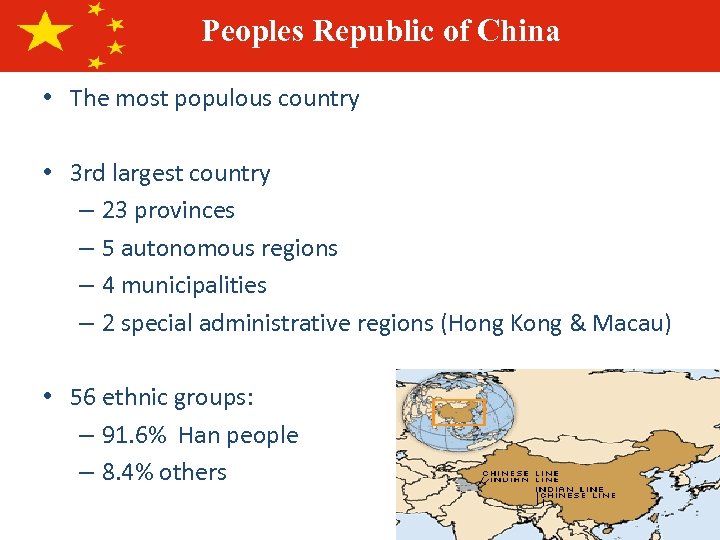 Peoples Republic of China • The most populous country • 3 rd largest country – 23 provinces – 5 autonomous regions – 4 municipalities – 2 special administrative regions (Hong Kong & Macau) • 56 ethnic groups: – 91. 6% Han people – 8. 4% others
 Economic Development in China • World’s economic superpower • Fastest-growing nation for the past 25 years • Average annual GDP growth rate above 10% www. Heritage. org
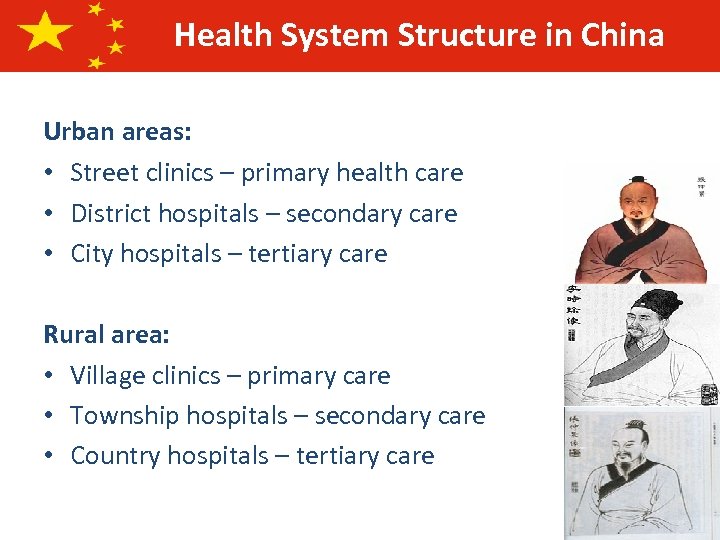 Health System Structure in China Urban areas: • Street clinics – primary health care • District hospitals – secondary care • City hospitals – tertiary care Rural area: • Village clinics – primary care • Township hospitals – secondary care • Country hospitals – tertiary care
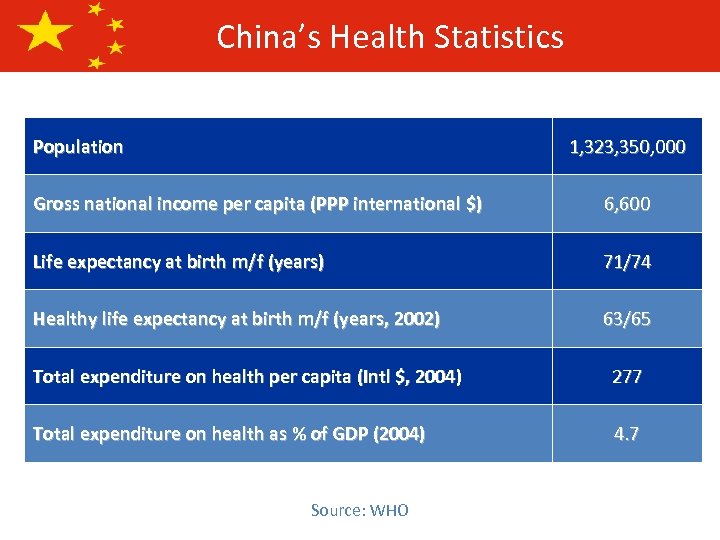 China’s Health Statistics Population 1, 323, 350, 000 Gross national income per capita (PPP international $) 6, 600 Life expectancy at birth m/f (years) 71/74 Healthy life expectancy at birth m/f (years, 2002) 63/65 Total expenditure on health per capita (Intl $, 2004) 277 Total expenditure on health as % of GDP (2004) 4. 7 Source: WHO
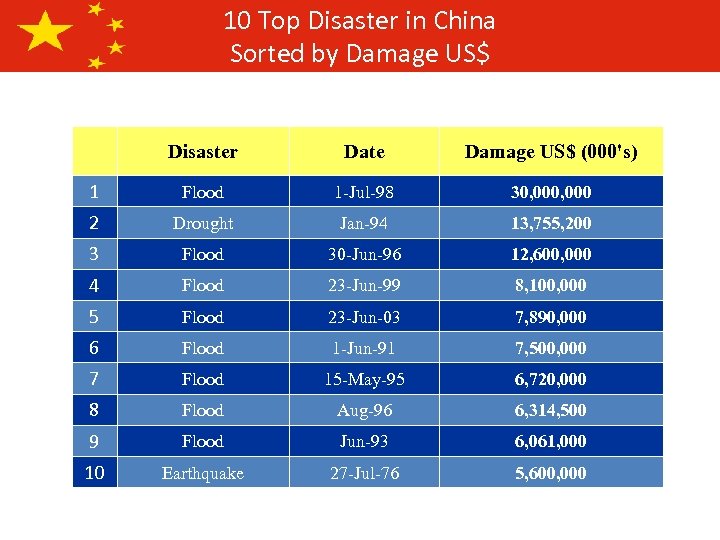 10 Top Disaster in China Sorted by Damage US$ Disaster Date Damage US$ (000's) 1 Flood 1 -Jul-98 30, 000 2 Drought Jan-94 13, 755, 200 3 Flood 30 -Jun-96 12, 600, 000 4 Flood 23 -Jun-99 8, 100, 000 5 Flood 23 -Jun-03 7, 890, 000 6 Flood 1 -Jun-91 7, 500, 000 7 Flood 15 -May-95 6, 720, 000 8 Flood Aug-96 6, 314, 500 9 Flood Jun-93 6, 061, 000 10 Earthquake 27 -Jul-76 5, 600, 000
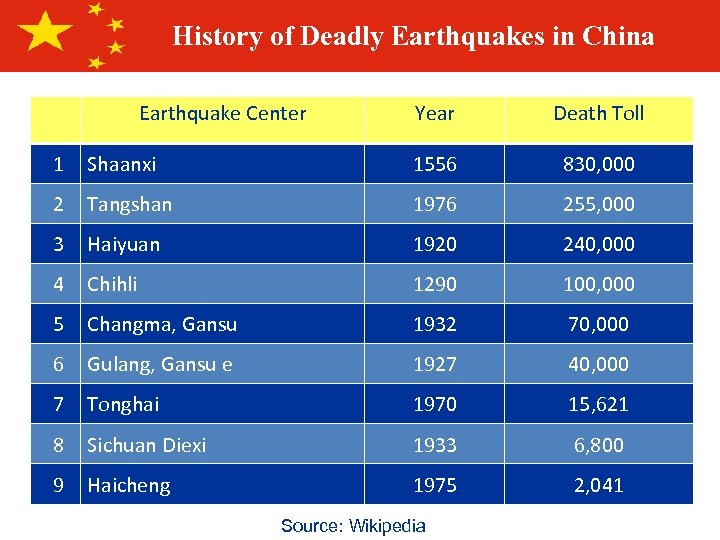 History of Deadly Earthquakes in China Earthquake Center Year Death Toll 1 Shaanxi 1556 830, 000 2 Tangshan 1976 255, 000 3 Haiyuan 1920 240, 000 4 Chihli 1290 100, 000 5 Changma, Gansu 1932 70, 000 6 Gulang, Gansu e 1927 40, 000 7 Tonghai 1970 15, 621 8 Sichuan Diexi 1933 6, 800 9 Haicheng 1975 2, 041 Source: Wikipedia
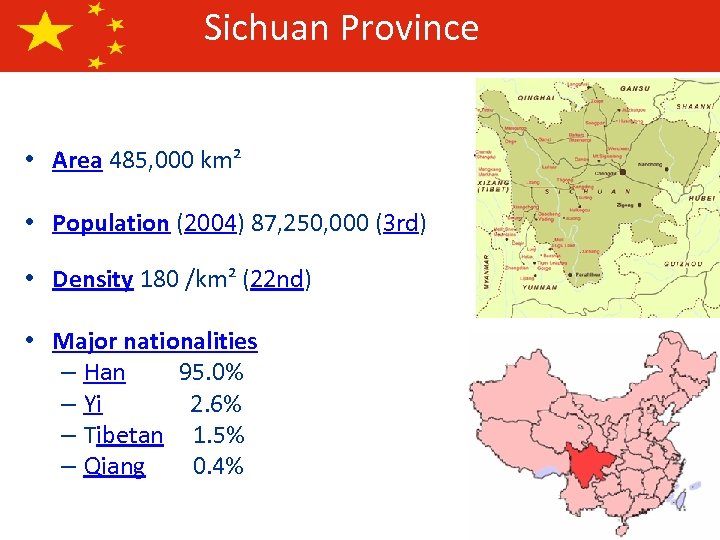 Sichuan Province • Area 485, 000 km² • Population (2004) 87, 250, 000 (3 rd) • Density 180 /km² (22 nd) • Major nationalities – Han 95. 0% – Yi 2. 6% – Tibetan 1. 5% – Qiang 0. 4%
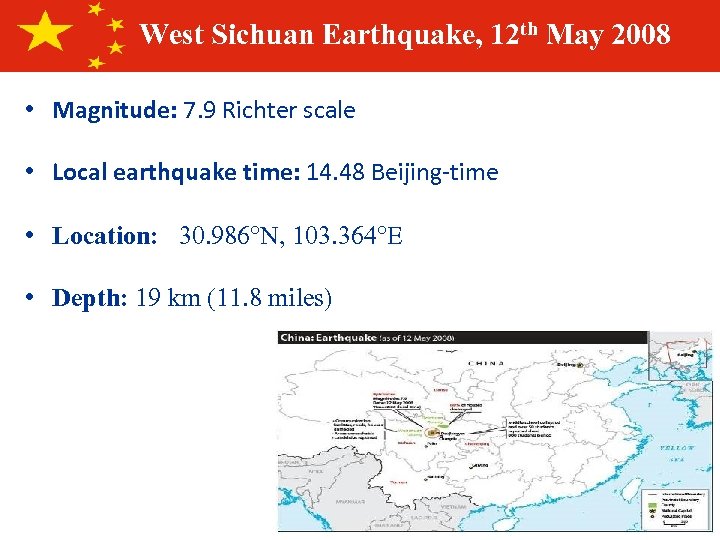 West Sichuan Earthquake, 12 th May 2008 • Magnitude: 7. 9 Richter scale • Local earthquake time: 14. 48 Beijing-time • Location: 30. 986°N, 103. 364°E • Depth: 19 km (11. 8 miles)
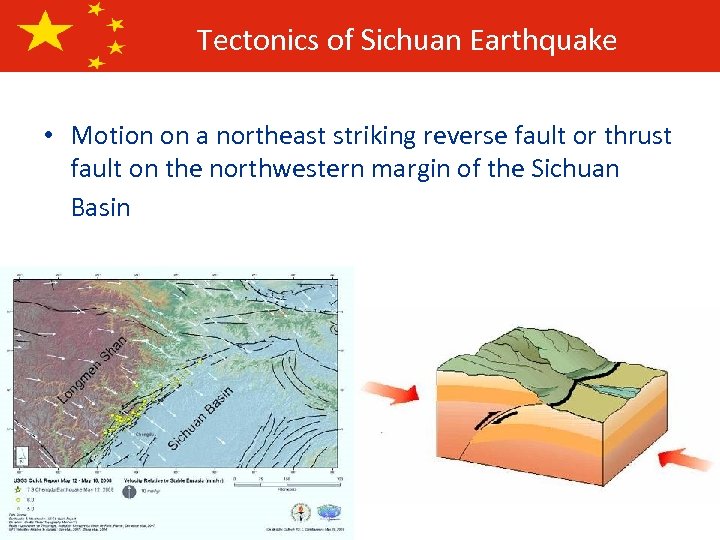 Tectonics of Sichuan Earthquake • Motion on a northeast striking reverse fault or thrust fault on the northwestern margin of the Sichuan Basin
 National Mourning • National Mourning Three-days period of national mourning • The Chinese National Flag and Regional Flags of Hong Kong SAR and Macau SAR were raised at half mast. Yahoo news
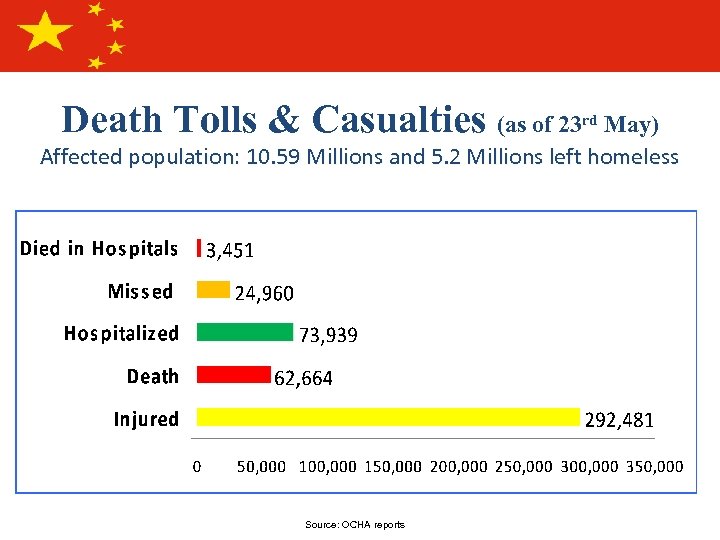 Death Tolls & Casualties (as of 23 May) Affected population: 10. 59 Millions and 5. 2 Millions left homeless Source: OCHA reports rd
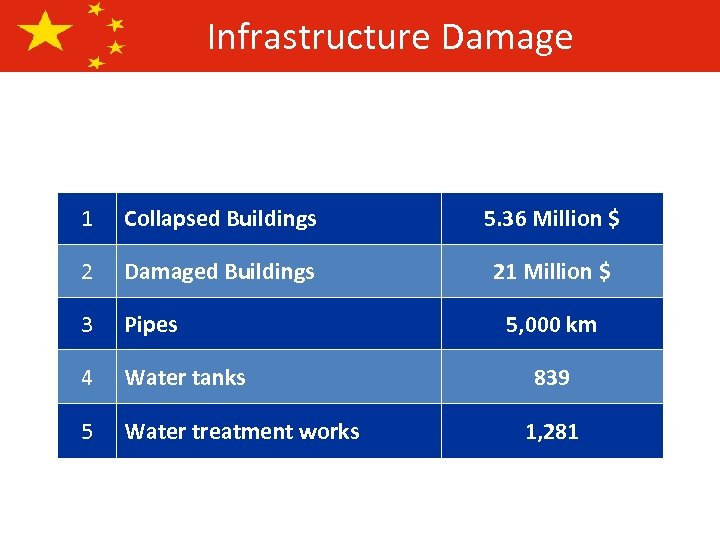 Infrastructure Damage 1 Collapsed Buildings 5. 36 Million $ 2 Damaged Buildings 21 Million $ 3 Pipes 4 Water tanks 5 Water treatment works 5, 000 km 839 1, 281
 Agricultural Damage • Irrigation systems for 100, 000 hectares of paddy fields • > 50, 000 greenhouses • 7. 3 million square meters of livestock barns Relief web
 Building Damage • Number of damaged/collapsed: >15, 000 • Building earthquake resistant structures makes good economic sense: 3 -5% for typical buildings
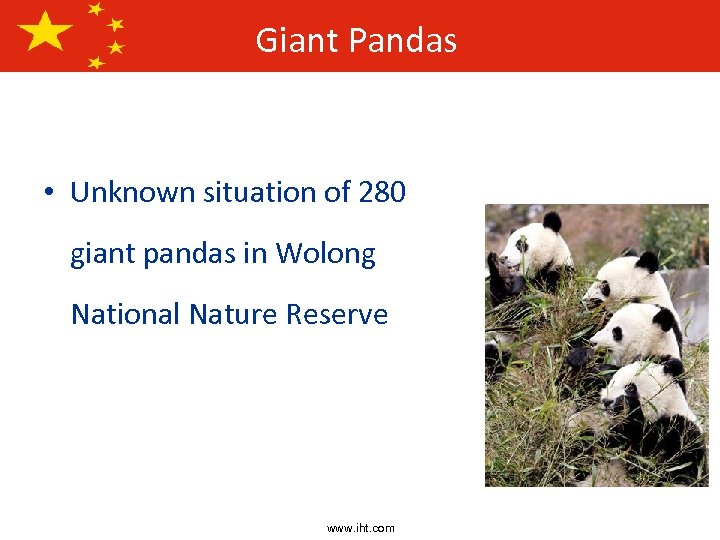 Giant Pandas • Unknown situation of 280 giant pandas in Wolong National Nature Reserve www. iht. com
 2006 -7 International Campaign on School Safety • The world just passed a 2 -years global campaign of Safe Schools • The 2006 -7 Global campaign focused on promoting the safety of school buildings & mainstreaming of disaster risk reduction (DRR) into school curricula or at least school activities. • How are safe the schools in your community?
 Public Health Priorities According WHO: 1) Treating The Injured 2) Communicable Disease Surveillance & Control 3) Ensuring Safe Water And Food Supply 4) Immediate & Long-term Mental Health & Psychosocial Support 5) Reconstruction Of Health Care System In The Affected Areas
 Urgent Needs • > 3. 3 million tents • Garbage Treatment Facilities & Sewage Treatment Facilities • Chemical proof protective clothing, Shoes and masks • Radiation detector (X ray and Y ray survey meter, Personal dosimeter) • Medical Instruments like ECG, Operational Kits, etc • Medication for infectious disease Source: UNOCHA situation report NO 6, 7 & 8
 Do not forget children in Sichuan! • At least 5, 498 children have been left alone in Sichuan Province's quake zone, either because they have been orphaned or their parents cannot be located
 Do not forget elderly in Sichuan! • About 8004, elderly people left alone due to death of their family or they have been separated from all their relatives
 Secondary hazards: Possible dam failure • 30 cm movement of China's largest earth-rock dam due to earthquake • 400 damaged dams with possible threat to downstream people
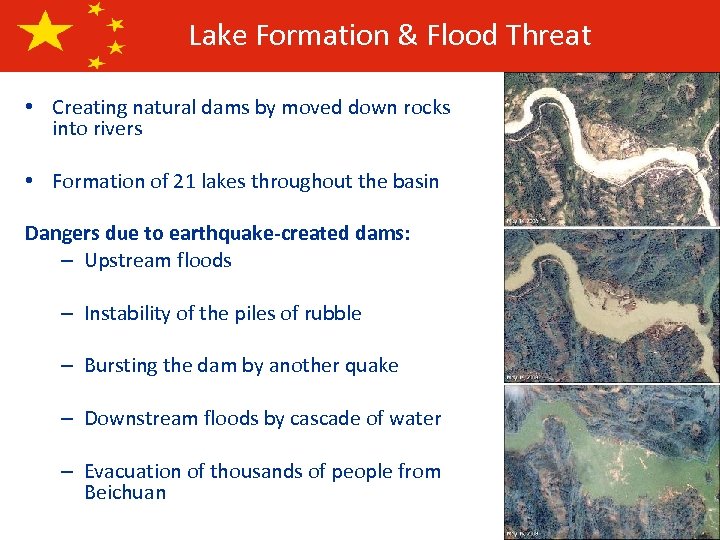 Lake Formation & Flood Threat • Creating natural dams by moved down rocks into rivers • Formation of 21 lakes throughout the basin Dangers due to earthquake-created dams: – Upstream floods – Instability of the piles of rubble – Bursting the dam by another quake – Downstream floods by cascade of water – Evacuation of thousands of people from Beichuan
 30 years continuous evolution in the practice of Crisis or Disaster Management § Civil defense § Emergency assistance § Disaster response and relief Strategic shift from managing a disastrous § Humanitarian assistance event to more § Emergency management preventive and § Civil protection § Disaster mitigation and prevention § Disaster Risk Management proactive approaches!!
 What is the Hazard? • A potentially damaging physical event, phenomenon or human activity that may cause the loss of life or injury, property damage, social and economic disruption or environmental degradation. Natural China Earthquake Hydro meteorological Flood, Hurricane Biological Hyman Induced Geological Pandemic Environmental degradation Deforestation Technological Nuclear release
 What is the Vulnerability? • The conditions determined by physical, social, economic, and environmental factors or processes, which increase the susceptibility of a community to the impact of hazards. • Vulnerable Sichuan: o Unprepared people o Non-resistant house & school building o High-density population o etc.
 What is Risk? • The probability of harmful consequences, or expected losses (deaths, injuries, property, livelihoods, economic activity disrupted or environment damaged) resulting from interactions between natural or human -induced hazards & vulnerable conditions. • Risk = Hazards x Vulnerability
 What is a Disaster ? • A serious disruption of the functioning of a community or a society causing widespread human, material, economic or environmental losses which exceed the ability of the affected community or society to cope using its own resources.
 Sichuan earthquake: Risk model • Maybe Sichuan was not able to modify the hazard part of the earthquake risk model, and predict it precisely, BUT they could assess their vulnerability conditions and reduced them! • This has been the same experience in Bam & Kashmir, Yogyakarta !
 Just-in-Time Education Let’s teach the communities right now ! Risk awareness & Knowledge development including education, training, research and information are of the important fields of action for Disaster Risk Reduction!
 What we should do/do not before, during & after the earthquake? Please read carefully at: http: //earthquake. usgs. gov/faq/prepare. html
 Main Lesson Learned So, an earthquake measuring 7. 9 on the Richter scale is a big earthquake, but not necessarily equal to a disaster. It is just movement of the earth crust. Our vulnerability has changed it to a disaster!!
 References
 We wish to express our warm thanks to GDHNet faculties and all groups that contributed their valuable materials.