


 Скачать презентацию JUNGLES AND GARDENS THE EVOLUTION OF KNOWLEDGE MANAGEMENT
143271eac3ead2e4e20a8426b96cd1a7.ppt
- Количество слайдов: 26
 JUNGLES AND GARDENS: THE EVOLUTION OF KNOWLEDGE MANAGEMENT AT J. D. EDWARDS Case presentation, IS 904 15. 10. Tero Päivärinta
 Agenda • What is the main idea? • What are the technological functionalities / applications involved? • How mature is the technology? • What new does that idea bring, if compared to related previous ideas or solutions? • How is that technology applied? • Reflections on another case
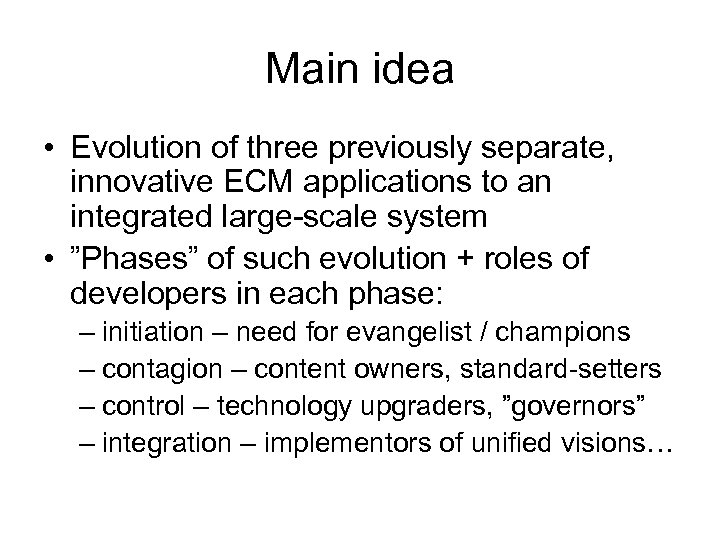 Main idea • Evolution of three previously separate, innovative ECM applications to an integrated large-scale system • ”Phases” of such evolution + roles of developers in each phase: – initiation – need for evangelist / champions – contagion – content owners, standard-setters – control – technology upgraders, ”governors” – integration – implementors of unified visions…
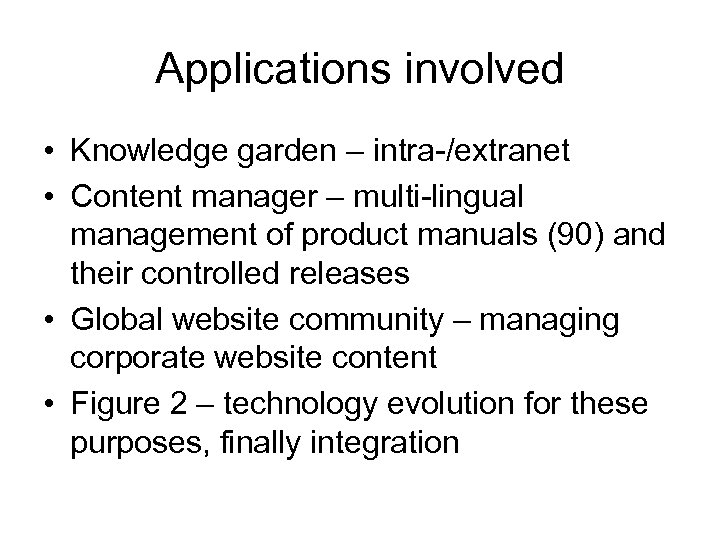 Applications involved • Knowledge garden – intra-/extranet • Content manager – multi-lingual management of product manuals (90) and their controlled releases • Global website community – managing corporate website content • Figure 2 – technology evolution for these purposes, finally integration
 Maturity of technology? • comments on that?
 What’s the news? • 12 ”lessons” for… – whom? – Other organizations, which follow a similar ”evolutionary” development of enterprise content management? • …but, if you realize you follow such path of evolution… would you still function on that manner? – However, a very valuable in-depth case description.
 Discussion • Evolutionary development of content management in other cases? – Org x. • Delivery of large-scale engineering products in projects • Still – separate content management for websites, Share Point for teams in certain areas, Technical documentation for products/projects in in-house applications, some documents in the ERP system… • …integration and new functionality development continuing – …but would the lessons apply as such? • need for research – would need to test – provide these 12 ideas for developers in the new target organization, and after a while ask if they have implemented it – why/why not
 Challenges of ”evolutionary development”? • Organizational – how does one guarantee that ”integration” / common vision is even a goal? – a ”vision” sounds a bit ”teleological”… • Human – can one cultivate ”champions” consciously, or do they just emerge? • Technological – many increasingly large-scale systems side by side? -> from ”silos” to ”spaghetti”? • Managerial? – How to manage evolution? • …
 Questions to discuss (could be exam questions) • Do you believe in the return-on-investment figures? – …how could that be done as a business case? • Does one need ”evolution” before a ”unifying vision” & integration? – …or… is it still possible to make ”innovative” enterprise-scale ECM / e. Collaboration applications? • Is the ”unifying vision” possible without mature 3 rd-party technology?
 Contemporary Issues of Enterprise Content Management Case presentation, IS 904 15. 10. Tero Päivärinta
 Agenda • What is the main idea? • What are the technological functionalities / applications involved? • How mature is the technology? • What new does that idea bring, if compared to related previous ideas or solutions? • How is that technology applied? • Reflections on another case
 Main idea • identify a wide range of issues related to management of content, infrastructure, and change in connection to large-scale (strategic) ECM programs – > understanding the ”enterprise perspective” on ECM as a holistic concept
 Applications included • at that moment, not clear yet • intent to replace previous applications • (later on, Microsoft-based application portfolio selected – Nordheim & Päivärinta, 2006)
 Maturity of technology • Immature, visionary ideas about the corporate-wide requirements…
 What’s the news? • ”Strategic” approach to ECM, replacing the old enterprise information ”jungle” fully – compare to the JD Edwards case • The (first version of) framework about the enterprise-wide ECM issues – …concept of ECM
 Discussion • Would the strategic approach be possible in Ui. A? – Statoil IT alone is the biggest IT company in Norway… – Ui. A portal project – same time: • • 2, 5 mill. NOK – to build an enterprise portal 50% project manager, more or less 50% participants -> lead, in the end, some update of the website ”realizing” that ECM is an organizational, not technological, challenge (although it is also a technological challenge)
 Questions • Is the ”strategic” & holistic approach feasible / possible for smaller companies? • Will there ever be intact corporate-wide ECM system implementations? – according to the definition of ECM given in the article • Is ECM meaningful concept to be discussed as a whole, or should we focus on particular smaller-scale applications?
 Corporate User Representatives and the Dialectics of Enterprise Systems: A Quest for Social Actors with Political Skill Case presentation, IS 904 15. 10. Tero Päivärinta
 Agenda • What is the main idea? • What are the technological functionalities / applications involved? • How mature is the technology? • What new does that idea bring, if compared to related previous ideas or solutions? • How is that technology applied? • Reflections on another case
 Main idea • Needs of particular user groups / organization units may clash with ”optimization” of enterprisewide ideas / – > studying how, in a large-scale ECM program, one target organization has used the idea of ”corporate user representative” to solve such emerging contradictions • Describes, if one is to do such a job, characteristics required: – ” a corporate user representative should be a management function with political skill. ”
 Applications involved • Focuses on challenges of implementation projects – the actual applications not perhaps so important – (beyond the fact that they are complex – still need for a corporate joint vision)
 Maturity of technology • immature / complex integrations -> leads to ”strategic program” in the first place
 What’s the news? • The idea about the management role: ”corporate user representative” – & how s/he should be • (under the realization that enterprise-wide development involves conflicts, to-besolved) – communicator, consensus-builder, domaincompetent as well as tech-savvy, politician (personal power & weight in the organization!)
 Discussion • …what if an enterprise does not realize in the first place that different stakeholders have competing goals? • a university project – very unclear goals: ”Here’s the money, just build a corporate portal” – a ”failure” will be conceptualized & advertised always by some stakeholder group • EITHER – clear, implementable and prioritized top mgmt goals onto which to claim success • OR – trying to implement some mechanism (like the user representative), which first realizes that contradictions are ”natural” and seeks ways to mitigate them!
 Challenges • …in this case, human and managerial – can you find really competent persons – can you really recruit them to an ”IT development project”? • …while they might have much more rewarding management positions waiting in their career…?
 Question(s) • Could you think you might work as a ”corporate user representative” some day? • Should this be a project-based or a continuing work role ? – and in what kind of organizations?