


 Скачать презентацию July 27 The Institutions of the European Union
0f6806aa5f4a3a9b9573404fe35d83ca.ppt
- Количество слайдов: 20
 July 27: The Institutions of the European Union READING ASSIGNMENT: The European Parliament, The European Council, The Council Presidency The European Commission, The Court of Justice, The European Court of Auditors 글로벌 KU 프론티어 스피릿!!!
 Tomorrow… • “cocktail party phrases” for the reading…
 Review: What role do International Organizations play? • International cooperation – Solve coordination problems (especially in PD settings) – E. g. , International financial institutions (IMF, World Bank, ADB) allow governments to pool resources that they can lend to countries for stability &/or development • Pursue foreign policy goals – Obfuscate the provision of foreign aid ("dirty work") – E. g. , Governments important to Japan receive more loans from the ADB • Pursue domestic goals – Commit governments to following a course of action – E. g. , IMF programs pressure veto players to adopt unpopular economic reform policies
 Human Rights Agreements under the United Nations? • International cooperation – Solve coordination problems (especially in PD settings)? ? – Tit-for-tat does NOT work here – Mainly about crimes of the state against its own citizens • Pursue foreign policy goals? ? – The goal of protecting citizens of OTHER countries? – These have been pursued through human rights clauses in *TRADE AGREEMENTS* (makes international competition fairer if all workers have the same rights) – This is not the nature of the main UN Human Rights agreements • CAT, ICCPR, CEDAW • Human rights agreements hold governments accountable for purely internal activities • *PURSUE DOMESTIC GOALS* – Commitment mechanism: commit governments to follow a course of action – 2 versions: 1. LOCK-IN – genuinely want to lock in human rights protection under potential future regimes (Moravscik – ECHR) 2. RESOLVE – send a signal to your domestic audience about your resolve to remain in office – Domestic enforcement (Hathaway) – Human rights agreements have little impact on state behavior
 United Nations Approach to international cooperation • Broad membership – shallow commitments at first then deepen • Universal Declaration of Human Rights (1948) • International Covenant on Civil and Political Rights (1966) • International Covenant on Economic, Social and Cultural Rights (1966) • International Covenant on Civil and Political Rights (ICCPR) (1976) • Convention on the Elimination of All Forms of Discrimination Against Women (CEDAW) (1981) • Convention Against Torture and Other Cruel, Inhuman or Degrading Treatment (CAT) (1987) – the only one with UNIVERSAL JURISDICTION
 The EU http: //www. youtube. com/user/eutube? b lend=6&ob=4#play/user/076 DFAC 291 E 71024/0/8 hd. L 3 Qc. IJSs Take homes?
 Take-homes • The EU has taken a narrow approach • Original agreement was just 6 members • Deepened slowly with great inertia • Lots of veto power – Ratification of agreements requires unanimity – Legislation requires Commission initiation + approval of Council (weighted voting) + (usually) approval of Parliament (Euro-wide ideological parties) • Progress is set to be slow, but irreversible • Major commitments • Now up to 27 members!
 European Union Approach to international cooperation • Narrow membership – deepen commitments first, then broaden membership • 1951: 6 countries enter into the European Coal and Steel Community – Belgium, France, Italy, Luxembourg, the Netherlands and West Germany • 1957: THE SIX enter into the “Treaties of Rome” – Extends the E. Coal and Steel Community – Creates the European Economic Community (EEC) establishing a customs union – Creates the European Atomic Energy Community (Euratom) for cooperation in developing nuclear energy • 1967: the "Merger Treaty" creates a single set of institutions for the three communities, collectively called "the European Communities" • 1973: first enlargement (6+3=9 total members) – Denmark, Ireland, and the United Kingdom (Norway - domestic referendum rejects membership) • 1979: the first direct, democratic elections to the European Parliament • 1981: Greece (9+1=10) • 1986: Spain & Portugal (10+2=12)
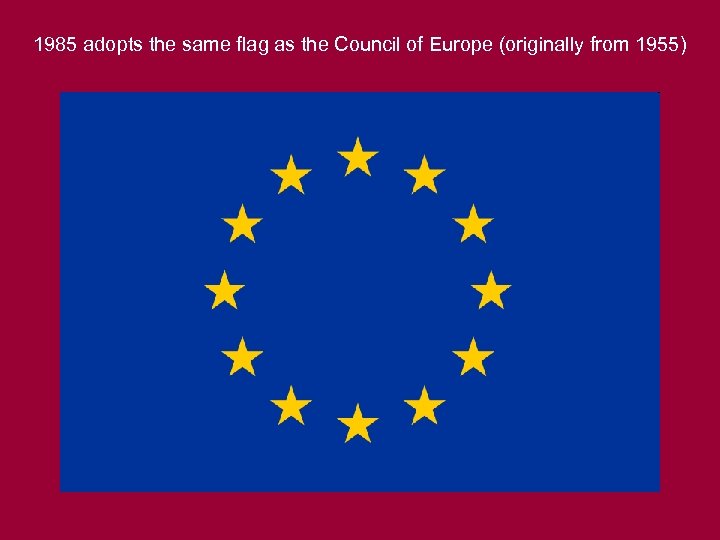 1985 adopts the same flag as the Council of Europe (originally from 1955)
 • 1993: Maastricht Treaty formally establishes THE EUROPEAN UNION • 1995: Austria, Sweden and Finland join (12+3=15) • 2002: The EURO! – – Note that not all EU members adopted the Euro - only 12 at first too deep for the others! Since then we have moved up to 16 countries using the Euro More on that tomorrow • 2004: biggest enlargement – Malta, Cyprus, Slovenia, Estonia, Latvia, Lithuania, Poland, the Czech Republic, Slovakia, and Hungary (15+10=25) • 2007: Romania and Bulgaria (25+2=27) • Currently 27 members
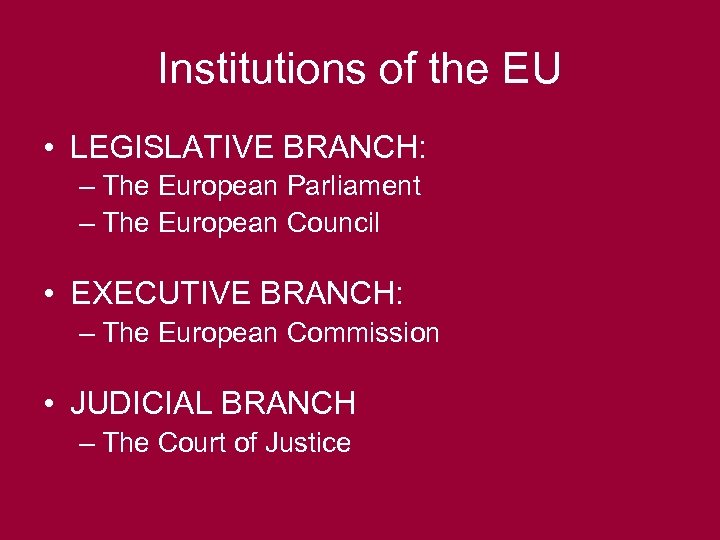 Institutions of the EU • LEGISLATIVE BRANCH: – The European Parliament – The European Council • EXECUTIVE BRANCH: – The European Commission • JUDICIAL BRANCH – The Court of Justice
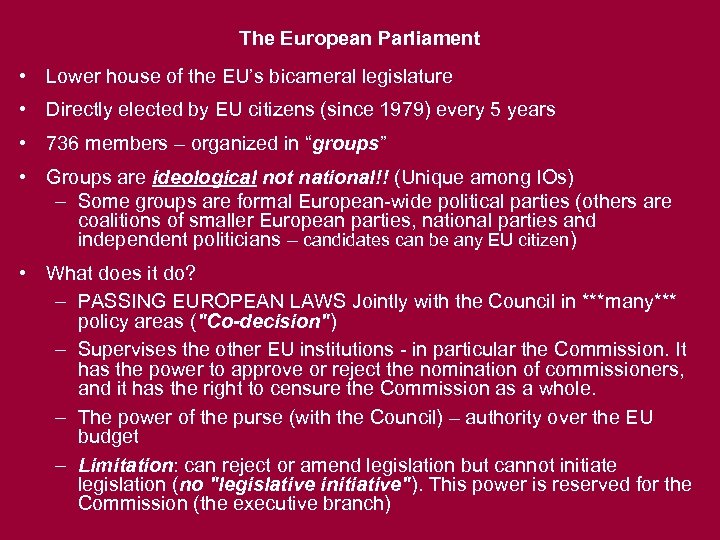 The European Parliament • Lower house of the EU’s bicameral legislature • Directly elected by EU citizens (since 1979) every 5 years • 736 members – organized in “groups” • Groups are ideological not national!! (Unique among IOs) – Some groups are formal European-wide political parties (others are coalitions of smaller European parties, national parties and independent politicians – candidates can be any EU citizen) • What does it do? – PASSING EUROPEAN LAWS Jointly with the Council in ***many*** policy areas ("Co-decision") – Supervises the other EU institutions - in particular the Commission. It has the power to approve or reject the nomination of commissioners, and it has the right to censure the Commission as a whole. – The power of the purse (with the Council) – authority over the EU budget – Limitation: can reject or amend legislation but cannot initiate legislation (no "legislative initiative"). This power is reserved for the Commission (the executive branch)
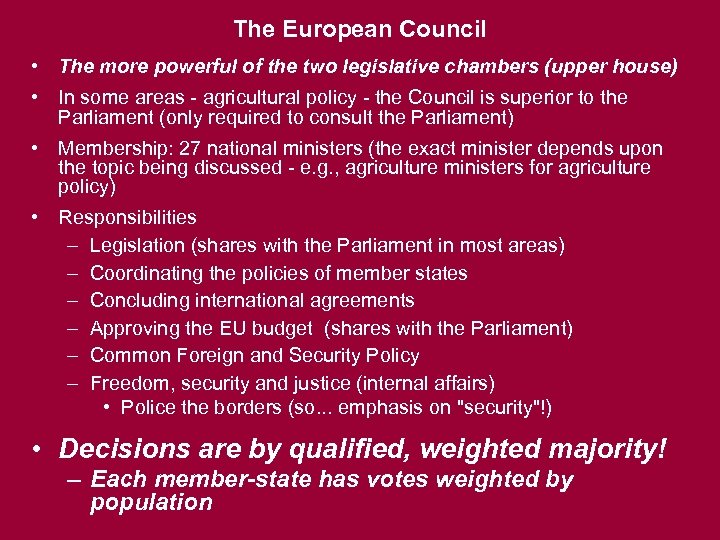 The European Council • The more powerful of the two legislative chambers (upper house) • In some areas - agricultural policy - the Council is superior to the Parliament (only required to consult the Parliament) • Membership: 27 national ministers (the exact minister depends upon the topic being discussed - e. g. , agriculture ministers for agriculture policy) • Responsibilities – Legislation (shares with the Parliament in most areas) – Coordinating the policies of member states – Concluding international agreements – Approving the EU budget (shares with the Parliament) – Common Foreign and Security Policy – Freedom, security and justice (internal affairs) • Police the borders (so. . . emphasis on "security"!) • Decisions are by qualified, weighted majority! – Each member-state has votes weighted by population
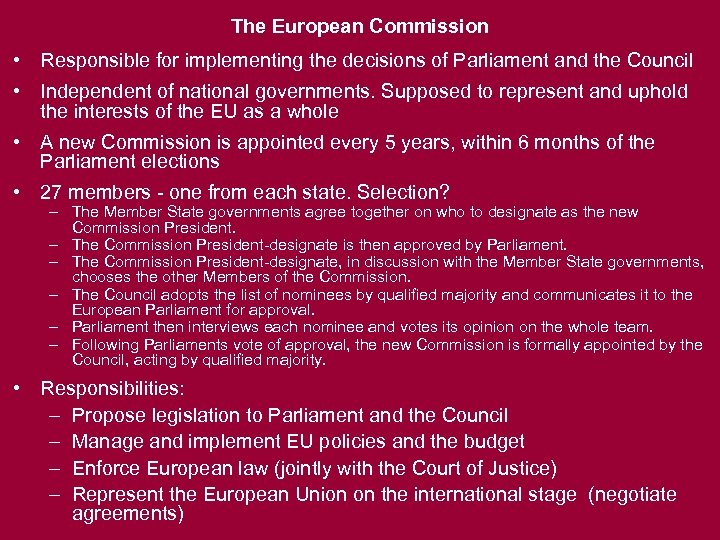 The European Commission • Responsible for implementing the decisions of Parliament and the Council • Independent of national governments. Supposed to represent and uphold the interests of the EU as a whole • A new Commission is appointed every 5 years, within 6 months of the Parliament elections • 27 members - one from each state. Selection? – The Member State governments agree together on who to designate as the new Commission President. – The Commission President-designate is then approved by Parliament. – The Commission President-designate, in discussion with the Member State governments, chooses the other Members of the Commission. – The Council adopts the list of nominees by qualified majority and communicates it to the European Parliament for approval. – Parliament then interviews each nominee and votes its opinion on the whole team. – Following Parliaments vote of approval, the new Commission is formally appointed by the Council, acting by qualified majority. • Responsibilities: – Propose legislation to Parliament and the Council – Manage and implement EU policies and the budget – Enforce European law (jointly with the Court of Justice) – Represent the European Union on the international stage (negotiate agreements)
 Veto players • For legislation 1. 2. Commission must propose Council must approve – 3. Parliament must approve (in most areas – “co-decision”) – • Appointed “federally” – by member governments by issue area Elected nationally – by all EU citizens According to veto player theory, EU policy stability should be ____ (high or low? ) “HIGH”! • New policies should be difficult to adopt • But adopted policies should be difficult to rescind! • Inherently conservative approach to governing • Policy “inertia” slow but sustainable deepening
 Current Challenge • Treaty of Lisbon (or Reform Treaty) – Drafted 2007 • Would further centralize power in the EU – Most visible change: the creation of a new EU “president” (not directly elected, however) – Also: a new EU foreign minister, able to make foreign policy under his own initiative – Change the qualified majority voting in the European Council – Extend co-decision to Parliament for more areas • Signed by all members, but NOT yet ratified – ALL MEMBERS MUST RATIFY! (VETO POWER OVER MAJOR CHANGES!!!) • Some countries ratify through their parliaments • Ireland must ratify with a national "referendum" – Treaty of Lisbon defeated 53% to 47% (53% voter turnout) – A Second Referendum is set for 2 October 2009… – Still waiting on Czech Rep, Poland, Germany http: //news. bbc. co. uk/2/hi/europe/6901353. stm
 Take-homes • The EU has taken a narrow approach • Original agreement was just 6 members • Deepened slowly with great inertia • Lots of veto power – Ratification of agreements requires unanimity – Legislation requires Commission initiation + approval of Council (weighted voting) + (usually) approval of Parliamentary (Eurowide ideological parties) • Progress is set to be slow, but irreversible • Major commitments • Now up to 27 members!
 THANK YOU 글로벌 KU 프론티어 스피릿 !
 The Court of Justice • Purpose: to make sure that EU legislation is interpreted and applied in the same way in all EU countries (so national courts do not give different rulings on the same issue) • Also makes sure that EU member states & institutions do what the law requires • Has the power to settle legal disputes between EU member states, EU institutions, businesses, & individuals • Court is composed of one judge per member state (though it usually sits as a ‘Grand Chamber’ of just 13 judges or in chambers of 5 or 3 judges • Judges (and advocates) are appointed by joint agreement between the governments of the EU member states • Each is appointed for a 6 year (renewable) term
 The European Court of Auditors • The Court’s job is to check that EU funds (which come from taxpayers) are properly collected and spent legally, economically and for their intended purpose • Its aim is to ensure that the taxpayers get maximum value for their money • It has the right to audit any person or organization handling EU funds. • The Court has one member from each EU country, appointed by the European Council for a renewable term of six years