


 Скачать презентацию July 2001 doc IEEE 802 11 -01 378
0c08fedfd0dae9096d8948c00162a364.ppt
- Количество слайдов: 22
 July 2001 doc. : IEEE 802. 11 -01/378 OCB Mode Phillip Rogaway Department of Computer Science UC Davis + CMU rogaway@cs. ucdavis. edu http: //www. cs. ucdavis. edu/~rogaway +66 1 530 7620 +1 530 753 0987 802. 11 Presentation – Security (TG i) - Portland, Oregon Submission 1 Phillip Rogaway
 July 2001 doc. : IEEE 802. 11 -01/378 What am I? • A cryptographer (MIT ® IBM ® UCD) • Practice-oriented provable security – 1993 ® present. Research program jointly envisioned with M. Bellare • Approach applied to many cryptographic problems • Work picked up in various standards & draft standards: (OEAP, DHIES, PSS-R) by (ANSI, IEEE, ISO, PKCS, SECG) What am I not ? • An expert in networking • A businessman • An attorney Submission 2 Phillip Rogaway
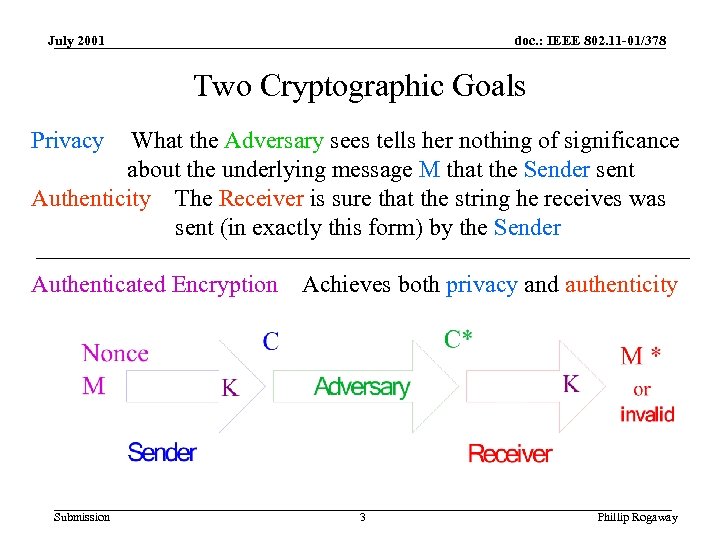 July 2001 doc. : IEEE 802. 11 -01/378 Two Cryptographic Goals Privacy What the Adversary sees tells her nothing of significance about the underlying message M that the Sender sent Authenticity The Receiver is sure that the string he receives was sent (in exactly this form) by the Sender Authenticated Encryption Submission Achieves both privacy and authenticity 3 Phillip Rogaway
 July 2001 doc. : IEEE 802. 11 -01/378 Authenticity is Essential • You may or may not care about privacy, but you almost certainly care about authenticity: without it, an adversary can completely disrupt the operation of the network. • The authenticity risk is higher in a wireless environment, as the adversary can easily inject her own packets. • Standard privacy methods do not provide authenticity, and simple ways to modify them (eg, “add redundancy then encrypt”) don't work Submission 4 Phillip Rogaway
![July 2001 doc. : IEEE 802. 11 -01/378 Folklore approach. See [Bellare, Nampre] and](https://present5.com/presentation/0c08fedfd0dae9096d8948c00162a364/image-5.jpg "July 2001 doc. : IEEE 802. 11 -01/378 Folklore approach. See [Bellare, Nampre] and") July 2001 doc. : IEEE 802. 11 -01/378 Folklore approach. See [Bellare, Nampre] and [Krawczyk] encryption for analysis. Generic Composition Traditional approach to authenticated Glue together an Encryption scheme + Message Integrity Code (MIC) Usually called a Message Authentication Code ( MAC ) Submission 5 Phillip Rogaway
July 2001 doc. : IEEE 802. 11 -01/378 Folklore approach. See [Bellare, Nampre] and [Krawczyk] encryption for analysis. Generic Composition Traditional approach to authenticated Glue together an Encryption scheme + Message Integrity Code (MIC) Usually called a Message Authentication Code ( MAC ) Submission 5 Phillip Rogaway
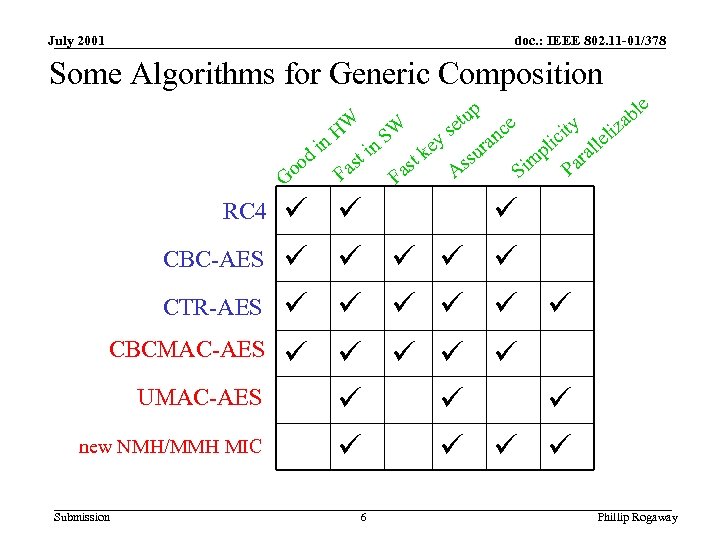 July 2001 doc. : IEEE 802. 11 -01/378 Some Algorithms for Generic Composition e s ity eliz HW SW nc y ic a in in pl rall ur ke t s t m Pa od as o as As Si F F G RC 4 CBC-AES CTR-AES CBCMAC-AES UMAC-AES new NMH/MMH MIC Submission ü ü e l ab p tu e ü ü ü ü ü ü 6 Phillip Rogaway
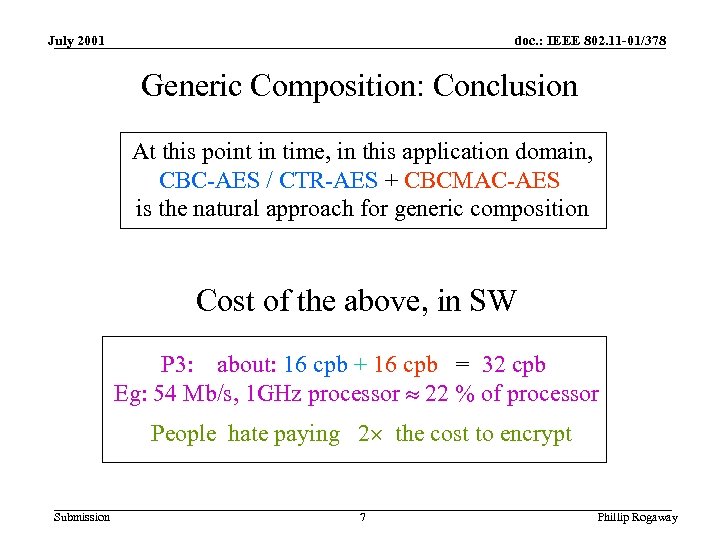 July 2001 doc. : IEEE 802. 11 -01/378 Generic Composition: Conclusion At this point in time, in this application domain, CBC-AES / CTR-AES + CBCMAC-AES is the natural approach for generic composition Cost of the above, in SW P 3: about: 16 cpb + 16 cpb = 32 cpb Eg: 54 Mb/s, 1 GHz processor » 22 % of processor People hate paying 2´ the cost to encrypt Submission 7 Phillip Rogaway
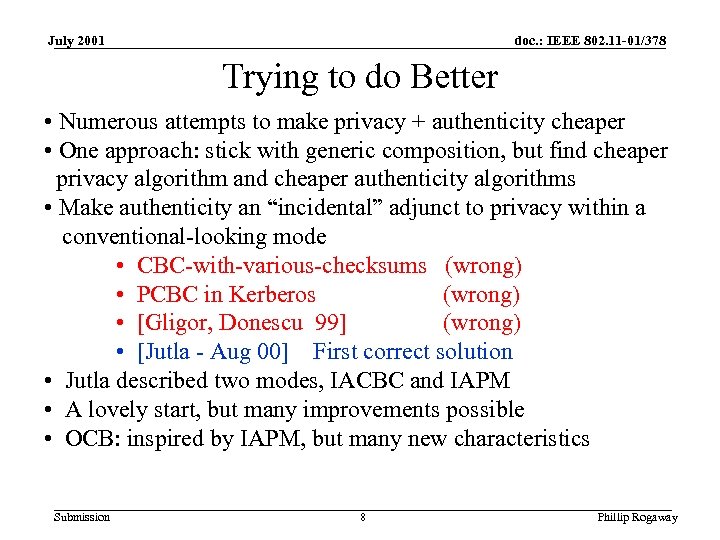 July 2001 doc. : IEEE 802. 11 -01/378 Trying to do Better • Numerous attempts to make privacy + authenticity cheaper • One approach: stick with generic composition, but find cheaper privacy algorithm and cheaper authenticity algorithms • Make authenticity an “incidental” adjunct to privacy within a conventional-looking mode • CBC-with-various-checksums (wrong) • PCBC in Kerberos (wrong) • [Gligor, Donescu 99] (wrong) • [Jutla - Aug 00] First correct solution • Jutla described two modes, IACBC and IAPM • A lovely start, but many improvements possible • OCB: inspired by IAPM, but many new characteristics Submission 8 Phillip Rogaway
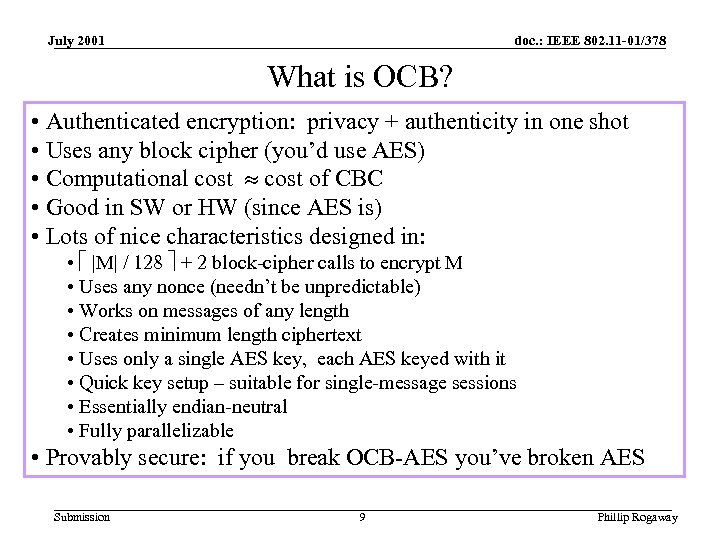 July 2001 doc. : IEEE 802. 11 -01/378 What is OCB? • Authenticated encryption: privacy + authenticity in one shot • Uses any block cipher (you’d use AES) • Computational cost » cost of CBC • Good in SW or HW (since AES is) • Lots of nice characteristics designed in: • é |M| / 128 ù + 2 block-cipher calls to encrypt M • Uses any nonce (needn’t be unpredictable) • Works on messages of any length • Creates minimum length ciphertext • Uses only a single AES key, each AES keyed with it • Quick key setup – suitable for single-message sessions • Essentially endian-neutral • Fully parallelizable • Provably secure: if you break OCB-AES you’ve broken AES Submission 9 Phillip Rogaway
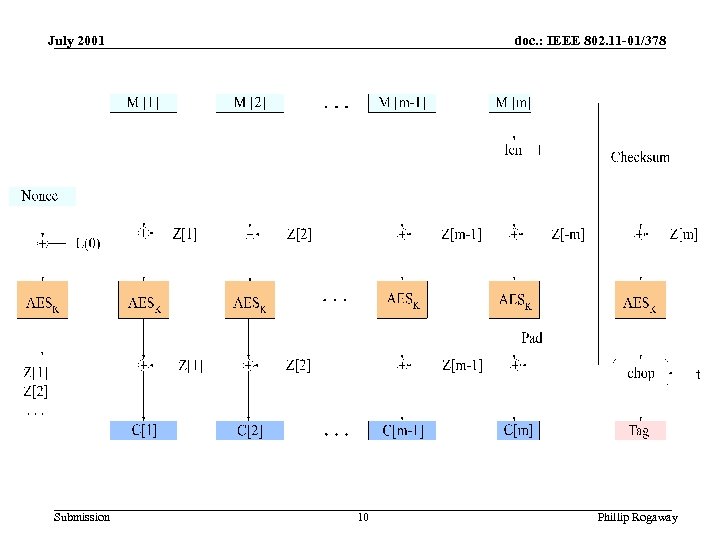 July 2001 doc. : IEEE 802. 11 -01/378 Diagram of OCB Submission 10 Phillip Rogaway
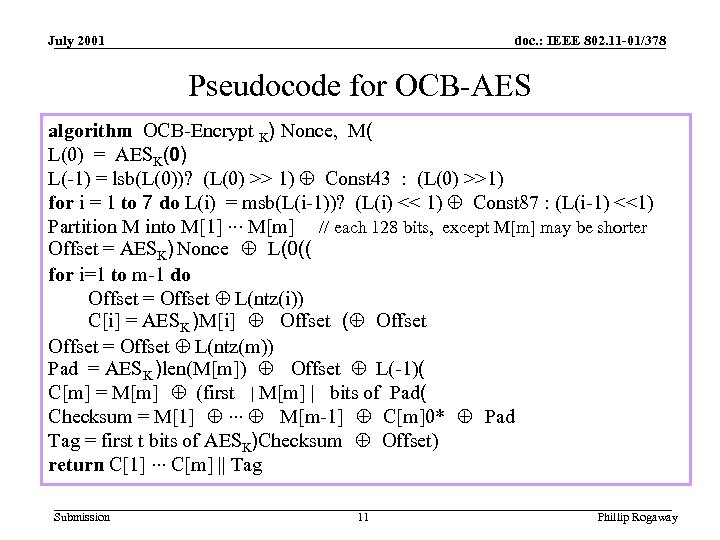 July 2001 doc. : IEEE 802. 11 -01/378 Pseudocode for OCB-AES algorithm OCB-Encrypt K) Nonce, M( L(0) = AESK(0) L(-1) = lsb(L(0))? (L(0) >> 1) Å Const 43 : (L(0) >>1) for i = 1 to 7 do L(i) = msb(L(i-1))? (L(i) << 1) Å Const 87 : (L(i-1) <<1) Partition M into M[1]. . . M[m] // each 128 bits, except M[m] may be shorter Offset = AESK) Nonce Å L(0(( for i=1 to m-1 do Offset = Offset Å L(ntz(i)) C[i] = AESK )M[i] Å Offset (Å Offset = Offset Å L(ntz(m)) Pad = AESK )len(M[m]) Å Offset Å L(-1)( C[m] = M[m] Å (first |M[m] | bits of Pad( Checksum = M[1] Å. . . Å M[m-1] Å C[m]0* Å Pad Tag = first t bits of AESK)Checksum Å Offset) return C[1]. . . C[m] || Tag Submission 11 Phillip Rogaway
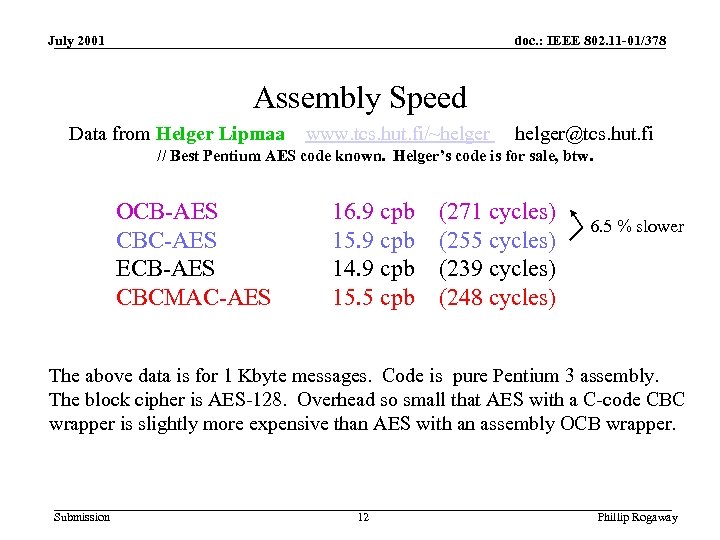 July 2001 doc. : IEEE 802. 11 -01/378 Assembly Speed Data from Helger Lipmaa www. tcs. hut. fi/~helger@tcs. hut. fi // Best Pentium AES code known. Helger’s code is for sale, btw. OCB-AES CBC-AES ECB-AES CBCMAC-AES 16. 9 cpb 15. 9 cpb 14. 9 cpb 15. 5 cpb (271 cycles) (255 cycles) (239 cycles) (248 cycles) 6. 5 % slower The above data is for 1 Kbyte messages. Code is pure Pentium 3 assembly. The block cipher is AES-128. Overhead so small that AES with a C-code CBC wrapper is slightly more expensive than AES with an assembly OCB wrapper. Submission 12 Phillip Rogaway
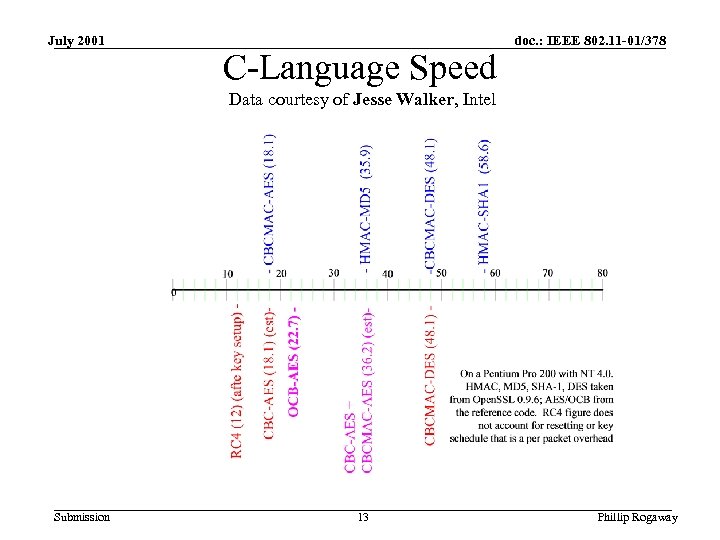 July 2001 C-Language Speed doc. : IEEE 802. 11 -01/378 Data courtesy of Jesse Walker, Intel Submission 13 Phillip Rogaway
 July 2001 doc. : IEEE 802. 11 -01/378 Why I like OCB • • Ease-of-correct-use. Reasons: all-in-one approach; any type of nonce; parameterization limited to block cipher and tag length Aggressively optimized: » optimal in many dimensions: key length, ciphertext length, key setup time, encryption time, decryption time, available parallelism; SW characteristics; HW characteristics; … Simple but sophisticated Ideal setting for practice-oriented provable security Submission 14 Phillip Rogaway
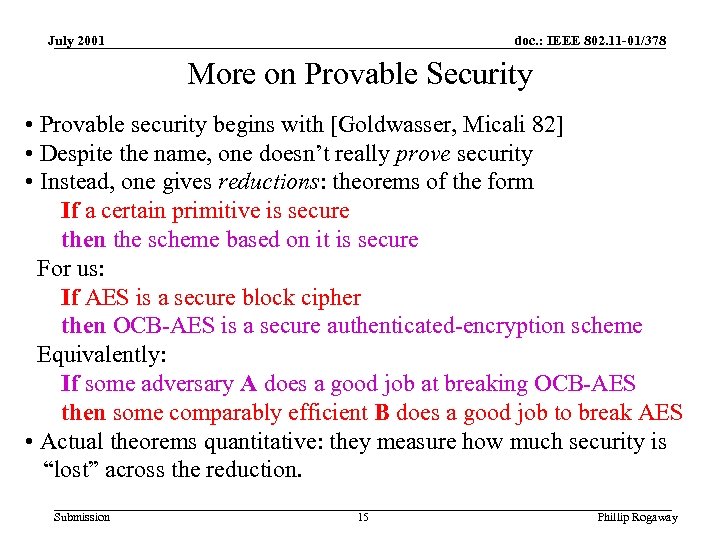 July 2001 doc. : IEEE 802. 11 -01/378 More on Provable Security • Provable security begins with [Goldwasser, Micali 82] • Despite the name, one doesn’t really prove security • Instead, one gives reductions: theorems of the form If a certain primitive is secure then the scheme based on it is secure For us: If AES is a secure block cipher then OCB-AES is a secure authenticated-encryption scheme Equivalently: If some adversary A does a good job at breaking OCB-AES then some comparably efficient B does a good job to break AES • Actual theorems quantitative: they measure how much security is “lost” across the reduction. Submission 15 Phillip Rogaway
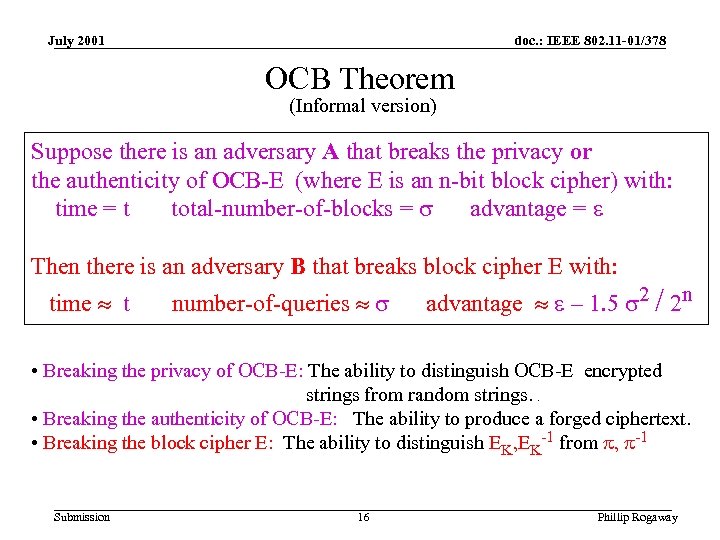 July 2001 doc. : IEEE 802. 11 -01/378 OCB Theorem (Informal version) Suppose there is an adversary A that breaks the privacy or the authenticity of OCB-E (where E is an n-bit block cipher) with: time = t total-number-of-blocks = s advantage = e Then there is an adversary B that breaks block cipher E with: time » t number-of-queries » s advantage » e – 1. 5 s 2 / 2 n • Breaking the privacy of OCB-E: The ability to distinguish OCB-E encrypted strings from random strings. • Breaking the authenticity of OCB-E: The ability to produce a forged ciphertext. • Breaking the block cipher E: The ability to distinguish EK, EK-1 from p, p-1. Submission 16 Phillip Rogaway
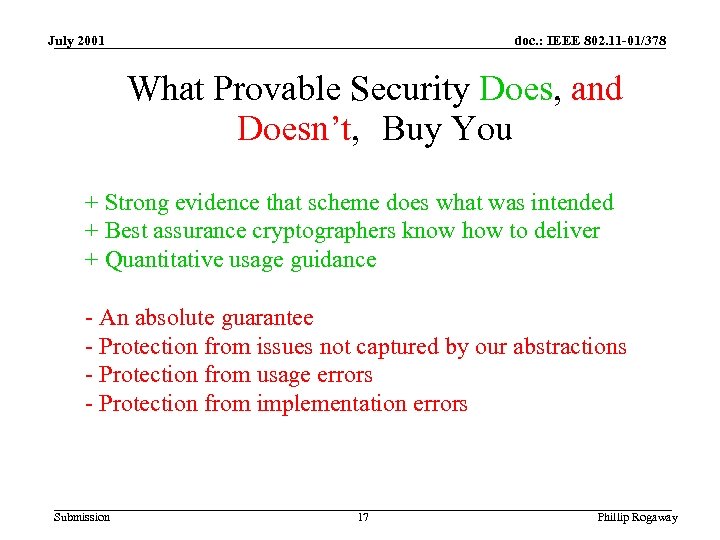 July 2001 doc. : IEEE 802. 11 -01/378 What Provable Security Does, and Doesn’t, Buy You + Strong evidence that scheme does what was intended + Best assurance cryptographers know how to deliver + Quantitative usage guidance - An absolute guarantee - Protection from issues not captured by our abstractions - Protection from usage errors - Protection from implementation errors Submission 17 Phillip Rogaway
 July 2001 doc. : IEEE 802. 11 -01/378 Adoption Issues • Scheme too new / might be wrong – Largely obviated by provable security • Stability - OCB (Apr 1) has not and will not change. Good schemes last forever • NIST does something else – If you care, send mail: Encryption. Modes@nist. gov • Export - Non-issue due to EAR 740. 18(b)(4) • Licensing – Next slides Submission 18 Phillip Rogaway
 July 2001 doc. : IEEE 802. 11 -01/378 Do I have a Patent? • • I filed patent applications covering OCB (12 Oct 00, 9 Feb 01) I will license the resulting patent(s) under fair, reasonable, non-discriminatory terms Letter of Assurance provided to the IEEE (3 May 01) My commitment goes well beyond the IEEE policy: - Public pricing, public license agreement - One-time fee (paid-in-full license) - I am committed to making this simple and easy for everyone - For further info: see “Licensing” on the OCB web page Submission 19 Phillip Rogaway
 July 2001 doc. : IEEE 802. 11 -01/378 Does Anyone Else Have a Patent OCB Would Infringe Upon? Do keep in mind the proviso from slide 2: I’m not a lawyer! • At present: No In the future: No way to know • Jutla / IBM • Has patent filing before me, including IAPM • IAPM resembles OCB. • But there are major differences which would have made it difficult to make claims for IAPM that read against OCB • My conclusion: IBM could come to hold a relevant patent, if their attorneys were lucky or insightful Submission 20 Phillip Rogaway
 July 2001 doc. : IEEE 802. 11 -01/378 Does Anyone Else Have a Patent, cont. • Gligor/VDG • Has patent filings before me and IBM • [GD, Aug 00] has an authenticated-encryption scheme, XCBC, but it does not resemble OCB • I know of no idea from [GD] that I used in OCB • My conclusion: I consider it unlikely that Gligor/VDG will come to hold a valid patent that reads against OCB • My overall conclusion • A company would be behaving with appropriate diligence to license from me - and no one else - at this time • The IEEE would be behaving with appropriate diligence to request patent-assurance letters from IBM and VDG, just in case Submission 21 Phillip Rogaway
 July 2001 doc. : IEEE 802. 11 -01/378 For More Information • OCB web page ® www. cs. ucdavis. edu/~rogaway Contains FAQ, papers, reference code, assurance letter, licensing info. . . • Feel free to call or send email • Upcoming talks: - NIST modes-of-operation workshop (Aug 24, Santa Barbara) • - MIT TOC/Security seminar (Oct ? ? , Cambridge) - ACM CCS conference (Nov 5 -8, Philadelphia) Grab me now or at CRYPTO (Aug 20 -23) Anything Else ? ? ? Submission 22 Phillip Rogaway