


 Скачать презентацию July 1 2005 http www oasis-open org Trusted
21acd3c30180938f2b8a7c4114f38b99.ppt
- Количество слайдов: 41
 July 1, 2005 http: //www. oasis-open. org Trusted Logic Voting Systems with OASIS EML 4. 0 (Election Markup Language) Presenter: David RR Webber Chair OASIS CAM TC http: //trustedelections. org
 Contents • Trusted Logic Voting (TLV) – Needs, Approach and Implementation • Using OASIS EML – History, Overview, Processes, Transactions • Applying OASIS EML – Example process steps and actions – Supporting US-style elections • Summary
 Trusted Logic Voting Needs • How can we ensure the voting machine does not cheat on the human operator who cannot “see inside”? • How can we know that every vote is counted as cast? • If you have two parties that you cannot trust, how do you create a process that works between the two – in a way that if either cheats you will know? • How can you create an audit trail that allows 100% crosschecking while keeping voter privacy? • Use existing work in the field on multi-party trusted logic process (e. g. MIT approach using the “Frog Principle”*) *see: http: //www. vote. caltech. edu/media/documents/vtp_WP 2. pdf
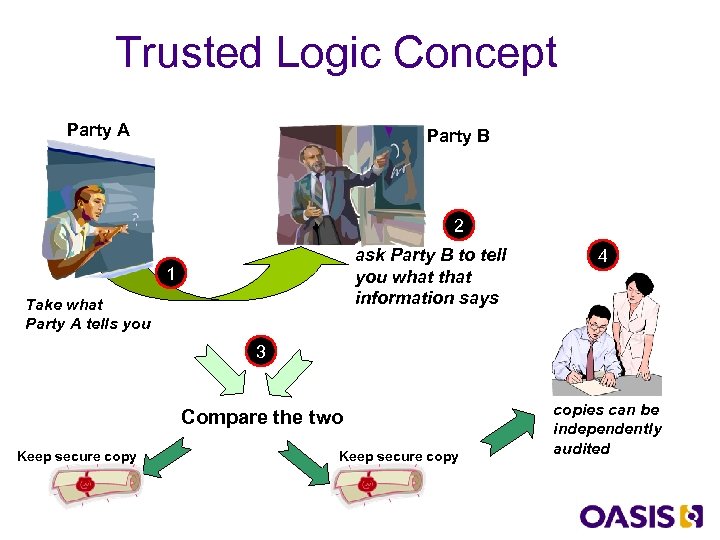 Trusted Logic Concept Party A Party B 2 ask Party B to tell you what that information says 1 Take what Party A tells you 4 3 Compare the two Keep secure copy copies can be independently audited
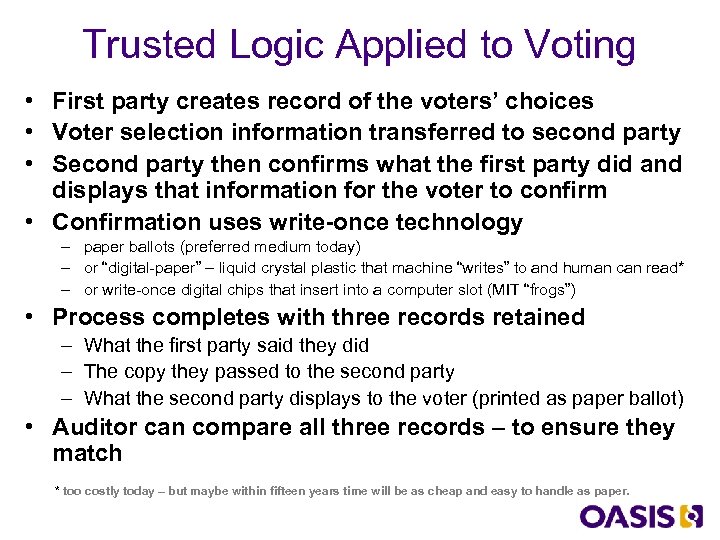 Trusted Logic Applied to Voting • First party creates record of the voters’ choices • Voter selection information transferred to second party • Second party then confirms what the first party did and displays that information for the voter to confirm • Confirmation uses write-once technology – paper ballots (preferred medium today) – or “digital-paper” – liquid crystal plastic that machine “writes” to and human can read* – or write-once digital chips that insert into a computer slot (MIT “frogs”) • Process completes with three records retained – What the first party said they did – The copy they passed to the second party – What the second party displays to the voter (printed as paper ballot) • Auditor can compare all three records – to ensure they match * too costly today – but maybe within fifteen years time will be as cheap and easy to handle as paper.
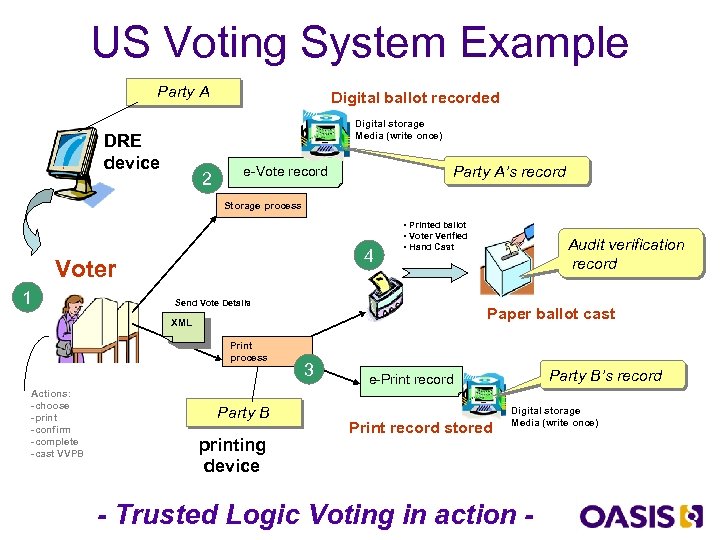 US Voting System Example Party A Digital ballot recorded Digital storage Media (write once) DRE device 2 Party A’s record e-Vote record Storage process 4 Voter 1 • Printed ballot • Voter Verified • Hand Cast Send Vote Details Paper ballot cast XML Print process Actions: -choose -print -confirm -complete -cast VVPB Party B printing device Audit verification record 3 Party B’s record e-Print record stored Digital storage Media (write once) - Trusted Logic Voting in action -
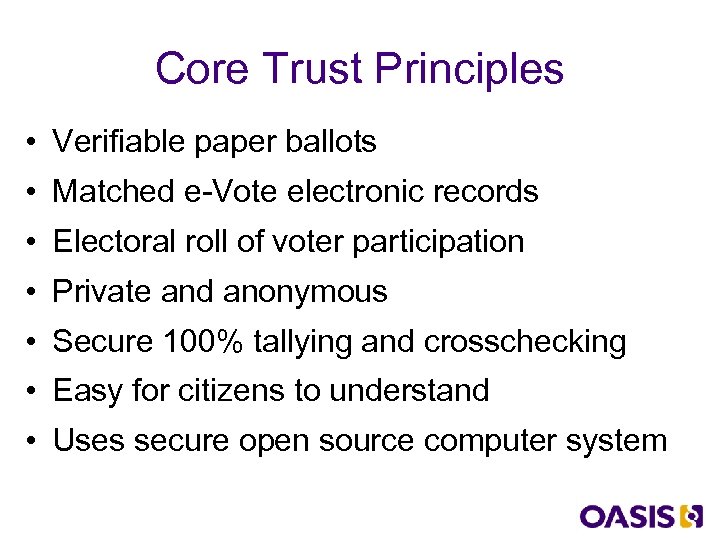 Core Trust Principles • Verifiable paper ballots • Matched e-Vote electronic records • Electoral roll of voter participation • Private and anonymous • Secure 100% tallying and crosschecking • Easy for citizens to understand • Uses secure open source computer system
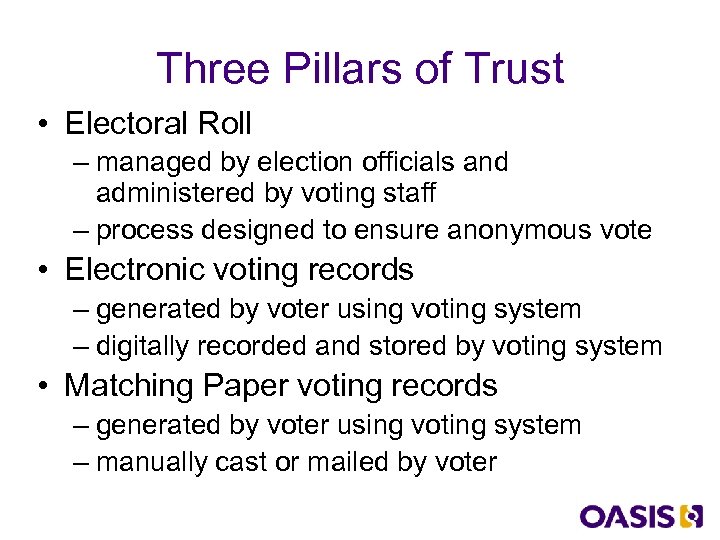 Three Pillars of Trust • Electoral Roll – managed by election officials and administered by voting staff – process designed to ensure anonymous vote • Electronic voting records – generated by voter using voting system – digitally recorded and stored by voting system • Matching Paper voting records – generated by voter using voting system – manually cast or mailed by voter
 Fundamentals of Trust • 100% audit and comparison every time of all three Trusted Pillar counts to produce a certified election result • Separation required between each step of the process; the trusted logic process is applied between the electronic and paper vote handling • No single system can control or access more than one of the Trusted Pillars processing – each has to be distinct • Every paper vote record is scanned and counted; every matching electronic vote is stored and then separately tallied
 Making Secure Computing • Process uses open public specifications • Logic and control parameters implemented as scripts that are hand-edited and verified • Core vote handling software components are open source • Implements secure operating environment (similar to anti-virus control) with locked master control execution agent to ensure correct components are running unmodified at all times • Certified closed and locked hardware environment to safeguard against unauthorized intrusions
 Designed to Mitigate Attacks • Attack Characteristics: – – • a launch platform; a manipulation method; an activation method; a cheating heuristic. Attack methods – – – vote presentation vote record shifting ballot stuffing count manipulation denial of service • Attack delivery – direct access allows install to occur – mal-ware loader replaces part or all of software (like virus) – hardware loader from card or component – trigger mechanism – network or remote device access
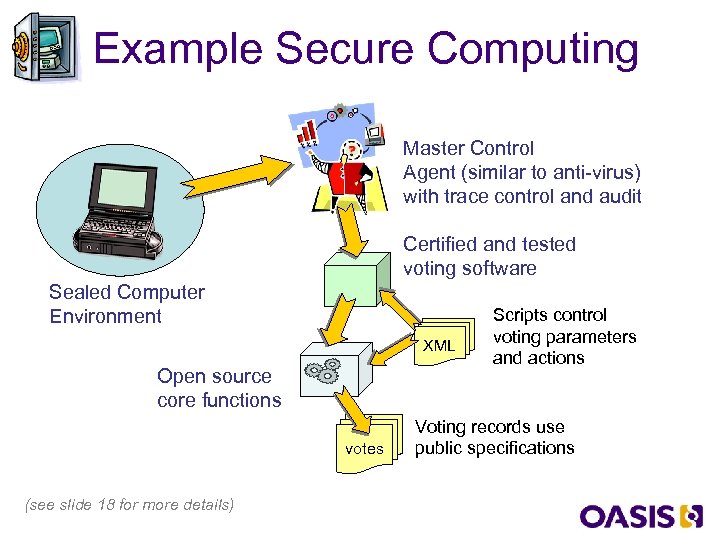 Example Secure Computing Master Control Agent (similar to anti-virus) with trace control and audit Certified and tested voting software Sealed Computer Environment XML Open source core functions votes (see slide 18 for more details) Scripts control voting parameters and actions Voting records use public specifications
 Ensuring Timely Results • To be trusted elections must be able to produce timely and accurate answers and results • 100% audit and comparison of three counting sources provides this direct analysis of voting counts immediately after the balloting closes • Avoids recrimination, legal challenges and uncertainty that is introduced by today’s partial audits only • Identifies and traces operational issues (machine problems or operator errors) and resolves them • Allows confidence in declared results of elections
 Balancing information capture • A trusted logic process allows the minimum effective information collection to effect a secure voting process • Too much information compromises anonymous voting in subtle ways • Too little information prevents effective audit trails • Example: stamping votes with machine IDs – good idea or bad idea? • Next we look at how OASIS EML 4. 0 instructs on the information exchange details…
 Ensuring Vote Process Consistency • Use of XML voting structures for election artifacts and XML scripts to monitor and control voting process • Use established international specifications for XML voting records – OASIS Election Markup Language (EML) • Allows consistent verification and certification testing of any voting system • Enables development of open source components of known behaviour to underpin election solutions • Makes interoperability between vendors equipment possible (scanners, printers, counting)
 Quick Overview of EML • History – Work begun in May 2001 in the USA and UK – Charter: To develop a standard for the structured interchange of data among hardware, software, and service providers who engage in any aspect of providing election or voter services to public or private organizations – UK government has implementations: • UK Local Election pilots held in May 2003. – http: //www. oasis-open. org/committees/election • Council of Europe Endorsement – Council of Europe Ministers have endorsed the e-voting recommendations and with that the use of EML http: //europa. eu. int/ida/en/document/3294/358 • EML 4. 0 is a committee draft for review and comment, other countries in Europe now exploring use, Spain, Swiss … Overview of EML and processing: http: //www. idealliance. org/papers/xmle 03/slides/spencer. ppt
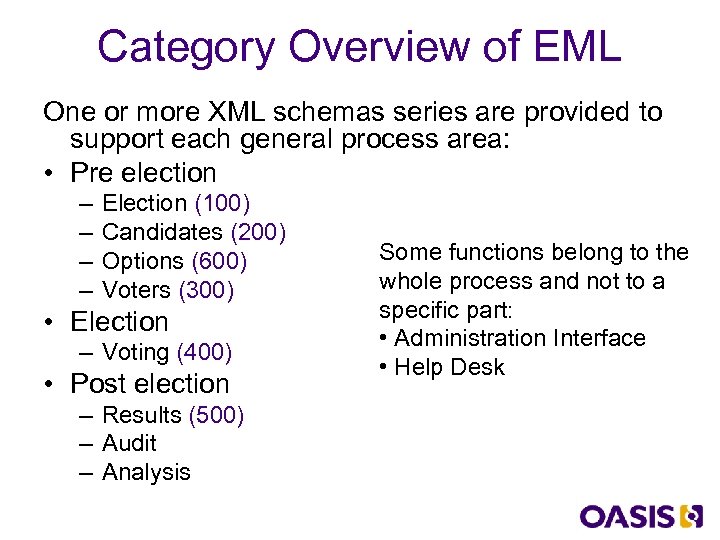 Category Overview of EML One or more XML schemas series are provided to support each general process area: • Pre election – – Election (100) Candidates (200) Options (600) Voters (300) • Election – Voting (400) • Post election – Results (500) – Audit – Analysis Some functions belong to the whole process and not to a specific part: • Administration Interface • Help Desk
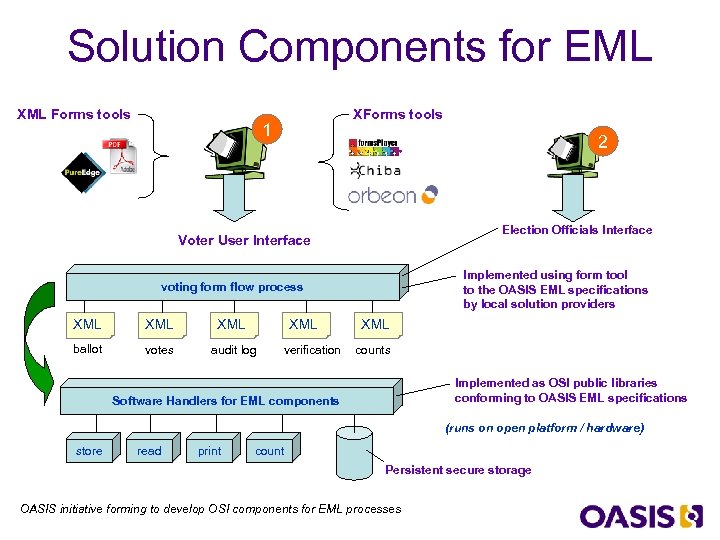 Solution Components for EML XML Forms tools XForms tools 1 2 Election Officials Interface Voter User Interface Implemented using form tool to the OASIS EML specifications by local solution providers voting form flow process XML XML ballot votes audit log verification XML counts Implemented as OSI public libraries conforming to OASIS EML specifications Software Handlers for EML components (runs on open platform / hardware) store read print count Persistent secure storage OASIS initiative forming to develop OSI components for EML processes
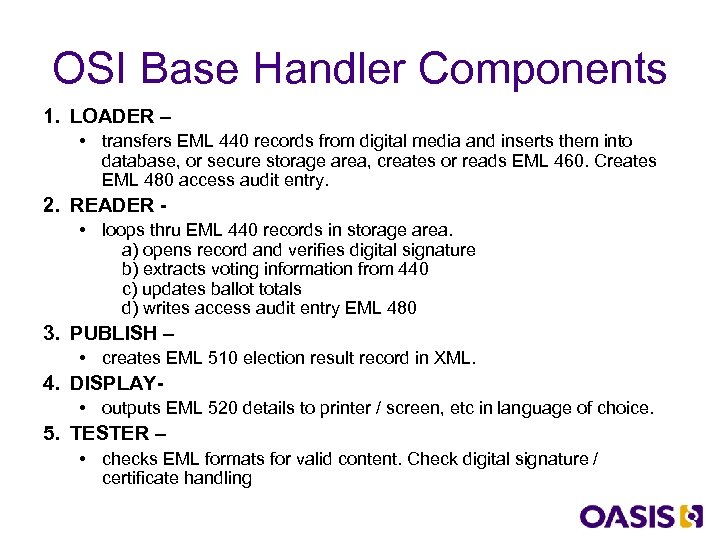 OSI Base Handler Components 1. LOADER – • transfers EML 440 records from digital media and inserts them into database, or secure storage area, creates or reads EML 460. Creates EML 480 access audit entry. 2. READER • loops thru EML 440 records in storage area. a) opens record and verifies digital signature b) extracts voting information from 440 c) updates ballot totals d) writes access audit entry EML 480 3. PUBLISH – • creates EML 510 election result record in XML. 4. DISPLAY • outputs EML 520 details to printer / screen, etc in language of choice. 5. TESTER – • checks EML formats for valid content. Check digital signature / certificate handling
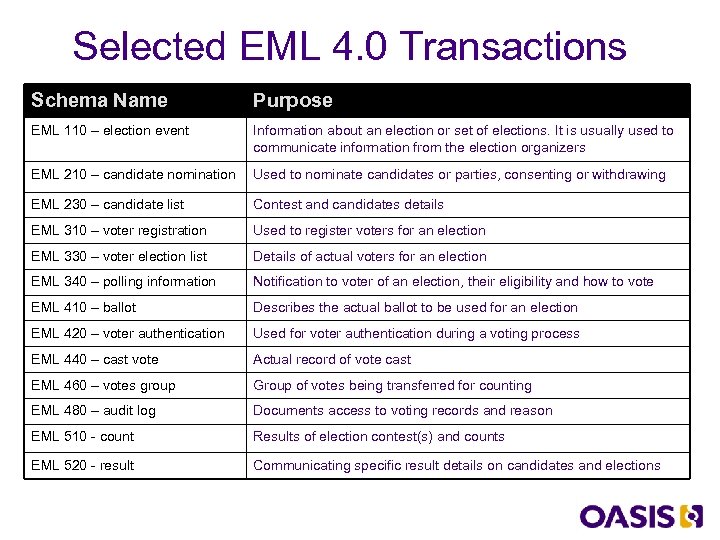 Selected EML 4. 0 Transactions Schema Name Purpose EML 110 – election event Information about an election or set of elections. It is usually used to communicate information from the election organizers EML 210 – candidate nomination Used to nominate candidates or parties, consenting or withdrawing EML 230 – candidate list Contest and candidates details EML 310 – voter registration Used to register voters for an election EML 330 – voter election list Details of actual voters for an election EML 340 – polling information Notification to voter of an election, their eligibility and how to vote EML 410 – ballot Describes the actual ballot to be used for an election EML 420 – voter authentication Used for voter authentication during a voting process EML 440 – cast vote Actual record of vote cast EML 460 – votes group Group of votes being transferred for counting EML 480 – audit log Documents access to voting records and reason EML 510 - count Results of election contest(s) and counts EML 520 - result Communicating specific result details on candidates and elections
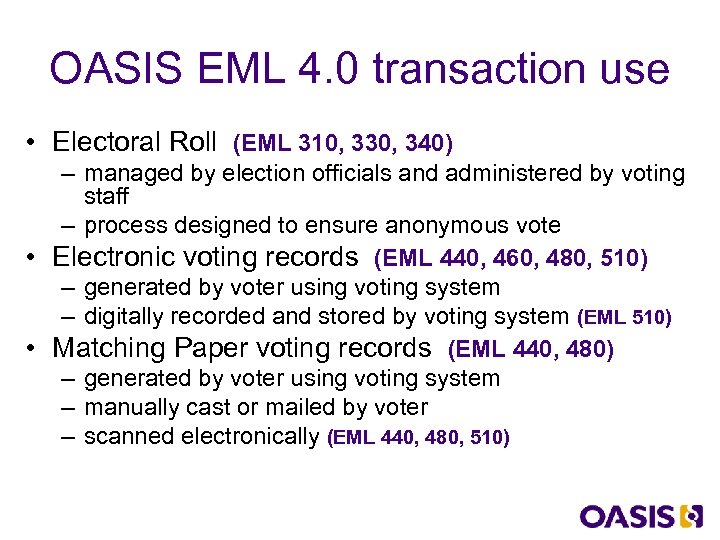 OASIS EML 4. 0 transaction use • Electoral Roll (EML 310, 330, 340) – managed by election officials and administered by voting staff – process designed to ensure anonymous vote • Electronic voting records (EML 440, 460, 480, 510) – generated by voter using voting system – digitally recorded and stored by voting system (EML 510) • Matching Paper voting records (EML 440, 480) – generated by voter using voting system – manually cast or mailed by voter – scanned electronically (EML 440, 480, 510)
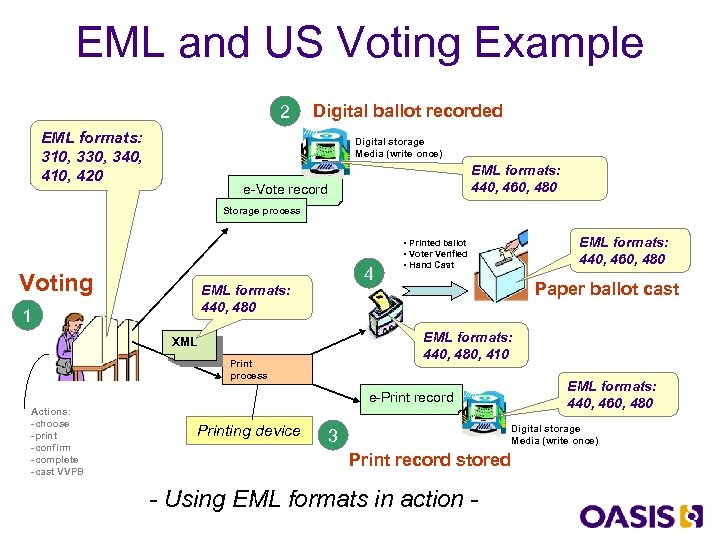 EML and US Voting Example 2 EML formats: 310, 330, 340, 410, 420 Digital ballot recorded Digital storage Media (write once) EML formats: 440, 460, 480 e-Vote record Storage process Voting 4 EML formats: 440, 480 1 Paper ballot cast EML formats: 440, 480, 410 XML Print process e-Print record Actions: -choose -print -confirm -complete -cast VVPB Printing device EML formats: 440, 460, 480 • Printed ballot • Voter Verified • Hand Cast EML formats: 440, 460, 480 Digital storage Media (write once) 3 Print record stored - Using EML formats in action -
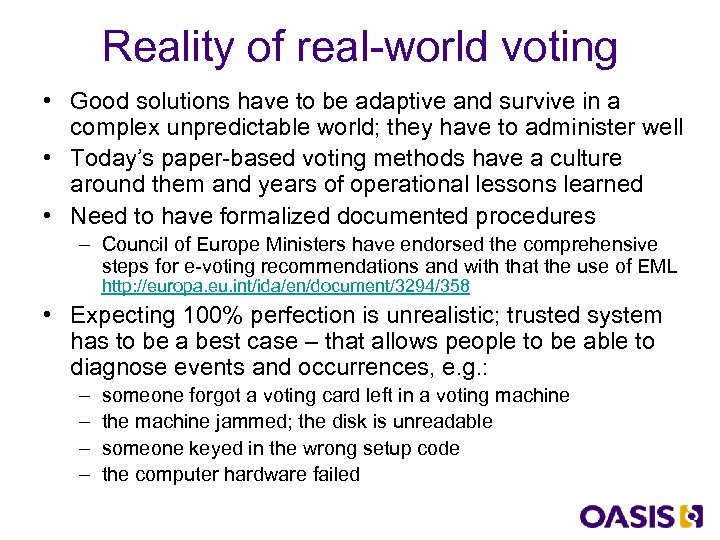 Reality of real-world voting • Good solutions have to be adaptive and survive in a complex unpredictable world; they have to administer well • Today’s paper-based voting methods have a culture around them and years of operational lessons learned • Need to have formalized documented procedures – Council of Europe Ministers have endorsed the comprehensive steps for e-voting recommendations and with that the use of EML http: //europa. eu. int/ida/en/document/3294/358 • Expecting 100% perfection is unrealistic; trusted system has to be a best case – that allows people to be able to diagnose events and occurrences, e. g. : – – someone forgot a voting card left in a voting machine the machine jammed; the disk is unreadable someone keyed in the wrong setup code the computer hardware failed
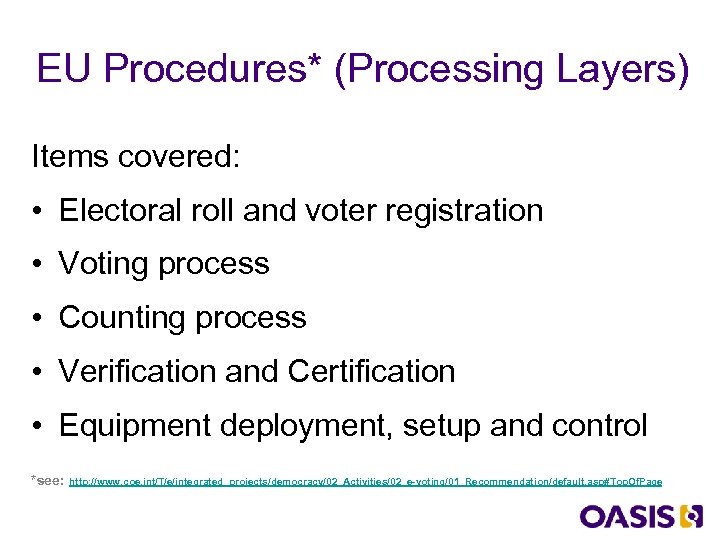 EU Procedures* (Processing Layers) Items covered: • Electoral roll and voter registration • Voting process • Counting process • Verification and Certification • Equipment deployment, setup and control *see: http: //www. coe. int/T/e/integrated_projects/democracy/02_Activities/02_e-voting/01_Recommendation/default. asp#Top. Of. Page
 EU Procedures – clarifying items (1) These trusted logic items should be added: 1. Explicit reference to the importance of using write-once media for vote recording - either paper or digital 2. Need for voters to be able to physically verify their vote directly - via paper ballot or equivalent physical representation of an actual ballot - not an electronic ephemeral representation, and to cast that physical representation by hand 3. Need to separate the layers of the process - so the same component provider is not doing all vote creating, printing, and counting the total votes (no single solution provider) 4. Need to use trusted logic principle so that the voter can verify that the digital voting choice recorded matches the physical voting choice they selected
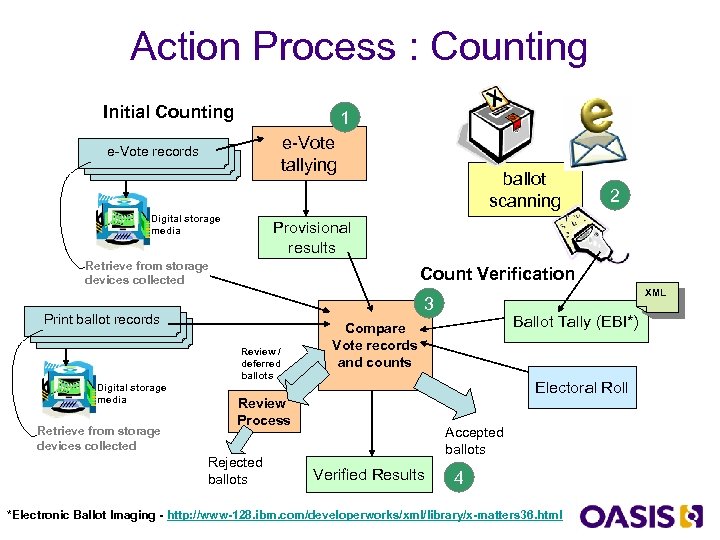
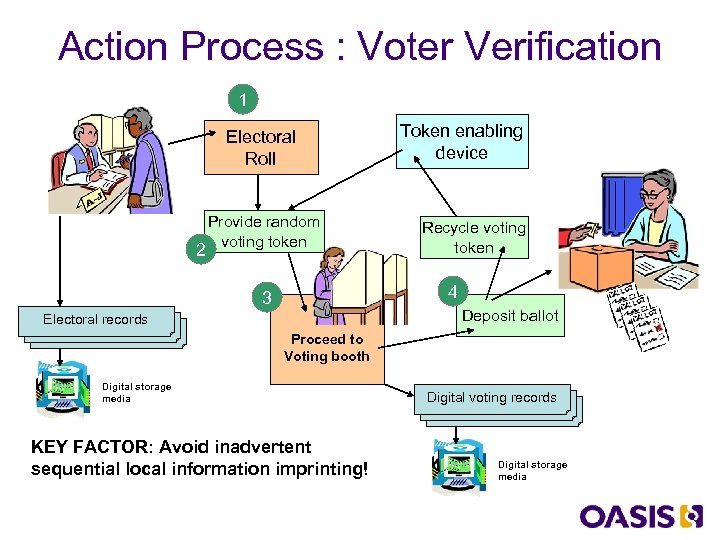
 EU Procedures – clarifying items (2) These ballot processing items should be added: 5. Need to compare 100% of all counts - electronic and physical ballot counts and electoral record counts to ensure they tally* 6. Explicit call-out of the need to avoid sequential processing information compromising vote privacy and anonymity 7. Explicitly call-out that overall election counts should be tallied independently for each of the sources - electoral roll, digital votes, and voter verified (paper) ballot counts (after scanning - EBI - Electronic Ballot Imaging**). * More in-depth technical operation level discussions here: http: //gnosis. cx/publish/voting/privacy-electronic-voting. pdf ** Electronic Ballot Imaging - http: //www-128. ibm. com/developerworks/xml/library/x-matters 36. html
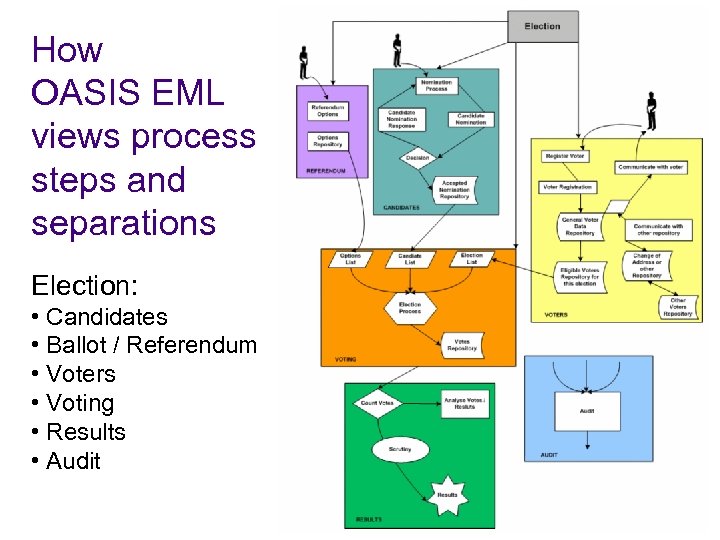 How OASIS EML views process steps and separations Election: • Candidates • Ballot / Referendum • Voters • Voting • Results • Audit
 Procedural requirements • One implementer cannot supply solutions across more than one layer or process • Each layer must be autonomous and passes information to next layer in open formats that can be inspected and verified • Software involved must be published to open source • Physical separation of layers and devices associated with them
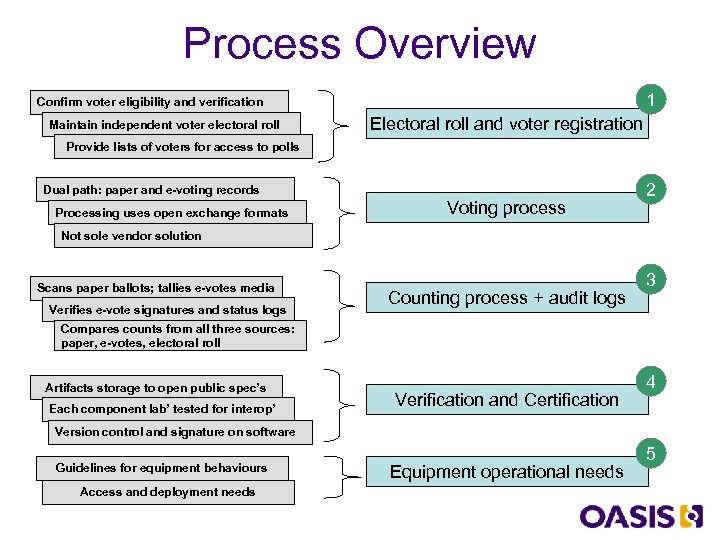 Process Overview 1 Confirm voter eligibility and verification Maintain independent voter electoral roll Electoral roll and voter registration Provide lists of voters for access to polls Dual path: paper and e-voting records Processing uses open exchange formats Voting process 2 Not sole vendor solution Scans paper ballots; tallies e-votes media Verifies e-vote signatures and status logs Counting process + audit logs 3 Compares counts from all three sources: paper, e-votes, electoral roll Artifacts storage to open public spec’s Each component lab’ tested for interop’ Verification and Certification 4 Version control and signature on software Guidelines for equipment behaviours Access and deployment needs Equipment operational needs 5
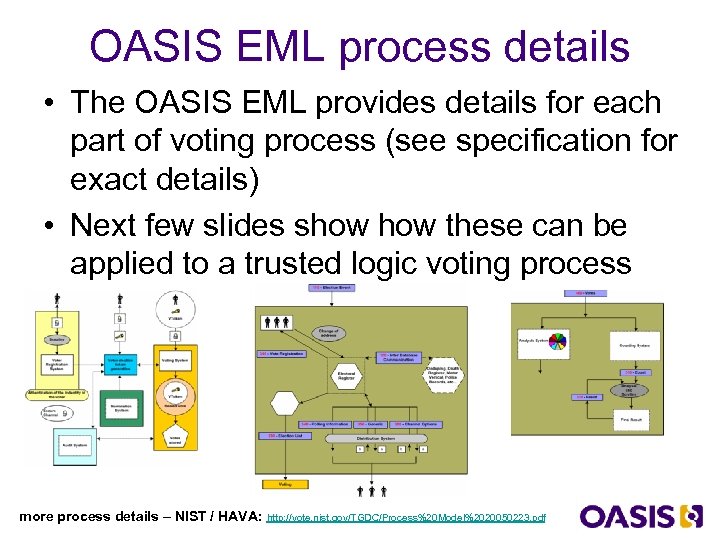 OASIS EML process details • The OASIS EML provides details for each part of voting process (see specification for exact details) • Next few slides show these can be applied to a trusted logic voting process more process details – NIST / HAVA: http: //vote. nist. gov/TGDC/Process%20 Model%2020050223. pdf
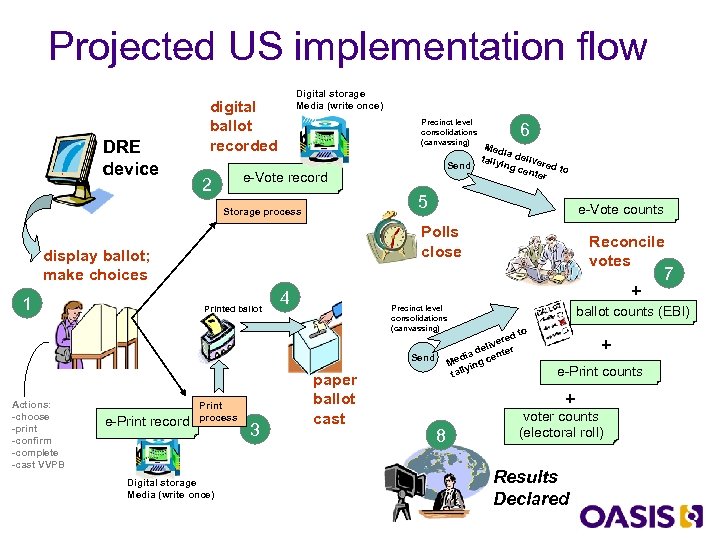 Projected US implementation flow DRE device Digital storage Media (write once) digital ballot recorded Precinct level consolidations (canvassing) 5 Storage process e-Vote counts Polls close display ballot; make choices 1 Med ia tally deliver ing c e Send ente d to r e-Vote record 2 Printed ballot e-Print record Print process Digital storage Media (write once) 3 Reconcile votes + 4 Precinct level consolidations (canvassing) Send Actions: -choose -print -confirm -complete -cast VVPB 6 paper ballot cast ballot counts (EBI) d ere eliv ter d en dia Me ing c y tall to + e-Print counts + 8 7 voter counts (electoral roll) Results Declared
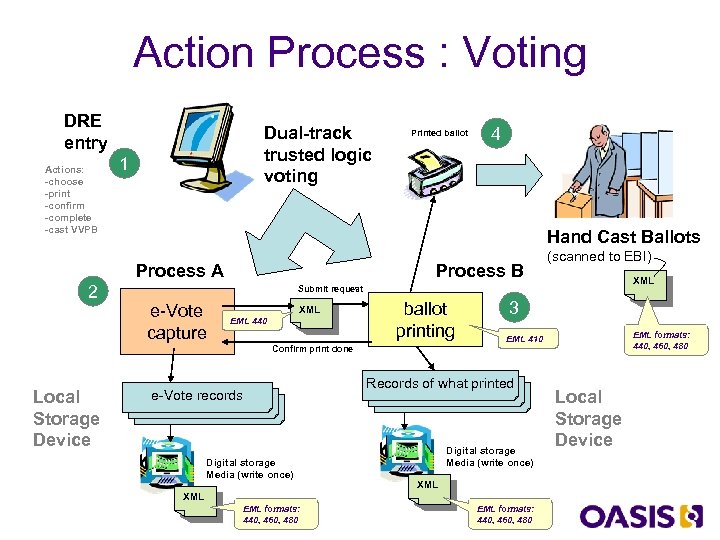 Action Process : Voting DRE entry Actions: -choose -print -confirm -complete -cast VVPB Dual-track trusted logic voting 1 4 Hand Cast Ballots Process A 2 Printed ballot Process B (scanned to EBI) XML Submit request e-Vote capture XML EML 440 ballot printing 3 EML formats: 440, 460, 480 EML 410 Confirm print done Local Storage Device e-Vote records Digital storage Media (write once) Records of what printed Digital storage Media (write once) XML EML formats: 440, 460, 480 Local Storage Device
 Action Process : Counting Initial Counting 1 e-Vote tallying e-Vote records Digital storage media Count Verification XML 3 Print ballot records Review / deferred ballots Retrieve from storage devices collected 2 Provisional results Retrieve from storage devices collected Digital storage media ballot scanning Electoral Roll Review Process Rejected ballots Ballot Tally (EBI*) Compare Vote records and counts Accepted ballots Verified Results 4 *Electronic Ballot Imaging - http: //www-128. ibm. com/developerworks/xml/library/x-matters 36. html
 Action Process : Voter Verification 1 Electoral Roll 2 Provide random voting token Token enabling device Recycle voting token 4 3 Deposit ballot Electoral records Proceed to Voting booth Digital storage media KEY FACTOR: Avoid inadvertent sequential local information imprinting! Digital voting records Digital storage media
 Creating an open marketplace • Open trusted logic voting (TLV) that underpins voting in the digital age • A healthy and open marketplace where a broad range of service providers can deliver solutions to citizens, using off-the-shelf cost-effective components, that support and enhance the voting system and experience • Based on open specifications that have free use licensing and not encumbered by any specific proprietary technology • Inform and guide legislators and administrators
 TLV Implementation Components 1. Voter registration and ballot day sign-in - separate system, with separate counts and reporting at end of day. Providers voters with access to voting system to cast their ballot; uses OASIS EML formats 2. Separate Voting system that voters access to select choices, make vote, passes choices to VVPAT printing system, creates electronic record of vote (uses simple ballot-ID to provide crosscheck and realtime auditing). Supports disabled access and multilingual access. 3. Ballot printing system - creates paper record, and printing audit electronic record. Voter confirms paper ballot detail, and casts vote into ballot box. Ballot-ID printed on ballot; ballot is scanned into EBI*. 4. Immediate counting - after polls close – provides 100% crosscheck via ballot-ID between counts from 1), 2) and 3). Takes OASIS EML records and counts them. Counting software is open source. Using 3 separate count systems – gives banking system level of robust auditing and trust. 5. The goal is to provide the underlying functions as OSI - and then allow solution providers to provide localization and value-add above that using the form tools of their choice. * EBI – electronic ballot image (EML 440)
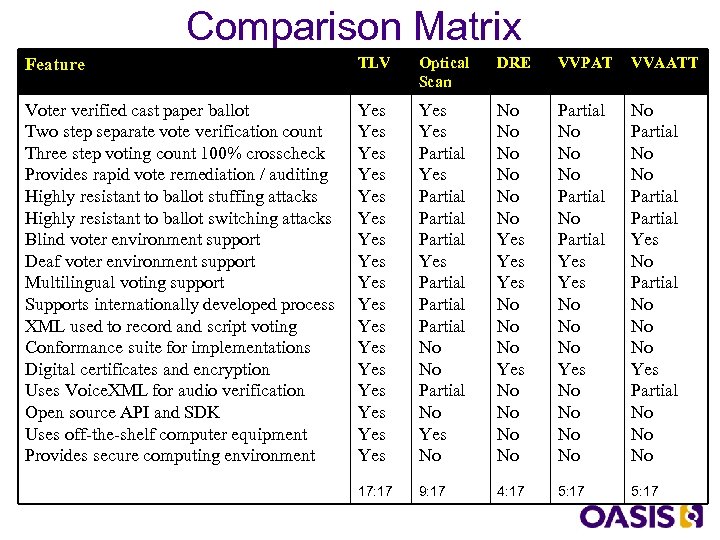 Comparison Matrix Feature TLV Optical Scan DRE VVPAT VVAATT Voter verified cast paper ballot Two step separate vote verification count Three step voting count 100% crosscheck Provides rapid vote remediation / auditing Highly resistant to ballot stuffing attacks Highly resistant to ballot switching attacks Blind voter environment support Deaf voter environment support Multilingual voting support Supports internationally developed process XML used to record and script voting Conformance suite for implementations Digital certificates and encryption Uses Voice. XML for audio verification Open source API and SDK Uses off-the-shelf computer equipment Provides secure computing environment Yes Yes Yes Yes Yes Partial Yes Partial No No Partial No Yes No No Yes Yes No No Partial No No No Partial Yes No No No Partial No No Partial Yes No Partial No No No Yes Partial No No No 17: 17 9: 17 4: 17 5: 17
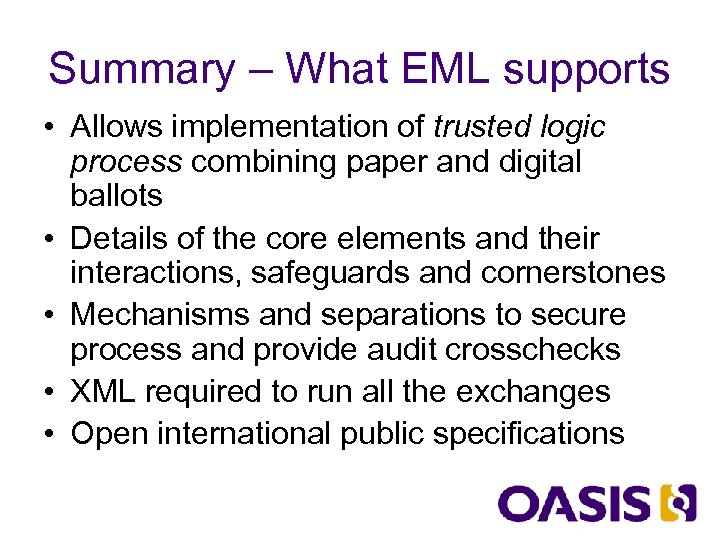 Summary – What EML supports • Allows implementation of trusted logic process combining paper and digital ballots • Details of the core elements and their interactions, safeguards and cornerstones • Mechanisms and separations to secure process and provide audit crosschecks • XML required to run all the exchanges • Open international public specifications
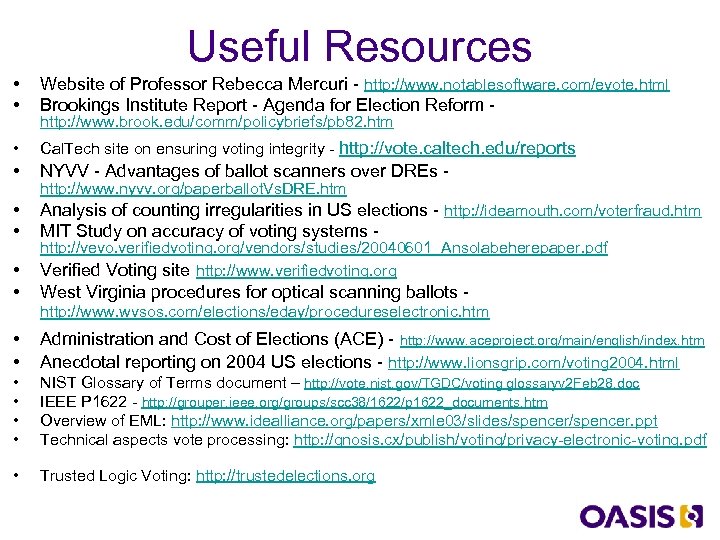 Useful Resources • • Website of Professor Rebecca Mercuri - http: //www. notablesoftware. com/evote. html Brookings Institute Report - Agenda for Election Reform - • Cal. Tech site on ensuring voting integrity - http: //vote. caltech. edu/reports • • • NYVV - Advantages of ballot scanners over DREs - http: //www. nyvv. org/paperballot. Vs. DRE. htm Analysis of counting irregularities in US elections - http: //ideamouth. com/voterfraud. htm MIT Study on accuracy of voting systems - • • West Virginia procedures for optical scanning ballots - http: //www. brook. edu/comm/policybriefs/pb 82. htm http: //vevo. verifiedvoting. org/vendors/studies/20040601_Ansolabeherepaper. pdf Verified Voting site http: //www. verifiedvoting. org http: //www. wvsos. com/elections/eday/procedureselectronic. htm • • Administration and Cost of Elections (ACE) - http: //www. aceproject. org/main/english/index. htm Anecdotal reporting on 2004 US elections - http: //www. lionsgrip. com/voting 2004. html • • NIST Glossary of Terms document – http: //vote. nist. gov/TGDC/voting glossaryv 2 Feb 28. doc IEEE P 1622 - http: //grouper. ieee. org/groups/scc 38/1622/p 1622_documents. htm Overview of EML: http: //www. idealliance. org/papers/xmle 03/slides/spencer. ppt Technical aspects vote processing: http: //gnosis. cx/publish/voting/privacy-electronic-voting. pdf • Trusted Logic Voting: http: //trustedelections. org
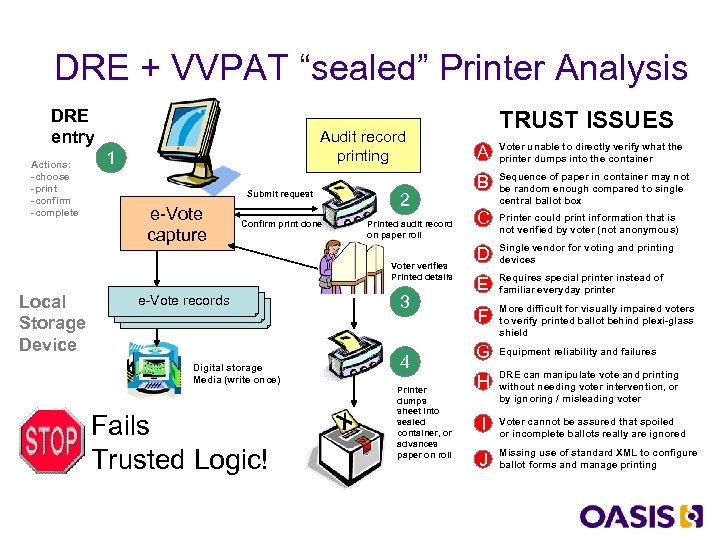 DRE + VVPAT “sealed” Printer Analysis DRE entry Actions: -choose -print -confirm -complete Audit record printing 1 Submit request e-Vote capture Confirm print done 2 Printed audit record on paper roll Voter verifies Printed details Local Storage Device e-Vote records Digital storage Media (write once) Fails Trusted Logic! 3 4 Printer dumps sheet into sealed container, or advances paper on roll TRUST ISSUES A Voter unable to directly verify what the printer dumps into the container B Sequence of paper in container may not be random enough compared to single central ballot box C Printer could print information that is not verified by voter (not anonymous) D Single vendor for voting and printing devices E Requires special printer instead of familiar everyday printer F More difficult for visually impaired voters to verify printed ballot behind plexi-glass shield G Equipment reliability and failures H DRE can manipulate vote and printing without needing voter intervention, or by ignoring / misleading voter I Voter cannot be assured that spoiled or incomplete ballots really are ignored J Missing use of standard XML to configure ballot forms and manage printing
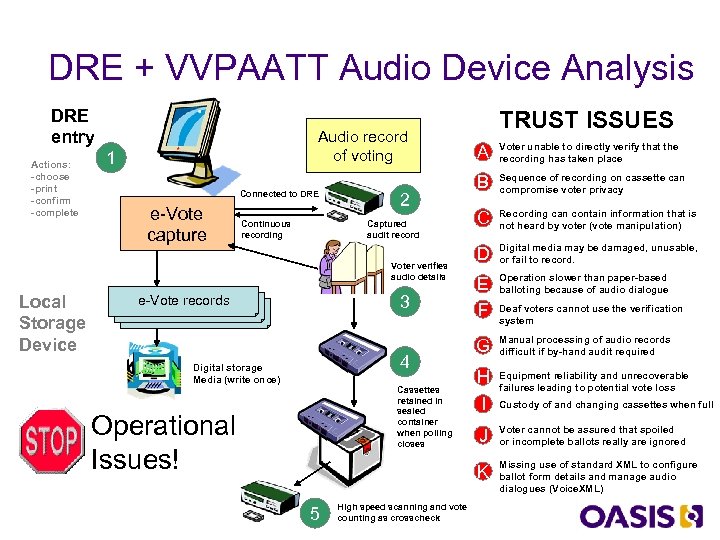 DRE + VVPAATT Audio Device Analysis DRE entry Actions: -choose -print -confirm -complete Audio record of voting 1 Connected to DRE e-Vote capture Continuous recording 2 Captured audit record Voter verifies audio details Local Storage Device 3 e-Vote records 4 Digital storage Media (write once) Cassettes retained in sealed container when polling closes TRUST ISSUES A Voter unable to directly verify that the recording has taken place B Sequence of recording on cassette can compromise voter privacy C Recording can contain information that is not heard by voter (vote manipulation) D Digital media may be damaged, unusable, or fail to record. E F Operation slower than paper-based balloting because of audio dialogue G Manual processing of audio records difficult if by-hand audit required H Equipment reliability and unrecoverable failures leading to potential vote loss Deaf voters cannot use the verification system 5 High speed scanning and vote counting as crosscheck Custody of and changing cassettes when full J Voter cannot be assured that spoiled or incomplete ballots really are ignored K Operational Issues! I Missing use of standard XML to configure ballot form details and manage audio dialogues (Voice. XML)