


 Скачать презентацию Judicial Institutions Couts I must speak the
Judicial Institutions.ppt
- Количество слайдов: 27
 Judicial Institutions. Couts.
 I must speak the truth , and nothing but the truth. Megual de Cervantes Saavedra
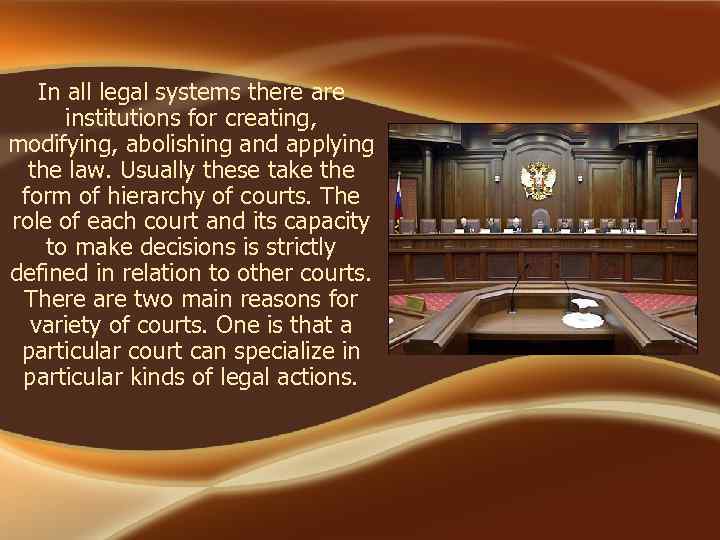 In all legal systems there are institutions for creating, modifying, abolishing and applying the law. Usually these take the form of hierarchy of courts. The role of each court and its capacity to make decisions is strictly defined in relation to other courts. There are two main reasons for variety of courts. One is that a particular court can specialize in particular kinds of legal actions.
 The other is so that a person who feels his case was not fairly treated in a lower court can appeal to a higher court for reassessment. The decisions of a higher court are binding upon lower courts.
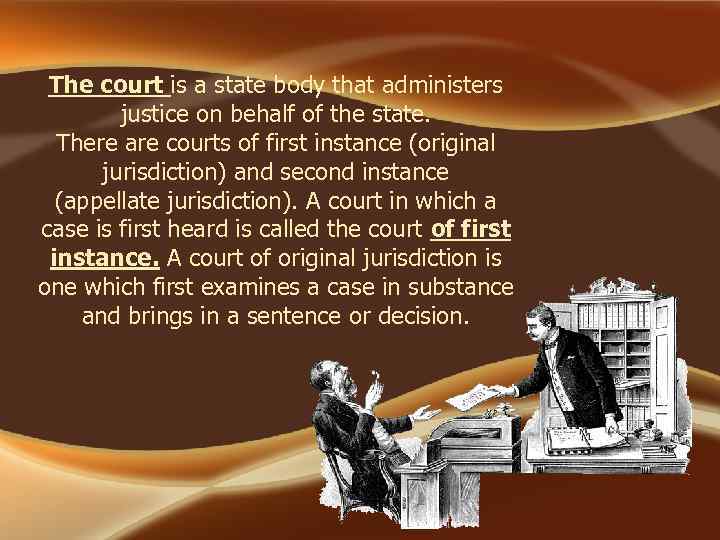 The court is a state body that administers justice on behalf of the state. There are courts of first instance (original jurisdiction) and second instance (appellate jurisdiction). A court in which a case is first heard is called the court of first instance. A court of original jurisdiction is one which first examines a case in substance and brings in a sentence or decision.
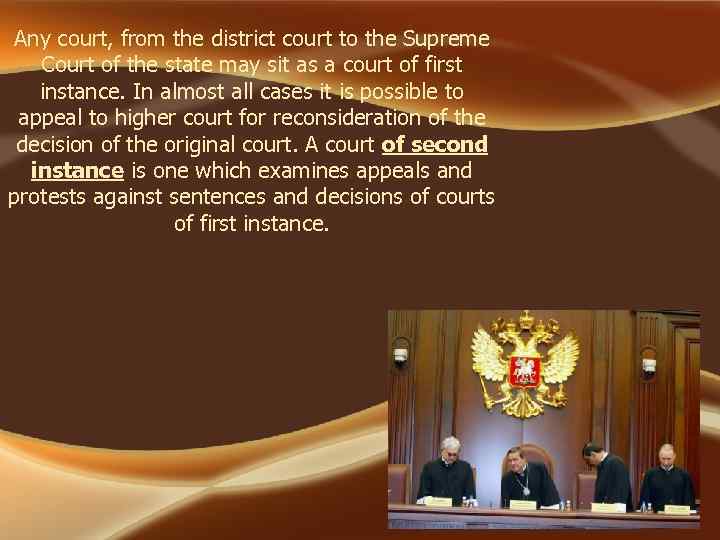 Any court, from the district court to the Supreme Court of the state may sit as a court of first instance. In almost all cases it is possible to appeal to higher court for reconsideration of the decision of the original court. A court of second instance is one which examines appeals and protests against sentences and decisions of courts of first instance.
 The Constitutional Court ensures that the laws and other normative acts passed or being considered by the supreme and local legislative branches are constitutional.
 The Supreme Court is the highest judicial body for civil, criminal, business and over cases. It has the power of supervision over the activities of all the judicial bodies of the state. The Supreme Court gives the court interpretation on the issues of court practice. It tries the most important criminal civil cases and likewise hears appeals against the judgements and sentences of other courts, as well as appeals against the judgements and sentences of the military courts of the state.
 The Supreme Arbitration Court is the highest judicial body for settling economics disputes and other cases examined by courts of arbitration. It exercises judicial supervision over their activities in the procedural forms envisaged by federal law and provides interpretation on issues of court proceedings.
 The basic judicial body is the district court. District courts try both criminal and civil cases. It is also the duty of the district courts to protect the electorial rights of citizens. The higher courts of constituent entities of the Russia Federation hear and determine cases of major importance. They are courts of appellate jurisdiction.
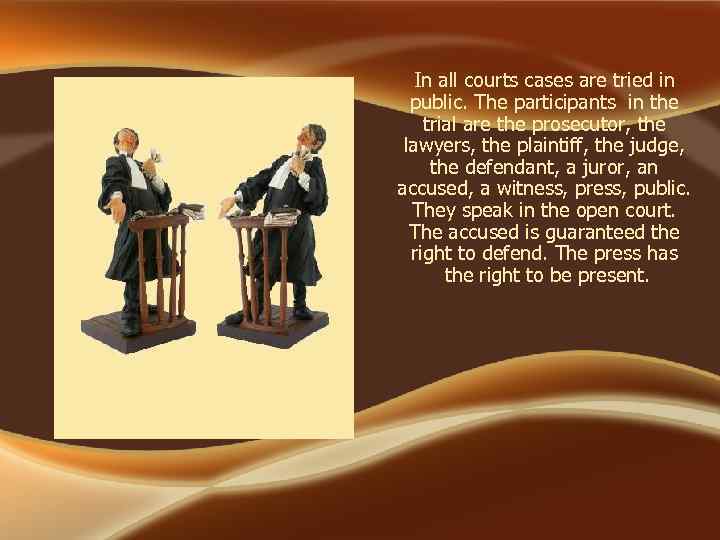 In all courts cases are tried in public. The participants in the trial are the prosecutor, the lawyers, the plaintiff, the judge, the defendant, a juror, an accused, a witness, press, public. They speak in the open court. The accused is guaranteed the right to defend. The press has the right to be present.

 During the hearing of a case any citizen may enter the courtroom and be present during the trial from the beginning to the end. The hearing of cases in closed session is allowed only in exceptional cases. Closed sessions are only allowed if it is in the interests of both sides or for the necessity to keep state secrets. Trial without participation of both sides is not allowed.
 The judges are independent, irremovable, inviolable and they must obey the law. Article 119 of the Constitutional of the Russian Federation states: “Judges shall be citizens of the Russian Federation over 25 years of age with a higher education in law who have served in the legal profession for not less than five years. ”
 1. Answer the questions 1. 2. 3. 4. 5. 6. 7. 8. What What is court? is the function of a court of the first instance? is the function of a court of the second instance? is the basic judicial body of the state? cases does a district court try? are the courts of higher instances? are the participants of the trial? is the status of judges?
 2. Complete the sentences with the phrases from the text 1. In all legal systems there are institutions for… 2. The role of each court and its capacity to make decisions is … 3. A court of original jurisdiction is … 4. The decisions of a higher court are … 5. The court is a state body that … 6. The Supreme Court is the highest judicial body for… 7. The participants in the trial are… 8. The hearing of cases in closed session is allowed only in … 9. The judges are …
 3. Find the beginning of the sentences in the text 1. … is called the court of first instance. 2. … is one which examines appeals and protest against sentences and decisions of courts of first instance. 3. … is the highest judicial body for civil, criminal, business and other cases. 4. … is the highest judicial body for setting economic disputes and other cases examined by courts of arbitration. 5. … is guaranteed the right to defend. 6. … in closed session is allowed only in exceptional cases 7. … are independent and they must obey the law.
 4. Match the left and the right a) to administer b) to bring in a sentence c) to examine a case in substance d) an appeal e) the power of supervision over f) to be subject to removal 1. рассматривать дело по существу 2. жалоба 3. вынести приговор, решение 4. отправлять правосудие 5. подлежать отзыву 6. право надзора
 4. Match the left and the right g) a prosecutor h) an accused i) a defendant j) a victim k) a plaintiff l) judicial 7. обвиняемый 8. обвинитель 9. ответчик 10. истец 11. потерпевший 12. судебный
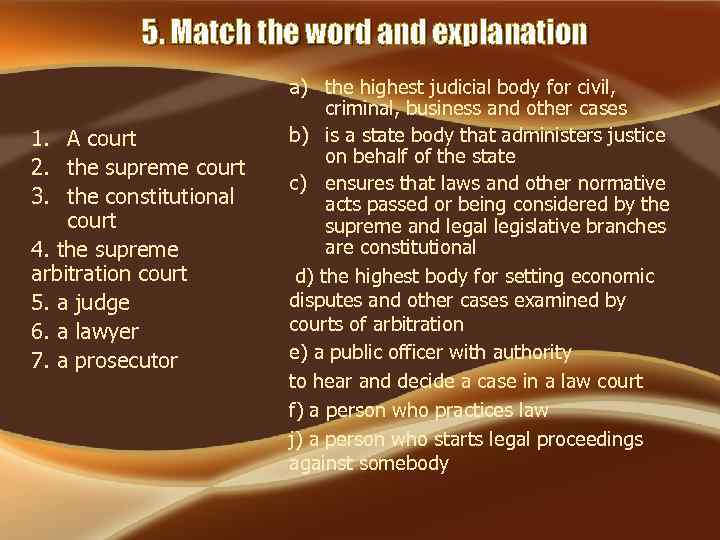 5. Match the word and explanation 1. A court 2. the supreme court 3. the constitutional court 4. the supreme arbitration court 5. a judge 6. a lawyer 7. a prosecutor a) the highest judicial body for civil, criminal, business and other cases b) is a state body that administers justice on behalf of the state c) ensures that laws and other normative acts passed or being considered by the supreme and legal legislative branches are constitutional d) the highest body for setting economic disputes and other cases examined by courts of arbitration e) a public officer with authority to hear and decide a case in a law court f) a person who practices law j) a person who starts legal proceedings against somebody
 6. Using the information from the text choose the right answer a) A court of first instance is one which first examines the case in substance. 1. a case 2. a court 3. an instance b) A court of second instance is one which examines appeals and protests against sentences and decisions of courts of first instance. 1. an appeal 2. a court 3. a sentence
 6. Using the information from the text choose the right answer c) The Supreme Court gives the court interpretation on the issues of 1. court practice 2. civil law 3. customs law d) The basic judicial body is. . 1. the district court. 2. The Supreme Arbitration Court 3. The Constitutional Court
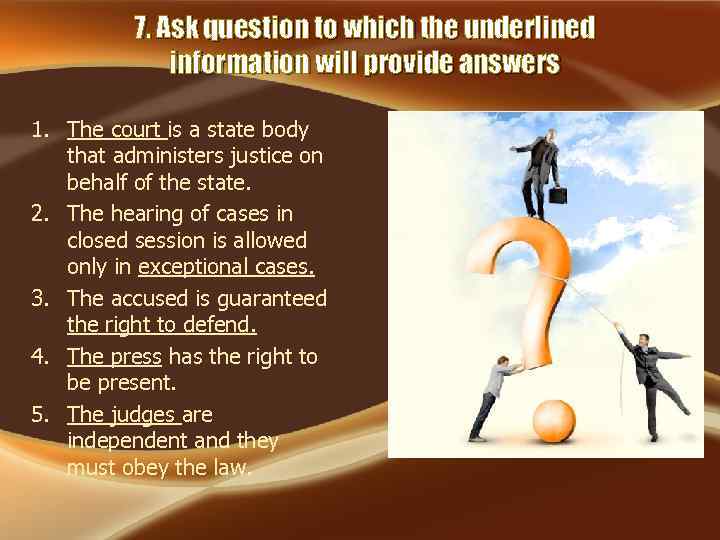 7. Ask question to which the underlined information will provide answers 1. The court is a state body that administers justice on behalf of the state. 2. The hearing of cases in closed session is allowed only in exceptional cases. 3. The accused is guaranteed the right to defend. 4. The press has the right to be present. 5. The judges are independent and they must obey the law.
 8. Translate the Russian words and phrases in the sentences into English 1. It has the power of supervision over the activities of all the судебных органов of the state. 2. The participants in the trial (обвинитель, адвокаты, истец, судья, ответчик и другие) speak in the open. court. 3. The higher courts of constituent entities of the Russia Federation hear and determine cases of важное значение.
 8. Translate the Russian words and phrases in the sentences into English 4. Роль каждого суда and its capacity to make decisions is strictly defined in relation to other courts. 5. Closed sessions are only allowed if it is in the interests of both sides or for the necessity to keep государственные тайны. 6. It exercises judicial supervision over their activities in the procedural forms envisaged by federal law and provides interpretation on issues of судебных процедур.
 9. Essential vocabulary to abolish – отменять, упразднять accused – обвиняемый to administer justice – отправлять првосудие an appeal - жалоба to apply – применять to create - создавать defence – защита a defendant – ответчик to examine a case in substance – рассматривать дело по существу to envisage - предусматривать
 9. Essential vocabulary inviolable - неприкосновенный judicial - судебный to modify - видоизменять a participant - участник power of supervision – право надзора proceeding – зд. судопроизводство prosecutor - обвинитель reassessment - переоценка, пересмотр