 Скачать презентацию JSC Earth Moon Libration Point L 1 Gateway
ccd1614b794b60bde70d8daa3166a192.ppt
- Количество слайдов: 62



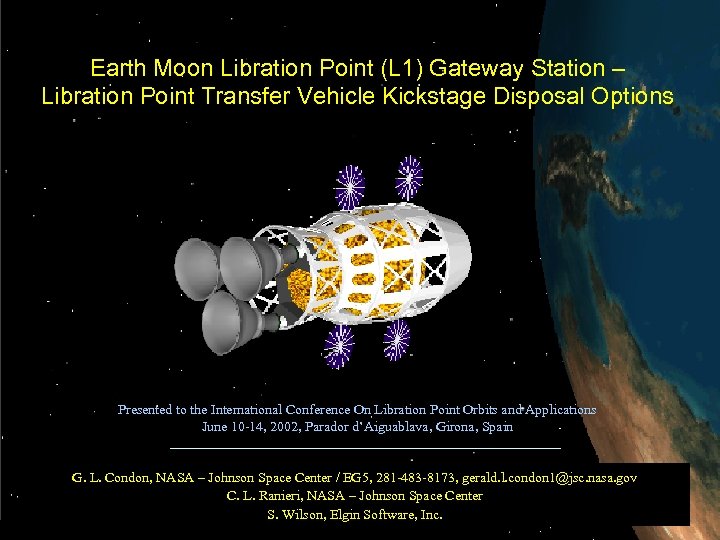
JSC Earth Moon Libration Point (L 1) Gateway Station – Libration Point Transfer Vehicle Kickstage Disposal Options Presented to the International Conference On Libration Point Orbits and Applications June 10 -14, 2002, Parador d’Aiguablava, Girona, Spain G. L. Condon, NASA – Johnson Space Center / EG 5, 281 -483 -8173, gerald. l. condon 1@jsc. nasa. gov C. L. Ranieri, NASA – Johnson Space Center S. Wilson, Elgin Software, Inc.
Acknowledgements • • JSC Chris Ranieri* – orbit lifetime analysis Joey Broome# – STK/Astrogator validation/movie Sam Wilson+ – software development / analysis Daniel M. Delwood + – analysis 2 * JSC Co-op # JSC Engineer + Elgin Software, Inc.
Outline JSC • Introduction • Expeditionary vs. Evolutionary Missions • Libration Point Transfer Vehicle (LTV) Kickstage Disposal Options • Geocentric Orbit Lifetime • Conclusion 3
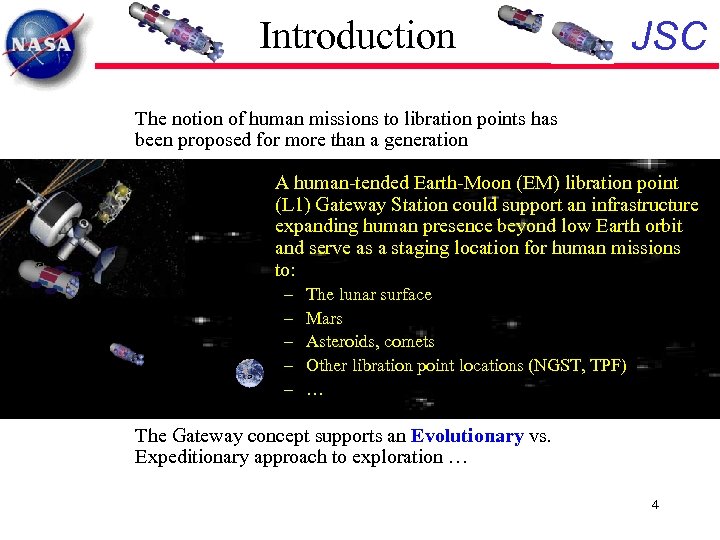
Introduction JSC The notion of human missions to libration points has been proposed for more than a generation A human-tended Earth-Moon (EM) libration point (L 1) Gateway Station could support an infrastructure expanding human presence beyond low Earth orbit and serve as a staging location for human missions to: – – – The lunar surface Mars Asteroids, comets Other libration point locations (NGST, TPF) … The Gateway concept supports an Evolutionary vs. Expeditionary approach to exploration … 4
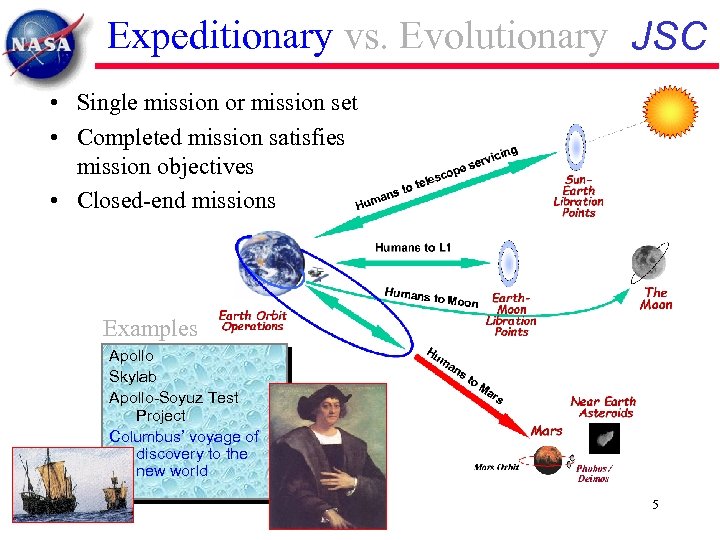
Expeditionary vs. Evolutionary JSC • Single mission or mission set • Completed mission satisfies mission objectives • Closed-end missions Examples Apollo Skylab Apollo-Soyuz Test Project Columbus’ voyage of discovery to the new world 5
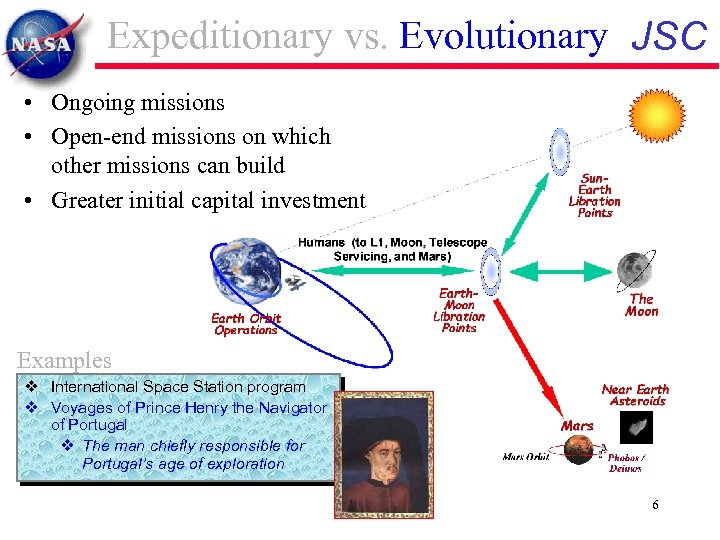
Expeditionary vs. Evolutionary JSC • Ongoing missions • Open-end missions on which other missions can build • Greater initial capital investment Examples v International Space Station program v Voyages of Prince Henry the Navigator of Portugal v The man chiefly responsible for Portugal’s age of exploration 6
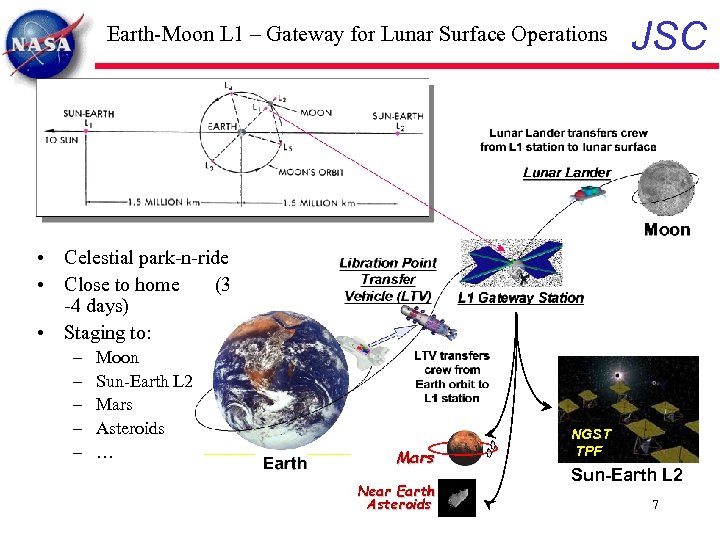
Earth-Moon L 1 – Gateway for Lunar Surface Operations JSC • Celestial park-n-ride • Close to home (3 -4 days) • Staging to: – – – Moon Sun-Earth L 2 Mars Asteroids … Mars Near Earth Asteroids NGST TPF Sun-Earth L 2 7
Gateway Operations – LTV Kickstage Disposal JSC • • Ongoing Gateway operations require robust capability for delivery & retrieval of a crew Human occupation of the Gateway Station requires a human transfer system in the form of a Libration Point Transfer Vehicle (LTV) designed to ferry the crew between low Earth orbit and the Gateway Station. A key element of such a system is the proper and safe disposal of the LTV kickstage 8
Purpose JSC 1. Identify concepts concerning the role of humans in libration point space missions 2. Examine mission design considerations for an Earth. Moon libration point (L 1) gateway station 3. Assess delta-V (DV) cost to retarget Earth-Moon L 1 Gateway-bound LTV spacecraft kickstage to a selected disposal destination 9
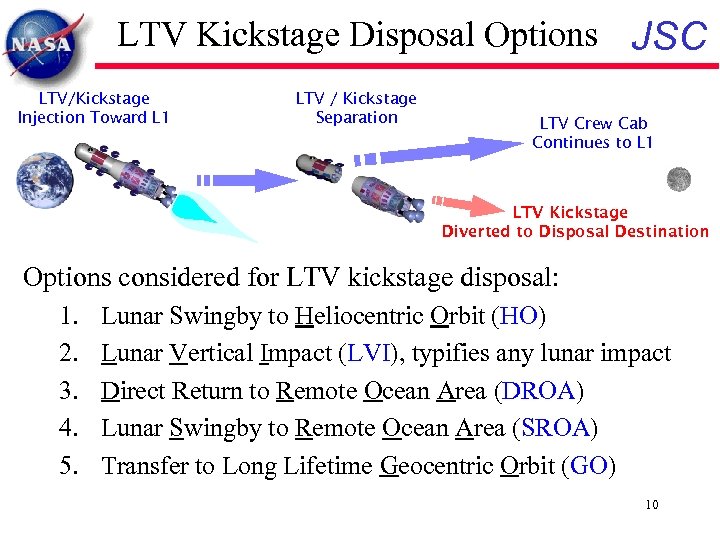
LTV Kickstage Disposal Options JSC LTV/Kickstage Injection Toward L 1 LTV / Kickstage Separation LTV Crew Cab Continues to L 1 LTV Kickstage Diverted to Disposal Destination Options considered for LTV kickstage disposal: 1. 2. 3. 4. 5. Lunar Swingby to Heliocentric Orbit (HO) Lunar Vertical Impact (LVI), typifies any lunar impact Direct Return to Remote Ocean Area (DROA) Lunar Swingby to Remote Ocean Area (SROA) Transfer to Long Lifetime Geocentric Orbit (GO) 10
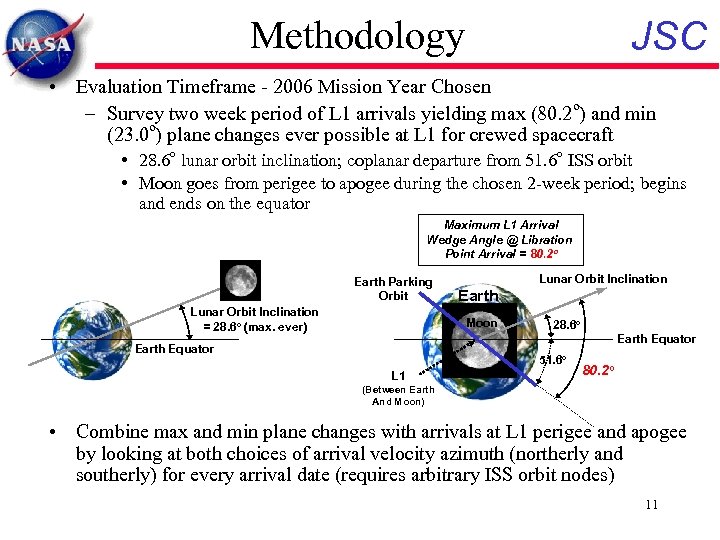
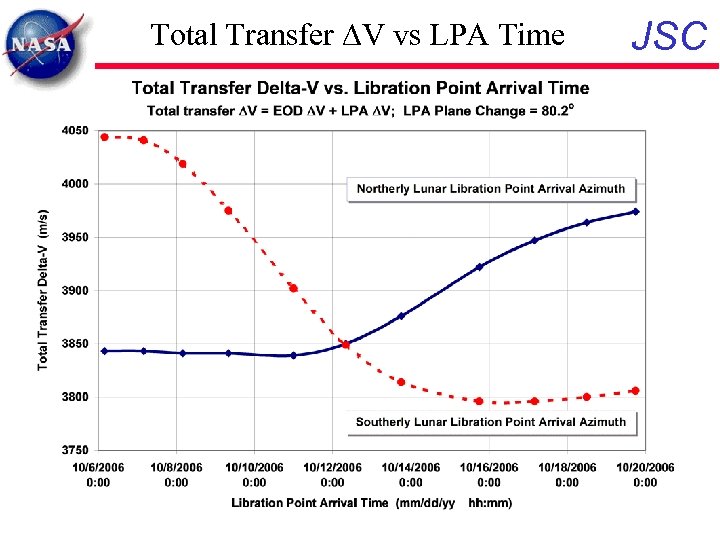
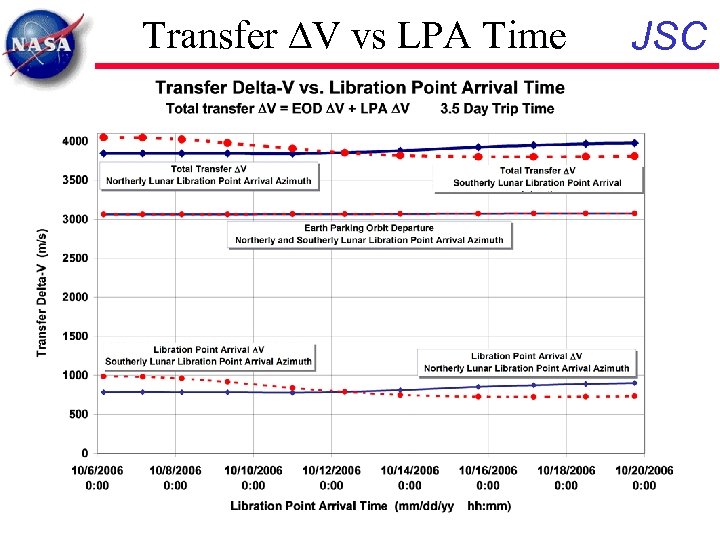
Methodology JSC • Evaluation Timeframe - 2006 Mission Year Chosen – Survey two week period of L 1 arrivals yielding max (80. 2 o) and min (23. 0 o) plane changes ever possible at L 1 for crewed spacecraft • 28. 6 o lunar orbit inclination; coplanar departure from 51. 6 o ISS orbit • Moon goes from perigee to apogee during the chosen 2 -week period; begins and ends on the equator Maximum L 1 Arrival Wedge Angle @ Libration Point Arrival = 80. 2 o Earth Parking Orbit Lunar Orbit Inclination = 28. 6 o (max. ever) Lunar Orbit Inclination Earth Moon 28. 6 o Earth Equator 51. 6 o L 1 80. 2 o (Between Earth And Moon) • Combine max and min plane changes with arrivals at L 1 perigee and apogee by looking at both choices of arrival velocity azimuth (northerly and southerly) for every arrival date (requires arbitrary ISS orbit nodes) 11
Methodology (continued) JSC • HO, LVI, DROA, SROA, and GO maneuver times designed to minimize DV for stage disposal subject to imposed constraints – Solutions considered to be a practical attempt to minimize these maneuver DVs (e. g. : coplanar kickstage deflection maneuver assumed optimal for some disposal options) and not rigorous global optimizations Analysis • Analysis Tools – Earth Orbit to Lunar Libration (EOLL) scanner* • Four-body model – Earth, moon, sun, spacecraft – Jean Meeus's analytic lunar and solar ephemerides • Overlapped conic split boundary value solutions individually calibrated to multiconic accuracy – Validation with STK/Astrogator * Developed and updated by Sam Wilson 12
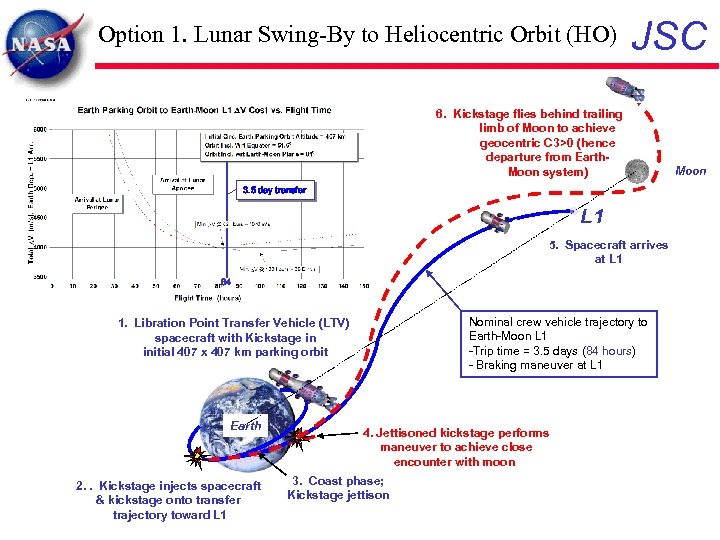
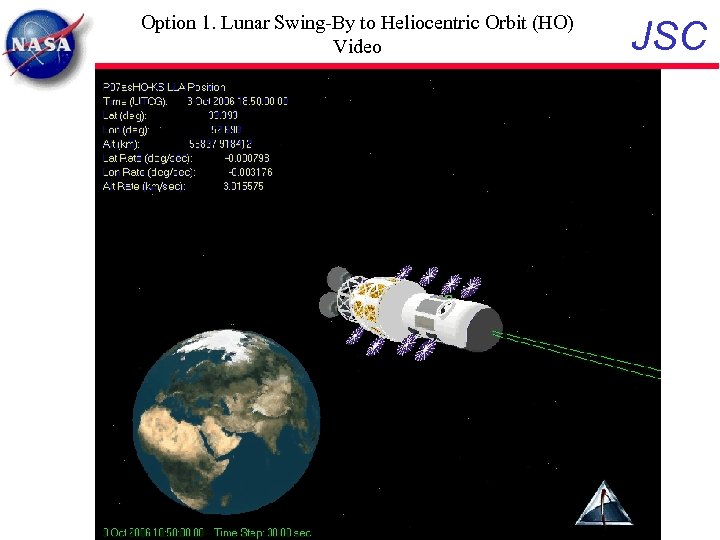
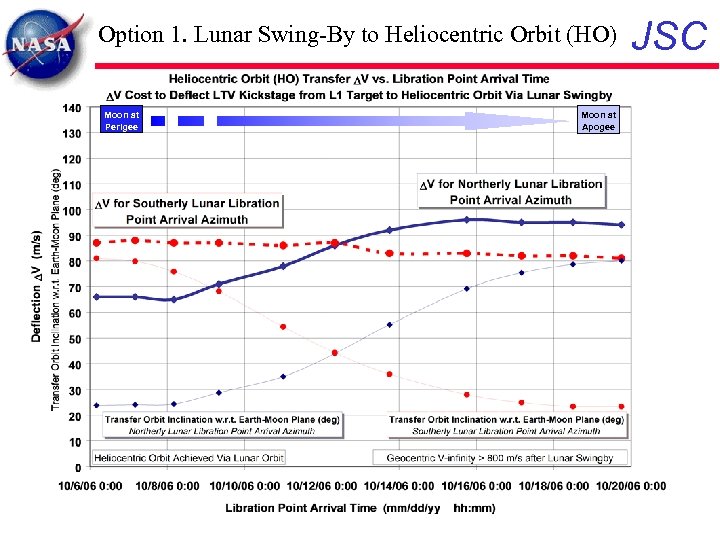
Option 1. Lunar Swing-By to Heliocentric Orbit (HO) JSC 6. Kickstage flies behind trailing limb of Moon to achieve geocentric C 3>0 (hence departure from Earth. Moon system) 3. 5 day transfer L 1 5. Spacecraft arrives at L 1 84 Nominal crew vehicle trajectory to Earth-Moon L 1 -Trip time = 3. 5 days (84 hours) - Braking maneuver at L 1 1. Libration Point Transfer Vehicle (LTV) spacecraft with Kickstage in initial 407 x 407 km parking orbit Earth 2. . Kickstage injects spacecraft & kickstage onto transfer trajectory toward L 1 4. Jettisoned kickstage performs maneuver to achieve close encounter with moon 3. Coast phase; Kickstage jettison Moon
Option 1. Lunar Swing-By to Heliocentric Orbit (HO) Video JSC
Option 1. Lunar Swing-By to Heliocentric Orbit (HO) Moon at Perigee Moon at Apogee JSC
Option 1. Lunar Swing-By to Heliocentric Orbit (HO) JSC • Advantages – No Earth or Lunar disposal issues (e. g. , impact location, debris footprint, litter) – Relatively low disposal DV cost • Disadvantages – Heliocentric space litter (kickstage heliocentric orbit near that of the earth) – Periodic possibility of re-contact with Earth 16
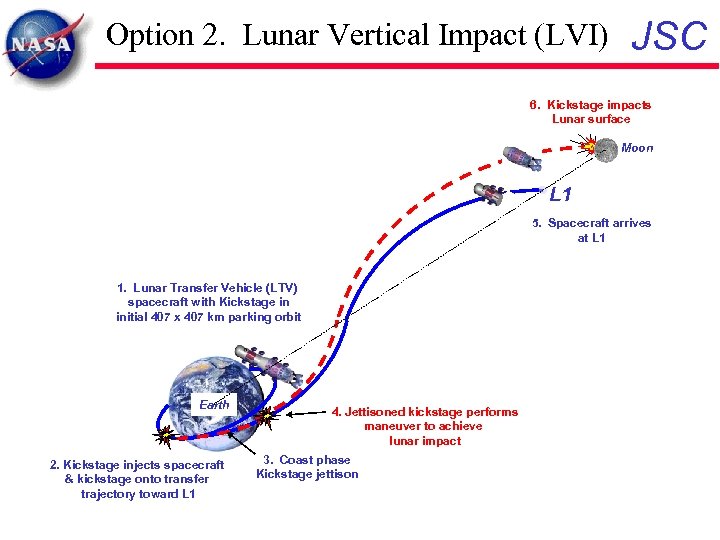
Option 2. Lunar Vertical Impact (LVI) JSC 6. Kickstage impacts Lunar surface Moon L 1 5. Spacecraft arrives at L 1 1. Lunar Transfer Vehicle (LTV) spacecraft with Kickstage in initial 407 x 407 km parking orbit Earth 2. Kickstage injects spacecraft & kickstage onto transfer trajectory toward L 1 4. Jettisoned kickstage performs maneuver to achieve lunar impact 3. Coast phase Kickstage jettison
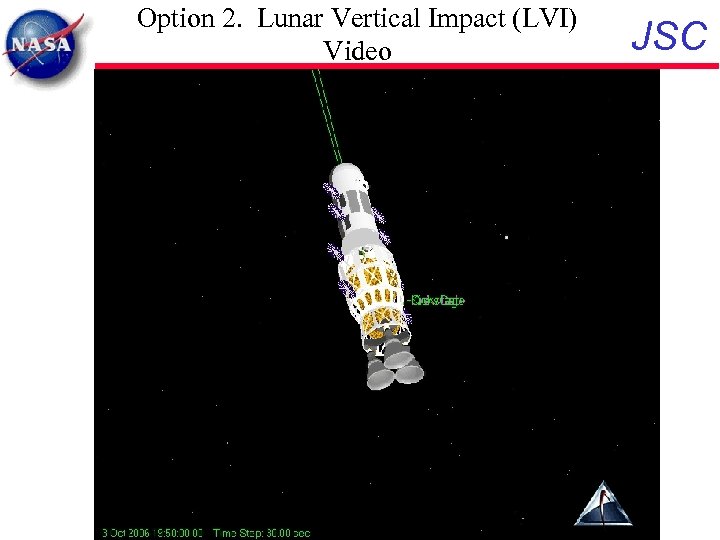
Option 2. Lunar Vertical Impact (LVI) Video JSC
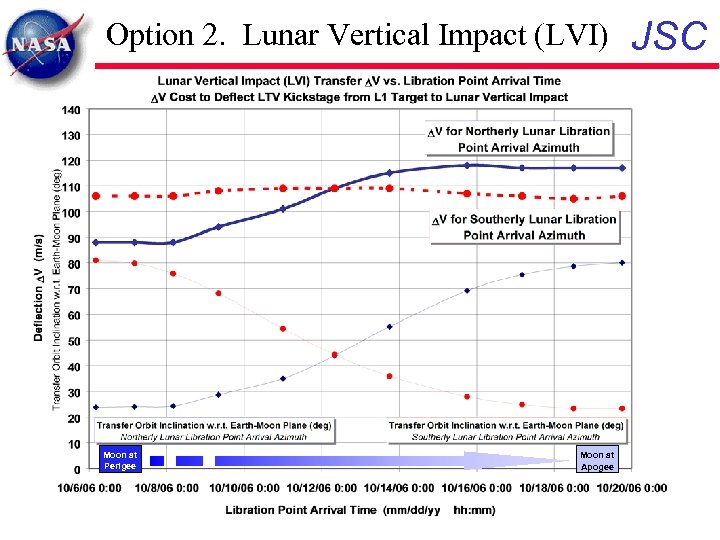
Option 2. Lunar Vertical Impact (LVI) Moon at Perigee Moon at Apogee JSC
Option 2. Lunar Vertical Impact (LVI) JSC • Advantages – No Earth disposal issues (e. g. , impact location, debris footprint, litter, possible recontact) • Disadvantage – Lunar litter – Relatively high disposal DV cost 20
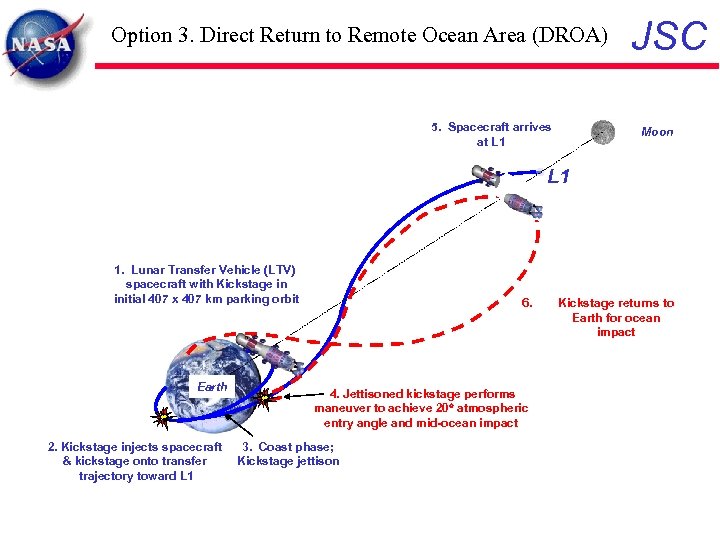
Option 3. Direct Return to Remote Ocean Area (DROA) 5. Spacecraft arrives at L 1 JSC Moon L 1 1. Lunar Transfer Vehicle (LTV) spacecraft with Kickstage in initial 407 x 407 km parking orbit Earth 2. Kickstage injects spacecraft & kickstage onto transfer trajectory toward L 1 6. 4. Jettisoned kickstage performs maneuver to achieve 20° atmospheric entry angle and mid-ocean impact 3. Coast phase; Kickstage jettison Kickstage returns to Earth for ocean impact
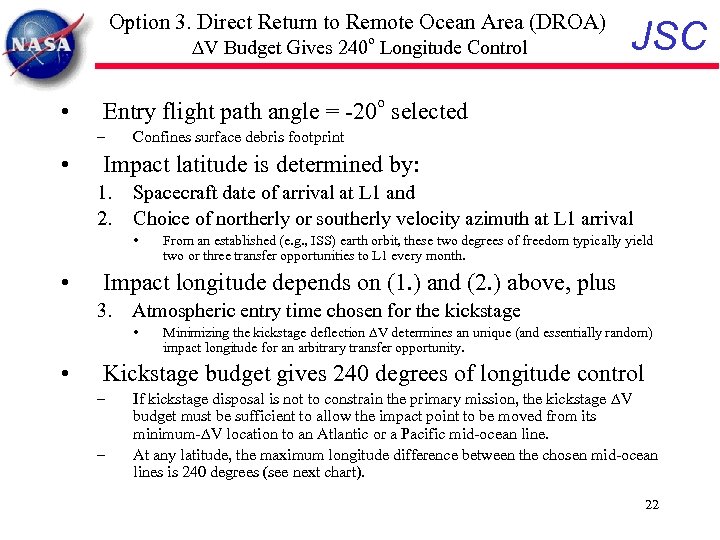
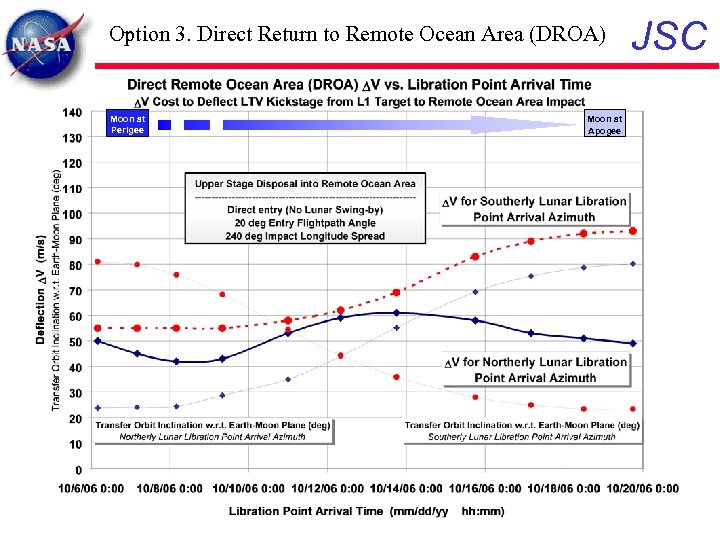
Option 3. Direct Return to Remote Ocean Area (DROA) DV Budget Gives 240 o Longitude Control • Entry flight path angle = -20 o selected – • Confines surface debris footprint Impact latitude is determined by: 1. 2. Spacecraft date of arrival at L 1 and Choice of northerly or southerly velocity azimuth at L 1 arrival • • From an established (e. g. , ISS) earth orbit, these two degrees of freedom typically yield two or three transfer opportunities to L 1 every month. Impact longitude depends on (1. ) and (2. ) above, plus 3. Atmospheric entry time chosen for the kickstage • • JSC Minimizing the kickstage deflection DV determines an unique (and essentially random) impact longitude for an arbitrary transfer opportunity. Kickstage budget gives 240 degrees of longitude control – – If kickstage disposal is not to constrain the primary mission, the kickstage DV budget must be sufficient to allow the impact point to be moved from its minimum-DV location to an Atlantic or a Pacific mid-ocean line. At any latitude, the maximum longitude difference between the chosen mid-ocean lines is 240 degrees (see next chart). 22
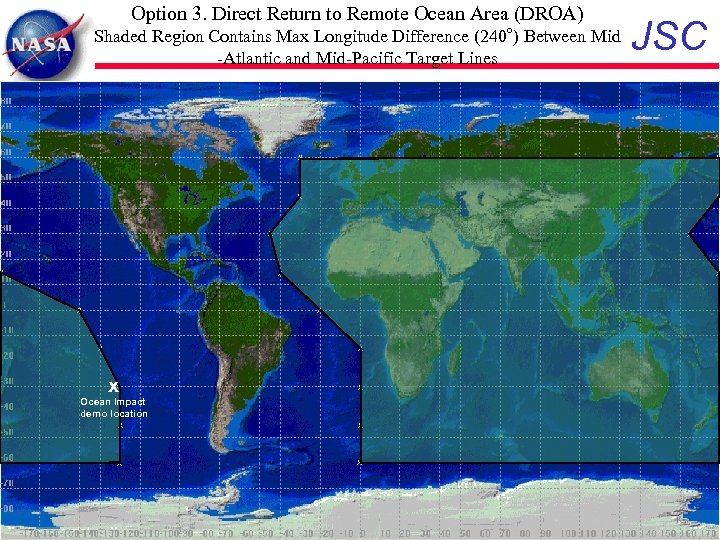
Option 3. Direct Return to Remote Ocean Area (DROA) o Shaded Region Contains Max Longitude Difference (240 ) Between Mid -Atlantic and Mid-Pacific Target Lines JSC x x x xx Ocean Impact demo location x x x
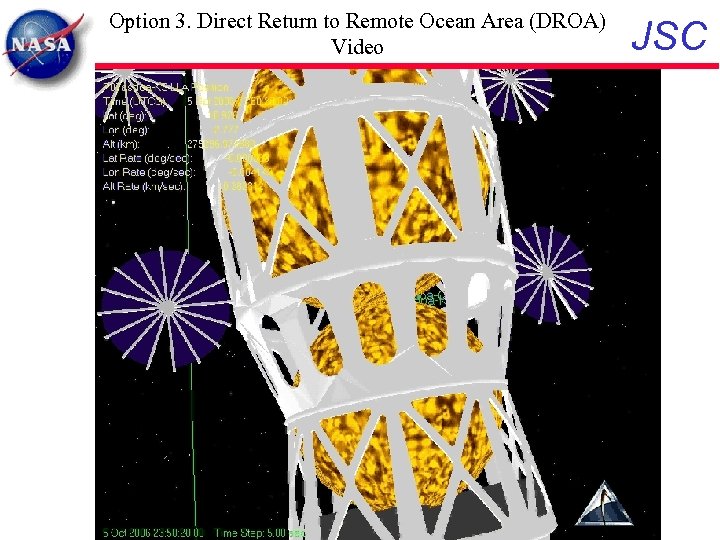
Option 3. Direct Return to Remote Ocean Area (DROA) Video JSC
Option 3. Direct Return to Remote Ocean Area (DROA) Moon at Perigee Moon at Apogee JSC
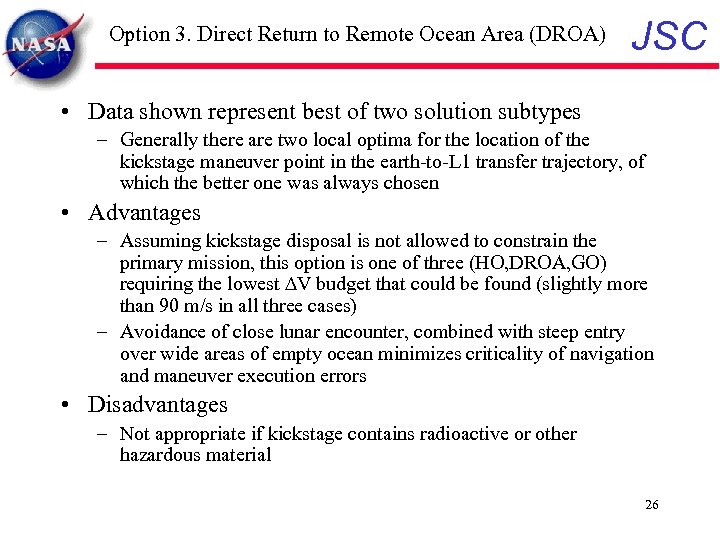
Option 3. Direct Return to Remote Ocean Area (DROA) JSC • Data shown represent best of two solution subtypes – Generally there are two local optima for the location of the kickstage maneuver point in the earth-to-L 1 transfer trajectory, of which the better one was always chosen • Advantages – Assuming kickstage disposal is not allowed to constrain the primary mission, this option is one of three (HO, DROA, GO) requiring the lowest DV budget that could be found (slightly more than 90 m/s in all three cases) – Avoidance of close lunar encounter, combined with steep entry over wide areas of empty ocean minimizes criticality of navigation and maneuver execution errors • Disadvantages – Not appropriate if kickstage contains radioactive or other hazardous material 26
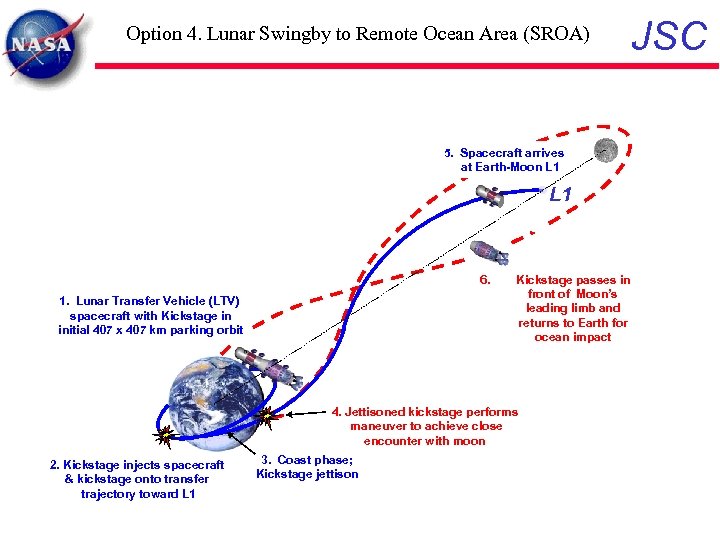
Option 4. Lunar Swingby to Remote Ocean Area (SROA) 5. Spacecraft arrives at Earth-Moon L 1 6. 1. Lunar Transfer Vehicle (LTV) spacecraft with Kickstage in initial 407 x 407 km parking orbit Kickstage passes in front of Moon’s leading limb and returns to Earth for ocean impact 4. Jettisoned kickstage performs maneuver to achieve close encounter with moon 2. Kickstage injects spacecraft & kickstage onto transfer trajectory toward L 1 3. Coast phase; Kickstage jettison JSC
Option 4. Lunar Swingby to Remote Ocean Area (SROA) JSC
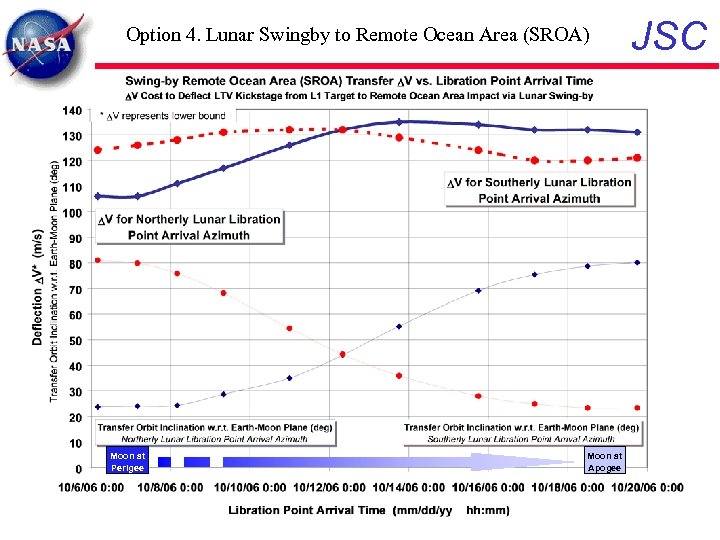
Option 4. Lunar Swingby to Remote Ocean Area (SROA) Moon at Perigee Moon at Apogee JSC
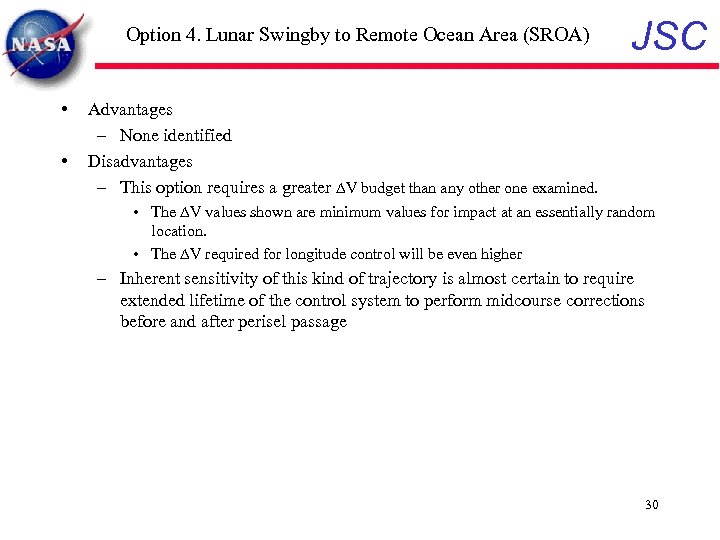
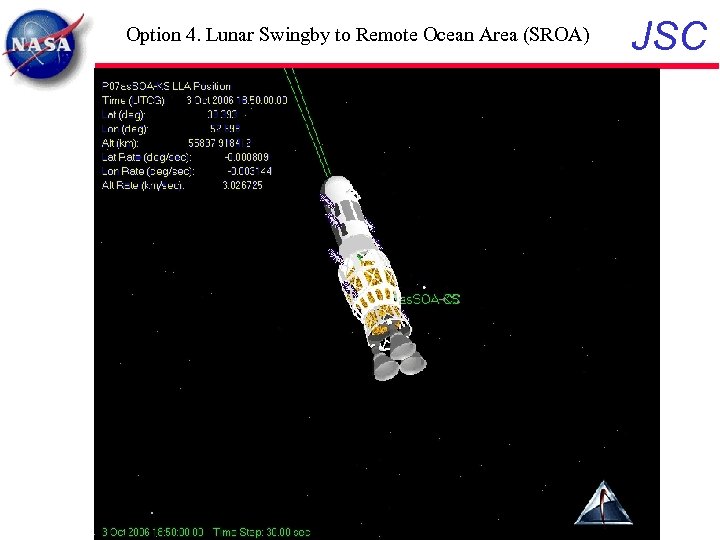
Option 4. Lunar Swingby to Remote Ocean Area (SROA) • • JSC Advantages – None identified Disadvantages – This option requires a greater DV budget than any other one examined. • The DV values shown are minimum values for impact at an essentially random location. • The DV required for longitude control will be even higher – Inherent sensitivity of this kind of trajectory is almost certain to require extended lifetime of the control system to perform midcourse corrections before and after perisel passage 30
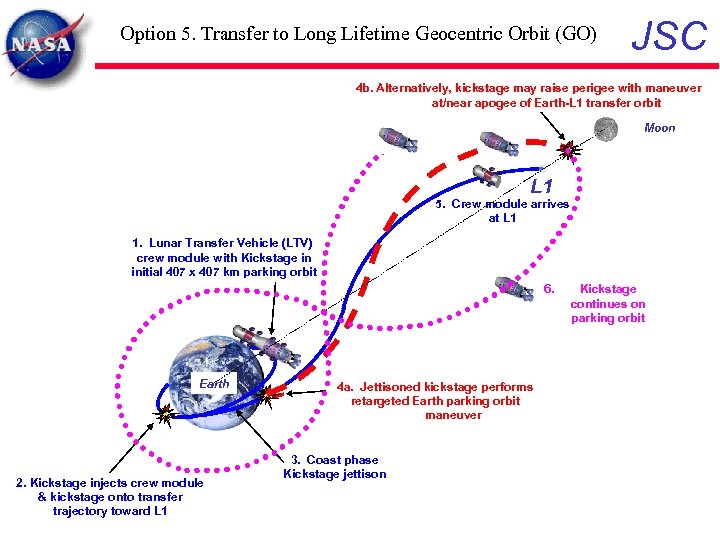
Option 5. Transfer to Long Lifetime Geocentric Orbit (GO) JSC 4 b. Alternatively, kickstage may raise perigee with maneuver at/near apogee of Earth-L 1 transfer orbit Moon L 1 5. Crew module arrives at L 1 1. Lunar Transfer Vehicle (LTV) crew module with Kickstage in initial 407 x 407 km parking orbit 6. Earth 2. Kickstage injects crew module & kickstage onto transfer trajectory toward L 1 4 a. Jettisoned kickstage performs retargeted Earth parking orbit maneuver 3. Coast phase Kickstage jettison Kickstage continues on parking orbit
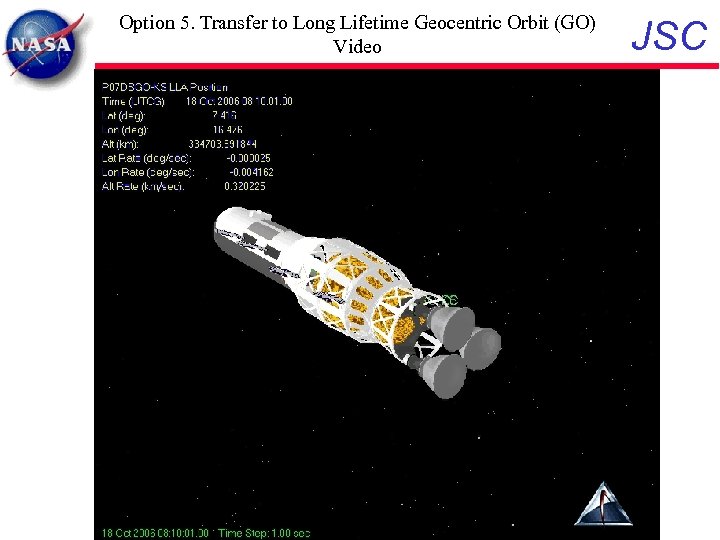
Option 5. Transfer to Long Lifetime Geocentric Orbit (GO) Video JSC
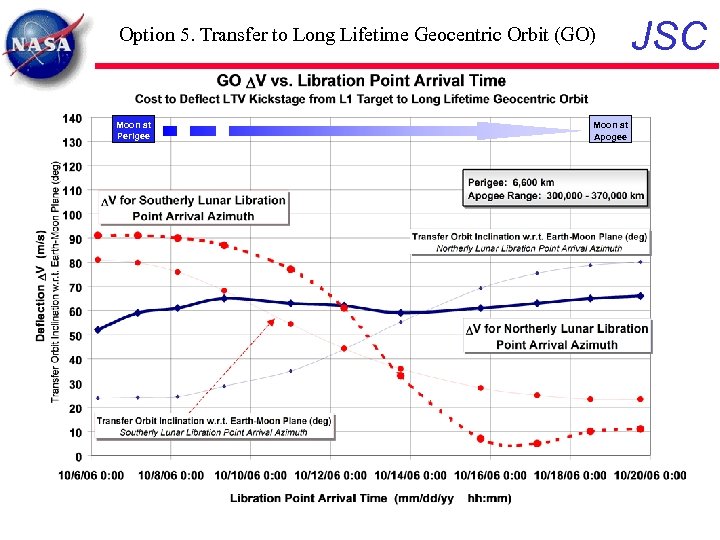
Option 5. Transfer to Long Lifetime Geocentric Orbit (GO) Moon at Perigee Moon at Apogee JSC
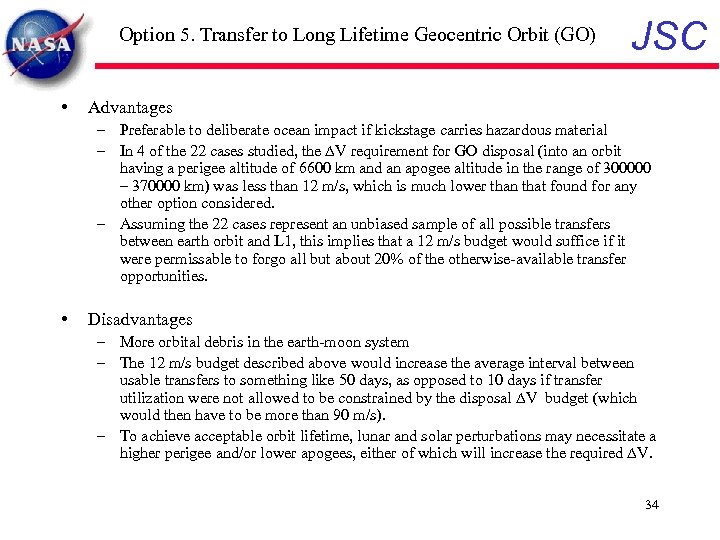
Option 5. Transfer to Long Lifetime Geocentric Orbit (GO) • JSC Advantages – Preferable to deliberate ocean impact if kickstage carries hazardous material – In 4 of the 22 cases studied, the DV requirement for GO disposal (into an orbit having a perigee altitude of 6600 km and an apogee altitude in the range of 300000 – 370000 km) was less than 12 m/s, which is much lower than that found for any other option considered. – Assuming the 22 cases represent an unbiased sample of all possible transfers between earth orbit and L 1, this implies that a 12 m/s budget would suffice if it were permissable to forgo all but about 20% of the otherwise-available transfer opportunities. • Disadvantages – More orbital debris in the earth-moon system – The 12 m/s budget described above would increase the average interval between usable transfers to something like 50 days, as opposed to 10 days if transfer utilization were not allowed to be constrained by the disposal DV budget (which would then have to be more than 90 m/s). – To achieve acceptable orbit lifetime, lunar and solar perturbations may necessitate a higher perigee and/or lower apogees, either of which will increase the required DV. 34
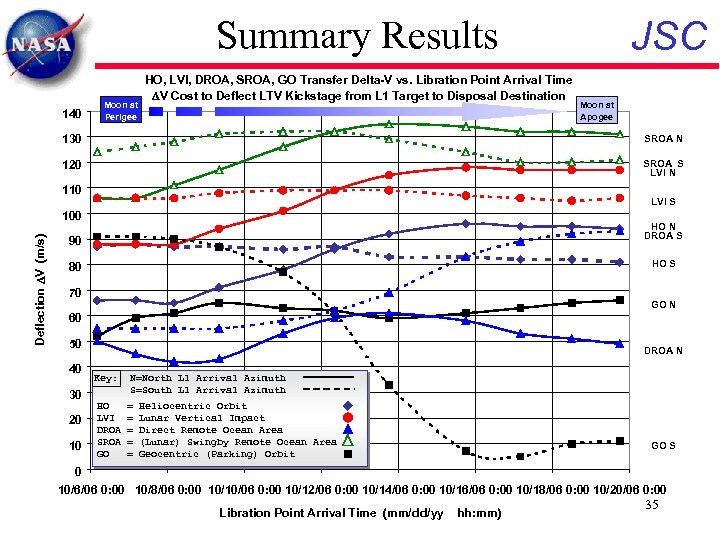
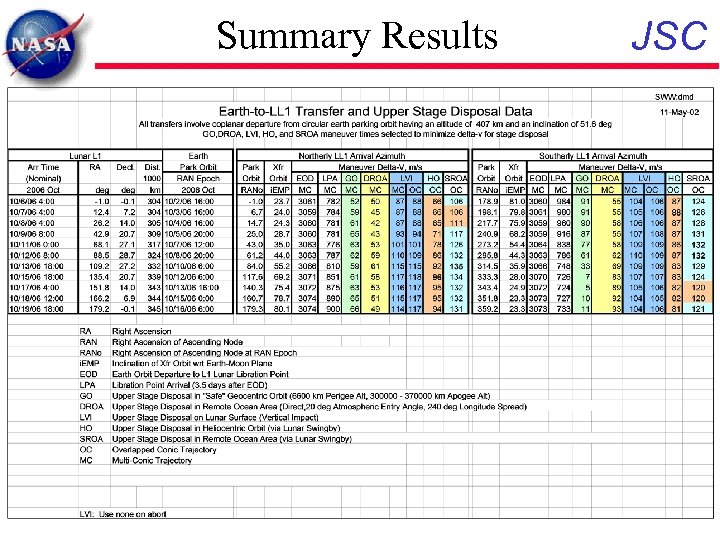
Summary Results 140 Moon at Perigee HO, LVI, DROA, SROA, GO Transfer Delta-V vs. Libration Point Arrival Time DV Cost to Deflect LTV Kickstage from L 1 Target to Disposal Destination JSC Moon at Apogee 130 SROA N 120 SROA S LVI N 110 LVI S Deflection DV (m/s) 100 HO N DROA S 90 HO S 80 70 GO N 60 50 40 30 20 10 DROA N Key: HO LVI DROA SROA GO N=North L 1 Arrival Azimuth S=South L 1 Arrival Azimuth = = = Heliocentric Orbit Lunar Vertical Impact Direct Remote Ocean Area (Lunar) Swingby Remote Ocean Area Geocentric (Parking) Orbit GO S 0 10/6/06 0: 00 10/8/06 0: 00 10/10/06 0: 00 10/12/06 0: 00 10/14/06 0: 00 10/16/06 0: 00 10/18/06 0: 00 10/20/06 0: 00 Libration Point Arrival Time (mm/dd/yy hh: mm) 35
JSC Geocentric Orbit Lifetime Study 36
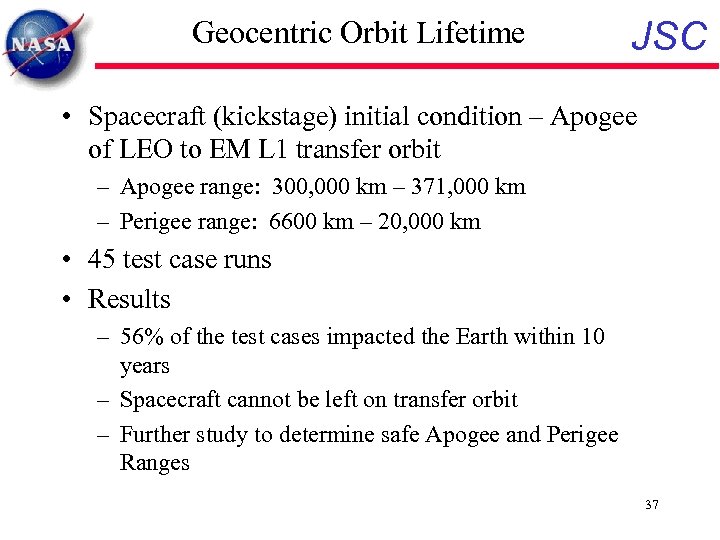
Geocentric Orbit Lifetime JSC • Spacecraft (kickstage) initial condition – Apogee of LEO to EM L 1 transfer orbit – Apogee range: 300, 000 km – 371, 000 km – Perigee range: 6600 km – 20, 000 km • 45 test case runs • Results – 56% of the test cases impacted the Earth within 10 years – Spacecraft cannot be left on transfer orbit – Further study to determine safe Apogee and Perigee Ranges 37
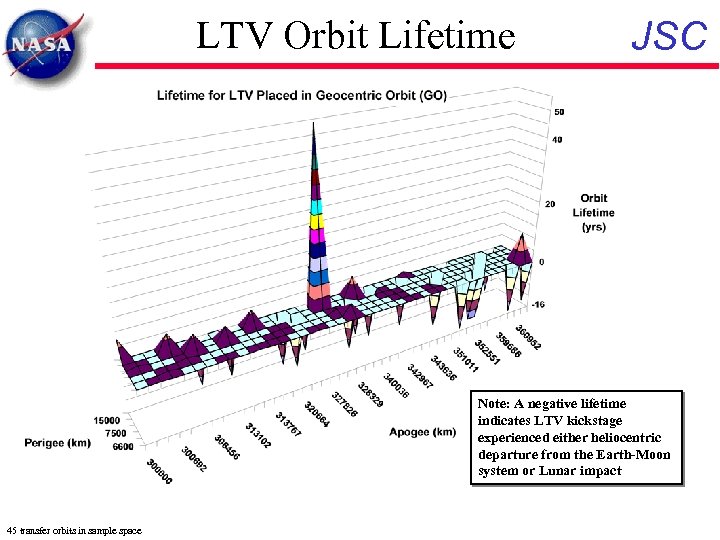
LTV Orbit Lifetime JSC Note: A negative lifetime indicates LTV kickstage experienced either heliocentric departure from the Earth-Moon system or Lunar impact 45 transfer orbits in sample space
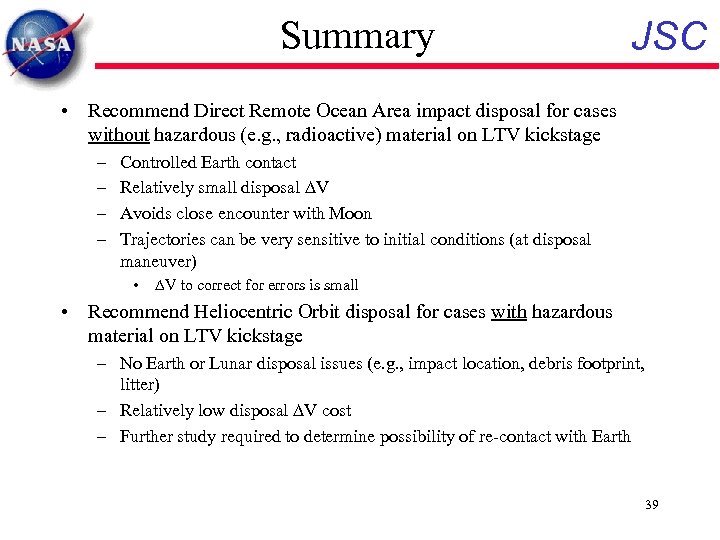
Summary JSC • Recommend Direct Remote Ocean Area impact disposal for cases without hazardous (e. g. , radioactive) material on LTV kickstage – – Controlled Earth contact Relatively small disposal DV Avoids close encounter with Moon Trajectories can be very sensitive to initial conditions (at disposal maneuver) • DV to correct for errors is small • Recommend Heliocentric Orbit disposal for cases with hazardous material on LTV kickstage – No Earth or Lunar disposal issues (e. g. , impact location, debris footprint, litter) – Relatively low disposal DV cost – Further study required to determine possibility of re-contact with Earth 39
JSC Additional Slides 40
Summary Results JSC
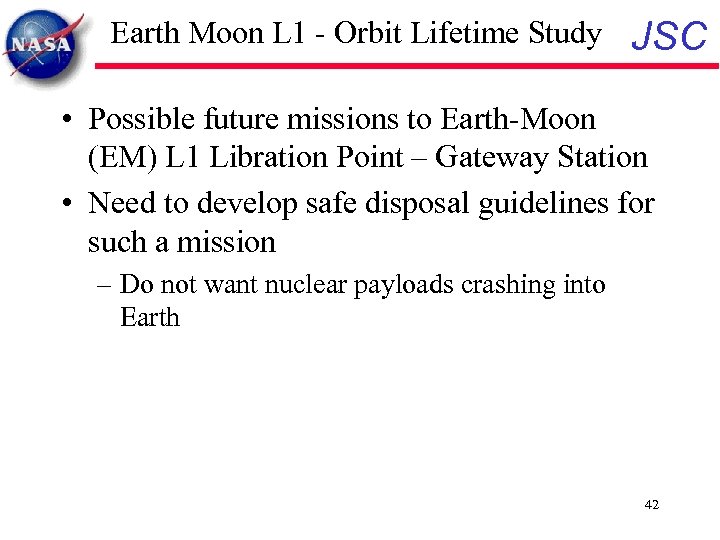
Earth Moon L 1 - Orbit Lifetime Study JSC • Possible future missions to Earth-Moon (EM) L 1 Libration Point – Gateway Station • Need to develop safe disposal guidelines for such a mission – Do not want nuclear payloads crashing into Earth 42
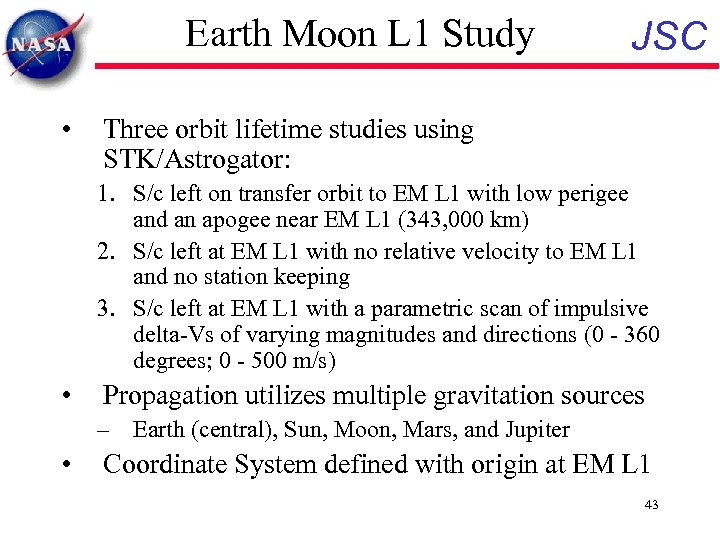
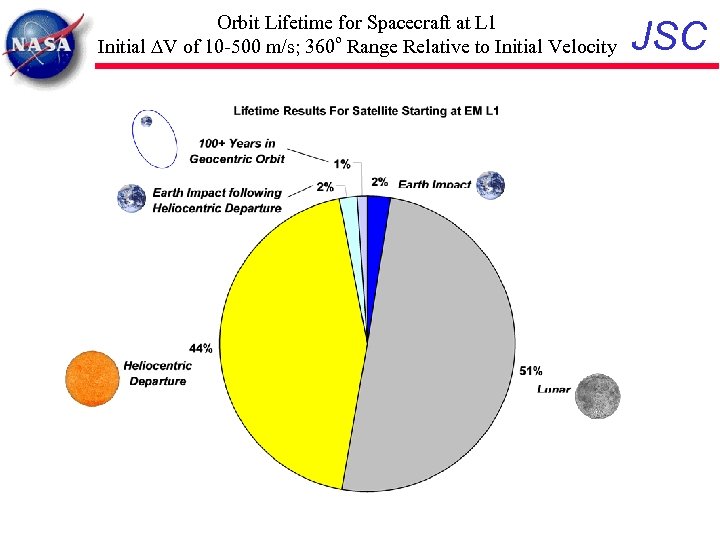
Earth Moon L 1 Study • JSC Three orbit lifetime studies using STK/Astrogator: 1. S/c left on transfer orbit to EM L 1 with low perigee and an apogee near EM L 1 (343, 000 km) 2. S/c left at EM L 1 with no relative velocity to EM L 1 and no station keeping 3. S/c left at EM L 1 with a parametric scan of impulsive delta-Vs of varying magnitudes and directions (0 - 360 degrees; 0 - 500 m/s) • Propagation utilizes multiple gravitation sources – Earth (central), Sun, Moon, Mars, and Jupiter • Coordinate System defined with origin at EM L 1 43
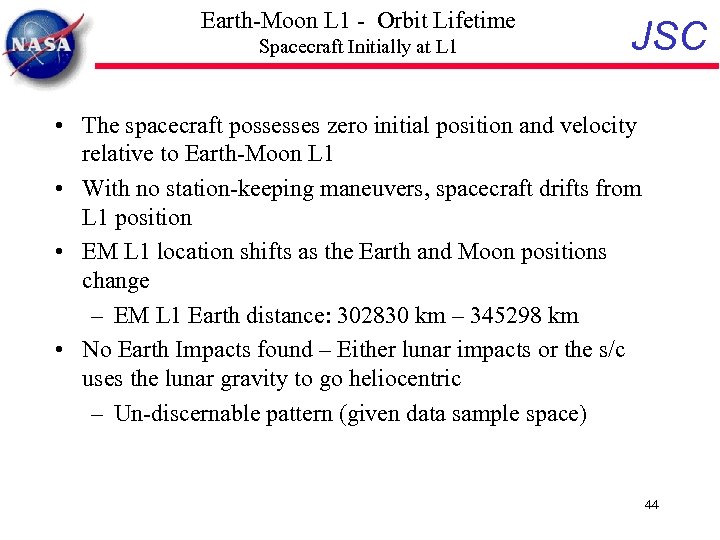
Earth-Moon L 1 - Orbit Lifetime Spacecraft Initially at L 1 JSC • The spacecraft possesses zero initial position and velocity relative to Earth-Moon L 1 • With no station-keeping maneuvers, spacecraft drifts from L 1 position • EM L 1 location shifts as the Earth and Moon positions change – EM L 1 Earth distance: 302830 km – 345298 km • No Earth Impacts found – Either lunar impacts or the s/c uses the lunar gravity to go heliocentric – Un-discernable pattern (given data sample space) 44
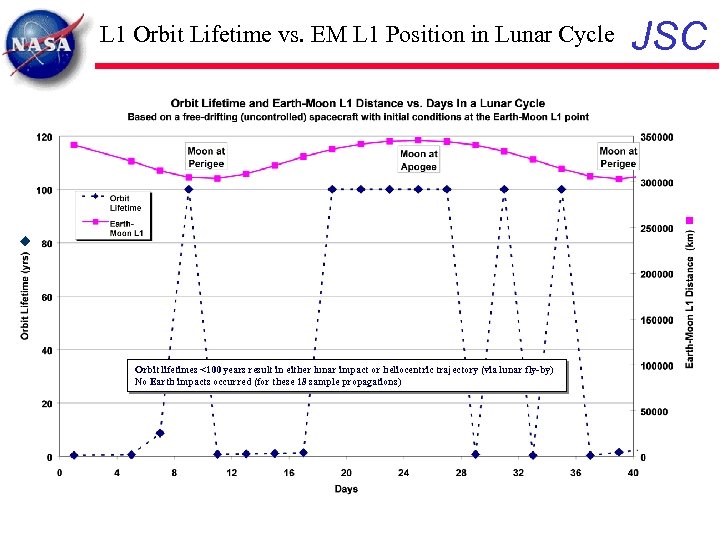
L 1 Orbit Lifetime vs. EM L 1 Position in Lunar Cycle Orbit lifetimes <100 years result in either lunar impact or heliocentric trajectory (via lunar fly-by) No Earth impacts occurred (for these 18 sample propagations) JSC
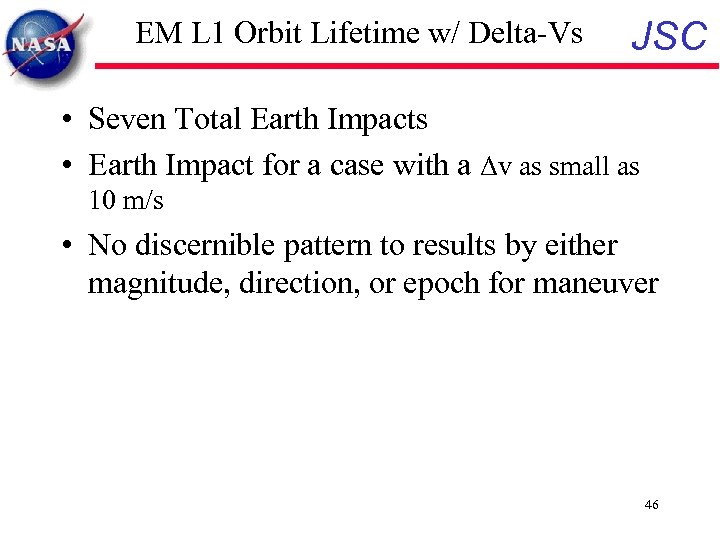
EM L 1 Orbit Lifetime w/ Delta-Vs JSC • Seven Total Earth Impacts • Earth Impact for a case with a Δv as small as 10 m/s • No discernible pattern to results by either magnitude, direction, or epoch for maneuver 46
Orbit Lifetime for Spacecraft at L 1 Initial DV of 10 -500 m/s; 360 o Range Relative to Initial Velocity JSC
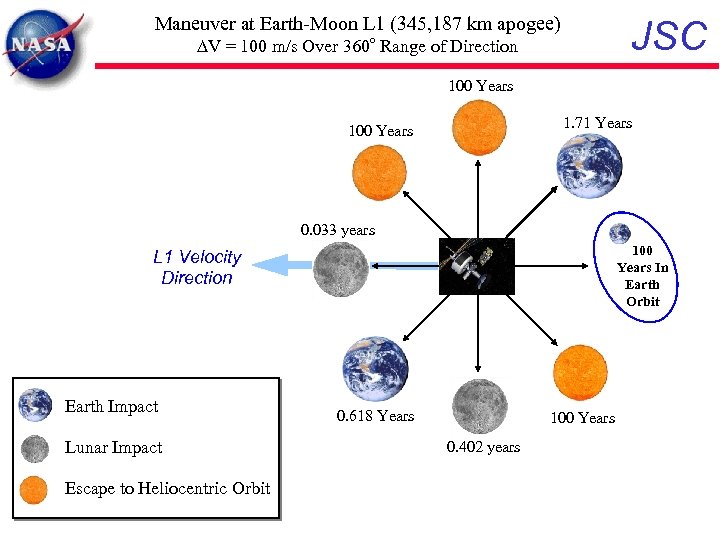
Maneuver at Earth-Moon L 1 (345, 187 km apogee) JSC DV = 100 m/s Over 360 o Range of Direction 100 Years 1. 71 Years 100 Years 0. 033 years 100 Years In Earth Orbit L 1 Velocity Direction Earth Impact Lunar Impact Escape to Heliocentric Orbit 0. 618 Years 100 Years 0. 402 years
EM L 1 Orbit Lifetime – Future Work JSC • Further studies to better define safe disposal guidelines for s/c launched to EM L 1 – Further examine lifetimes for s/c at or near EM L 1 position and velocity – Examine transfers to other disposal orbits, possibly b/w GEO and EM L 1 that are less affected by lunar perturbations – Write for paper to be possibly presented in Spain on this work 49
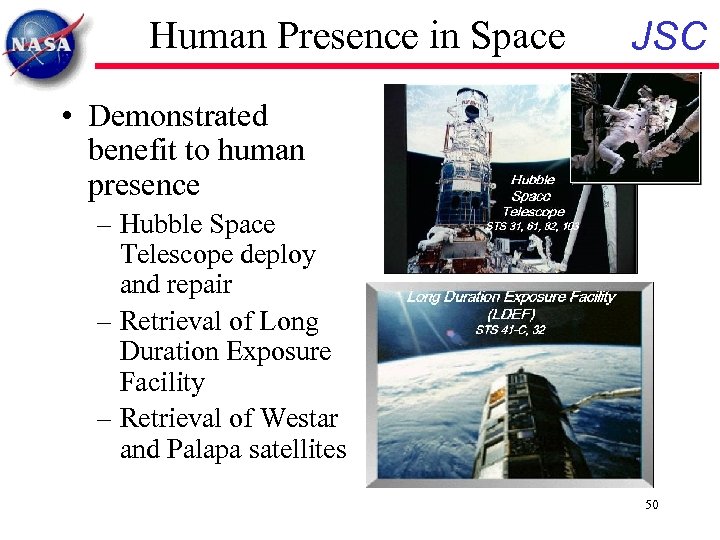
Human Presence in Space JSC • Demonstrated benefit to human presence – Hubble Space Telescope deploy and repair – Retrieval of Long Duration Exposure Facility – Retrieval of Westar and Palapa satellites 50
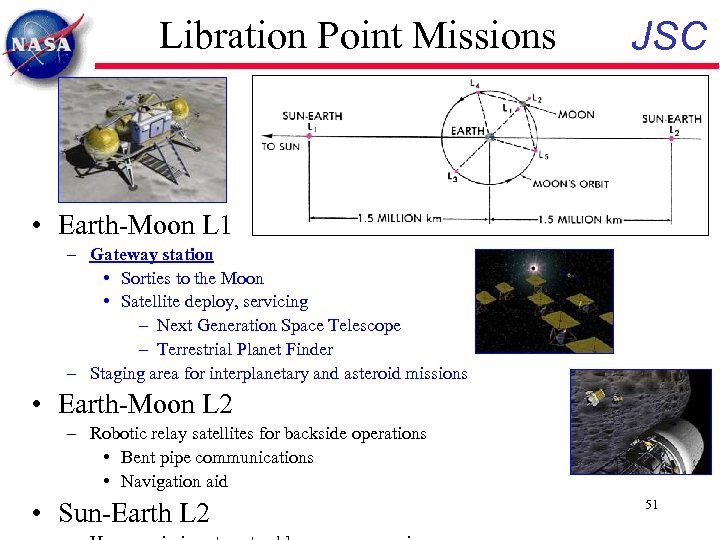
Libration Point Missions JSC • Earth-Moon L 1 – Gateway station • Sorties to the Moon • Satellite deploy, servicing – Next Generation Space Telescope – Terrestrial Planet Finder – Staging area for interplanetary and asteroid missions • Earth-Moon L 2 – Robotic relay satellites for backside operations • Bent pipe communications • Navigation aid • Sun-Earth L 2 51
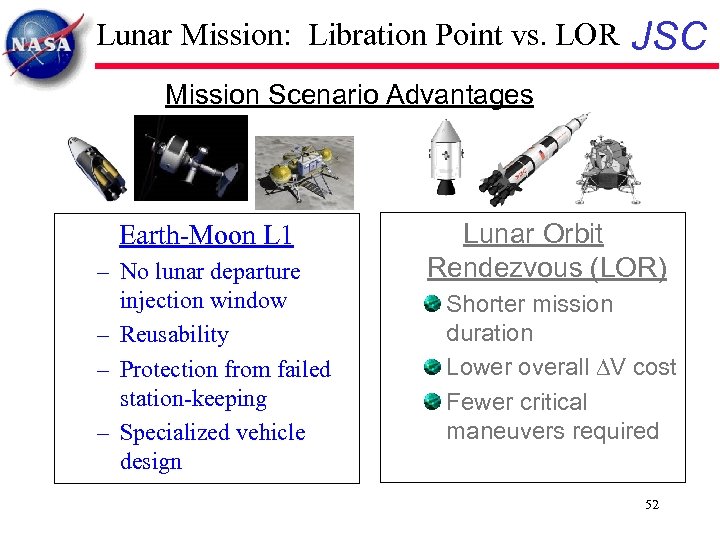
Lunar Mission: Libration Point vs. LOR JSC Mission Scenario Advantages Earth-Moon L 1 – No lunar departure injection window – Reusability – Protection from failed station-keeping – Specialized vehicle design Lunar Orbit Rendezvous (LOR) Shorter mission duration Lower overall DV cost Fewer critical maneuvers required 52
Considerations for Human Lunar L 1 Missions JSC • 18 year lunar inclination cycle • Eccentricity of lunar orbit • Performance cost versus time • Frequency of outbound & inbound opportunities 53
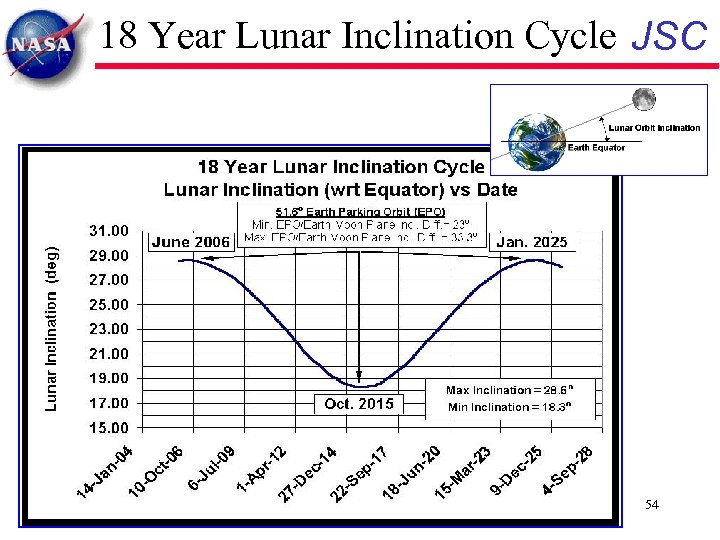
18 Year Lunar Inclination Cycle JSC 54
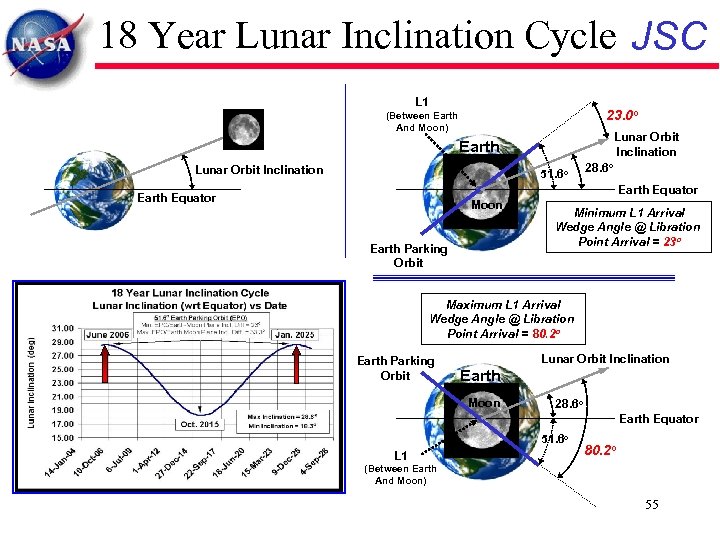
18 Year Lunar Inclination Cycle JSC L 1 23. 0 o (Between Earth And Moon) Lunar Orbit Inclination Earth Lunar Orbit Inclination 51. 6 o 28. 6 o Earth Equator Moon Earth Parking Orbit Minimum L 1 Arrival Wedge Angle @ Libration Point Arrival = 23 o Maximum L 1 Arrival Wedge Angle @ Libration Point Arrival = 80. 2 o Earth Parking Orbit Lunar Orbit Inclination Earth Moon 28. 6 o Earth Equator 51. 6 o L 1 80. 2 o (Between Earth And Moon) 55
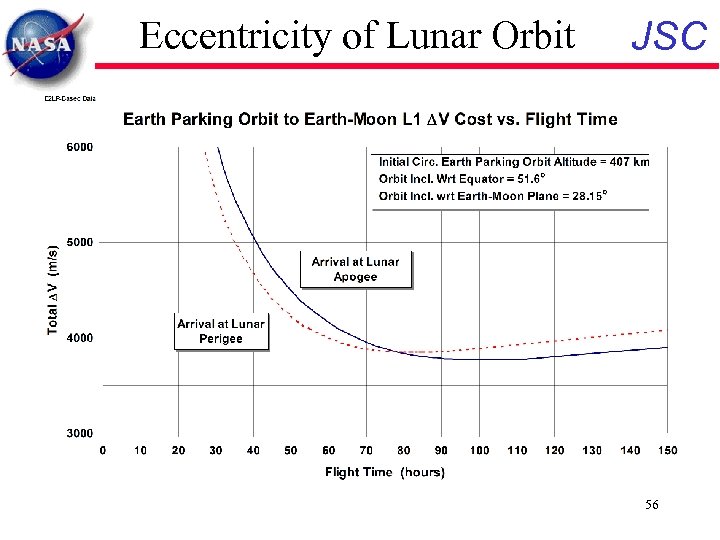
Eccentricity of Lunar Orbit JSC 56
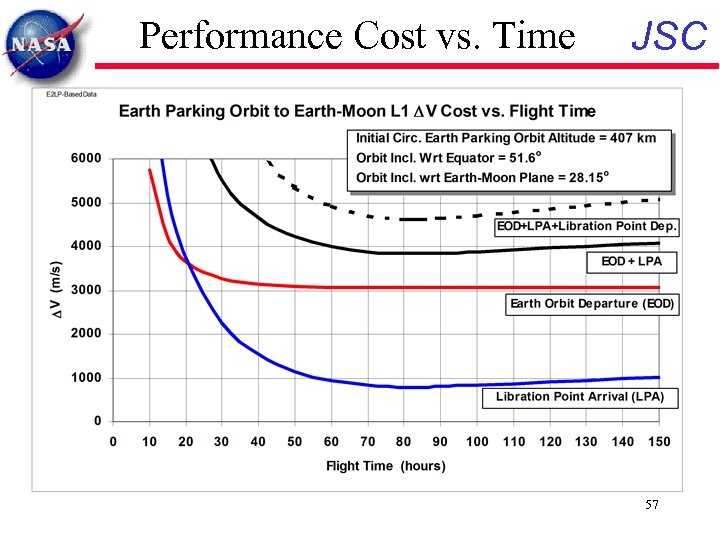
Performance Cost vs. Time JSC 57
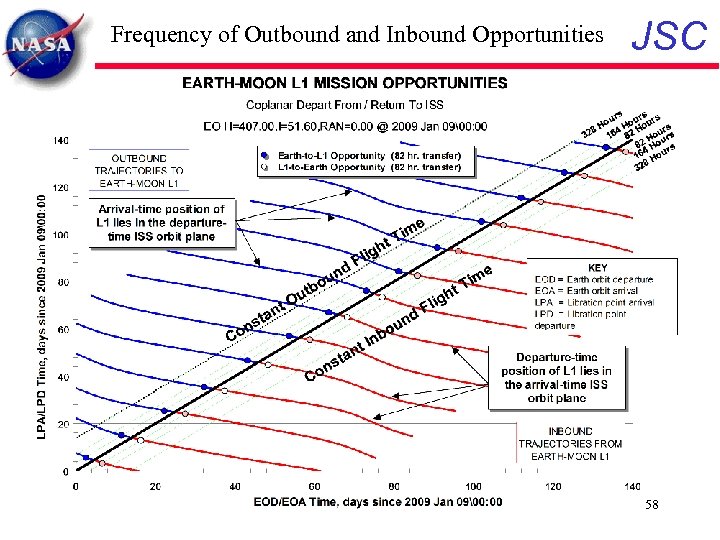
Frequency of Outbound and Inbound Opportunities JSC 58
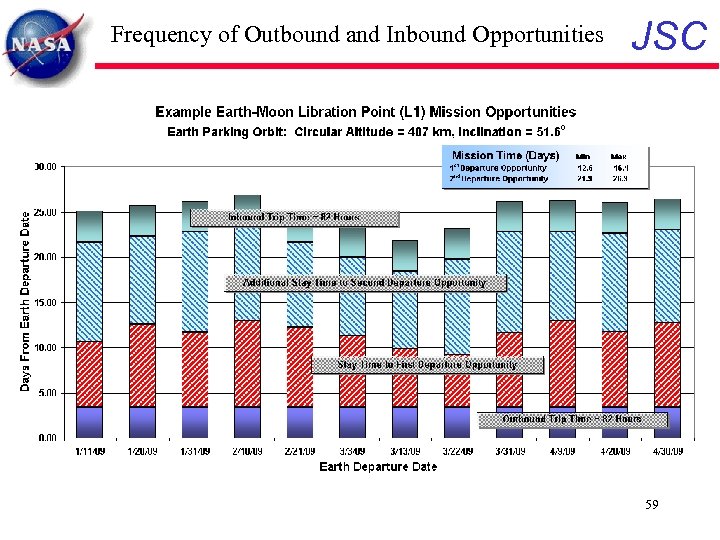
Frequency of Outbound and Inbound Opportunities JSC 59
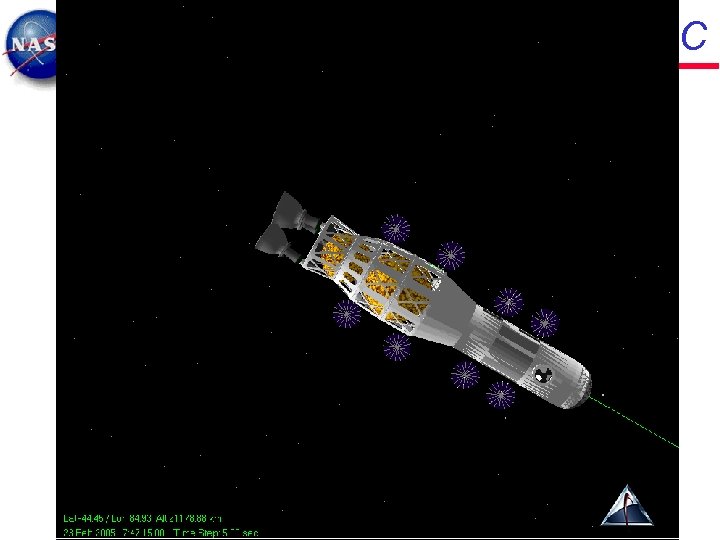
JSC
Total Transfer DV vs LPA Time JSC
Transfer DV vs LPA Time JSC
Скачать презентацию JSC Earth Moon Libration Point L 1 Gateway
ccd1614b794b60bde70d8daa3166a192.ppt