 Скачать презентацию JRRD Editorial Board Meeting Webinar 103 South Gay
8d331e5e61b15b65b4a8d03a4ff64d5f.ppt
- Количество слайдов: 72



JRRD Editorial Board Meeting Webinar 103 South Gay Street Baltimore, MD July 24, 2013, 1: 00 -3: 00 pm EST Hosted by Go. To. Webinar Stacieann C. Yuhasz, Ph. D, Editor Researcher. ID: B-5428 -2011 1
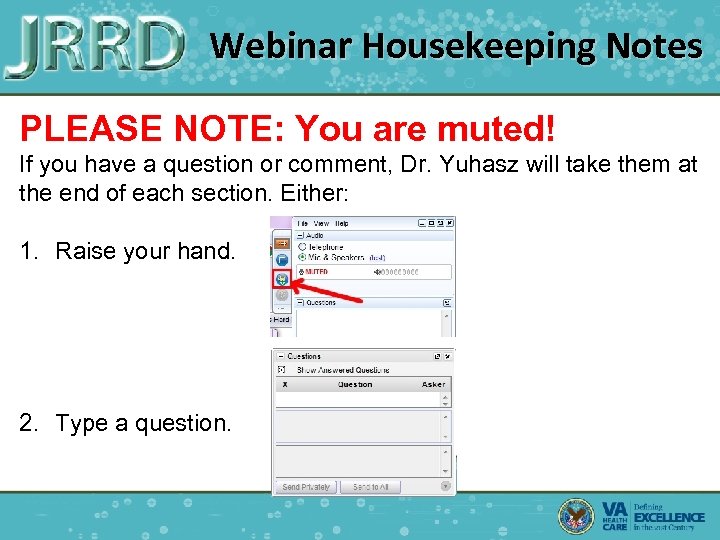
Webinar Housekeeping Notes PLEASE NOTE: You are muted! If you have a question or comment, Dr. Yuhasz will take them at the end of each section. Either: 1. Raise your hand. 2. Type a question.
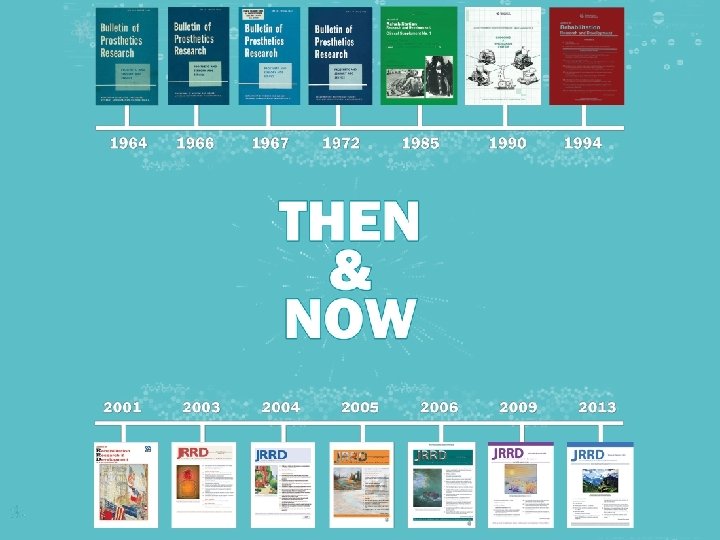
July 2, 2013 HEY VA! HAVE YOU HEARD? In rehabilitation research, 50 years can be transformational and life changing. As the Journal of Rehabilitation Research and Development, JRRD, celebrates 50 years of publication this year, VA looks back at the remarkable achievements in rehabilitation research in a special Then & Now section. These reflective commentaries look at how the achievements of the past have allowed VA to reach where we are today. Thanks to the contributions of some present-day researchers, from both within the VA and other esteemed rehabilitation research institutions, each volume 50 issue includes a reflective commentary that relates to an article from the 1964 volume then called the Bulletin of Prosthetics Research. The first issue features a commentary on 65 years of progress at the VA Prosthetics and Sensory Aids Service by Dr. Lucille Beck. “Research into prosthetics and rehabilitation have provided new opportunities to so many Veterans and civilians … opportunities that were unimaginable 50 years ago, ” said JRRD Editor Stacieann Yuhasz, Ph. D. JRRD, an international peer-reviewed rehabilitation journal, has been a leading research journal in the field of rehabilitation medicine and technology for 50 years and is an official VA publication available to anyone with an Internet connection at webmail. va. gov/OWA/redir. aspx? C=D 7 Bvh. Vn_0 m. BHD 6 o 80 OKrc. ODv 000 UNBIg-jt. JO 0 TZU 8 wwac. YLXKats. B 6 Lv. Cg. GYnvw 1 W 3 Kdyam. A. &URL=http%3 a%2 f%2 fwww. rehab. res
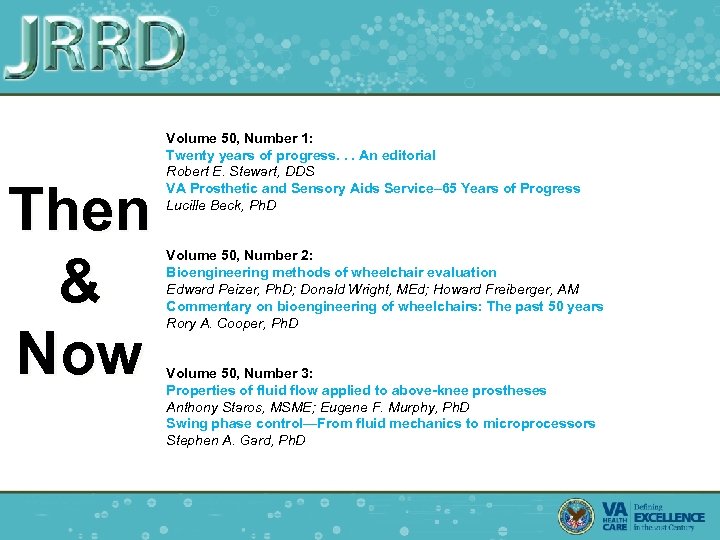
Then & Now Volume 50, Number 1: Twenty years of progress. . . An editorial Robert E. Stewart, DDS VA Prosthetic and Sensory Aids Service– 65 Years of Progress Lucille Beck, Ph. D Volume 50, Number 2: Bioengineering methods of wheelchair evaluation Edward Peizer, Ph. D; Donald Wright, MEd; Howard Freiberger, AM Commentary on bioengineering of wheelchairs: The past 50 years Rory A. Cooper, Ph. D Volume 50, Number 3: Properties of fluid flow applied to above-knee prostheses Anthony Staros, MSME; Eugene F. Murphy, Ph. D Swing phase control—From fluid mechanics to microprocessors Stephen A. Gard, Ph. D
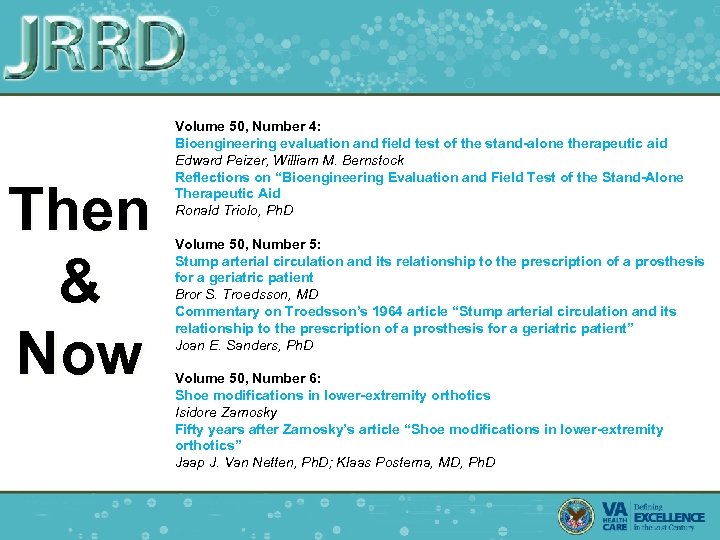
Then & Now Volume 50, Number 4: Bioengineering evaluation and field test of the stand-alone therapeutic aid Edward Peizer, William M. Bernstock Reflections on “Bioengineering Evaluation and Field Test of the Stand-Alone Therapeutic Aid Ronald Triolo, Ph. D Volume 50, Number 5: Stump arterial circulation and its relationship to the prescription of a prosthesis for a geriatric patient Bror S. Troedsson, MD Commentary on Troedsson’s 1964 article “Stump arterial circulation and its relationship to the prescription of a prosthesis for a geriatric patient” Joan E. Sanders, Ph. D Volume 50, Number 6: Shoe modifications in lower-extremity orthotics Isidore Zamosky Fifty years after Zamosky’s article “Shoe modifications in lower-extremity orthotics” Jaap J. Van Netten, Ph. D; Klaas Postema, MD, Ph. D
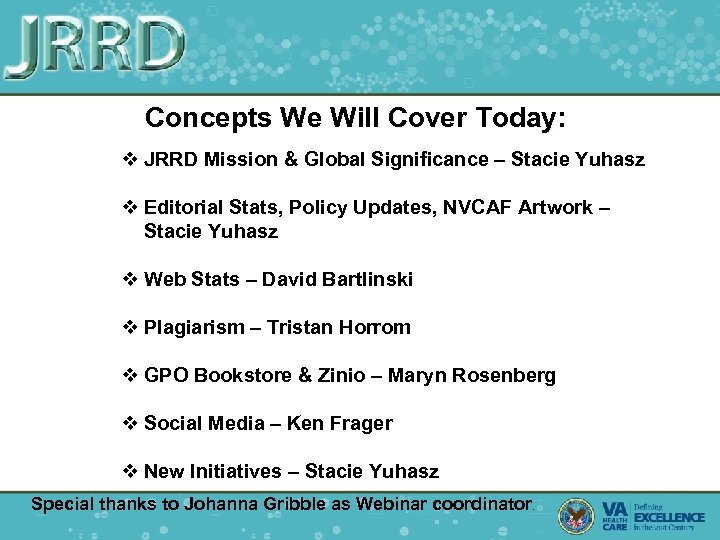
Concepts We Will Cover Today: v JRRD Mission & Global Significance – Stacie Yuhasz v Editorial Stats, Policy Updates, NVCAF Artwork – Stacie Yuhasz v Web Stats – David Bartlinski v Plagiarism – Tristan Horrom v GPO Bookstore & Zinio – Maryn Rosenberg v Social Media – Ken Frager v New Initiatives – Stacie Yuhasz Special thanks to Johanna Gribble as Webinar coordinator.
JRRD Mission & Global Significance – Stacie Yuhasz Researcher. ID/ORCID: B-5428 -2011
JRRD Mission To responsibly evaluate and disseminate scientific research findings impacting the rehabilitative healthcare community. So why does JRRD NEED to be an international publication?
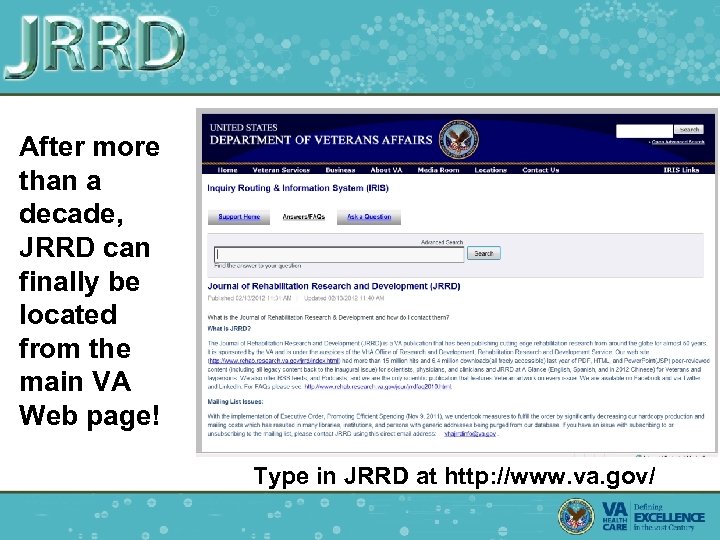
After more than a decade, JRRD can finally be located from the main VA Web page! Type in JRRD at http: //www. va. gov/
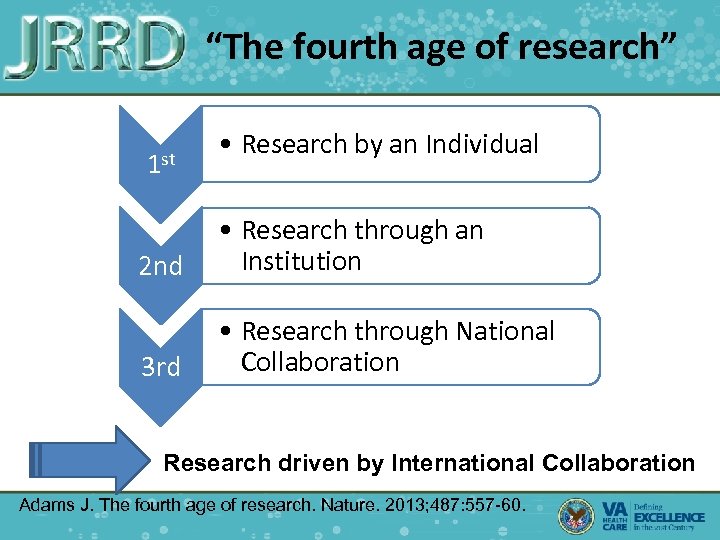
“The fourth age of research” 1 st • Research by an Individual 2 nd • Research through an Institution 3 rd • Research through National Collaboration Research driven by International Collaboration Adams J. The fourth age of research. Nature. 2013; 487: 557 -60.
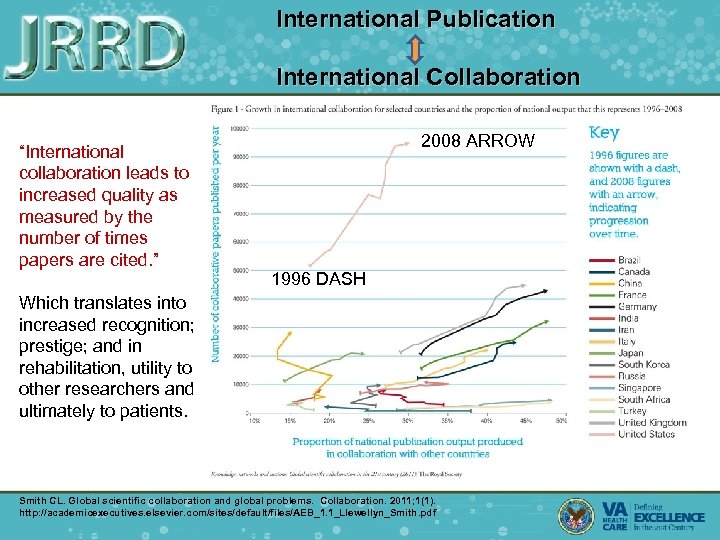
International Publication International Collaboration “International collaboration leads to increased quality as measured by the number of times papers are cited. ” 2008 ARROW 1996 DASH Which translates into increased recognition; prestige; and in rehabilitation, utility to other researchers and ultimately to patients. Smith CL. Global scientific collaboration and global problems. Collaboration. 2011; 1(1). http: //academicexecutives. elsevier. com/sites/default/files/AEB_1. 1_Llewellyn_Smith. pdf
Article Summary Ø Analyzed Web of Science between 1981 and 2012 (3 decades), 25 million papers. Ø Tallied author addresses by country. Ø Calculated the balance of international and domestic research collaboration for the U. S. , U. K. , Germany, France, the Netherlands, and Switzerland. Ø Probed the relative citation impact of purely domestic vs. international research in publications. Adams J. The fourth age of research. Nature. 2013; 487: 557 -60.
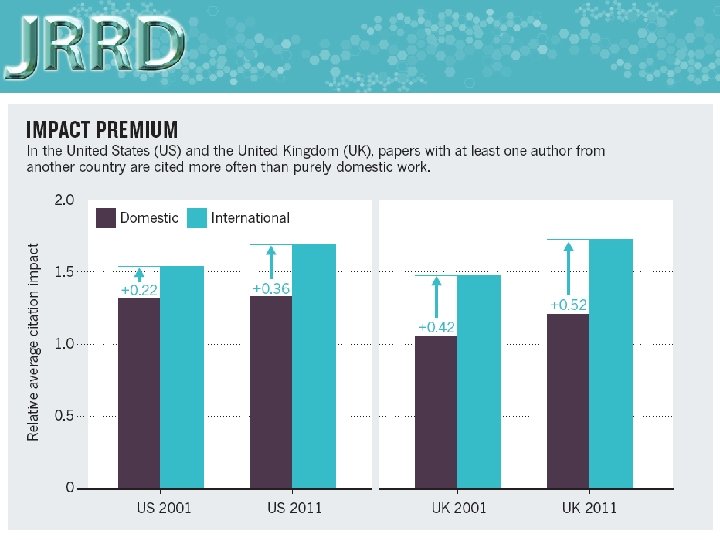
Conclusions Ø Domestic publication output has FLATLINED in the U. S. and Western European countries. Ø The RISE in total annual publication output for each country is due to international collaboration. Ø % of papers entirely “homegrown” is FALLING. Ø In emerging economies, like China (reported last year), domestic output is EXPANDING. Adams J. The fourth age of research. Nature. 2013; 487: 557 -60.
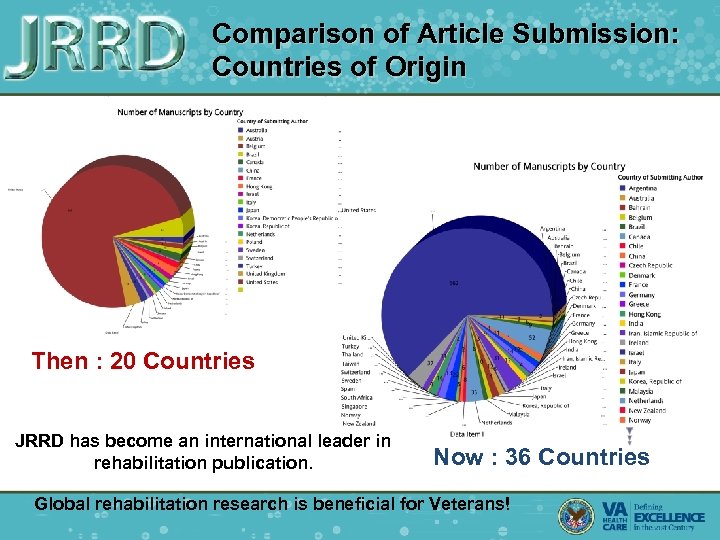
Comparison of Article Submission: Countries of Origin Then : 20 Countries JRRD has become an international leader in rehabilitation publication. Now : 36 Countries Global rehabilitation research is beneficial for Veterans!
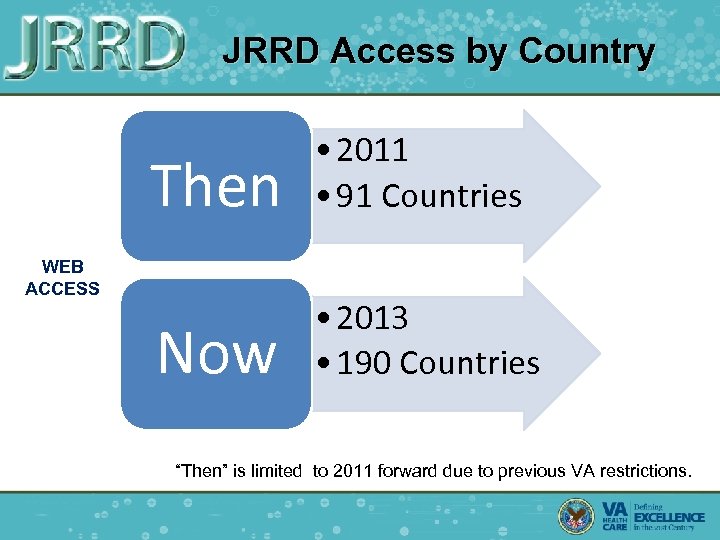
JRRD Access by Country Then • 2011 • 91 Countries Now • 2013 • 190 Countries WEB ACCESS “Then” is limited to 2011 forward due to previous VA restrictions.
Take-Home Message JRRD’s role as an INTERNATIONAL publication is VITAL in rehabilitation research so that the publication truly reflects the most cutting edge research on behalf of Veterans as well as people around the globe. JRRD IS VA MONEY WELL SPENT!
Editorial Stats, Policy, & Veteran Artwork – Stacie Yuhasz Researcher. ID/ORCID: B-5428 -2011
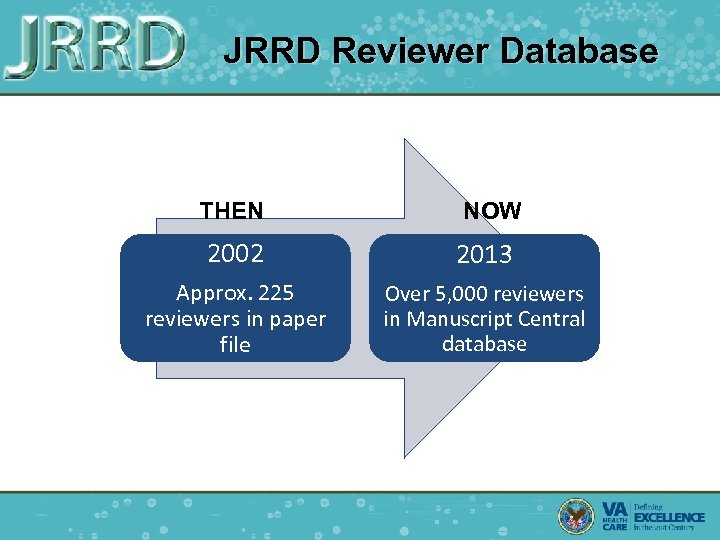
JRRD Reviewer Database THEN NOW 2002 2013 Approx. 225 reviewers in paper file Over 5, 000 reviewers in Manuscript Central database
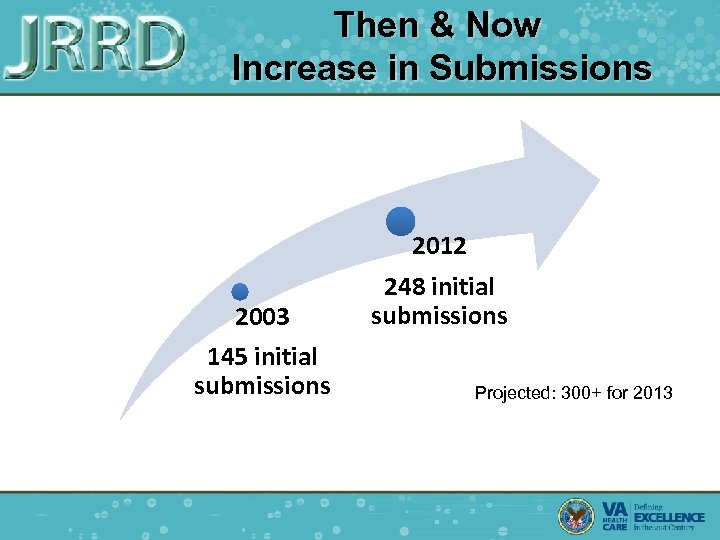
Then & Now Increase in Submissions 2003 145 initial submissions 2012 248 initial submissions Projected: 300+ for 2013
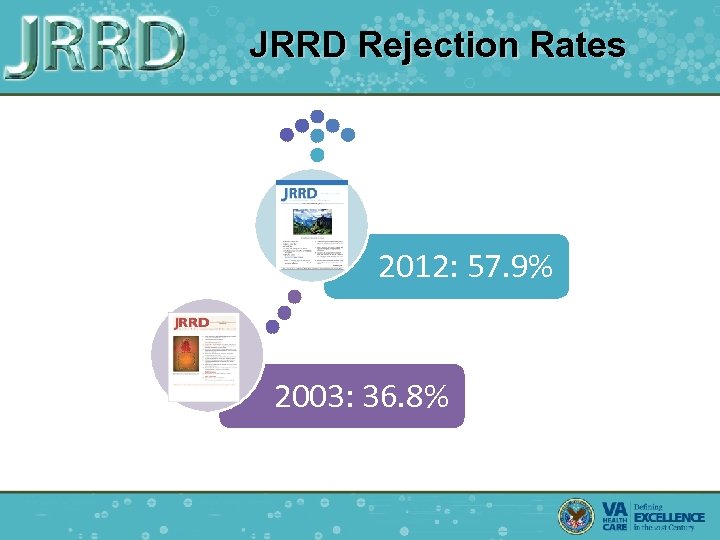
JRRD Rejection Rates 2012: 57. 9% 2003: 36. 8%
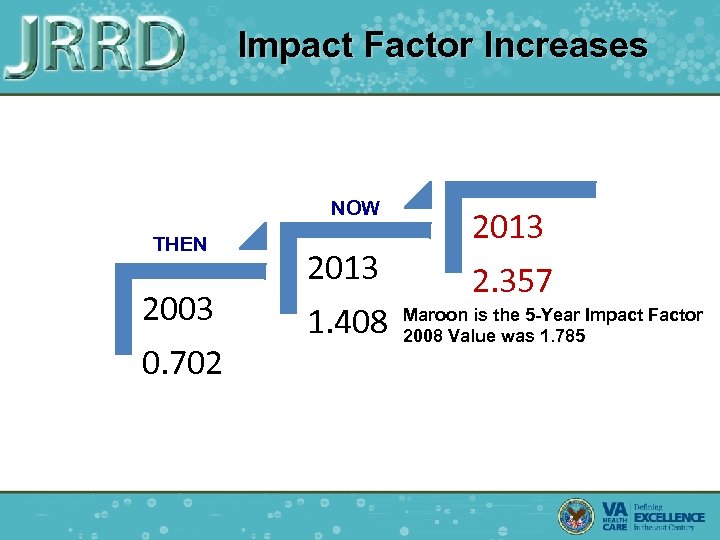
Impact Factor Increases NOW THEN 2003 0. 702 2013 1. 408 2013 2. 357 Maroon is the 5 -Year Impact Factor 2008 Value was 1. 785
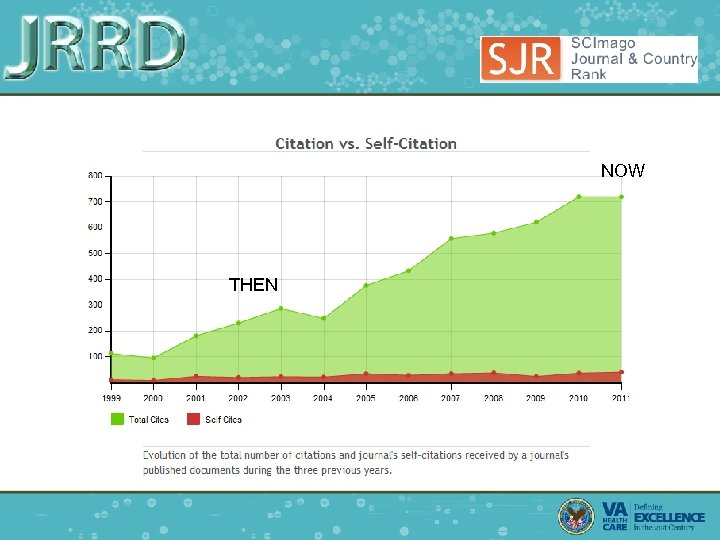
NOW THEN
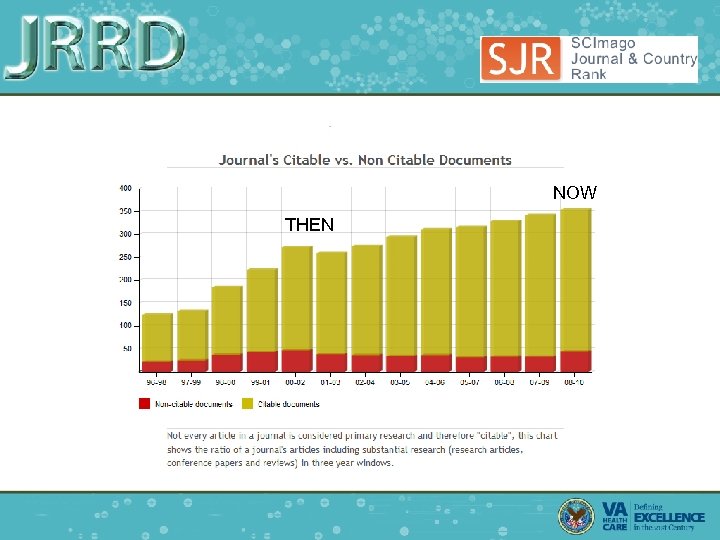
NOW THEN
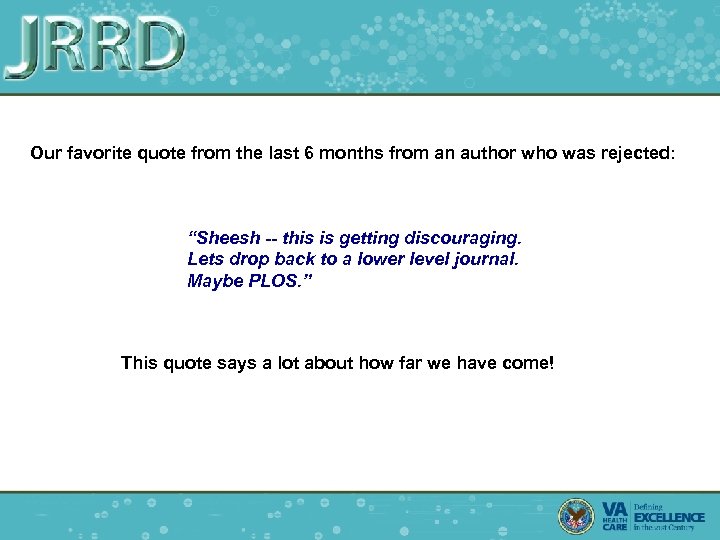
Our favorite quote from the last 6 months from an author who was rejected: “Sheesh -- this is getting discouraging. Lets drop back to a lower level journal. Maybe PLOS. ” This quote says a lot about how far we have come!
2014 NVCAF Veteran Artwork View our FLICKR page of the Veteran artwork for the 2014 covers at: http: //www. flickr. com/photos/jrrdeditor/sets/72157634336240701/ and email your FIVE choices to Kenneth. frager@va. gov by Monday if you have not already done so.

Hover your mouse over the image to get the number or name to create your top 5 list!
“Journals Adapt to U. S. Trade Sanctions on Iran” 30 April 2013 “Under a policy that went into effect in March …. U. S. editors and reviewers must ‘avoid’ handling manuscripts if they include an author employed by the government of Iran. According to the U. S Office of Foreign Assets Control, a division of the Treasury Department, journals can publish articles authored by nongovernmental scientists from Iran and other sanctioned countries. ” Science. 2013 May 10; 340: 664. Mr. Tinker checked all JRRD submissions, either under review or in the postproduction queue, and found NO articles that violated these sanctions. We will continue to monitor papers as we receive them.
Web Development and Analytics – David Bartlinski Researcher. ID/ORCID: H-5612 -2013
Rehabilitation Research & Development Service (www. rehab. research. va. gov) & JRRD (www. rehab. research. va. gov/jrrd) Ø Hosted by Austin Information Technology Center (AITC) Ø All analyzed data is provided by: Web. Trends (hosted and maintained by AITC) Google Analytics
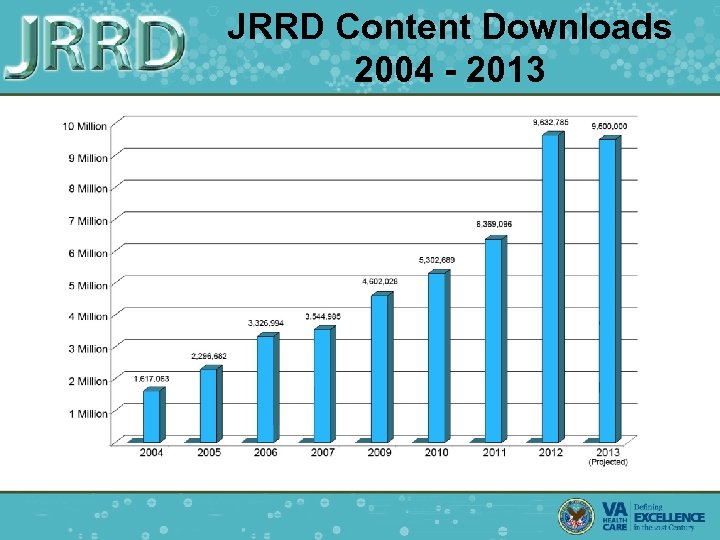
JRRD Content Downloads 2004 - 2013
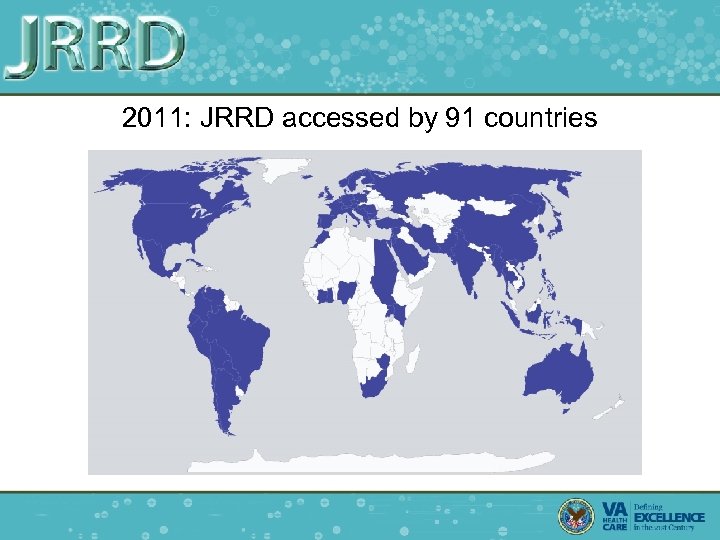
2011: JRRD accessed by 91 countries
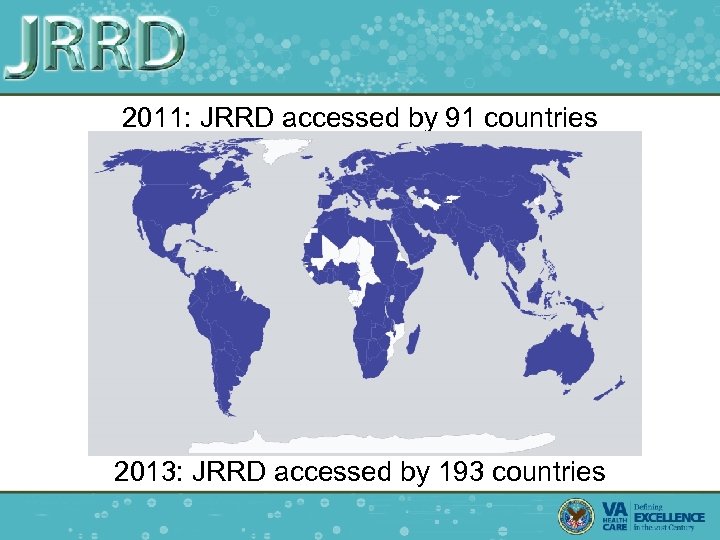
2011: JRRD accessed by 91 countries 2013: JRRD accessed by 193 countries
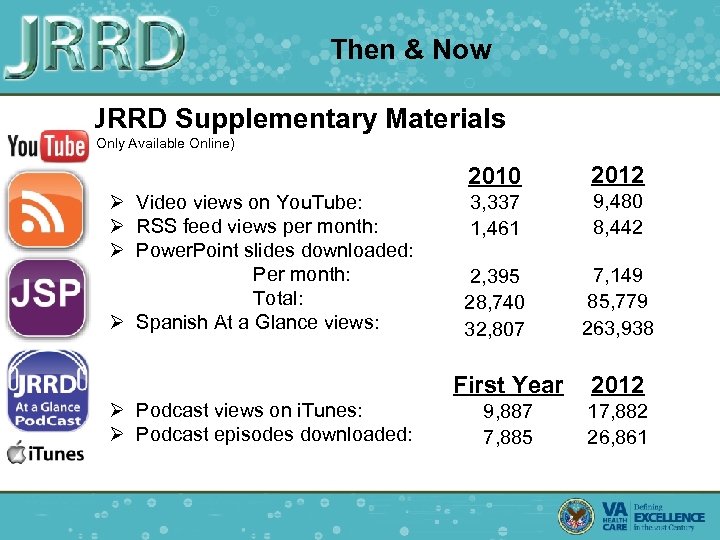
Then & Now JRRD Supplementary Materials (Only Available Online) 2010 Ø Video views on You. Tube: Ø RSS feed views per month: Ø Power. Point slides downloaded: Per month: Total: Ø Spanish At a Glance views: Ø Podcast views on i. Tunes: Ø Podcast episodes downloaded: 2012 3, 337 1, 461 9, 480 8, 442 2, 395 28, 740 32, 807 7, 149 85, 779 263, 938 First Year 2012 9, 887 7, 885 17, 882 26, 861
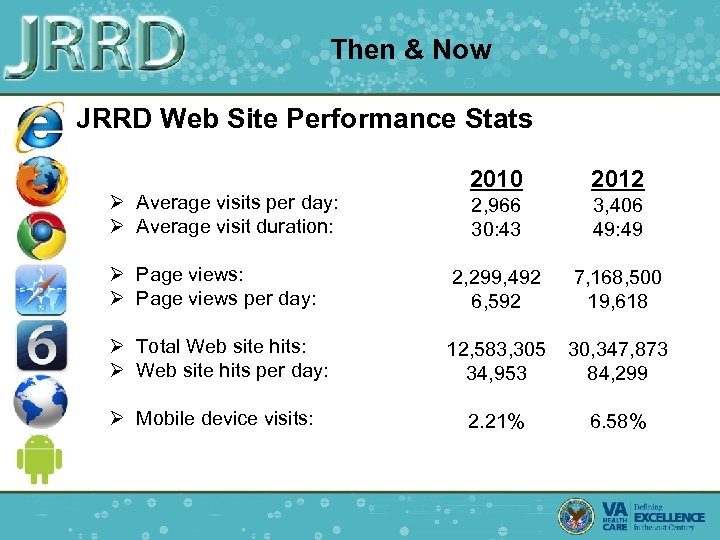
Then & Now JRRD Web Site Performance Stats 2010 2012 2, 966 30: 43 3, 406 49: 49 Ø Page views: Ø Page views per day: 2, 299, 492 6, 592 7, 168, 500 19, 618 Ø Total Web site hits: Ø Web site hits per day: 12, 583, 305 34, 953 30, 347, 873 84, 299 2. 21% 6. 58% Ø Average visits per day: Ø Average visit duration: Ø Mobile device visits:
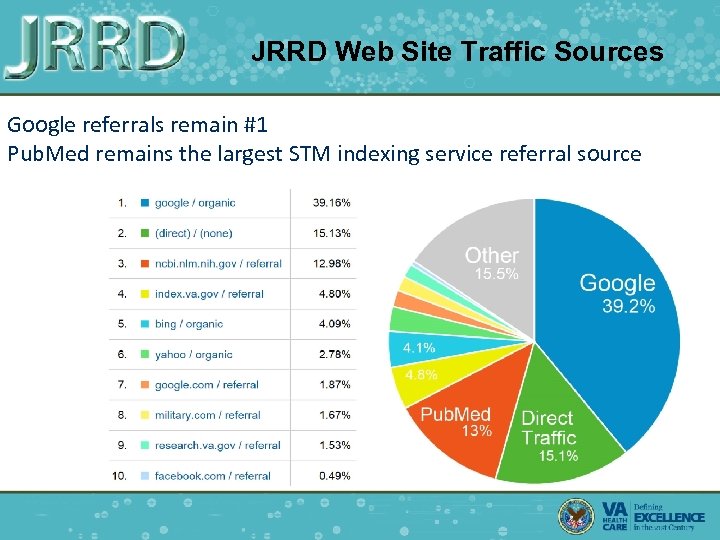
JRRD Web Site Traffic Sources Google referrals remain #1 Pub. Med remains the largest STM indexing service referral source
Going Forward Ø Continue to look for ways to increase Web site traffic. Ø Continue to push and track the worldwide dissemination of JRRD content. Ø Continue to create and repurpose JRRD content for the Web. Ø Continue to enhance the online user experience. Ø Adapt our efforts to what Web site trends and data suggest.

Plagiarism – Tristan Horrom Researcher. ID/ORCID: H-6560 -2013
2013 Plagiarism Policies Ø Every article is run through i. Thenticate during the production process before it is edited. Ø Any paper in which plagiarism is found will be immediately rejected and COPE procedures will be followed. Ø For cases of self-plagiarism, the author is contacted and given four options depending on the nature of the duplication: 1. Paraphrase the text and add a citation to the original. 2. Put matching text in quotes and add a citation to the original. 3. Refer to the original publication without repeating the text. 4. Include a properly cited appendix with the relevant text for online publication. Ø Articles are run through i. Thenticate again after the author has revised.
Plagiarism Numbers: 2012 - 2013 Ø 130 articles checked with i. Thenticate since the last Editorial Board Meeting. Ø 13 articles found to contain some form of self-plagiarism or duplication. Ø 1 article rejected because of “salami-slicing” of research.
For more information on JRRD’s plagiarism policies and what action we take when we find it, please refer to the editorial “The perils of copy and paste: Plagiarism in scientific publishing” published in issue 49(8): http: //www. rehab. research. va. gov/jour/2012/498 /pdf/horrom 498. pdf
GPO Bookstore & Zinio – Maryn Rosenberg Researcher. ID/ORCID: H-5522 -2013
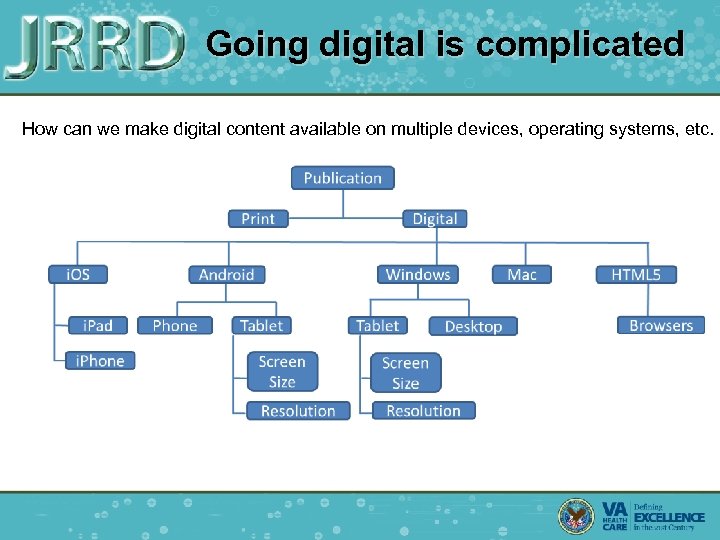
Going digital is complicated How can we make digital content available on multiple devices, operating systems, etc.
GPO partnered with Zinio What is Zinio? The World’s Largest Newsstand Digital magazine Web site and app: Ø Founded 2001, based in San Francisco Ø 5, 500+ brands from 1, 000+ consumer publishers Ø Delivered 169, 000 magazines to date Ø 206 countries, 33 languages Available on almost all devices: Ø PC and Mac for all browsers Ø i. Pad Ø i. Phone Ø Android (4”, 5”, 7”, and 10”) Ø Windows 8 Ø New HTML 5 reader to go live in January September 2011: Zinio honored as “Best Global App” at 2011 IMA Awards February 2013: Zinio named Best i. OS Magazine App Best App Ever Awards at the Mobile World Congress “To see magazines done correctly, look at Zinio”--Huffington Post
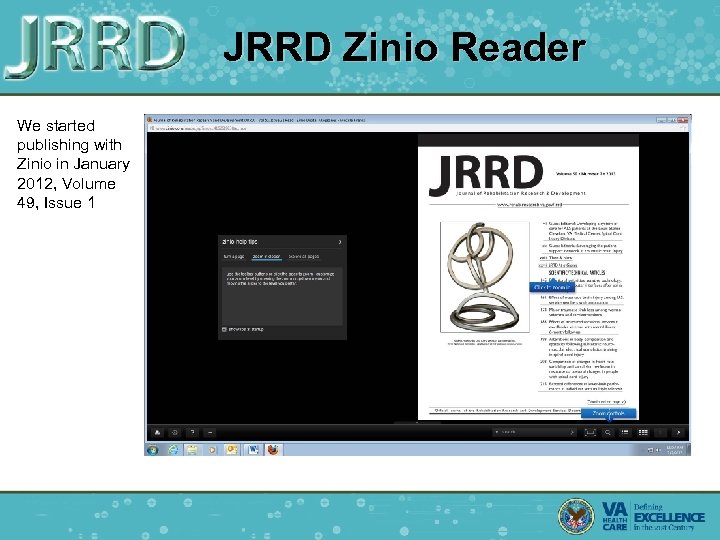
JRRD Zinio Reader We started publishing with Zinio in January 2012, Volume 49, Issue 1
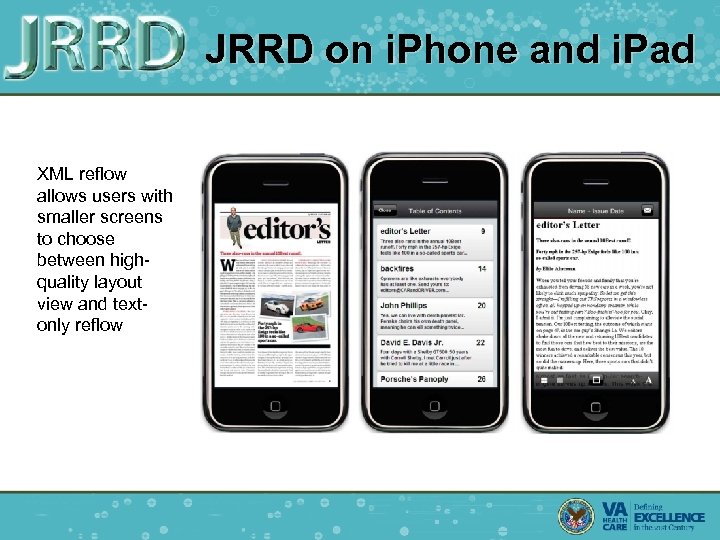
JRRD on i. Phone and i. Pad XML reflow allows users with smaller screens to choose between highquality layout view and textonly reflow
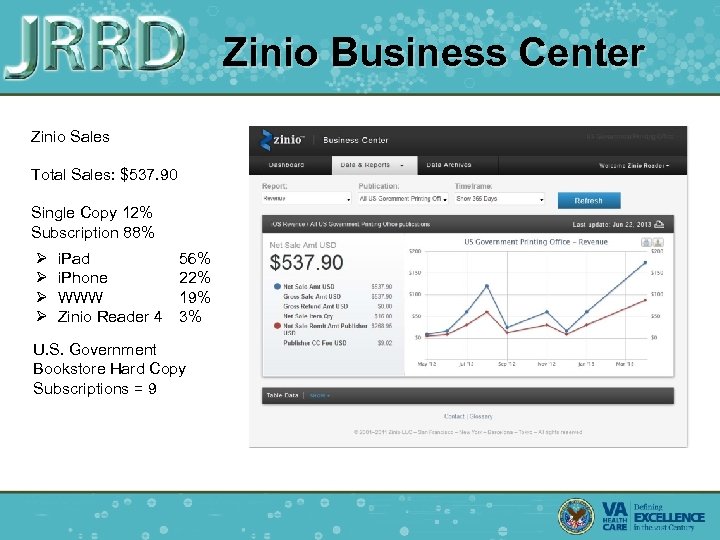
Zinio Business Center Zinio Sales Total Sales: $537. 90 Single Copy 12% Subscription 88% Ø Ø i. Pad i. Phone WWW Zinio Reader 4 56% 22% 19% 3% U. S. Government Bookstore Hard Copy Subscriptions = 9
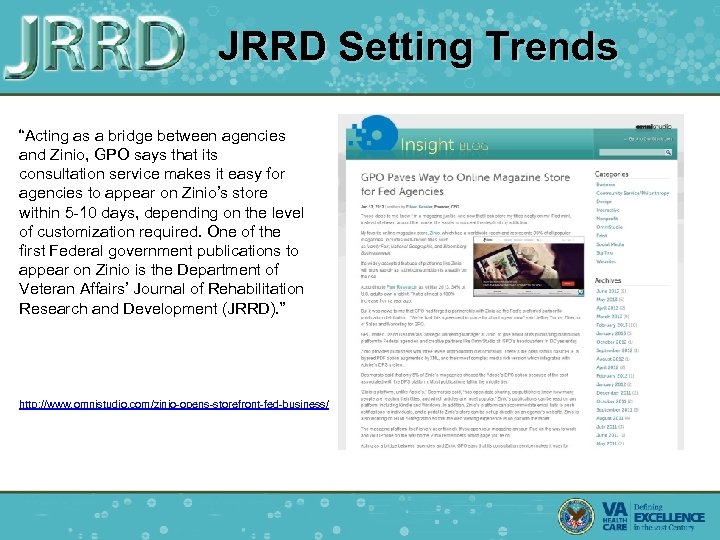
JRRD Setting Trends “Acting as a bridge between agencies and Zinio, GPO says that its consultation service makes it easy for agencies to appear on Zinio’s store within 5 -10 days, depending on the level of customization required. One of the first Federal government publications to appear on Zinio is the Department of Veteran Affairs’ Journal of Rehabilitation Research and Development (JRRD). ” http: //www. omnistudio. com/zinio-opens-storefront-fed-business/
Social Media – Ken Frager Researcher. ID/ORCID: H-5525 -2013
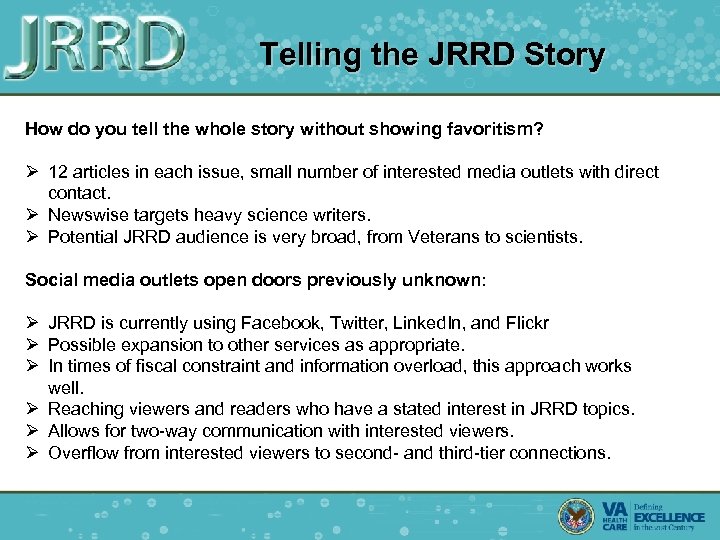
Telling the JRRD Story How do you tell the whole story without showing favoritism? Ø 12 articles in each issue, small number of interested media outlets with direct contact. Ø Newswise targets heavy science writers. Ø Potential JRRD audience is very broad, from Veterans to scientists. Social media outlets open doors previously unknown: Ø JRRD is currently using Facebook, Twitter, Linked. In, and Flickr Ø Possible expansion to other services as appropriate. Ø In times of fiscal constraint and information overload, this approach works well. Ø Reaching viewers and readers who have a stated interest in JRRD topics. Ø Allows for two-way communication with interested viewers. Ø Overflow from interested viewers to second- and third-tier connections.
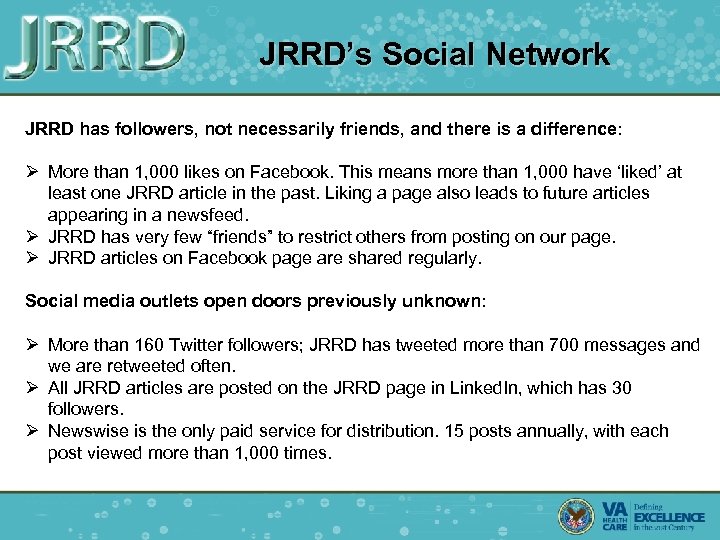
JRRD’s Social Network JRRD has followers, not necessarily friends, and there is a difference: Ø More than 1, 000 likes on Facebook. This means more than 1, 000 have ‘liked’ at least one JRRD article in the past. Liking a page also leads to future articles appearing in a newsfeed. Ø JRRD has very few “friends” to restrict others from posting on our page. Ø JRRD articles on Facebook page are shared regularly. Social media outlets open doors previously unknown: Ø More than 160 Twitter followers; JRRD has tweeted more than 700 messages and we are retweeted often. Ø All JRRD articles are posted on the JRRD page in Linked. In, which has 30 followers. Ø Newswise is the only paid service for distribution. 15 posts annually, with each post viewed more than 1, 000 times.
New Initiatives – Stacie Yuhasz Researcher. ID/ORCID: B-5428 -2011
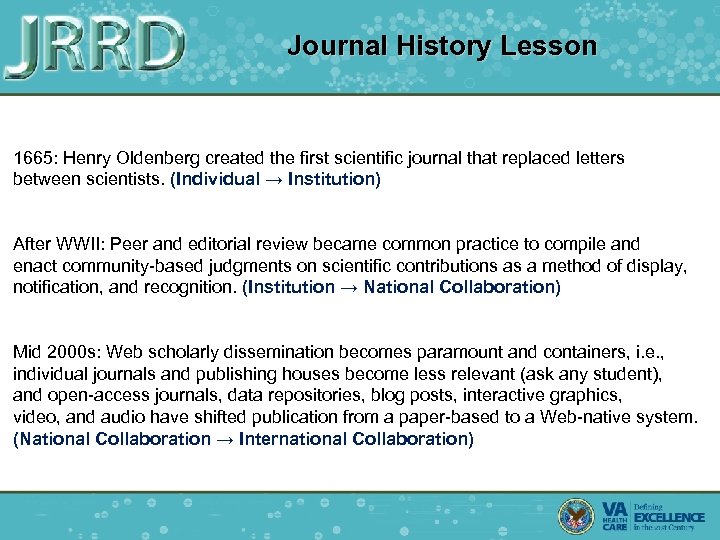
Journal History Lesson 1665: Henry Oldenberg created the first scientific journal that replaced letters between scientists. (Individual → Institution) After WWII: Peer and editorial review became common practice to compile and enact community-based judgments on scientific contributions as a method of display, notification, and recognition. (Institution → National Collaboration) Mid 2000 s: Web scholarly dissemination becomes paramount and containers, i. e. , individual journals and publishing houses become less relevant (ask any student), and open-access journals, data repositories, blog posts, interactive graphics, video, and audio have shifted publication from a paper-based to a Web-native system. (National Collaboration → International Collaboration)
Consequences Metrics for measuring scientific output will change–alternative metrics (views in domain-specific Web enterprises, mentions in social media, citations in open-access journals, recommendations in social media [Linked. In, Faculty of 1000], etc. ) as well as standard citation measures (H-index). Altmetrics will include all products emerging from hypothesis-generated research rather than citation indices alone. Data, once the bailiwick of the individual or collaborative group, will be expected to become part of the public record because in the Web age, “scholarship leaves footprints. ”
Anticipatory Measures to be Adopted by JRRD
JRRD has joined FUNDREF & CHORUS OSTP mandated in Feb 2013 that ALL Federally funded peer-reviewed papers are to be FREELY available within 12 months of publication. JRRD currently in Pub. Med, working to be part of Pub. Med Central. FUNDREF: Indexing papers by federal grant numbers that support the work. In practical terms, works like a DOI and will be part of the JRRD submission upload process, part of the final publication, & reported to CROSSREF. CHORUS: Clearinghouse for the Open Research of the United States. In practical terms, builds on the DOI, FUNDREF, and ORCID/Researcher. ID and utilizes the existing databases by providing a public-private partnership to fulfill the OSTP mandate.
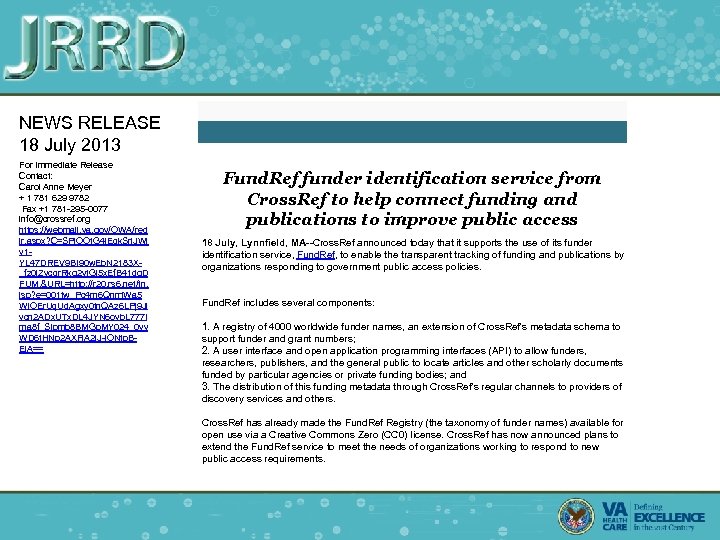
NEWS RELEASE 18 July 2013 For Immediate Release Contact: Carol Anne Meyer + 1 781 629 9782 Fax +1 781 -295 -0077 info@crossref. org https: //webmail. va. gov/OWA/red ir. aspx? C=SPl. OOt. G 4 l. Eqk. Srl. JWl v 1 YL 47 DREV 9 BI 90 w. Eb. N 2183 X_fz 0 i. Zycqr. Rkg 2 vt. Gi 5 x. Ef. B 41 dg. D FUM. &URL=http: //r 20. rs 6. net/tn. jsp? e=001 tw_Pc 4 m 6 Qnrrt. Wa 5 Wl. OEr. Uq. Ud. Agxy 0 tn. QAz 6 LPj 9 Ji vcn 2 ADx. UTx. DL 4 JYN 6 ovb. L 777 I ma 8 f_SIpmb 8 BMGp. MY 024_0 yy WD 6 t. HNp 2 AXFl. A 2 i. J-i. ONtp. BEj. A== Fund. Ref funder identification service from Cross. Ref to help connect funding and publications to improve public access 18 July, Lynnfield, MA--Cross. Ref announced today that it supports the use of its funder identification service, Fund. Ref, to enable the transparent tracking of funding and publications by organizations responding to government public access policies. Fund. Ref includes several components: 1. A registry of 4000 worldwide funder names, an extension of Cross. Ref's metadata schema to support funder and grant numbers; 2. A user interface and open application programming interfaces (API) to allow funders, researchers, publishers, and the general public to locate articles and other scholarly documents funded by particular agencies or private funding bodies; and 3. The distribution of this funding metadata through Cross. Ref's regular channels to providers of discovery services and others. Cross. Ref has already made the Fund. Ref Registry (the taxonomy of funder names) available for open use via a Creative Commons Zero (CC 0) license. Cross. Ref has now announced plans to extend the Fund. Ref service to meet the needs of organizations working to respond to new public access requirements.
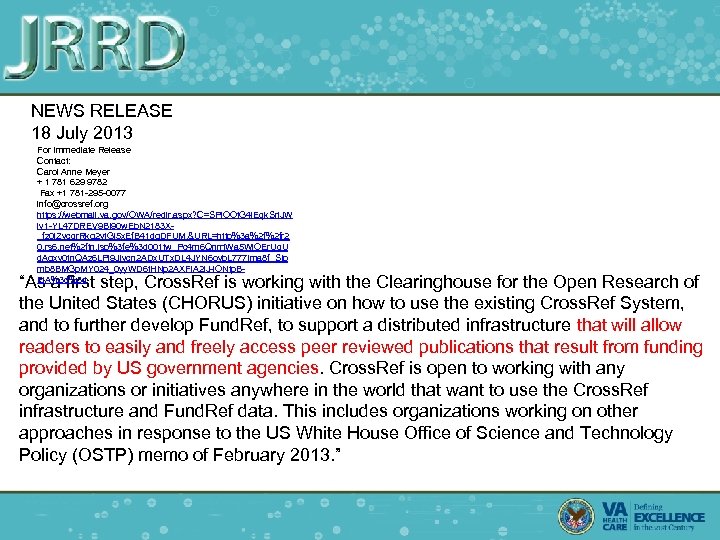
NEWS RELEASE 18 July 2013 For Immediate Release Contact: Carol Anne Meyer + 1 781 629 9782 Fax +1 781 -295 -0077 info@crossref. org https: //webmail. va. gov/OWA/redir. aspx? C=SPl. OOt. G 4 l. Eqk. Srl. JW lv 1 -YL 47 DREV 9 BI 90 w. Eb. N 2183 X_fz 0 i. Zycqr. Rkg 2 vt. Gi 5 x. Ef. B 41 dg. DFUM. &URL=http%3 a%2 f%2 fr 2 0. rs 6. net%2 ftn. jsp%3 fe%3 d 001 tw_Pc 4 m 6 Qnrrt. Wa 5 Wl. OEr. Uq. U d. Agxy 0 tn. QAz 6 LPj 9 Jivcn 2 ADx. UTx. DL 4 JYN 6 ovb. L 777 Ima 8 f_SIp mb 8 BMGp. MY 024_0 yy. WD 6 t. HNp 2 AXFl. A 2 i. J-i. ONtp. BEj. A%3 d%3 d “As a first step, Cross. Ref is working with the Clearinghouse for the Open Research of the United States (CHORUS) initiative on how to use the existing Cross. Ref System, and to further develop Fund. Ref, to support a distributed infrastructure that will allow readers to easily and freely access peer reviewed publications that result from funding provided by US government agencies. Cross. Ref is open to working with any organizations or initiatives anywhere in the world that want to use the Cross. Ref infrastructure and Fund. Ref data. This includes organizations working on other approaches in response to the US White House Office of Science and Technology Policy (OSTP) memo of February 2013. ”
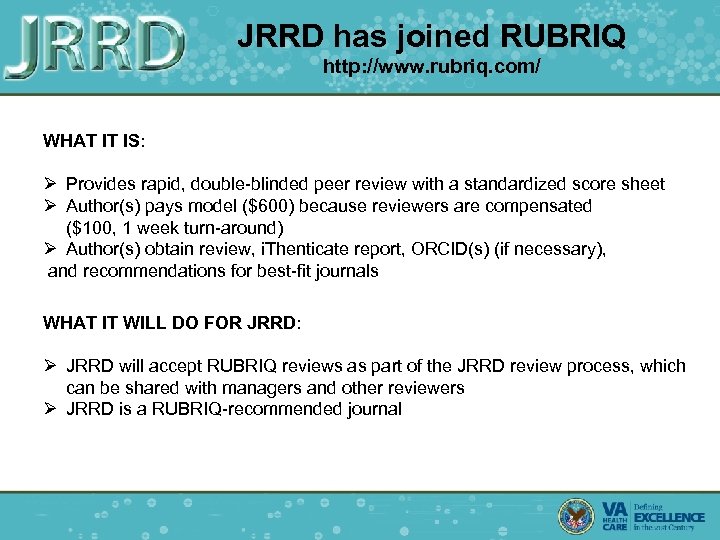
JRRD has joined RUBRIQ http: //www. rubriq. com/ WHAT IT IS: Ø Provides rapid, double-blinded peer review with a standardized score sheet Ø Author(s) pays model ($600) because reviewers are compensated ($100, 1 week turn-around) Ø Author(s) obtain review, i. Thenticate report, ORCID(s) (if necessary), and recommendations for best-fit journals WHAT IT WILL DO FOR JRRD: Ø JRRD will accept RUBRIQ reviews as part of the JRRD review process, which can be shared with managers and other reviewers Ø JRRD is a RUBRIQ-recommended journal
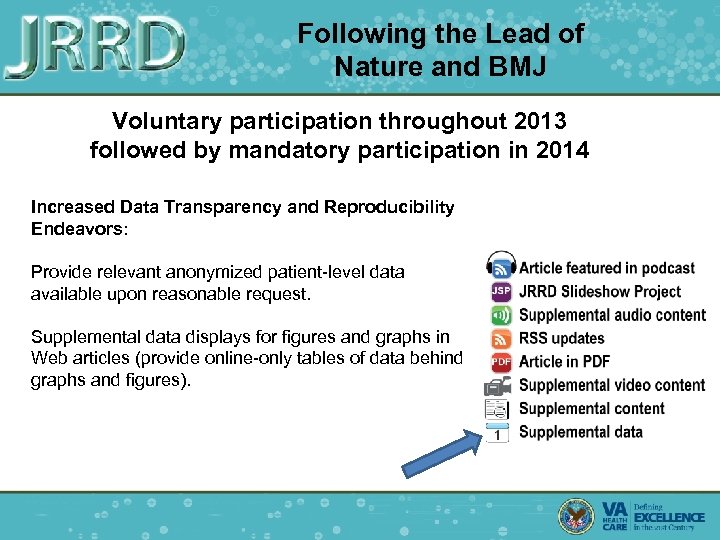
Following the Lead of Nature and BMJ Voluntary participation throughout 2013 followed by mandatory participation in 2014 Increased Data Transparency and Reproducibility Endeavors: Provide relevant anonymized patient-level data available upon reasonable request. Supplemental data displays for figures and graphs in Web articles (provide online-only tables of data behind graphs and figures).
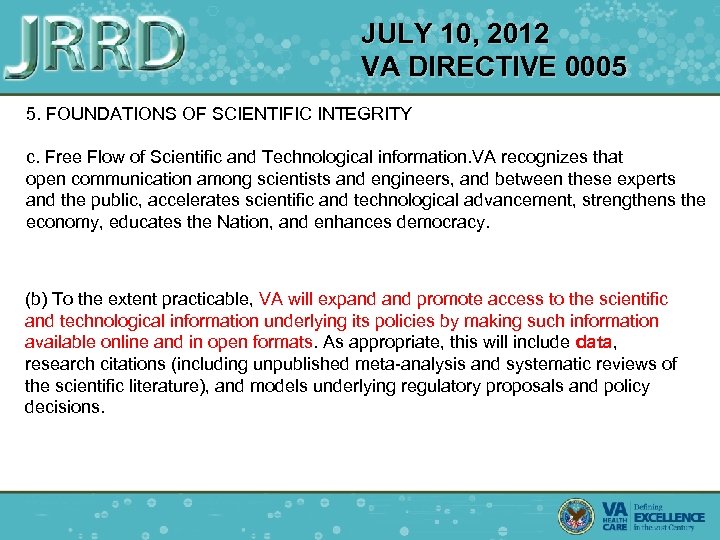
JULY 10, 2012 VA DIRECTIVE 0005 5. FOUNDATIONS OF SCIENTIFIC INTEGRITY c. Free Flow of Scientific and Technological information. VA recognizes that open communication among scientists and engineers, and between these experts and the public, accelerates scientific and technological advancement, strengthens the economy, educates the Nation, and enhances democracy. (b) To the extent practicable, VA will expand promote access to the scientific and technological information underlying its policies by making such information available online and in open formats. As appropriate, this will include data, research citations (including unpublished meta-analysis and systematic reviews of the scientific literature), and models underlying regulatory proposals and policy decisions.
Researcher. ID/ORCID (Open Researcher & Contributor Identifier) have merged and JRRD has adopted the linkage starting in 2013. Using this identifier, researchers can: Ø Ø Manage their publication profile Manage their product profile (like this PP) Track citations Identify potential collaborators from around the globe
JRRD Editorial Policies THEN: No Policy NOW: Evolving Policy Currently reflects these 2013 additions: Ø COPE Ethical Guidelines for Peer Reviewers & COPE Code of Conduct and Best Practice Guidelines for Journal Editors http: //publicationethics. org/resources/guidelines Ø VA Scientific-Integrity-Policy 2012: VA DIRECTIVE 0005 http: //www. rehab. research. va. gov/jour/VA_Scientific-Integrity-Policy_2012. pdf Next round of revision will add: Ø Ø Ø Supplemental data descriptions and submission details Process for requesting and providing anonymized patient-level data FUNDREF requirements and submission details RUBRIQ information CHORUS information
Basic Principles to Which Peer Reviewers Should Adhere ØOnly agree to review manuscripts for which they have the subject expertise required to carry out a proper assessment and which they can assess in a timely manner. ØRespect the confidentiality of peer review and not reveal any details of a manuscript or its review, during or after the peer-review process, beyond those that are released by the journal. ØNot use information obtained during the peer-review process for their own or any other person’s or organization’s advantage, or to disadvantage or discredit others. ØDeclare all potential conflicting interests, seeking advice from the journal if they are unsure whether something constitutes a relevant interest. ØNot allow their reviews to be influenced by the origins of a manuscript, by the nationality, religious or political beliefs, gender or other characteristics of the authors, or by commercial considerations. ØBe objective and constructive in their reviews, refraining from being hostile or inflammatory and from making libelous or derogatory personal comments. ØAcknowledge that peer review is largely a reciprocal endeavor and undertake to carry out their fair share of reviewing and in a timely manner. ØProvide journals with personal and professional information that is accurate and a true representation of their expertise. ØRecognize that impersonation of another individual during the review process is considered serious misconduct. http: //publicationethics. org/files/Ethical_guidelines_for_peer_reviewers_0. pdf
Code of Conduct and Best Practice Guidelines for Journal Editors should be accountable for everything published in their journals. General duties and responsibilities of editors: Ø Strive to meet the needs of readers and authors. Ø Strive to constantly improve their journal. Ø Have processes in place to assure the quality of the material they publish. Ø Champion freedom of expression. Ø Maintain the integrity of the academic record. Ø Preclude business needs from compromising intellectual and ethical standards. Ø Always be willing to publish corrections, clarifications, retractions, and apologies when needed. http: //publicationethics. org/files/Code_of_conduct_for_journal_editors_0. pdf
First Part of Interest VA DIRECTIVE 0005 JULY 10, 2012 VA DIRECTIVE 0005 5. Foundations of Scientific Integrity c. Free Flow of Scientific and Technological information. VA recognizes that open communication among scientists and engineers, and between these experts and the public, accelerates scientific and technological advancement, strengthens the economy, educates the Nation, and enhances democracy. (1) Dissemination and acquisition of information is a critical element of VA research in that it maximally promotes advances in health care for Veterans and the general public. (2) Consistent with applicable privacy and classification standards, it is VA policy to promote the appropriate free flow and exchange of scientific and technological information in the scientific and medical communities as well as awareness of VA research among broader audiences. (3) VA investigators are encouraged to report their work at professional meetings and in scientific, technical, and medical publications, and to participate in the activities of their professional organizations, in compliance with applicable conflict of interest laws and the Standards of Conduct for Employees. (d) Publication of the Journal of Rehabilitation Research and Development, which covers an area of research of particular interest to Veterans and key Veteran organizations. (5 (6) It is VA policy to continuously strengthen its academic affiliation program, which now constitutes the most comprehensive academic health system partnership in history, to foster the appropriate free flow of medical, scientific, and technological information. http: //www. rehab. research. va. gov/jour/VA_Scientific-Integrity-Policy_2012. pdf
Second Part of Interest VA DIRECTIVE 0005 JULY 10, 2012 8. PROFESSIONAL DEVELOPMENT OF VA SCIENCE/TECHNOLOGY EXPERTS a. Promotion of Professional Development. VA actively promotes and facilitates the professional development of its employees consistent with their job responsibilities, applicable ethics requirements, and policies regarding political appointees. To this end, VA: (1) Encourages the publication of VA scientific and technological findings in peer reviewed, professional, or scholarly journals. (2) Encourages the presentation of VA scientific and technological findings at professional meetings. (3) Encourages VA employees to become editors or editorial board members of professional or scholarly journals. http: //www. rehab. research. va. gov/jour/VA_Scientific-Integrity-Policy_2012. pdf
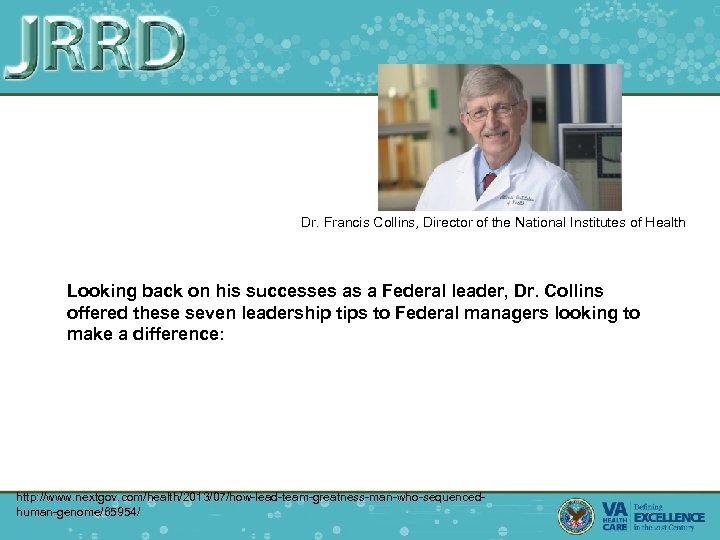
Dr. Francis Collins, Director of the National Institutes of Health Looking back on his successes as a Federal leader, Dr. Collins offered these seven leadership tips to Federal managers looking to make a difference: http: //www. nextgov. com/health/2013/07/how-lead-team-greatness-man-who-sequencedhuman-genome/65954/
The Keys to JRRD Success 1. Have the right team. “I’ve always lived by two maxims when it comes to management, ” said Collins. “One is to try and surround yourself with people who are smarter than you. . . The other is to always value people who will give you bad news and tell you when something is going wrong. ” 2. Allow people to grow and they’ll surprise you. “Give [your team] the opportunity to show what they can do, ” he said. “Don’t be a micromanager. ” 3. Encourage risk taking. “Create an environment where risk taking is acceptable, in fact, is encouraged, ” said Collins. “An environment where it is appropriate for people to think beyond next week and think about visions for the future. ” 4. Connect everyone to the mission. “Ideally, get a job for a part of the government that has a noble mission” he advises. “That really helps when all the other things seem to be going the wrong way. You can wake up in the morning and say, ‘I know what I’m doing today really matters. ’” “That will motivate people to get beyond lots of obstacles. ” 5. Pursue a calling, not just a job. Public servants should “serve in a fashion that is a calling and not just a job, ” said Collins. “If you’ve lost that sense, waking up someday and saying, ‘You know, I could be doing something else [and] where I am right now isn’t really a mission, it’s more of a clock punching experience, ’ then move on. ” 6. Be realistic about government service. “Certainly, [public service] is not a way to get rich—we all know that!” Collins laughed. “Being in government is going to have a lot of aspects that are simply just not fun. It can be frustrating. You can look around and see lots of other people having an easier time. ” 7. Never forget you have the opportunity to change the world. “The things you can do in the government can change the world if you know how the system can be organized to work on behalf of the public, ” said Collins. “[The potential] is unmatched anywhere. ”
Thank you to the JRRD Board Finally, JRRD could not do all it does without the overwhelming help and support from all of the Board members and JRRD reviewers. Thank you for your untiring assistance. And sincere thanks to the ORD RR&D Service for unwavering support.
Summary Ø JRRD continues to improve in content, quality, delivery, and outreach Ø JRRD has begun the transition to a fee-based publication Ø JRRD stays current on regulations and publishing trends Ø JRRD continues to experiment with alternate modalities for dissemination Ø JRRD continually strives to be frugal and resourceful with VA dollars
Скачать презентацию JRRD Editorial Board Meeting Webinar 103 South Gay
8d331e5e61b15b65b4a8d03a4ff64d5f.ppt