 Скачать презентацию JPF Tutorial Part 2 Symbolic Path Finder
7583238a21db4e62ec5aaa72e0817b72.ppt
- Количество слайдов: 29



JPF Tutorial – Part 2 Symbolic Path. Finder – Symbolic Execution of Java Byte-code Corina Pãsãreanu Carnegie Mellon University/NASA Ames Research

Symbolic Path. Finder (SPF) • Combines symbolic execution with model checking and constraint solving to perform symbolic execution • Used mainly for automated test-case generation • Applies to executable models (e. g. Stateflow, UML state-machines) and to code • Generates an optimized test suite that exercise all the behavior of the system under test • Reports coverage (e. g. MC/DC) • During test generation process, checks for errors • Uses JPF’s search engine • Applications: – NASA (JSC’s Onboard Abort Executive, Pad. Abort-1, Ames K 9 Rover Executive, Aero, Tac. Sat -- SCL script generation, testing of fault tolerant systems) – Fujitsu (testing of web applications, 60 000 LOC) – Academia (MIT, U. Minnesota, U. Nebraska, UT Austin, Politecnico di Milano, etc. )
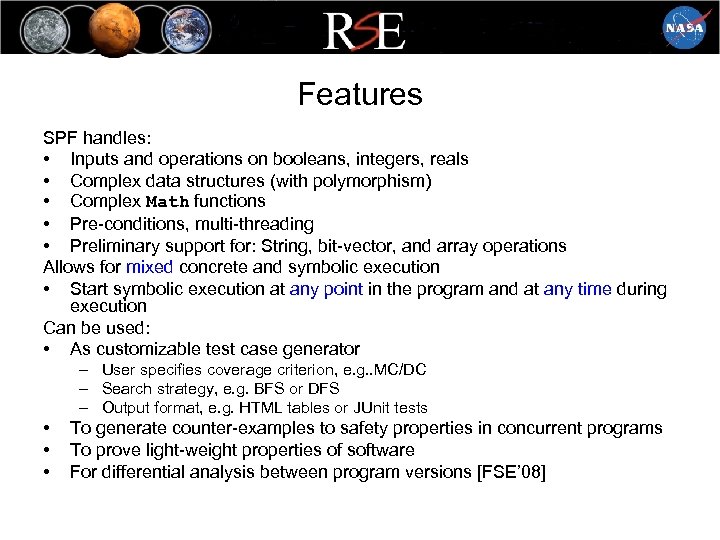
Features SPF handles: • Inputs and operations on booleans, integers, reals • Complex data structures (with polymorphism) • Complex Math functions • Pre-conditions, multi-threading • Preliminary support for: String, bit-vector, and array operations Allows for mixed concrete and symbolic execution • Start symbolic execution at any point in the program and at any time during execution Can be used: • As customizable test case generator – User specifies coverage criterion, e. g. . MC/DC – Search strategy, e. g. BFS or DFS – Output format, e. g. HTML tables or JUnit tests • • • To generate counter-examples to safety properties in concurrent programs To prove light-weight properties of software For differential analysis between program versions [FSE’ 08]
![Symbolic Execution • King [Comm. ACM 1976], Clarke [IEEE TSE 1976] • Analysis of](https://present5.com/presentation/7583238a21db4e62ec5aaa72e0817b72/image-4.jpg "Symbolic Execution • King [Comm. ACM 1976], Clarke [IEEE TSE 1976] • Analysis of")
Symbolic Execution • King [Comm. ACM 1976], Clarke [IEEE TSE 1976] • Analysis of programs with unspecified inputs – Execute a program on symbolic inputs • Symbolic states represent sets of concrete states • For each path, build a path condition – Condition on inputs – for the execution to follow that path – Check path condition satisfiability – explore only feasible paths • Symbolic state – Symbolic values/expressions for variables – Path condition – Program counter
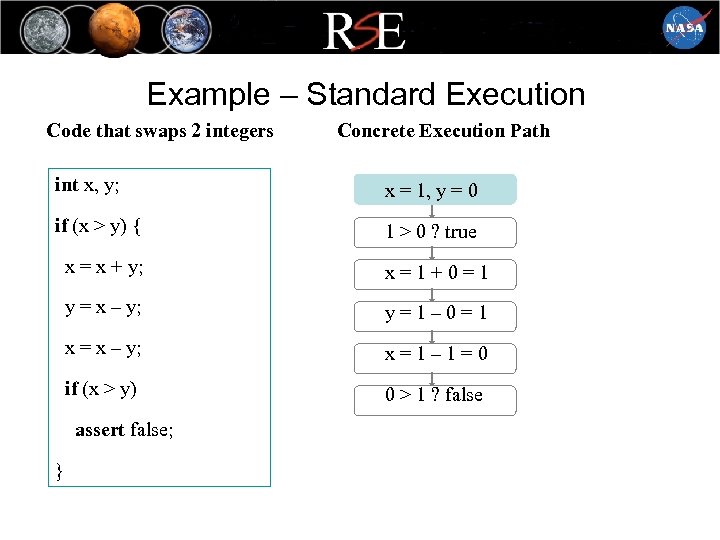
Example – Standard Execution Code that swaps 2 integers Concrete Execution Path int x, y; x = 1, y = 0 if (x > y) { 1 > 0 ? true x = x + y; x=1+0=1 y = x – y; y=1– 0=1 x = x – y; x=1– 1=0 if (x > y) 0 > 1 ? false assert false; }
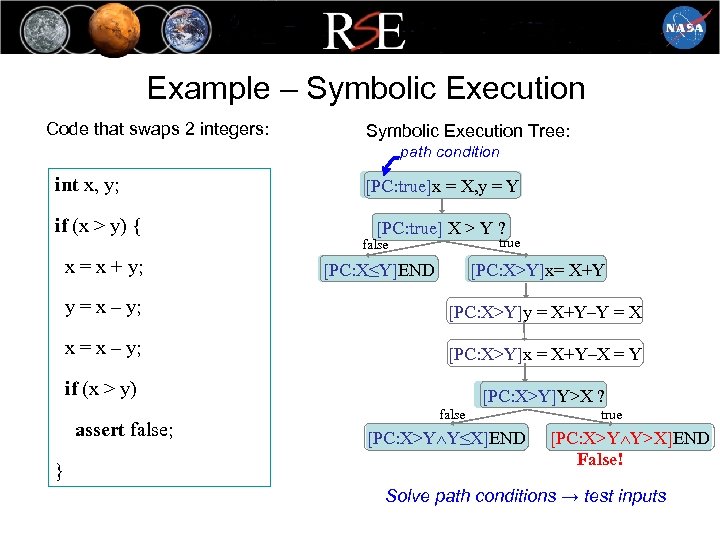
Example – Symbolic Execution Code that swaps 2 integers: Symbolic Execution Tree: path condition int x, y; if (x > y) { [PC: true]x = X, y = Y [PC: true] X > Y ? true false x = x + y; [PC: X≤Y]END [PC: X>Y]x= X+Y y = x – y; [PC: X>Y]y = X+Y–Y = X x = x – y; [PC: X>Y]x = X+Y–X = Y if (x > y) [PC: X>Y]Y>X ? assert false; } false [PC: X>Y Y≤X]END true [PC: X>Y Y>X]END False! Solve path conditions → test inputs

Symbolic Path. Finder • JPF-core’s search engine used – To generate and explore the symbolic execution tree – To also analyze thread inter-leavings and other forms of non-determinism that might be present in the code • • No state matching performed – some abstract state matching The symbolic search space may be infinite due to loops, recursion – We put a limit on the search depth • Off-the-shelf decision procedures/constraint solvers used to check path conditions – Search backtracks if path condition becomes infeasible • Generic interface for multiple decision procedures – Choco (for linear/non-linear integer/real constraints, mixed constraints), http: //sourceforge. net/projects/choco/ – IASolver (for interval arithmetic) http: //www. cs. brandeis. edu/~tim/Applets/IAsolver. html – CVC 3 http: //www. cs. nyu. edu/acsys/cvc 3/ – Other constraint solvers: HAMPI, randomized solvers for complex Math constraints – work in progress
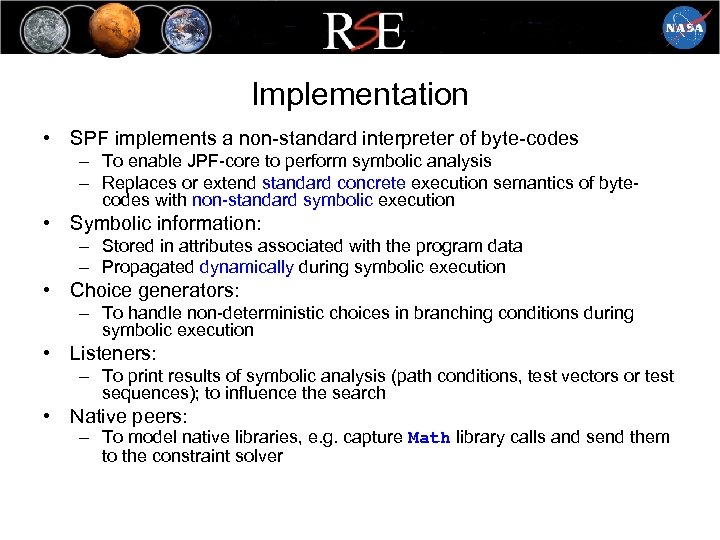
Implementation • SPF implements a non-standard interpreter of byte-codes – To enable JPF-core to perform symbolic analysis – Replaces or extend standard concrete execution semantics of bytecodes with non-standard symbolic execution • Symbolic information: – Stored in attributes associated with the program data – Propagated dynamically during symbolic execution • Choice generators: – To handle non-deterministic choices in branching conditions during symbolic execution • Listeners: – To print results of symbolic analysis (path conditions, test vectors or test sequences); to influence the search • Native peers: – To model native libraries, e. g. capture Math library calls and send them to the constraint solver
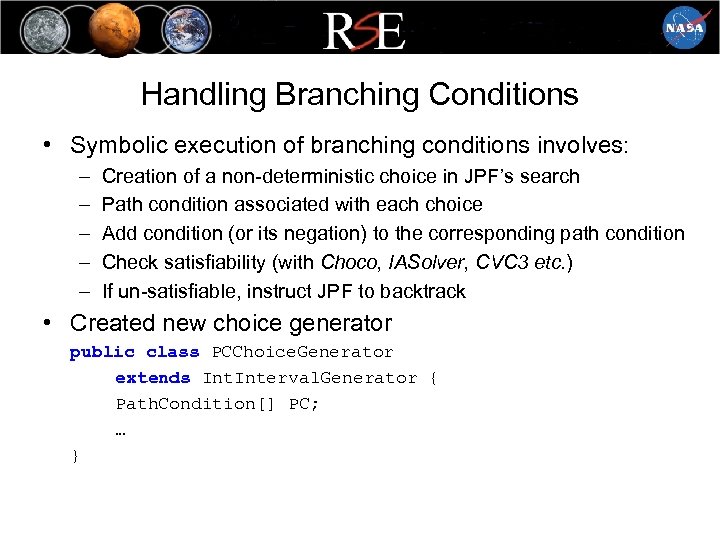
Handling Branching Conditions • Symbolic execution of branching conditions involves: – – – Creation of a non-deterministic choice in JPF’s search Path condition associated with each choice Add condition (or its negation) to the corresponding path condition Check satisfiability (with Choco, IASolver, CVC 3 etc. ) If un-satisfiable, instruct JPF to backtrack • Created new choice generator public class PCChoice. Generator extends Interval. Generator { Path. Condition[] PC; … }
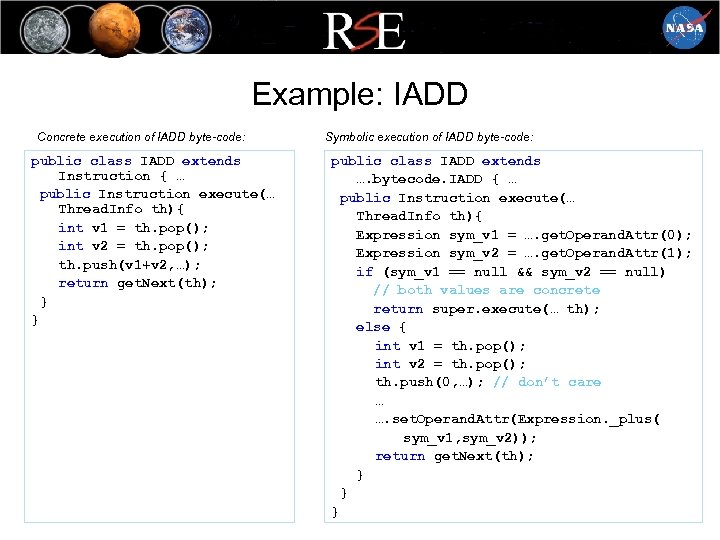
Example: IADD Concrete execution of IADD byte-code: public class IADD extends Instruction { … public Instruction execute(… Thread. Info th){ int v 1 = th. pop(); int v 2 = th. pop(); th. push(v 1+v 2, …); return get. Next(th); } } Symbolic execution of IADD byte-code: public class IADD extends …. bytecode. IADD { … public Instruction execute(… Thread. Info th){ Expression sym_v 1 = …. get. Operand. Attr(0); Expression sym_v 2 = …. get. Operand. Attr(1); if (sym_v 1 == null && sym_v 2 == null) // both values are concrete return super. execute(… th); else { int v 1 = th. pop(); int v 2 = th. pop(); th. push(0, …); // don’t care … …. set. Operand. Attr(Expression. _plus( sym_v 1, sym_v 2)); return get. Next(th); } } }
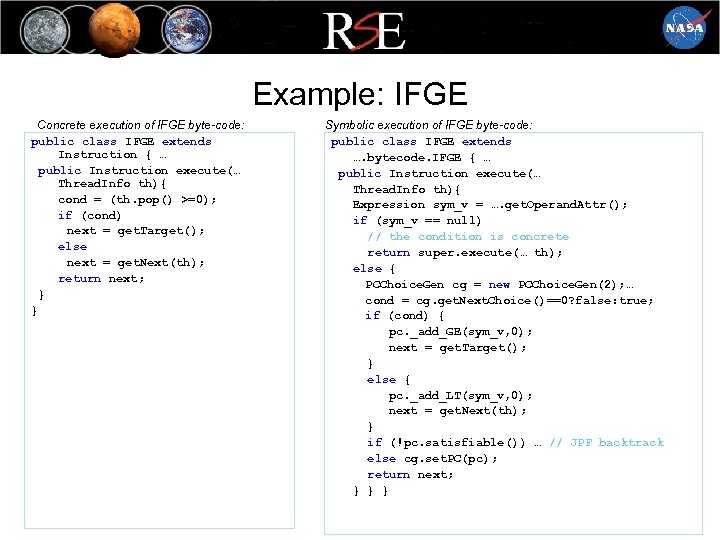
Example: IFGE Concrete execution of IFGE byte-code: public class IFGE extends Instruction { … public Instruction execute(… Thread. Info th){ cond = (th. pop() >=0); if (cond) next = get. Target(); else next = get. Next(th); return next; } } Symbolic execution of IFGE byte-code: public class IFGE extends …. bytecode. IFGE { … public Instruction execute(… Thread. Info th){ Expression sym_v = …. get. Operand. Attr(); if (sym_v == null) // the condition is concrete return super. execute(… th); else { PCChoice. Gen cg = new PCChoice. Gen(2); … cond = cg. get. Next. Choice()==0? false: true; if (cond) { pc. _add_GE(sym_v, 0); next = get. Target(); } else { pc. _add_LT(sym_v, 0); next = get. Next(th); } if (!pc. satisfiable()) … // JPF backtrack else cg. set. PC(pc); return next; } } }
![Handling Input Data Structures • Lazy initialization for recursive data structures [TACAS’ 03] and](https://present5.com/presentation/7583238a21db4e62ec5aaa72e0817b72/image-12.jpg "Handling Input Data Structures • Lazy initialization for recursive data structures [TACAS’ 03] and")
Handling Input Data Structures • Lazy initialization for recursive data structures [TACAS’ 03] and arrays [SPIN’ 05] • JPF-core used – To generate and explore the symbolic execution tree – Non-determinism handles aliasing • Explore different heap configurations explicitly • Implementation: – Lazy initialization via modification of GETFIELD, GETSTATIC bytecode instructions – Listener to print input heap constraints and method effects (outputs)
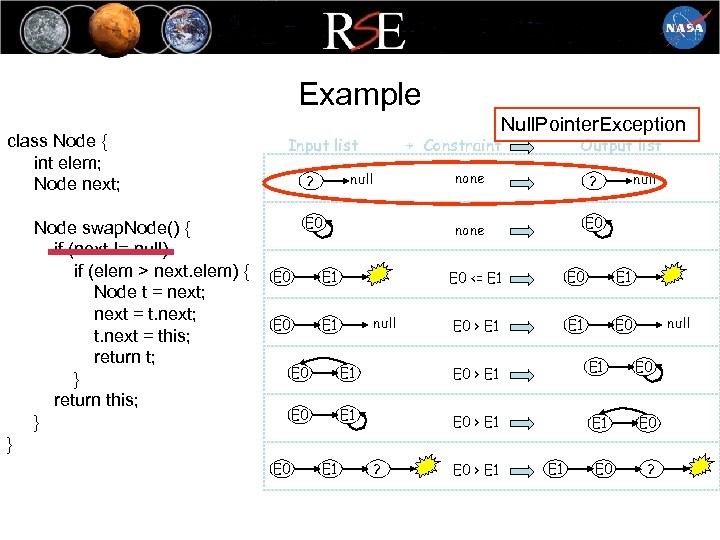
Example class Node { int elem; Node next; Node swap. Node() { if (next != null) if (elem > next. elem) { Node t = next; next = t. next; t. next = this; return t; } return this; } Null. Pointer. Exception Input list + Constraint none null ? E 0 E 1 null ? E 0 none E 1 E 0 Output list E 0 <= E 1 null E 0 E 1 E 0 > E 1 E 0 null E 1 E 0 > E 1 E 0 E 0 ? } E 0 E 1 ? E 0 > E 1
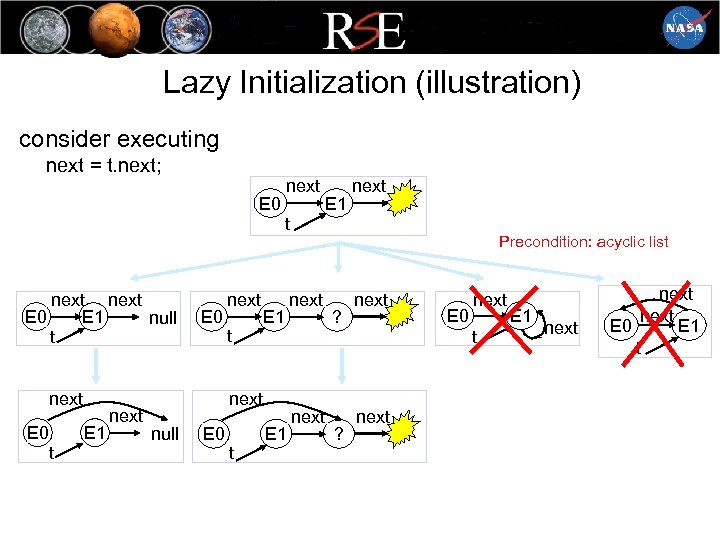
Lazy Initialization (illustration) consider executing next = t. next; next E 0 E 1 next t next E 0 E 1 null t next E 0 t E 1 next E 0 next t E 1 next null E 0 t E 1 Precondition: acyclic list next ? ? next E 0 next t next E 1 next E 0 E 1 t
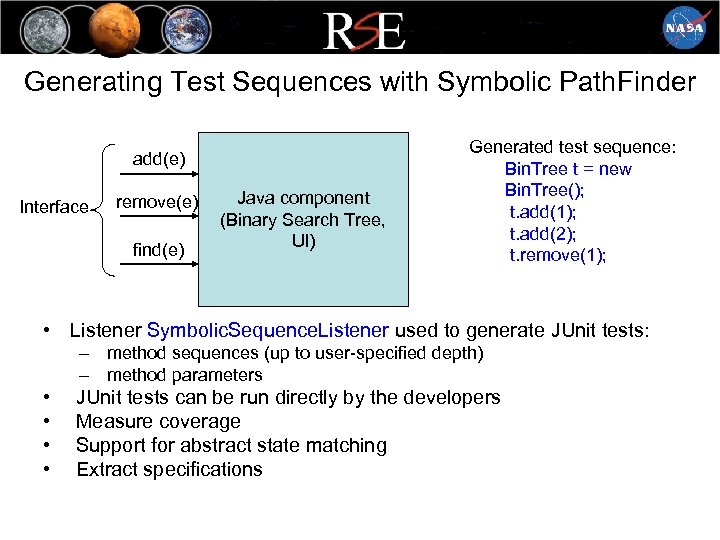
Generating Test Sequences with Symbolic Path. Finder add(e) Interface remove(e) find(e) Java component (Binary Search Tree, UI) Generated test sequence: Bin. Tree t = new Bin. Tree(); t. add(1); t. add(2); t. remove(1); • Listener Symbolic. Sequence. Listener used to generate JUnit tests: – method sequences (up to user-specified depth) – method parameters • • JUnit tests can be run directly by the developers Measure coverage Support for abstract state matching Extract specifications
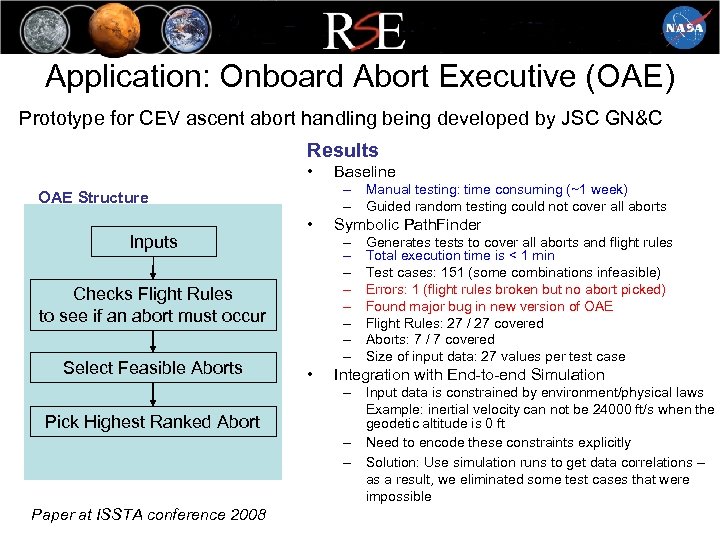
Application: Onboard Abort Executive (OAE) Prototype for CEV ascent abort handling being developed by JSC GN&C Results • – Manual testing: time consuming (~1 week) – Guided random testing could not cover all aborts OAE Structure Inputs • Pick Highest Ranked Abort Paper at ISSTA conference 2008 Symbolic Path. Finder – – – – Checks Flight Rules to see if an abort must occur Select Feasible Aborts Baseline • Generates tests to cover all aborts and flight rules Total execution time is < 1 min Test cases: 151 (some combinations infeasible) Errors: 1 (flight rules broken but no abort picked) Found major bug in new version of OAE Flight Rules: 27 / 27 covered Aborts: 7 / 7 covered Size of input data: 27 values per test case Integration with End-to-end Simulation – Input data is constrained by environment/physical laws Example: inertial velocity can not be 24000 ft/s when the geodetic altitude is 0 ft – Need to encode these constraints explicitly – Solution: Use simulation runs to get data correlations -as a result, we eliminated some test cases that were impossible
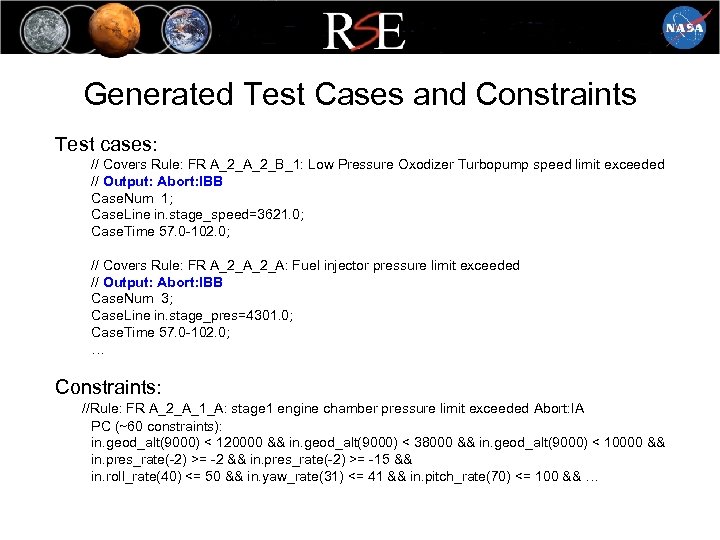
Generated Test Cases and Constraints Test cases: // Covers Rule: FR A_2_B_1: Low Pressure Oxodizer Turbopump speed limit exceeded // Output: Abort: IBB Case. Num 1; Case. Line in. stage_speed=3621. 0; Case. Time 57. 0 -102. 0; // Covers Rule: FR A_2_A: Fuel injector pressure limit exceeded // Output: Abort: IBB Case. Num 3; Case. Line in. stage_pres=4301. 0; Case. Time 57. 0 -102. 0; … Constraints: //Rule: FR A_2_A_1_A: stage 1 engine chamber pressure limit exceeded Abort: IA PC (~60 constraints): in. geod_alt(9000) < 120000 && in. geod_alt(9000) < 38000 && in. geod_alt(9000) < 10000 && in. pres_rate(-2) >= -2 && in. pres_rate(-2) >= -15 && in. roll_rate(40) <= 50 && in. yaw_rate(31) <= 41 && in. pitch_rate(70) <= 100 && …
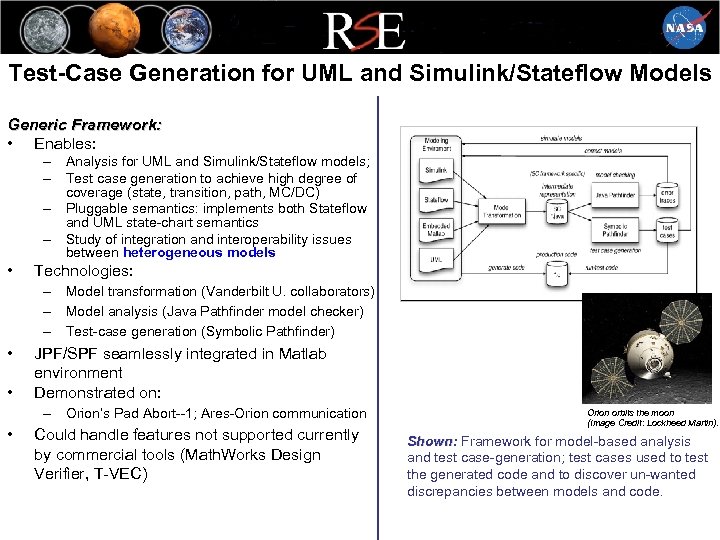
Test-Case Generation for UML and Simulink/Stateflow Models Generic Framework: • Enables: – Analysis for UML and Simulink/Stateflow models; – Test case generation to achieve high degree of coverage (state, transition, path, MC/DC) – Pluggable semantics: implements both Stateflow and UML state-chart semantics – Study of integration and interoperability issues between heterogeneous models • Technologies: – Model transformation (Vanderbilt U. collaborators) – Model analysis (Java Pathfinder model checker) – Test-case generation (Symbolic Pathfinder) • • JPF/SPF seamlessly integrated in Matlab environment Demonstrated on: – Orion’s Pad Abort--1; Ares-Orion communication • Could handle features not supported currently by commercial tools (Math. Works Design Verifier, T-VEC) Orion orbits the moon (Image Credit: Lockheed Martin). Shown: Framework for model-based analysis and test case-generation; test cases used to test the generated code and to discover un-wanted discrepancies between models and code.
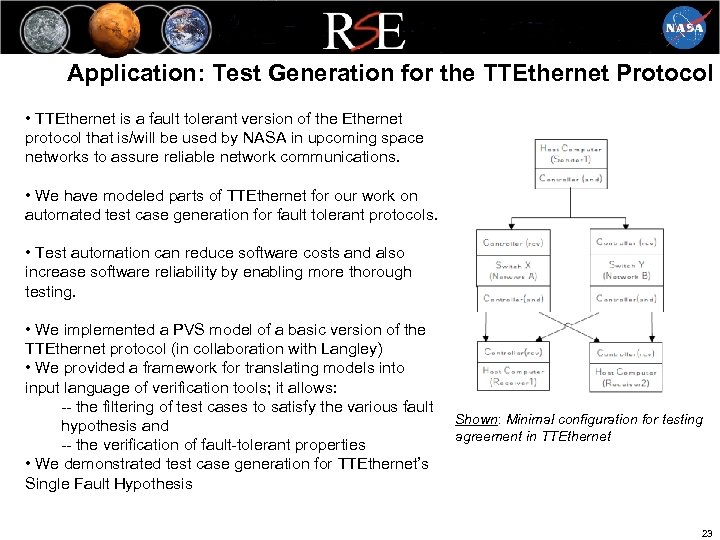
Application: Test Generation for the TTEthernet Protocol • TTEthernet is a fault tolerant version of the Ethernet protocol that is/will be used by NASA in upcoming space networks to assure reliable network communications. • We have modeled parts of TTEthernet for our work on automated test case generation for fault tolerant protocols. • Test automation can reduce software costs and also increase software reliability by enabling more thorough testing. • We implemented a PVS model of a basic version of the TTEthernet protocol (in collaboration with Langley) • We provided a framework for translating models into input language of verification tools; it allows: -- the filtering of test cases to satisfy the various fault hypothesis and -- the verification of fault-tolerant properties • We demonstrated test case generation for TTEthernet’s Single Fault Hypothesis Shown: Minimal configuration for testing agreement in TTEthernet 23
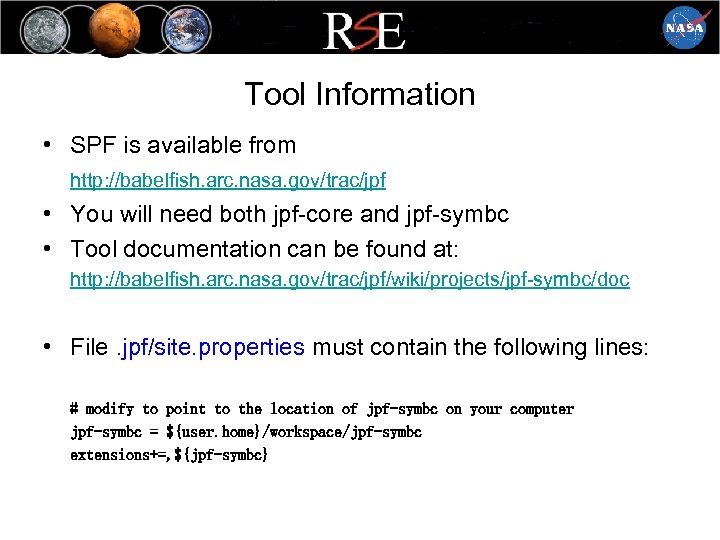
Tool Information • SPF is available from http: //babelfish. arc. nasa. gov/trac/jpf • You will need both jpf-core and jpf-symbc • Tool documentation can be found at: http: //babelfish. arc. nasa. gov/trac/jpf/wiki/projects/jpf-symbc/doc • File. jpf/site. properties must contain the following lines: # modify to point to the location of jpf-symbc on your computer jpf-symbc = ${user. home}/workspace/jpf-symbc extensions+=, ${jpf-symbc}
![Example. java package examples; public class Example { public static void main (String[] args)](https://present5.com/presentation/7583238a21db4e62ec5aaa72e0817b72/image-21.jpg "Example. java package examples; public class Example { public static void main (String[] args)")
Example. java package examples; public class Example { public static void main (String[] args) { Example ex= new Example(); ex. foo(2, 1); } public int foo(int x, int y){ if (x>y) { System. out. println("First"); return x; } else { System. out. println("Second"); return y; } } }
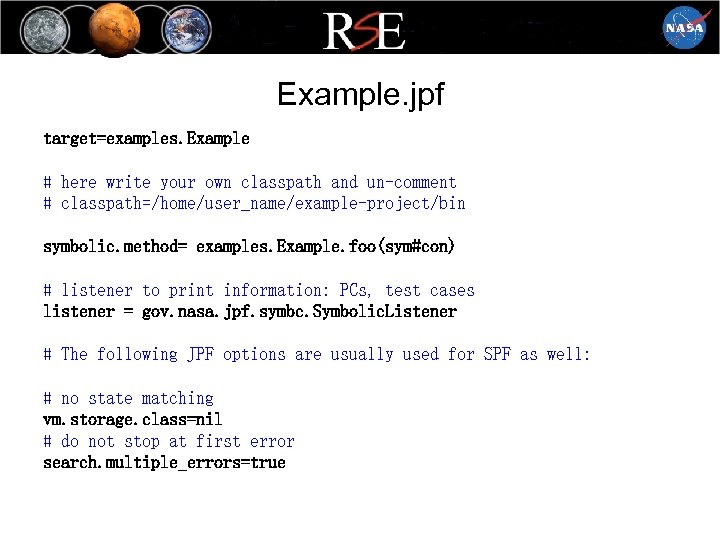
Example. jpf target=examples. Example # here write your own classpath and un-comment # classpath=/home/user_name/example-project/bin symbolic. method= examples. Example. foo(sym#con) # listener to print information: PCs, test cases listener = gov. nasa. jpf. symbc. Symbolic. Listener # The following JPF options are usually used for SPF as well: # no state matching vm. storage. class=nil # do not stop at first error search. multiple_errors=true
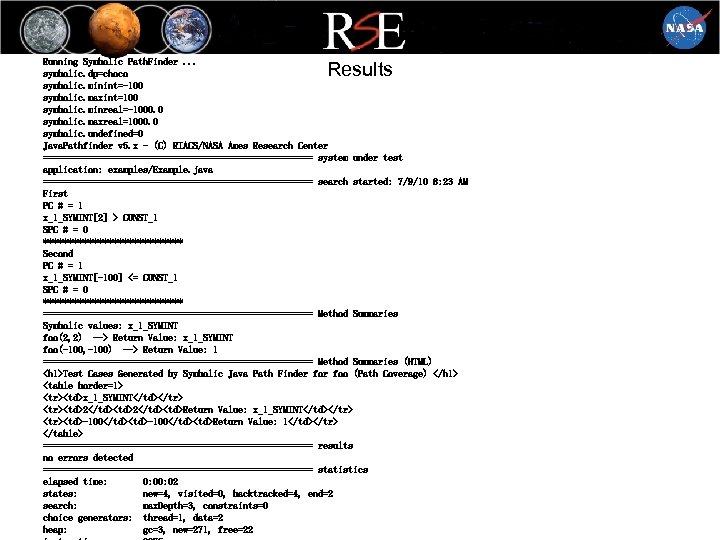
Running Symbolic Path. Finder. . . symbolic. dp=choco symbolic. minint=-100 symbolic. maxint=100 symbolic. minreal=-1000. 0 symbolic. maxreal=1000. 0 symbolic. undefined=0 Java. Pathfinder v 5. x - (C) RIACS/NASA Ames Research Center =========================== system under test application: examples/Example. java =========================== search started: 7/9/10 8: 23 AM First PC # = 1 x_1_SYMINT[2] > CONST_1 SPC # = 0 ************** Second PC # = 1 x_1_SYMINT[-100] <= CONST_1 SPC # = 0 ************** =========================== Method Summaries Symbolic values: x_1_SYMINT foo(2, 2) --> Return Value: x_1_SYMINT foo(-100, -100) --> Return Value: 1 =========================== Method Summaries (HTML) <h 1>Test Cases Generated by Symbolic Java Path Finder foo (Path Coverage) </h 1> <table border=1> <tr><td>x_1_SYMINT</td></tr> <tr><td>2</td><td>Return Value: x_1_SYMINT</td></tr> <tr><td>-100</td><td>Return Value: 1</td></tr> </table> =========================== results no errors detected =========================== statistics elapsed time: 0: 02 states: new=4, visited=0, backtracked=4, end=2 search: max. Depth=3, constraints=0 choice generators: thread=1, data=2 heap: gc=3, new=271, free=22 Results
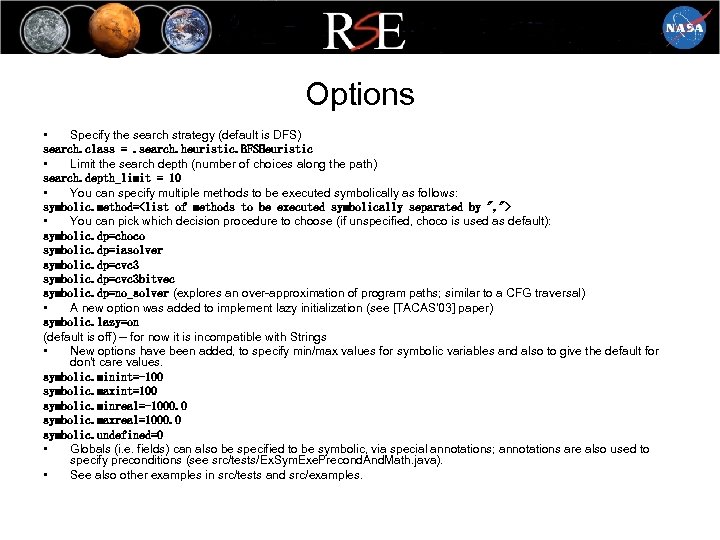
Options • Specify the search strategy (default is DFS) search. class =. search. heuristic. BFSHeuristic • Limit the search depth (number of choices along the path) search. depth_limit = 10 • You can specify multiple methods to be executed symbolically as follows: symbolic. method=<list of methods to be executed symbolically separated by ", "> • You can pick which decision procedure to choose (if unspecified, choco is used as default): symbolic. dp=choco symbolic. dp=iasolver symbolic. dp=cvc 3 bitvec symbolic. dp=no_solver (explores an over-approximation of program paths; similar to a CFG traversal) • A new option was added to implement lazy initialization (see [TACAS'03] paper) symbolic. lazy=on (default is off) -- for now it is incompatible with Strings • New options have been added, to specify min/max values for symbolic variables and also to give the default for don't care values. symbolic. minint=-100 symbolic. maxint=100 symbolic. minreal=-1000. 0 symbolic. maxreal=1000. 0 symbolic. undefined=0 • Globals (i. e. fields) can also be specified to be symbolic, via special annotations; annotations are also used to specify preconditions (see src/tests/Ex. Sym. Exe. Precond. And. Math. java). • See also other examples in src/tests and src/examples.
![Comparison with Our Previous Work JPF– SE [TACAS’ 03, TACAS’ 07]: • • •](https://present5.com/presentation/7583238a21db4e62ec5aaa72e0817b72/image-25.jpg "Comparison with Our Previous Work JPF– SE [TACAS’ 03, TACAS’ 07]: • • •")
Comparison with Our Previous Work JPF– SE [TACAS’ 03, TACAS’ 07]: • • • http: //javapathfinder. sourceforge. net (symbolic extension) Worked by code instrumentation (partially automated) Quite general but may result in sub-optimal execution – For each instrumented byte-code, JPF needed to check a set of byte-codes representing the symbolic counterpart • Required an approximate static type propagation to determine which byte-code to instrument [Anand et al. TACAS’ 07] – No longer needed in the new framework, since symbolic information is propagated dynamically – Symbolic JPF always maintains the most precise information about the symbolic nature of the data • [data from Fujitsu: Symbolic JPF is 10 times faster than JPF--SE]
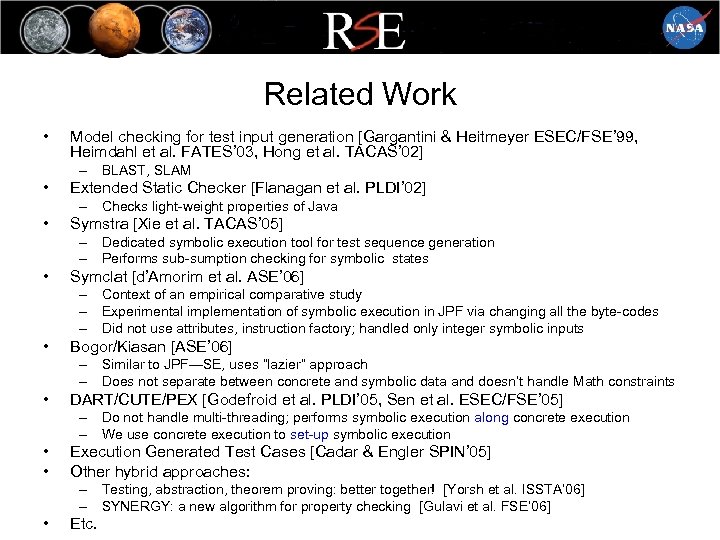
Related Work • Model checking for test input generation [Gargantini & Heitmeyer ESEC/FSE’ 99, Heimdahl et al. FATES’ 03, Hong et al. TACAS’ 02] – BLAST, SLAM • Extended Static Checker [Flanagan et al. PLDI’ 02] – Checks light-weight properties of Java • Symstra [Xie et al. TACAS’ 05] – Dedicated symbolic execution tool for test sequence generation – Performs sub-sumption checking for symbolic states • Symclat [d’Amorim et al. ASE’ 06] – Context of an empirical comparative study – Experimental implementation of symbolic execution in JPF via changing all the byte-codes – Did not use attributes, instruction factory; handled only integer symbolic inputs • Bogor/Kiasan [ASE’ 06] – Similar to JPF—SE, uses “lazier” approach – Does not separate between concrete and symbolic data and doesn’t handle Math constraints • DART/CUTE/PEX [Godefroid et al. PLDI’ 05, Sen et al. ESEC/FSE’ 05] – Do not handle multi-threading; performs symbolic execution along concrete execution – We use concrete execution to set-up symbolic execution • • Execution Generated Test Cases [Cadar & Engler SPIN’ 05] Other hybrid approaches: – Testing, abstraction, theorem proving: better together! [Yorsh et al. ISSTA’ 06] – SYNERGY: a new algorithm for property checking [Gulavi et al. FSE’ 06] • Etc.
![Selected Bibliography [ASE’ 10] “Symbolic Path. Fnder: Symbolic Execution for Java Bytecode” – tool](https://present5.com/presentation/7583238a21db4e62ec5aaa72e0817b72/image-27.jpg "Selected Bibliography [ASE’ 10] “Symbolic Path. Fnder: Symbolic Execution for Java Bytecode” – tool")
Selected Bibliography [ASE’ 10] “Symbolic Path. Fnder: Symbolic Execution for Java Bytecode” – tool paper, C. Pasareanu and N. Rungta [ISSTA’ 08] “Combining Unit-level Symbolic Execution and System-level Concrete Execution for Testing NASA Software”, C. Pãsãreanu, P. Mehlitz, D. Bushnell, K. Gundy-Burlet, M. Lowry, S. Person, M. Pape [FSE’ 08] “Differential Symbolic Execution”, S. Person, M. Dwyer, S. Elbaum, C. Pãsãreanu [TACAS’ 07] “JPF—SE: A Symbolic Execution Extenion to Java Path. Finder”, S. Anand, C. Pãsãreanu, W. Visser [SPIN’ 04] “Verification of Java Programs using Symbolic Execution and Invariant Generation”, C. Pãsãreanu, W. Visser [TACAS’ 03] “Generalized Symbolic Execution for Model Checking and Testing”, S. Khurshid, C. Pãsãreanu, W. Visser
Summary • Symbolic Path. Finder – Non-standard interpretation of byte-codes – Symbolic information propagated via attributes associated with program variables, operands, etc. – Available from http: //babelfish. arc. nasa. gov/trac/jpf (jpf-symbc) • Applications at NASA, industry, academia • Some current work: – – Parallel Symbolic Execution [ISSTA’ 10] String Analysis – with contributions from Fujitsu Load Testing Concolic execution (JPF’s concolic extension) Contributed by MIT: David Harvison & Adam Kiezun http: //people. csail. mit. edu/dharv/jfuzz
Questions?
Скачать презентацию JPF Tutorial Part 2 Symbolic Path Finder
7583238a21db4e62ec5aaa72e0817b72.ppt