


 Скачать презентацию Journal WP-1 Answer the following questions in complete
df8c6336599d213c579e8a447240ee50.ppt
- Количество слайдов: 25
 Journal WP-1 Answer the following questions in complete sentences: 1. Why is water important? 2. What are some uses for water?
 http: //www. youtube. com/watch? v=n. SENol Wby. YQ&feature=player_detailpage
 1. IMPORTANCE OF WATER a. Major Uses 1. Household 2. Agriculture-irrigation a. History 1. China 3000 BC irrigation by flooding rice paddies 2. Egypt, 2000 BC-Bucket device invented to raise water 3. Assyria, 700 BC-Stone aqueduct used by king for plantation 4. Mexico, 500 AD-raised plots with a canal 5. USA, 1870 windmills bring water 6. Israel, 2000 -drip irrigation in the desert directly to roots
 3. Industry-used to make products but can be recycled to cool machinery 4. Transportation-goods and boats 5. Recreation-boating, swimming, etc b. Water is used by living things to grow, reproduce and carry out life processeslike photosynthesis • 66% of the human body is made up of water. • At just 2% dehydration your performance decreases by around 20%. • We should drink at least 1. 5 litres of water a day.
 c. Groundwater is water that fills cracks and spaces in soil helping to bring nutrients to the soils and organisms in the soil.
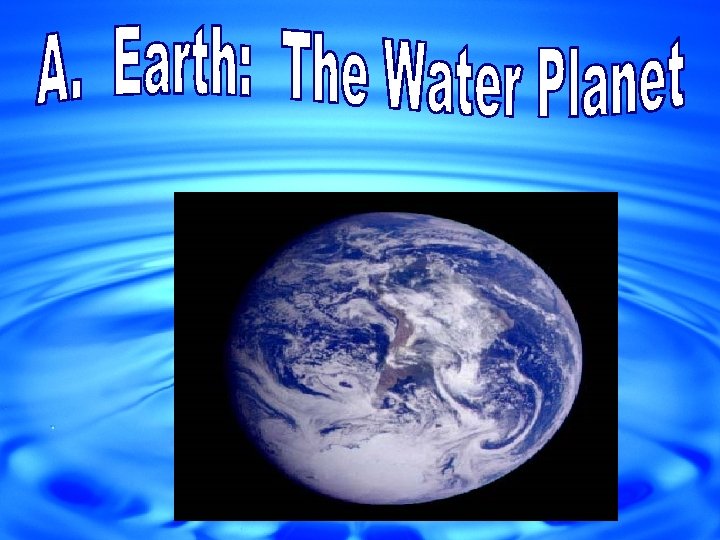
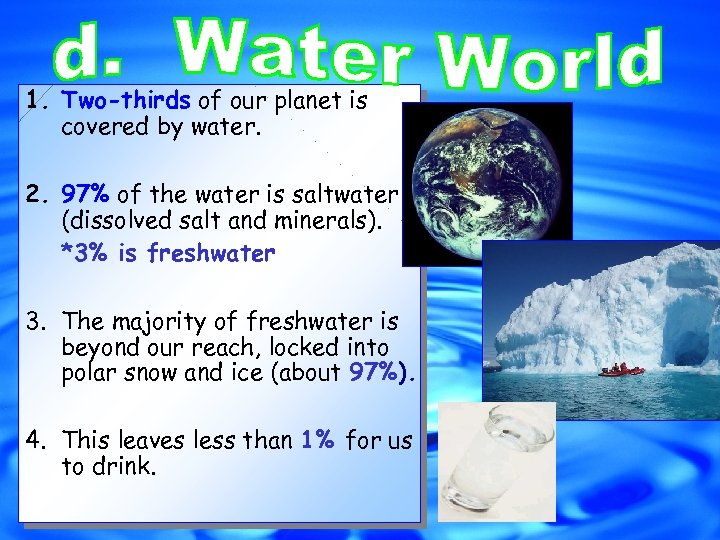 1. Two-thirds of our planet is covered by water. 2. 97% of the water is saltwater (dissolved salt and minerals). *3% is freshwater 3. The majority of freshwater is beyond our reach, locked into polar snow and ice (about 97%). 4. This leaves less than 1% for us to drink.
 http: //www. youtube. com/watch? v=v. YBj. PE 0 wekw&feature=player_detailpage
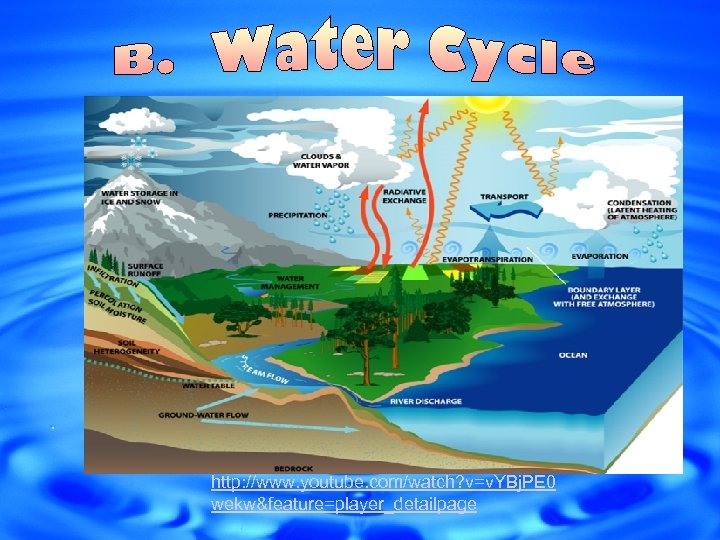
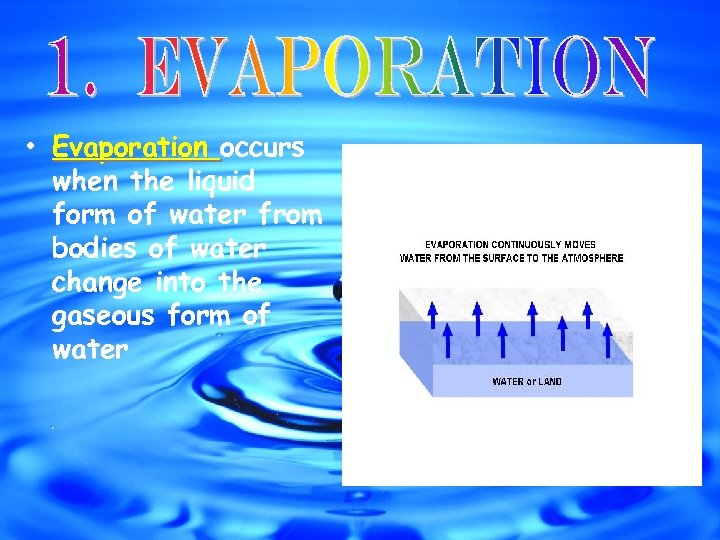 • Evaporation occurs when the liquid form of water from bodies of water change into the gaseous form of water
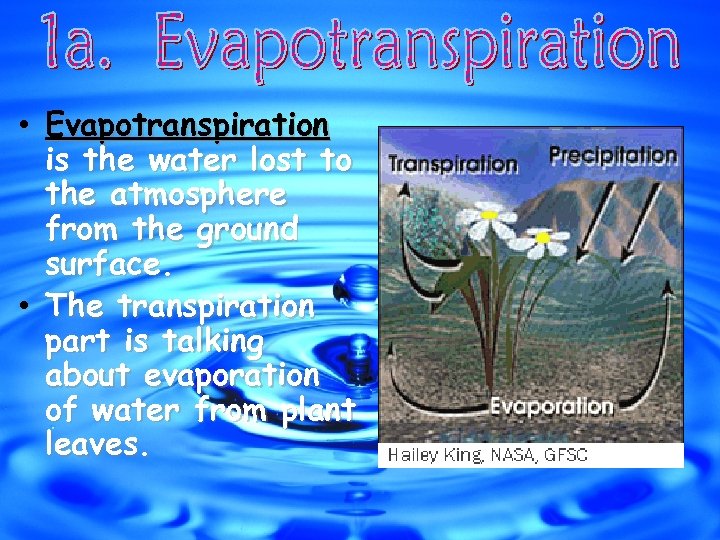 • Evapotranspiration is the water lost to the atmosphere from the ground surface. • The transpiration part is talking about evaporation of water from plant leaves.
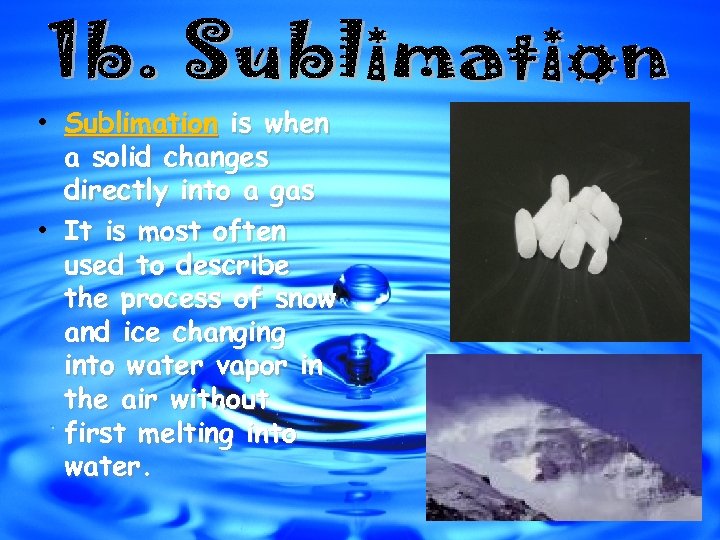 • Sublimation is when a solid changes directly into a gas • It is most often used to describe the process of snow and ice changing into water vapor in the air without first melting into water.
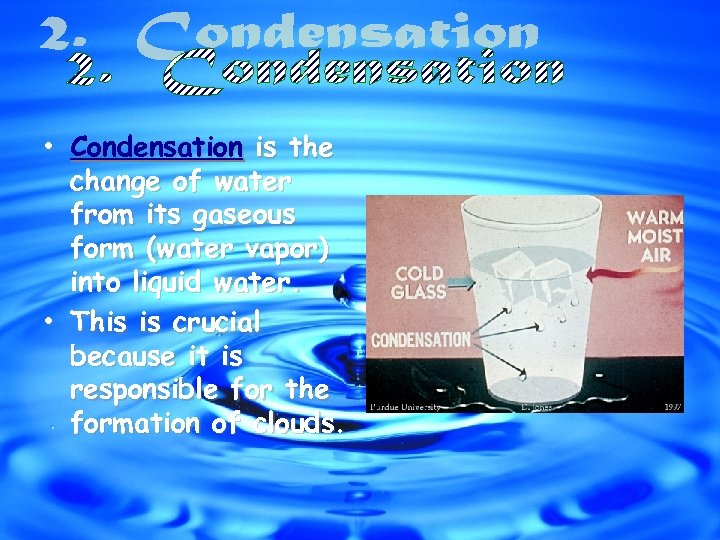 • Condensation is the change of water from its gaseous form (water vapor) into liquid water. • This is crucial because it is responsible for the formation of clouds.
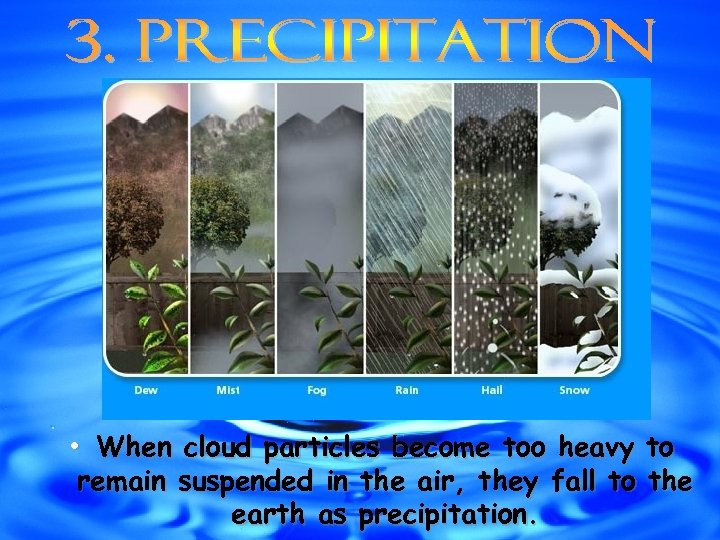 • When cloud particles become too heavy to remain suspended in the air, they fall to the earth as precipitation.
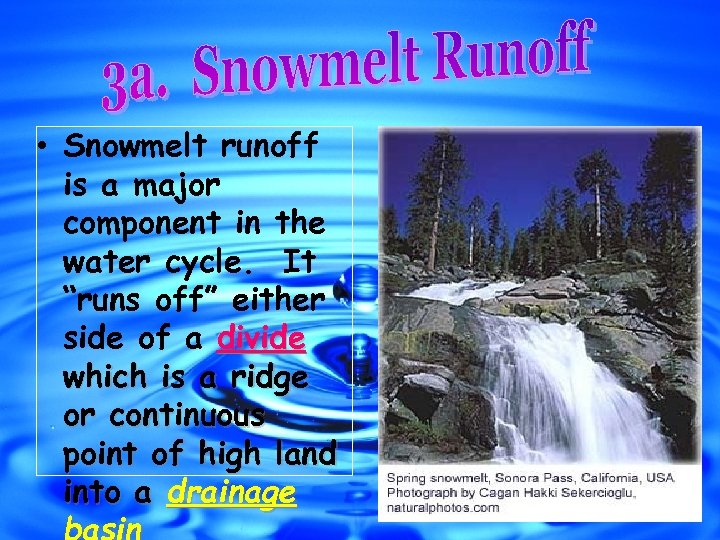 • Snowmelt runoff is a major component in the water cycle. It “runs off” either side of a divide which is a ridge or continuous point of high land into a drainage
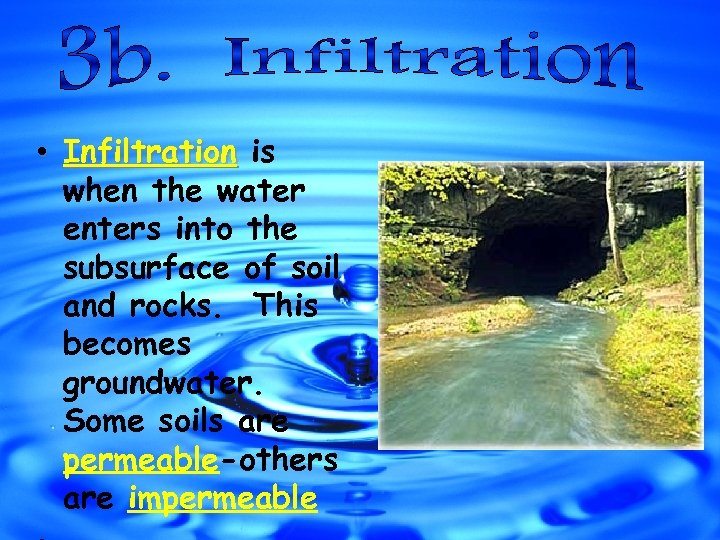 • Infiltration is when the water enters into the subsurface of soil and rocks. This becomes groundwater. Some soils are permeable-others are impermeable
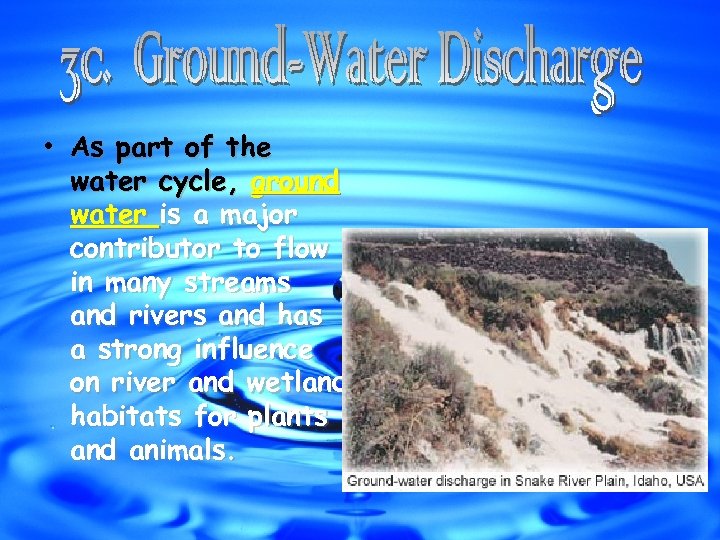 • As part of the water cycle, ground water is a major contributor to flow in many streams and rivers and has a strong influence on river and wetland habitats for plants and animals.
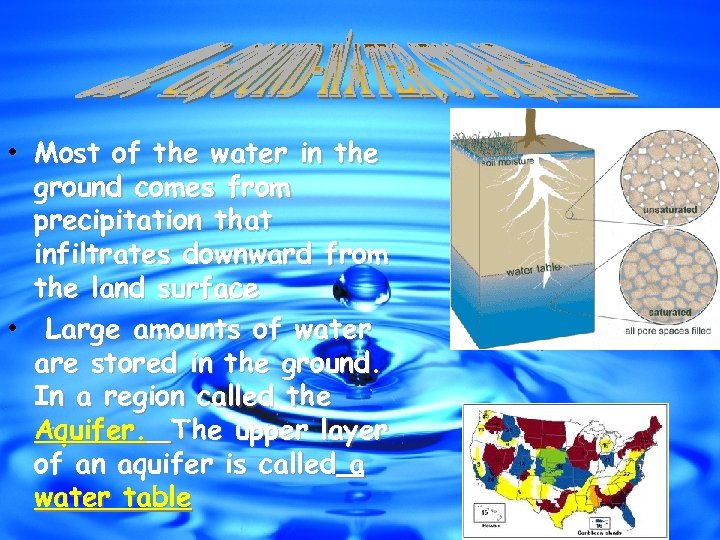 • Most of the water in the ground comes from precipitation that infiltrates downward from the land surface • Large amounts of water are stored in the ground. In a region called the Aquifer. The upper layer of an aquifer is called a water table
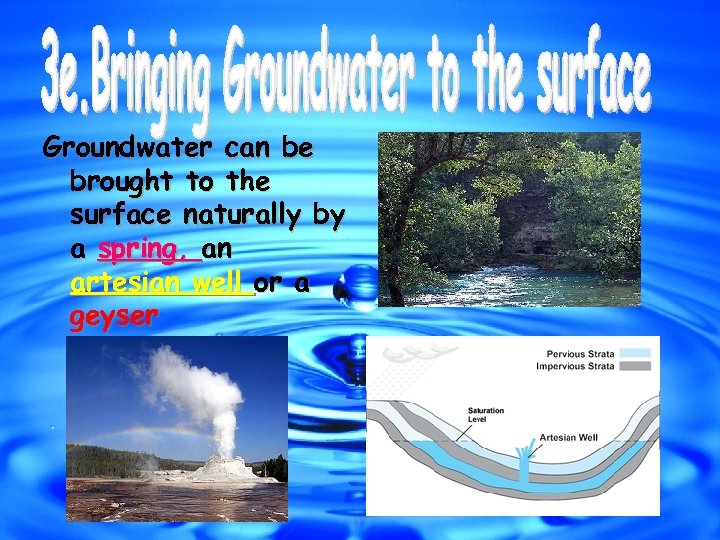 Groundwater can be brought to the surface naturally by a spring, an artesian well or a geyser
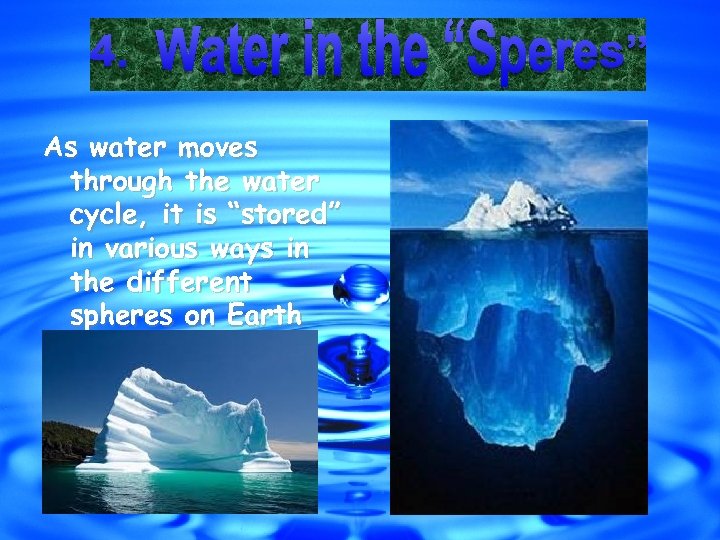 As water moves through the water cycle, it is “stored” in various ways in the different spheres on Earth
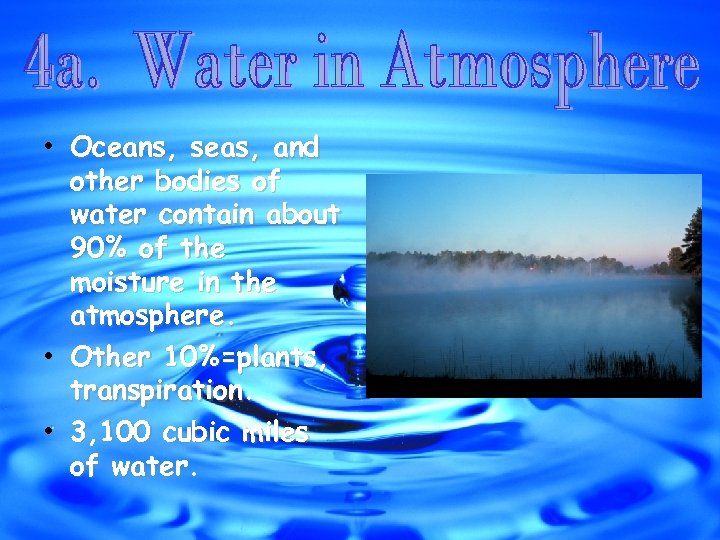 • Oceans, seas, and other bodies of water contain about 90% of the moisture in the atmosphere. • Other 10%=plants, transpiration. • 3, 100 cubic miles of water.
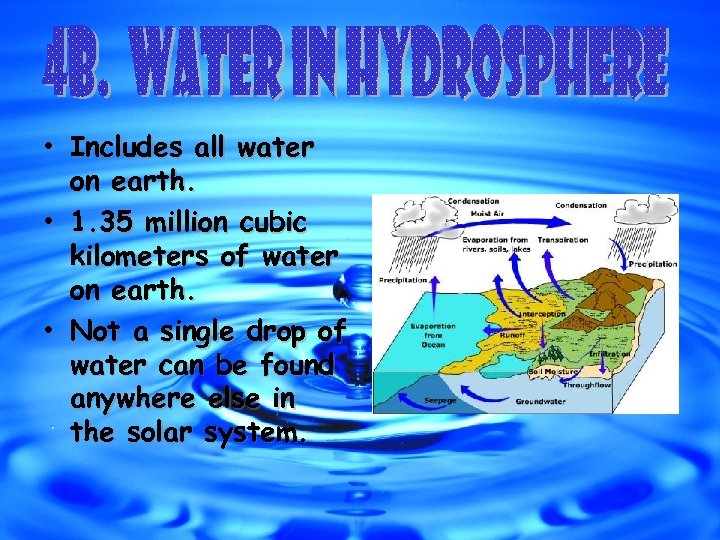 • Includes all water on earth. • 1. 35 million cubic kilometers of water on earth. • Not a single drop of water can be found anywhere else in the solar system.
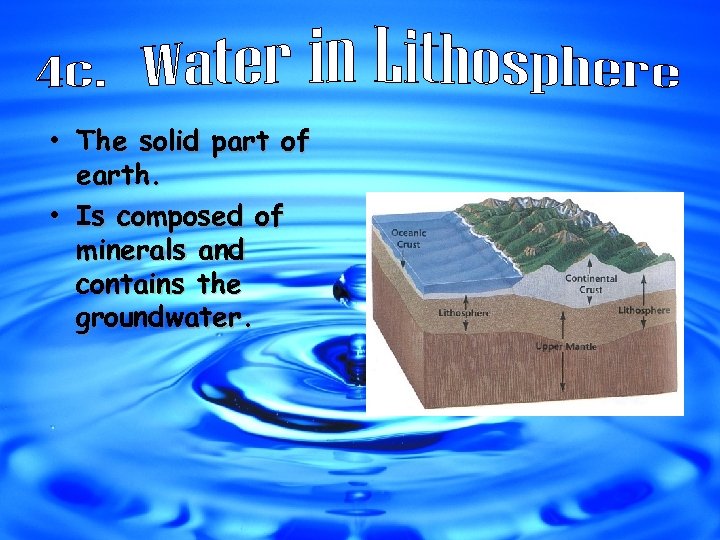 • The solid part of earth. • Is composed of minerals and contains the groundwater.
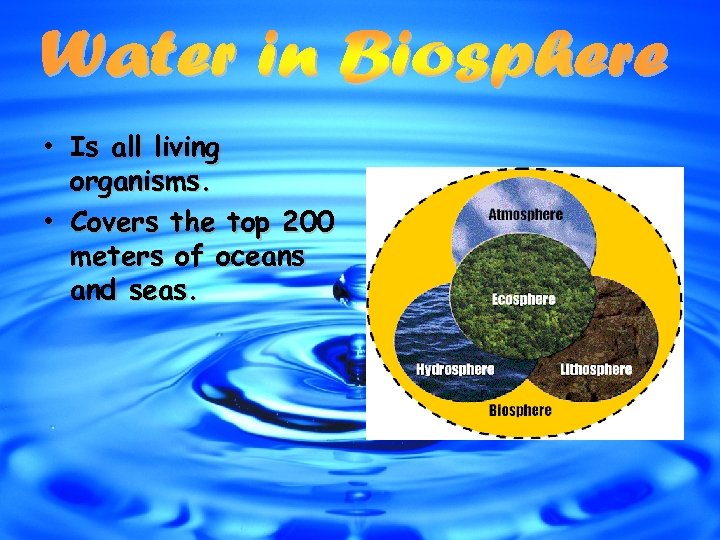 • Is all living organisms. • Covers the top 200 meters of oceans and seas.
 • Study your notes from the last 2 days. We will have a quiz or journal of some sort WITHOUT your notes! BE READY!!!!!
 • • • http: //techalive. mtu. edu/meec/module 01/Evaporationand. Transpiration. htm http: //ga. water. usgs. gov/edu/watercycleevapotranspiration. html http: //geography. about. com/od/physicalgeography/a/fourspheres. htm http: //www. deafhoosiers. com/sci/soarhigh/lithosphere. Comp. html http: //www. nps. gov/archive/acad/flow/atmosphere. html http: //ga. water. usgs. gov/edu/watercycleatmosphere. html