 Скачать презентацию Journal Club Alcohol Other Drugs and Health Current
c490caa658c42091d6977bd0dcdc1b42.ppt
- Количество слайдов: 21



Journal Club Alcohol, Other Drugs, and Health: Current Evidence November-December, 2015
Featured Article Effects of Initiating Moderate Alcohol Intake on Cardiometabolic Risk in Adults With Type 2 Diabetes: A 2 -Year Randomized, Controlled Trial. Gepner Y, et al. Ann Intern Med. 2015; 163(8): 569– 579.
Study Objectives • “To assess cardiometabolic effects of initiating moderate alcohol intake in persons with [type-2 diabetes mellitus] and whether the type of wine matters. ” www. aodhealth. org 3
Study Design • Randomized trial among 224 participants in Israel. • Participants had no alcohol use at baseline and well-controlled type-2 diabetes mellitus (T 2 DM). • Randomization to three arms: – 150 m. L of mineral water, white wine, or red wine with dinner for 2 years. www. aodhealth. org 4
Assessing Validity of an Article about Therapy • Are the results valid? • What are the results? • How can I apply the results to patient care? www. aodhealth. org 5
Are the Results Valid? • Were patients randomized? • Was randomization concealed? • Were patients analyzed in the groups to which they were randomized? • Were patients in the treatment and control groups similar with respect to known prognostic variables? www. aodhealth. org 6
Are the Results Valid? (cont‘d) • Were patients aware of group allocation? • Were clinicians aware of group allocation? • Were outcome assessors aware of group allocation? • Was follow-up complete? www. aodhealth. org 7
Were patients randomized? • Yes. www. aodhealth. org 8
Was randomization concealed? • Not stated. www. aodhealth. org 9
Were patients analyzed in the groups to which they were randomized? • Yes. www. aodhealth. org 10
Were the patients in the treatment and control groups similar? • Mostly. – There were more men in the red wine group: • 77%, compared with 65% in both the white wine and water groups. www. aodhealth. org 11
Were patients aware of group allocation? • Yes, patients were aware of group allocation based on beverage. www. aodhealth. org 12
Were clinicians aware of group allocation? • Not stated. www. aodhealth. org 13

Were outcome assessors aware of group allocation? • Not stated. www. aodhealth. org 14
Was follow-up complete? • Not quite. – Of the 224 participants, 94% had follow-up data at 1 year and 87% at 2 years. www. aodhealth. org 15
What Are the Results? • How large was the treatment effect? • How precise was the estimate of the treatment effect? www. aodhealth. org 16
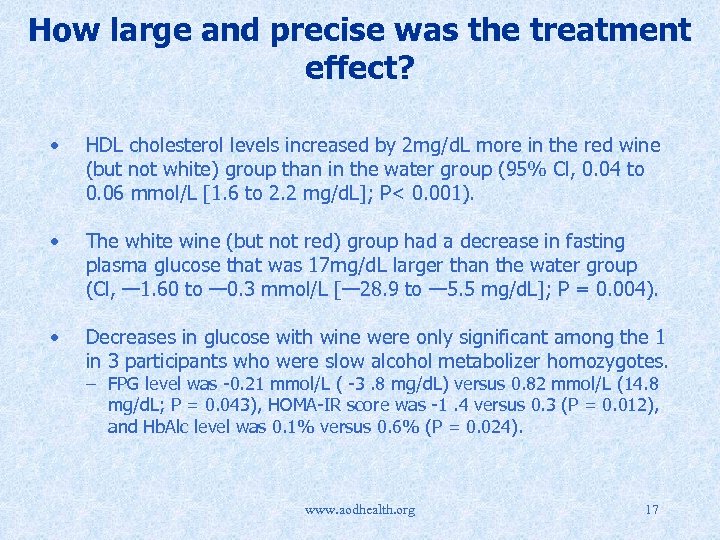
How large and precise was the treatment effect? • HDL cholesterol levels increased by 2 mg/d. L more in the red wine (but not white) group than in the water group (95% Cl, 0. 04 to 0. 06 mmol/L [1. 6 to 2. 2 mg/d. L]; P< 0. 001). • The white wine (but not red) group had a decrease in fasting plasma glucose that was 17 mg/d. L larger than the water group (Cl, — 1. 60 to — 0. 3 mmol/L [— 28. 9 to — 5. 5 mg/d. L]; P = 0. 004). • Decreases in glucose with wine were only significant among the 1 in 3 participants who were slow alcohol metabolizer homozygotes. – FPG level was -0. 21 mmol/L ( -3. 8 mg/d. L) versus 0. 82 mmol/L (14. 8 mg/d. L; P = 0. 043), HOMA-IR score was -1. 4 versus 0. 3 (P = 0. 012), and Hb. Alc level was 0. 1% versus 0. 6% (P = 0. 024). www. aodhealth. org 17
How Can I Apply the Results to Patient Care? • Were the study patients similar to the patients in my practice? • Were all clinically important outcomes considered? • Are the likely treatment benefits worth the potential harm and costs? www. aodhealth. org 18
Were the study patients similar to those in my practice? • The trial was conducted in Israel among people consuming a Mediterranean diet. • Men and women aged 40 to 75 years with T 2 DM. • Exclusion criteria were: – more than 1 alcoholic drink per week; – personal or family history of addiction, smoking, stroke, or myocardial infarction; – major surgery within the past 3 months; – using more than 2 insulin injections per day or an insulin pump; – triglyceride level >4. 52 mmol/L (400 mg/d. L), hemoglobin A 1 c (Hb. A 1 c) level <6. 4% or ≥ 10%; – women with first-degree relatives with breast cancer; – pregnant women. www. aodhealth. org 19
Were all clinically important outcomes considered? • These results are insufficient to support any recommendation to start drinking for health reasons. www. aodhealth. org 20
Are the likely treatment benefits worth the potential harm and costs? • Costs were not reported, nor was there evidence of a therapeutic benefit from alcohol consumption. www. aodhealth. org 21
Скачать презентацию Journal Club Alcohol Other Drugs and Health Current
c490caa658c42091d6977bd0dcdc1b42.ppt