 Скачать презентацию Joslin Diabetes Center Affiliated Programs Annual Meeting Exam
ac824afb7785fc3b2a1bd5133efd7b30.ppt
- Количество слайдов: 34



Joslin Diabetes Center Affiliated Programs Annual Meeting Exam Room Utilization: Simple Analysis for Constructive Discussion Sarah O’Neill Ambulatory Director Beth Israel Deaconess Medical Center Oct. 25, 2011
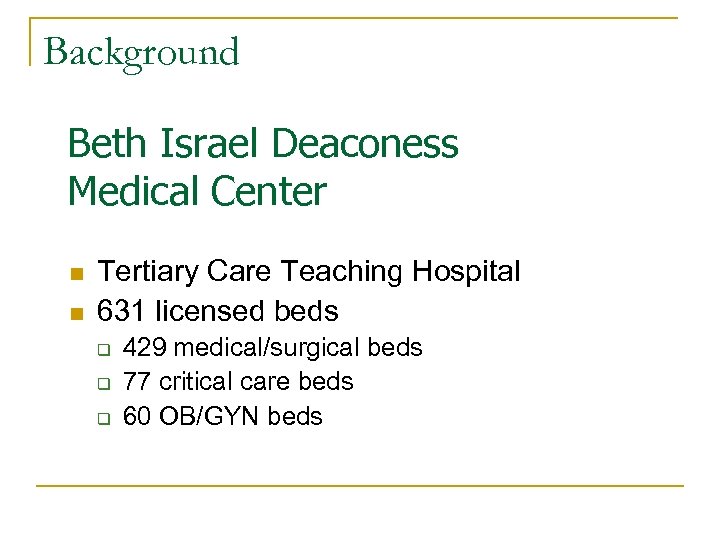
Background Beth Israel Deaconess Medical Center n n Tertiary Care Teaching Hospital 631 licensed beds q q q 429 medical/surgical beds 77 critical care beds 60 OB/GYN beds
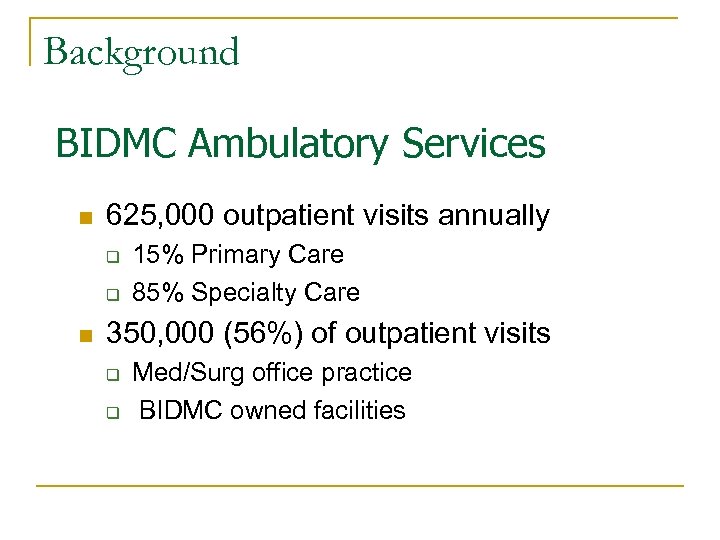
Background BIDMC Ambulatory Services n 625, 000 outpatient visits annually q q n 15% Primary Care 85% Specialty Care 350, 000 (56%) of outpatient visits q q Med/Surg office practice BIDMC owned facilities
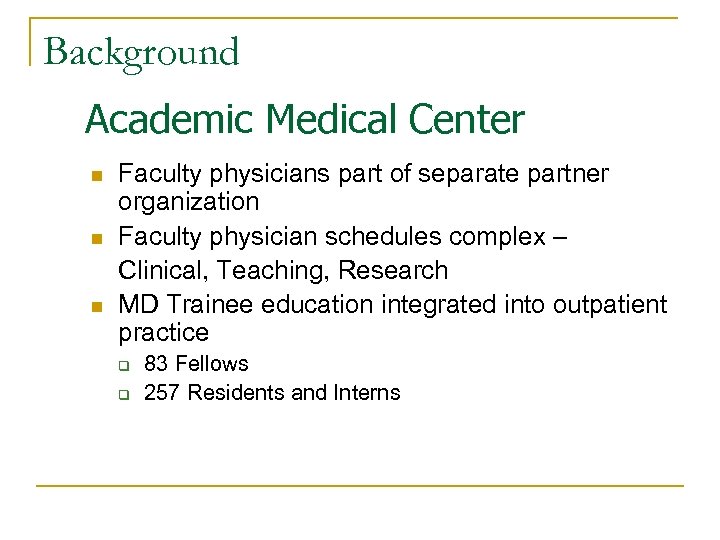
Background Academic Medical Center n n n Faculty physicians part of separate partner organization Faculty physician schedules complex – Clinical, Teaching, Research MD Trainee education integrated into outpatient practice q q 83 Fellows 257 Residents and Interns
Context n n Medical office practice growing on average 4% a year 2007 three year strategic development – MD recruitment in many ambulatory areas Market analysis indicated optimal location in Boston GME credentialing required expanded outpatient experience
Context n n n Space tight on campus Increased need for additional space for on campus off practice Cost of significant renovations prohibitive
The Goal n n Understand utilization – are we truly using what we have Develop standard and fair measure to inform decision making
Decision Making to Date n n Based on room reservation schedules Anecdotal reports of actual practice sessions q n n Ad hoc site visits range from overflowing to empty Little detail beyond # of planned physician recruits Failed efforts to assess use based on patient time in room
Beginning the Conversation n Initial analyses reviewed q q Weekday use Reservation use
Weekday Use n n Request for more space based on peak usage Is usage even across the week?
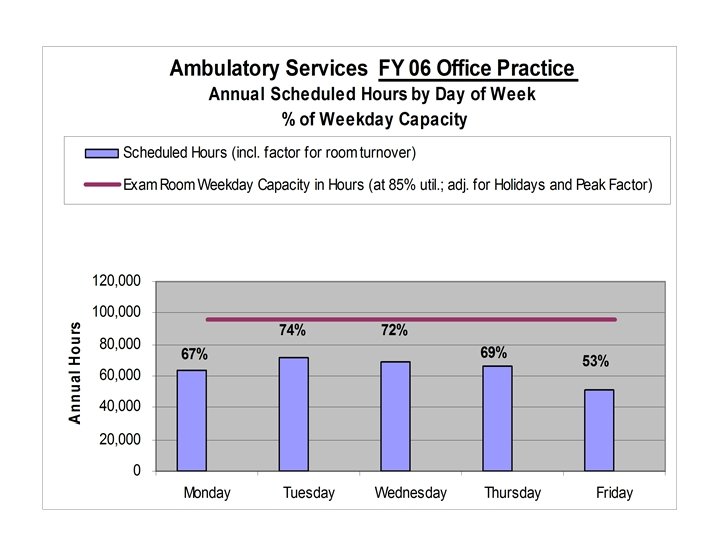
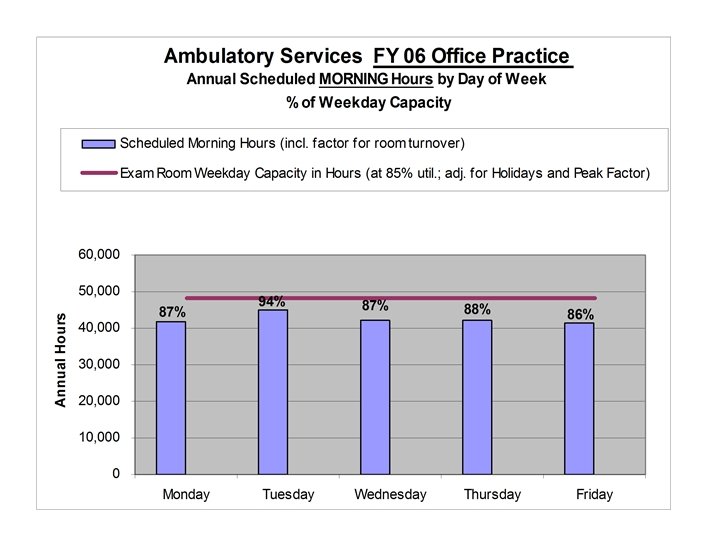
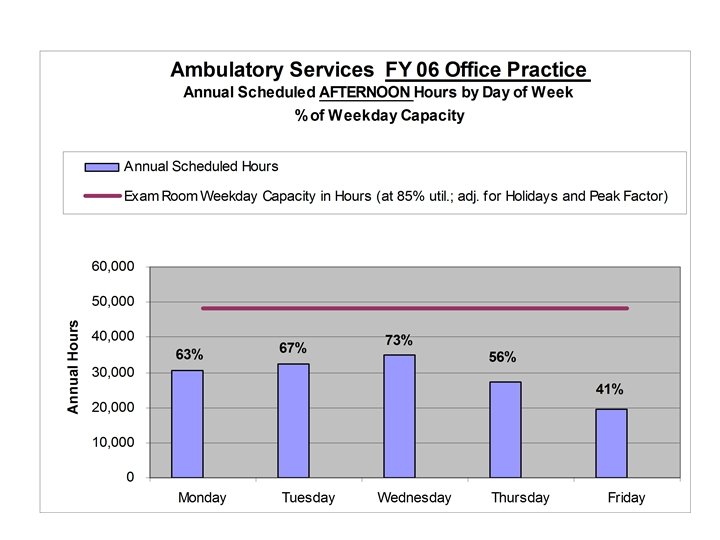
Weekday Use n Helped identify unused capacity – reduced the anecdotal “noise” n Data for analysis not readily available q q Analysis at the appointment level – huge amount of data Limited ability to dig in to detail by service or provider
Reservation Use n n Exam room “reserved” for regular weekly session Reserved session = 4 hours
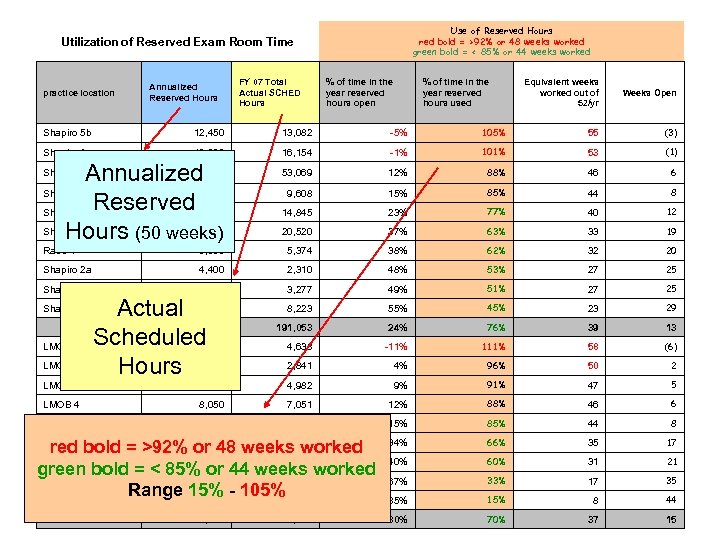
Use of Reserved Hours red bold = >92% or 48 weeks worked green bold = < 85% or 44 weeks worked Utilization of Reserved Exam Room Time practice location Annualized Reserved Hours FY 07 Total Actual SCHED Hours % of time in the year reserved hours open % of time in the year reserved hours used Equivalent weeks worked out of 52/yr Weeks Open Shapiro 5 b 12, 450 13, 082 -5% 105% 55 (3) Shapiro 8 a 16, 000 16, 154 -1% 101% 53 (1) 53, 069 12% 88% 46 6 9, 608 15% 85% 44 8 14, 845 23% 77% 40 12 20, 520 37% 63% 33 19 60, 050 Annualized Shapiro 2 c 11, 300 Reserved 19, 300 Shapiro 7 b Shapiro 8 b 32, 400 Hours (50 weeks) Shapiro 6, 1 Rabb 1 8, 650 5, 374 38% 62% 32 20 Shapiro 2 a 4, 400 2, 310 48% 53% 27 25 Shapiro 3 a 6, 400 3, 277 49% 51% 27 25 8, 223 55% 45% 23 29 191, 053 24% 76% 39 13 4, 638 -11% 111% 58 (6) 2, 841 4% 96% 50 2 Shapiro 7 c LMOB 7 LMOB 5 a Actual 18, 400 252, 400 Scheduled 4, 175 Hours 2, 950 LMOB 5 5, 500 4, 982 9% 91% 47 5 LMOB 4 8, 050 7, 051 12% 88% 46 6 LMOB 3 a 2, 750 2, 329 15% 85% 44 8 34% 66% 35 17 40% 60% 31 21 67% 33% 17 35 85% 15% 8 44 30% 70% 37 5, 450 3, 619 red bold = >92% or 48 weeks worked LMOB 6 3, 800 2, 283 green bold = < 85% or 44 weeks worked LMOB 3 b 4, 000 1, 332 Range 15% - 105% 445 LMOB 2 a 3, 000 LMOB 1 65, 250 45, 969 15
Reservation Use Helpful n Highlights wide variation q q n Clinical contract oversight – length of sessions, cancellations, make ups, etc. Ongoing review of space available for others to reserve Reinforced existing space still available Long term usefulness n Evaluates reserved time only n More provider use of reserved time versus space use n Depends on managers providing schedules n Based on a snapshot in time (schedules change)
Finding a Simpler Metric n Use more readily available data q q q Not dependent on practice management Evaluates 12 months – level seasonal and academic variation From scheduling system – existing data extract Available at clinic and provider level Analyses exam room versus provider use
Premise of Metric n n Physician schedule reliable - needs to reflect real average time needed for each visit type Begin generously q q q Scheduled versus kept activity All visits – within session or add on Based on weekday use – any extended hours improves metric
Exam Room Availability n Assume room available 8 hours, M-F q q q n Two 4 hours sessions 250 days a year (less 10 holidays) One room available 2, 000 hours/year For each practice suite - include all clinics/ providers (MDs, NPs, etc. ) using exam room space in that location
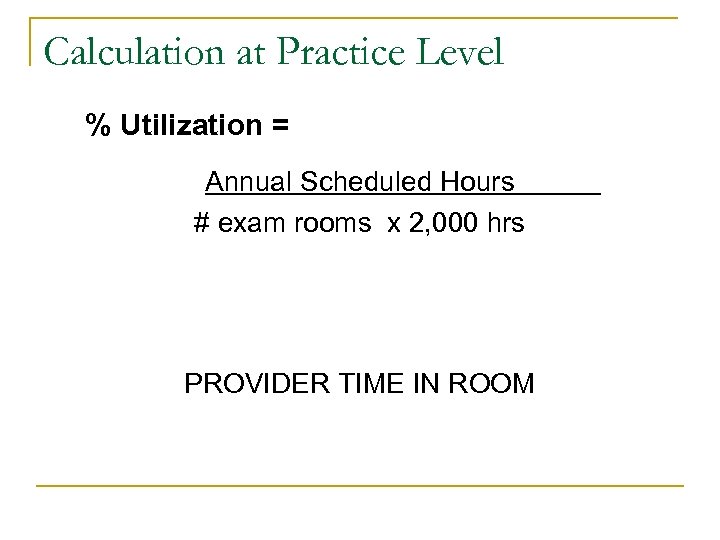
Calculation at Practice Level % Utilization = Annual Scheduled Hours # exam rooms x 2, 000 hrs PROVIDER TIME IN ROOM
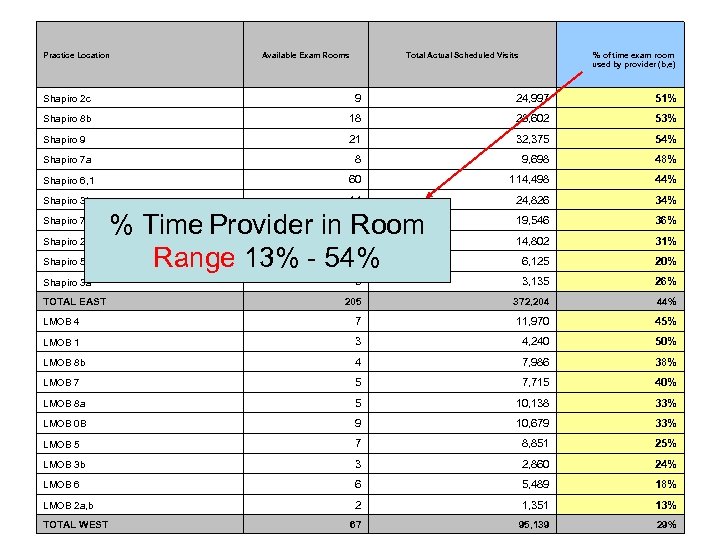
Practice Location Available Exam Rooms % of time exam room used by provider (b, e) Total Actual Scheduled Visits Shapiro 2 c 9 24, 997 51% Shapiro 8 b 18 28, 602 53% Shapiro 9 21 32, 375 54% Shapiro 7 a 8 9, 698 48% Shapiro 6, 1 60 114, 498 44% Shapiro 3 b 14 24, 826 34% 13 19, 546 36% 10 14, 802 31% 6 6, 125 20% 3 3, 135 26% 205 372, 204 44% LMOB 4 7 11, 970 45% LMOB 1 3 4, 240 50% LMOB 8 b 4 7, 986 38% LMOB 7 5 7, 715 40% LMOB 8 a 5 10, 138 33% LMOB 0 B 9 10, 679 33% LMOB 5 7 8, 851 25% LMOB 3 b 3 2, 860 24% LMOB 6 6 5, 489 18% LMOB 2 a, b 2 1, 351 13% 67 95, 139 29% Shapiro 7 c Shapiro 2 a Shapiro 5 a Shapiro 3 a TOTAL EAST TOTAL WEST % Time Provider in Room Range 13% - 54%
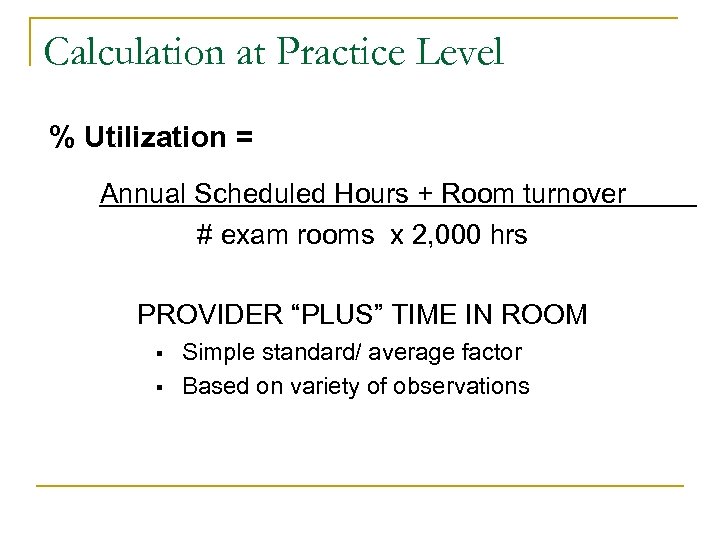
Calculation at Practice Level % Utilization = Annual Scheduled Hours + Room turnover # exam rooms x 2, 000 hrs PROVIDER “PLUS” TIME IN ROOM § § Simple standard/ average factor Based on variety of observations
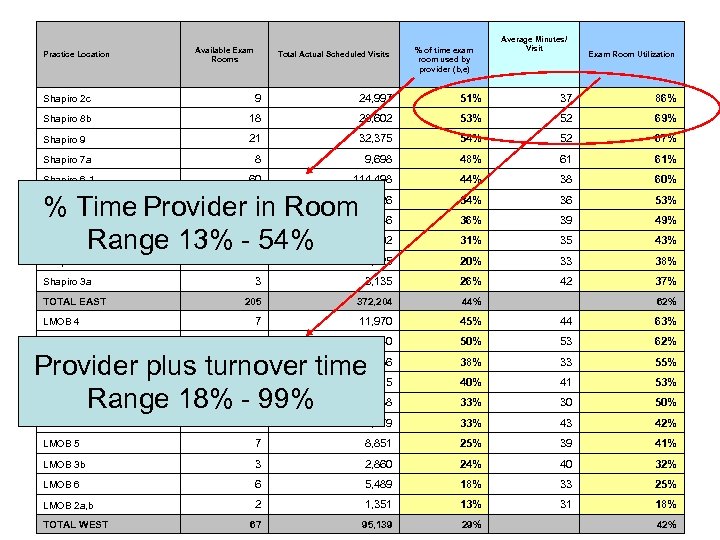
Practice Location Available Exam Rooms Total Actual Scheduled Visits % of time exam room used by provider (b, e) Average Minutes/ Visit Exam Room Utilization Shapiro 2 c 9 24, 997 51% 37 86% Shapiro 8 b 18 28, 602 53% 52 69% Shapiro 9 21 32, 375 54% 52 67% Shapiro 7 a 8 9, 698 48% 61 61% Shapiro 6, 1 60 114, 498 44% 38 60% % Time Provider in Room Range 13% - 54% Shapiro 3 b 14 24, 826 34% 36 53% Shapiro 7 c 13 19, 546 36% 39 49% Shapiro 2 a 10 14, 802 31% 35 43% Shapiro 5 a 6 6, 125 20% 33 38% Shapiro 3 a 3 3, 135 26% 42 37% 205 372, 204 44% 62% LMOB 4 7 11, 970 45% 44 63% LMOB 1 3 4, 240 50% 53 62% TOTAL EAST Provider plus turnover time Range 18% - 99% LMOB 8 b 4 7, 986 38% 33 55% LMOB 7 5 7, 715 40% 41 53% LMOB 8 a 5 10, 138 33% 30 50% LMOB 0 B 9 10, 679 33% 43 42% LMOB 5 7 8, 851 25% 39 41% LMOB 3 b 3 2, 860 24% 40 32% LMOB 6 6 5, 489 18% 33 25% LMOB 2 a, b 2 1, 351 13% 31 18% 67 95, 139 29% 42% TOTAL WEST
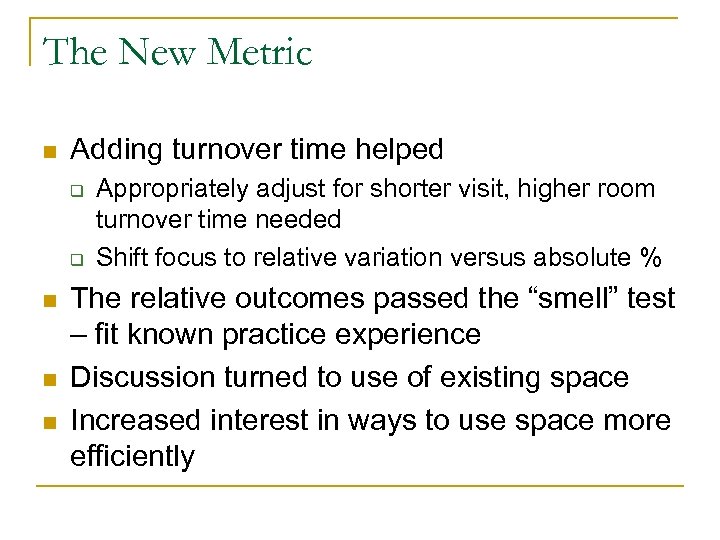
The New Metric n Adding turnover time helped q q n n n Appropriately adjust for shorter visit, higher room turnover time needed Shift focus to relative variation versus absolute % The relative outcomes passed the “smell” test – fit known practice experience Discussion turned to use of existing space Increased interest in ways to use space more efficiently
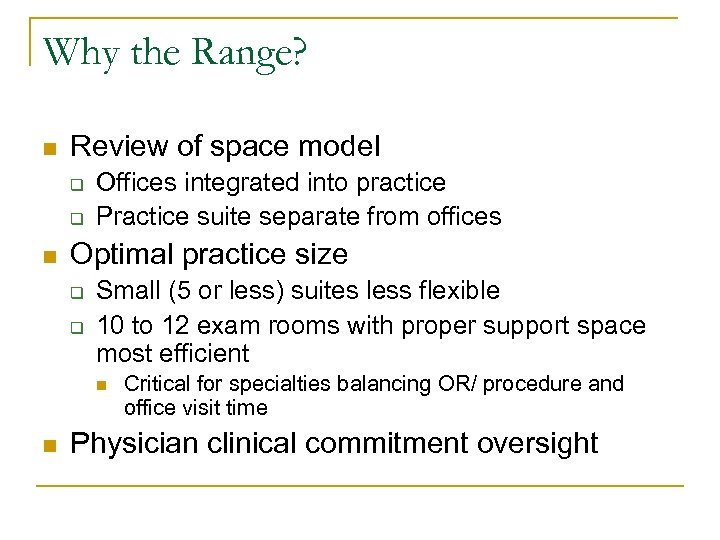
Why the Range? n Review of space model q q n Offices integrated into practice Practice suite separate from offices Optimal practice size q q Small (5 or less) suites less flexible 10 to 12 exam rooms with proper support space most efficient n n Critical for specialties balancing OR/ procedure and office visit time Physician clinical commitment oversight
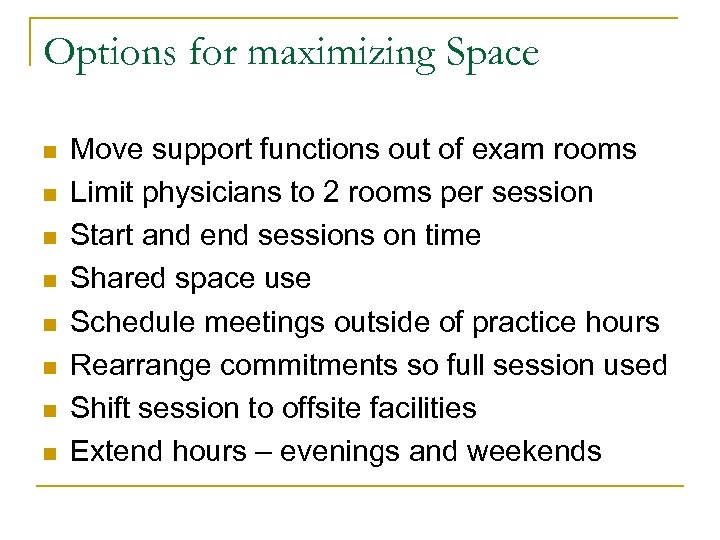
Options for maximizing Space n n n n Move support functions out of exam rooms Limit physicians to 2 rooms per session Start and end sessions on time Shared space use Schedule meetings outside of practice hours Rearrange commitments so full session used Shift session to offsite facilities Extend hours – evenings and weekends
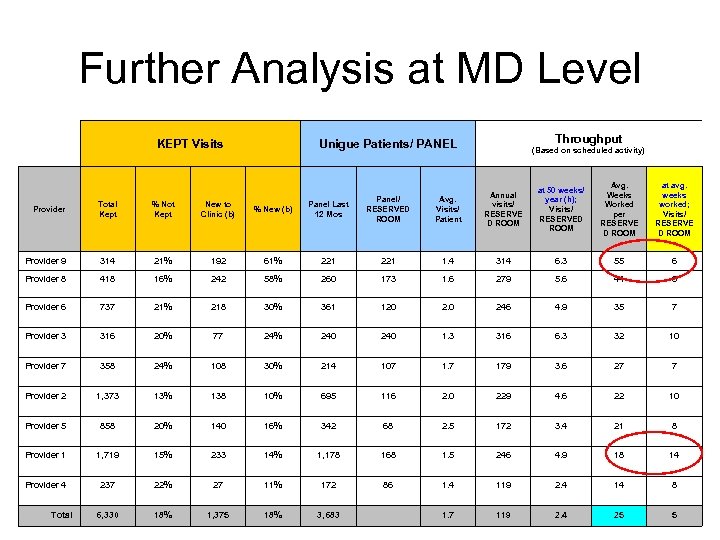
Further Analysis at MD Level KEPT Visits Throughput Unigue Patients/ PANEL (Based on scheduled activity) at 50 weeks/ year (h); Visits/ RESERVED ROOM Avg. Weeks Worked per RESERVE D ROOM at avg. weeks worked; Visits/ RESERVE D ROOM Total Kept % Not Kept New to Clinic (b) % New (b) Panel Last 12 Mos Panel/ RESERVED ROOM Avg. Visits/ Patient Annual visits/ RESERVE D ROOM Provider 9 314 21% 192 61% 221 1. 4 314 6. 3 55 6 Provider 8 418 16% 242 58% 260 173 1. 6 279 5. 6 44 6 Provider 6 737 21% 218 30% 361 120 2. 0 246 4. 9 35 7 Provider 3 316 20% 77 24% 240 1. 3 316 6. 3 32 10 Provider 7 358 24% 108 30% 214 107 1. 7 179 3. 6 27 7 Provider 2 1, 373 13% 138 10% 695 116 2. 0 229 4. 6 22 10 Provider 5 858 20% 140 16% 342 68 2. 5 172 3. 4 21 8 Provider 1 1, 719 15% 233 14% 1, 178 168 1. 5 246 4. 9 18 14 Provider 4 237 22% 27 11% 172 86 1. 4 119 2. 4 14 8 6, 330 18% 1, 375 18% 3, 683 1. 7 119 2. 4 25 5 Provider Total
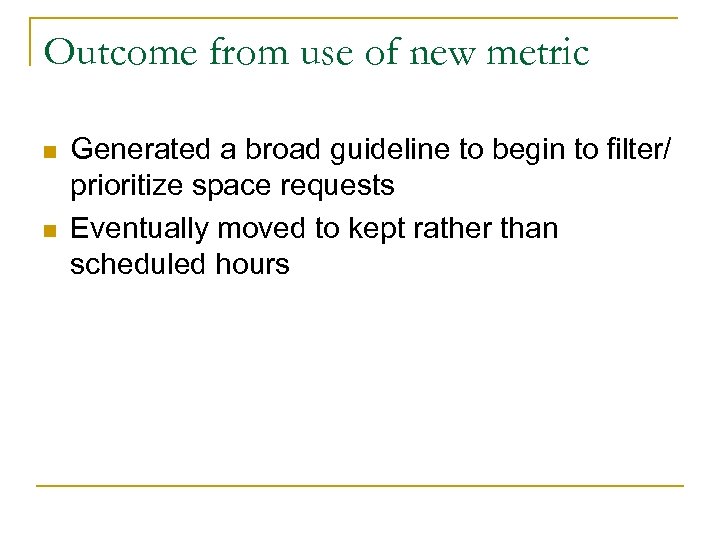
Outcome from use of new metric n n Generated a broad guideline to begin to filter/ prioritize space requests Eventually moved to kept rather than scheduled hours
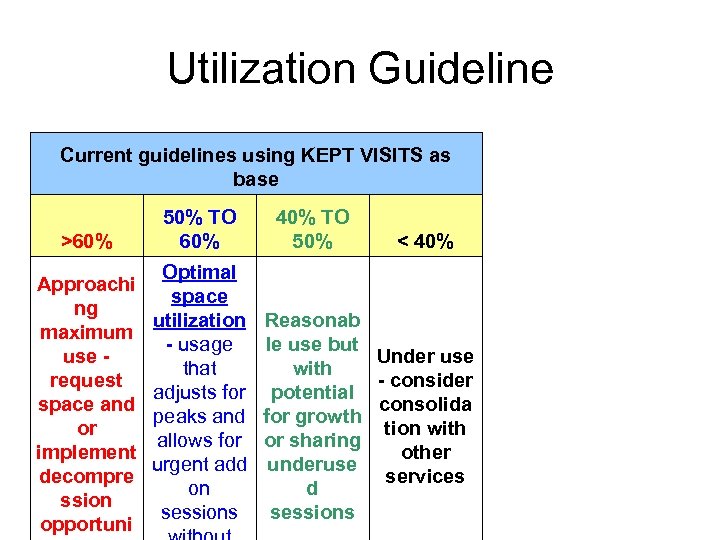
Utilization Guideline Current guidelines using KEPT VISITS as base >60% Approachi ng maximum use - request space and or implement decompre ssion opportuni 50% TO 60% 40% TO 50% Optimal space utilization - usage that adjusts for peaks and allows for urgent add on sessions Reasonab le use but with potential for growth or sharing underuse d sessions < 40% Under use - consider consolida tion with other services
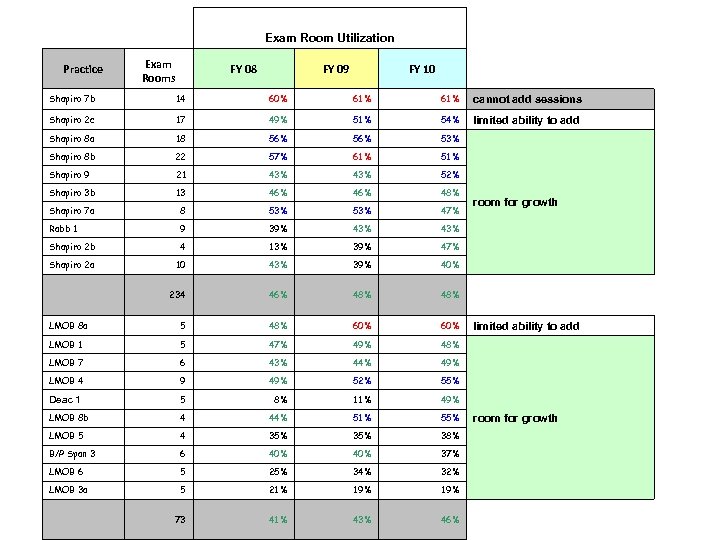
Exam Room Utilization Exam Rooms Practice FY 08 FY 09 FY 10 Shapiro 7 b 14 60% 61% cannot add sessions Shapiro 2 c 17 49% 51% 54% limited ability to add Shapiro 8 a 18 56% 53% Shapiro 8 b 22 57% 61% 51% Shapiro 9 21 43% 52% Shapiro 3 b 13 46% 48% Shapiro 7 a 8 53% 47% Rabb 1 9 39% 43% Shapiro 2 b 4 13% 39% 47% Shapiro 2 a 10 43% 39% 40% 234 46% 48% LMOB 8 a 5 48% 60% LMOB 1 5 47% 49% 48% LMOB 7 6 43% 44% 49% LMOB 4 9 49% 52% 55% Deac 1 5 8% 11% 49% LMOB 8 b 4 44% 51% 55% LMOB 5 4 35% 38% B/P Span 3 6 40% 37% LMOB 6 5 25% 34% 32% LMOB 3 a 5 21% 19% 73 41% 43% 46% room for growth limited ability to add room for growth
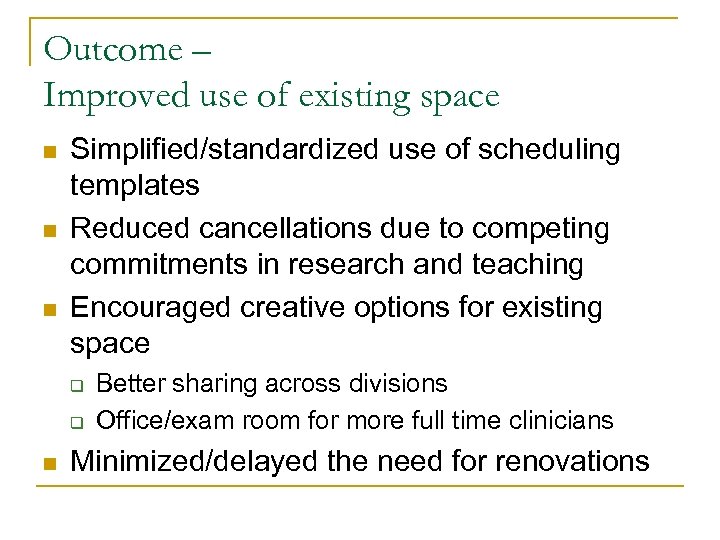
Outcome – Improved use of existing space n n n Simplified/standardized use of scheduling templates Reduced cancellations due to competing commitments in research and teaching Encouraged creative options for existing space q q n Better sharing across divisions Office/exam room for more full time clinicians Minimized/delayed the need for renovations
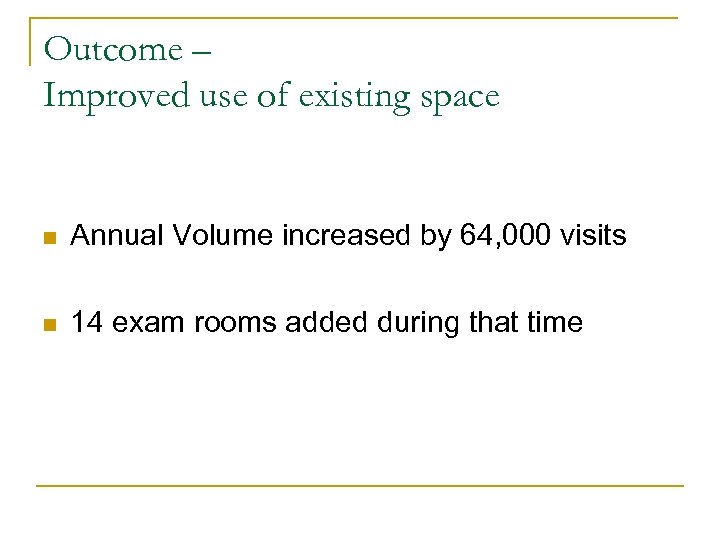
Outcome – Improved use of existing space n Annual Volume increased by 64, 000 visits n 14 exam rooms added during that time

Questions?
Скачать презентацию Joslin Diabetes Center Affiliated Programs Annual Meeting Exam
ac824afb7785fc3b2a1bd5133efd7b30.ppt