Скачать презентацию JOSEPHINE J FRANCISCO Philippines GENERAL AGREEMENT ON
5732edd217c11dd86607596decbc99aa.ppt
- Количество слайдов: 48
 JOSEPHINE J. FRANCISCO Philippines
 GENERAL AGREEMENT ON TRADE IN SERVICES (GATS) Provides a framework for temporary stay of people in other countries for the purpose of providing services
 CHALLENGE FOR THE PHILIPPINES • Take advantage of the opportunities • Untangle from existing institutional barriers to liberalization of movements of temporary migrants
 I. Trends in overseas employment, its economic contribution and composition of Filipino service providers II. Barriers to free movement of migrants, particularly Filipinos
 I. TRENDS IN OVERSEAS TEMPORARY MIGRATION EMPLOYMENT Labor migration is not a new phenomenon among Filipinos
 OVERSEAS EMPLOYMENT PROGRAM (1974) • tight domestic labor market ountry’s abilizes balance-of-payment the • position ative strategy mployment as erves • for Filipinos
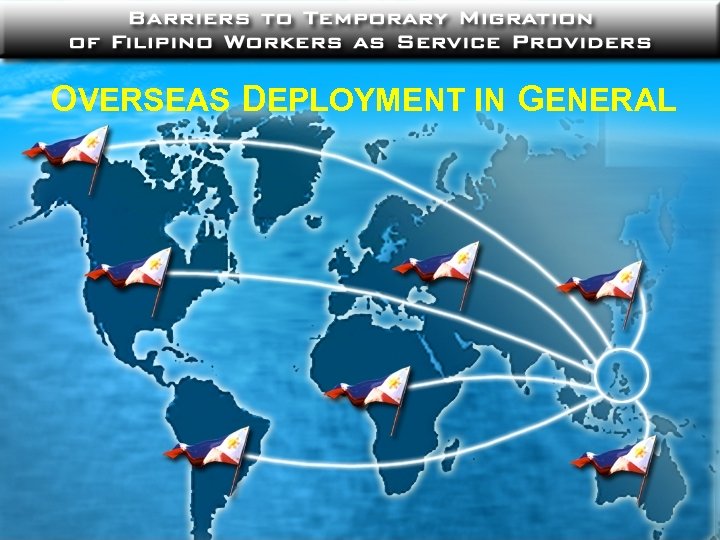 OVERSEAS DEPLOYMENT IN GENERAL
 Processed and Deployed OFW’s
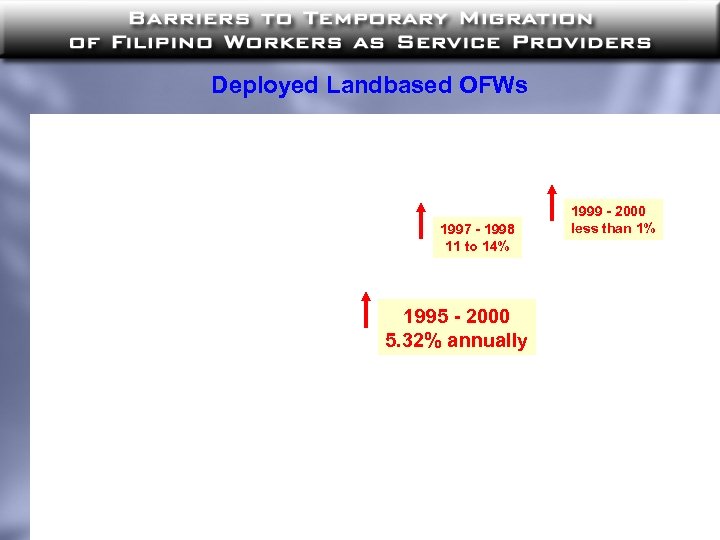 Deployed Landbased OFWs 1997 - 1998 11 to 14% 1995 - 2000 5. 32% annually 1999 - 2000 less than 1%
 Deployed Seabased OFWs 1995 -2000 25%
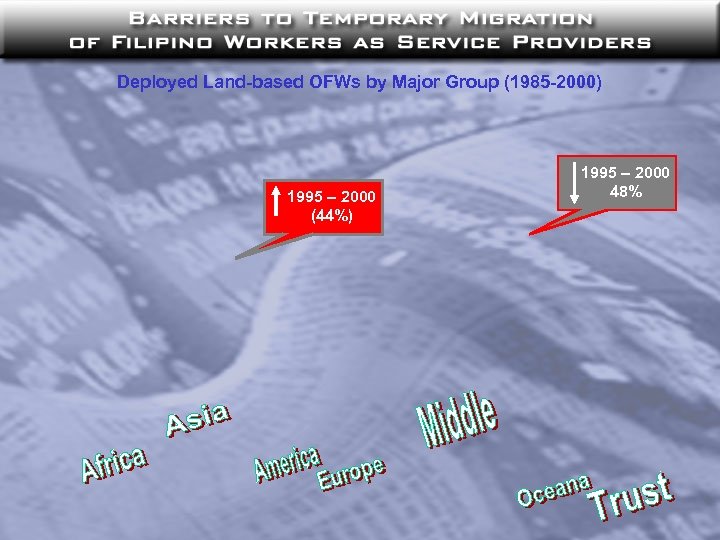 Deployed Land-based OFWs by Major Group (1985 -2000) 1995 – 2000 (44%) 1995 – 2000 48%
 OVERSEAS EMPLOYMENT • Provides temporary employment to Filipinos • Major generator of foreign exchange
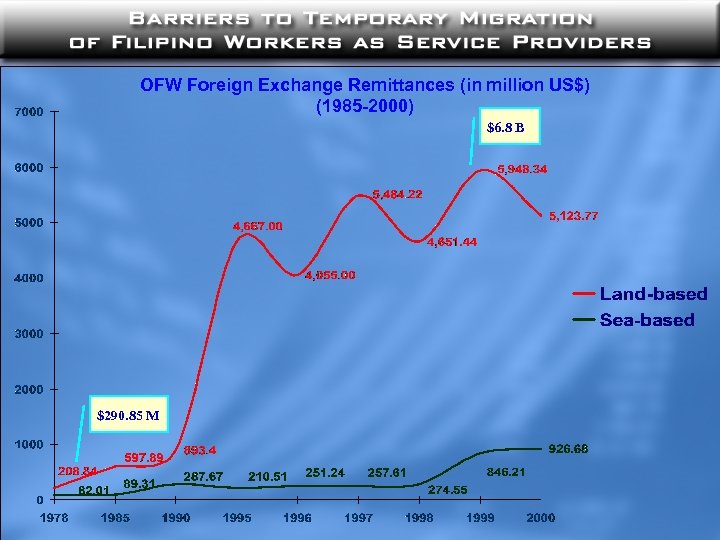 OFW Foreign Exchange Remittances (in million US$) (1985 -2000) $6. 8 B $290. 85 M
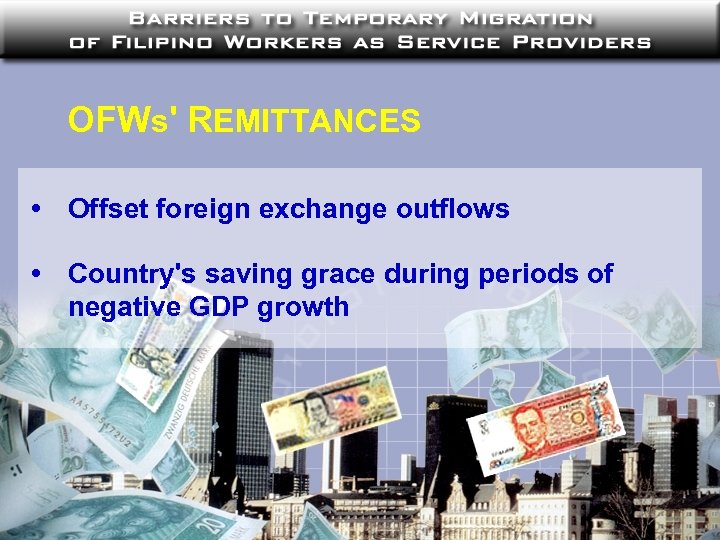 OFWs' REMITTANCES • Offset foreign exchange outflows • Country's saving grace during periods of negative GDP growth
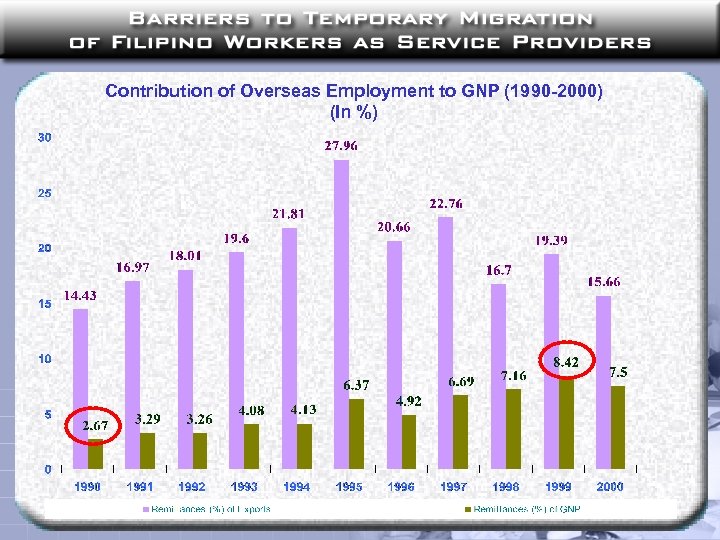 Contribution of Overseas Employment to GNP (1990 -2000) (In %)
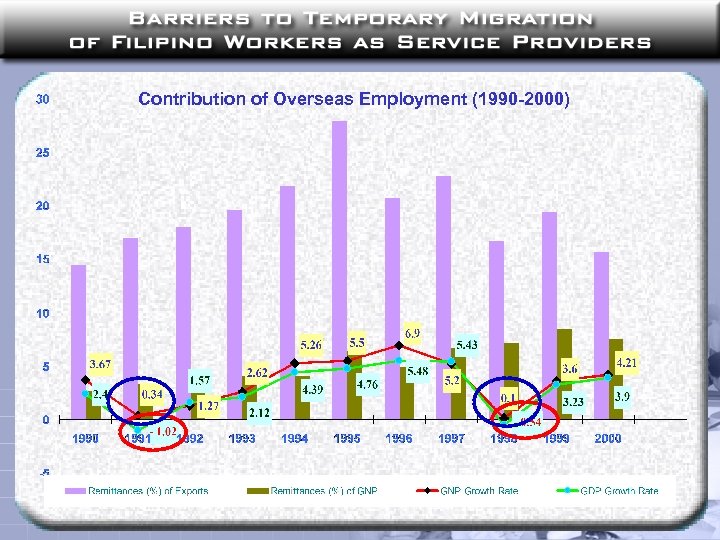 Contribution of Overseas Employment (1990 -2000)
 DEPLOYMENT AS SERVICE PROVIDERS
 Who are the International Service Providers (ISP)? • Sent by his/her employer to a foreign country to undertake a specific assignment for a restricted period of time • Engaged in work that requires professional, commercial, technical or other highly specialized skills for a restricted period of time • Upon the request of his/her employer in the country of employment, engaged in work that is transitory or brief for a restricted and definite period of time (Garnier, 1996)
 ISP Engage in : • Consulting Service • • Training activities Supervisory functions • Overseas Construction Contracting - skilled engineers - managers or supervisors - consultants NOT ISP • Seasonal and contract workers • Engage in manufacturing activities
 MAIN TYPES OF SERVICE PROVIDERS A. Intra-company transferees B. Individual service providers and specialists on specific assignments C. Short term or business visitors D. Diplomatic and international personnel
 DEPLOYMENT LEVEL Number of newly hired workers as classified by the Philippines Overseas Employment Administration (POEA)
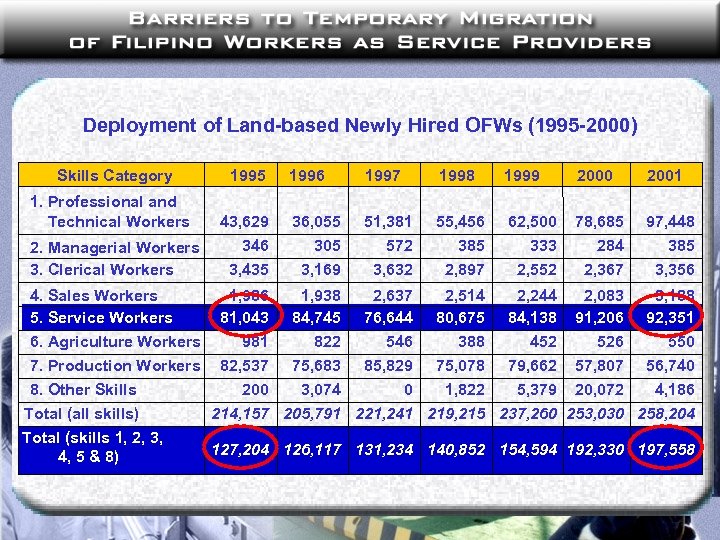 Deployment of Land-based Newly Hired OFWs (1995 -2000) Skills Category 1. Professional and Technical Workers 2. Managerial Workers 3. Clerical Workers 1995 1996 1997 1998 1999 2000 2001 43, 629 36, 055 51, 381 55, 456 62, 500 78, 685 97, 448 346 3, 435 305 3, 169 572 3, 632 385 2, 897 333 2, 552 284 2, 367 385 3, 356 4. Sales Workers 1, 986 1, 938 2, 637 2, 514 2, 244 2, 083 3, 188 5. Service Workers 81, 043 84, 745 76, 644 80, 675 84, 138 91, 206 92, 351 6. Agriculture Workers 981 822 546 388 452 526 550 7. Production Workers 82, 537 75, 683 85, 829 75, 078 79, 662 57, 807 56, 740 8. Other Skills 200 3, 074 0 1, 822 5, 379 20, 072 4, 186 Total (all skills) 214, 157 205, 791 221, 241 219, 215 237, 260 253, 030 258, 204 Total (skills 1, 2, 3, 127, 204 126, 117 131, 234 140, 852 154, 594 192, 330 197, 558 4, 5 & 8)
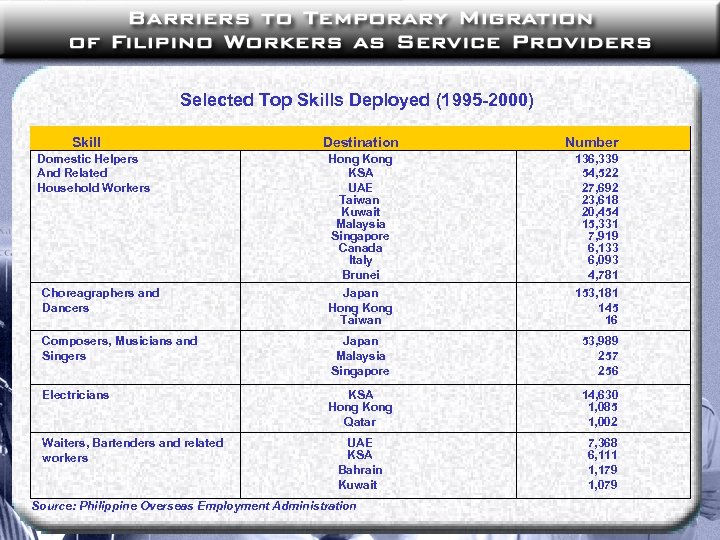 Selected Top Skills Deployed (1995 -2000) Skill Domestic Helpers And Related Household Workers Destination Number Hong KSA UAE Taiwan Kuwait Malaysia Singapore Canada Italy Brunei Japan Hong Kong Taiwan 136, 339 54, 522 27, 692 23, 618 20, 454 15, 331 7, 919 6, 133 6, 093 4, 781 153, 181 145 16 Composers, Musicians and Singers Japan Malaysia Singapore 53, 989 257 256 Electricians KSA Hong Kong Qatar 14, 630 1, 085 1, 002 UAE KSA Bahrain Kuwait 7, 368 6, 111 1, 179 1, 079 Choreagraphers and Dancers Waiters, Bartenders and related workers Source: Philippine Overseas Employment Administration
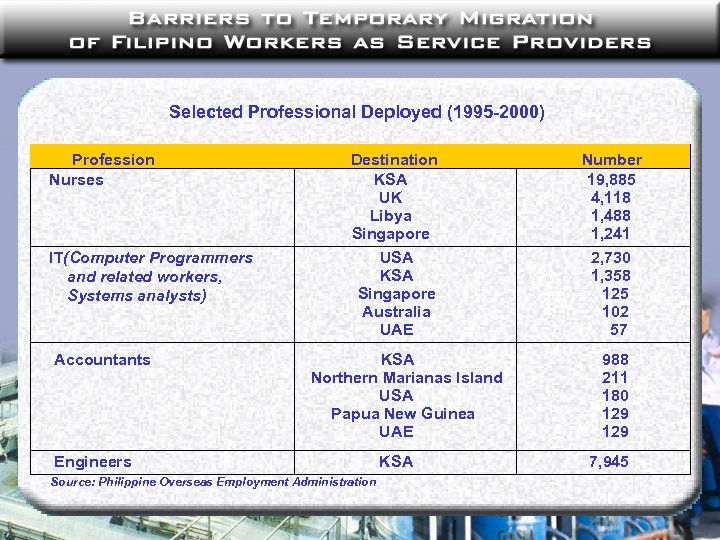 Selected Professional Deployed (1995 -2000) Profession Nurses IT(Computer Programmers and related workers, Systems analysts) Accountants Destination KSA UK Libya Singapore USA KSA Singapore Australia UAE KSA Northern Marianas Island USA Papua New Guinea UAE Engineers Source: Philippine Overseas Employment Administration KSA Number 19, 885 4, 118 1, 488 1, 241 2, 730 1, 358 125 102 57 988 211 180 129 7, 945
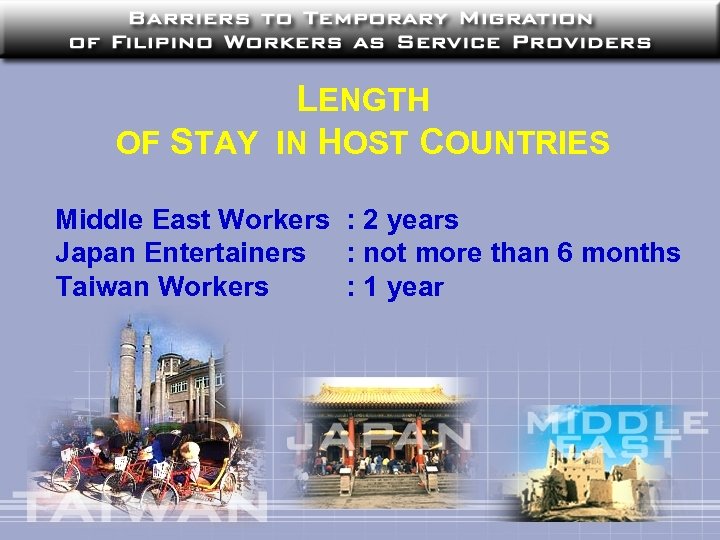 LENGTH OF STAY IN HOST COUNTRIES Middle East Workers : 2 years Japan Entertainers : not more than 6 months Taiwan Workers : 1 year
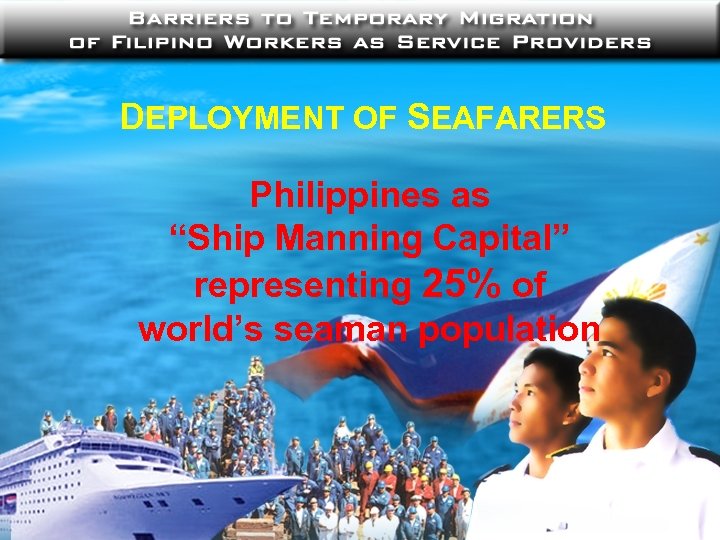 DEPLOYMENT OF SEAFARERS Philippines as “Ship Manning Capital” representing 25% of world’s seaman population
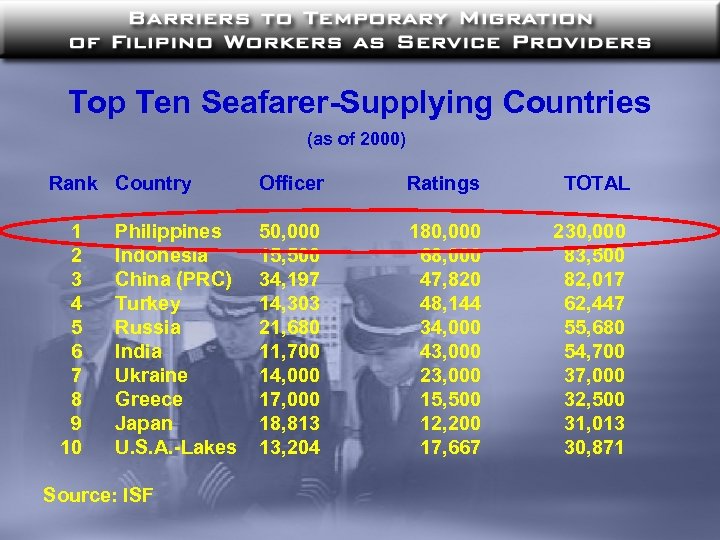 Top Ten Seafarer-Supplying Countries (as of 2000) Rank Country 1 Philippines 2 Indonesia 3 China (PRC) 4 Turkey 5 Russia 6 India 7 Ukraine 8 Greece 9 Japan 10 U. S. A. -Lakes Source: ISF Officer Ratings TOTAL 50, 000 180, 000 230, 000 15, 500 68, 000 83, 500 34, 197 47, 820 82, 017 14, 303 48, 144 62, 447 21, 680 34, 000 55, 680 11, 700 43, 000 54, 700 14, 000 23, 000 37, 000 17, 000 15, 500 32, 500 18, 813 12, 200 31, 013 13, 204 17, 667 30, 871
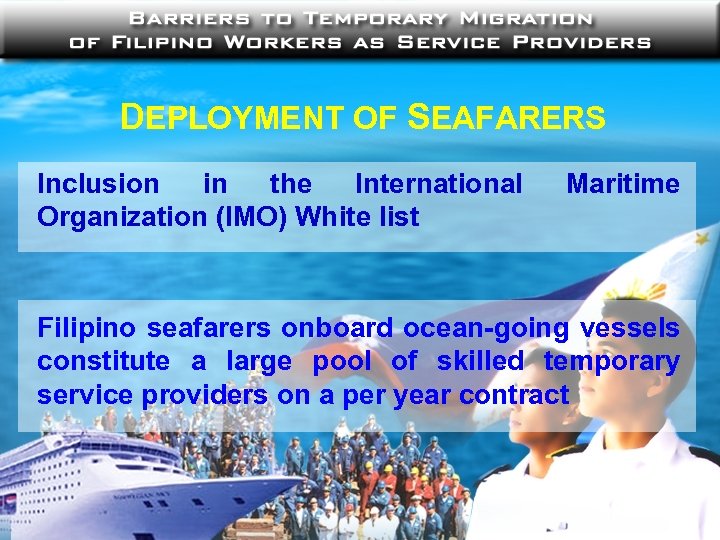 DEPLOYMENT OF SEAFARERS Inclusion in the International Organization (IMO) White list Maritime Filipino seafarers onboard ocean-going vessels constitute a large pool of skilled temporary service providers on a per year contract
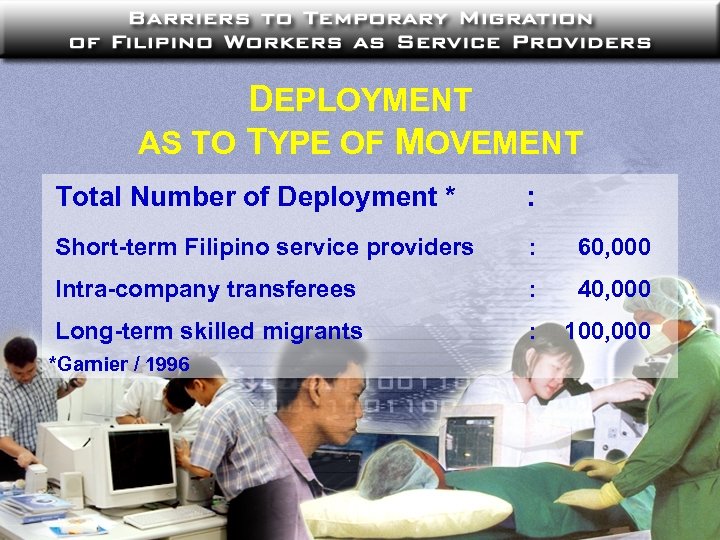 DEPLOYMENT AS TO TYPE OF MOVEMENT Total Number of Deployment * : Short-term Filipino service providers : 60, 000 Intra-company transferees : 40, 000 Long-term skilled migrants : 100, 000 *Garnier / 1996
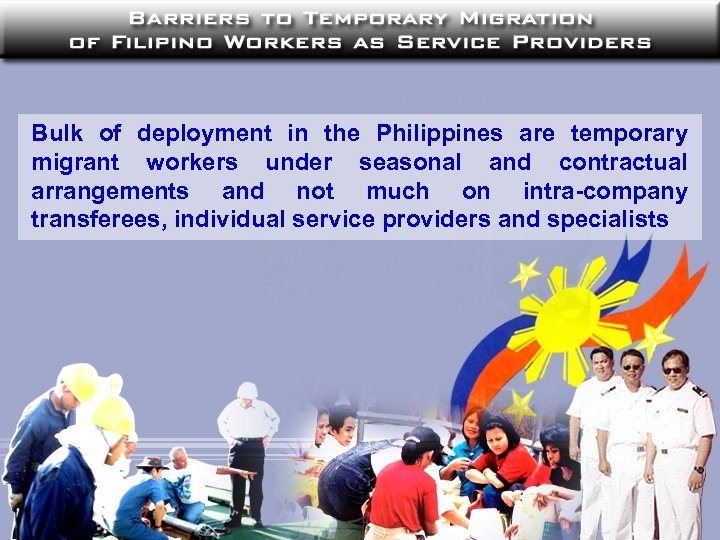 Bulk of deployment in the Philippines are temporary migrant workers under seasonal and contractual arrangements and not much on intra-company transferees, individual service providers and specialists
 BARRIERS OBILITY OF II. TO M FILIPINOS UNDER MODE 4 (PRESENCE OF NATURAL PERSONS)
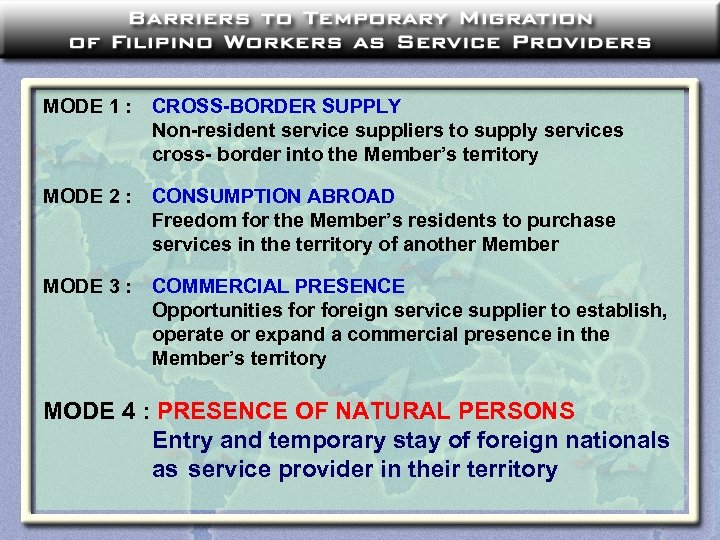 MODE 1 : CROSS-BORDER SUPPLY Non-resident service suppliers to supply services cross- border into the Member’s territory MODE 2 : CONSUMPTION ABROAD Freedom for the Member’s residents to purchase services in the territory of another Member MODE 3 : COMMERCIAL PRESENCE Opportunities foreign service supplier to establish, operate or expand a commercial presence in the Member’s territory MODE 4 : PRESENCE OF NATURAL PERSONS Entry and temporary stay of foreign nationals as service provider in their territory
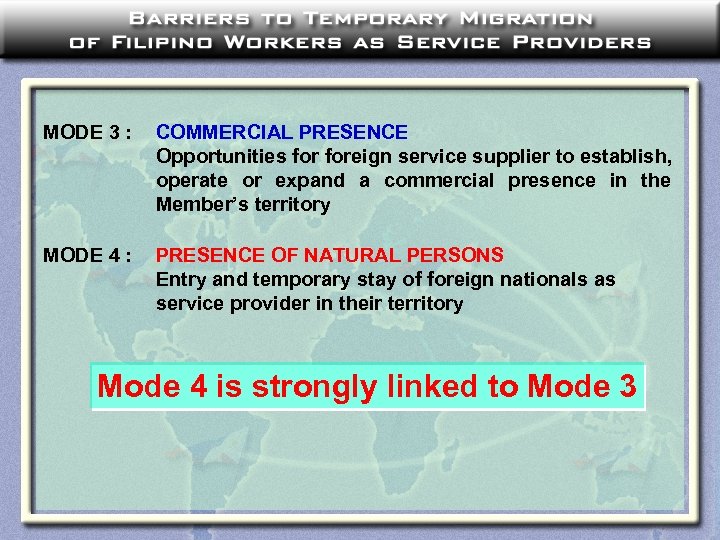 MODE 3 : COMMERCIAL PRESENCE Opportunities foreign service supplier to establish, operate or expand a commercial presence in the Member’s territory MODE 4 : PRESENCE OF NATURAL PERSONS Entry and temporary stay of foreign nationals as service provider in their territory Mode 4 is strongly linked to Mode 3
 • delay the movement of individuals • barriers
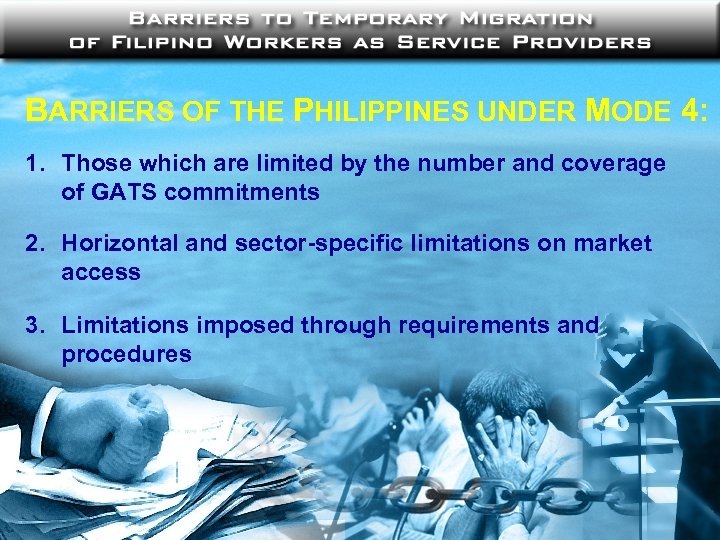 BARRIERS OF THE PHILIPPINES UNDER MODE 4: 1. Those which are limited by the number and coverage of GATS commitments 2. Horizontal and sector-specific limitations on market access 3. Limitations imposed through requirements and procedures
 LIMITED GATS COVERAGE Philippines, like other developing countries, seeks to liberalize commitments in GATS under Mode 4 Developed countries are more cautious in their approach towards Mode 4 while seeking to dismantle the barriers in the other 3 modes
 LIMITED GATS COVERAGE Too much concentration on highly skilled labour and expertise than less skilled labour Both developing and developed countries expect significant gains from GATS However, the hold-off stance of developed countries toward less skilled labour may inhibit success of GATS
 LIMITED GATS COVERAGE Under GATS, bulk of Commitment entries in developing countries consist of intra-corporate transferees (Mode 3) Local businesses in developing countries are hindered by lack of capital and investment to establish commercial presence through branch or subsidiary
 LIMITED GATS COVERAGE 17% of all horizontal entries may cover low-skilled persons in categories as vague as “business sellers”, “non-specified”, and “others” Construction and engineering services (labour-intensive export potential) are confined largely to intra-corporate transferees in highly skilled or managerial capacities
 LIMITED GATS COVERAGE Progress in Mode 4 commitments is reactive to developments Emphasis on high training and expertise on mobility of persons may be related to the expansion of world trade and growing role of intra-firm linkages Reflect the proliference of internal labour market within multinational firms as well as limited institutional frameworks for facilitating exchange of skills
 LIMITED GATS COVERAGE Growth of specialized service providers or professionals is a result of changing demographic patterns in certain developing countries The current Commitments under Mode 4 are only an extension of Commitments in Mode 3
 QUOTA, PRE-EMPLOYMENT AND WAGE REQUIREMENTS Horizontal and Sectoral Commitments on Market Access • Numerical limit to what is allowed (low number of quotas relating to “ordinary staff” and senior staff) • Intra-corporate type of movement tied to the preemployment requirements (at least 1 year residency with the firm) • restriction on work condition, working hours and social security benefits
 RECOGNITION REQUIREMENTS AND PROCEDURES Licensing and qualifications such as sufficient education, experience and training before being allowed entry Impediments: • Variation in the educational system of membercountries • Variation in testing, certification and licensing requirements Because of these variations, service providers are given lower position, salary or benefits even if actual qualifications or skills are comparable
 ADMINISTRATIVE BARRIERS Vague terminologies and definitions used in the Schedule of Commitments resulting to various interpretations • “standard” categories (90 days for business visitors or intra-corporate transferees / 2 to 5 years for other groups such as executives, managers and specialists) ity • eed economic needs or labor market test
 III. TOWARDS GREATER MOBILITY
 • Mode 4 Commitments should move its focus from highly trained and skilled service providers and must be de-linked to commercial presence • Mutual recognition schemes should be pursued even outside of GATS • Address closely the bottlenecks in market access Commitments • Give attention to the limitations on wages and regulations curtailing benefits under mandatory social insurance systems • Overcome administrative barriers
 CONCLUSION • Overseas deployment is an important contributor to the Philippine economy • The key element in expanding trade through Mode 4 is negotiations to reduce barriers and facilitate greater and freer cross-border flows of service providers • Only when a proactive and developmental approach to negotiations is adopted will the GATS agreement achieved its goal of distributing opportunities to all