 Скачать презентацию Jordan s Higher Education Experiences Ala Abu-Samaha Assistant Professor
d88c8219cf6555631dcecfb9990f97a0.ppt
- Количество слайдов: 28



Jordan’s Higher Education Experiences Ala Abu-Samaha Assistant Professor of Information Systems Amman University Amman Jordan A. Abu-Samaha
Overview n n n Jordan’s Higher Education National IT plan Human Resource Development Market Value Case Study: FIT’s computing programme Conclusions A. Abu-Samaha 2
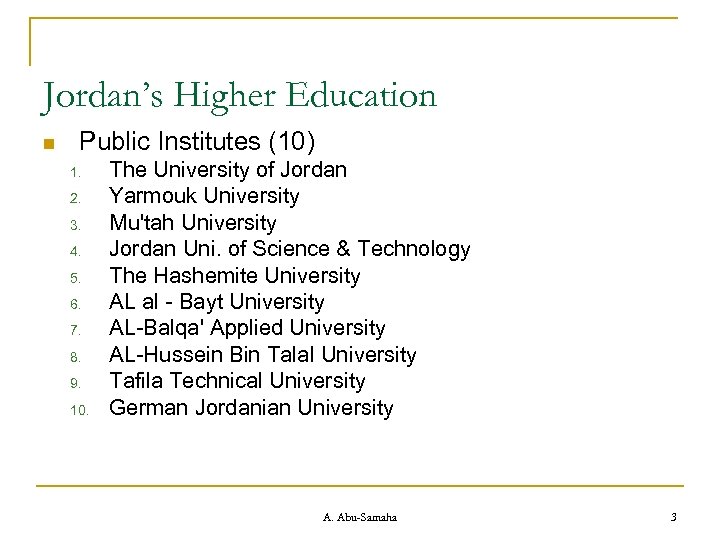
Jordan’s Higher Education n Public Institutes (10) 1. 2. 3. 4. 5. 6. 7. 8. 9. 10. The University of Jordan Yarmouk University Mu'tah University Jordan Uni. of Science & Technology The Hashemite University AL al - Bayt University AL-Balqa' Applied University AL-Hussein Bin Talal University Tafila Technical University German Jordanian University A. Abu-Samaha 3
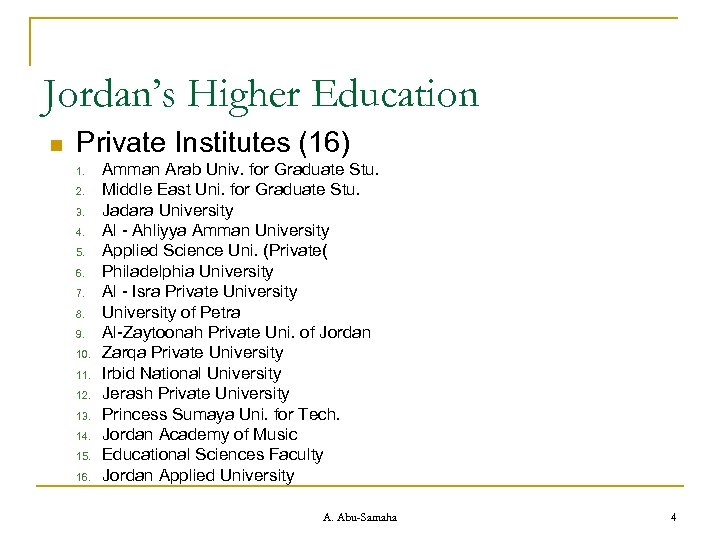
Jordan’s Higher Education n Private Institutes (16) 1. 2. 3. 4. 5. 6. 7. 8. 9. 10. 11. 12. 13. 14. 15. 16. Amman Arab Univ. for Graduate Stu. Middle East Uni. for Graduate Stu. Jadara University Al - Ahliyya Amman University Applied Science Uni. (Private( Philadelphia University Al - Isra Private University of Petra Al-Zaytoonah Private Uni. of Jordan Zarqa Private University Irbid National University Jerash Private University Princess Sumaya Uni. for Tech. Jordan Academy of Music Educational Sciences Faculty Jordan Applied University A. Abu-Samaha 4
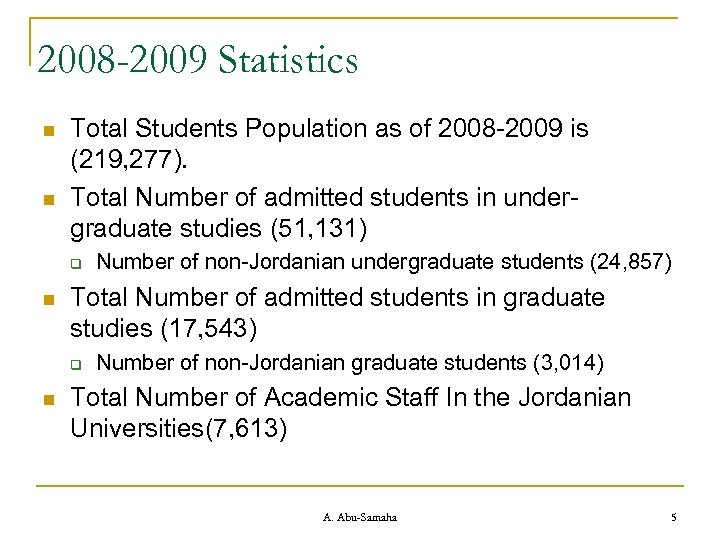
2008 -2009 Statistics n n Total Students Population as of 2008 -2009 is (219, 277). Total Number of admitted students in undergraduate studies (51, 131) q n Total Number of admitted students in graduate studies (17, 543) q n Number of non-Jordanian undergraduate students (24, 857) Number of non-Jordanian graduate students (3, 014) Total Number of Academic Staff In the Jordanian Universities(7, 613) A. Abu-Samaha 5
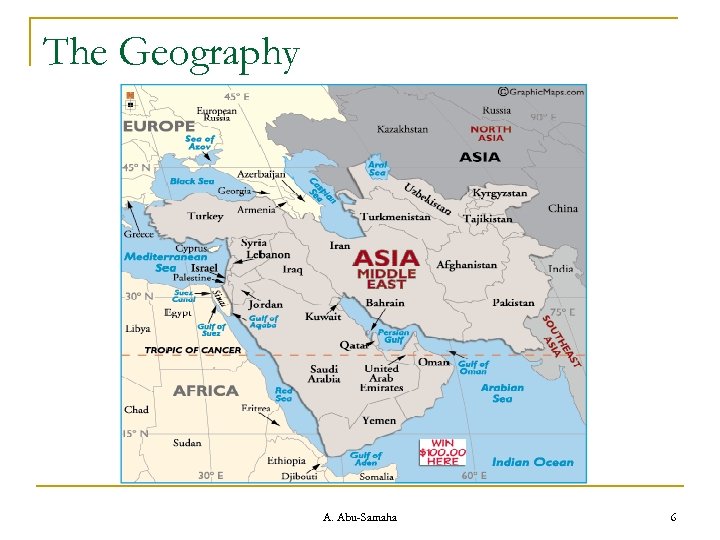
The Geography A. Abu-Samaha 6
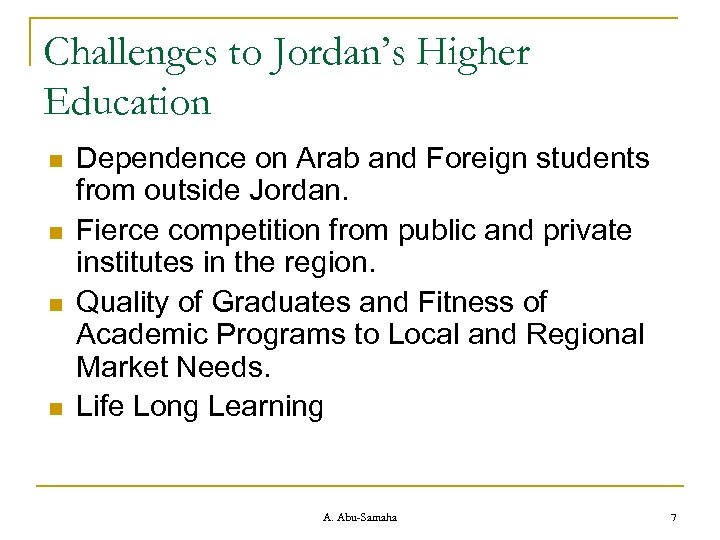
Challenges to Jordan’s Higher Education n n Dependence on Arab and Foreign students from outside Jordan. Fierce competition from public and private institutes in the region. Quality of Graduates and Fitness of Academic Programs to Local and Regional Market Needs. Life Long Learning A. Abu-Samaha 7
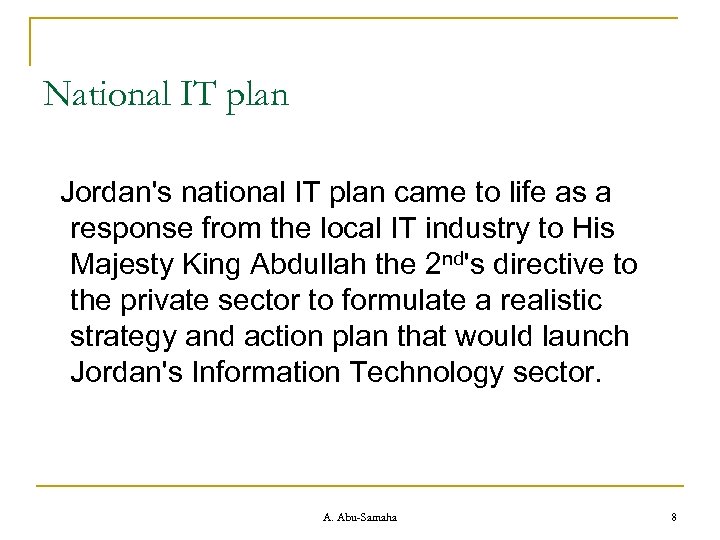
National IT plan Jordan's national IT plan came to life as a response from the local IT industry to His Majesty King Abdullah the 2 nd's directive to the private sector to formulate a realistic strategy and action plan that would launch Jordan's Information Technology sector. A. Abu-Samaha 8
National IT plan REACH n Regulatory framework, n Enabling environment infrastructure, n Advancement of national IT programmes, n Capital and finance, n Human resource development A. Abu-Samaha 9
National IT plan The long-term goal of the Jordanian IT plan n To position Jordan favorably within the knowledge economy. n Transform the local IT industry to an export oriented software development and information technology service industry. A. Abu-Samaha 10
Human Resource Development n n Human resource development in the shape of bachelor, diploma and training courses is perceived by such an initiative to be of paramount importance to realise the national plan. The Information Technology (IT) industry in Jordan has directed many criticisms to Jordanian institutes of higher education regarding the structure and content of programmes offered by IT faculties and departments despite relentless effort to fulfilling shortages in the local and regional markets for adequate IT graduates. A. Abu-Samaha 11
Human Resource Development n n n Computer science education at Jordanian universities does not meet the needs of industry. Limited interaction between universities and the IT industry Limits on the commercialization of research Absence of specialized institutes in the IT area Limited computer resources and awareness at all aspects of educational system A. Abu-Samaha 12
Human Resource Development “The computer science curricula of Jordanian universities have a traditional focus on theory and conceptual understanding, not linked to the needs of the marketplace”. “Students do not have exposure to Project Management, Technical Writing, Graphics, Internet Development, Web Applications, and numerous skill areas demanded by industry. The lack of skills puts a major burden on IT firms in terms of in-house training. ” A. Abu-Samaha 13
Human Resource Development REACH 2. 0 identifies a number of actions to be bring human resource development closer to its market expectations. n n Action 1: Initiate program by IT industry to benefit IT students; Action 2: Work with universities to focus on critical skills; q n Action 3: Strengthen IT industry-universities; q n n To develop curricula and set standards relevant to its human resources needs in critical skills (analysis, critical thinking, decisionmaking and communication) Industry-based collaborative projects to allow university staff to develop professionally while improving the quality and relevance of research and teaching and enabling companies to benefit from the expertise of the universities Action 4: Promote collaborations with overseas universities; Action 5: Establish a Centre of Excellence for software industry A. Abu-Samaha 14
Case Study: FIT’s computing programme n n Amman University is a leading private institute of higher education established in 1990. The University houses 6 faculties: q q q Faculty of Engineering Faculty of Pharmacology Faculty of Management Faculty of Literature and Arts Faculty of Nursing Faculty of Information Technology A. Abu-Samaha 15
Case Study: FIT’s computing programme n n The Faculty of Information Technology/Amman University was established in 2001. The faculty currently offers three programs. An undergraduate major in q q q Computer Science, Computer Information Systems and Software Engineering. A. Abu-Samaha 16
Case Study: FIT’s computing programme Theory - without Practice - is Sterile; Practice - without Theory - is Blind. A. Abu-Samaha 17
FIT’s Survey n n To evaluate market value of the Computing Programmes’ structure and content. A sample of sixty organizations was chosen from the database of INT@J (software/ system development organizations and organisations with a sizable Information Technology Department). A. Abu-Samaha 18
FIT’s Survey n Two Sections: q The respondent was anticipated to indicate the appropriateness of the offered module on a scale of 6 (where 0 means not needed, 1 least needed, 2 may be needed, 3 needed, 4 highly needed, 5 essential). q list any area of knowledge that has not been mentioned and thought to be of an importance to their industrial needs on a scale of 5 (where 1 means least needed, 2 may be needed, 3 needed, 4 highly needed, and 5 essential. A. Abu-Samaha 19
FIT’s Survey n 43 filled copies where returned either by post or by email, q q q q 9 Information technology managers, 4 Project managers, 7 Team leaders, 6 Lead developers, 5 Programmers, 2 Software Engineers, 2 System Administrators, OTHERS. A. Abu-Samaha 20
FIT’s Survey - Findings n Three major areas of knowledge being the most relevant in Computing Programmes to industries' needs: q Systems/Software Development/Engineering and Management: a) Database Design and Management, b) Systems Analysis & Design, c) Project Management, d) Software Architecture And Design, e) Software Testing & Quality Assurance, and f) Information Systems Concepts and Management. A. Abu-Samaha 21
FIT’s Survey - Findings q q Electronic Business Development and Management: a) Internet Technology, b) Computer Networks, d) Internet Application Programming, and e) Information & Computer Security. System/Software Development Tools and Languages: a) Structured Programming, b) Visual Programming, and c) Object Oriented (Java & C++) Programming. A. Abu-Samaha 22
FIT’s Survey - Findings n n The modules that scored the highest (an average importance rate of greater than 4) were: Internet Application Programming, Computer Network, Information & Computer Security, Systems Analysis & Design, and Database Design and Management. The modules that scored the lowest (an importance rate of 2. 00 -2. 49) were: Numerical Analysis and Discrete Mathematics/structures and Computer Organisation & Assembly Language. A. Abu-Samaha 23
FIT’s Survey - Findings n n n Great conformity between market needs and ACM’s Information Systems core knowledge areas. Great disparity between market needs and ACM's Computer Science core knowledge areas. Core knowledge areas like: Discrete Structures; Algorithms; Computer Architecture and Organization; Human-Computer Interaction; Social and Professional Issues have scored lower than expected on the industrial needs importance scale. A. Abu-Samaha 24
FIT’s Survey n n More business oriented areas of knowledge has been perceived to be less important than academically thought. Information Technology Ethics, Filed Training, and Technical Writing scored a higher relevance rate than Graduation Project. A. Abu-Samaha 25
FIT’s Survey- Lacking Knowledge Areas n n n n Research Skills Enterprise Resource Planning Statistics On line database design & concurrency Applied design Business Process Analysis and Reengineering Systems Integration and Auditing n n n A. Abu-Samaha MIS applications in several industries Business Ethics Communication Skills (reporting, presentations, public speaking…) Creative thinking Problem solving – real life problems Team Work 26
FIT’s Survey- Lacking Knowledge Areas n n It shows a change of hearts in terms of industrial needs. Enterprise Resource Planning, Research Skills, Business Process Analysis and Reengineering, Systems Integration and Auditing and Creative thinking are of an increasing importance to local industries’ needs. A. Abu-Samaha 27
References n REACH q n Int@j q n http: //www. moict. gov. jo/ Ministry of Higher Education and Scientific Research q n http: //www. intaj. net/ Ministry of Information & Communications Technology q n http: //www. reach. jo/ http: //www. mohe. gov. jo/ Abu-Samaha, A. M. , “Chapter IX: Relevance of Computing Programmes to Industry Needs in Jordan’s Higher Education Institutes”, in “Information Systems and Technology Education: From the University to the Workplace”, edited by Glenn R. Lowry and Rodney L. Turner, IGI Global, Information Science Reference: Hershey • New York, 2007, pp 195 -213. A. Abu-Samaha 28
Скачать презентацию Jordan s Higher Education Experiences Ala Abu-Samaha Assistant Professor
d88c8219cf6555631dcecfb9990f97a0.ppt