



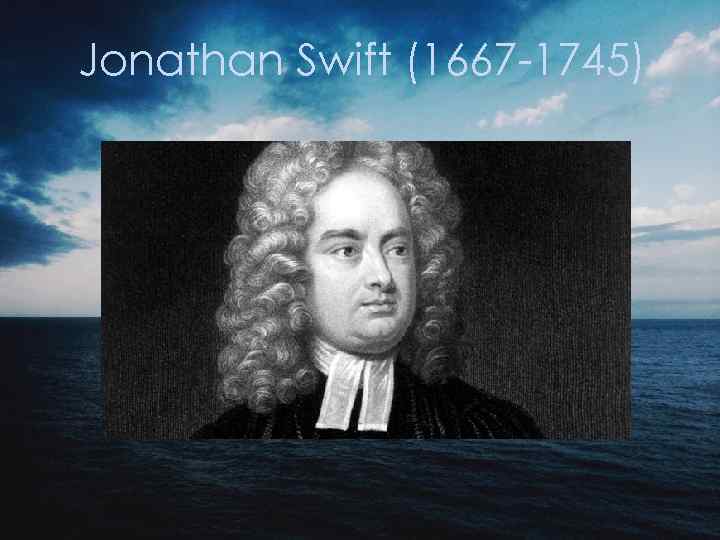
 Jonathan Swift (1667 1745)
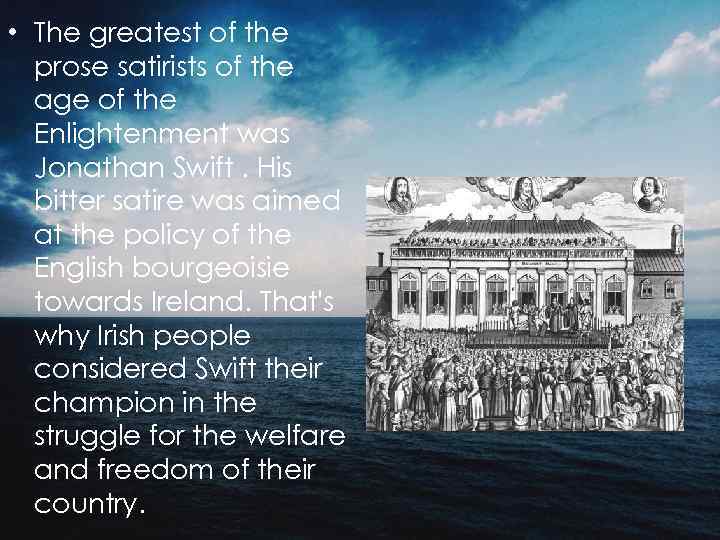 • The greatest of the prose satirists of the age of the Enlightenment was Jonathan Swift. His bitter satire was aimed at the policy of the English bourgeoisie towards Ireland. That's why Irish people considered Swift their champion in the struggle for the welfare and freedom of their country.
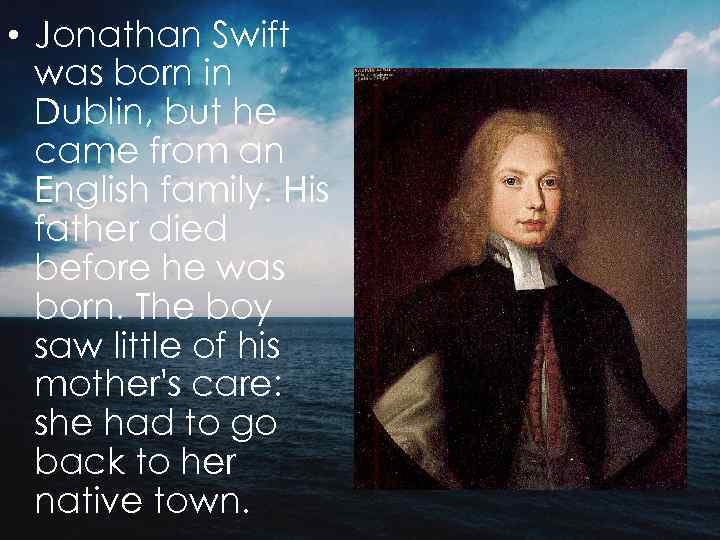 • Jonathan Swift was born in Dublin, but he came from an English family. His father died before he was born. The boy saw little of his mother's care: she had to go back to her native town.
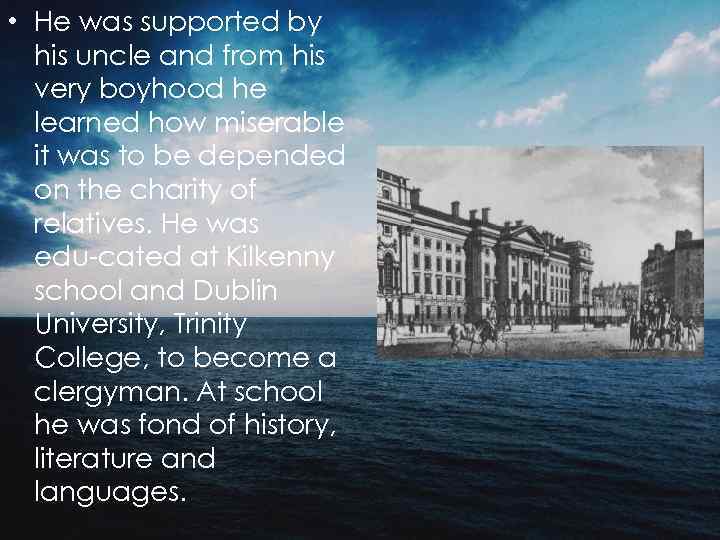 • He was supported by his uncle and from his very boyhood he learned how miserable it was to be depended on the charity of relatives. He was edu cated at Kilkenny school and Dublin University, Trinity College, to become a clergyman. At school he was fond of history, literature and languages.
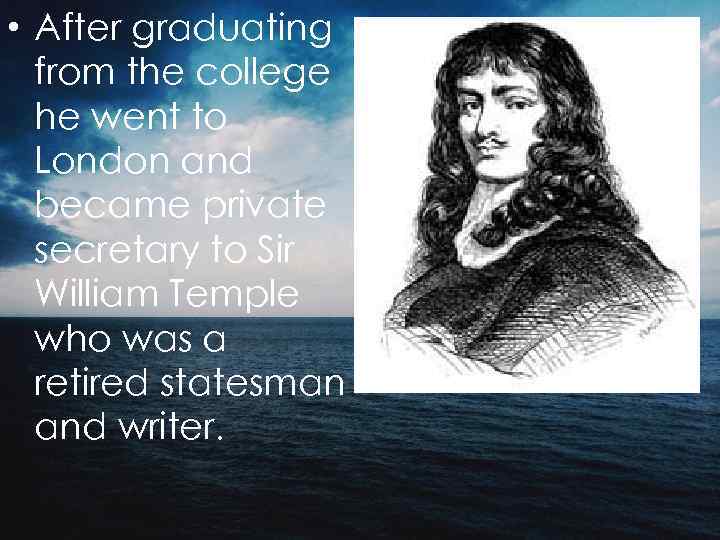 • After graduating from the college he went to London and became private secretary to Sir William Temple who was a retired statesman and writer.
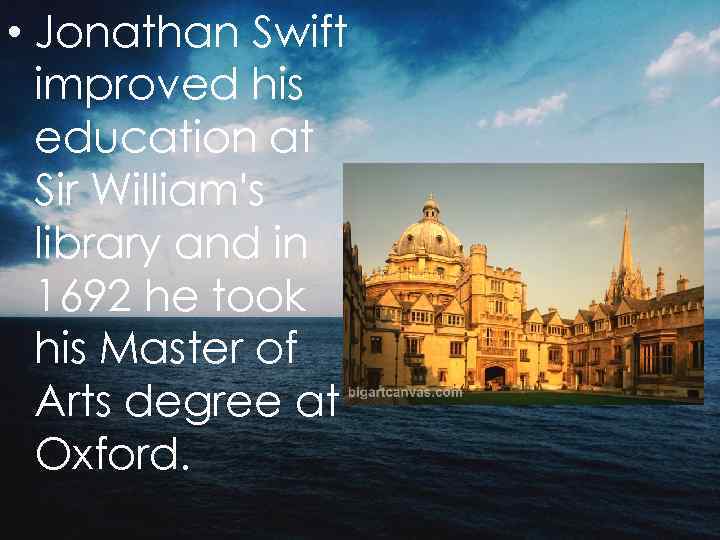 • Jonathan Swift improved his education at Sir William's library and in 1692 he took his Master of Arts degree at Oxford.
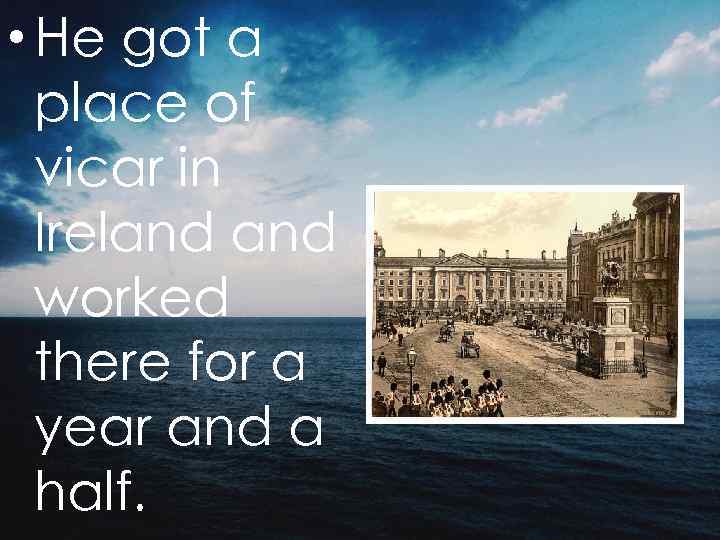 • He got a place of vicar in Ireland worked there for a year and a half.
 • He wrote much and burned most of what he wrote.
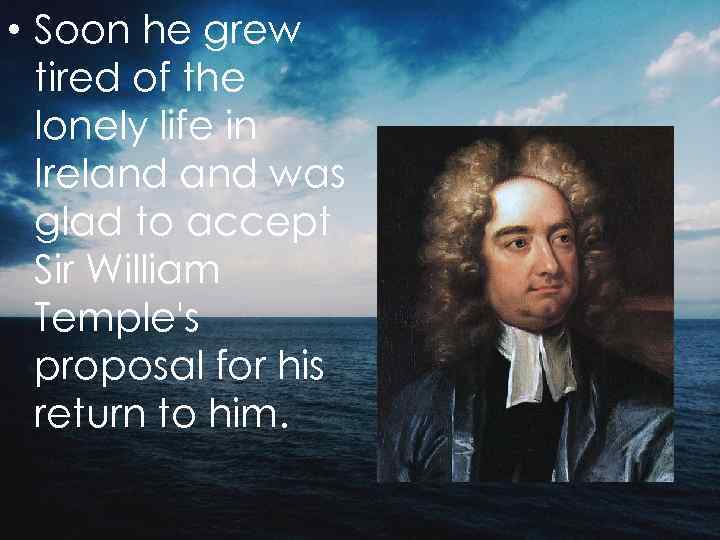 • Soon he grew tired of the lonely life in Ireland was glad to accept Sir William Temple's proposal for his return to him.
 • Swift lived and worked there until Temple's death in 1699.
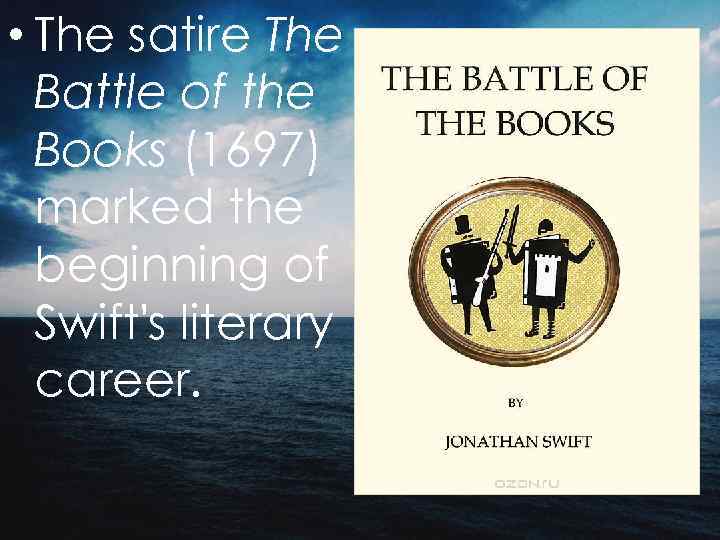 • The satire The Battle of the Books (1697) marked the beginning of Swift's literary career.
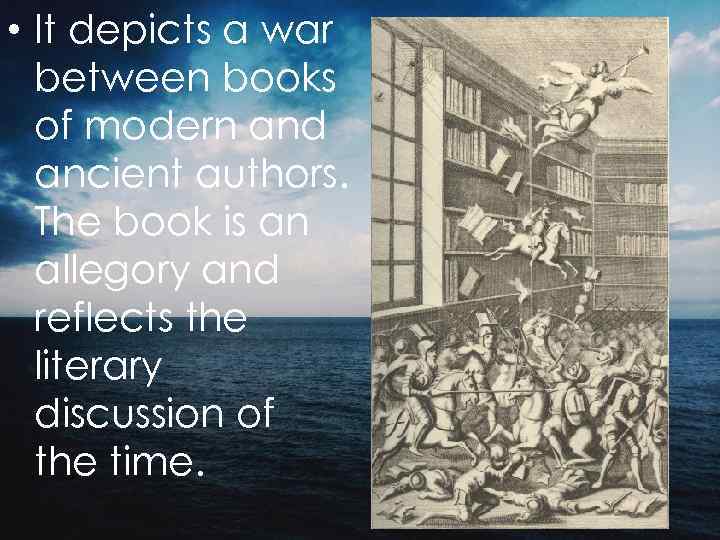 • It depicts a war between books of modern and ancient authors. The book is an allegory and reflects the literary discussion of the time.
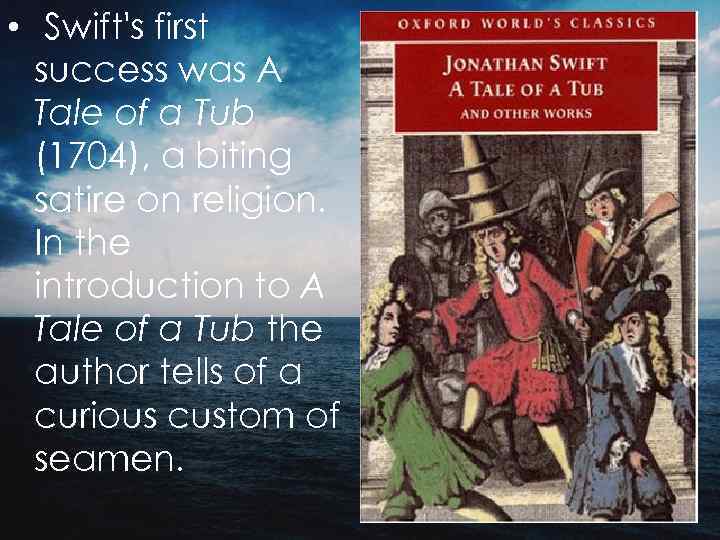 • Swift's first success was A Tale of a Tub (1704), a biting satire on religion. In the introduction to A Tale of a Tub the author tells of a curious custom of seamen.
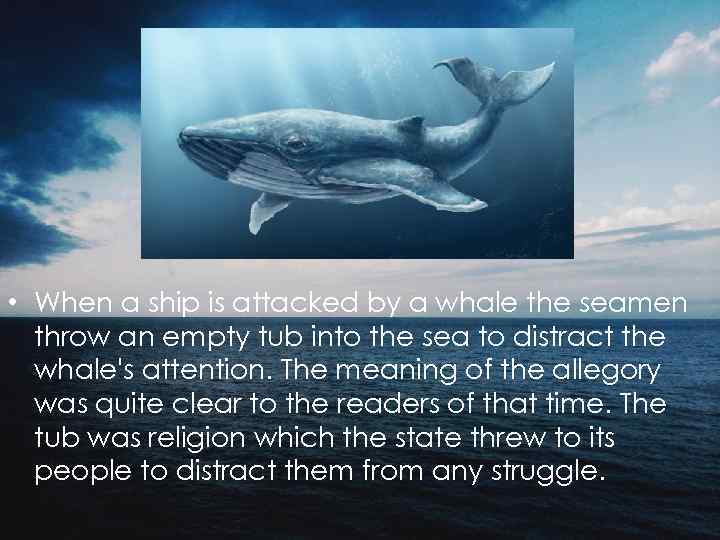 • When a ship is attacked by a whale the seamen throw an empty tub into the sea to distract the whale's attention. The meaning of the allegory was quite clear to the readers of that time. The tub was religion which the state threw to its people to distract them from any struggle.
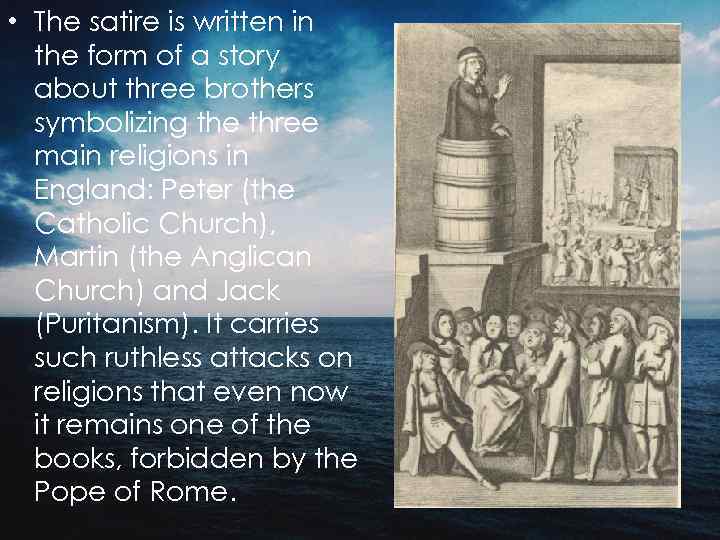 • The satire is written in the form of a story about three brothers symbolizing the three main religions in England: Peter (the Catholic Church), Martin (the Anglican Church) and Jack (Puritanism). It carries such ruthless attacks on religions that even now it remains one of the books, forbidden by the Pope of Rome.
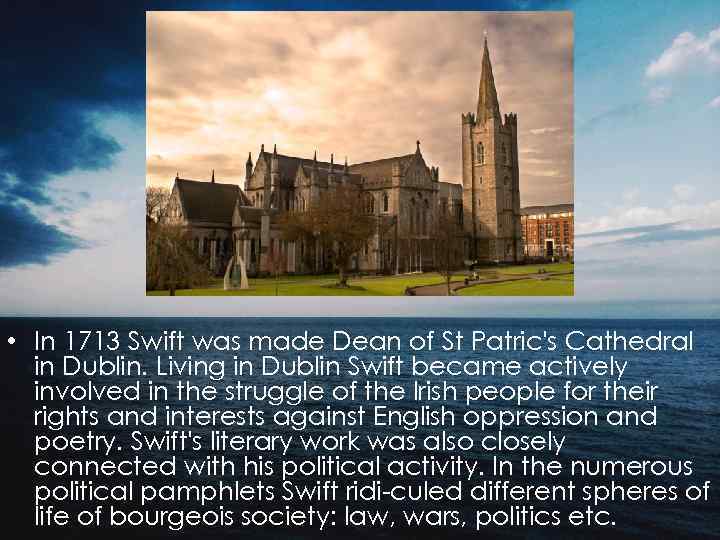 • In 1713 Swift was made Dean of St Patric's Cathedral in Dublin. Living in Dublin Swift became actively involved in the struggle of the Irish people for their rights and interests against English oppression and poetry. Swift's literary work was also closely connected with his political activity. In the numerous political pamphlets Swift ridi culed different spheres of life of bourgeois society: law, wars, politics etc.
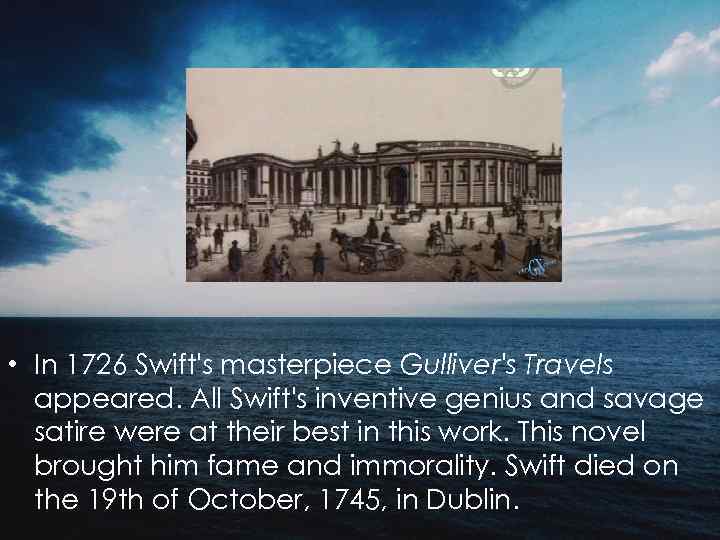 • In 1726 Swift's masterpiece Gulliver's Travels appeared. All Swift's inventive genius and savage satire were at their best in this work. This novel brought him fame and immorality. Swift died on the 19 th of October, 1745, in Dublin.
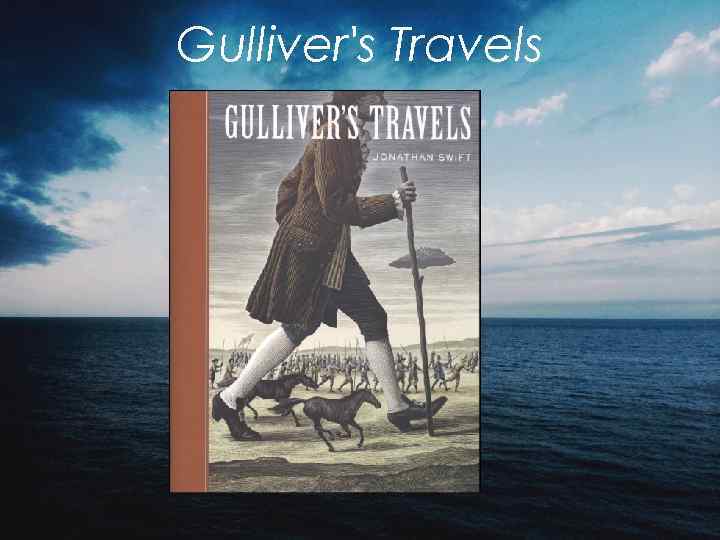 Gulliver's Travels
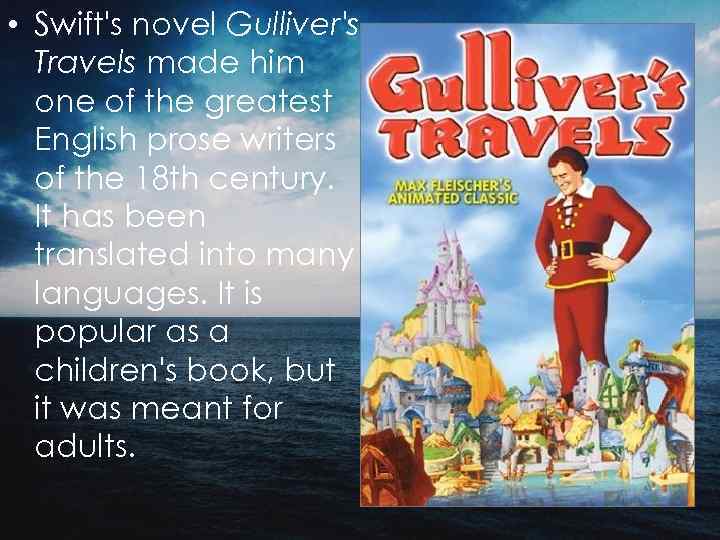 • Swift's novel Gulliver's Travels made him one of the greatest English prose writers of the 18 th century. It has been translated into many languages. It is popular as a children's book, but it was meant for adults.
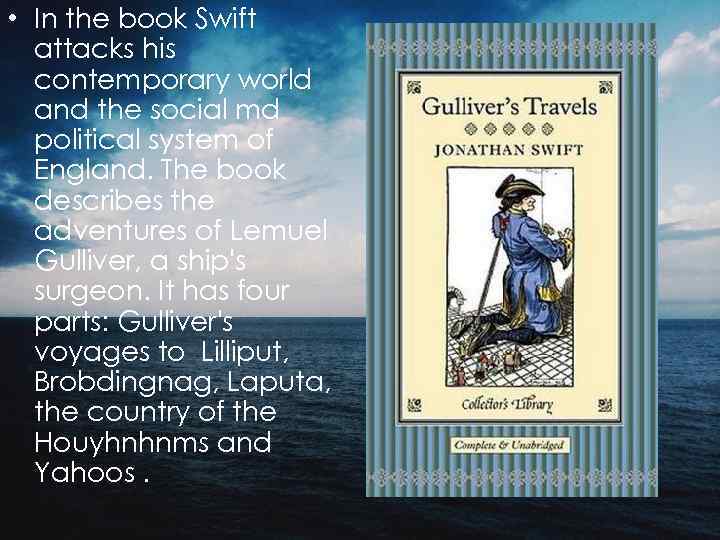 • In the book Swift attacks his contemporary world and the social md political system of England. The book describes the adventures of Lemuel Gulliver, a ship's surgeon. It has four parts: Gulliver's voyages to Lilliput, Brobdingnag, Laputa, the country of the Houyhnhnms and Yahoos.
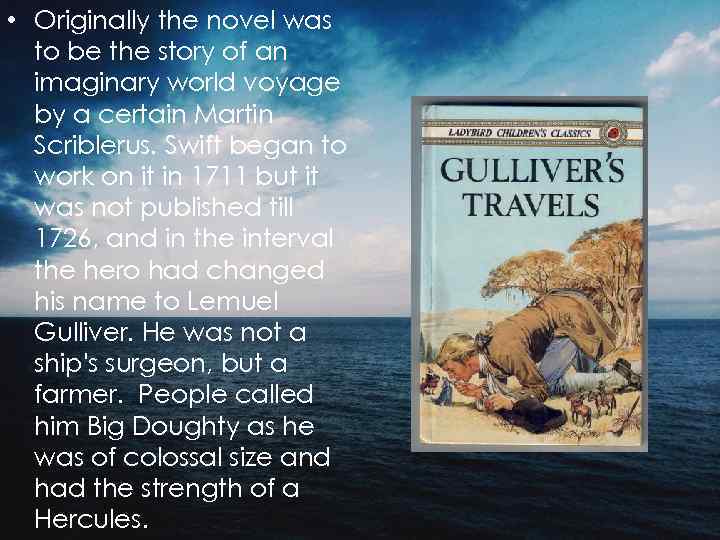 • Originally the novel was to be the story of an imaginary world voyage by a certain Martin Scriblerus. Swift began to work on it in 1711 but it was not published till 1726, and in the interval the hero had changed his name to Lemuel Gulliver. He was not a ship's surgeon, but a farmer. People called him Big Doughty as he was of colossal size and had the strength of a Hercules.
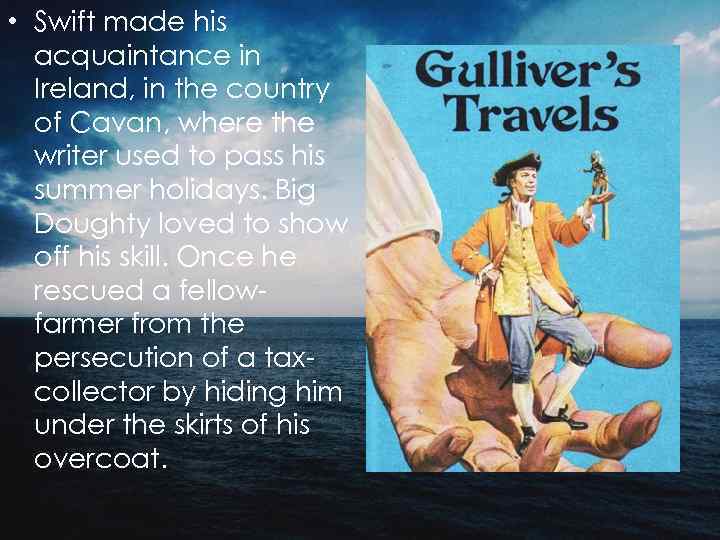 • Swift made his acquaintance in Ireland, in the country of Cavan, where the writer used to pass his summer holidays. Big Doughty loved to show off his skill. Once he rescued a fellow farmer from the persecution of a tax collector by hiding him under the skirts of his overcoat.
 • On another occasion he lifted a poor widow's cow out of pound where it had been imprisoned for straying and delivered it safely to its mistress. The highlight of this show of strength was to carry a horse from one field to another across the fence. This impressed Swift tremendously. That is how Gulliver originated.
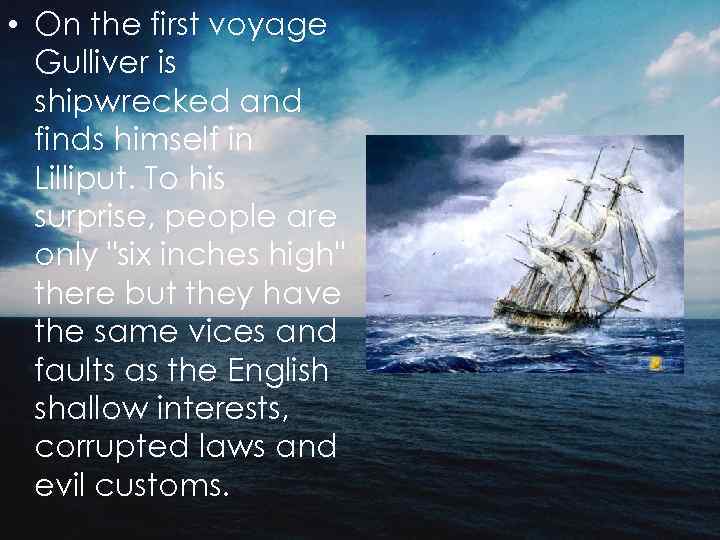 • On the first voyage Gulliver is shipwrecked and finds himself in Lilliput. To his surprise, people are only "six inches high" there but they have the same vices and faults as the English shallow interests, corrupted laws and evil customs.
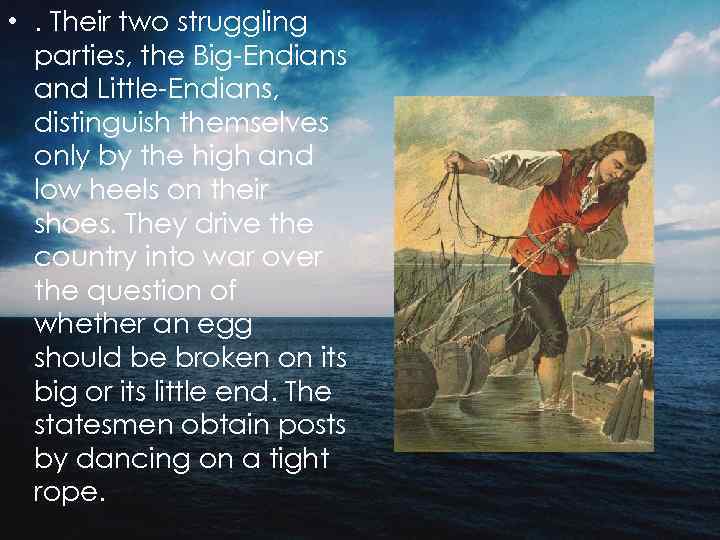 • . Their two struggling parties, the Big Endians and Little Endians, distinguish themselves only by the high and low heels on their shoes. They drive the country into war over the question of whether an egg should be broken on its big or its little end. The statesmen obtain posts by dancing on a tight rope.
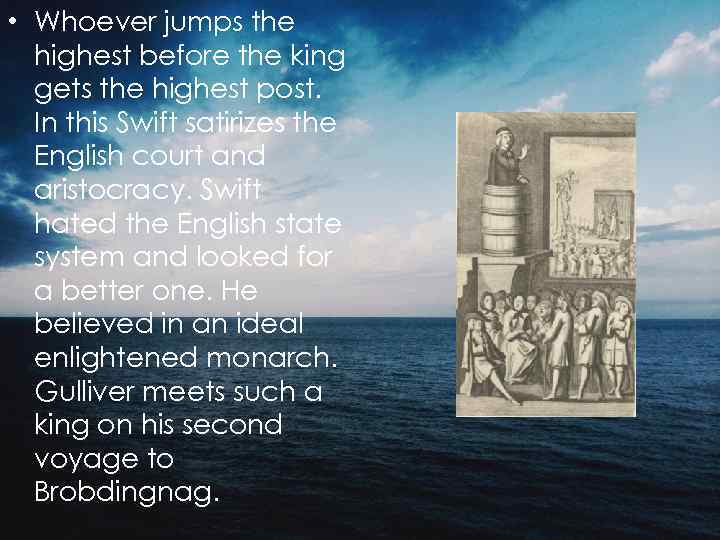 • Whoever jumps the highest before the king gets the highest post. In this Swift satirizes the English court and aristocracy. Swift hated the English state system and looked for a better one. He believed in an ideal enlightened monarch. Gulliver meets such a king on his second voyage to Brobdingnag.
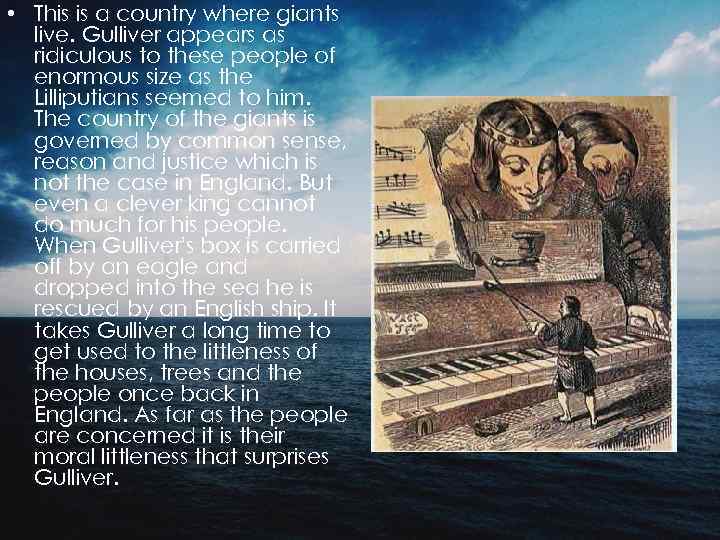 • This is a country where giants live. Gulliver appears as ridiculous to these people of enormous size as the Lilliputians seemed to him. The country of the giants is governed by common sense, reason and justice which is not the case in England. But even a clever king cannot do much for his people. When Gulliver's box is carried off by an eagle and dropped into the sea he is rescued by an English ship. It takes Gulliver a long time to get used to the littleness of the houses, trees and the people once back in England. As far as the people are concerned it is their moral littleness that surprises Gulliver.
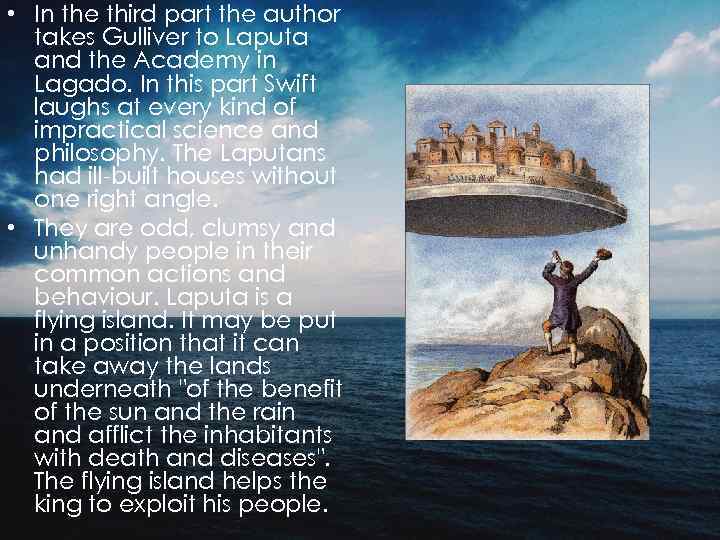 • In the third part the author takes Gulliver to Laputa and the Academy in Lagado. In this part Swift laughs at every kind of impractical science and philosophy. The Laputans had ill built houses without one right angle. • They are odd, clumsy and unhandy people in their common actions and behaviour. Laputa is a flying island. It may be put in a position that it can take away the lands underneath "of the benefit of the sun and the rain and afflict the inhabitants with death and diseases". The flying island helps the king to exploit his people.
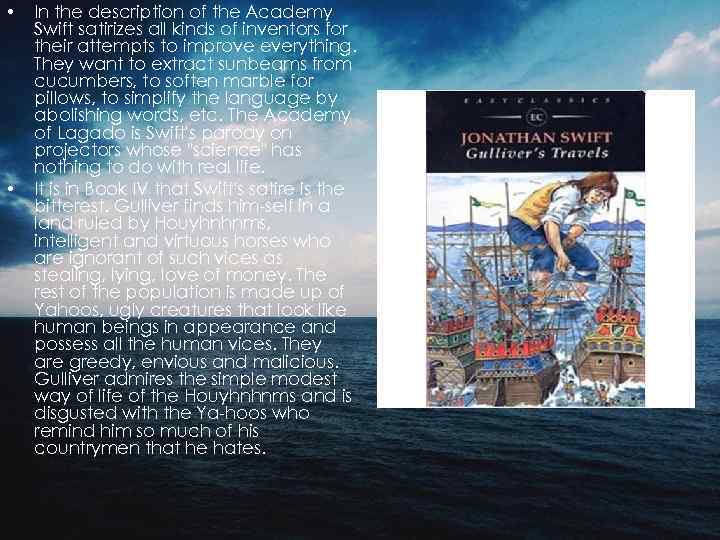 • • In the description of the Academy Swift satirizes all kinds of inventors for their attempts to improve everything. They want to extract sunbeams from cucumbers, to soften marble for pillows, to simplify the language by abolishing words, etc. The Academy of Lagado is Swift's parody on projectors whose "science" has nothing to do with real life. It is in Book IV that Swift's satire is the bitterest. Gulliver finds him self in a land ruled by Houyhnhnms, intelligent and virtuous horses who are ignorant of such vices as stealing, lying, love of money. The rest of the population is made up of Yahoos, ugly creatures that look like human beings in appearance and possess all the human vices. They are greedy, envious and malicious. Gulliver admires the simple modest way of life of the Houyhnhnms and is disgusted with the Ya hoos who remind him so much of his countrymen that he hates.
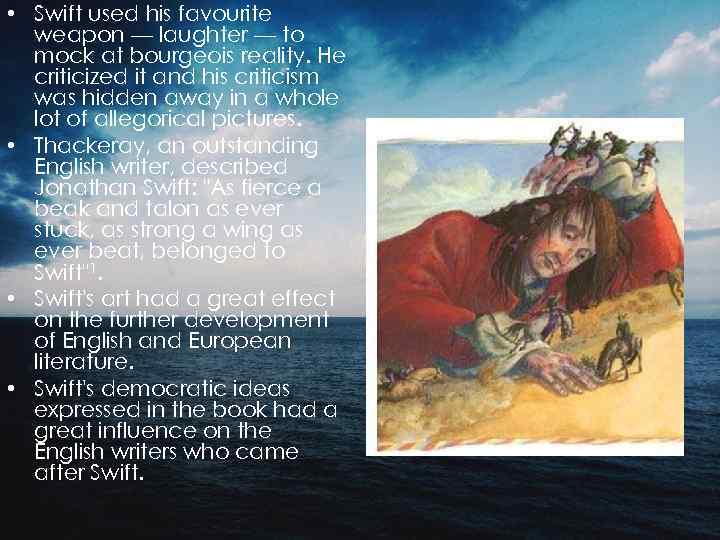 • Swift used his favourite weapon — laughter — to mock at bourgeois reality. He criticized it and his criticism was hidden away in a whole lot of allegorical pictures. • Thackeray, an outstanding English writer, described Jonathan Swift: "As fierce a beak and talon as ever stuck, as strong a wing as ever beat, belonged to Swift"1. • Swift's art had a great effect on the further development of English and European literature. • Swift's democratic ideas expressed in the book had a great influence on the English writers who came after Swift.