


 Скачать презентацию JOINT UNCTAD WTO INFORMAL INFORMATION SESSION ON PRIVATE STANDARDS
0d44d3f4750e5176cd5f188a658227aa.ppt
- Количество слайдов: 27
 JOINT UNCTAD/WTO INFORMAL INFORMATION SESSION ON PRIVATE STANDARDS Private-sector standards on Good Agricultural Practices (GAP) and national GAP initiatives in developing countries Comparison of national experiences René Vossenaar
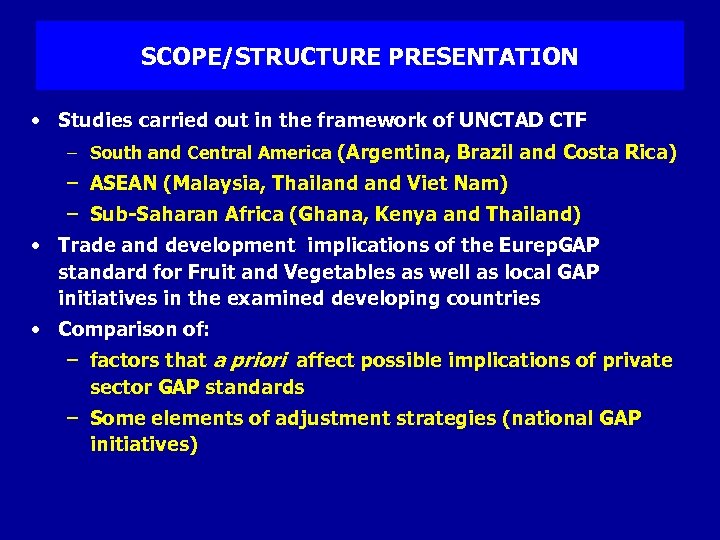 SCOPE/STRUCTURE PRESENTATION • Studies carried out in the framework of UNCTAD CTF – South and Central America (Argentina, Brazil and Costa Rica) – ASEAN (Malaysia, Thailand Viet Nam) – Sub-Saharan Africa (Ghana, Kenya and Thailand) • Trade and development implications of the Eurep. GAP standard for Fruit and Vegetables as well as local GAP initiatives in the examined developing countries • Comparison of: – factors that a priori affect possible implications of private sector GAP standards – Some elements of adjustment strategies (national GAP initiatives)
 Comparison of certain factors that a priori affect possible implications of private sector GAP standards 3
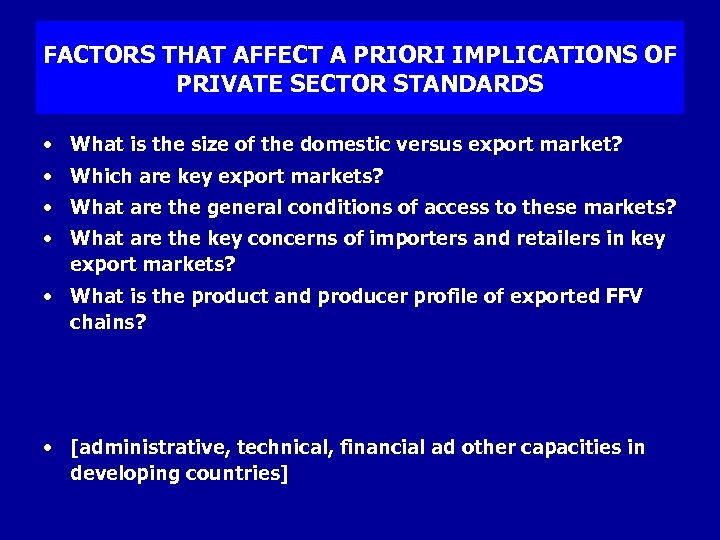 FACTORS THAT AFFECT A PRIORI IMPLICATIONS OF PRIVATE SECTOR STANDARDS • What is the size of the domestic versus export market? • Which are key export markets? • What are the general conditions of access to these markets? • What are the key concerns of importers and retailers in key export markets? • What is the product and producer profile of exported FFV chains? • [administrative, technical, financial ad other capacities in developing countries]
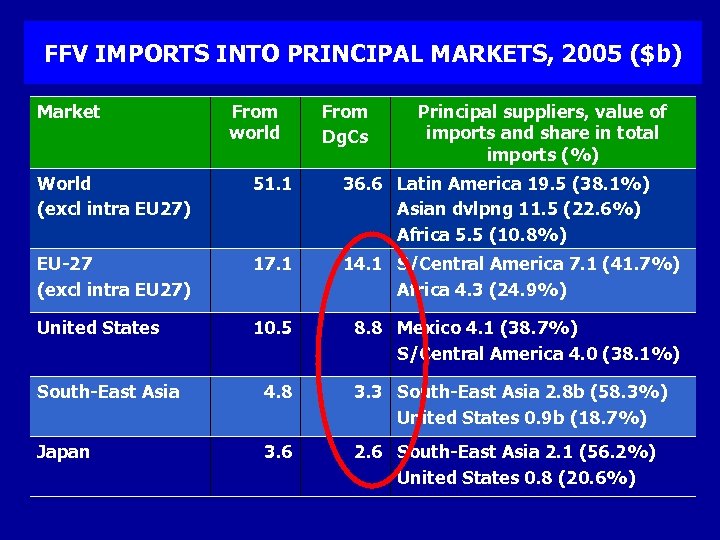 FFV IMPORTS INTO PRINCIPAL MARKETS, 2005 ($b) Market From world From Dg. Cs Principal suppliers, value of imports and share in total imports (%) World (excl intra EU 27) 51. 1 36. 6 Latin America 19. 5 (38. 1%) Asian dvlpng 11. 5 (22. 6%) Africa 5. 5 (10. 8%) EU-27 (excl intra EU 27) 17. 1 14. 1 S/Central America 7. 1 (41. 7%) Africa 4. 3 (24. 9%) United States 10. 5 8. 8 Mexico 4. 1 (38. 7%) S/Central America 4. 0 (38. 1%) South-East Asia 4. 8 3. 3 South-East Asia 2. 8 b (58. 3%) United States 0. 9 b (18. 7%) Japan 3. 6 2. 6 South-East Asia 2. 1 (56. 2%) United States 0. 8 (20. 6%)
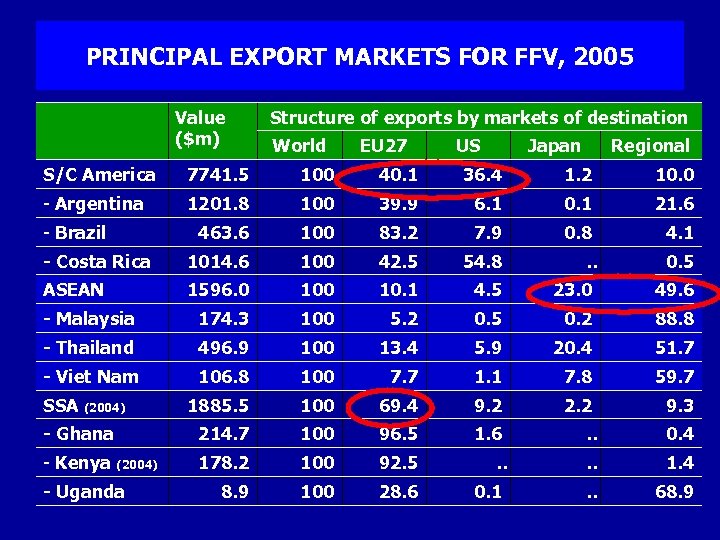 PRINCIPAL EXPORT MARKETS FOR FFV, 2005 Value ($m) Structure of exports by markets of destination World EU 27 US Japan Regional S/C America 7741. 5 100 40. 1 36. 4 1. 2 10. 0 - Argentina 1201. 8 100 39. 9 6. 1 0. 1 21. 6 463. 6 100 83. 2 7. 9 0. 8 4. 1 - Costa Rica 1014. 6 100 42. 5 54. 8 ASEAN 1596. 0 10. 1 4. 5 23. 0 49. 6 - Malaysia 174. 3 100 5. 2 0. 5 0. 2 88. 8 - Thailand 496. 9 100 13. 4 5. 9 20. 4 51. 7 - Viet Nam 106. 8 100 7. 7 1. 1 7. 8 59. 7 1885. 5 100 69. 4 9. 2 2. 2 9. 3 - Ghana 214. 7 100 96. 5 1. 6 - Kenya (2004) 178. 2 100 92. 5 8. 9 100 28. 6 - Brazil SSA (2004) - Uganda . . 0. 1 . . 0. 5 . . 0. 4 . . 1. 4 . . 68. 9
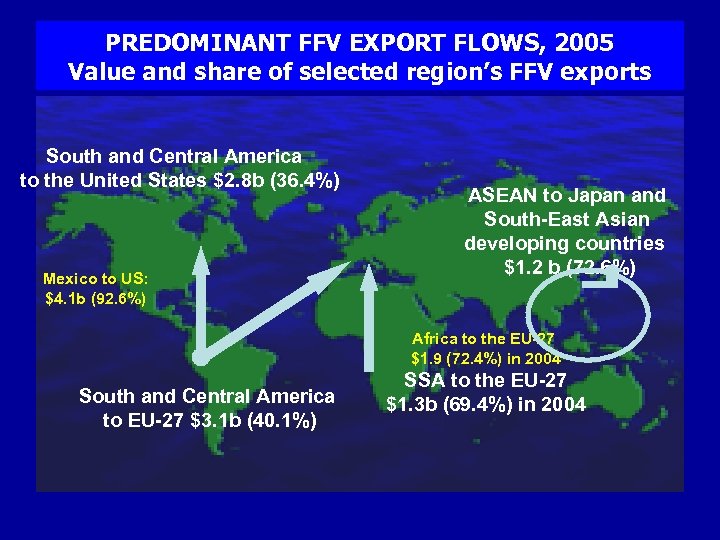 PREDOMINANT FFV EXPORT FLOWS, 2005 Value and share of selected region’s FFV exports • ) South and Central America to the United States $2. 8 b (36. 4%) Mexico to US: $4. 1 b (92. 6%) ASEAN to Japan and South-East Asian developing countries $1. 2 b (72. 6%) Africa to the EU-27 $1. 9 (72. 4%) in 2004 South and Central America to EU-27 $3. 1 b (40. 1%) SSA to the EU-27 $1. 3 b (69. 4%) in 2004
 GOVERNMENT REGULATIONS AND PRIVATE STANDARDS • In certain markets, phytosanitary restrictions based on country of origin reduce the relevance of private-sector standards for producers/exporters in affected countries – US: individual country listings of FFV approved for entry (USDA Fresh Fruit and Vegetables Import Manual) – Japan: the Plant Protection Law prohibits imports of certain FFV from specific countries, although certain products may still be allowed under prescribed conditions of quarantine and after the completion of specified procedures • Certain legislation is transmitted to developing countries through the supply chain, buyer requirements (e. g. EC/178/2002) • Private sector standards and GAP schemes may assist exporters in complying with Government regulations
 PENETRATION OF PRIVATE SECTOR VOLUNTARY STANDARDS IN EUROPEAN MARKETS (FAO STUDY) • Share of product from certified producers difficult to quantify • Private standards increasingly becoming essential (Eurep. GAP for GAP and BRC for packing/handling). Importers and supermarkets (including Eurep. GAP members) also buy noncertified products depending on product availability and price • Demand for private standards depends on markets: essential for large supermarkets and less so for wholesaler, smaller supermarkets, street markets and ethnic/specialty outlets, although their importance is growing in those sectors too • Eurep. GAP certification will become increasingly important. However, there are opportunities for non-certified products as well, which makes it important to implement GAP even if there is no commercial certification
 SOUTH AND CENTRAL AMERICA: LARGER IMPACTS • Principal FFV export markets are EU and US. Intra-regional trade plays a minor role • In both EU and US markets, private-sector GAP standards play a potentially important role. • Consequently, the immediate and direct implications of Eurep. GAP and other private-sector GAP standards for producers/exporters may be significant • Exporters may have to meet multiple GAP standards in external markets (Arg and Bra export largely to EU) • Large exporters have achieved certification where necessary • Smallholders depend on links with exporters, group certification, benchmarking (relatively little donor support)
 ASEAN: RELATIVELY SMALL IMPACTS • ASEAN FFV export principally to regional markets. Only a small portion of exports goes to the EU: 3 per cent of fresh fruit exports and 12. 8 per cent of fresh vegetable exports in 2005 • In most regional markets, the most important challenge for FFV exporters is to meet public-sector SPS regulations. These markets are primarily concerned with issues such as plant diseases, insect problems and the level of pesticide residues. Private-sector standards appear to be a less important factor, at least for the time being. • Consequently, the immediate and direct trade implications of Eurep. GAP and other private-sector GAP standards for ASEAN FFV exports may be relatively small. • Pressure from local supermarkets
 ASEAN: GAP IN REGIONAL TRADE CONTEXT • Government of Thailand encourages producers to adhere to GAP schemes to enhance their capacities to comply with stringent Government regulations in overseas markets. QGAP Plus • China and Japan are developing national GAP schemes and reportedly are seeking Eurep. GAP benchmarking • Adherence to GAP is encouraged in context of Thailand. China free trade agreement (initially agricultural products) • Singapore (a net importer of FFV) has bilateral agreement with Malaysia: faster testing procedures in Singapore for produce from SALM-certified farms
 SUB-SAHARAN AFRICA: EU MARKET ESSENTIAL • EU is clearly the most important export market. Intraregional trade is relatively small • Ghana – Importance of EU market has increased as volume is needed for the effective introduction of new varieties (pineapple, papaya) – Fresh produce industry is trying to develop capacity to link with supermarkets (currently independent buyers and wholesalers) • Kenya – Important links with supermarkets • Uganda – Most FFV exports to the EU go to wholesale markets in the United Kingdom and small supermarkets in the Netherlands. From this perspective, there is no immediate pressure to certify against Eurep. GAP
 SSA: LARGE DONOR PRESENCE • Large donor presence to support horticultural production (food safety, traceability, etcetera) • Large donor support for Eurep. GAP certification (training, certification, laboratory costs and, sometimes, initial investment costs) • Small-scale growers can comply only with continued financial support.
 IMPACTS OF EUREPGAP IN SSA • Positive: meeting regulatory and buyer’s requirements – In Ghana, involvement with Eurep. GAP and later the Pesticide Initiative started after pineapples were found to exceed EU MRLs – Meeting buyers’ requirements, e. g. regarding traceability • Benefits from GAP implementation • Negative: marginalization of small-growers (NRI/IIED) – In Kenya, since introduction of Eurep. GAP standard in Sep 2003, exporters started to ask growers to certify – By mid 2006, 60% of smallgrowers had been dropped by exporters or withdrawn from Eurep. GAP compliance schemes, largely because of lack of financial viability • Smallgrowers may become dependent on donors/buyers for access to export markets 15
 Comparison of some aspects of adjustment strategies 16
 ADJUSTMENT STRATEGIES • What are the key objectives and issues addressed in national GAP initiatives? • What lessons can be learned from national experiences with different options for Eurep. GAP certification, in particular benchmarking of national GAP schemes? • What lessons can be learned from the country experiences for national strategies on GAP, from a trade and development perspective in particular with regard to the role of the Government, the private sector and other stakeholders?
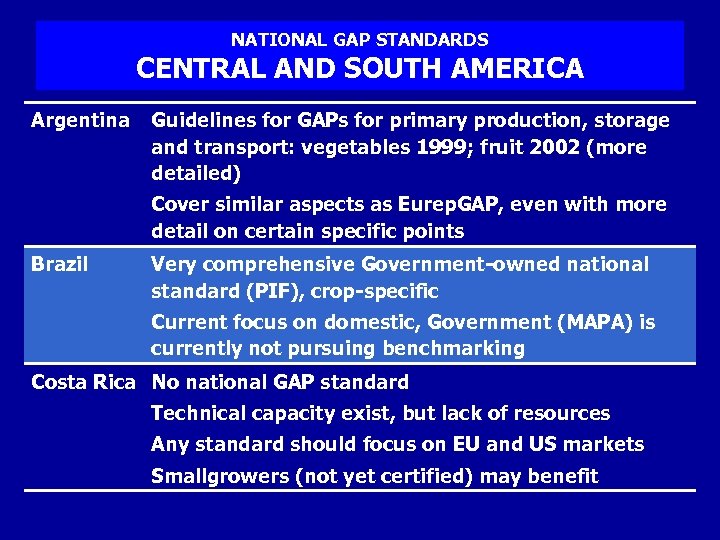 NATIONAL GAP STANDARDS CENTRAL AND SOUTH AMERICA Argentina Guidelines for GAPs for primary production, storage and transport: vegetables 1999; fruit 2002 (more detailed) Cover similar aspects as Eurep. GAP, even with more detail on certain specific points Brazil Very comprehensive Government-owned national standard (PIF), crop-specific Current focus on domestic, Government (MAPA) is currently not pursuing benchmarking Costa Rica No national GAP standard Technical capacity exist, but lack of resources Any standard should focus on EU and US markets Smallgrowers (not yet certified) may benefit
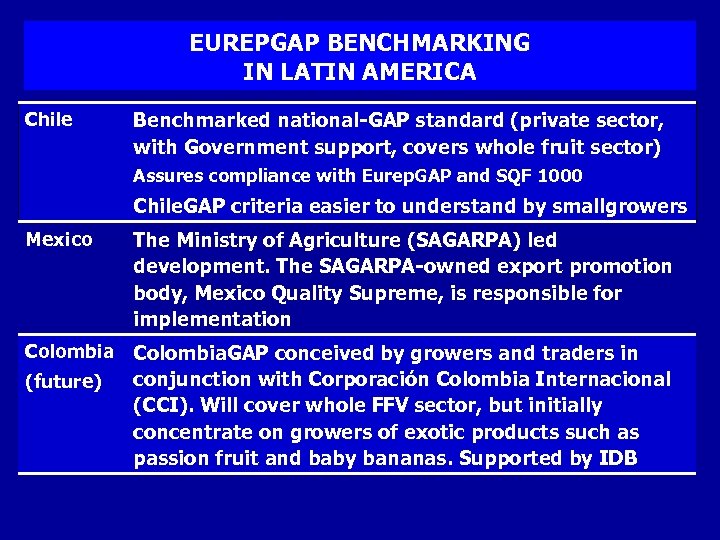 EUREPGAP BENCHMARKING IN LATIN AMERICA Chile Benchmarked national-GAP standard (private sector, with Government support, covers whole fruit sector) Assures compliance with Eurep. GAP and SQF 1000 Chile. GAP criteria easier to understand by smallgrowers Mexico The Ministry of Agriculture (SAGARPA) led development. The SAGARPA-owned export promotion body, Mexico Quality Supreme, is responsible for implementation Colombia. GAP conceived by growers and traders in (future) conjunction with Corporación Colombia Internacional (CCI). Will cover whole FFV sector, but initially concentrate on growers of exotic products such as passion fruit and baby bananas. Supported by IDB
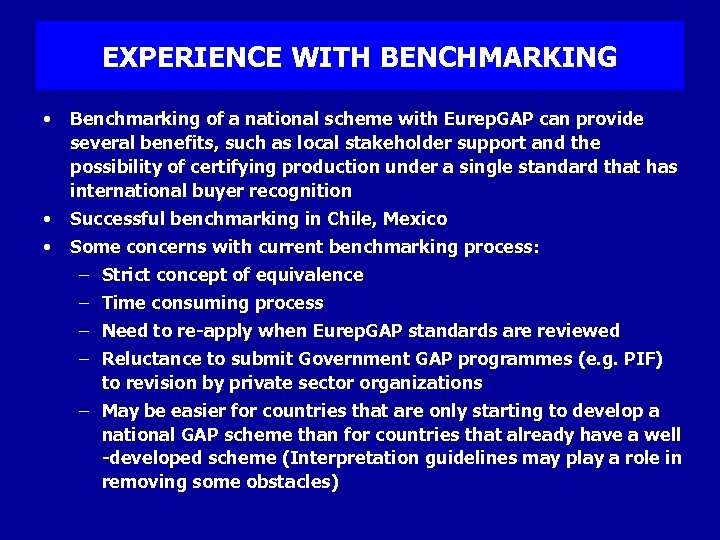 EXPERIENCE WITH BENCHMARKING • Benchmarking of a national scheme with Eurep. GAP can provide several benefits, such as local stakeholder support and the possibility of certifying production under a single standard that has international buyer recognition • Successful benchmarking in Chile, Mexico • Some concerns with current benchmarking process: – Strict concept of equivalence – Time consuming process – Need to re-apply when Eurep. GAP standards are reviewed – Reluctance to submit Government GAP programmes (e. g. PIF) to revision by private sector organizations – May be easier for countries that are only starting to develop a national GAP scheme than for countries that already have a well -developed scheme (Interpretation guidelines may play a role in removing some obstacles)
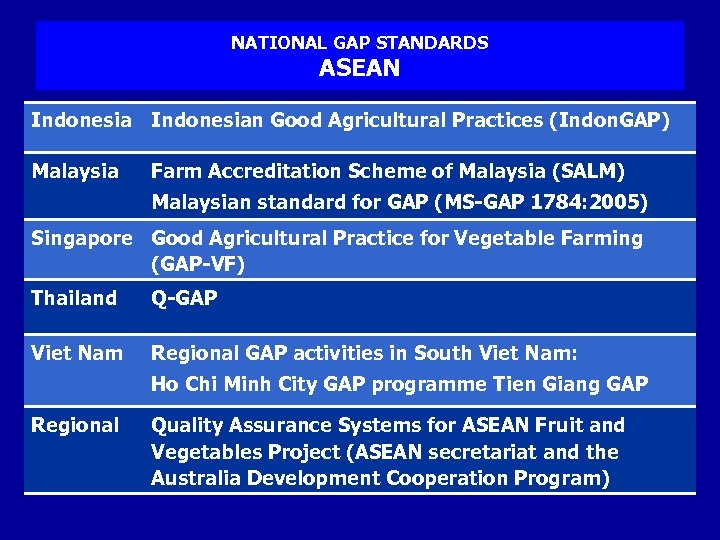 NATIONAL GAP STANDARDS ASEAN Indonesian Good Agricultural Practices (Indon. GAP) Malaysia Farm Accreditation Scheme of Malaysia (SALM) Malaysian standard for GAP (MS-GAP 1784: 2005) Singapore Good Agricultural Practice for Vegetable Farming (GAP-VF) Thailand Q-GAP Viet Nam Regional GAP activities in South Viet Nam: Ho Chi Minh City GAP programme Tien Giang GAP Regional Quality Assurance Systems for ASEAN Fruit and Vegetables Project (ASEAN secretariat and the Australia Development Cooperation Program)
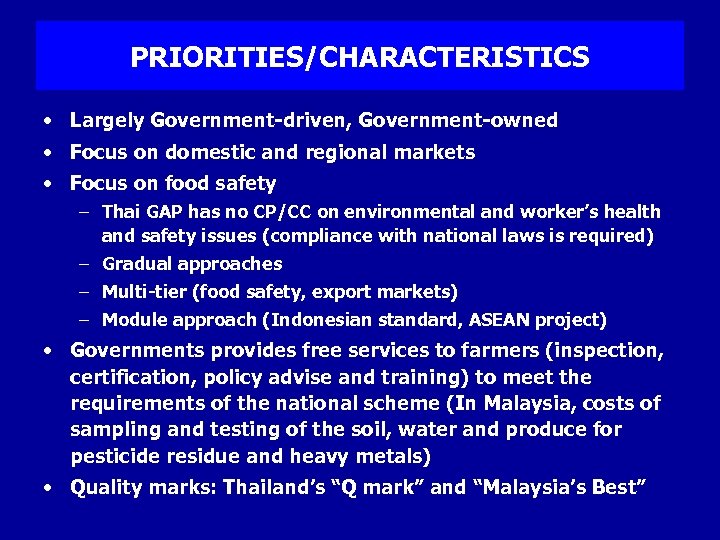 PRIORITIES/CHARACTERISTICS • Largely Government-driven, Government-owned • Focus on domestic and regional markets • Focus on food safety – Thai GAP has no CP/CC on environmental and worker’s health and safety issues (compliance with national laws is required) – Gradual approaches – Multi-tier (food safety, export markets) – Module approach (Indonesian standard, ASEAN project) • Governments provides free services to farmers (inspection, certification, policy advise and training) to meet the requirements of the national scheme (In Malaysia, costs of sampling and testing of the soil, water and produce for pesticide residue and heavy metals) • Quality marks: Thailand’s “Q mark” and “Malaysia’s Best”
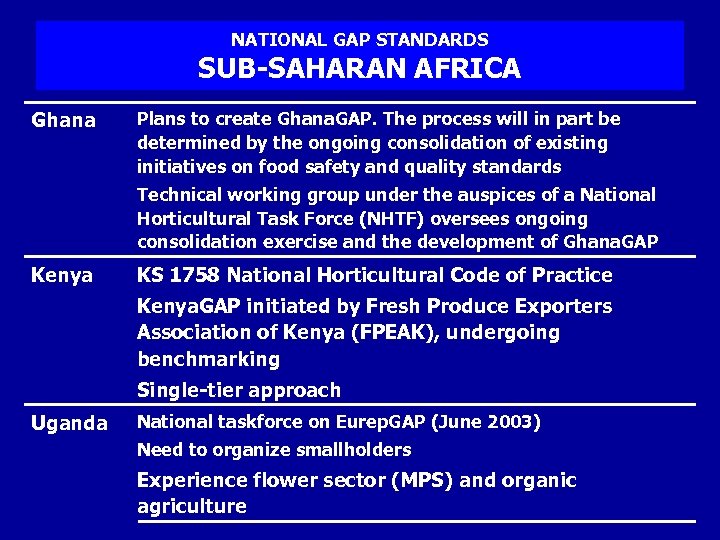 NATIONAL GAP STANDARDS SUB-SAHARAN AFRICA Ghana Plans to create Ghana. GAP. The process will in part be determined by the ongoing consolidation of existing initiatives on food safety and quality standards Technical working group under the auspices of a National Horticultural Task Force (NHTF) oversees ongoing consolidation exercise and the development of Ghana. GAP Kenya KS 1758 National Horticultural Code of Practice Kenya. GAP initiated by Fresh Produce Exporters Association of Kenya (FPEAK), undergoing benchmarking Single-tier approach Uganda National taskforce on Eurep. GAP (June 2003) Need to organize smallholders Experience flower sector (MPS) and organic agriculture
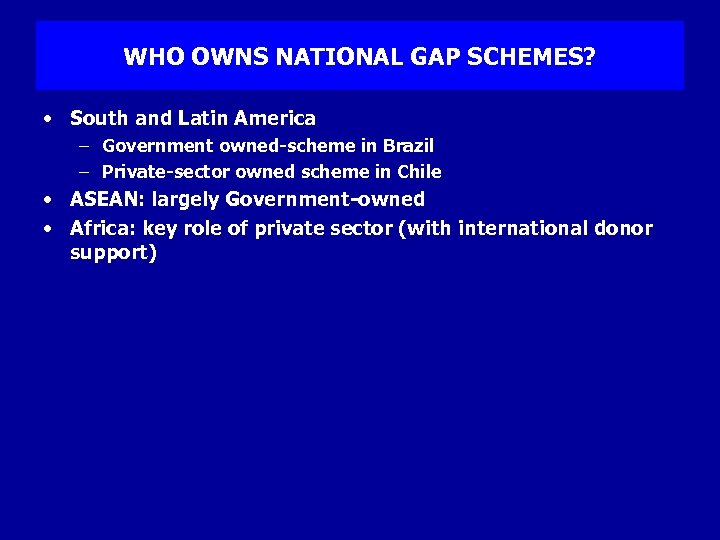 WHO OWNS NATIONAL GAP SCHEMES? • South and Latin America – Government owned-scheme in Brazil – Private-sector owned scheme in Chile • ASEAN: largely Government-owned • Africa: key role of private sector (with international donor support)
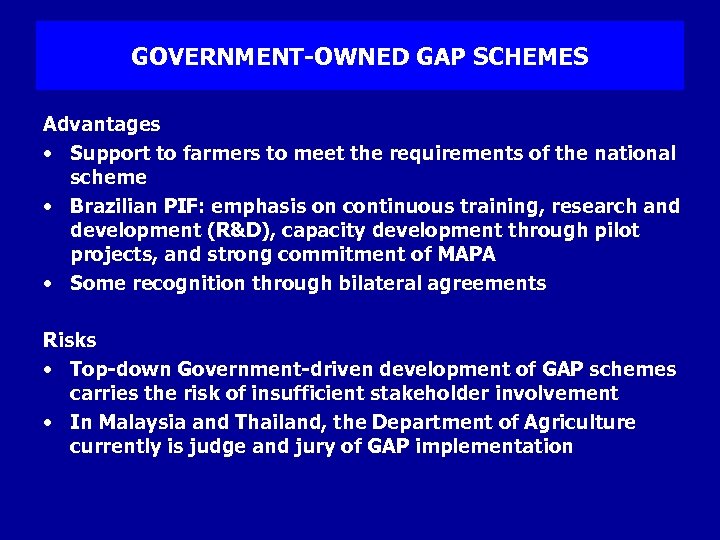 GOVERNMENT-OWNED GAP SCHEMES Advantages • Support to farmers to meet the requirements of the national scheme • Brazilian PIF: emphasis on continuous training, research and development (R&D), capacity development through pilot projects, and strong commitment of MAPA • Some recognition through bilateral agreements Risks • Top-down Government-driven development of GAP schemes carries the risk of insufficient stakeholder involvement • In Malaysia and Thailand, the Department of Agriculture currently is judge and jury of GAP implementation
 ROLE OF GOVERNMENT From strategic perspective • Promoting and facilitating the design and implementation of national GAP standards in a way that meets domestic and international buyers’ requirements. Assessing and prioritizing the country’s needs • Promoting dialogues with stakeholders and clarifying the role and responsibilities of government agencies as well as private-sector entities (laboratories, third-party certification bodies, consultants, training and research institutes, food producer associations) • Providing technical and financial support and fostering enabling legal/regulatory environment. Public-private partnerships.
 CONCLUSIONS • Common and differential elements in implications of private sector standards and in adjustment approaches • The development of national (or regional) GAP schemes requires a clear understanding of their objectives and strategies to be followed • National GAP schemes should adequately balance the requirements in domestic and export markets, paying special attention to the needs of small-scale producers, based on a realistic evaluation of existing capacity and the potential for its development. Multi-tier approaches may be appropriate in some cases • The most important way of achieving this is by ensuring that standards development is carried out in close consultation with all key stakeholders