


 Скачать презентацию Joint tracking in Friction Stir Welding Paul Fleming
88584da7ab5afbf23974645792963e5f.ppt
- Количество слайдов: 26
 Joint tracking in Friction Stir Welding Paul Fleming Vanderbilt University Welding Automation Laboratory
 Introduction n This research presents methods for ¨ monitoring of tool alignment relative to the joint -seam in Friction Stir Welding ¨ techniques for implementing automatic seamtracking for Friction Stir Welding
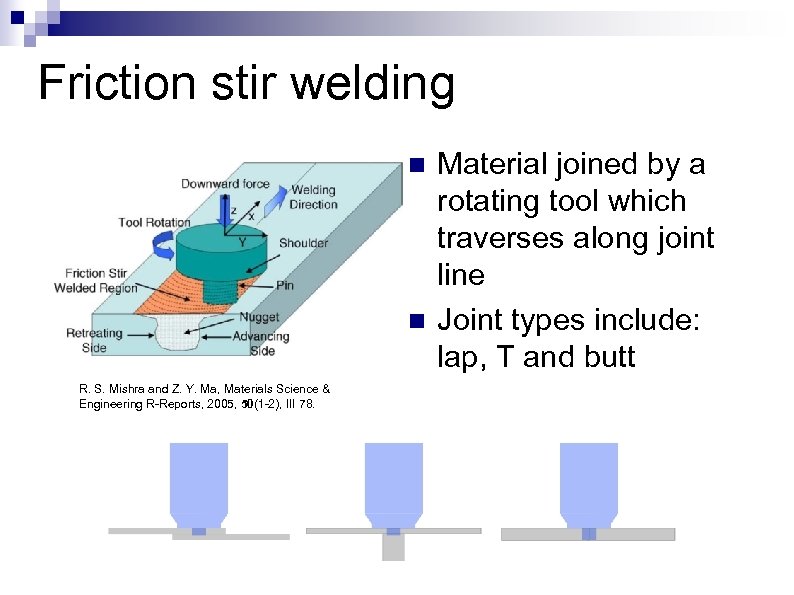 Friction stir welding n n R. S. Mishra and Z. Y. Ma, Materials Science & Engineering R-Reports, 2005, 50(1 -2), III 78. Material joined by a rotating tool which traverses along joint line Joint types include: lap, T and butt
 Goal of this research n n Develop system capable of detecting the lateral position of the FSW with respect to a desired position such as centered about the weld seam Develop system which utilizes above estimator in a feedback control system in order to maintain a desired lateral position or alignment ¨ This n is “Through the Tool Tracking” (TTT) Patent pending serial number 12/130, 622
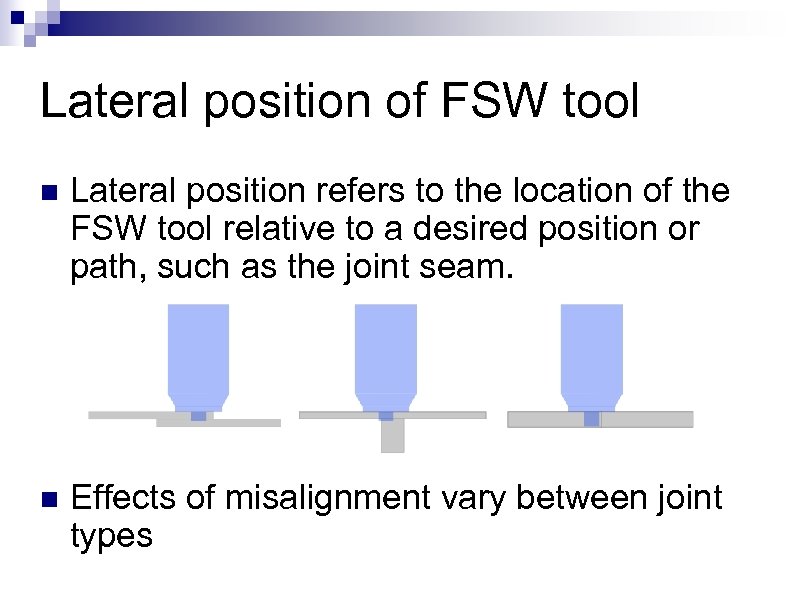 Lateral position of FSW tool n Lateral position refers to the location of the FSW tool relative to a desired position or path, such as the joint seam. n Effects of misalignment vary between joint types
 Purpose of research n In-system quality check ¨ misalignment can cause a number of quality flaws and in some joint-types (such as blind T -joints) it may not be possible to determine lateral position by visual inspection n Seam tracking ¨ automated seam-tracking of linear and nonlinear weld seams.
 Force as a feedback signal Forces collected during the weld are used as the feedback signal to determine lateral position n Force signals have already been used in FSW: n ¨ Discover metallurgical defects ¨ Detect gaps in sample fit-up ¨ Implement load-control ¨ Estimate tensile strength
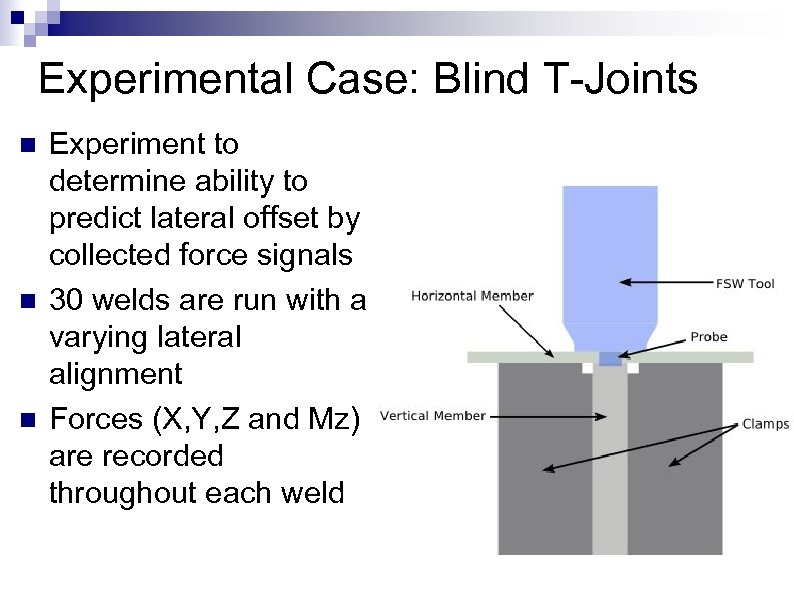 Experimental Case: Blind T-Joints n n n Experiment to determine ability to predict lateral offset by collected force signals 30 welds are run with a varying lateral alignment Forces (X, Y, Z and Mz) are recorded throughout each weld
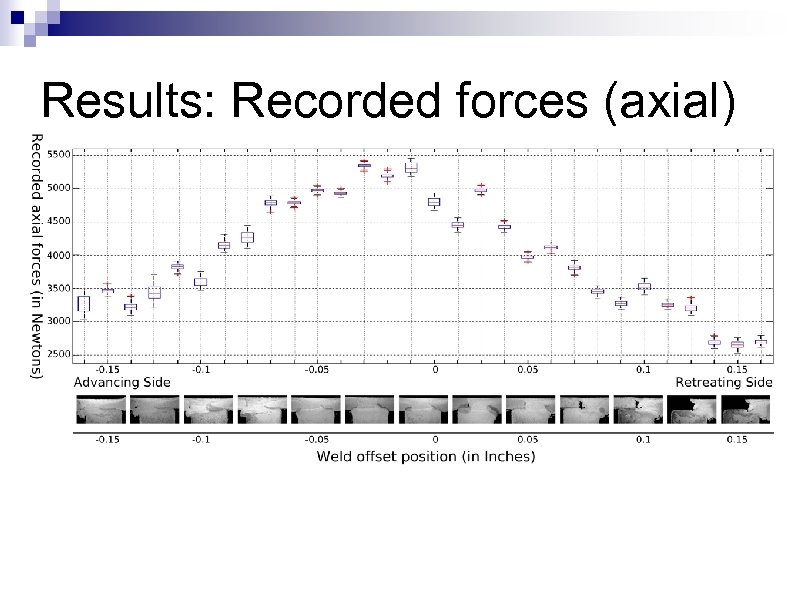 Results: Recorded forces (axial)
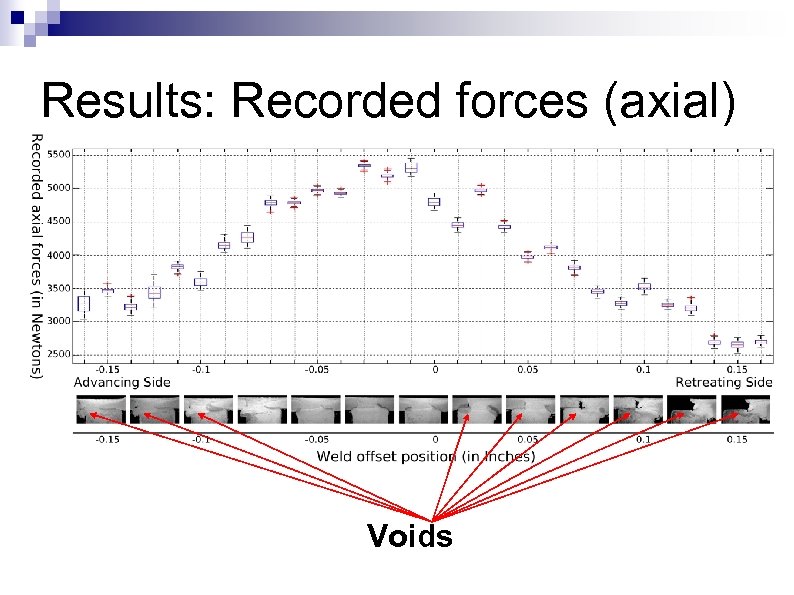 Results: Recorded forces (axial) Voids
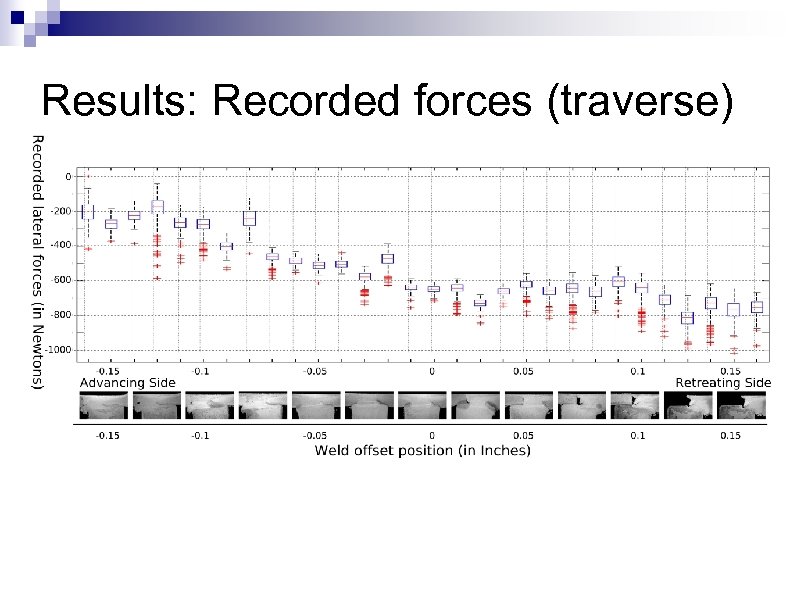 Results: Recorded forces (traverse)
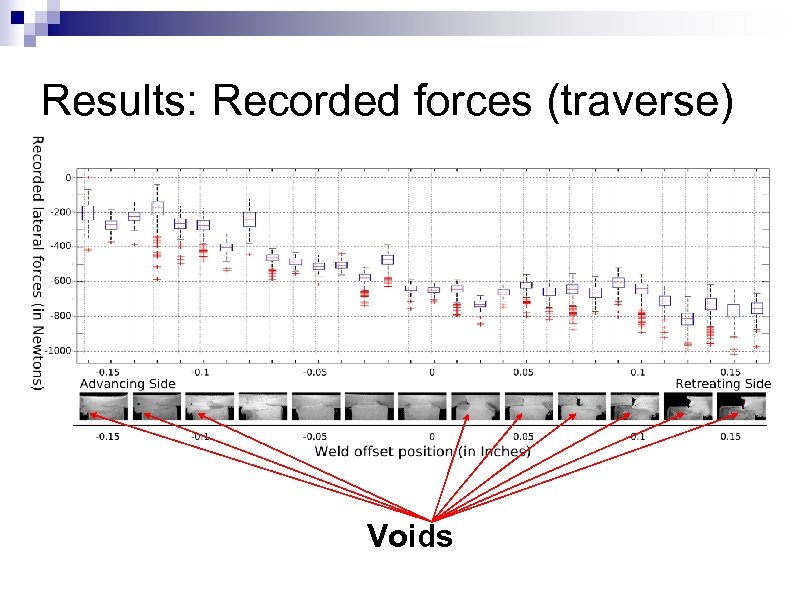 Results: Recorded forces (traverse) Voids
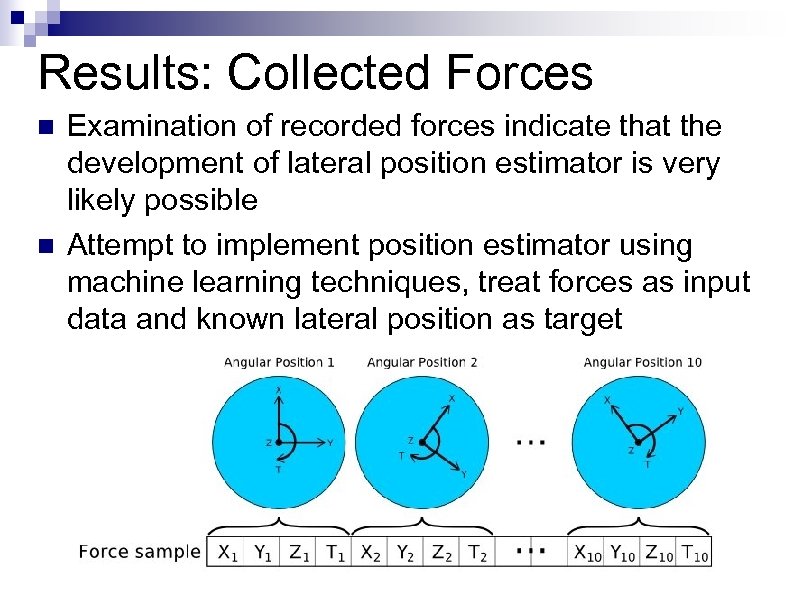 Results: Collected Forces n n Examination of recorded forces indicate that the development of lateral position estimator is very likely possible Attempt to implement position estimator using machine learning techniques, treat forces as input data and known lateral position as target
 Position estimation Estimator which can predict offset position given gathered forces is desired n Many possible choices: linear or non-linear regression, regression tree, SVM n General regression neural network chosen n
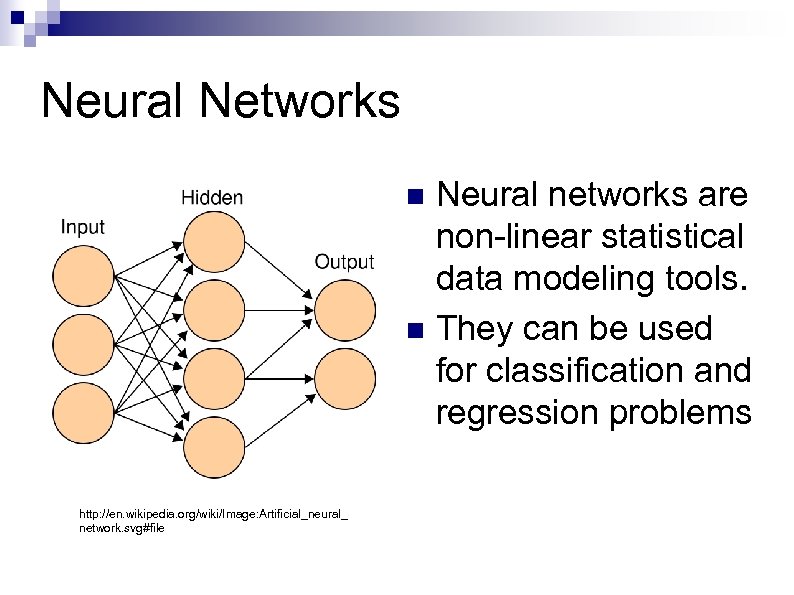 Neural Networks Neural networks are non-linear statistical data modeling tools. n They can be used for classification and regression problems n http: //en. wikipedia. org/wiki/Image: Artificial_neural_ network. svg#file
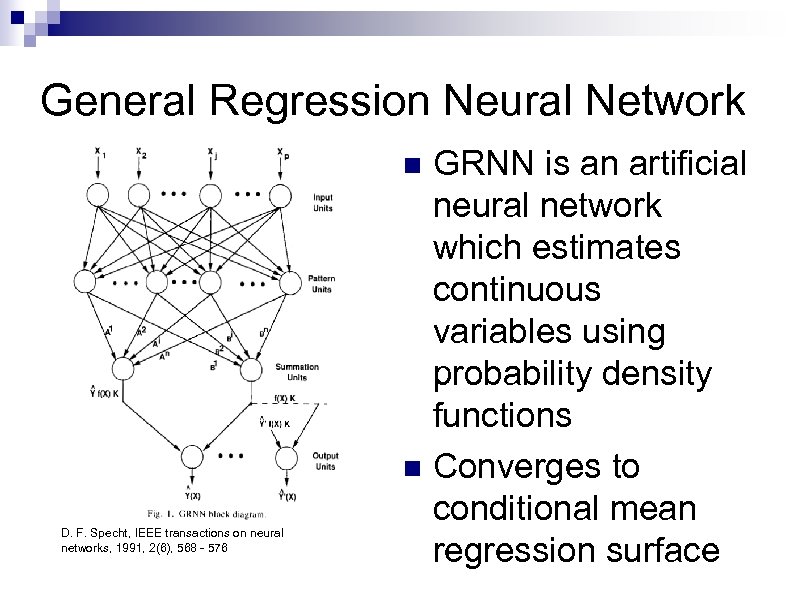 General Regression Neural Network GRNN is an artificial neural network which estimates continuous variables using probability density functions n Converges to conditional mean regression surface n D. F. Specht, IEEE transactions on neural networks, 1991, 2(6), 568 - 576
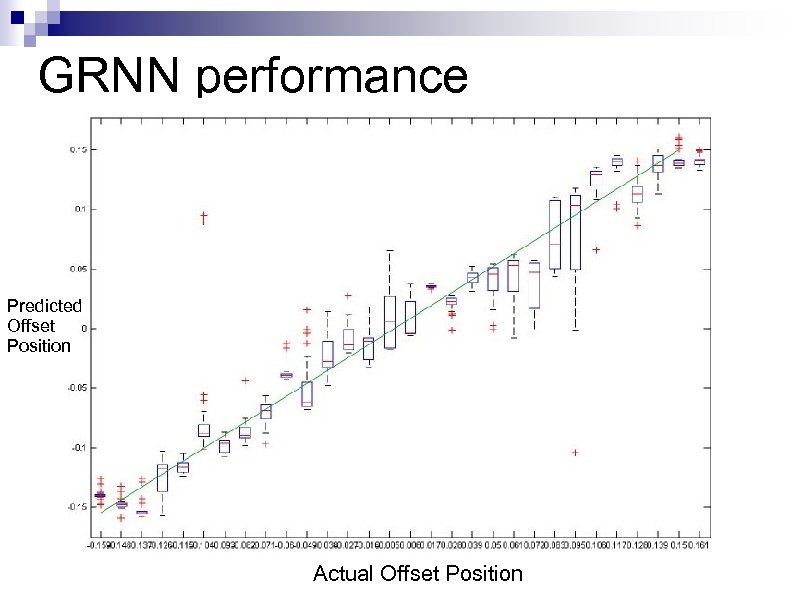 GRNN performance Predicted Offset Position Actual Offset Position
 Continuous monitoring of weld First learned the GRNN using training data n Then applied GRNN to new weld runs where the lateral offset was changed several times throughout each weld n
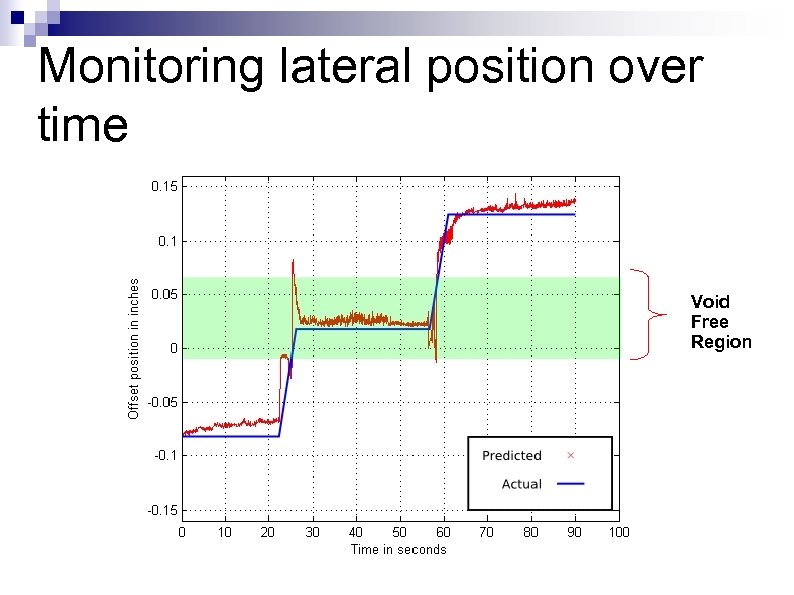 Monitoring lateral position over time Void Free Region
 Research into Monitoring Capabilities Presented research demonstrates effectiveness of technique for determining lateral position in T-joints n Current research seeks to apply the same technique to lap-joints n
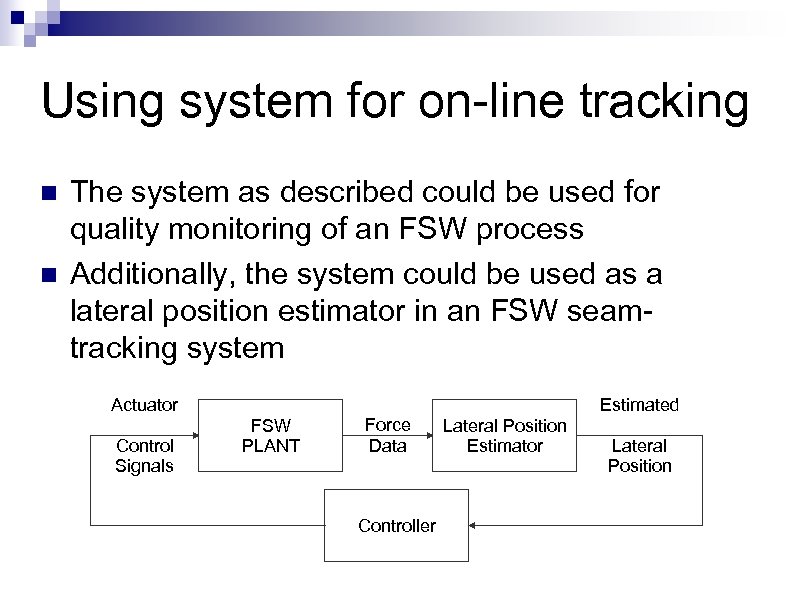 Using system for on-line tracking n n The system as described could be used for quality monitoring of an FSW process Additionally, the system could be used as a lateral position estimator in an FSW seamtracking system Actuator Control Signals Estimated FSW PLANT Force Data Controller Lateral Position Estimator Lateral Position
 On-line seam-tracking n The system is envisioned in two-varieties ¨ 1 st case: assume it is possible for an estimator block to be developed which can determine the absolute lateral position. n a controller maintains the desired offset throughout the weld ¨ 2 nd case: a signal is maximized at a certain position (such as the axial force in this experiment around the centered position). n the system weaves back and forth to gain the center position.
 Incorporating load control n n Axial force control is a component of some FSW systems. The seam tracking system, which uses force as its input signal, could be made to include load control by operating in two alternating stages: ¨ Use seam-tracking to move tool to desired location ¨ Use load control to obtain desired axial force at known location
 Future research n n Future research for both monitoring and control Monitoring: ¨ Improving the offset monitoring system and applying it to more joint types n Tracking: ¨ Developing and testing systems which automatically track linear and non-linear weld seams
 Thank you Questions?
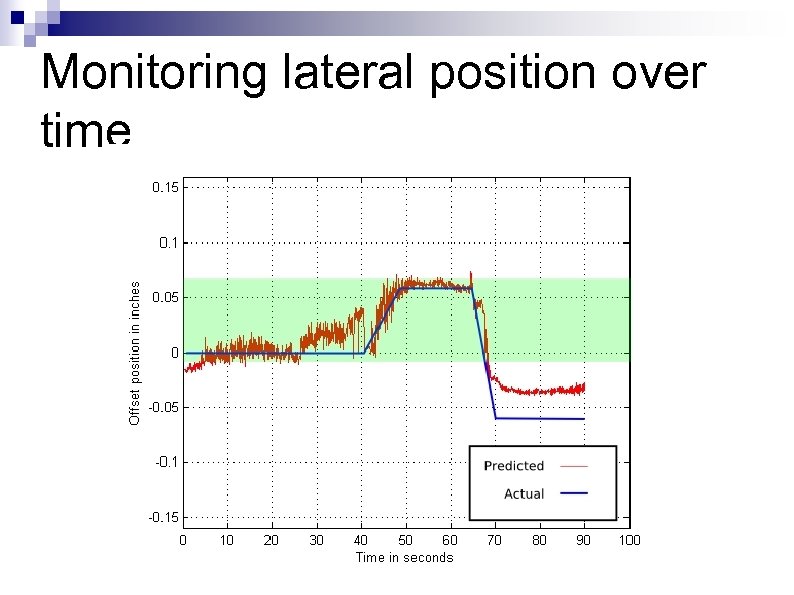 Monitoring lateral position over time