


 Скачать презентацию Joint Russia-US studies in the Pacific sector of
fafa6f6405c1674eef4e2f717b33f6ae.ppt
- Количество слайдов: 27
 Joint Russia-US studies in the Pacific sector of the Arctic: towards IPY-07 FEB RAS Academician Valentin Sergienko Chairman Far Eastern Branch of the Russian Academy of Sciences PAG Meeting Shanghai, China, October 11 -13, 2006
 Why the Arctic? • Arctic plays a key role in climate “kitchen”; • Atmospheric maximums in СО 2 и СН 4, distribution were found during “warm” climate stages, while ones were absent during “cold” epochs. • Arctic ecosystems are the most sensitive for global change: a climate feedback between warming-permafrost thawing- carbon storage disturbance- СО 2 и СН 4 atmospheric emission-greenhouse effect enhancement-warming… are working there.
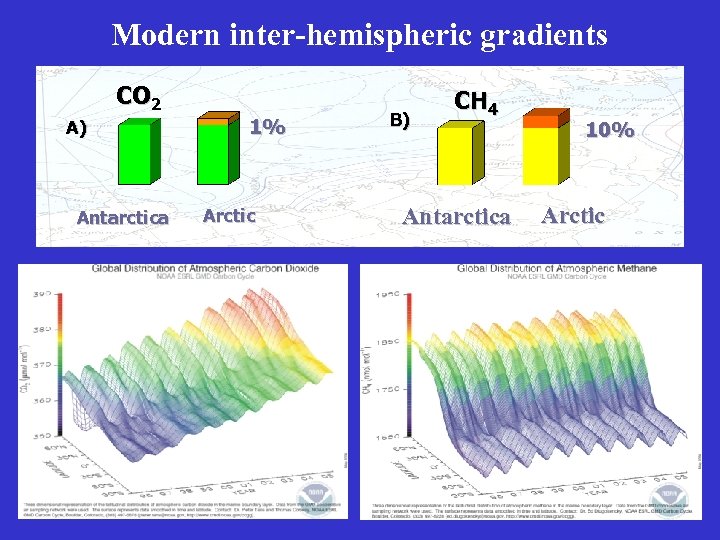 Modern inter-hemispheric gradients CO 2 A) Antarctica 1% Arctic B) CH 4 Antarctica 10% Arctic
 FACT 1. During cold epochs the Arctic ecosystems accumulate a huge amount of organic carbon trapped in permafrost. FACT 2. During warm epochs the Arctic ecosystems become a source of atmospheric СО 2 и СН 4 because of permafrost thawing. HYPOTHESIS Upon continuing warming the permafrost degradation may contribute to the atmospheric carbon dioxide and methane budget which can cause unpredictable changes in climate.
 Our Goal Identify and major processes responsible for carbon budget and spatial-time variability of major carbon components in the atmosphere-land-shelf system with focus in the Pacific Arctic. Explore connections among changes with carbon cycle hydro-meteorological
 Methods • We apply a complex approach to explore climatic, hydrologic, biogeochemical and geological factors which affect formation and change in elements of carbon cycling and their dynamics in the atmosphere-land-shelf system • The same techniques and methodological approach were applied for measurements and data analyses concerning with dynamics of carbon cycling (lateral and vertical fluxes), and environmental regimes. First time direct measurements of р. СО 2 and methane in air and water, and their fluxes between air-sea interface were made in the Russian Arctic seas. These measurements were accompanied with in situ T, S, turbidity, and CDOM (colored dissolved organic matter) measurements. • The same complex of measurements in the same time (September) was used in offshore and onshore (rivers and lakes) studies to identify inter-annual variability. In some year intra-seasonal studies were made. • Specific studies were focused on the least explored elements of carbon cycling in the Arctic: vertical and horizontal fluxes of СО 2 and СН 4 (including the role of sea ice). Three kinds of technique were used: 1) traditional calculations using relationship between wind speed and gas exchange; 2) eddy correlation technique; 3) chamber technique using floating platform
 MAJOR ACTIVITIES / FUNDS (in order of amount of funds) I phase: Onshore studies (1990 -1999): FEBRAS/ International Science (Soros) Foundation, Russian Foundation for Basic Research (RFBR); II phase: Siberian Shallow Shelf (SSS) and River-Sea Studies (1994 -2006): FEBRAS & IARC / FEBRAS, NOAA USA, NSF USA, RFBR, Mac. Arthur Foundation; III phase: Biogeochemical Studies along the Eurasian Shelf Margin and Arctic Basin (2007 -2008): IARC & FEBRAS / NOAA, FEBRAS, NSF (pending), RFBR (continuation of the SSS studies)
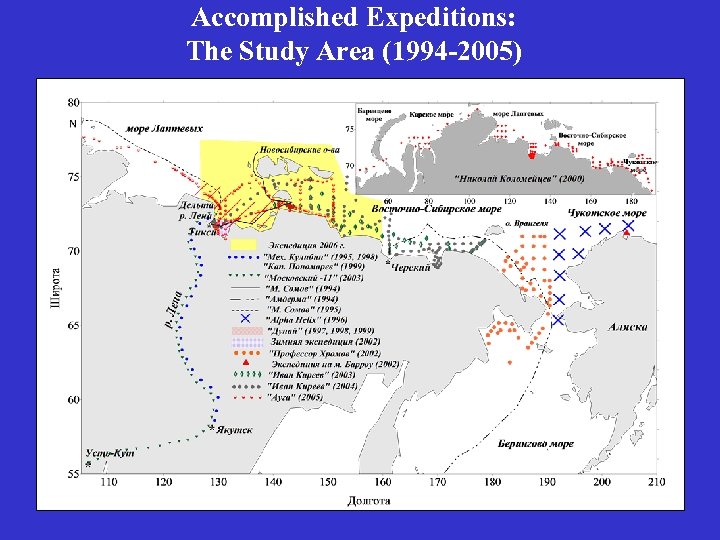 Accomplished Expeditions: The Study Area (1994 -2005)
 MAJOR RESULTS: 1. Onshore studies • Dynamics of onshore components of carbon cycle is determined by the permafrost state, namely; • Development of thermokarst/ lakes and emission of methane into the atmosphere • Riverbed taliks and degradation of coastal ice-complexes (edomas) are a strong source of methane and carbon dioxide;
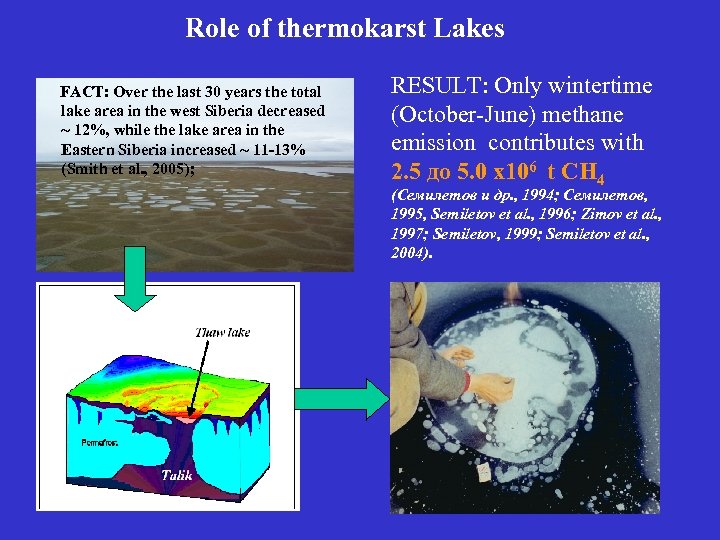 Role of thermokarst Lakes FACT: Over the last 30 years the total lake area in the west Siberia decreased ~ 12%, while the lake area in the Eastern Siberia increased ~ 11 -13% (Smith et al. , 2005); RESULT: Only wintertime (October-June) methane emission contributes with 2. 5 до 5. 0 х106 t СН 4 (Семилетов и др. , 1994; Семилетов, 1995, Semiletov et al. , 1996; Zimov et al. , 1997; Semiletov, 1999; Semiletov et al. , 2004).
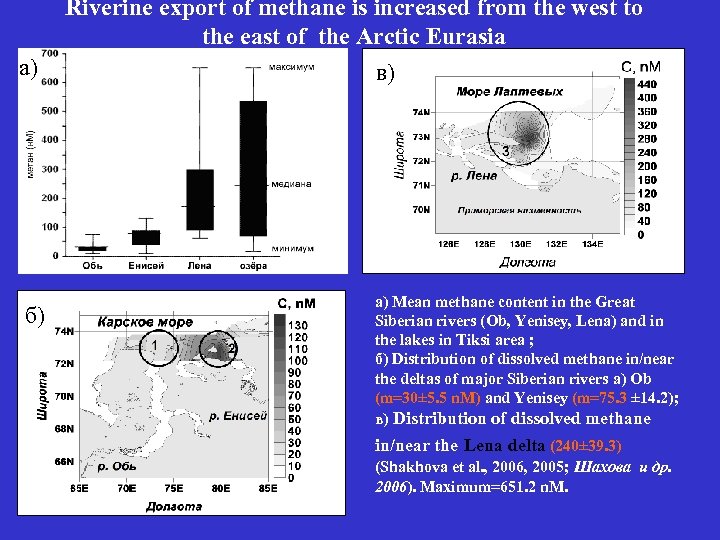 Riverine export of methane is increased from the west to the east of the Arctic Eurasia а) б) в) а) Mean methane content in the Great Siberian rivers (Ob, Yenisey, Lena) and in the lakes in Tiksi area ; б) Distribution of dissolved methane in/near the deltas of major Siberian rivers а) Ob (m=30± 5. 5 n. M) and Yenisey (m=75. 3 ± 14. 2); в) Distribution of dissolved methane in/near the Lena delta (240± 39. 3) (Shakhova et al. , 2006, 2005; Шахова и др. 2006). Maximum=651. 2 n. M.
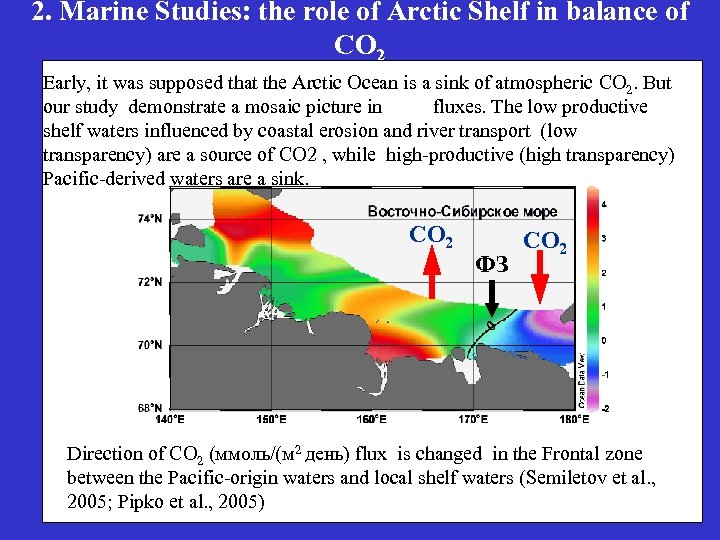 2. Marine Studies: the role of Arctic Shelf in balance of СО 2 Early, it was supposed that the Arctic Ocean is a sink of atmospheric СО 2. But our study demonstrate a mosaic picture in СО 2 fluxes. The low productive shelf waters influenced by coastal erosion and river transport (low transparency) are a source of СО 2 , while high-productive (high transparency) Pacific-derived waters are a sink. СО 2 ФЗ СО 2 Direction of CO 2 (ммоль/(м 2 день) flux is changed in the Frontal zone between the Pacific-origin waters and local shelf waters (Semiletov et al. , 2005; Pipko et al. , 2005)
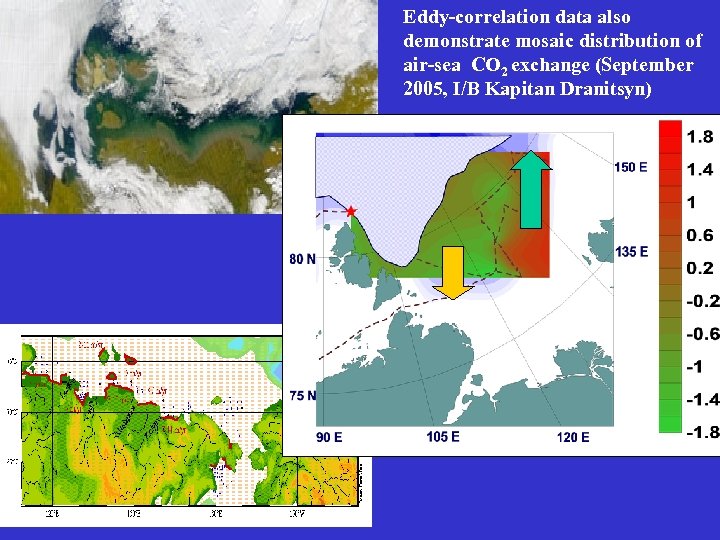 Eddy-correlation data also demonstrate mosaic distribution of air-sea СО 2 exchange (September 2005, I/B Kapitan Dranitsyn)
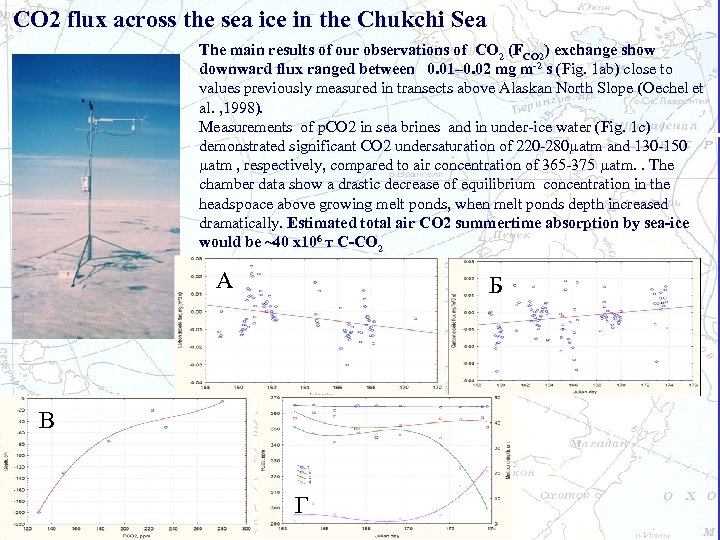 CO 2 flux across the sea ice in the Chukchi Sea The main results of our observations of CO 2 (FCO 2) exchange show downward flux ranged between 0. 01– 0. 02 mg m-2 s (Fig. 1 ab) close to values previously measured in transects above Alaskan North Slope (Oechel et al. , 1998). Measurements of p. CO 2 in sea brines and in under-ice water (Fig. 1 c) demonstrated significant CO 2 undersaturation of 220 -280 atm and 130 -150 atm , respectively, compared to air concentration of 365 -375 atm. . The chamber data show a drastic decrease of equilibrium concentration in the headspoace above growing melt ponds, when melt ponds depth increased dramatically. Estimated total air CO 2 summertime absorption by sea-ice would be ~40 х106 т С-СО 2 А Б В Г
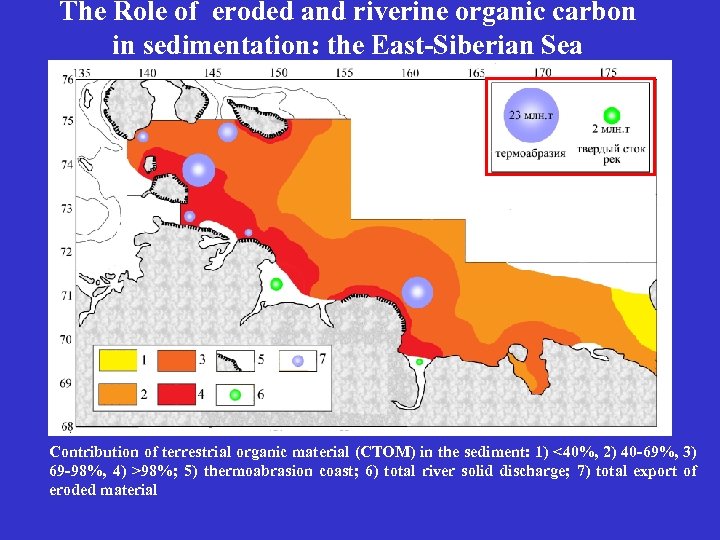 The Role of eroded and riverine organic carbon in sedimentation: the East-Siberian Sea Contribution of terrestrial organic material (CTOM) in the sediment: 1) <40%, 2) 40 -69%, 3) 69 -98%, 4) >98%; 5) thermoabrasion coast; 6) total river solid discharge; 7) total export of eroded material
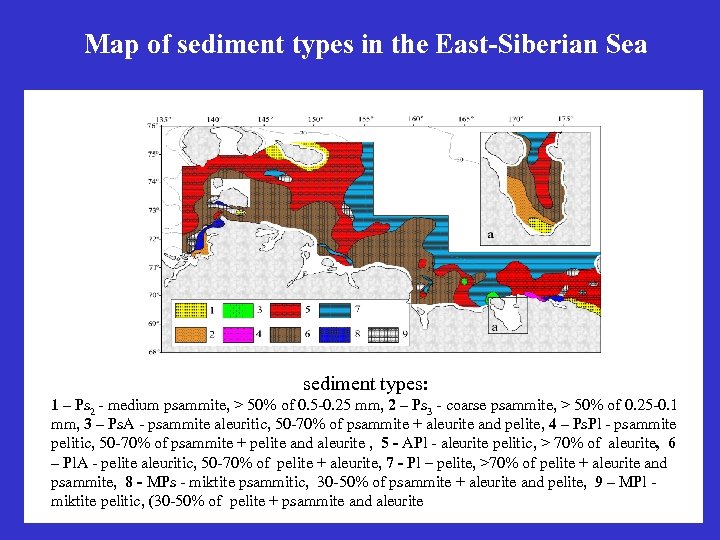 Map of sediment types in the East-Siberian Sea sediment types: 1 – Ps 2 - medium psammite, > 50% of 0. 5 -0. 25 mm, 2 – Ps 3 - coarse psammite, > 50% of 0. 25 -0. 1 mm, 3 – Ps. A - psammite aleuritic, 50 -70% of psammite + aleurite and pelite, 4 – Ps. Pl - psammite pelitic, 50 -70% of psammite + pelite and aleurite , 5 - APl - aleurite pelitic, > 70% of aleurite, 6 – Pl. A - pelite aleuritic, 50 -70% of pelite + aleurite, 7 - Pl – pelite, >70% of pelite + aleurite and psammite, 8 - MPs - miktite psammitic, 30 -50% of psammite + aleurite and pelite, 9 – MPl - miktite pelitic, (30 -50% of pelite + psammite and aleurite
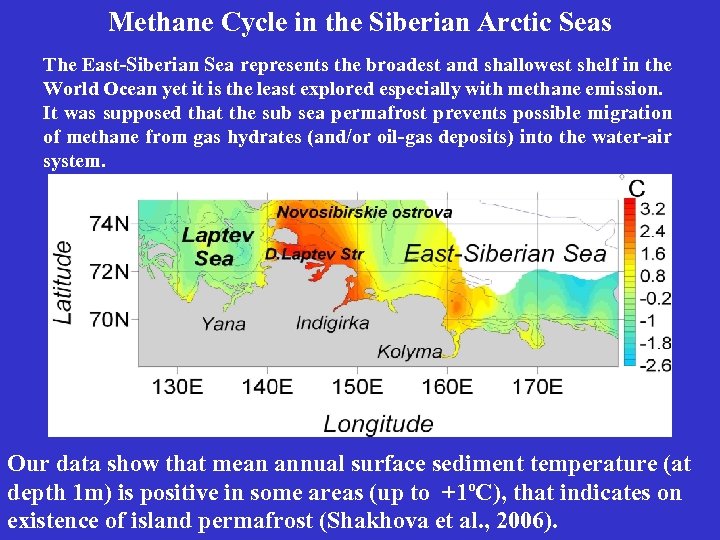 Methane Cycle in the Siberian Arctic Seas The East-Siberian Sea represents the broadest and shallowest shelf in the World Ocean yet it is the least explored especially with methane emission. It was supposed that the sub sea permafrost prevents possible migration of methane from gas hydrates (and/or oil-gas deposits) into the water-air system. Our data show that mean annual surface sediment temperature (at depth 1 m) is positive in some areas (up to +1ºС), that indicates on existence of island permafrost (Shakhova et al. , 2006).
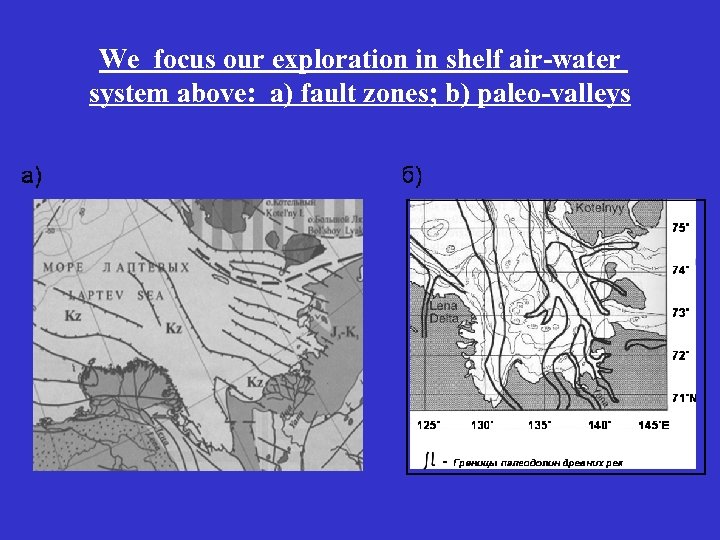 We focus our exploration in shelf air-water system above: a) fault zones; b) paleo-valleys
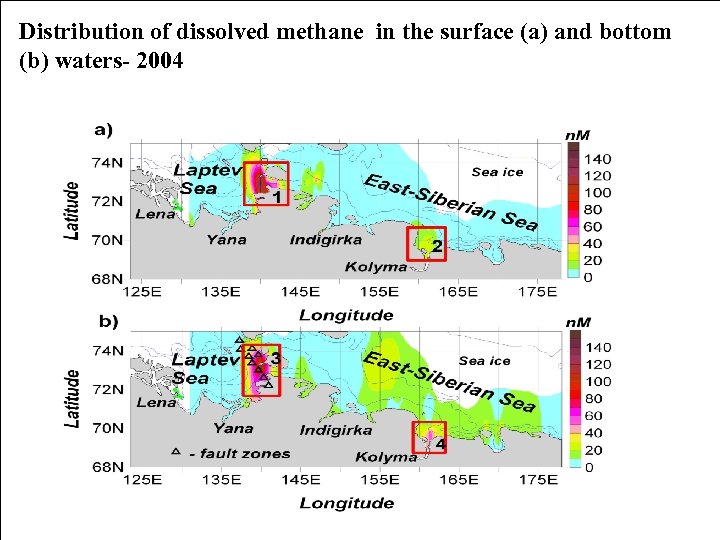 Distribution of dissolved methane in the surface (a) and bottom (b) waters- 2004
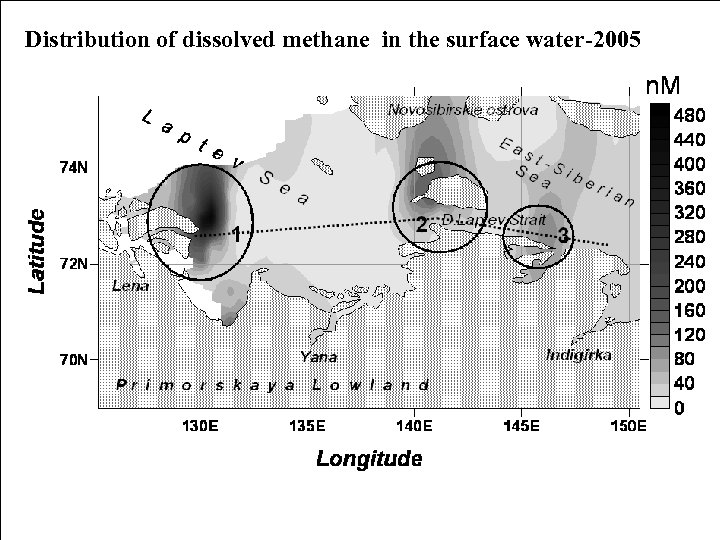 Distribution of dissolved methane in the surface water-2005
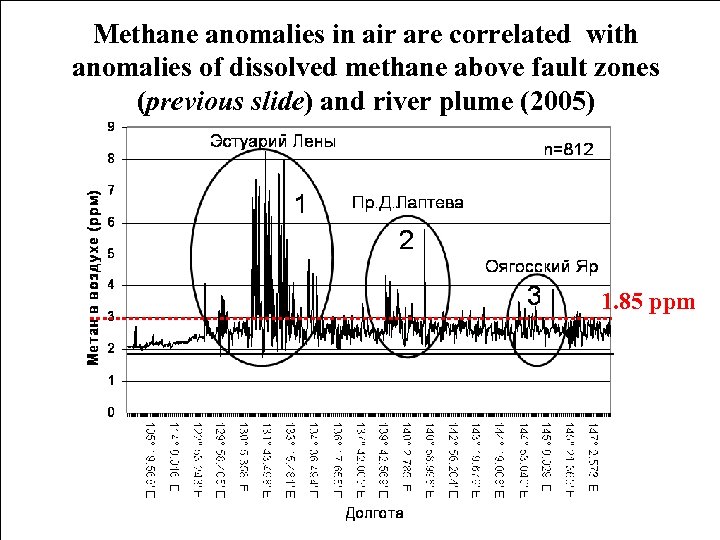 Methane anomalies in air are correlated with anomalies of dissolved methane above fault zones (previous slide) and river plume (2005) 1. 85 ppm
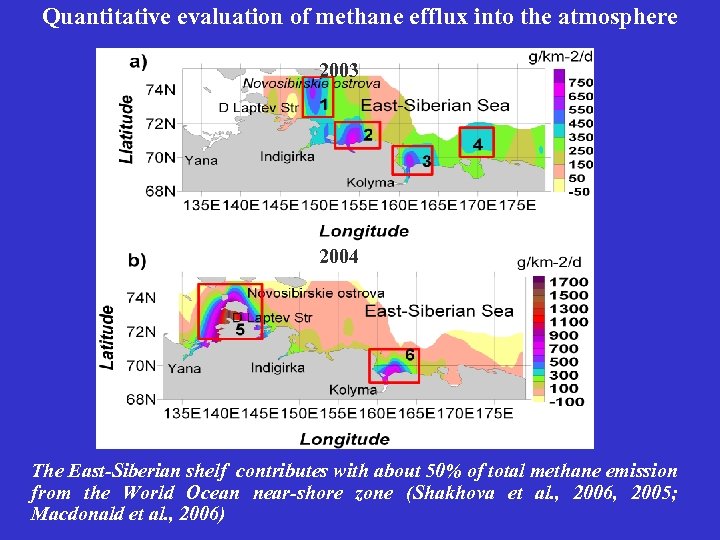 Quantitative evaluation of methane efflux into the atmosphere 2003 2004 The East-Siberian shelf contributes with about 50% of total methane emission from the World Ocean near-shore zone (Shakhova et al. , 2006, 2005; Macdonald et al. , 2006)
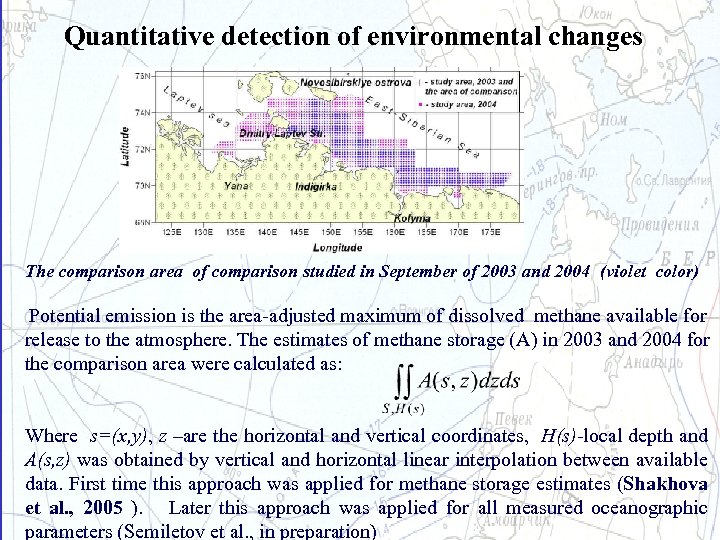 Quantitative detection of environmental changes Интегральный подход The comparison area of comparison studied in September of 2003 and 2004 (violet color) Potential emission is the area-adjusted maximum of dissolved methane available for release to the atmosphere. The estimates of methane storage (A) in 2003 and 2004 for the comparison area were calculated as: Where s=(x, y), z –are the horizontal and vertical coordinates, H(s)-local depth and A(s, z) was obtained by vertical and horizontal linear interpolation between available data. First time this approach was applied for methane storage estimates (Shakhova et al. , 2005 ). Later this approach was applied for all measured oceanographic parameters (Semiletov et al. , in preparation)
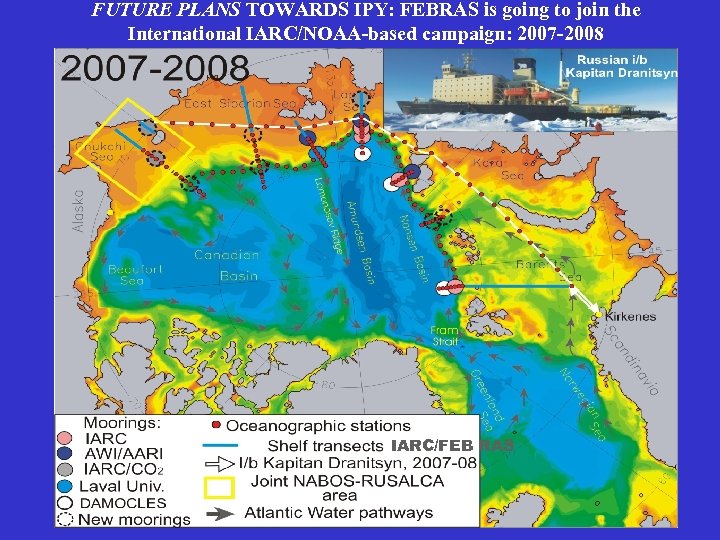 FUTURE PLANS TOWARDS IPY: FEBRAS is going to join the International IARC/NOAA-based campaign: 2007 -2008 IARC/FEB RAS
 Major Publications • • • Shakhova N. , and i. Semiletov, 2006. Methane release and coastal environment in the East. Siberian Arctic Shelf// J. Marine Systems (MARSYS 1323) Semiletov I. P. , Pipko I. I. , Pivovarov N. Ya. , Popov V. V. , Zimov S. A. , Voropaev Yu. V. , and Daviodov S. P. Atmospheric carbon emission from North Asian Lakes: a factor of global significance // Atmospheric Environment. 1996. Vol. 30: 10/11. P. 1657 -1671. Semiletov I. P. . On aquatic sources and sinks of CO 2 and CH 4 in the Polar Regions // Journal Atmospheric Sciences, 1999. Vol. 56, N 2. P. 286 -306. Лучин В. А. , Варламов С. М. , Семилетов И. П. , Пипко И. И. , Пугач С. П. , Прошутинский А. Ю. , Веллер Г. О межгодовой изменчивости в системе атмосфера-океан: Берингово море // Доклады Академии Наук. 1999. Т. 368, № 1. C. 111 -115. Семилетов И. П. , Тищенко П. Я. , Христенсен Дж. П, Пипко И. И. , Пугач С. П. О карбонатной системе Чукотского моря // Доклады Академии Наук. 1999. T. 364, № 3. C. 382 -386. Семилетов И. П. Разрушение мерзлых пород побережья как важный фактор в биогеохимии шельфовых вод Арктики // Доклады Академии Наук. 1999. T. 368, № 5. C. 679 -682. Semiletov I. P. , Savelieva N. I. , Weller G. E. , Pipko I. I. , Pugach S. P. , Gukov A. Yu. , and L. N. Vasilevskaya. The Dispersion of Siberian River Flows into Coastal Waters: Meteorological, Hydrological and Hydrochemical Aspects. In: E. L. Lewis (ed. ) The freshwater Budget of the Arctic Ocean, Kluwer Academic Publishers, Dordrecht, 2000. P. 323 -366. Savelieva N. I. , Semiletov I. P. , Vasilevskaya L. N, and S. P. Pugach. Long-range variability and climate shift in seasonal values of meteorological and hydrological parameters in the Northern Asia // Progress in Oceanography. 2000. Vol. 47. P. 279 -297. Naidu A. S. , Cooper L. W. , Finey B. P. , Macdonald R. W. , Alexander C. , Semiletov I. P. Organic carbon isotope ratios ( 13 C) of Arctic Amerasian Continental shelf sediments // International Journal of Earth Sciences. 2000. Vol. 89/3. P. 522 -532.
 • • • Pipko I. I. , Semiletov I. P. , Tishchenko P. Ya. , Pugach S. P. , Christensen J. P. Carbonate chemistry dynamics in Bering Strait and the Chukchi Sea. Progress in Oceanography. 2002. Vol. 55/1 -2. P. 77 -94. Luchin V. A. , I. P. Semiletov, G. E. Weller. Changes in the Bering Sea region: atmosphere – ice - water system in the second half of the twentieth century. Progress in Oceanography. 2002. Vol. 55/1 -2. P. 23 -44. Семилетов И. П. , Дударев О. В. , Савельева Н. И. , Пипко И. И. , Пугач С. П. Исследования ТОИ ДВО РАН на амеразийском шельфе Арктики // Вестник ДВО РАН. 2003. Т. 108, № 2. С. 73 -80. Дударев О. В. , Боцул А. И. , Семилетов И. П. , Чаркин А. Н. Современное осадкообразование в прибрежно-шельфовой криолитозоне пролива Дмитрия Лаптева (Восточно-Сибирское море) // Тихоокеанская геология. 2003. Т. 22, № 1. c. 51 -60. Guo L. , I. Semiletov, Gustafsson O. , J. Ingri, Andersson P. , Dudarev O. , White D. Characterization of Siberian Arctic coastal sediments: implications for terrestrial organic carbon export // Global Biogeochemical cycles. 2004. Vol. 18, GB 1036, doi: 10. 1029/2003 GB 002087. Semiletov I. P. , Makshtas A. P. , Akasofu S. , Andreas E. L. Atmospheric CO 2 balance: The role of Arctic sea ice // Geophysical Research Letters. 2004. Vol. 31, N 5. L 05121. 10. 1029/2003 GL 017996. Savelieva N. I. , Semiletov I. P. , Weller G. E. , Vasilevskaya L. N. , Yusupov V. I. Climate change in the northern Asia in the second half of the 20 th century // Pacific Oceanography. 2004. Vol. 2, No. 1 -2, p. 74 -84. Semiletov I. , Shakhova N. , Romanovsky V. , and Pipko I. Methane Climate Forcing and Methane Observations in the Siberian Arctic Land-Shelf System // World Resource Review. 2004. Vol. 16, N 4, pp. 503 -543. Semiletov I. , Dudarev O. , Luchin V. , Charkin A. , Shin K. , Tanaka N. The East. Siberian Sea as a transition zone between the Pacific origin water and local shelf water // Geophysical Research Letters. 2005. Vol. 32, L 10614, doi: 10. 1029/2005 GL 022490.
 • Shakhova N. , Semiletov I. , Panteleev G. The distribution of methane on the Siberian Arctic shelves: Implications for the marine methane cycle // Geophysical Research Letters. 2005. Vol. 32, L 09601, doi: 10. 1029/2005 GL 022751. • • • Пипко И. И. , Семилетов И. П. , Пугач С. П. О карбонатной системе вод Восточно. Сибирского моря // Доклады Академии Наук. 2005. Т. 402, N 3. С. 398 -401. Юсупов В. И. , Саломатин А. С. , Семилетов И. П. Связь обратного высокочастотного рассеяния звука и температуры в верхнем слое осадков на шельфе арктических морей // Доклады Академии Наук. 2005. Т. 402, N 5. С. 686 -688. Шахова Н. Е. , Семилетов И. П. , Бельчева Н. Н. Метан в морях Восточной Арктики // Доклады Академии Наук. 2005. Т. 402, N 4. С. 529 -533. Pipko I. I. , Semiletov I. P. , Pugach S. P. Carbonate system dynamics in the East-Siberian region : coastal zone // Report of 5 th Arctic Coastal Dynamics International Workshop, October 13 -16, 2004, Montreal, Canada. 2005. P. 89 -93. Semiletov I. P. and O. V. Dudarev. Biogeochemical studies (2000 -2003) in the East. Siberian Sea: the coastal zone // Report of 5 th Arctic Coastal Dynamics International Workshop, October 13 -16, 2004, Montreal, Canada. 2005. P. 97 -99. Shakhova N. , Semiletov I. P. , Sergienko V. and V. Romanovsky. Dissolved methane in the East-Siberian and Laptev seas: the coastal zone // Report of 5 th Arctic Coastal Dynamics International Workshop, October 13 -16, 2004, Montreal, Canada. 2005. P. 100 -103. Гуков А. Ю. , Дударев О. В. , Чаркин А. Н. Океанология. 2005. Дударев О. В. , Семилетов И. П. , Чаркин А. Н. Масштабы неоднородностей состава взвеси в системе «река Лена-море Лаптевых» // Доклады Академии Наук, в печати. Semiletov I. P. , Pipko I. I. , Repina I. , Shakhova N. E. Carbonate chemistry dynamics and carbon dioxide fluxes across the atmosphere-ice-water interfaces in the Arctic Ocean: Pacific sector of the Arctic //Journal of Marine Systems, MARSYS 1324. Пипко И. И. , Семилетов И. П. , Пугач С. П. Об обмене СО 2 в системе океанатмосфера на шельфе Чукотского моря// Доклады Академии Наук, в печати.