 Скачать презентацию Joint Project Capacity Building in the Field of
62ba31ec6ac04d2e92bbdb18dca1cdeb.ppt
- Количество слайдов: 21



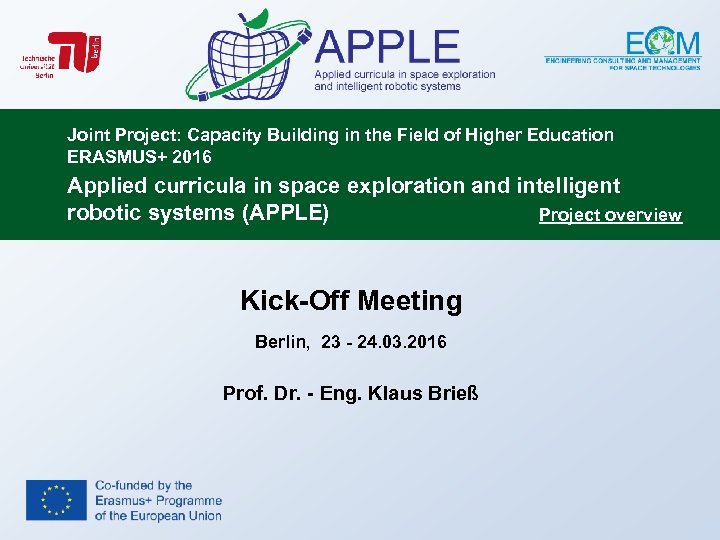
Joint Project: Capacity Building in the Field of Higher Education ERASMUS+ 2016 Applied curricula in space exploration and intelligent robotic systems (APPLE) Project overview Kick-Off Meeting Berlin, 23 - 24. 03. 2016 Prof. Dr. - Eng. Klaus Brieß
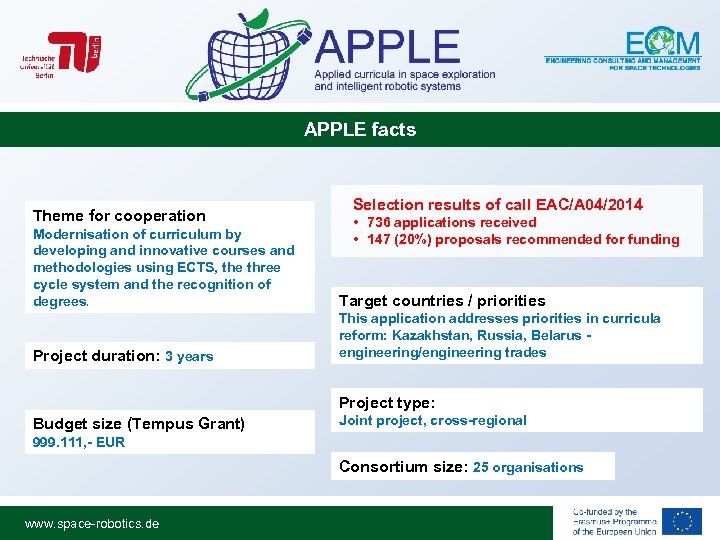
APPLE facts Theme for cooperation Selection results of call EAC/A 04/2014 • 736 applications received • 147 (20%) proposals recommended for funding Modernisation of curriculum by developing and innovative courses and methodologies using ECTS, the three cycle system and the recognition of degrees. Target countries / priorities Project duration: 3 years This application addresses priorities in curricula reform: Kazakhstan, Russia, Belarus engineering/engineering trades Project type: Budget size (Tempus Grant) Joint project, cross-regional 999. 111, - EUR Consortium size: 25 organisations www. space-robotics. de
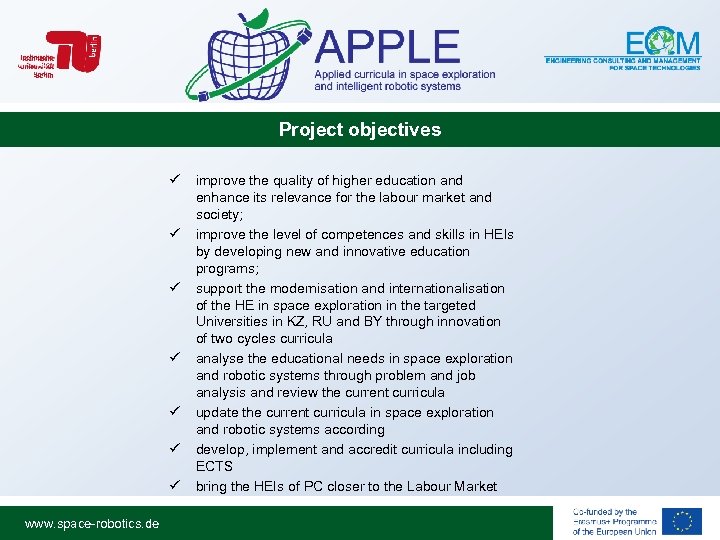
Project objectives ü ü ü ü www. space-robotics. de improve the quality of higher education and enhance its relevance for the labour market and society; improve the level of competences and skills in HEIs by developing new and innovative education programs; support the modernisation and internationalisation of the HE in space exploration in the targeted Universities in KZ, RU and BY through innovation of two cycles curricula analyse the educational needs in space exploration and robotic systems through problem and job analysis and review the current curricula update the current curricula in space exploration and robotic systems according develop, implement and accredit curricula including ECTS bring the HEIs of PC closer to the Labour Market
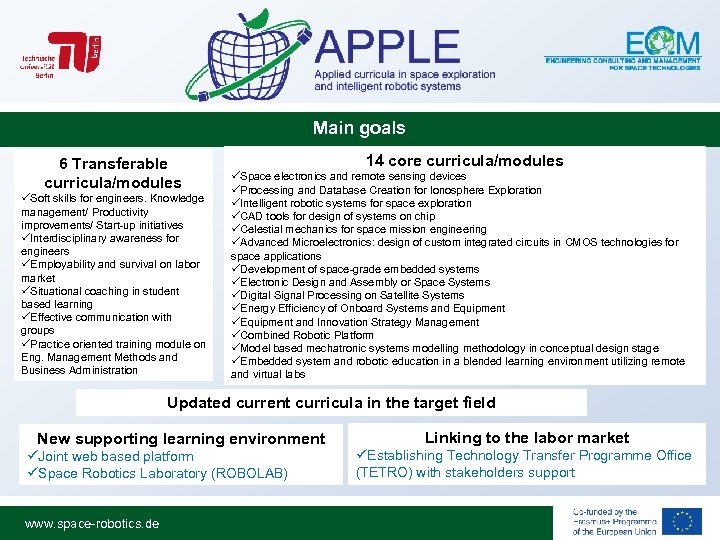
Main goals 6 Transferable curricula/modules üSoft skills for engineers. Knowledge management/ Productivity improvements/ Start-up initiatives üInterdisciplinary awareness for engineers üEmployability and survival on labor market üSituational coaching in student based learning üEffective communication with groups üPractice oriented training module on Eng. Management Methods and Business Administration 14 core curricula/modules üSpace electronics and remote sensing devices üProcessing and Database Creation for Ionosphere Exploration üIntelligent robotic systems for space exploration üCAD tools for design of systems on chip üCelestial mechanics for space mission engineering üAdvanced Microelectronics: design of custom integrated circuits in CMOS technologies for space applications üDevelopment of space-grade embedded systems üElectronic Design and Assembly or Space Systems üDigital Signal Processing on Satellite Systems üEnergy Efficiency of Onboard Systems and Equipment üEquipment and Innovation Strategy Management üCombined Robotic Platform üModel based mechatronic systems modelling methodology in conceptual design stage üEmbedded system and robotic education in a blended learning environment utilizing remote and virtual labs Updated current curricula in the target field New supporting learning environment üJoint web based platform üSpace Robotics Laboratory (ROBOLAB) www. space-robotics. de Linking to the labor market üEstablishing Technology Transfer Programme Office Establishing Material Engineering Service Office (TETRO) with stakeholders support (MESO) with stakeholders support
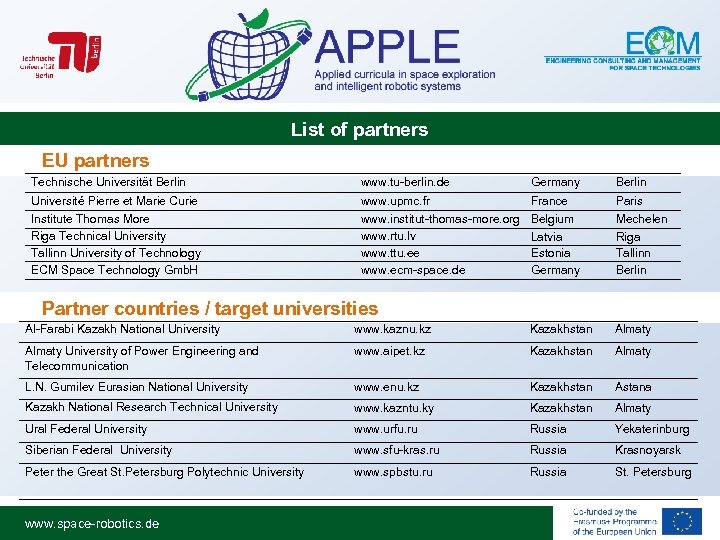
List of partners EU partners Technische Universität Berlin www. tu-berlin. de Germany Berlin Université Pierre et Marie Curie Institute Thomas More Riga Technical University Tallinn University of Technology ECM Space Technology Gmb. H www. upmc. fr www. institut-thomas-more. org www. rtu. lv www. ttu. ee www. ecm-space. de France Belgium Latvia Estonia Germany Paris Mechelen Riga Tallinn Berlin Partner countries / target universities Al-Farabi Kazakh National University www. kaznu. kz Kazakhstan Almaty University of Power Engineering and Telecommunication www. aipet. kz Kazakhstan Almaty L. N. Gumilev Eurasian National University www. enu. kz Kazakhstan Astana Kazakh National Research Technical University www. kazntu. ky Kazakhstan Almaty Ural Federal University www. urfu. ru Russia Yekaterinburg Siberian Federal University www. sfu-kras. ru Russia Krasnoyarsk Peter the Great St. Petersburg Polytechnic University www. spbstu. ru Russia St. Petersburg www. space-robotics. de
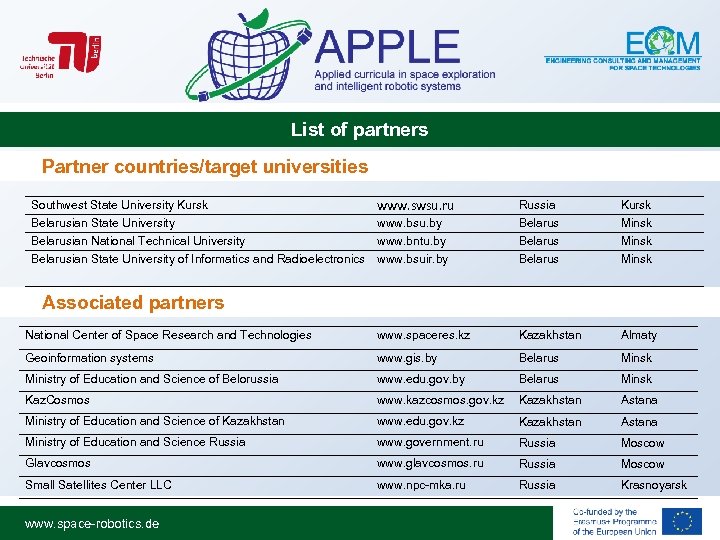
List of partners Partner countries/target universities Southwest State University Kursk Belarusian State University Belarusian National Technical University Belarusian State University of Informatics and Radioelectronics www. swsu. ru www. bsu. by www. bntu. by www. bsuir. by Russia Belarus Kursk Minsk National Center of Space Research and Technologies www. spaceres. kz Kazakhstan Almaty Geoinformation systems www. gis. by Belarus Minsk Ministry of Education and Science of Belorussia www. edu. gov. by Belarus Minsk Kaz. Cosmos www. kazcosmos. gov. kz Kazakhstan Astana Ministry of Education and Science of Kazakhstan www. edu. gov. kz Kazakhstan Astana Ministry of Education and Science Russia www. government. ru Russia Moscow Glavcosmos www. glavcosmos. ru Russia Moscow Small Satellites Center LLC www. npc-mka. ru Russia Krasnoyarsk Associated partners www. space-robotics. de
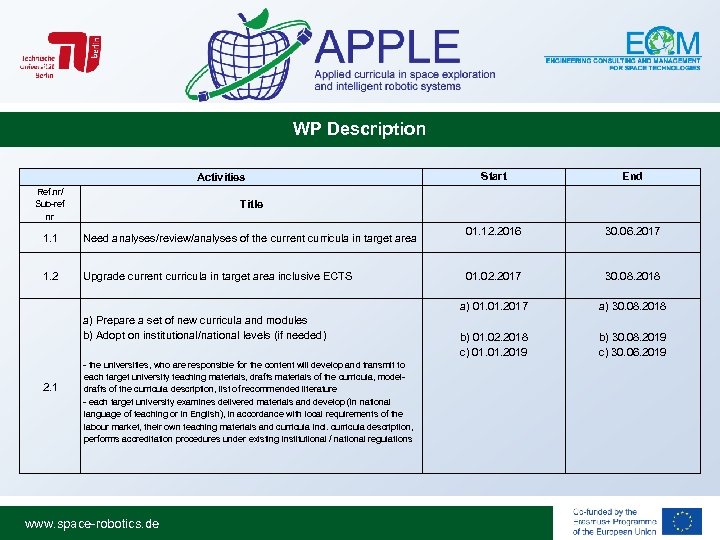
WP Description Activities Ref. nr/ Sub-ref nr Title 1. 1 Need analyses/review/analyses of the current curricula in target area 1. 2 Upgrade current curricula in target area inclusive ECTS a) Prepare a set of new curricula and modules b) Adopt on institutional/national levels (if needed) 2. 1 - the universities, who are responsible for the content will develop and transmit to each target university teaching materials, drafts materials of the curricula, modeldrafts of the curricula description, list of recommended literature - each target university examines delivered materials and develop (in national language of teaching or in English), in accordance with local requirements of the labour market, their own teaching materials and curricula incl. curricula description, performs accreditation procedures under existing institutional / national regulations www. space-robotics. de Start End 01. 12. 2016 30. 06. 2017 01. 02. 2017 a) 01. 2017 b) 01. 02. 2018 c) 01. 2019 30. 08. 2018 a) 30. 08. 2018 b) 30. 08. 2019 c) 30. 06. 2019
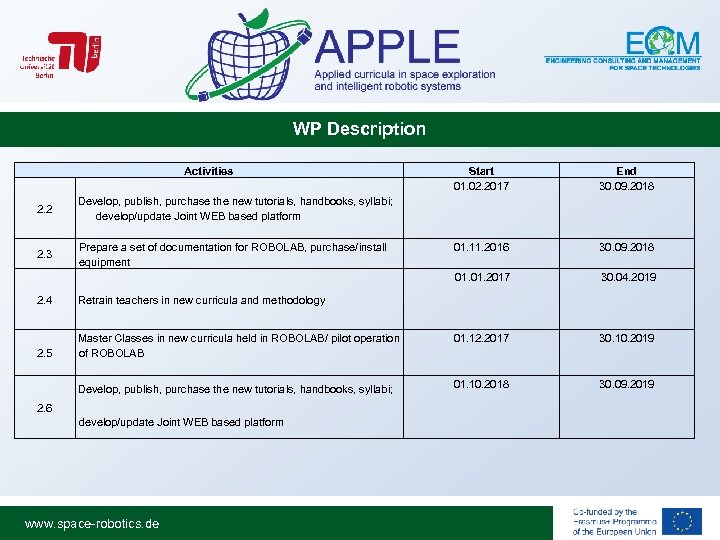
WP Description Activities Prepare a set of documentation for ROBOLAB, purchase/install equipment 01. 11. 2016 30. 09. 2018 30. 04. 2019 Develop, publish, purchase the new tutorials, handbooks, syllabi; develop/update Joint WEB based platform 2. 3 End 30. 09. 2018 01. 2017 2. 2 Start 01. 02. 2017 2. 4 Retrain teachers in new curricula and methodology 01. 12. 2017 30. 10. 2019 2. 5 Master Classes in new curricula held in ROBOLAB/ pilot operation of ROBOLAB Develop, publish, purchase the new tutorials, handbooks, syllabi; 01. 10. 2018 30. 09. 2019 2. 6 develop/update Joint WEB based platform www. space-robotics. de
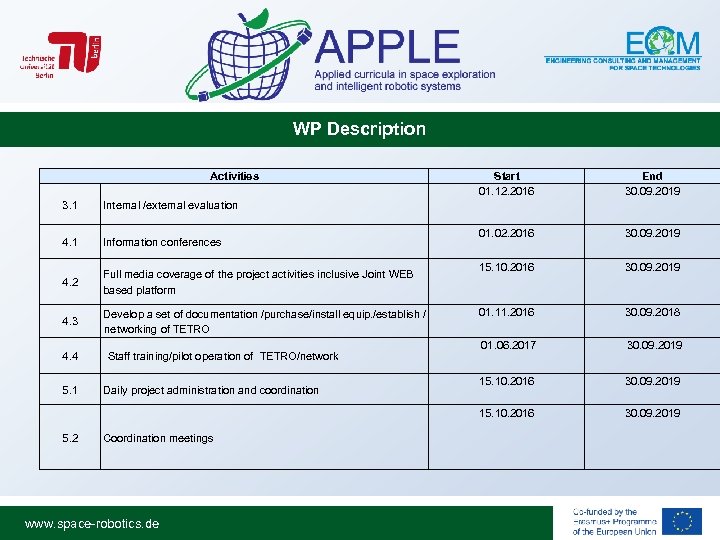
WP Description Activities Information conferences 4. 2 Full media coverage of the project activities inclusive Joint WEB based platform 4. 3 Develop a set of documentation /purchase/install equip. /establish / networking of TETRO 01. 02. 2016 30. 09. 2019 15. 10. 2016 30. 09. 2019 01. 11. 2016 30. 09. 2018 01. 06. 2017 30. 09. 2019 15. 10. 2016 30. 09. 2019 Internal /external evaluation 4. 1 End 30. 09. 2019 15. 10. 2016 3. 1 Start 01. 12. 2016 4. 4 5. 1 5. 2 Staff training/pilot operation of TETRO/network Daily project administration and coordination Coordination meetings www. space-robotics. de
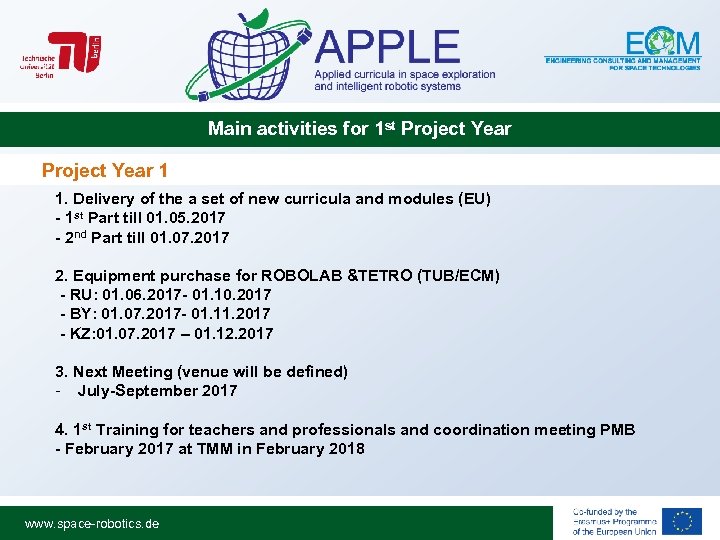
Main activities for 1 st Project Year 1 1. Delivery of the a set of new curricula and modules (EU) - 1 st Part till 01. 05. 2017 - 2 nd Part till 01. 07. 2017 2. Equipment purchase for ROBOLAB &TETRO (TUB/ECM) - RU: 01. 06. 2017 - 01. 10. 2017 - BY: 01. 07. 2017 - 01. 11. 2017 - KZ: 01. 07. 2017 – 01. 12. 2017 3. Next Meeting (venue will be defined) - July-September 2017 4. 1 st Training for teachers and professionals and coordination meeting PMB - February 2017 at TMM in February 2018 www. space-robotics. de
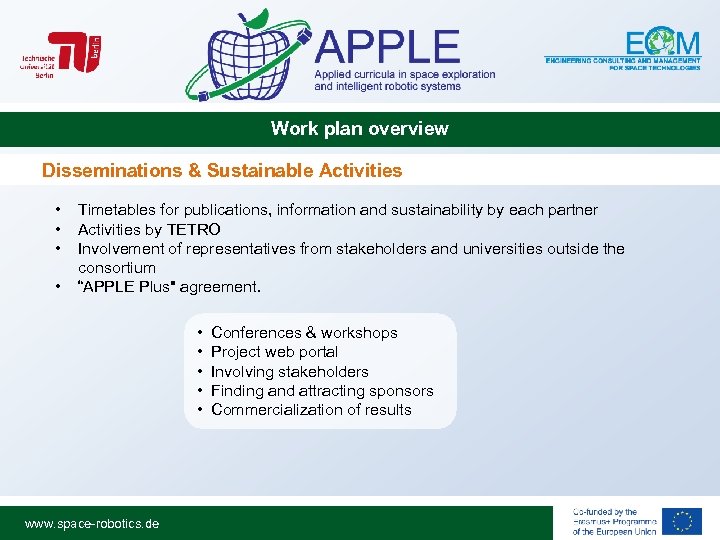
Work plan overview Disseminations & Sustainable Activities • • Timetables for publications, information and sustainability by each partner Activities by TETRO Involvement of representatives from stakeholders and universities outside the consortium “APPLE Plus" agreement. • • • www. space-robotics. de Conferences & workshops Project web portal Involving stakeholders Finding and attracting sponsors Commercialization of results
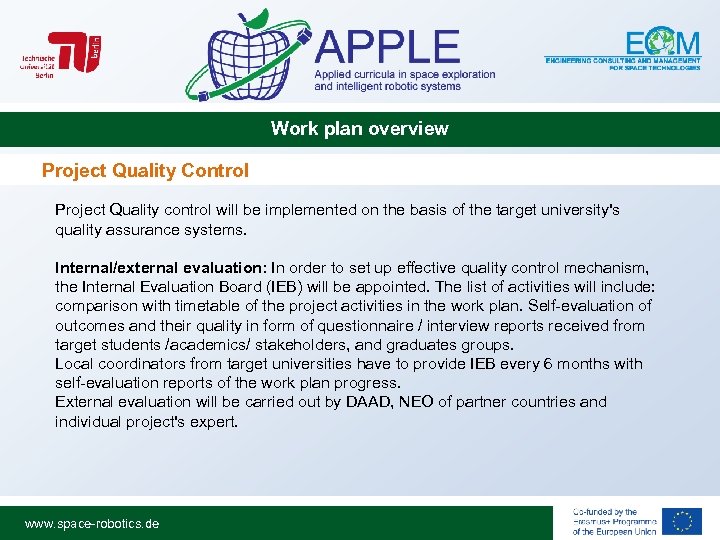
Work plan overview Project Quality Control Project Quality control will be implemented on the basis of the target university's quality assurance systems. Internal/external evaluation: In order to set up effective quality control mechanism, the Internal Evaluation Board (IEB) will be appointed. The list of activities will include: comparison with timetable of the project activities in the work plan. Self-evaluation of outcomes and their quality in form of questionnaire / interview reports received from target students /academics/ stakeholders, and graduates groups. Local coordinators from target universities have to provide IEB every 6 months with self-evaluation reports of the work plan progress. External evaluation will be carried out by DAAD, NEO of partner countries and individual project's expert. www. space-robotics. de
Work plan overview Project Management A Project Management Board (PMB) – Project Council - will be formed as a strategic decision-making body inclusive one representative from each consortium member who at the same time will operate as local coordinators in their institutions. The local coordinator will lead the special formed Local Project Team (LPT) of his institution. Coordination meetings: International, regional and local/hosting coordination meetings. Daily project administration and coordination: project management, administration and coordination will be carried out by the coordinator (TUB) and project manager (ECM) with LPT from target universities. www. space-robotics. de
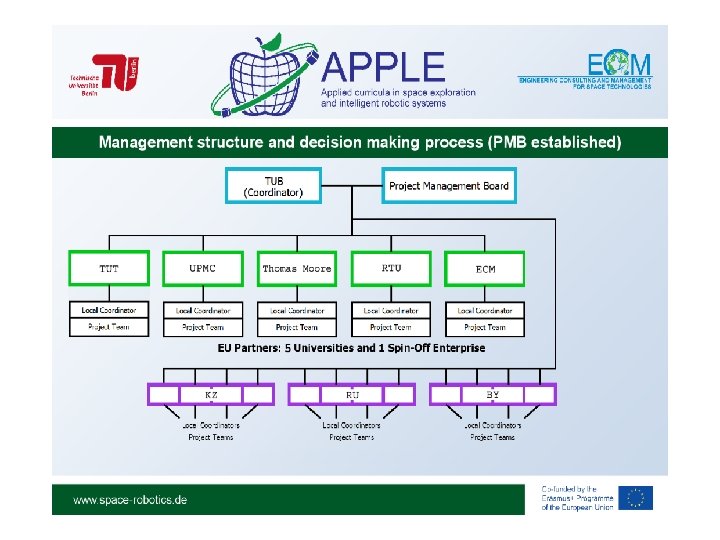
Management structure and decision making process (PMB established) www. space-robotics. de
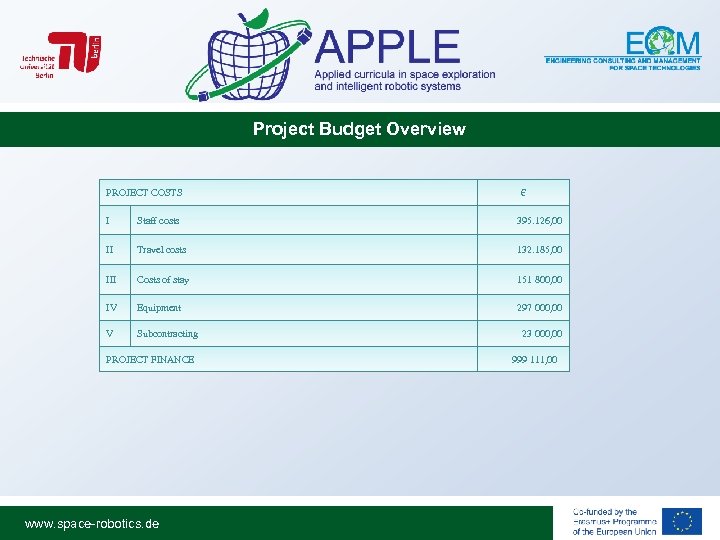
Project Budget Overview PROJECT COSTS € I Staff costs 395. 126, 00 II Travel costs 132. 185, 00 III Costs of stay 151 800, 00 IV Equipment 297 000, 00 V Subcontracting PROJECT FINANCE www. space-robotics. de 23 000, 00 999 111, 00
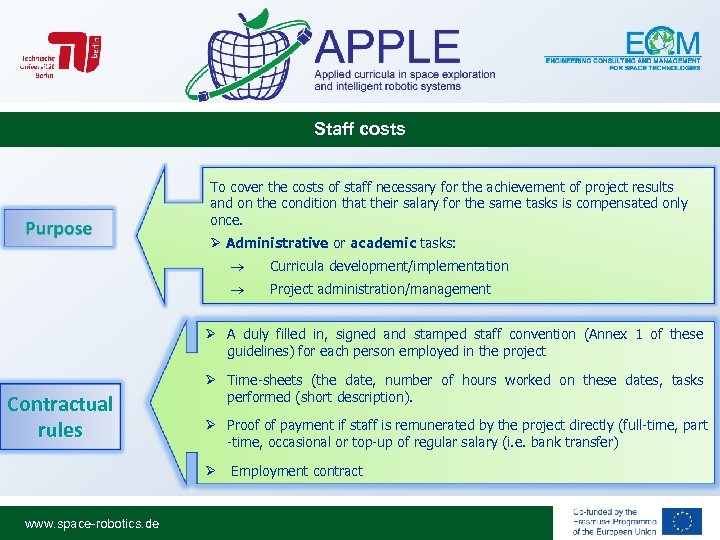
Staff costs To cover the costs of staff necessary for the achievement of project results and on the condition that their salary for the same tasks is compensated only once. Ø Administrative or academic tasks: ® Curricula development/implementation ® Project administration/management Ø A duly filled in, signed and stamped staff convention (Annex 1 of these guidelines) for each person employed in the project Contractual rules Ø Time-sheets (the date, number of hours worked on these dates, tasks performed (short description). Ø Proof of payment if staff is remunerated by the project directly (full-time, part -time, occasional or top-up of regular salary (i. e. bank transfer) Ø www. space-robotics. de Employment contract
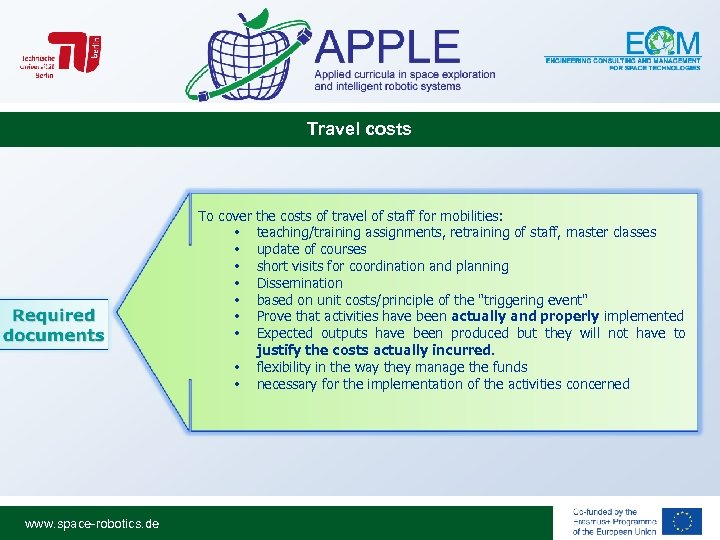
Travel costs To cover • • • www. space-robotics. de the costs of travel of staff for mobilities: teaching/training assignments, retraining of staff, master classes update of courses short visits for coordination and planning Dissemination based on unit costs/principle of the "triggering event" Prove that activities have been actually and properly implemented Expected outputs have been produced but they will not have to justify the costs actually incurred. flexibility in the way they manage the funds necessary for the implementation of the activities concerned
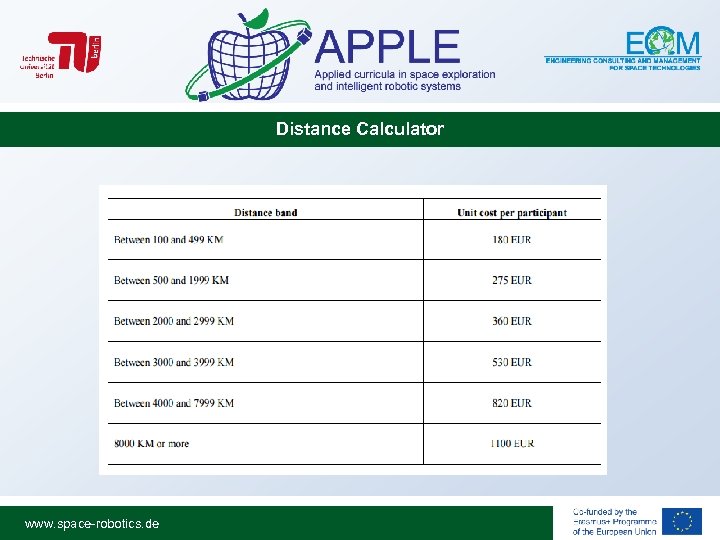
Distance Calculator www. space-robotics. de
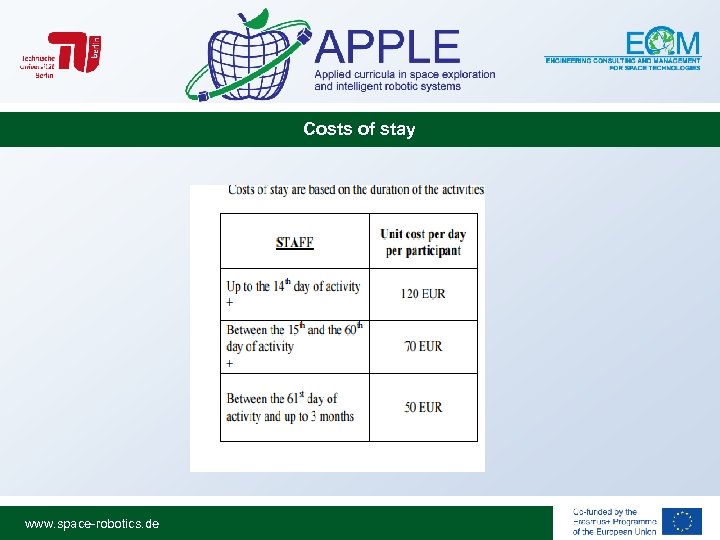
Costs of stay www. space-robotics. de
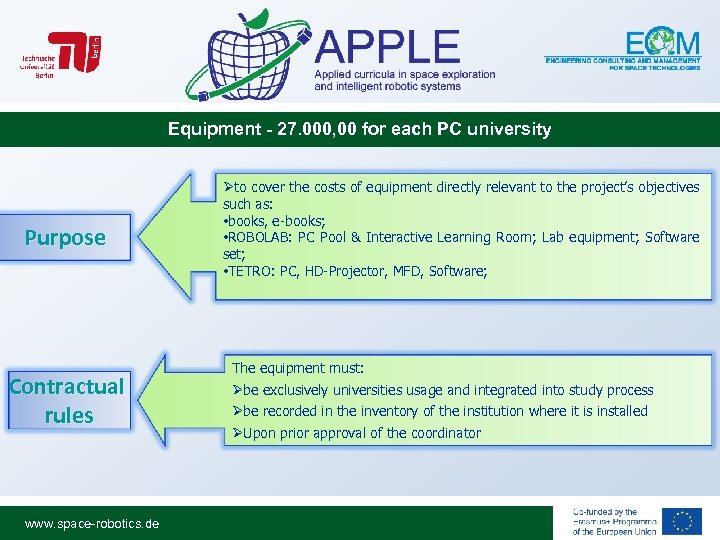
Equipment - 27. 000, 00 for each PC university Purpose Contractual rules www. space-robotics. de Øto cover the costs of equipment directly relevant to the project’s objectives such as: • books, e-books; • ROBOLAB: PC Pool & Interactive Learning Room; Lab equipment; Software set; • TETRO: PC, HD-Projector, MFD, Software; The equipment must: Øbe exclusively universities usage and integrated into study process Øbe recorded in the inventory of the institution where it is installed ØUpon prior approval of the coordinator
THANK YOU FOR YOUR ATTENTION! Coordinator, TUB: Prof. Dr. -Ing. Klaus Brieß Head of the Chair of Space Technology Klaus. Brieß@tu-berlin. de www. space-robotics. de
Скачать презентацию Joint Project Capacity Building in the Field of
62ba31ec6ac04d2e92bbdb18dca1cdeb.ppt