 Скачать презентацию Joint Implementation Projects Legal Background Foresta Tropicana
50744722146c8a19adc20ce306b34695.ppt
- Количество слайдов: 28




Joint Implementation Projects – Legal Background Foresta Tropicana Hotel, Zelinograd Oblast August 22, 2006 Dr. Bernd Beckmann Rechtsanwalt /Attorney Hogan & Hartson Raue L. L. P.
Overview z What is Joint Implementation (JI)? z Background: Climate Change and Global Governance z The Kyoto Protocol Climate Change Regime z JI as a Flexible Mechanism • • • Structure Procedure Legal Issues z z 2 2 Excursus: EU Emission Trading Scheme Outlook
What is Joint Implementation (JI)? The basic idea of Joint Implementation in a nutshell: z Joint Implementation is a programme under the Kyoto Protocol that allows industrialized countries to meet part of their required cuts in greenhouse-gas emissions by paying for projects that reduce emissions in other industrialized countries. z “Mutual Help for countries with emission targets”. z In practice, this will likely mean facilities built in the countries of Eastern Europe and the former Soviet Union - the "transition economies" - paid for by Western European and North American countries. (Definition from the official UNFCCC web site, http: //unfccc. int) 3 3
Background: Climate Change and Global Governance z Climate Change Symptoms • • • Term “Climate Change“ refers to various phenomena Rising temperatures: “Global Warming“ and “Green House Effect“ Desertification Melt-off of glaciers and pole caps Rising water levels z Growing Global Awareness z Nations decide to take Action • • 4 4 United Nations Framework Convention on Climate Change (UNFCCC) in 1992 Kyoto Protocol in 1997
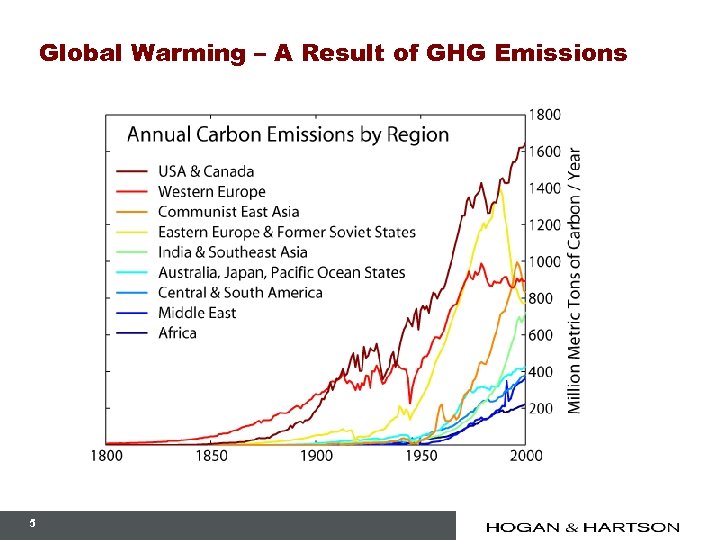
Global Warming – A Result of GHG Emissions 5 5
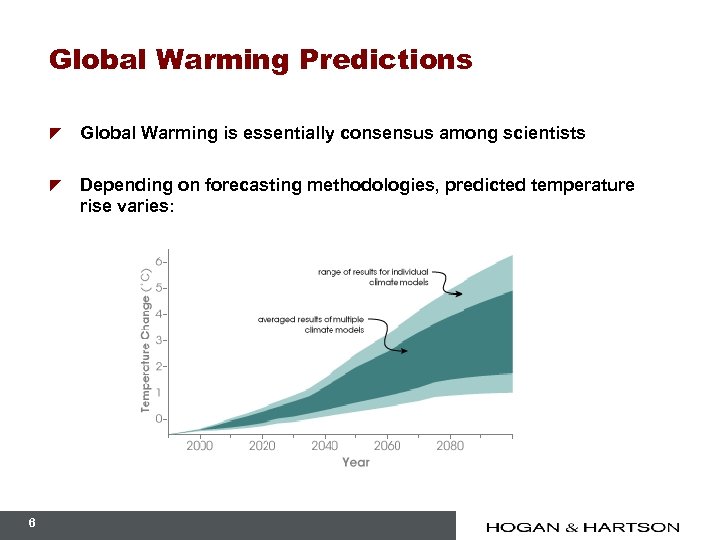
Global Warming Predictions z z 6 6 Global Warming is essentially consensus among scientists Depending on forecasting methodologies, predicted temperature rise varies:
Framework Convention (UNFCCC) of 1992 z The United Nations Framework Convention on Climate Change (UNFCCC) ”sets framework for intergovernmental efforts to tackle climate change“. z Under the Convention, governments: • Gather and share information on greenhouse gas (GHG) emissions, national policies and best practices, • Launch national strategies for addressing greenhouse gas emissions and adapting to expected impacts, including the provision of financial and technological support to developing countries, • Cooperate in preparing for adaptation to the impacts of climate change. z 7 7 Main Problem: No binding GHG reduction targets!
Kyoto Protocol of 1997 z Strengthens UNFCCC by introducing legally binding targets to limit or reduce greenhouse gas emissions z Of 164 countries ratified until today, of which 35 countries and the EC (EU) have accepted binding GHG reduction targets • • Countries with reduction targets are referred to as Annex I countries are all industrialized countries or economies in transition like Russia z z 8 8 Important detail questions left open and later specified at member state meetings (e. g. “Marrakech Accords”) Protocol came into force in February 2005 (after Russia ratified)
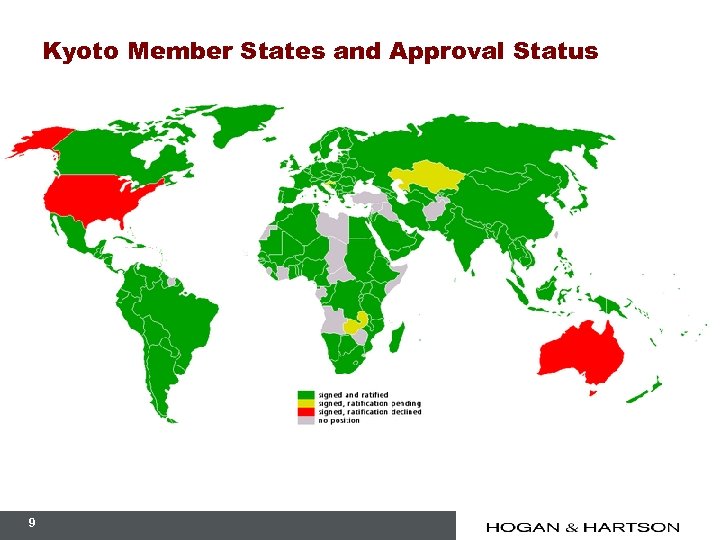
Kyoto Member States and Approval Status 9 9
Kyoto Protocol Regime z Legal Elements • • • z United Nations Framework Convention on Climate Change (UNFCCC) 1992 Kyoto Protocol 1997 Decisions/Resolutions based on the Protocol (“COP/MOP”), especially “Marrakesh Accords” (COP 7) Institutions • • 10 10 COP/MOP (Member State Conventions) UNFCCC Secretariat (Bonn, Germany)
Kyoto Protocol Regime z Subject of Regulation • • • Binding Climate Protection Obligations for States (not Private Entities) Green House Gas (GHG) Reduction Targets for States (average 5, 2 % with respect to base level year 1990), to be met within “Kyoto Period“ (2008 -2012) 3 Flexible Mechanisms Ø Inter-State Emission Trading (Trading of AAUs) Ø CDM – Clean Development Mechanism (Generation of CERs) Ø JI – Joint Implementation (Generation of ERUs) • 11 11 Countries operate National Registries, connected by International Transaction Log (ITL), to execute flexible mechanism transactions
Flexible Mechanisms under the Kyoto Protocol z Annex I States have limited “Assigned Amount Units” (AAUs), according to their reduction targets z Flexible Project Mechanisms represent way to generate needed additional units • Joint Implementation (JI) Ø Project resulting in specific Emission Reductions in Annex I State (e. g. Russia) Ø “Generation” of Emission Reduction Units (ERUs) through conversion of AAUs • Clean Development (CDM) Ø Project resulting in specific Emission Reductions in Non-Annex I State (e. g. India, Brazil) Ø Generation of Certified Emission Reductions (CERs) z z 12 Complex Involvement of National Authorities and UNFCCC Secretariat Direct Private Sector Participation! 12
JI Projects – Basic Facts z z Details specified in Decision 9/CMP. 1 (2005) z Participating parties: Annex I countries z Private sector involvement (e. g. companies in need of extra credits) z Responsible UNFCCC institution: JI Supervisory Committee (JISC) z 13 JI mechanism is stipulated in Article 6 of the Kyoto Protocol Projects can operate before 2008, but only “generate” ERUs from then on 13
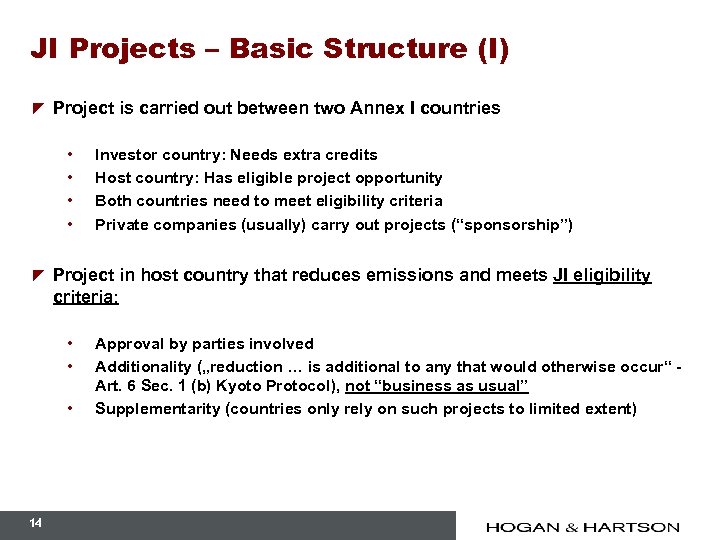
JI Projects – Basic Structure (I) z Project is carried out between two Annex I countries • • z Project in host country that reduces emissions and meets JI eligibility criteria: • • • 14 14 Investor country: Needs extra credits Host country: Has eligible project opportunity Both countries need to meet eligibility criteria Private companies (usually) carry out projects (“sponsorship”) Approval by parties involved Additionality („reduction … is additional to any that would otherwise occur“ - Art. 6 Sec. 1 (b) Kyoto Protocol), not “business as usual” Supplementarity (countries only rely on such projects to limited extent)
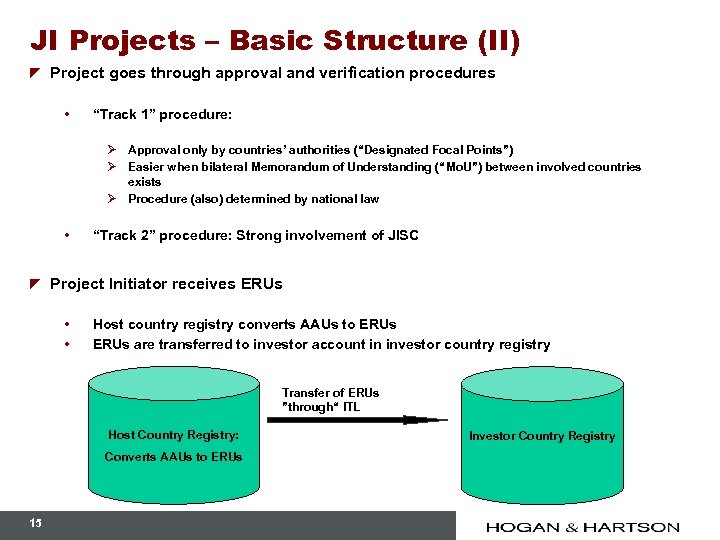
JI Projects – Basic Structure (II) z Project goes through approval and verification procedures • “Track 1” procedure: Ø Approval only by countries’ authorities (“Designated Focal Points”) Ø Easier when bilateral Memorandum of Understanding (“Mo. U”) between involved countries exists Ø Procedure (also) determined by national law • z “Track 2” procedure: Strong involvement of JISC Project Initiator receives ERUs • • Host country registry converts AAUs to ERUs are transferred to investor account in investor country registry Transfer of ERUs ”through“ ITL Host Country Registry: Converts AAUs to ERUs 15 15 Investor Country Registry
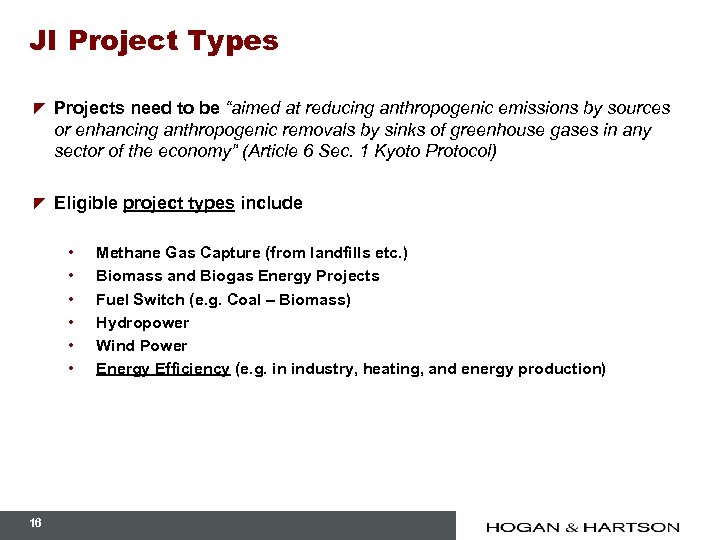
JI Project Types z Projects need to be “aimed at reducing anthropogenic emissions by sources or enhancing anthropogenic removals by sinks of greenhouse gases in any sector of the economy” (Article 6 Sec. 1 Kyoto Protocol) z Eligible project types include • • • 16 16 Methane Gas Capture (from landfills etc. ) Biomass and Biogas Energy Projects Fuel Switch (e. g. Coal – Biomass) Hydropower Wind Power Energy Efficiency (e. g. in industry, heating, and energy production)
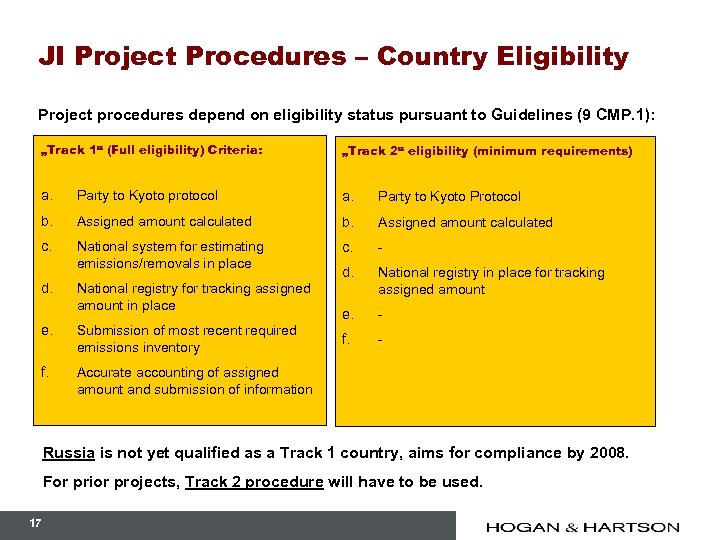
JI Project Procedures – Country Eligibility Project procedures depend on eligibility status pursuant to Guidelines (9 CMP. 1): „Track 1“ (Full eligibility) Criteria: „Track 2“ eligibility (minimum requirements) a. Party to Kyoto protocol a. Party to Kyoto Protocol b. Assigned amount calculated c. National system for estimating emissions/removals in place c. - d. National registry in place for tracking assigned amount e. - f. - d. National registry for tracking assigned amount in place e. Submission of most recent required emissions inventory f. Accurate accounting of assigned amount and submission of information Russia is not yet qualified as a Track 1 country, aims for compliance by 2008. For prior projects, Track 2 procedure will have to be used. 17 17
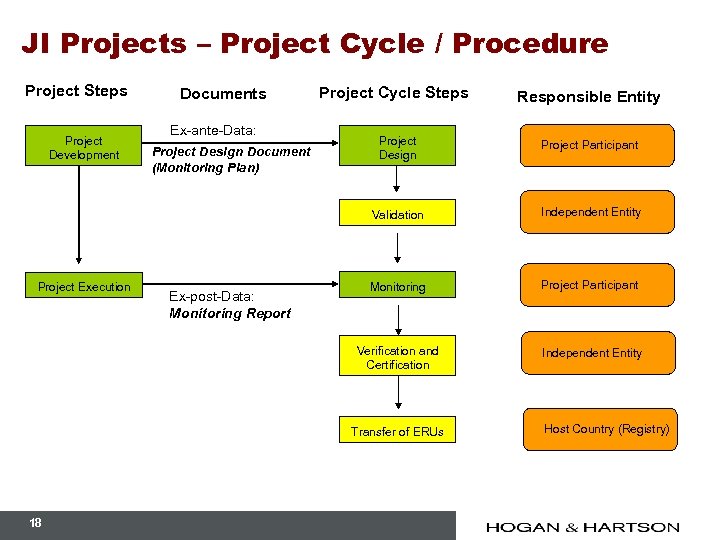
JI Projects – Project Cycle / Procedure Project Steps Project Development Documents Ex-ante-Data: Project Cycle Steps Responsible Entity Ex-post-Data: Monitoring Report Project Participant Independent Entity Monitoring Project Participant Verification and Certification Project Execution Project Design Validation Project Design Document (Monitoring Plan) Independent Entity Transfer of ERUs 18 18 Host Country (Registry)
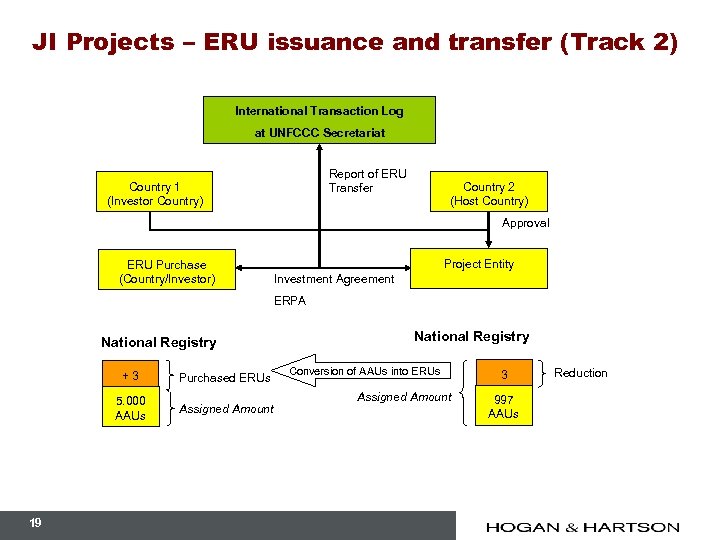
JI Projects – ERU issuance and transfer (Track 2) International Transaction Log at UNFCCC Secretariat Report of ERU Transfer Country 1 (Investor Country) Country 2 (Host Country) Approval ERU Purchase (Country/Investor) Project Entity Investment Agreement ERPA National Registry +3 5. 000 AAUs 19 19 Purchased ERUs Assigned Amount National Registry Conversion of AAUs into ERUs Assigned Amount 3 997 AAUs Reduction
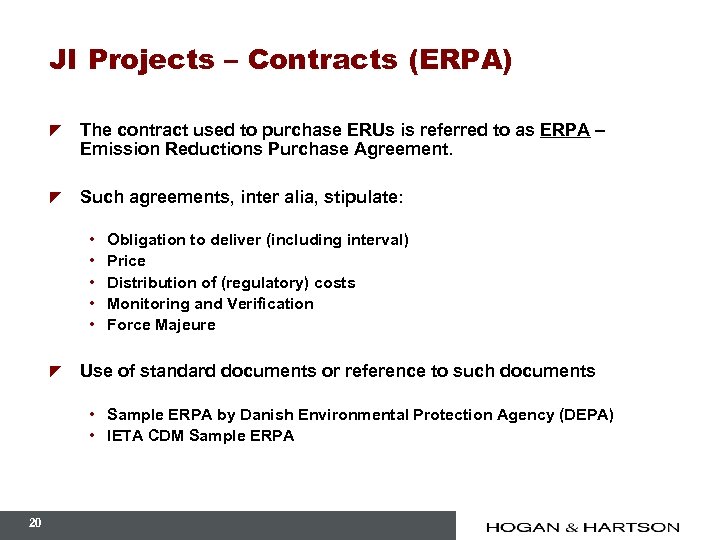
JI Projects – Contracts (ERPA) z The contract used to purchase ERUs is referred to as ERPA – Emission Reductions Purchase Agreement. z Such agreements, inter alia, stipulate: • • • z Obligation to deliver (including interval) Price Distribution of (regulatory) costs Monitoring and Verification Force Majeure Use of standard documents or reference to such documents • Sample ERPA by Danish Environmental Protection Agency (DEPA) • IETA CDM Sample ERPA 20 20
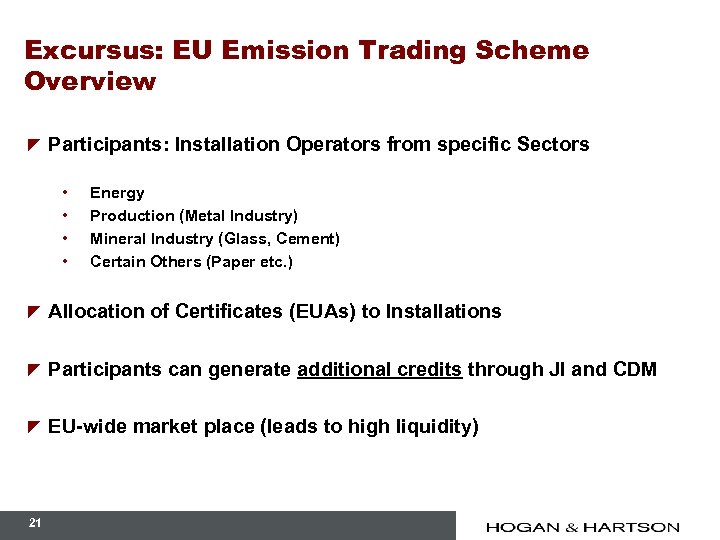
Excursus: EU Emission Trading Scheme Overview z Participants: Installation Operators from specific Sectors • • Energy Production (Metal Industry) Mineral Industry (Glass, Cement) Certain Others (Paper etc. ) z z Participants can generate additional credits through JI and CDM z 21 Allocation of Certificates (EUAs) to Installations EU-wide market place (leads to high liquidity) 21
Excursus: EU Emission Trading Scheme Overview z Regulatory Background • EU Emissions Trading Directive 2003/87/EC: Ø Establishment of Cap-and-Trade System on Emissions (EU Emission Trading Scheme - EU ETS) for Private Entities Ø Green House Gas (GHG) Emissions Subject to Permission and Monitoring • Linking Directive (2004/101/EC): Ø Links EU ETS to Kyoto Level Certificates generated from CDM and JI Projects Ø Creates incentive for companies to get involved in Kyoto project mechanisms like JI! 22 22
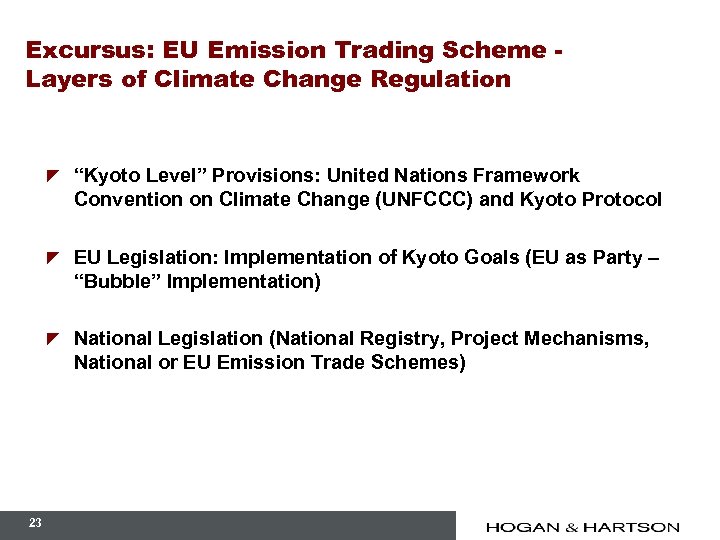
Excursus: EU Emission Trading Scheme Layers of Climate Change Regulation z z 23 EU Legislation: Implementation of Kyoto Goals (EU as Party – “Bubble” Implementation) z 23 “Kyoto Level” Provisions: United Nations Framework Convention on Climate Change (UNFCCC) and Kyoto Protocol National Legislation (National Registry, Project Mechanisms, National or EU Emission Trade Schemes)
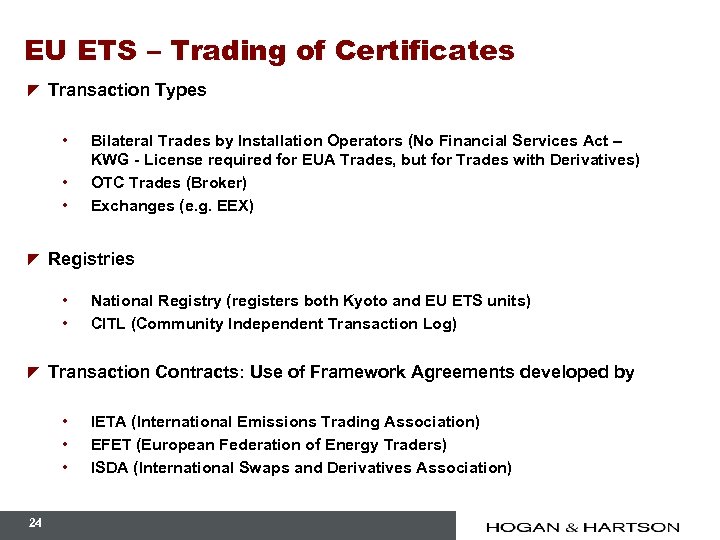
EU ETS – Trading of Certificates z Transaction Types • • • z Registries • • z 24 National Registry (registers both Kyoto and EU ETS units) CITL (Community Independent Transaction Log) Transaction Contracts: Use of Framework Agreements developed by • • • 24 Bilateral Trades by Installation Operators (No Financial Services Act – KWG - License required for EUA Trades, but for Trades with Derivatives) OTC Trades (Broker) Exchanges (e. g. EEX) IETA (International Emissions Trading Association) EFET (European Federation of Energy Traders) ISDA (International Swaps and Derivatives Association)
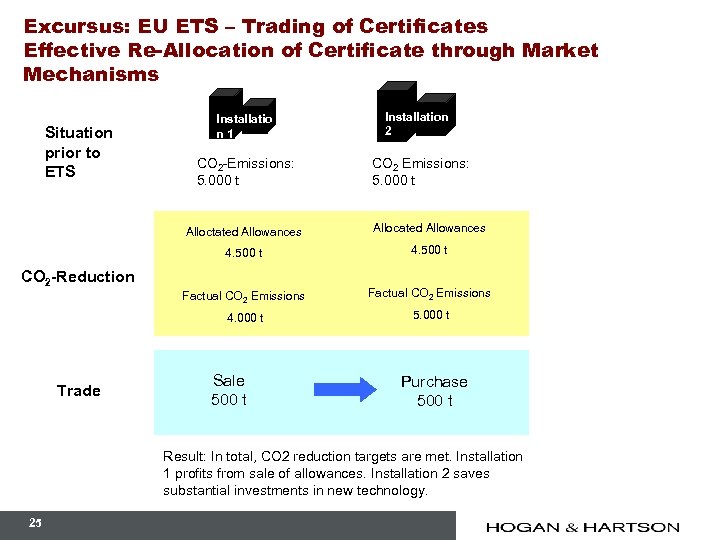
Excursus: EU ETS – Trading of Certificates Effective Re-Allocation of Certificate through Market Mechanisms Situation prior to ETS Installatio n 1 Installation 2 CO 2 -Emissions: 5. 000 t CO 2 Emissions: 5. 000 t Alloctated Allowances Allocated Allowances 4. 500 t Factual CO 2 Emissions 4. 000 t 5. 000 t CO 2 -Reduction Trade Sale 500 t Purchase 500 t Result: In total, CO 2 reduction targets are met. Installation 1 profits from sale of allowances. Installation 2 saves substantial investments in new technology. 25 25
Outlook z z Project Mechanisms complement GHG Emissions Trading and provide an effective Opportunity to enlarge Certificate Base, and therefore provide a Business Opportunity for Companies z 26 A (Global) Climate Change Governance System is here to stay: ET and Project Mechanisms will most likely remain a Key Instrument in European and Global Climate Policies The Russian Municipal Heating Sector can profit from JI Investments, and should actively pursue such Opportunities. 26

Thank you for your attention! Spasiba!

For further information : : please contact. . . Dr. Bernd Beckmann Dr. Carl-Stephan Schweer Hogan & Hartson Raue L. L. P. Potsdamer Platz 1 10785 Berlin Germany Tel: (+49) 30 726 115 330 Fax: (+49) 30 726 115 107 Email: bbeckmann@hhlaw. com Tel: (+49) 30 726 115 330 Fax: (+49) 30 726 115 107 Email: csschweer@hhlaw. com . . . or visit : : www. hhlaw. com 28 28
Скачать презентацию Joint Implementation Projects Legal Background Foresta Tropicana
50744722146c8a19adc20ce306b34695.ppt