


 Скачать презентацию Joint CEC CPUC Proceeding on Advanced Meters Dynamic Pricing
2478a9c201055029248b8907718f4c5f.ppt
- Количество слайдов: 36
 Joint CEC/CPUC Proceeding on Advanced Meters, Dynamic Pricing, and Demand Response in California Utility Energy Forum Granlibakken May 9, 2003 Arthur H. Rosenfeld, Commissioner California Energy Commission 916 654 4930 Arosenfe@Energy. State. CA. US www. Energy. CA. gov www. utilityforum. com Efficiency Energy for the Future
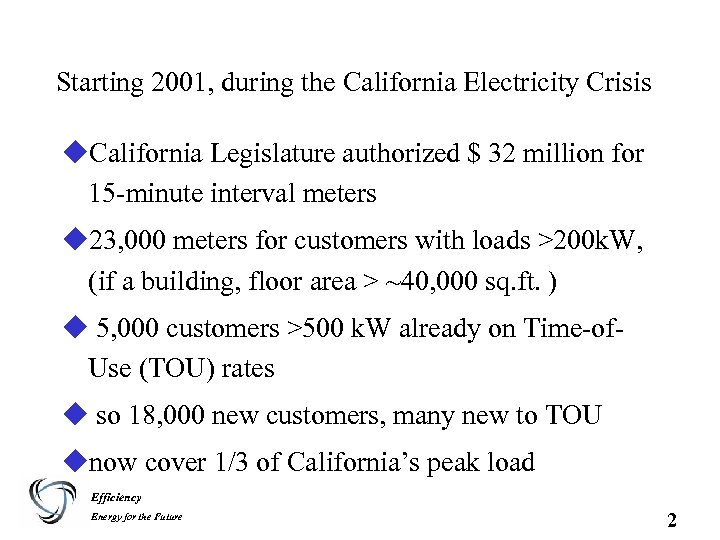 Starting 2001, during the California Electricity Crisis u. California Legislature authorized $ 32 million for 15 -minute interval meters u 23, 000 meters for customers with loads >200 k. W, (if a building, floor area > ~40, 000 sq. ft. ) u 5, 000 customers >500 k. W already on Time-of. Use (TOU) rates u so 18, 000 new customers, many new to TOU unow cover 1/3 of California’s peak load Efficiency Energy for the Future 2
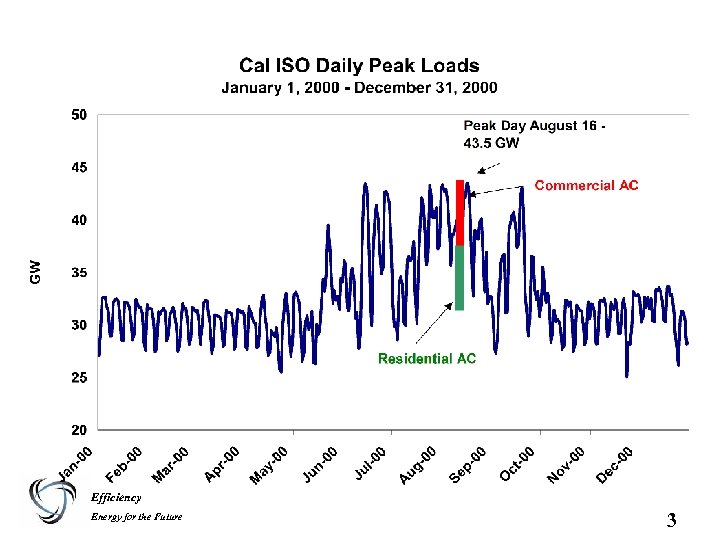 Efficiency Energy for the Future 3
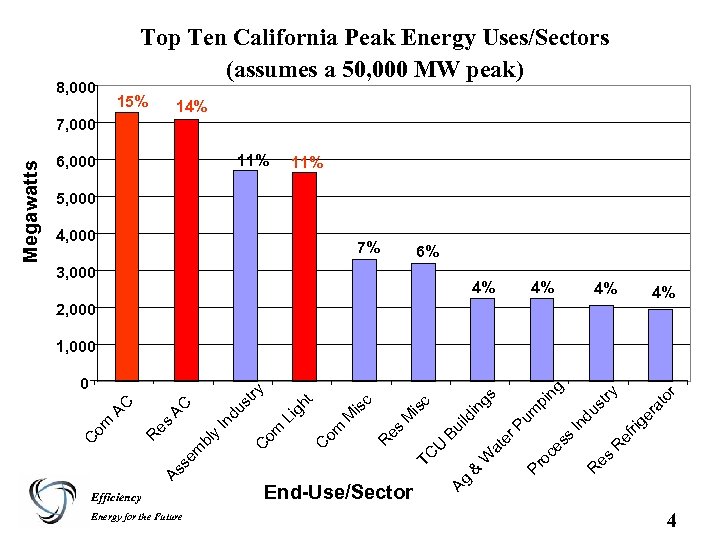 Top Ten California Peak Energy Uses/Sectors (assumes a 50, 000 MW peak) 8, 000 15% 14% 11% 6, 000 11% 5, 000 4, 000 7% 6% 3, 000 4% 4% 2, 000 Energy for the Future or at R es R ef In rig er du s try pi ng oc es s um Pr & W at er P U R es Bu ild M M C om Li om C is c gh t st ry End-Use/Sector Ag Efficiency TC As se m bl y In du AC es R om AC 0 in gs 1, 000 C Megawatts 7, 000 4
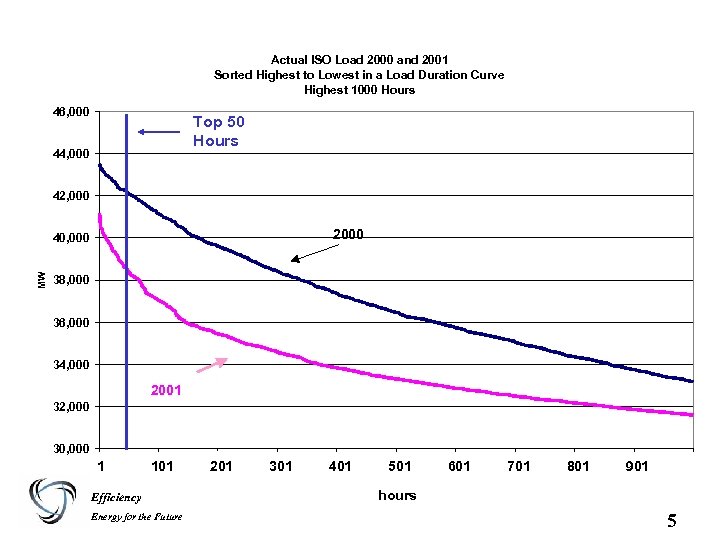 Actual ISO Load 2000 and 2001 Sorted Highest to Lowest in a Load Duration Curve Highest 1000 Hours 46, 000 Top 50 Hours 44, 000 42, 000 2000 MW 40, 000 38, 000 36, 000 34, 000 2001 32, 000 30, 000 1 101 Efficiency Energy for the Future 201 301 401 501 601 701 801 901 hours 5
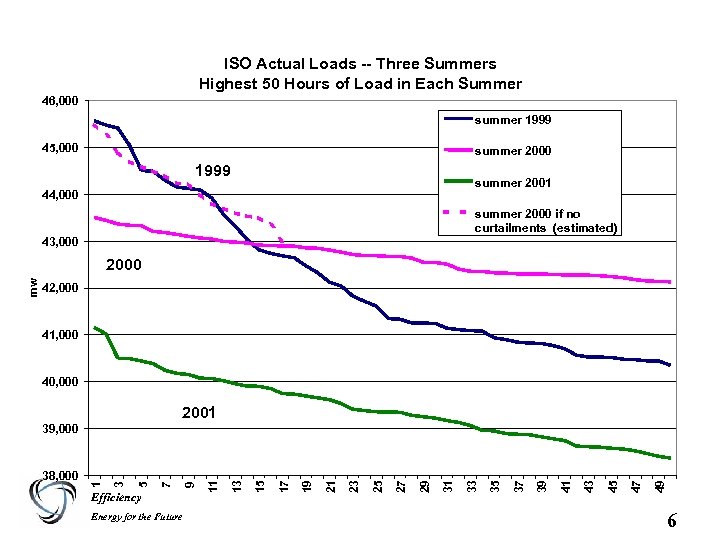 ISO Actual Loads -- Three Summers Highest 50 Hours of Load in Each Summer 46, 000 summer 1999 45, 000 summer 2000 1999 summer 2001 44, 000 summer 2000 if no curtailments (estimated) 43, 000 42, 000 41, 000 40, 000 2001 Energy for the Future 49 47 45 43 41 39 37 35 33 31 29 27 25 23 21 19 17 15 13 11 Efficiency 9 7 5 38, 000 3 39, 000 1 mw 2000 6
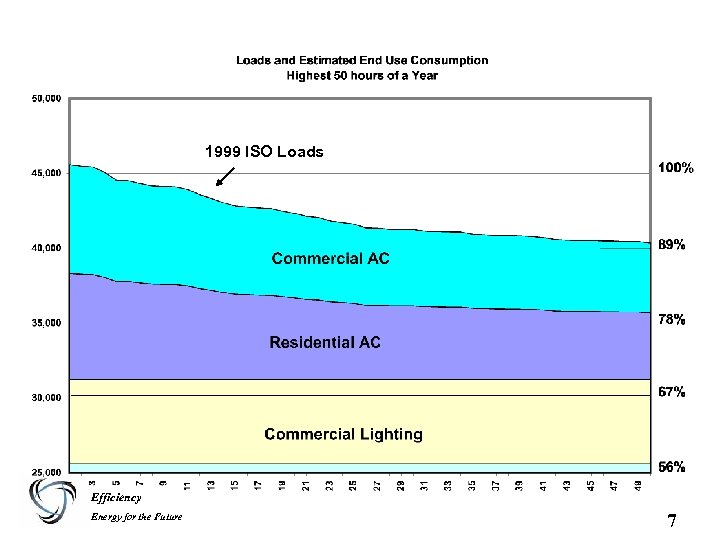 1999 ISO Loads Efficiency Energy for the Future 7
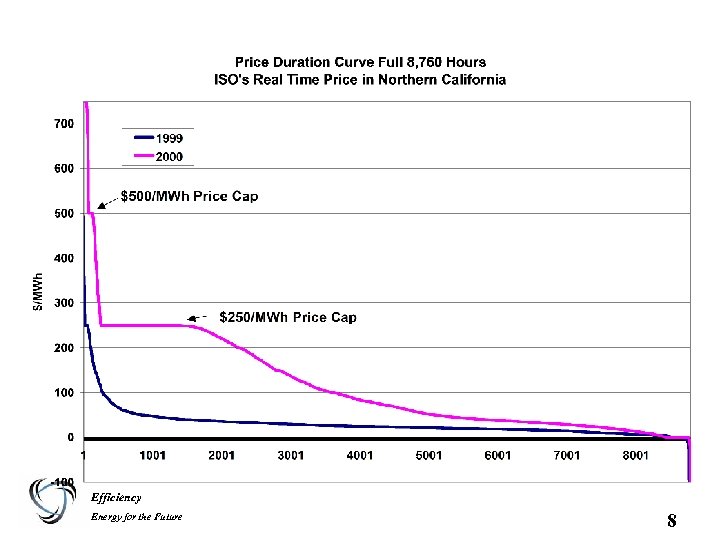 Efficiency Energy for the Future 8
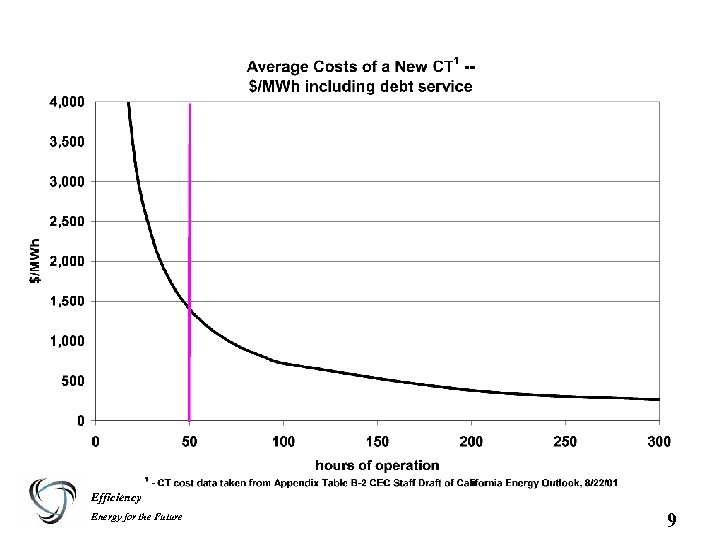 Efficiency Energy for the Future 9
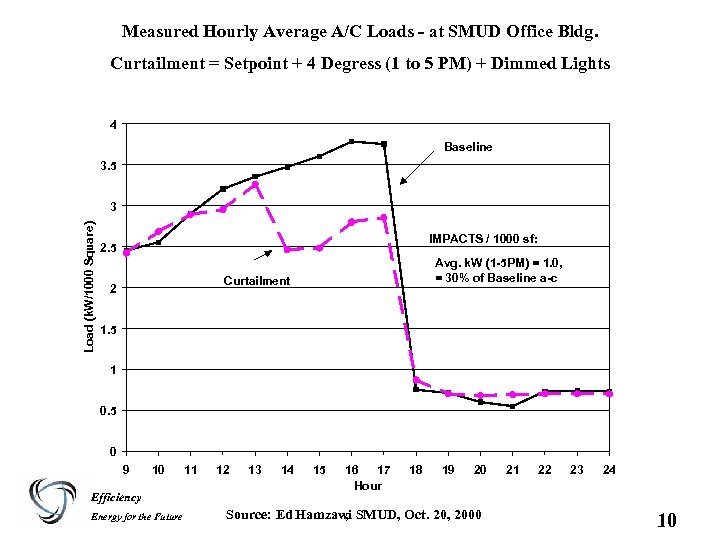 Measured Hourly Average A/C Loads - at SMUD Office Bldg. Curtailment = Setpoint + 4 Degress (1 to 5 PM) + Dimmed Lights 4 Baseline 3. 5 Load (k. W/1000 Square) 3 IMPACTS / 1000 sf: 2. 5 Avg. k. W (1 -5 PM) = 1. 0, = 30% of Baseline a-c Curtailment 2 1. 5 1 0. 5 0 9 10 Efficiency Energy for the Future 11 12 13 14 15 16 17 Hour 18 19 20 Source: Ed Hamzawi SMUD, Oct. 20, 2000 , 21 22 23 24 10
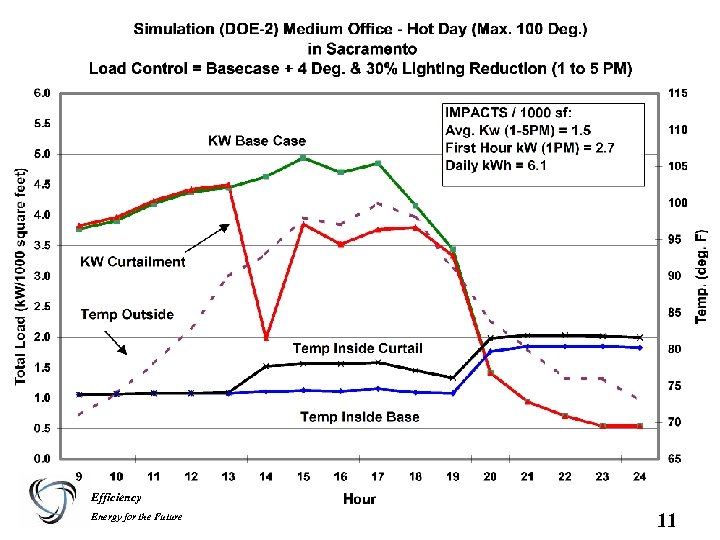 Efficiency Energy for the Future 11
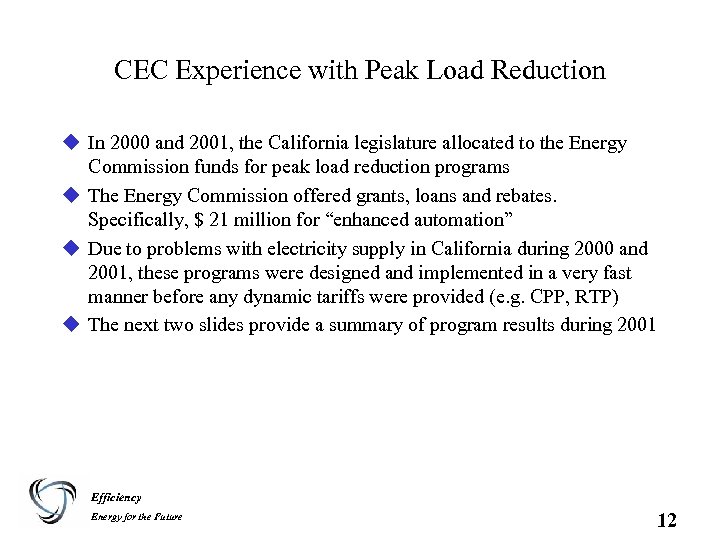 CEC Experience with Peak Load Reduction u In 2000 and 2001, the California legislature allocated to the Energy Commission funds for peak load reduction programs u The Energy Commission offered grants, loans and rebates. Specifically, $ 21 million for “enhanced automation” u Due to problems with electricity supply in California during 2000 and 2001, these programs were designed and implemented in a very fast manner before any dynamic tariffs were provided (e. g. CPP, RTP) u The next two slides provide a summary of program results during 2001 Efficiency Energy for the Future 12
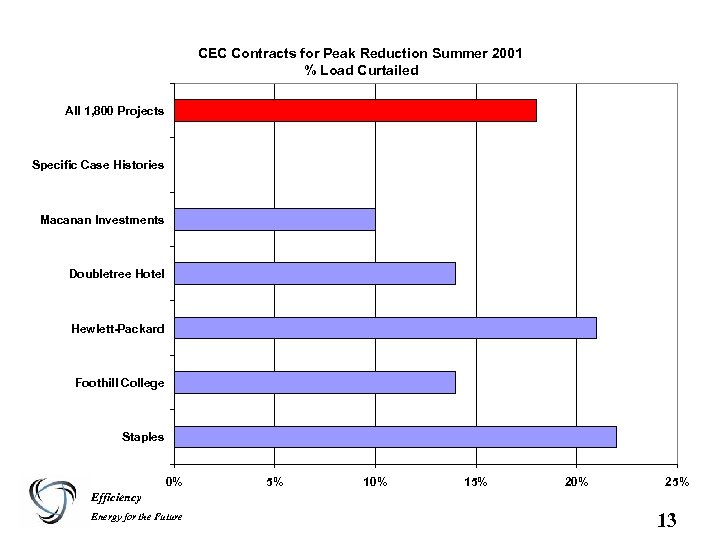 CEC Contracts for Peak Reduction Summer 2001 % Load Curtailed All 1, 800 Projects Specific Case Histories Macanan Investments Doubletree Hotel Hewlett-Packard Foothill College Staples 0% 5% 10% 15% 20% 25% Efficiency Energy for the Future 13
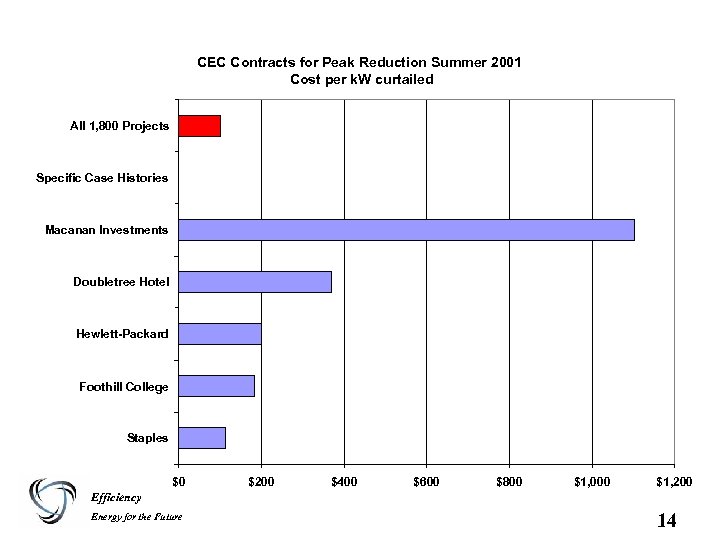 CEC Contracts for Peak Reduction Summer 2001 Cost per k. W curtailed All 1, 800 Projects Specific Case Histories Macanan Investments Doubletree Hotel Hewlett-Packard Foothill College Staples $0 $200 $400 $600 $800 $1, 000 $1, 200 Efficiency Energy for the Future 14
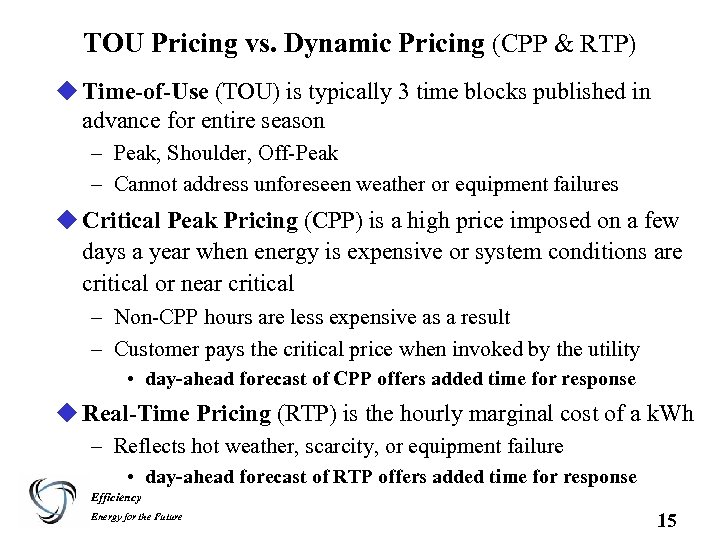 TOU Pricing vs. Dynamic Pricing (CPP & RTP) u Time-of-Use (TOU) is typically 3 time blocks published in advance for entire season – Peak, Shoulder, Off-Peak – Cannot address unforeseen weather or equipment failures u Critical Peak Pricing (CPP) is a high price imposed on a few days a year when energy is expensive or system conditions are critical or near critical – Non-CPP hours are less expensive as a result – Customer pays the critical price when invoked by the utility • day-ahead forecast of CPP offers added time for response u Real-Time Pricing (RTP) is the hourly marginal cost of a k. Wh – Reflects hot weather, scarcity, or equipment failure • day-ahead forecast of RTP offers added time for response Efficiency Energy for the Future 15
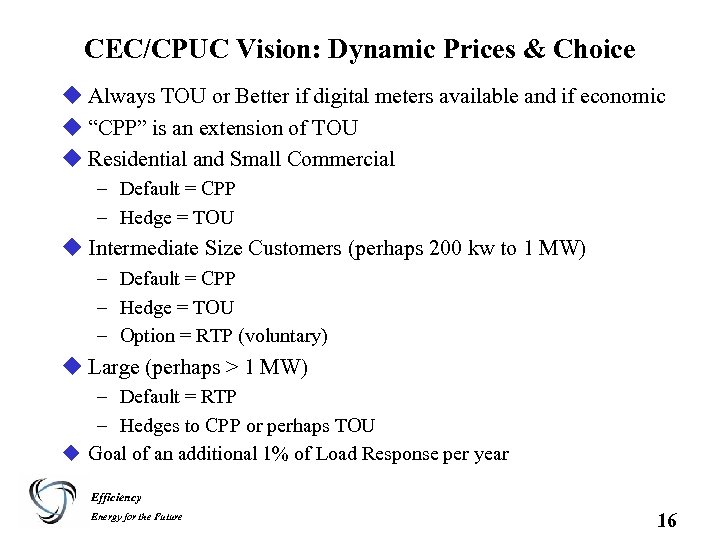 CEC/CPUC Vision: Dynamic Prices & Choice u Always TOU or Better if digital meters available and if economic u “CPP” is an extension of TOU u Residential and Small Commercial – Default = CPP – Hedge = TOU u Intermediate Size Customers (perhaps 200 kw to 1 MW) – Default = CPP – Hedge = TOU – Option = RTP (voluntary) u Large (perhaps > 1 MW) – Default = RTP – Hedges to CPP or perhaps TOU u Goal of an additional 1% of Load Response per year Efficiency Energy for the Future 16
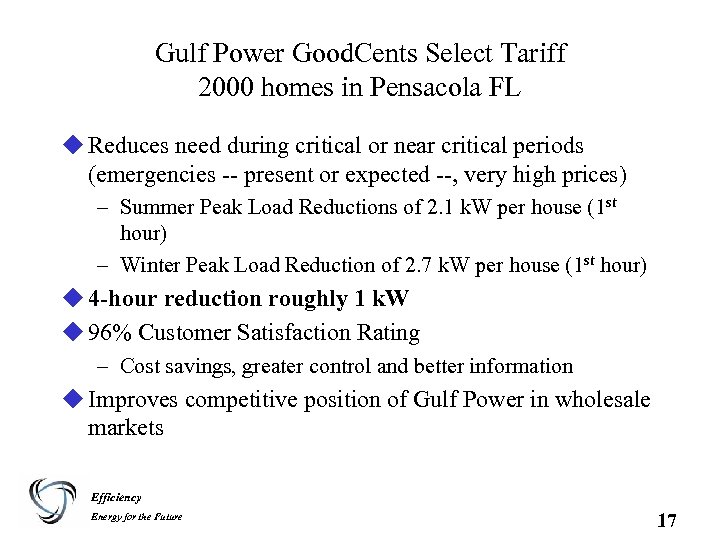 Gulf Power Good. Cents Select Tariff 2000 homes in Pensacola FL u Reduces need during critical or near critical periods (emergencies -- present or expected --, very high prices) – Summer Peak Load Reductions of 2. 1 k. W per house (1 st hour) – Winter Peak Load Reduction of 2. 7 k. W per house (1 st hour) u 4 -hour reduction roughly 1 k. W u 96% Customer Satisfaction Rating – Cost savings, greater control and better information u Improves competitive position of Gulf Power in wholesale markets Efficiency Energy for the Future 17
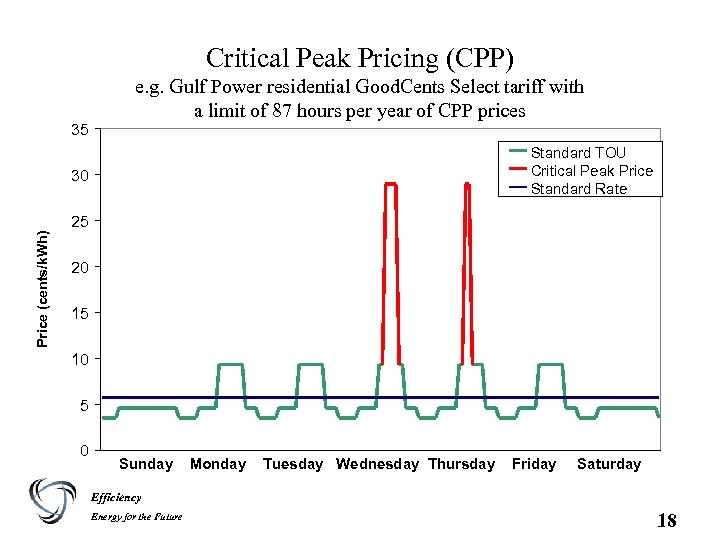 Critical Peak Pricing (CPP) 35 e. g. Gulf Power residential Good. Cents Select tariff with a limit of 87 hours per year of CPP prices Standard TOU Critical Peak Price Standard Rate 30 Price (cents/k. Wh) 25 20 15 10 5 0 Sunday Monday Tuesday Wednesday Thursday Friday Saturday Efficiency Energy for the Future 18
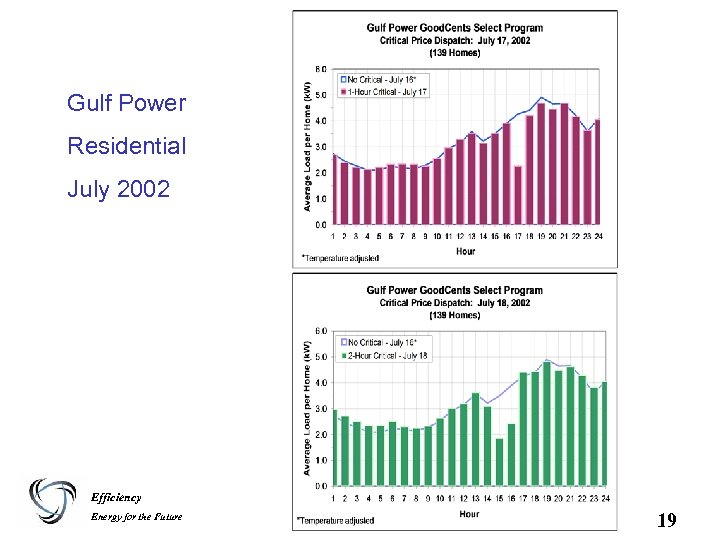 Gulf Power Residential July 2002 Efficiency Energy for the Future 19
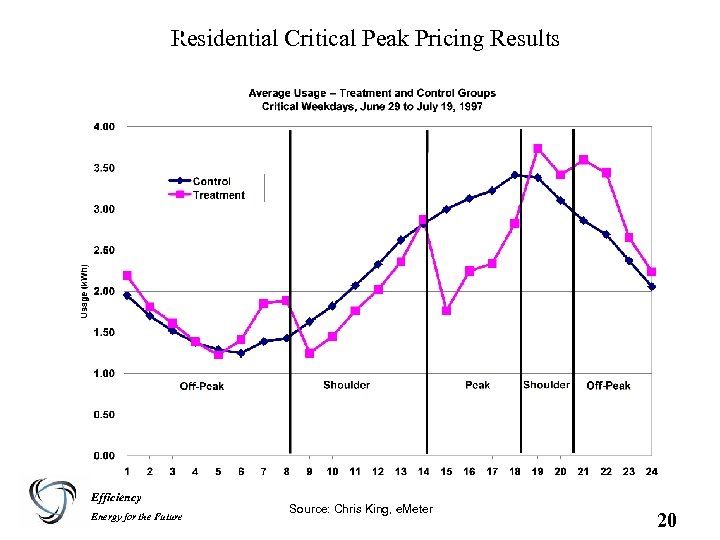 Residential Critical Peak Pricing Results Efficiency Energy for the Future Source: Chris King, e. Meter 20
 Georgia Power’s Voluntary 2 -part RTP Program u Customer bill = Part 1 + Part 2 – Part 1 based on historical load profile (customer baseline load -CBL). CBL is a list of hourly loads for entire year – Part 2 based on price responsive departures from load profile u Part 1 is the CBL x TOU tariff – What you expect to pay if you don’t respond to real-time price u Part 2 is the hourly departures from CBL – Enables customer to buy additional k. Wh when prices are low – And sell back k. Wh when prices are high u Saves 17% of participant’s load at ~$1/k. Wh on hot afternoons Efficiency Energy for the Future 21
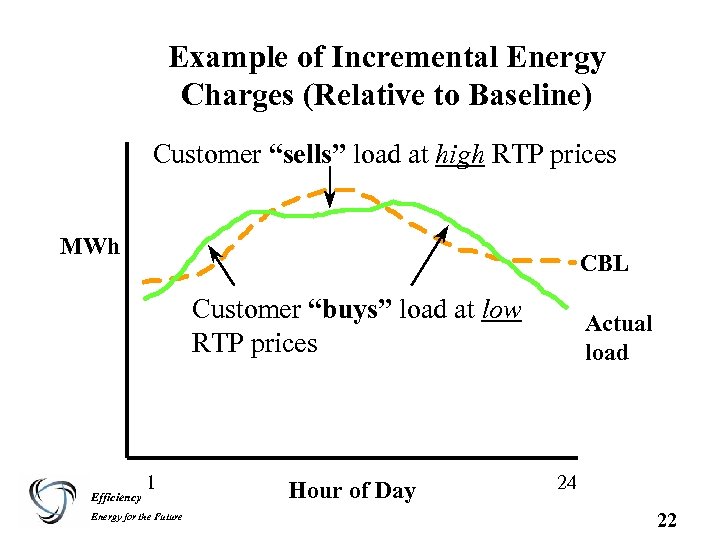 Example of Incremental Energy Charges (Relative to Baseline) Customer “sells” load at high RTP prices MWh CBL Customer “buys” load at low RTP prices Efficiency 1 Energy for the Future Hour of Day Actual load 24 22
 Real Time Pricing at Georgia Power q q q 1, 650 commercial and industrial customers, totaling 5, 000 MW Two-part, day-ahead and hour-ahead hourly pricing High customer satisfaction; low turnover Up to 1, 000 MW of load response during critical high-price conditions Related risk management products called Price Protection Policies Efficiency Energy for the Future 23
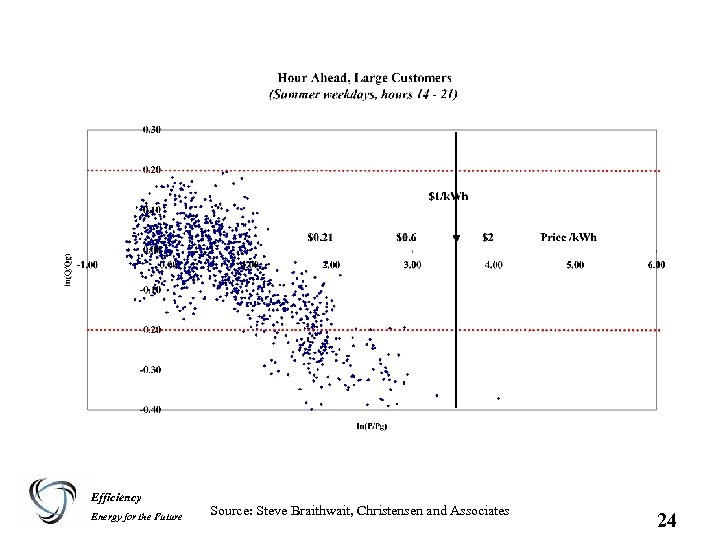 Efficiency Energy for the Future Source: Steve Braithwait, Christensen and Associates 24
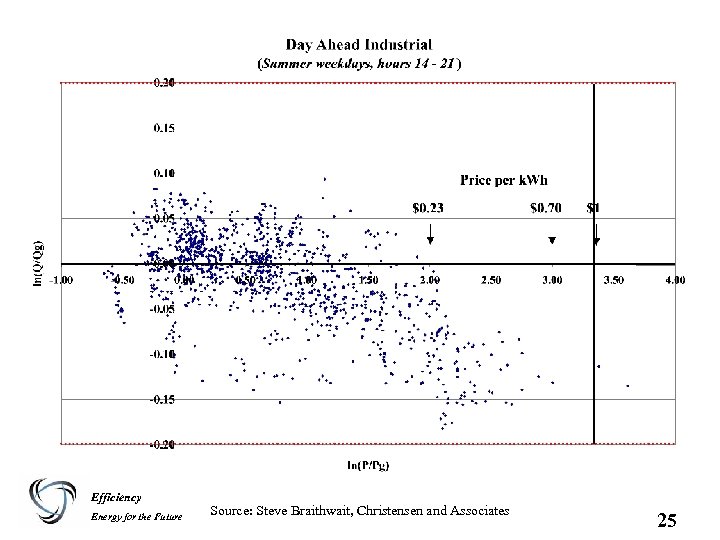 Efficiency Energy for the Future Source: Steve Braithwait, Christensen and Associates 25
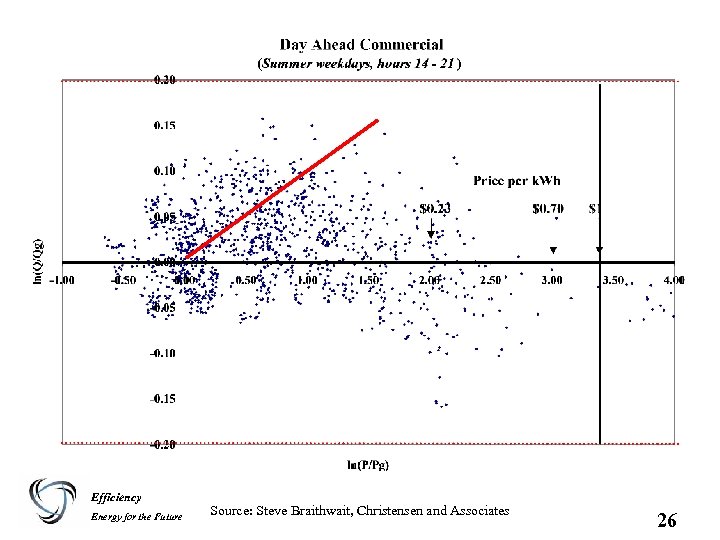 Efficiency Energy for the Future Source: Steve Braithwait, Christensen and Associates 26
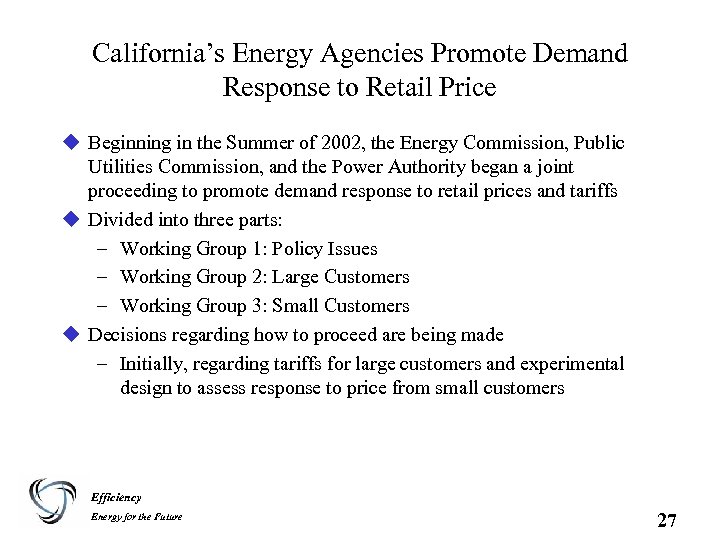 California’s Energy Agencies Promote Demand Response to Retail Price u Beginning in the Summer of 2002, the Energy Commission, Public Utilities Commission, and the Power Authority began a joint proceeding to promote demand response to retail prices and tariffs u Divided into three parts: – Working Group 1: Policy Issues – Working Group 2: Large Customers – Working Group 3: Small Customers u Decisions regarding how to proceed are being made – Initially, regarding tariffs for large customers and experimental design to assess response to price from small customers Efficiency Energy for the Future 27
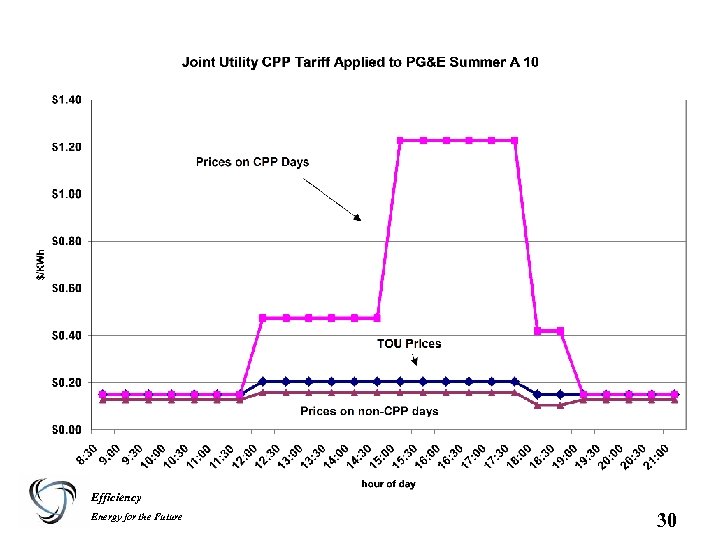
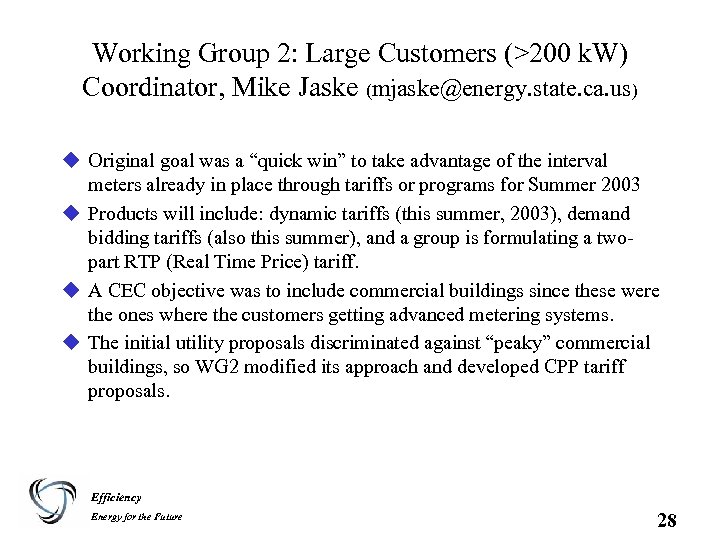 Working Group 2: Large Customers (>200 k. W) Coordinator, Mike Jaske (mjaske@energy. state. ca. us) u Original goal was a “quick win” to take advantage of the interval meters already in place through tariffs or programs for Summer 2003 u Products will include: dynamic tariffs (this summer, 2003), demand bidding tariffs (also this summer), and a group is formulating a twopart RTP (Real Time Price) tariff. u A CEC objective was to include commercial buildings since these were the ones where the customers getting advanced metering systems. u The initial utility proposals discriminated against “peaky” commercial buildings, so WG 2 modified its approach and developed CPP tariff proposals. Efficiency Energy for the Future 28
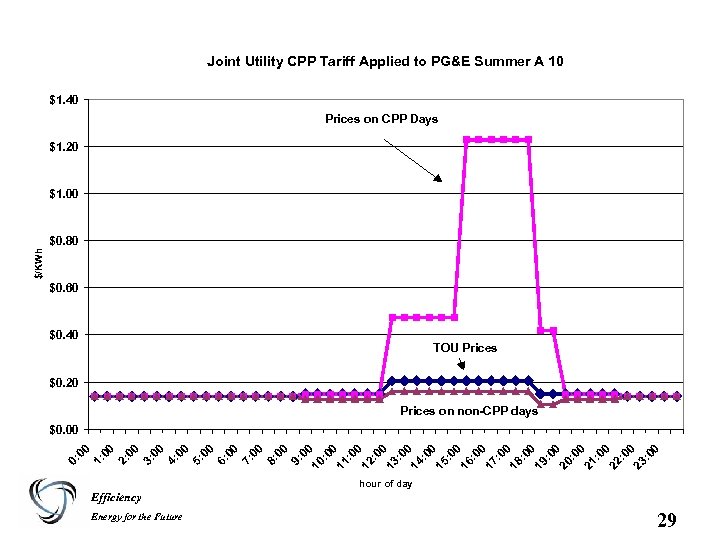 Joint Utility CPP Tariff Applied to PG&E Summer A 10 $1. 40 Prices on CPP Days $1. 20 $1. 00 $/KWh $0. 80 $0. 60 $0. 40 TOU Prices $0. 20 Prices on non-CPP days 0: 00 1: 00 2: 00 3: 00 4: 00 5: 00 6: 00 7: 00 8: 00 9: 00 10 : 0 0 11 : 0 0 12 : 0 0 13 : 0 0 14 : 0 0 15 : 0 0 16 : 0 0 17 : 0 0 18 : 0 0 19 : 0 0 20 : 0 0 21 : 0 0 22 : 0 0 23 : 0 0 $0. 00 hour of day Efficiency Energy for the Future 29
 Efficiency Energy for the Future 30
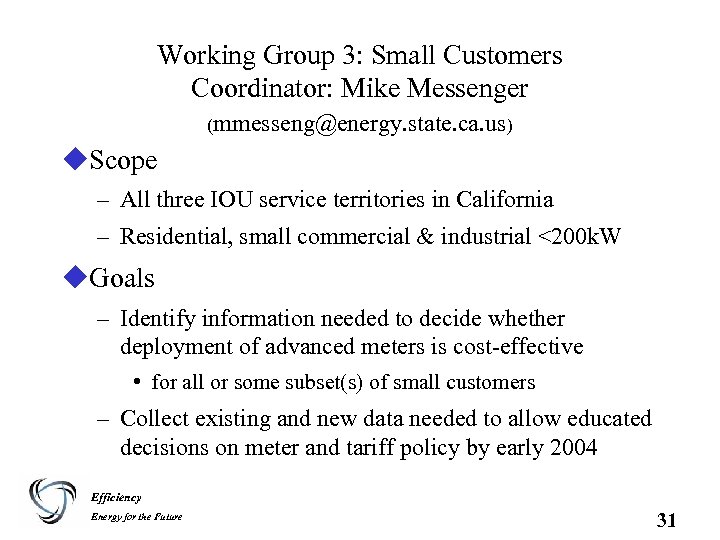 Working Group 3: Small Customers Coordinator: Mike Messenger (mmesseng@energy. state. ca. us) u. Scope – All three IOU service territories in California – Residential, small commercial & industrial <200 k. W u. Goals – Identify information needed to decide whether deployment of advanced meters is cost-effective • for all or some subset(s) of small customers – Collect existing and new data needed to allow educated decisions on meter and tariff policy by early 2004 Efficiency Energy for the Future 31
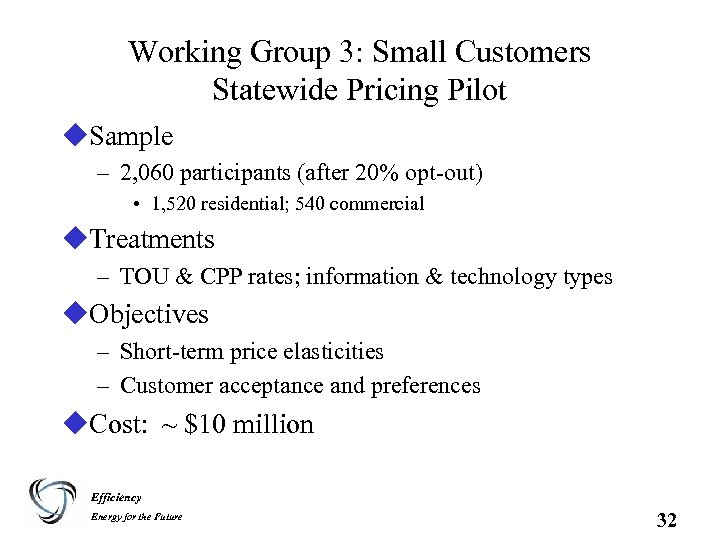 Working Group 3: Small Customers Statewide Pricing Pilot u. Sample – 2, 060 participants (after 20% opt-out) • 1, 520 residential; 540 commercial u. Treatments – TOU & CPP rates; information & technology types u. Objectives – Short-term price elasticities – Customer acceptance and preferences u. Cost: ~ $10 million Efficiency Energy for the Future 32
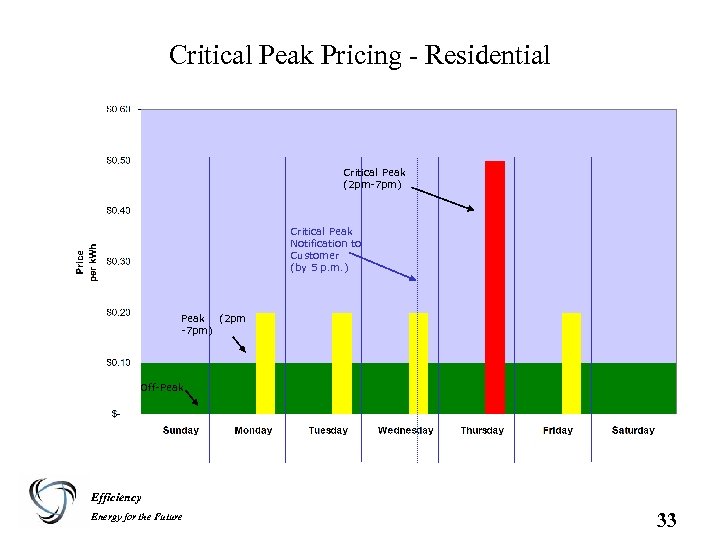 Critical Peak Pricing - Residential Critical Peak (2 pm-7 pm) Critical Peak Notification to Customer (by 5 p. m. ) Peak (2 pm -7 pm) Off-Peak Efficiency Energy for the Future 33
 Concluding Remarks u Price responsive demand will enhance the competitiveness of electricity markets u A direct link between wholesale and retails markets is essential u However, other types of electrical system emergencies may require instantaneous load response u California had a separate proceeding dealing with interruptible load programs u We plan to merge price-sensitive demand response and interruptible programs – For example, one approach could involve a curtailment signal that a customer would not have the option to over ride. – The next graph illustrates how this might work Efficiency Energy for the Future 34
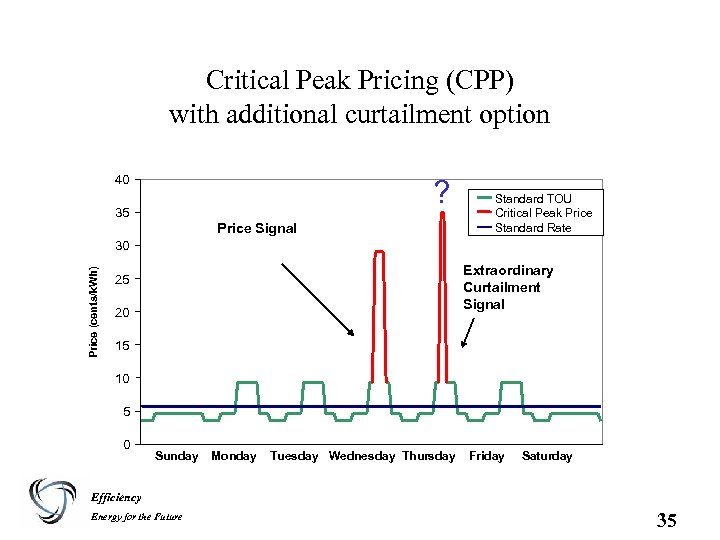 Critical Peak Pricing (CPP) with additional curtailment option 40 ? 35 Price Signal Standard TOU Critical Peak Price Standard Rate Price (cents/k. Wh) 30 Extraordinary Curtailment Signal 25 20 15 10 5 0 Sunday Monday Tuesday Wednesday Thursday Friday Saturday Efficiency Energy for the Future 35
 For more details see u PUC R. 02 -06 -001 – http: //www. cpuc. ca. gov/static/industry/electric/demand/index. htm u CEC 02 -Demand Response-01 – http: //www. energy. ca. gov/demandresponse/documents/index. html u Dynamic Pricing, Advanced Metering and Demand Response in Electricity Markets – The Hewlett Foundation Energy Series Foundation monograph by Severin Borenstein, Mike Jaske and Art Rosenfeld, September 2002 – http: //www. energy. ca. gov/commissioners/rosenfeld. html, http: //www. ef. org/energyseries_dynamic. cfm u How and Why Customers Respond to Electricity Price Variability: A Study of NYISO and NYSERDA 2002 PRL Program Performance – Neenan, B. , et. al. , January 2003 http: //certs. lbl. gov/PDF/NYISO. pdf Efficiency Energy for the Future 36