


 Скачать презентацию Johnson Congress Reconstruction Differences of Opinion
9f815c065b72cb5373160d6822e435bf.ppt
- Количество слайдов: 21
 Johnson, Congress, & Reconstruction
 Differences of Opinion n President Andrew Johnson n n No equal rights/No right to vote former slaves States should decide the fate of freed people Punishment for Confederate leaders Each state must be represented for laws to “count”. n Congress n n n Right to vote for freed people The federal government should act to ensure fairness in southern states Congress composed of Union states should make laws for the southern states.
 Reconstruction Act of 1867 n n n New governments required in Southern States (except Tennessee) 5 military districts In the south African-American voting rights No confederates in office To reenter Union, the states must ratify the 14 th (nativeborn citizenship) amendment and submit constitutions for approval. A second act required military commanders to begin registering voters.
 Response to Reconstruction n n Many white southerners refuse to vote in state elections. Because of this, Republicans gain control of southern states. n By 1868 Alabama, Arkansas, Florida, Georgia, Louisiana, N. Carolina, and S. Carolina have met conditions. (Mississippi, Virginia, and Texas by 1870)
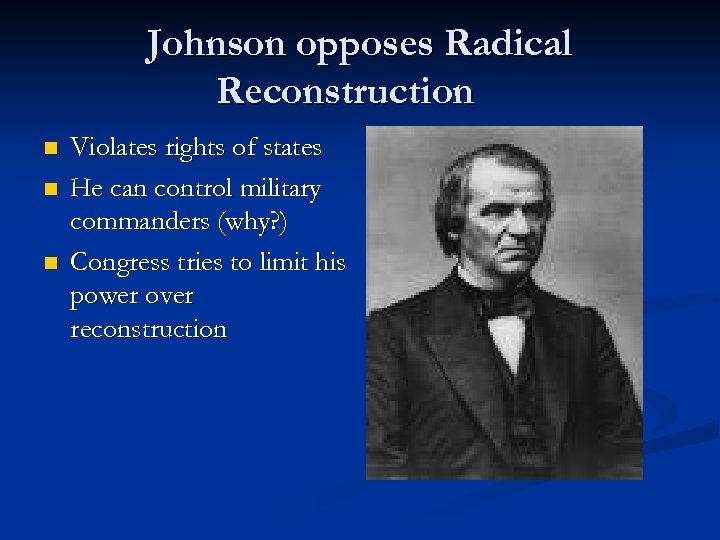 Johnson opposes Radical Reconstruction n Violates rights of states He can control military commanders (why? ) Congress tries to limit his power over reconstruction
 Tenure of Office Act n The president must now seek approval to remove government officials. n n This threatens the power of the president. This act would lead to impeachment proceedings against the president.
 IMPEACHMENT! In 1867 Johnson suspends Edwin Stanton (Sec. of War) without congressional approval. n Congress Charges him with violating the Tenure of Office Act. n Johnson responds by installing military commanders that congress doesn’t like. n The House impeaches Johnson n
 Impeachment Trial n Andrew Johnson goes on trial in 1868. n n He claims that he has the right to challenge the Tenure of Office Act as being unconstitutional. Also, he claimed that removal of the president over “a difference of opinion” was wrong. Congress votes 35 -19 in favor of impeachment, but this is 1 vote shy of the 2/3 rds majority needed. Johnson is able to finish his term, but does not run again.
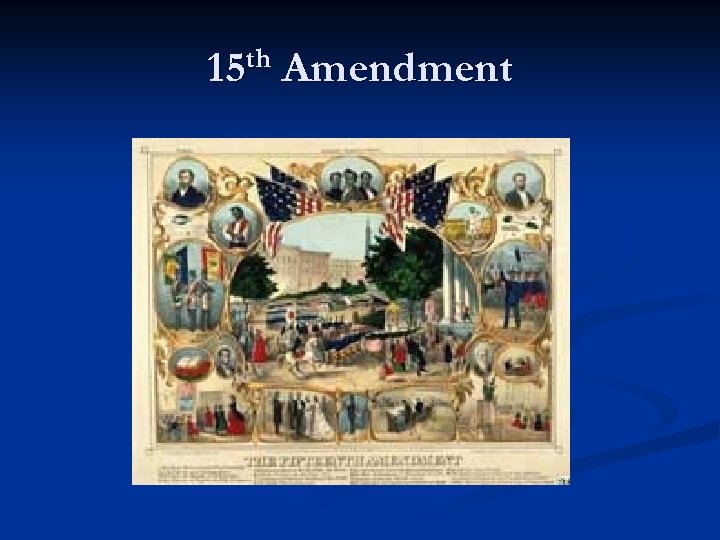
 Election of 1870 n Ulysses S. Grant wins as a Republican Candidate. n n He is helped in his win by garnering almost all the votes of the freedmen. After the election, congress passes the 15 th amendment. n This guarantees the right to vote for all male citizens regardless of race, color, or previous condition of servitude”
 The South During Reconstruction
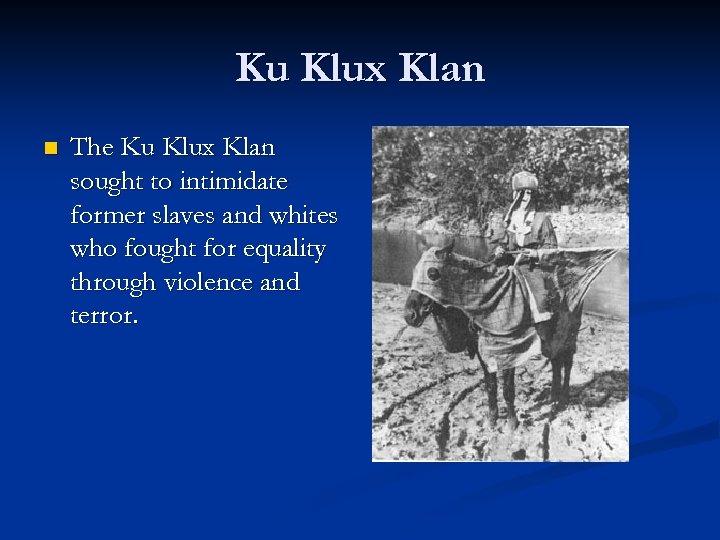 Ku Klux Klan n The Ku Klux Klan sought to intimidate former slaves and whites who fought for equality through violence and terror.
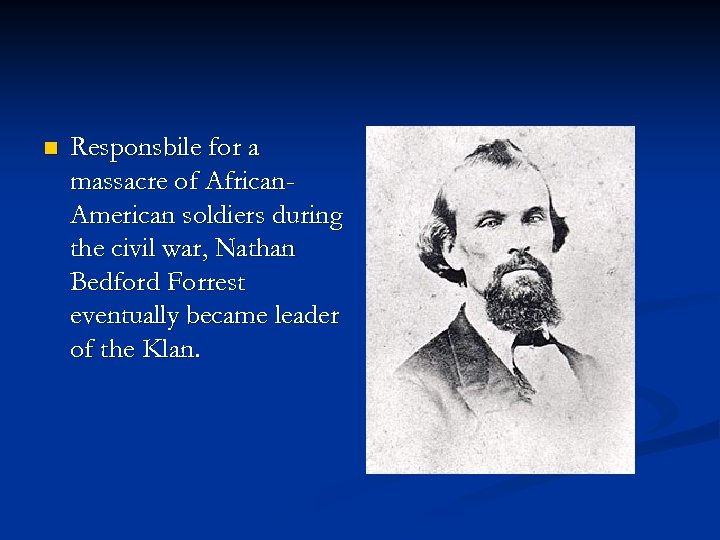 n Responsbile for a massacre of African. American soldiers during the civil war, Nathan Bedford Forrest eventually became leader of the Klan.
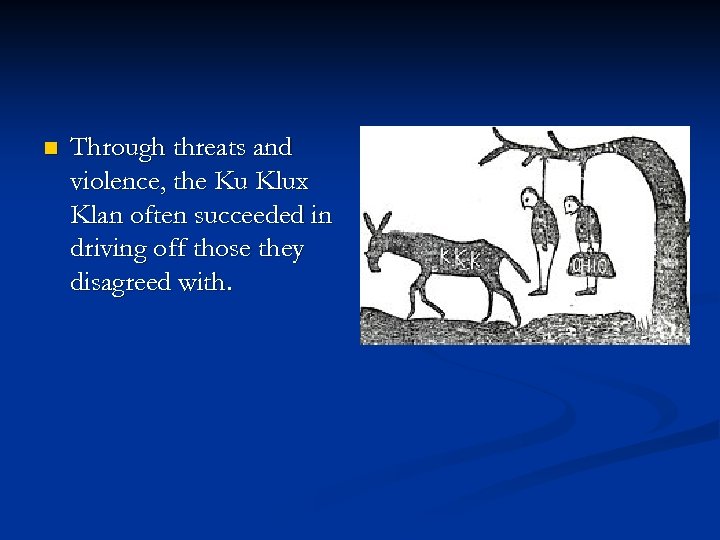 n Through threats and violence, the Ku Klux Klan often succeeded in driving off those they disagreed with.
 th 15 Amendment
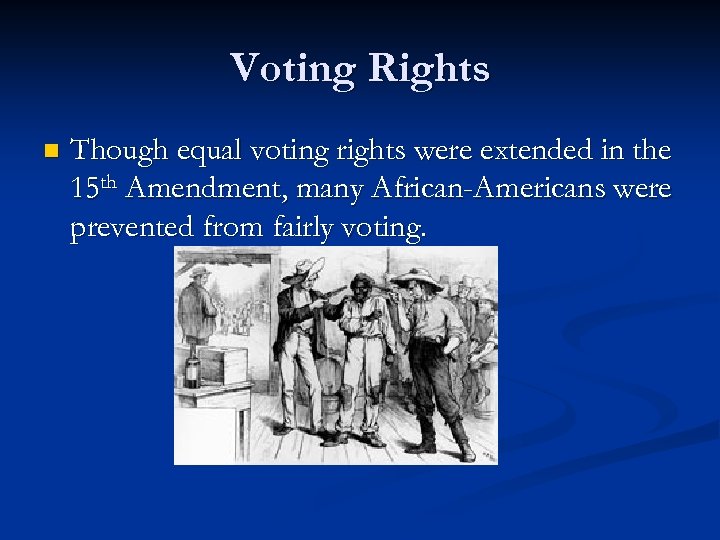 Voting Rights n Though equal voting rights were extended in the 15 th Amendment, many African-Americans were prevented from fairly voting.
 Improvements Public Schools (mostly segregated) n Universities (Morehouse, Atlanta) n Some landownership, mostly sharecropping though. n
 Reconstruction Declines Northerners begin to lose interest n Southern Democrats begin to regain control as Republicans splinter. n Former confederates gain amnesty and can vote and run for office. n
 The End of Reconstruction
 Amnesty Act n In 1872, Congress passes the Amnesty Act which pardons almost all former confederates. n How will this affect reconstruction?
 Democrats back in Power White southerners return to voting n Intimidation prevents African-Americans from voting in southern states. n This brings the Democrats back into political power. n
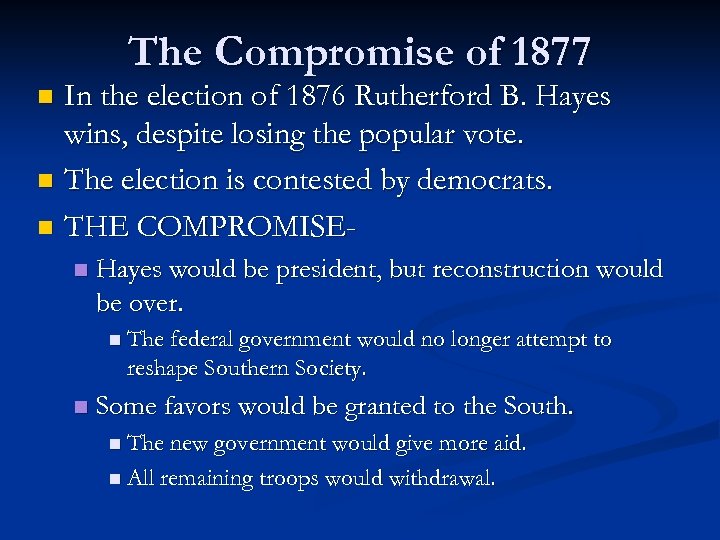 The Compromise of 1877 In the election of 1876 Rutherford B. Hayes wins, despite losing the popular vote. n The election is contested by democrats. n THE COMPROMISEn n Hayes would be president, but reconstruction would be over. n The federal government would no longer attempt to reshape Southern Society. n Some favors would be granted to the South. n The new government would give more aid. n All remaining troops would withdrawal.