Скачать презентацию John Keats London 1795 Rome 1821
118c478b1cd01f3744879cd8972de280.ppt
- Количество слайдов: 20
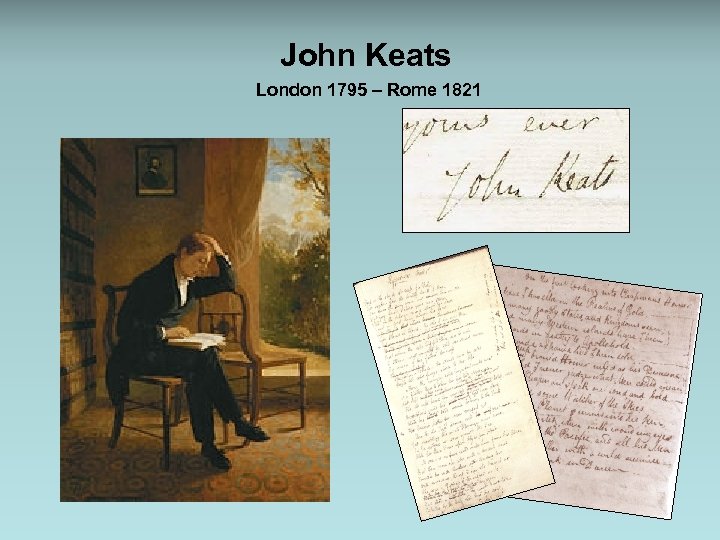 John Keats London 1795 – Rome 1821
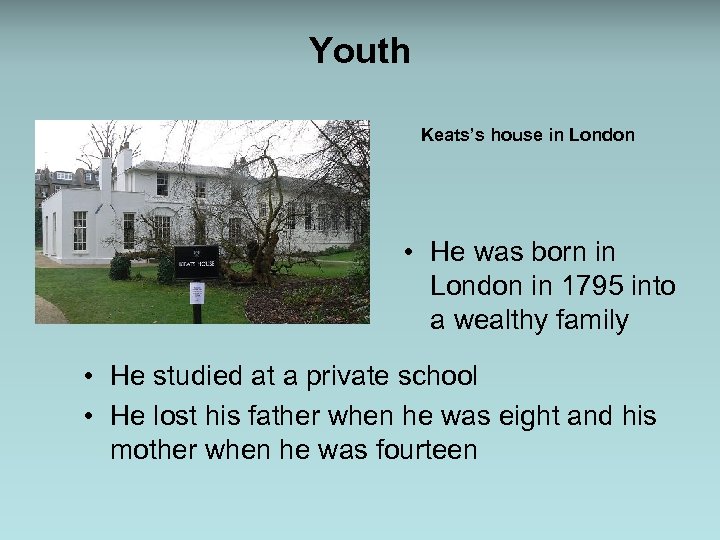 Youth Keats’s house in London • He was born in London in 1795 into a wealthy family • He studied at a private school • He lost his father when he was eight and his mother when he was fourteen
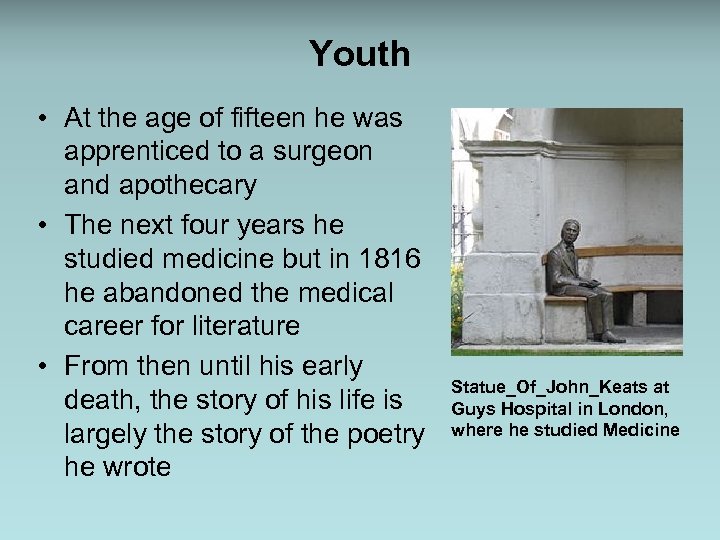 Youth • At the age of fifteen he was apprenticed to a surgeon and apothecary • The next four years he studied medicine but in 1816 he abandoned the medical career for literature • From then until his early death, the story of his life is largely the story of the poetry he wrote Statue_Of_John_Keats at Guys Hospital in London, where he studied Medicine
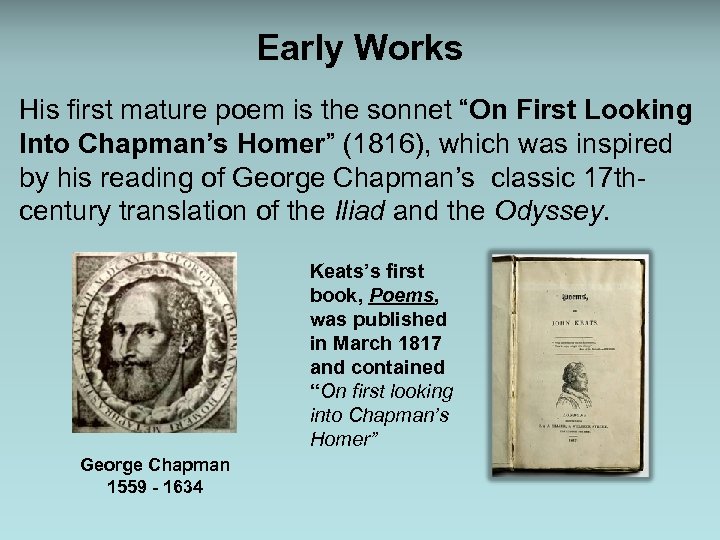 Early Works His first mature poem is the sonnet “On First Looking Into Chapman’s Homer” (1816), which was inspired by his reading of George Chapman’s classic 17 thcentury translation of the Iliad and the Odyssey. Keats’s first book, Poems, was published in March 1817 and contained “On first looking into Chapman’s Homer” George Chapman 1559 - 1634
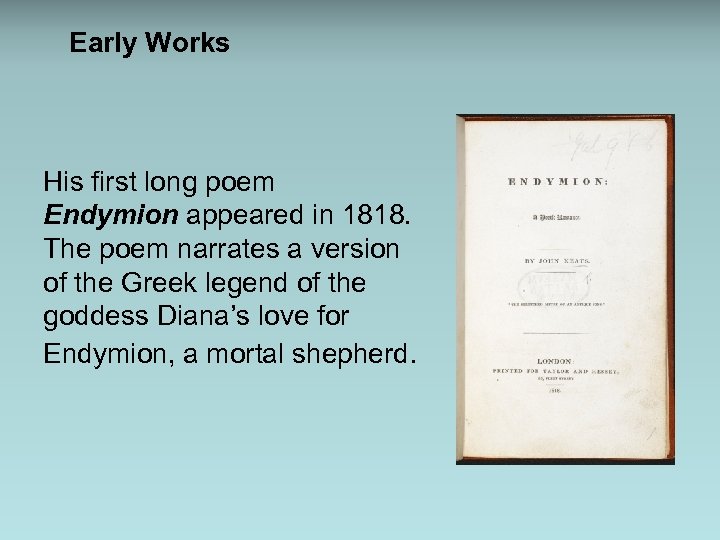 Early Works His first long poem Endymion appeared in 1818. The poem narrates a version of the Greek legend of the goddess Diana’s love for Endymion, a mortal shepherd.
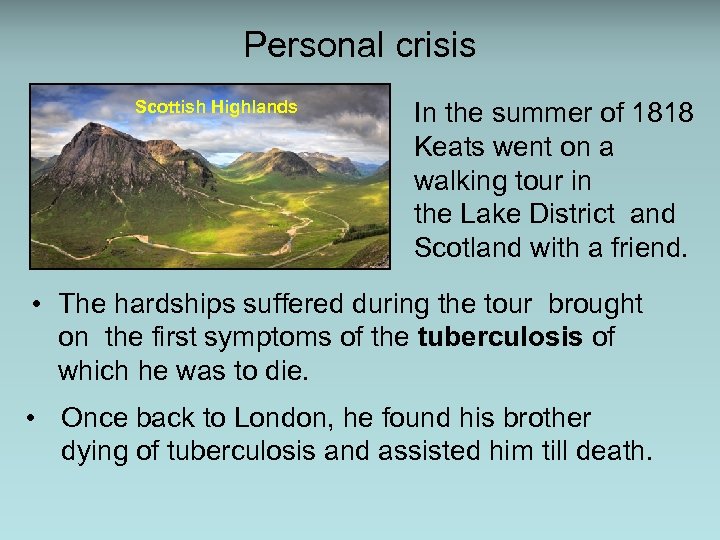 Personal crisis Scottish Highlands In the summer of 1818 Keats went on a walking tour in the Lake District and Scotland with a friend. • The hardships suffered during the tour brought on the first symptoms of the tuberculosis of which he was to die. • Once back to London, he found his brother dying of tuberculosis and assisted him till death.
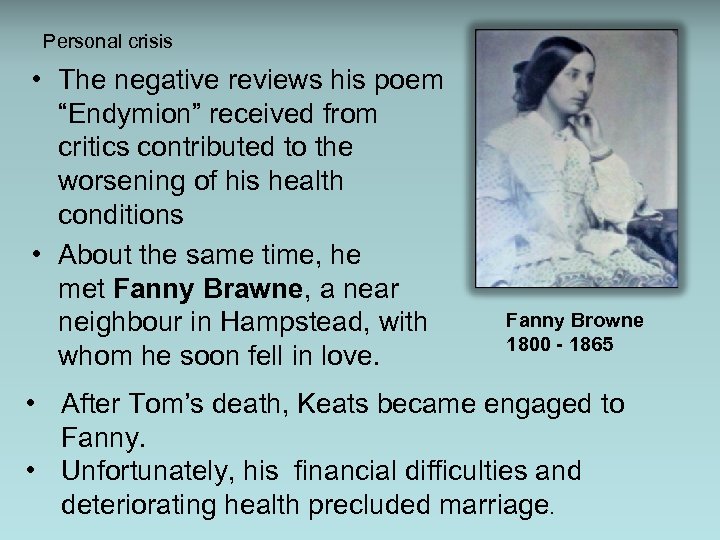 Personal crisis • The negative reviews his poem “Endymion” received from critics contributed to the worsening of his health conditions • About the same time, he met Fanny Brawne, a near neighbour in Hampstead, with whom he soon fell in love. Fanny Browne 1800 - 1865 • After Tom’s death, Keats became engaged to Fanny. • Unfortunately, his financial difficulties and deteriorating health precluded marriage.
 The Year 1819 Between autumn 1818 and autumn 1819 all Keats’s greatest poetry was written: the narrative poems: Lamia The Eve of St. Agnes the great odes : Ode to a Nightingale Ode on a Grecian Urn To Psyche Ode on Melancholy To Autumn the ballad: the epic poem: La Belle Dame Sans Merci Hyperion (unfinished)
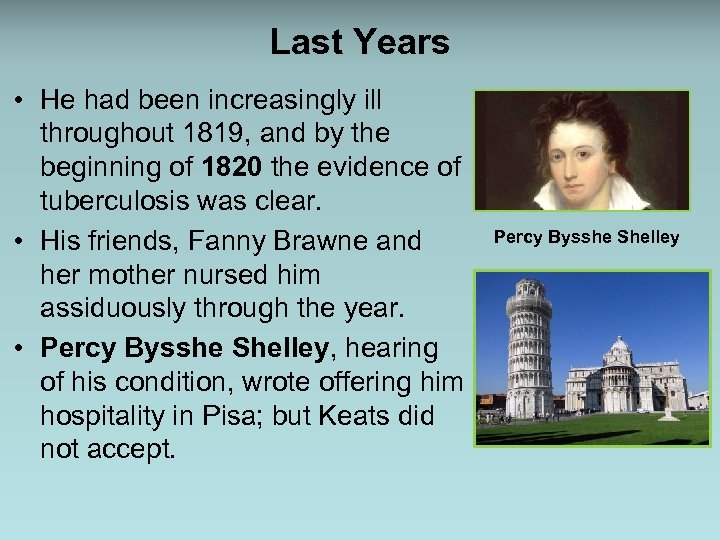 Last Years • He had been increasingly ill throughout 1819, and by the beginning of 1820 the evidence of tuberculosis was clear. • His friends, Fanny Brawne and her mother nursed him assiduously through the year. • Percy Bysshe Shelley, hearing of his condition, wrote offering him hospitality in Pisa; but Keats did not accept. Percy Bysshe Shelley
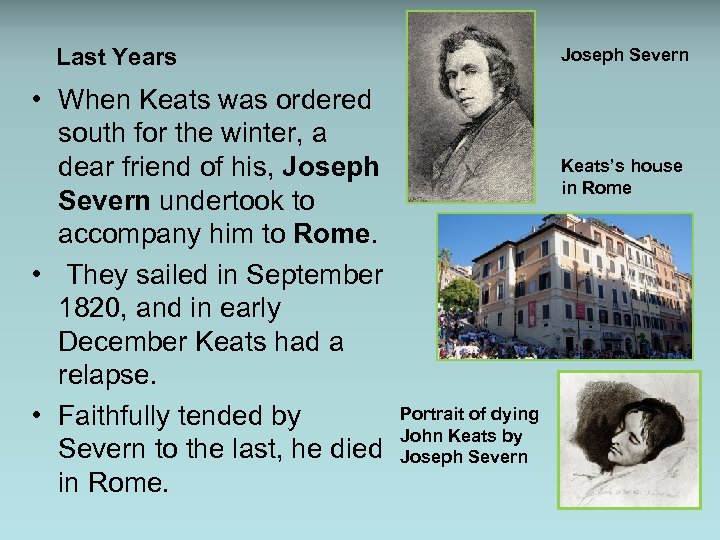 Last Years • When Keats was ordered south for the winter, a dear friend of his, Joseph Severn undertook to accompany him to Rome. • They sailed in September 1820, and in early December Keats had a relapse. • Faithfully tended by Severn to the last, he died in Rome. Joseph Severn Keats’s house in Rome Portrait of dying John Keats by Joseph Severn
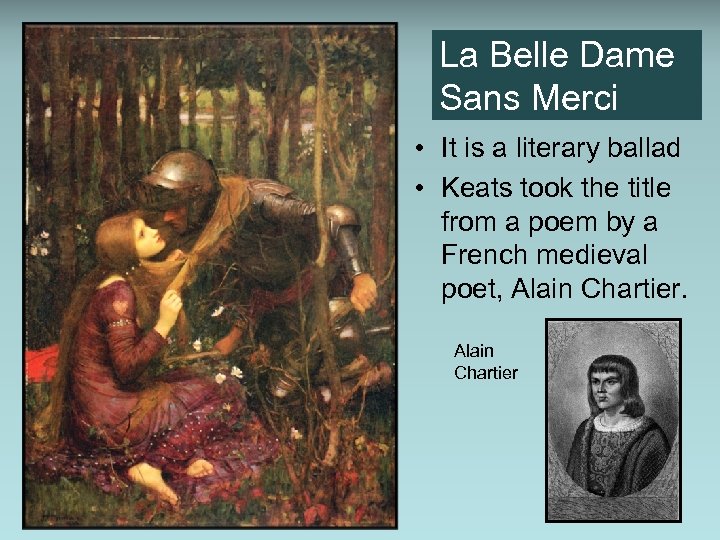 La Belle Dame Sans Merci • It is a literary ballad • Keats took the title from a poem by a French medieval poet, Alain Chartier
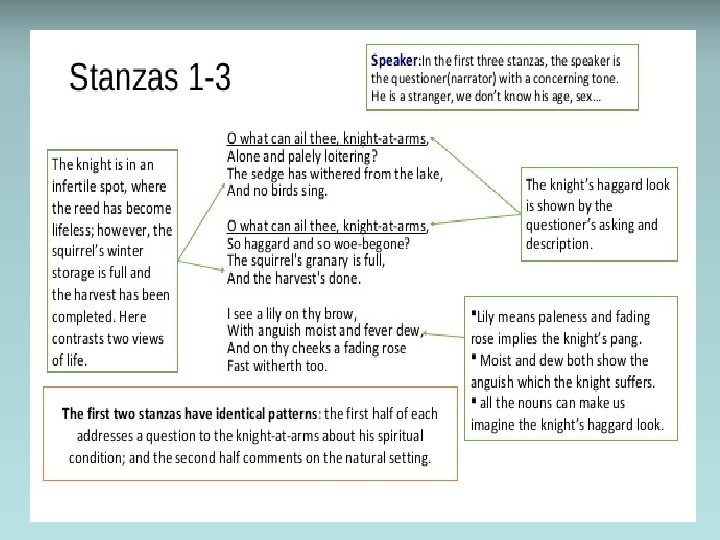
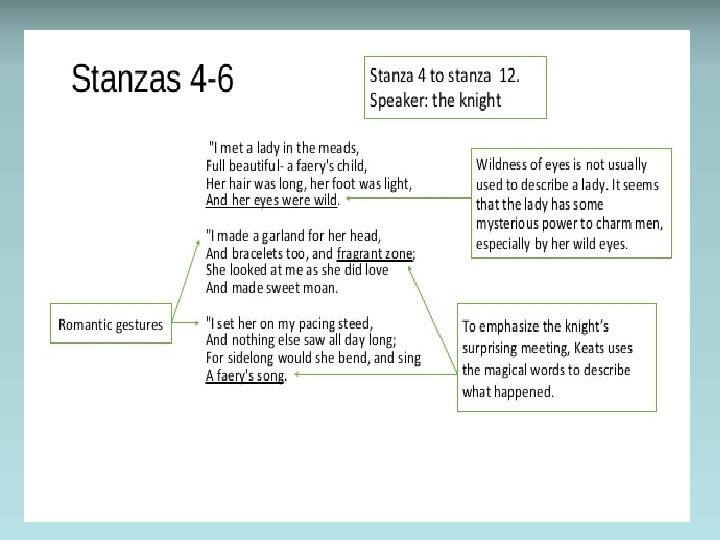
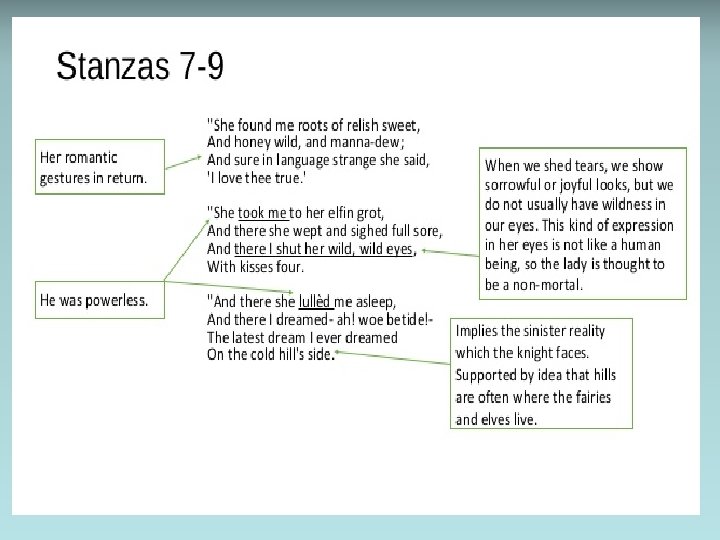
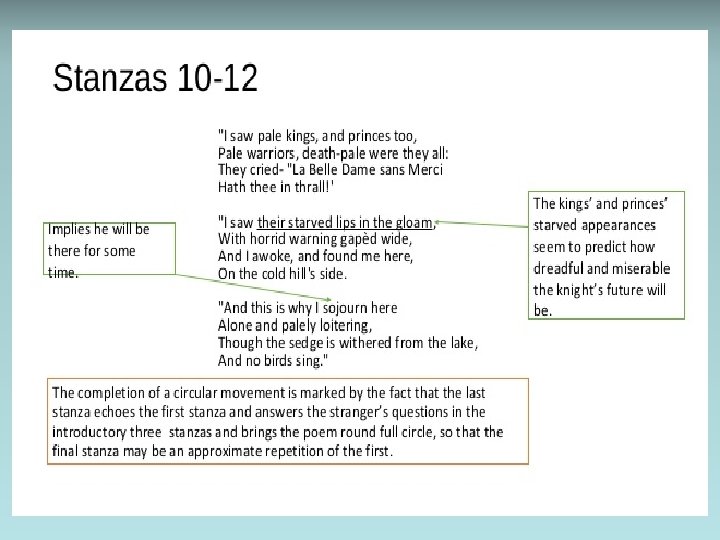
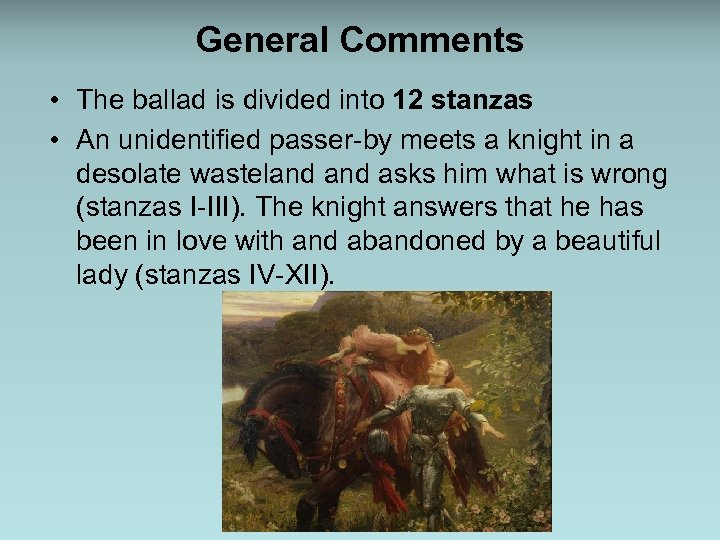 General Comments • The ballad is divided into 12 stanzas • An unidentified passer-by meets a knight in a desolate wasteland asks him what is wrong (stanzas I-III). The knight answers that he has been in love with and abandoned by a beautiful lady (stanzas IV-XII).
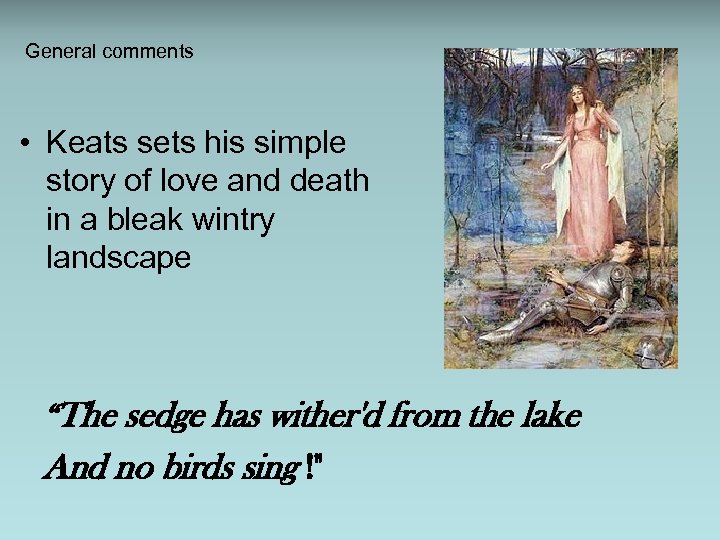 General comments • Keats sets his simple story of love and death in a bleak wintry landscape “The sedge has wither'd from the lake And no birds sing !"
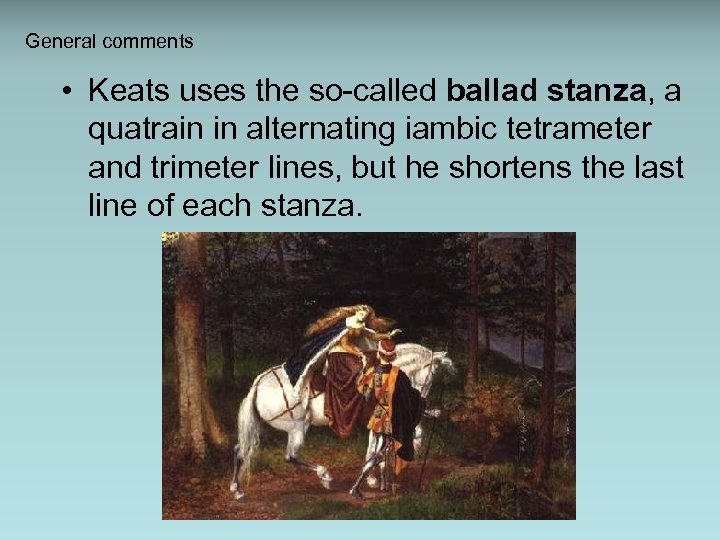 General comments • Keats uses the so-called ballad stanza, a quatrain in alternating iambic tetrameter and trimeter lines, but he shortens the last line of each stanza.
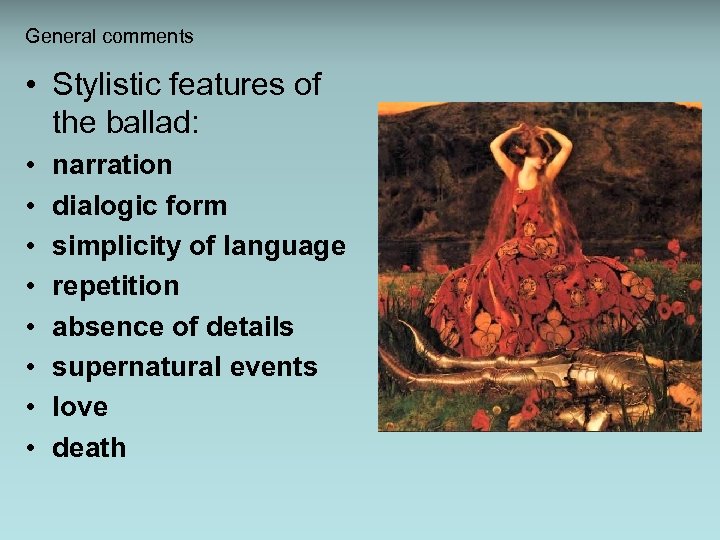 General comments • Stylistic features of the ballad: • • narration dialogic form simplicity of language repetition absence of details supernatural events love death
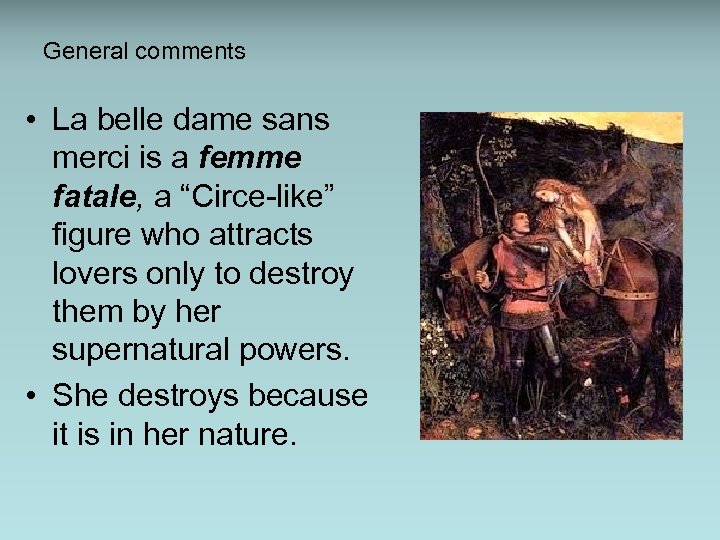 General comments • La belle dame sans merci is a femme fatale, a “Circe-like” figure who attracts lovers only to destroy them by her supernatural powers. • She destroys because it is in her nature.